Prepositions in Mycenaean Linear B & Homeric Greek & the Cases they Govern (Click to ENLARGE):The use of prepositions and the cases they govern in Mycenaean Linear B correspond exactly to the use of the same prepositions in Homeric and Classical Greek. Just a few minor notes: first of all, Linear B uses the more ancient form “apu”, which is (not surprisingly) Arcado-Cypriot & hence also found in Linear C for “apo”, and again, uses “eni” (often used by Homer in Book II of the Iliad, in which we find the most archaic Greek) for “en”. Other than that, everything is pretty much straightforward. Beginning with the next post, I shall proceed to illustrate the uses of the prepositions with examples of sentences in both Linear B and in (Homeric) Greek, according to the case(s) they govern, beginning with prepositions governing only 1 case, either genitive or dative or accusative, moving on to prepositions which govern 2 cases, and finally to those which govern 3 cases. Finally, while almost all the prepositions in Mycenaean Greek are either Attested [A] or Derived [D], we can pretty much assume their authenticity. However, I cannot guarantee the same for the prepositions "eke" or "eise", as they are entirely conjectural [C], and quite possibly unreliable. Richard
Category: Poetry
-
Prepositions in Mycenaean Linear B & Homeric Greek & the Cases they Govern
-
KEY POST! Complete Conjugations in the Active Voice of Thematic Verbs in Mycenaean Linear B
KEY POST! Complete Conjugations in the Active Voice of Thematic Verbs in Mycenaean Linear B (Click to ENLARGE):
 It is of vital importance to researchers and serious students of Mycenaean Linear B grammar to carefully read and study this post, as it serves as the basis and starting point for the complete reconstruction of both Mycenaean Linear B grammar & vocabulary, following the tenets of my Theory of Regressive-Progressive Linear B Grammar, by the end of 2015. This reconstruction encompasses, but is not necessarily limited to, the recovery of:
1 All tenses in all voices of Mycenaean verbs, active, middle & passive, and of the optative and (possibly) the subjunctive moods.
2 The recovery of as much of the system of participles as can be reasonably achieved.
3 The restoration of as many adverbs as can be reasonably expected.
4 The restoration of the first, second & third declensions of adjectives and nouns, in so far and to the extent that this is feasible. There are several roadblocks and gaping holes in declensions which I will address later this year or early in 2015.
5 The use of prepositions and the cases they govern.
6 Any other aspects of Mycenaean grammar which I have not addressed here.
7 A considerable increase in the corpus of Mycenaean vocabulary, both attributed and derived, from the current 2,500 words or so to at least double that, i.e. at least 5,000 words.
Richard
It is of vital importance to researchers and serious students of Mycenaean Linear B grammar to carefully read and study this post, as it serves as the basis and starting point for the complete reconstruction of both Mycenaean Linear B grammar & vocabulary, following the tenets of my Theory of Regressive-Progressive Linear B Grammar, by the end of 2015. This reconstruction encompasses, but is not necessarily limited to, the recovery of:
1 All tenses in all voices of Mycenaean verbs, active, middle & passive, and of the optative and (possibly) the subjunctive moods.
2 The recovery of as much of the system of participles as can be reasonably achieved.
3 The restoration of as many adverbs as can be reasonably expected.
4 The restoration of the first, second & third declensions of adjectives and nouns, in so far and to the extent that this is feasible. There are several roadblocks and gaping holes in declensions which I will address later this year or early in 2015.
5 The use of prepositions and the cases they govern.
6 Any other aspects of Mycenaean grammar which I have not addressed here.
7 A considerable increase in the corpus of Mycenaean vocabulary, both attributed and derived, from the current 2,500 words or so to at least double that, i.e. at least 5,000 words.
Richard
Share this:
-
Which Greek Dialects are the Descendents of Mycenaean Greek?
Which Greek Dialects are the Descendents of Mycenaean Greek? (Click to ENLARGE):
 Allow me to cite at some length four authoritative sources for the close-knit relationship between Mycenaean Greek (ca. 1500-1200 BCE) and the East Greek dialects which sprang up later, spreading out, first to Arcadia itself, as the Arcado-Cypriot dialect, which then in turn spread westward to Cyprus in the period of the great Greek migrations through colonization (ca. 750-550 BCE), also northwards towards Ionia and Attica, and eastwards to the island of Lesbos and its environs (Aeolic).
Arcado-Cypriot, as C.D. Buck states in his ground-breaking study, The Greek Dialects (University of Chicago Press, 1955; republished in 1998 by Bristol Classical Press, © 1998 – ISBN 1-85399-556-8. xvi, 373 pp.), belongs to “The East Greek... Old Hellenic dialects, that is, those employed by the peoples who held the stage almost exclusively in the period represented by the Homeric poems, when the West Greek peoples remained in obscurity in in the northwest. To the East Greek division belong the Ionic and Aeolic groups.. [and].. also the Arcado-Cyprian.” Then he makes a point of stressing that “no two dialects, not even Attic and Ionic, belong together more obviously than do those of Arcadia and the distant Cyprus.” (pg. 7), and goes on to say, “There are, in fact, notable points of agreement between Arcado-Cypriot and Aeolic... which cannot be accidental.” (pg. 8, all italics mine). I have taken pains to quote all of these observations to make it abundantly clear that following dialects, Mycenaean, Arcado-Cypriot, Attic-Ionic, Aeolic and Lesbian, are all East Greek dialects, as illustrated by his table on page 9, as opposed to the West & North-West Greek dialects, which include all of the Doric dialects, such as Argolic, Megarian, Cretan etc.
while Egbert J. Bakker. in his A Companion to the Ancient Greek (Wiley-Blackwell, © 2010. 704 pp. ISBN 978-1-4051-5326-3), asserts that “Mycenaean is clearly, therefore, an East Greek dialect, along with Attic-Ionic and Arcado-Cypriot... passim ... Some features align Mycenaean more closely with Arcado-Cypriot... passim... Mycenaean is therefore a dialect directly related to Arcado-Cypriot – not unexpected, given the geography...” (pp. 198-199),
and again, Roger D. Woodward, in The Ancient Languages of Europe (Cambridge University Press, © 2008 ISBN 9780521684958), states that “Of the first-millennium dialects, it is Arcado-Cypriot to which Mycenaean Greek is most closely related.” (pg. 52)
I wish to stress emphatically that there is no direct relationship between the East Greek dialects (Mycenaean, Arcado-Cypriot, Attic-Ionic or Aeolic) and the West Greek dialects, most notably, the Doric dialect, since the earliest of the East-Greek dialects, Mycenaean Greek, was widely spoken in the Peloponnese and around the Saronic Gulf well before the Doric invasion, and that consequently since all of the other East Greek dialects, Arcado-Cypriot, Attic-Ionic & Aeolic, spread out from the Mycenaean epicentre, they too are not and cannot be directly related to the West Greek dialects. To add further fuel to the fire, allow me to conclude with these highly pertinent observations Denys Page makes in, History and the Homeric Iliad (University of California Press, © 1966. 350 pp.) He says:
The new theory maintains, in briefest summary, the following position. “The dialect which we call Ionic is fundamentally akin to Arcadian; the peculiar features which differentiate it from other dialects as Ionic are all (or most) of relatively late development. In the Mycenaean period one dialect was predominant in southern Greece: when the Dorians occupied the Peloponnese, part of the Mycenaean population stayed at home, part emigrated; the stay-at-homes, to be called “Arcadians”, retained their dialect with comparatively little change through the Dark Ages, ...”
Now, from all we have just seen here, I feel I can safely draw the following conclusions:
1 there is no direct relationship between the East Greek dialects (Mycenaean, Arcado-Cypriot, Attic-Ionic or Aeolic) and the West Greek dialects, most notably, the Doric dialect;
2 All of the East Greek dialects migrated from their original home base during the great age of Greek colonization (ca. 750-550 BCE), as witnessed by the spread of the Arcadian dialect to Cyprus in the historical period, and of Attic-Ionic eastwards as Aeolic towards Lesbos and its environs.
3 these patterns of migration of the East Greek dialects were paralleled by the migration of the West Greek dialects to colonies as prosperous and large as the great city of Syracuse (Doric) and other Greek cities along the west coast of Italy.
4 Confirmation of Denys Page’s “new theory” (1966) has been re-affirmed and validated over and over again all the way through to the present day (Cf. Woodward, 2008 & Bakker, 2010), so that there remains little doubt, if any, that his “new theory”, which is no longer new at all, having persisted a half century, is here to stay.
Richard
Allow me to cite at some length four authoritative sources for the close-knit relationship between Mycenaean Greek (ca. 1500-1200 BCE) and the East Greek dialects which sprang up later, spreading out, first to Arcadia itself, as the Arcado-Cypriot dialect, which then in turn spread westward to Cyprus in the period of the great Greek migrations through colonization (ca. 750-550 BCE), also northwards towards Ionia and Attica, and eastwards to the island of Lesbos and its environs (Aeolic).
Arcado-Cypriot, as C.D. Buck states in his ground-breaking study, The Greek Dialects (University of Chicago Press, 1955; republished in 1998 by Bristol Classical Press, © 1998 – ISBN 1-85399-556-8. xvi, 373 pp.), belongs to “The East Greek... Old Hellenic dialects, that is, those employed by the peoples who held the stage almost exclusively in the period represented by the Homeric poems, when the West Greek peoples remained in obscurity in in the northwest. To the East Greek division belong the Ionic and Aeolic groups.. [and].. also the Arcado-Cyprian.” Then he makes a point of stressing that “no two dialects, not even Attic and Ionic, belong together more obviously than do those of Arcadia and the distant Cyprus.” (pg. 7), and goes on to say, “There are, in fact, notable points of agreement between Arcado-Cypriot and Aeolic... which cannot be accidental.” (pg. 8, all italics mine). I have taken pains to quote all of these observations to make it abundantly clear that following dialects, Mycenaean, Arcado-Cypriot, Attic-Ionic, Aeolic and Lesbian, are all East Greek dialects, as illustrated by his table on page 9, as opposed to the West & North-West Greek dialects, which include all of the Doric dialects, such as Argolic, Megarian, Cretan etc.
while Egbert J. Bakker. in his A Companion to the Ancient Greek (Wiley-Blackwell, © 2010. 704 pp. ISBN 978-1-4051-5326-3), asserts that “Mycenaean is clearly, therefore, an East Greek dialect, along with Attic-Ionic and Arcado-Cypriot... passim ... Some features align Mycenaean more closely with Arcado-Cypriot... passim... Mycenaean is therefore a dialect directly related to Arcado-Cypriot – not unexpected, given the geography...” (pp. 198-199),
and again, Roger D. Woodward, in The Ancient Languages of Europe (Cambridge University Press, © 2008 ISBN 9780521684958), states that “Of the first-millennium dialects, it is Arcado-Cypriot to which Mycenaean Greek is most closely related.” (pg. 52)
I wish to stress emphatically that there is no direct relationship between the East Greek dialects (Mycenaean, Arcado-Cypriot, Attic-Ionic or Aeolic) and the West Greek dialects, most notably, the Doric dialect, since the earliest of the East-Greek dialects, Mycenaean Greek, was widely spoken in the Peloponnese and around the Saronic Gulf well before the Doric invasion, and that consequently since all of the other East Greek dialects, Arcado-Cypriot, Attic-Ionic & Aeolic, spread out from the Mycenaean epicentre, they too are not and cannot be directly related to the West Greek dialects. To add further fuel to the fire, allow me to conclude with these highly pertinent observations Denys Page makes in, History and the Homeric Iliad (University of California Press, © 1966. 350 pp.) He says:
The new theory maintains, in briefest summary, the following position. “The dialect which we call Ionic is fundamentally akin to Arcadian; the peculiar features which differentiate it from other dialects as Ionic are all (or most) of relatively late development. In the Mycenaean period one dialect was predominant in southern Greece: when the Dorians occupied the Peloponnese, part of the Mycenaean population stayed at home, part emigrated; the stay-at-homes, to be called “Arcadians”, retained their dialect with comparatively little change through the Dark Ages, ...”
Now, from all we have just seen here, I feel I can safely draw the following conclusions:
1 there is no direct relationship between the East Greek dialects (Mycenaean, Arcado-Cypriot, Attic-Ionic or Aeolic) and the West Greek dialects, most notably, the Doric dialect;
2 All of the East Greek dialects migrated from their original home base during the great age of Greek colonization (ca. 750-550 BCE), as witnessed by the spread of the Arcadian dialect to Cyprus in the historical period, and of Attic-Ionic eastwards as Aeolic towards Lesbos and its environs.
3 these patterns of migration of the East Greek dialects were paralleled by the migration of the West Greek dialects to colonies as prosperous and large as the great city of Syracuse (Doric) and other Greek cities along the west coast of Italy.
4 Confirmation of Denys Page’s “new theory” (1966) has been re-affirmed and validated over and over again all the way through to the present day (Cf. Woodward, 2008 & Bakker, 2010), so that there remains little doubt, if any, that his “new theory”, which is no longer new at all, having persisted a half century, is here to stay.
Richard Share this:
-
Haiku in Linear B, Homeric Greek, English & French
Haiku in Linear B, Homeric Greek, English & French Haïku en Linéaire B, Grec homérique, en anglais et en français Click to ENLARGE:
 * In the second version below the haiku in Linear B, the Linear B syllabograms and vowels are given in their Latin equivalents, so that you can get some idea of the pronunciation of the Mycenaean Greek (ca. 1300-1200 BCE).
** The Greek version of this haiku is composed in very ancient Greek (ca. 800 BCE), matching the Greek of “The Catalogue of Ships” in Book II of the Iliad as closely as possible.
Richard
* In the second version below the haiku in Linear B, the Linear B syllabograms and vowels are given in their Latin equivalents, so that you can get some idea of the pronunciation of the Mycenaean Greek (ca. 1300-1200 BCE).
** The Greek version of this haiku is composed in very ancient Greek (ca. 800 BCE), matching the Greek of “The Catalogue of Ships” in Book II of the Iliad as closely as possible.
Richard
Share this:
-
Bryn Mawr Classical Reviews
Be sure to read Bryn Mawr Classical Reviews, which are of extreme import to the study of Mycenaean, Homeric and Classical Greek, and Latin.
Share this:
-
CRITICAL POST: The Present and Imperfect Tenses of Reduplicating – MI – Verbs in Linear B
CRITICAL POST: The Present and Imperfect Tenses of Reduplicating – MI – Verbs in Linear B [Click to ENLARGE):
 NOTE: If you are a researcher in Linear B, it is highly advisable that you read and thoroughly digest this post in its entirety, as it constitutes a major milestone in the exegesis of my Theory of Regressive Linear B Grammar & Vocabulary. Failure to read this post may result in an inability to further confirm or reject, either in whole or in part, the premises upon which my entire theory rests.
Athematic – MI –verbs are shared in large part by Greek and and Sanskrit, respectively the Occidental & Oriental agnates or close/near descendents of the same extremely ancient (proto-) Indo-European class. All verbs of this athematic class invariably share the standard ending – mi – in the 1st. person sing. of the present tense.
Ancient Greek and Indic (Sanskrit) are similar in many respects, which may strike some as surprising since they cross the hypothetical “satem/centum” line, which the Occidental sub-class (all ancient Greek dialects & Latin & its dialects) treats the Proto IE gutturals as hard (Gr.e9kato/n Lat. centum = 100,) as against Sanscrit, chatam, and Old Persian, satem. But there are so many structural affinities, from parallel verb forms down to musical pitches, that some special connections must have existed between and prior to these two groups, which appear to have almost certainly sprung from the same Proto IE ancestral language. On the other hand, while Sanskrit is normally considered solidly IE, less than 40% of Greek vocabulary and grammar appears to derive directly from Proto IE roots, giving rise to the hypothesis that other extra-structural factors are surely involved in the evolution of ancient Greek. This phenomenon, peculiar to Greek alone, may also have significant implications for the eventual decipherment of Linear A. But this is mere speculation on my part. Still... you never know. At any rate, I intend eventually to follow this avenue of approach, my small contribution to the eventual decipherment of at least a tiny substrate (superstrate?) of Linear A sometime in 2016.
Seminal Characteristics of Athematic MI Verbs:
Athematic MI verbs are characterized, for the most part, by their own unique set of endings, although the 2nd. and 3rd. plurals are virtually the same as those of the Thematic so-called “regular” verbs in ancient Greek. It would appear, then, that “regular” verbs retained the athematic 2nd. and 3rd. plurals of their ancestors, the athematic Mi verbs, while casting all other athematic endings aside.
Reduplication in the Present Tense:
The most striking phenomenon of MI verbs is reduplication in the present tense, which is restricted to perfect formations of “regular” thematic verbs in ancient Greek. This state of affairs raises two critical questions in my mind: [1] are so-called “regular” verbs in ancient Greek derived from the more ancient athematic MI verbs, or did they simply borrow the athematic endings of the athematic 2nd. and 3rd. plurals the ancestral MI verbs? Later this year, I shall demonstrate the apparent yet quite possibly significant link between the SI endings of the present indicative and san endings of the perfect indicative in both classes of verbs, thematic and athematic. Another truly striking similarity between the more archaic and early “regular” forms in Homeric Greek is the sharing of the SI ending in the dative plural. I am highly inclined to stress the statistically probable significance of these endings, in both their verbal and nominal forms, shared by their more ancestral and and early “regular” forms in both Mycenaean and Homeric Greek.
This phenomenon will re-appear frequently in both the attested [A] and derivative [D] forms of the 3rd. person plural of all verbs, thematic or athematic regardless and in the SI ending of the dative plural, not only in Homeric, but also in Mycenaean Linear B, which attests to their extreme antiquity in ancient Greek. The fact that these forms were already fully developed in Mycenaean Greek strongly points to the likelihood that they arose from the earliest ancestral (proto-) Greek of Mycenaean and Homeric Greek alike (above all in the Catalogue of Ships in Book II of the Iliad). All of these grammatical constructs are already firmly rooted in Mycenaean and Homeric Greek, giving rise to my hypothesis that it is not only possible, but highly feasible to regressively reconstruct huge chunks of Mycenaean Greek grammar and vocabulary from their (quasi-direct) descendent, the Homeric Greek of (the Catalogue of Ships) of the second Book of the Iliad.
All of this raises another hypothetical question in my mind: did there exist ancestral forms of thematic verbs in ancient Greek which shared all or most of their endings, in all tenses, with their (apparently) more ancient MI counterparts, giving rise to the hypothesis that both athematic and thematic verbs were derived from even more ancient verbal constructs, in which all remotely ancient (proto-) Greek verbs were in fact athematic? That this is possible, and even probable, is reinforced by the uncontested fact that in Sanskrit both MI and O verbs alike share reduplication, meaning there is no marked distinction between “thematic” and “athematic” verbs in Sanskrit, in other words, they are of one and the same class. This phenomenon then reappears in a restricted number of Latin perfects, like tutudi from tundo "beat", old tetuli from thw stem tul- which supplements the forms of Latin. fero (Gr.fe/rw ). Since Latin developed in parallel with ancient Greek, but independently from the latter, this then raises the question yet again, how on earth can it be that such reduplication occurs in Latin but not in Greek, unless there is a possibility (however remote) that reduplication occurred in both thematic and athematic verbs of their proto-Greek and proto-Latin ancestors?
If indeed that is the case, then it would appear that proto-Greek and proto-Latin shared this seminal characteristic with not only Sanskrit, but proto-Sanskrit, and hence, by inference, with the proto IE ancestor of all three of these languages. If this is that case, it necessarily follows that both the thematic O endings and athematic MI endings share one and the same singular ancestor, which must have been neither thematic nor athematic, but one and the very same root of both classes. So I have to wonder out loud whether thematic O and athematic MI verbs in Sanskrit, Mycenaean Greek and Homeric Greek alike all derive from a single class of verbs, embodying the characteristics of both of these classes of verbs. If that is even remotely a possibility, then we cannot afford to ignore it, since it allows us to regressivly reconstruct, to some degree at least, even some of the tenses of the Proto-IE ancestor of all of these languages. Wouldn't that be a revelation? Of course, all this is speculation on my part, but I love to indulge in speculative hypotheses, if there is even a remote chance that someday some of them may prove to be sound.
Only time and future refinements in the science of linguistics may lend some credence to the hypotheses I am making here. If anything, computational linguistics and the great leaps in the application of artificial intelligence to linguistic theory (-ies) are likely to give rise to even more speculative hypotheses, hypotheses which may yet prove to rest on a much more solid foundation in applied linguistics than we can hope to approach at present. We shall see.
In other words, the foundation of my theory of the Regressive Reconstruction of Mycenaean Linear B grammar and vocabulary rests firmly on the regressive extrapolation of all such forms from he Homeric Greek of (the Catalogue of Ships) of the second Book of the Iliad or from any of the following dialects, Cypriot Linear C (above all others), Aeolic, Arcadian and early Ionic Greek, all of which appear to have been (quasi-) direct descendents of Mycenaean Greek. Doric Greek does not properly enter into the equation.
Conclusions:
On thing, however, is certain: the athematic – mi – verbs, in all tenses & moods, and in the all-pervasive participial constructions in ancient Homeric Greek must have been already firmly entrenched in Mycenaean Greek, from the simple observation of the facts, namely, that at least some these forms of all tenses, moods and participles are already almost all attested [A] on Mycenaean Linear B tablets. And even where some forms of all tenses, moods and participles in verbs are not to be found on any Linear B tablets, enough of them are attested for us to be able to reasonably reconstruct them in their entirety or at least in part from the attested forms.
And what applies to verbs, applies also to all other parts of speech in Mycenaean Linear B (nouns, adjectives, adverbs, prepositions and even formulaic phrases shared with Homeric Greek). These happily fortuitous antecedents in Linear B to their later counterparts in Homeric Greek recur quite frequently enough for me to be able to regressively reconstitute the Linear B forms from their subsequent Homeric forms. This, in a nutshell, is the entire premise of the Theory of Regressive Linear B as I intend to clearly demonstrate in the reconstruction of large chunks of ancestral Mycenaean Greek grammar and vocabulary, both attributed [A] and derivative [D] from its direct descent, Homeric Greek, and in particular the frequent occurrences of archaic Greek in Book II of the Iliad, in which in turn even more archaic forms frequently recur in the Catalogue of Ships (lines 484-789), the most reliable source for ancestral Mycenaean Greek grammar and vocabulary in the entire Iliad. Concomitantly, and once again happily, any of the following dialects, Cypriot Linear C (above all others), Aeolic, Arcadian and early Ionic Greek also well serve the purpose as direct and indirect descendents of Mycenaean Greek, from which it is feasible to regressively extrapolate grammatical and terminological constructs in Linear B. Doric Greek, however, does not enter into the equation, since the Dorian invasion transpired after the fall of Mycenaean civilization.
Richard
NOTE: If you are a researcher in Linear B, it is highly advisable that you read and thoroughly digest this post in its entirety, as it constitutes a major milestone in the exegesis of my Theory of Regressive Linear B Grammar & Vocabulary. Failure to read this post may result in an inability to further confirm or reject, either in whole or in part, the premises upon which my entire theory rests.
Athematic – MI –verbs are shared in large part by Greek and and Sanskrit, respectively the Occidental & Oriental agnates or close/near descendents of the same extremely ancient (proto-) Indo-European class. All verbs of this athematic class invariably share the standard ending – mi – in the 1st. person sing. of the present tense.
Ancient Greek and Indic (Sanskrit) are similar in many respects, which may strike some as surprising since they cross the hypothetical “satem/centum” line, which the Occidental sub-class (all ancient Greek dialects & Latin & its dialects) treats the Proto IE gutturals as hard (Gr.e9kato/n Lat. centum = 100,) as against Sanscrit, chatam, and Old Persian, satem. But there are so many structural affinities, from parallel verb forms down to musical pitches, that some special connections must have existed between and prior to these two groups, which appear to have almost certainly sprung from the same Proto IE ancestral language. On the other hand, while Sanskrit is normally considered solidly IE, less than 40% of Greek vocabulary and grammar appears to derive directly from Proto IE roots, giving rise to the hypothesis that other extra-structural factors are surely involved in the evolution of ancient Greek. This phenomenon, peculiar to Greek alone, may also have significant implications for the eventual decipherment of Linear A. But this is mere speculation on my part. Still... you never know. At any rate, I intend eventually to follow this avenue of approach, my small contribution to the eventual decipherment of at least a tiny substrate (superstrate?) of Linear A sometime in 2016.
Seminal Characteristics of Athematic MI Verbs:
Athematic MI verbs are characterized, for the most part, by their own unique set of endings, although the 2nd. and 3rd. plurals are virtually the same as those of the Thematic so-called “regular” verbs in ancient Greek. It would appear, then, that “regular” verbs retained the athematic 2nd. and 3rd. plurals of their ancestors, the athematic Mi verbs, while casting all other athematic endings aside.
Reduplication in the Present Tense:
The most striking phenomenon of MI verbs is reduplication in the present tense, which is restricted to perfect formations of “regular” thematic verbs in ancient Greek. This state of affairs raises two critical questions in my mind: [1] are so-called “regular” verbs in ancient Greek derived from the more ancient athematic MI verbs, or did they simply borrow the athematic endings of the athematic 2nd. and 3rd. plurals the ancestral MI verbs? Later this year, I shall demonstrate the apparent yet quite possibly significant link between the SI endings of the present indicative and san endings of the perfect indicative in both classes of verbs, thematic and athematic. Another truly striking similarity between the more archaic and early “regular” forms in Homeric Greek is the sharing of the SI ending in the dative plural. I am highly inclined to stress the statistically probable significance of these endings, in both their verbal and nominal forms, shared by their more ancestral and and early “regular” forms in both Mycenaean and Homeric Greek.
This phenomenon will re-appear frequently in both the attested [A] and derivative [D] forms of the 3rd. person plural of all verbs, thematic or athematic regardless and in the SI ending of the dative plural, not only in Homeric, but also in Mycenaean Linear B, which attests to their extreme antiquity in ancient Greek. The fact that these forms were already fully developed in Mycenaean Greek strongly points to the likelihood that they arose from the earliest ancestral (proto-) Greek of Mycenaean and Homeric Greek alike (above all in the Catalogue of Ships in Book II of the Iliad). All of these grammatical constructs are already firmly rooted in Mycenaean and Homeric Greek, giving rise to my hypothesis that it is not only possible, but highly feasible to regressively reconstruct huge chunks of Mycenaean Greek grammar and vocabulary from their (quasi-direct) descendent, the Homeric Greek of (the Catalogue of Ships) of the second Book of the Iliad.
All of this raises another hypothetical question in my mind: did there exist ancestral forms of thematic verbs in ancient Greek which shared all or most of their endings, in all tenses, with their (apparently) more ancient MI counterparts, giving rise to the hypothesis that both athematic and thematic verbs were derived from even more ancient verbal constructs, in which all remotely ancient (proto-) Greek verbs were in fact athematic? That this is possible, and even probable, is reinforced by the uncontested fact that in Sanskrit both MI and O verbs alike share reduplication, meaning there is no marked distinction between “thematic” and “athematic” verbs in Sanskrit, in other words, they are of one and the same class. This phenomenon then reappears in a restricted number of Latin perfects, like tutudi from tundo "beat", old tetuli from thw stem tul- which supplements the forms of Latin. fero (Gr.fe/rw ). Since Latin developed in parallel with ancient Greek, but independently from the latter, this then raises the question yet again, how on earth can it be that such reduplication occurs in Latin but not in Greek, unless there is a possibility (however remote) that reduplication occurred in both thematic and athematic verbs of their proto-Greek and proto-Latin ancestors?
If indeed that is the case, then it would appear that proto-Greek and proto-Latin shared this seminal characteristic with not only Sanskrit, but proto-Sanskrit, and hence, by inference, with the proto IE ancestor of all three of these languages. If this is that case, it necessarily follows that both the thematic O endings and athematic MI endings share one and the same singular ancestor, which must have been neither thematic nor athematic, but one and the very same root of both classes. So I have to wonder out loud whether thematic O and athematic MI verbs in Sanskrit, Mycenaean Greek and Homeric Greek alike all derive from a single class of verbs, embodying the characteristics of both of these classes of verbs. If that is even remotely a possibility, then we cannot afford to ignore it, since it allows us to regressivly reconstruct, to some degree at least, even some of the tenses of the Proto-IE ancestor of all of these languages. Wouldn't that be a revelation? Of course, all this is speculation on my part, but I love to indulge in speculative hypotheses, if there is even a remote chance that someday some of them may prove to be sound.
Only time and future refinements in the science of linguistics may lend some credence to the hypotheses I am making here. If anything, computational linguistics and the great leaps in the application of artificial intelligence to linguistic theory (-ies) are likely to give rise to even more speculative hypotheses, hypotheses which may yet prove to rest on a much more solid foundation in applied linguistics than we can hope to approach at present. We shall see.
In other words, the foundation of my theory of the Regressive Reconstruction of Mycenaean Linear B grammar and vocabulary rests firmly on the regressive extrapolation of all such forms from he Homeric Greek of (the Catalogue of Ships) of the second Book of the Iliad or from any of the following dialects, Cypriot Linear C (above all others), Aeolic, Arcadian and early Ionic Greek, all of which appear to have been (quasi-) direct descendents of Mycenaean Greek. Doric Greek does not properly enter into the equation.
Conclusions:
On thing, however, is certain: the athematic – mi – verbs, in all tenses & moods, and in the all-pervasive participial constructions in ancient Homeric Greek must have been already firmly entrenched in Mycenaean Greek, from the simple observation of the facts, namely, that at least some these forms of all tenses, moods and participles are already almost all attested [A] on Mycenaean Linear B tablets. And even where some forms of all tenses, moods and participles in verbs are not to be found on any Linear B tablets, enough of them are attested for us to be able to reasonably reconstruct them in their entirety or at least in part from the attested forms.
And what applies to verbs, applies also to all other parts of speech in Mycenaean Linear B (nouns, adjectives, adverbs, prepositions and even formulaic phrases shared with Homeric Greek). These happily fortuitous antecedents in Linear B to their later counterparts in Homeric Greek recur quite frequently enough for me to be able to regressively reconstitute the Linear B forms from their subsequent Homeric forms. This, in a nutshell, is the entire premise of the Theory of Regressive Linear B as I intend to clearly demonstrate in the reconstruction of large chunks of ancestral Mycenaean Greek grammar and vocabulary, both attributed [A] and derivative [D] from its direct descent, Homeric Greek, and in particular the frequent occurrences of archaic Greek in Book II of the Iliad, in which in turn even more archaic forms frequently recur in the Catalogue of Ships (lines 484-789), the most reliable source for ancestral Mycenaean Greek grammar and vocabulary in the entire Iliad. Concomitantly, and once again happily, any of the following dialects, Cypriot Linear C (above all others), Aeolic, Arcadian and early Ionic Greek also well serve the purpose as direct and indirect descendents of Mycenaean Greek, from which it is feasible to regressively extrapolate grammatical and terminological constructs in Linear B. Doric Greek, however, does not enter into the equation, since the Dorian invasion transpired after the fall of Mycenaean civilization.
Richard
Share this:
-
Archaic Greek in Book II, The Iliad, “The Catalogue of Ships” Translation into English: Part II, Lines 35-75
Archaic Greek in Book II, The Iliad, “The Catalogue of Ships” Translation into English: Part II, Lines 35-75 (Click to ENLARGE):
 My commentary on the derivation of the archaic Greek vocabulary and grammar in Book II of the Iliad from its much older Mycenean Linear B counterparts appears immediately after this post, and after every consecutive post of my running translation of Book II. As we proceed through Book II of the Iliad, we shall come to realize, quickly enough, that in fact the grammar and vocabulary of Book II, and in particular of the Catalogue of Ships (Lines 484-779), is inextricably woven with its parent dialect, namely, Mycenaean Greek, and consequently with the grammar and vocabulary of Linear B itself, from which the archaic Greek of this book of th Iliad is ultimately derived.
One thing I would like to make perfectly clear. While the Greek of Book II of the Iliad is archaic in many places, there is no way on earth that I would translate any of the Iliad into archaic English! Far too many translations of the Iliad reek of archaic English, and to my mind at least, have no place whatsoever in the annals of twenty-first century translations of ancient Greek texts into English, or into any other modern language, for that matter. The whole idea of the exercise is to make the ancient Homeric Greek as accessible and as readable as is humanly possible to today's allophone readers of the Iliad. Otherwise, I see no point in translating the text at all. If we are to get any real enjoyment out of any translation of the Iliad, for heaven's sake, let it be easy (and perhaps even fun) to read!
Richard
My commentary on the derivation of the archaic Greek vocabulary and grammar in Book II of the Iliad from its much older Mycenean Linear B counterparts appears immediately after this post, and after every consecutive post of my running translation of Book II. As we proceed through Book II of the Iliad, we shall come to realize, quickly enough, that in fact the grammar and vocabulary of Book II, and in particular of the Catalogue of Ships (Lines 484-779), is inextricably woven with its parent dialect, namely, Mycenaean Greek, and consequently with the grammar and vocabulary of Linear B itself, from which the archaic Greek of this book of th Iliad is ultimately derived.
One thing I would like to make perfectly clear. While the Greek of Book II of the Iliad is archaic in many places, there is no way on earth that I would translate any of the Iliad into archaic English! Far too many translations of the Iliad reek of archaic English, and to my mind at least, have no place whatsoever in the annals of twenty-first century translations of ancient Greek texts into English, or into any other modern language, for that matter. The whole idea of the exercise is to make the ancient Homeric Greek as accessible and as readable as is humanly possible to today's allophone readers of the Iliad. Otherwise, I see no point in translating the text at all. If we are to get any real enjoyment out of any translation of the Iliad, for heaven's sake, let it be easy (and perhaps even fun) to read!
RichardShare this:
-
Derivative [D] Reconstruction of the First Aorist in Linear B
Derivative [D] Reconstruction of the First Aorist in Linear B (Click to ENLARGE):
 Taking the First Aorist conjugation (EKAUSA) of the verb KAUO “to burn” from the Homeric Greek as our point of departure for regression to the same tense in Linear B, we end up with the paradigm illustrated in the table above.
It is impossible for me to reconstruct the 2nd. person sing. or the 3rd. person pl. of this verb in Linear B with any degree of certainty, as the Homeric conjugation necessitates that these persons end with a consonant, for which Linear B, consisting of syllabograms and vowels only, cannot account.
We have now successfully reconstructed (for the most part) the following tenses of Linear B verbs: the present, the future & the first aorist of active verbs. We shall eventually proceed to regressively reconstruct the imperfect & perfect tenses (leaving aside the pluperfect, as it is very rare even in ancient alphabetical Greek). Afterwards, we shall move onto the same conjugations for middle & passive verbs. Finally, later this year, we shall attempt to reconstruct at least some of the conjugations in the subjunctive and optative, in so far as this is feasible.
Once we have reconstructed the conjugations of Linear B verbs in all tenses, voices & moods, we shall move onto the reconstruction of the declensions of nouns & adjectives, probably in the summer of 2014. As we can already glean, the reconstruction of Linear B grammar is a highly labour-intensive project, but this is, after all,the whole point of this blog.
Richard
Taking the First Aorist conjugation (EKAUSA) of the verb KAUO “to burn” from the Homeric Greek as our point of departure for regression to the same tense in Linear B, we end up with the paradigm illustrated in the table above.
It is impossible for me to reconstruct the 2nd. person sing. or the 3rd. person pl. of this verb in Linear B with any degree of certainty, as the Homeric conjugation necessitates that these persons end with a consonant, for which Linear B, consisting of syllabograms and vowels only, cannot account.
We have now successfully reconstructed (for the most part) the following tenses of Linear B verbs: the present, the future & the first aorist of active verbs. We shall eventually proceed to regressively reconstruct the imperfect & perfect tenses (leaving aside the pluperfect, as it is very rare even in ancient alphabetical Greek). Afterwards, we shall move onto the same conjugations for middle & passive verbs. Finally, later this year, we shall attempt to reconstruct at least some of the conjugations in the subjunctive and optative, in so far as this is feasible.
Once we have reconstructed the conjugations of Linear B verbs in all tenses, voices & moods, we shall move onto the reconstruction of the declensions of nouns & adjectives, probably in the summer of 2014. As we can already glean, the reconstruction of Linear B grammar is a highly labour-intensive project, but this is, after all,the whole point of this blog.
RichardShare this:
-
Progressive Linear B Grammar: was there a Future Tense?
Progressive Linear B Grammar: the Conjectural Future Tense (Click to ENLARGE):
 Progressive Linear B Grammar: was there a Future Tense? Well, yes and no...
The first thing we need to clear up before we go any further with the conjectural derived future tense in Linear B is this: there are absolutely no instances of the future tense attested anywhere on any extant Linear B tablets (at least to date), and I doubt there ever will be any. Why so? It is actually quite simple: the Linear B scribes were accountants, solely concerned with record-keeping and fiscal accounts for the current year only, and nothing else. Linear B scribes never kept records or accounts for more than one fiscal year (so-called, since that is scarcely what they would have called it, being as it is modern terminology). They routinely destroyed all accounting records for the previous year by wiping their clay tablets clean and reusing them all over again, year after year, until of course they (the tablets, not the scribes!) were no longer usable, and had to be replaced.
In other words, their total preoccupation with records for the current year, or as they called it, WETO or the “running year” precluded any concern at all for what lay ahead in the future, near or far, not even the next “running year”, a contradiction in terms per se, since only the current year can be “running”. So I must conclude that it is unlikely that the Linear B scribes ever used the future tense for their strictly administrative tabular accounts.
This does not mean, however, that the Mycenaeans did not use the spoken future tense, as that too is an absurd proposition. Like all peoples speaking almost any Occidental IE language, they had to use the future tense, and do so frequently, which is why I have reconstructed it regressively from Homeric Greek (or if not possible, from other early Greek dialectical forms). Once I have derived the conjugation for any tense, present, future, aorist, perfect, etc. it is a simple matter to reconstruct progressively the conjugation in its quasi-entirety, omitting the second person singular in the present & future tenses, since I am unable to reconstruct it with any degree of certainty... as I have pointed out numerous times before on this Blog.
CONCLUSION: Just because the future tense is not attested anywhere on extant Linear B tablets does not mean it did not exist. In fact, the contrary must be the case, since an IE (Indo-European) language (in almost all cases) must have a future tense. Had the Mycenaeans ever had reason to write in the future tense, they most surely would have. But they didn’t – at least we have not seen it so far. Linear B tablets unearthed sometime in the future may possibly give instances of the use of the future tense in writing, but once again, I sincerely doubt it, for the reasons elucidated above.
Richard
Progressive Linear B Grammar: was there a Future Tense? Well, yes and no...
The first thing we need to clear up before we go any further with the conjectural derived future tense in Linear B is this: there are absolutely no instances of the future tense attested anywhere on any extant Linear B tablets (at least to date), and I doubt there ever will be any. Why so? It is actually quite simple: the Linear B scribes were accountants, solely concerned with record-keeping and fiscal accounts for the current year only, and nothing else. Linear B scribes never kept records or accounts for more than one fiscal year (so-called, since that is scarcely what they would have called it, being as it is modern terminology). They routinely destroyed all accounting records for the previous year by wiping their clay tablets clean and reusing them all over again, year after year, until of course they (the tablets, not the scribes!) were no longer usable, and had to be replaced.
In other words, their total preoccupation with records for the current year, or as they called it, WETO or the “running year” precluded any concern at all for what lay ahead in the future, near or far, not even the next “running year”, a contradiction in terms per se, since only the current year can be “running”. So I must conclude that it is unlikely that the Linear B scribes ever used the future tense for their strictly administrative tabular accounts.
This does not mean, however, that the Mycenaeans did not use the spoken future tense, as that too is an absurd proposition. Like all peoples speaking almost any Occidental IE language, they had to use the future tense, and do so frequently, which is why I have reconstructed it regressively from Homeric Greek (or if not possible, from other early Greek dialectical forms). Once I have derived the conjugation for any tense, present, future, aorist, perfect, etc. it is a simple matter to reconstruct progressively the conjugation in its quasi-entirety, omitting the second person singular in the present & future tenses, since I am unable to reconstruct it with any degree of certainty... as I have pointed out numerous times before on this Blog.
CONCLUSION: Just because the future tense is not attested anywhere on extant Linear B tablets does not mean it did not exist. In fact, the contrary must be the case, since an IE (Indo-European) language (in almost all cases) must have a future tense. Had the Mycenaeans ever had reason to write in the future tense, they most surely would have. But they didn’t – at least we have not seen it so far. Linear B tablets unearthed sometime in the future may possibly give instances of the use of the future tense in writing, but once again, I sincerely doubt it, for the reasons elucidated above.
Richard
Share this:
-
Knossos Palace – Architecture – Geometric, Circular – Minoan Columns
Knossos Palace – Architecture – Geometric, Circular – Minoan Columns (Click to ENLARGE):

Photo taken at Knossos, May 2 2012
Share this:
-
Palace of Knossos – Queen’s Megaron – ceremonial stairwell
Palace of Knossos – Queen’s Megaron – ceremonial stairwell (Click to ENLARGE each photo):


Photos taken by yours truly on May 2, 2012
Share this:
-
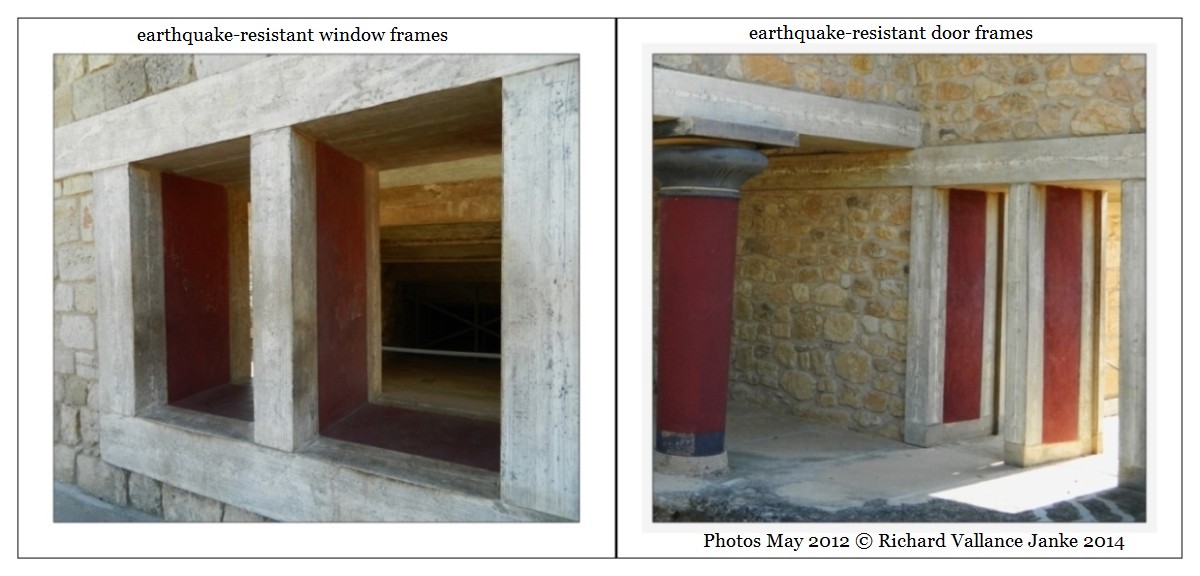
Palace of Knossos, Architecture – Earthquake-resistant
Palace of Knossos, Architecture – Earthquake-resistant (Click to ENLARGE each photo):


Photos taken by yours truly on May 2, 2012 at Knossos.
Share this:
-
The Amazing Antikythera Mechanism: the First Analog Computer in History?
The Amazing Antikythera Mechanism: the First Analog Computer in History? To read this article in its entirety, please click on the Wikipedia logo below:
 The “Antikythera mechanism” was recovered from a shipwreck off the Greek island of Antikythera in 1900-1901, at the precise time the city of Knossos was being excavated by Sir Arthur Evans. Its significance and complexity were not understood until a century later when it was analyzed with modern X-ray technology. Its construction has been attributed to the Hellenistic Greeks. Technological artifacts approaching its complexity and workmanship did not appear again until the fourteenth century, when mechanical astronomical clocks were first constructed in Western Europe. Professor Michael Edmunds of Cardiff University, who led a 2006 study of the mechanism, said, “This device is just extraordinary, the only thing of its kind. The design is beautiful, the astronomy is exactly right. The way the mechanics are designed just makes your jaw drop. Whoever has done this has done it extremely carefully ... in terms of historic and scarcity value, I have to regard this mechanism as being more valuable than the Mona Lisa.” Illustration of the Antikythera archeological mechanism, with radiographic details of its intricate gearing system (Click to ENLARGE):
 The mechanism was housed in a wooden box approximately 340 × 180 × 90 mm in size and comprised 30 (!) bronze gears(although more could have been lost). The largest gear, clearly visible in fragment A, is approximately 140 mm in diameter and has 223 teeth.
You may also wish to consult The Antikythera Mechanism Research Project. Click on the logo:
The mechanism was housed in a wooden box approximately 340 × 180 × 90 mm in size and comprised 30 (!) bronze gears(although more could have been lost). The largest gear, clearly visible in fragment A, is approximately 140 mm in diameter and has 223 teeth.
You may also wish to consult The Antikythera Mechanism Research Project. Click on the logo:
 http://www.antikythera-mechanism.gr/project/publications
from which I draw this résumé. The Antikythera Mechanism is a Hellenistic astronomical machine with bronze gearing system, made about the second century B.C, preserved in fragments only. In 2005, new data considerably enhanced our knowledge of its functions, being as it is an instrument measuring geocentric cosmology, portraying the stars, Sun, Moon, and all five planets known in antiquity.
Here are images of the gearing system and a modern reconstruction of the truly elegant Antikythera Mechanism (Click to ENLARGE):
http://www.antikythera-mechanism.gr/project/publications
from which I draw this résumé. The Antikythera Mechanism is a Hellenistic astronomical machine with bronze gearing system, made about the second century B.C, preserved in fragments only. In 2005, new data considerably enhanced our knowledge of its functions, being as it is an instrument measuring geocentric cosmology, portraying the stars, Sun, Moon, and all five planets known in antiquity.
Here are images of the gearing system and a modern reconstruction of the truly elegant Antikythera Mechanism (Click to ENLARGE):
 and again, in Scientific American 2009. Click on the logo to read the article:
 Résumé: The Antikythera mechanism is a unique & highly sophisticated mechanical analog calculator from the second-century BCE. Advanced imaging tools have enabled researchers to reconstruct how the device predicted with such astonishing accuracy lunar and solar eclipses and the motion of the moon in the sky.
To read about the much earlier Minoan Disc (so-called Analog Computer) see the previous post. It is almost as mind-blowing!
Richard
Résumé: The Antikythera mechanism is a unique & highly sophisticated mechanical analog calculator from the second-century BCE. Advanced imaging tools have enabled researchers to reconstruct how the device predicted with such astonishing accuracy lunar and solar eclipses and the motion of the moon in the sky.
To read about the much earlier Minoan Disc (so-called Analog Computer) see the previous post. It is almost as mind-blowing!
Richard
Share this:
-
Mycenae: 3 May 2012: Interior Walls & Museum
Mycenae: 3 May 2012: Interior Walls & Museum. Please note that I misspelled Mycenae in Linear B as MIKENA instead of MUKENA in the previous posts. I will correct this error in the New Year. (Click to ENLARGE photos):


Share this:
-
Mycenae: 3 May 2012: Foundations, Grave Circle & Village
Mycenae: 3 May 2012: Foundations, Grave Circle & Village (Click to ENLARGE each photo):


Share this:
-
Mycenae: Photos I took on 3 May 2012: Citadel & Fortifications
Mycenae: Photos I took on 3 May 2012: Citadel & Fortifications (Click to ENLARGE each photo):


Share this:
-
Knossos: the magnificent Queen’s Megaron (Late Minoan III)
Knossos: the magnificent Queen’s Megaron (Late Minoan III) [Click to ENLARGE]:

In Linear B, WANAKATERO literally means “the house of the King or Queen” and in this case, the Linear B title refers to “the new palace of the Queen”, which is, I can assure you, a masterpiece of Minoan architecture at its zenith. This is the only building which has been completely restored from the ruins of the Last Palace (Late Minoan III ca. 1450 BCE).
Share this:




You must be logged in to post a comment.