Category: Poetry

  • Knossos: Fresco of the Spectators & the Bull Fresco

    Knossos: Fresco of the Spectators & the Bull Fresco (Click to ENLARGE):

    Knossos fresco of the spectators and bull fresco

    It is difficult to imagine frescoes more breathtaking than these at Knossos, regardless of the era in which  we find frescoes.  The Minoans quite simply were supreme masters of the art and artisanship of the fresco.

  • Knossos: Fresco of the Cupbearers & walls of the Second Palace

    Knossos: walls of the Second Palace & Fresco of the Cupbearers (Click to ENLARGE):

    Knossos cup bearers & second palace walls

    The Fresco of the Cupbearers adorned the magnificent Palatial Entranceway to the Last Palace of Knossos (Late Minoan III, ca. 1400 BCE), while the walls of the Second Palace are Middle Minoan (1700-1600 BCE)


  • Knossos: Plan of the Second Palace (Late Minoan III)

    Knossos: Plan of the Second Palace (Late Minoan III) [Click to ENLARGE]

    Knossos plan of the Palace

    I took these photos and the next 4 in the next 2 posts when I was in Knossos on May 2 2012 (among several hundred others).

  • Samples of Colours on Frescoes at Knossos: Les Parisiennes & The Bluebird

    Samples of Colours on Frescoes at Knossos: Les Parisiennes & The Bluebird [Click to ENLARGE]:

    Knossos Frescos Blue Bird and Les Parisiennes details

    See NOTES on the previous post.

  • Samples of Colours on Frescoes at Knossos: The Griffin Fresco

    Samples of Colours on Frescoes at Knossos: The Griffin Fresco in the Queen’s Megaron (Click to ENLARGE):

    Knossos Griffin fresco Queen's throne room

    In this splendid example of colours on frescoes at the Palace of Knossos, “The Griffin Fresco in the Queen’s Megaron”, I have given the names of the most common colours used on Minoan/Mycenaean frescos.   The Linear B characters and their Latin equivalents are shown for the first 6 colours in this illustration.  In the next post, you will be able to view portions of the famous fresco, the so-called “Les Parisiennes” and the equally lavish “Blue Bird or Caravanseri’” fresco, with the Latin equivalents of the Linear B characters shown for the next 6 colours [7] – [12].

  • Minoan Frescoes & the Prevalence of Colour in Linear B Vocabulary

    Minoan Frescoes & the Prevalence of Colour in Linear B Vocabulary (Click to ENLARGE):

    Dyes Colors Colours Frescos Cloth Purple in Linear B

    Minoan Frescoes & The Prevalence of Colours in Linear B Vocabulary:

    Despite the paucity of Linear B vocabulary on extant Mycenaean/Minoan tablets (estimated as some 2,000 words more or less), colours play a predominant rôle. What is so striking about the Linear B vocabulary for colours is its precision and richness. Linear B not only has the standard words for several colours, white, red, purple and black, it even has words for (often highly) unusual variants of the some colours, such as the colour of the yellow water lily (instead of just plain “yellow”); aquamarine (instead of plain “blue”); saffron (from the crocus); crimson, which is directly derived from the Linear B word for “Phoenician”, meaning of course that the colour we know as “crimson” is in actuality, “the Phoenican colour”; “painted/dyed red”, in addition to just plain old red; and “shell purple” as well as “purple”. Shell purple is a gorgeous marbled purple from sea shells. So to summarize, the Minoans were extremely conscious of the power and magnificence of colours, and they sure knew how to “put on the Ritz” in their generous application of them. One look at any single surviving Minoan/Mycenaean fresco speaks volumes to the exquisite taste the Minoans and Mycenaeans had for colour in art, as attested by their absolutely stunning frescoes! Few, if any, civilizations, ancient or modern, have ever attained the heights of brilliant artistry in frescoes as did the Minoans. I for one consider Minoan/Mycenaean frescoes to be far superior to the rather stiff frescoes and iconic art of the early Christian and Medieval churches. But of course I am biased.

    Now, one seemingly perplexing question remains. Where is the colour green? The answer is much simpler than you might imagine. In spite of all their talent for producing a dizzying array of lustrous colours on their frescoes, the Minoans – or for that matter – none of the ancients in the Western world at that time – were unable to produce green, which is why all the trees in their frescoes are blue. But we can forgive them for this omission, considering the spectacular and enduring beauty of their frescoes.

    In the next post, I will display for your delight and artistic appreciation 2 of the most magnificent frescoes from Knossos, illustrating the highly imaginative application of colours the Minoan artisans lavished on their frescoes. I will tag these frescoes with the colours applied with their Linear B, Greek and English names.

    Richard


  • Conjugations in the present Active and Middle voices of 9 common Mycenaean Greek verbs in Linear B

    Conjugations in the present active and middle of 9 common Greek verbs in Linear B:

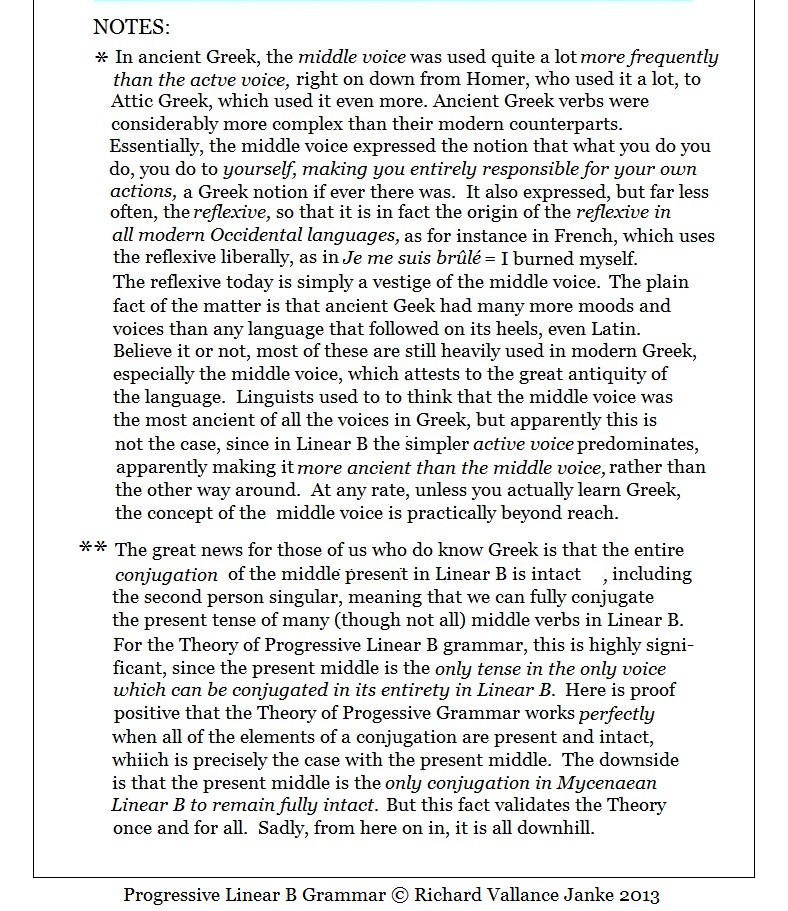
    Introduction: we now take the Theory of Progressive Linear B one step further, by illustrating its eminently successful application to the Greek Middle Voice in the present tense.  This is the one and only conjugation in Linear B which remains fully intact, and as such it fundamentally serves  to validate the Theory of Progressive Linear B Grammar, and it does so nicely, thank you very much.  For those of you who are not familiar with ancient Greek, I suggest once again that it is probably better for your sanity not to read this post, as it discusses the minutiae of one of the most convoluted grammatical concepts in Greek, ancient or modern, the function of the Middle Voice, which unless you already know Greek, is so maddeningly difficult to get a handle on that is probably not worth your trouble.  But I know that, regardless of what I say, some of you more adventurous “curious cats” will storm right ahead anyway… and who can blame you for that? If you do manage a basic understanding of the notion of the Middle Voice, all the more power to you.  In fact, leave me a comment bragging about your marvelous feat.  It took me three months (!) to really get a  grip on the Middle Voice when I first learned Greek.  Finally, one day the light came on, I shouted the proverbial “EUREKA!”, and ever since then there’s been no looking back !  Anyway, here is the table of conjugations of the present tense of 9 of the most common verbs in Mycenaean Linear B, one of which just so happens to be in the Middle Voice, either a disaster or a blessing, depending.  So why not give it yourself a shot? Here we go! CLICK to ENLARGE:

    Progressive Linear B Present Tense Active & Middle600

    I offer up another of my typically copious and convoluted “notes” (much like the labyrinth of Knossos) for your entertainment, enlightenment or nervous breakdown, as the case may be.  A bit of humour never hurt anyone, eh?  I know it practically drove me mad to compile them in the first place.  So here we go again! CLICK to ENLARGE:

    NOTES

    Richard

  • Theory 3: The Principle of Cross-Correlation in Progressive Linear B Grammar – a giant leap forward

    The Principle of Cross-Correlation in Progressive Linear B Grammar:

    CAVEATS:

    1 If you are not familiar with the fundamental principles of linguistics and/ or you cannot understand ancient Greek, it is highly advisable that you do not read this post, since it is almost certain it will leave you completely baffled even before you get half way through it. This is in no way a reflection on your intelligence, only on my native ability even to get all of what I am about to say across in a manner even approaching clarity. It is not critical to your learning the grammar of Linear B, as I will be expoundinig it, since all you really need to know is the grammar of Mycenaean Linear B itself, and nothing more. Mercifully, Mycenaean Linear B grammar will prove to be much simpler than classical Greek grammar. But the upside to this is that you will be in a much better position to learn ancient Greek once you know Mycenaean Greek, rather than the other way around. Doing it the other way around is liable to drive you half mad, as ancient Greek is notoriously difficult to get a handle on.

    2. If you are a linguist or you do know ancient Greek, it is advisable to print out this entire post, so that you can read it at your leisure. Even for me, it is a bit of a “mind blower”.

    That said, we are about to make the first GIANT leap in the refinement of the Theory of Progressive Linear B Grammar & Vocabulary. To date, I have enumerated the following 3 basic principles underlining the theory I am in the process of expostulating. Before we can move on to explaining the Principle of Cross-Correlation in Progressive Linear B Grammar, it is imperative that we understand as fully as possible all the principles leading up to it. Since the original post for each principle antecedent to the The Principle of Cross-Correlation has been posted on this blog, I am cross-referencing to that post, so that you can review my explanation of each principle, step by step, from the first to the fourth. These steps are:

    1. The first, the Principle of Regression: http://linearalinearblinearc.ca/2013/09/30/951/

    whereby I proceed from a particular standard ancient Greek grammatical form, for instance, the conjugation of the present tense of the verb e1xein (to have) using it as my point of reference or departure to apply retrospectively (i.e. in reverse chronology) to the quasi- “identical” grammatical form in Mycenaean Greek in this instance, the present tense of the Mycenaean verb EKO (to have) in order to reconstruct the conjugation of its present tense, in so far as I possibly can, by applying the conjugation of the present tense of its chronologically much later ancient Greek grammatical equivalent, here being the verb e1xein but only in those instances where it is patently clear that the much more ancient Mycenaean grammatical form is in fact (quasi-) identical to its chronologically much later equivalent. You will forgive me for repeating my terminology over and over, but I do so simply because it was a struggle for me to delineate this principle in the first place. So I suppose it will be the same for you. Still, once you have grasped this, the first Principle of Progressive Linear B Grammar, all subsequent principles should (hopefully) fall neatly into place.

    In the application of the Principle of Regression, the chronologically much later ancient Greek grammatical form (in this case, the present tense of present tense of the verb e1xein (to have) thereby becomes the paradigm or template of its equivalent in Mycenaean Linear B, the verb EKO (to have).

    2 The second Principle of Progression (covered in the same post above) is the actual reconstruction of the same grammatical form in question, here the present tense of the Mycenaean Linear B verb EKO from its much later ancient Greek conjugation, in so far as this is even feasible and practical. In the event, we soon discover that I am able to reconstruct all persons of the present tense of EKO, except the second person singular, for the reasons I postulated in the post referenced above, as we can see here:

    Regressive Extrapolation Verb EKEE to have

    In so far as the first two principles are concerned, the chronologically much later grammatical form which serves as the point of reference or departure, i.e. the template or paradigm, is called the source, while its Mycenaean Linear B counterpart is known as the target. I will be using these terms henceforth in any discussion of grammatical forms transferred from ancient Greek to their Mycenaean Linear B equivalents, so please bear them in mind at all times.

    NOTE: where it is practically impossible to reconstruct the (presumed) Mycenaean target grammatical form from the sparsity of evidence from extant tablets, I shall not even venture to make such an attempt, since to do so would simply invalidate the procedure.

    3 The third Principle of Correlation takes all other instances of the same grammatical form with the same root, to reconstruct them in Linear B, given the assumption that, if all grammatical forms of the source template are identical when their root is the same, then the equivalent target forms in Mycenaean Greek must also be identical when their root is either identical or equivalent to their source forms. This just so happens to be the case for the ancient Greek source verbs e1xein, a1gein, qh=kein and their Linear B equivalents EKEE, AKEE & TEKEE. All this is explained in excruciating detail here:

    http://linearalinearblinearc.ca/2013/12/09/the-principle-of-correlation-in-progressive-reconstruction-of-the-present-tense-of-verbs-in-kee/

    and hereby illustrated:

    Mycanaean Verbs in KEE

    What, you say?… if you happen to know ancient Greek. How can this be, when these 3 source verbs in ancient Greek do not share the same root?… or so it would appear. But in fact they do, because their roots, ending in e1x, a1g, qh=k respectively are all of the same class, in this instance, the gutturals x, g, k. The distinction between gutturals of the same source class simply vanishes in their Linear B equivalent, the target syllabogram KE, since it must do service for all three of the source gutturals. This is because Linear B has no way to distinguish between Greek variants of the same class, whether they be the gutturals, linguals or labials. But enough of that for now. Only people familiar with ancient Greek or the fundamental principles of linguistics will understand what I am talking about. So if are neither a linguist nor one who reads ancient Greek, just forget about it.

    4 The Principle of Cross-Correlation:

    The fourth Principle of Cross-Correlation takes the previous principle one step further, but this time it is a giant leap. Fortunately, it is a lot easier to explain, now that we have slogged our way through the mire of the first 3 principles. Starting with the specific case of the conjugation of all regular source verbs whose stem ends in x, g, k – xein, gein, kein in ancient Greek, we assume in principle that the same target verbs in Linear B with the same stem KE must all be conjugated just as they are in their source equivalents. The best analogy to this theoretical assumption may just well be Einstein’s Theory of Specific Relatively, although our theory hardly approaches Einstein’s in its complexity. The one thing the Theory of Progressive Linear B Grammar and Einstein’s Theory of Specific Relatively do have in common is that they are logically both mathematical constructs, at least to my mind.

    Extrapolating from our example of the present tense of the aforementioned verbs with the same root in both ancient Greek (the source) and in Linear B (the target), we may now make the obvious leap from Specific Cross-Correlation to The General Principle of Cross-Correlation, whereby we claim that virtually all regular source verbs in ancient Greek with the same class of roots, regardless of class, must be conjugated the same way in Mycenaean Greek. Again, a comparison of Einstein’s General Theory of Relativity helps us place the General Principle of Cross-Correlation into its proper context, but with one crucial difference. Einstein’s General Theory of Relativity is a theoretical system sufficient in and of itself, whereas the the General Principle of Cross-Correlation is merely one of several consecutive parallel principles all derived from the same theoretical construct, the General Theory of Progressive Linear B Grammar (and ultimately Vocabulary).

    At this point in time, I am still a long way off from expostulating the General Theory of Progressive Linear B Grammar, but we have at last (and at least) arrived at the point where we can apply the General Principle of Cross-Correlation to absolutely any grammatical form in Linear B, whether verbal, adverbial, nominal, prepositional or modifying. Throughout the winter of 2014, I will be implementing the practical application of the first four principles, in their exact order in every case, to the reconstruction of every source verbal construct in ancient Greek for which it is possible to reconstruct the equivalent target construct in Mycenaean Linear B. Reconstructions will proceed from the present tense to the future, the aorist, perfect, optative, all the way through to the participles. A word of warning: it is far from possible to do so for a great many verbal constructs, for the simple reason that there are not enough examples of them on extant Linear B tablets to warrant any accurate reconstruction. In such cases, I simply won’t proceed. Reconstruction of the second person singular of the present tense of regular source (ancient Greek) verbs into their putative target (the second person singular) in Mycenaean Linear B is a case in point. I simply neither have enough evidence nor do I feel qualified “to go there”, as the saying goes. If any of you can crack it, all the more power to you. And if you can, please share your insights with me, because again, as the old saying goes, “two heads are better than one”, to which I would add, many heads are better than two.

    SUMMARY:

    In the reconstruction of any grammatical form in its target in Mycenaean Linear B, from its equivalent in its source, ancient Greek, it is necessary to follow each of these steps in order:

    1 deconstruction on the Principle of Regression

    2 reconstruction on the Principle of Progression

    3 correlative reconstruction on the Principle of Correlation

    4 complete reconstruction of an entire grammatical class on the Principle of Cross-Correlation

    the last of which we no longer need to call the General Principle of Cross-Correlation, because that is what it is anyway.

    Richard Vallance

  • First haiga ever written by yours truly in Linear B

    First haiga ever written by yours truly in Linear B:

    haiga Knossos burnt to the ground

    But, you may ask, “What is a haiga?”  A haiga is a brief Japanese haiku (3 line poem) composed on a painting or photo, just as you see here. Of course, no one ever wrote haiga in Linear B, until now at least.  As far as I can tell, I am the first to do so.  I recently posted the first ever haiku here on our Blog, so now we have two poems (both in Japanese style).

    I have mentioned Derivative Vocabulary before on our Blog.  By Derivative Vocabulary I mean vocabulary in Linear B nowhere attested on any extant Linear B tablets.  In this haiga, there are 2 derivative words,

    METOROPORI

    (which would NEVER have appeared on any Linear B tablet, as it is a classical Greek word)

    and

    KATAKEKAUMENO

    (which could have appeared on a Linear B tablet, but has not done so to date… at least not yet).  In other words, this past participle passive, while derivative, might yet still be discovered on a tablet unearthed in the future, and is a perfectly legitimate derived Linear B word.  It literally means, “thoroughly burnt”, but in Classical Greek this also means “burnt to the ground”.  Since after all, Knossos was burnt to the ground, there is no reason whatsoever to conclude that this participle is not a perfectly valid Linear B derivative.  Quite to the contrary. This is all the more likely, since the same participle without the prefix “kata” (KEKAUMENO) IS attested as a past participle passive on at least one extant Linear B tablet, and is listed in the Mycenaean (Linear B) – ENGLISH Glossary, so popular on the Internet.

    More to come later.

    Richard

  • THEORY 1: INTRODUCTION to Progressive Linear B: Theory, Methodology & Practice

    Progressive Linear B: Theory, Methodology & Practice:

    In honour of the outstanding achievement of Michael Ventris (1922-1956), who single-handedly deciphered a hitherto “undecipherable” ancient script, Linear B, as being the earliest written form of ancient Greek, which Sir Arthur Evans called “Linear B”, and rightly assumed was a syllabary, but wrongly assumed was not Greek, I intend to build on his all too remarkable achievement by applying what I choose to call the principles of Progressive Linear B, a theory of Linear B grammar, syntax and vocabulary which I am putting to the test for the first time ever. After Michael Ventris’ tragic death in a fatal car crash on 6 September 1956, his loyal collaborator and disciple, Professor John Chadwick (1920-1998) of Cambridge University carried on his work, codifying the Linear B tablets, grammar and vocabulary, confirming once and for all that Mycenaean Linear B was the earliest written form of ancient Greek, predating the earliest Greek alphabet by at least 600 years.

    What is Progressive Linear B?

    Progressive Linear B constitutes an entirely novel theoretical approach to the syllabary, logograms, phonetics, grammar, syntax and vocabulary of Mycenaean Linear B. By applying the methodology of progressive Linear B, we may be able to reconstruct grammatical forms and vocabulary, which are nowhere attested in the approximately 6,000 extant Linear B tablets from Knossos, Pylos, Thebes, Mycenae, Chania or any other archeological sites where tablets have been discovered to date. The recovery of more tablets in the future may fill in some of the gaps in Linear B grammar and vocabulary, but the likelihood of this seems remote.

    Theory, Methodology and Practice:

    It is perhaps best to illustrate how I apply the reconstitutive methodology of progressive Linear B to extrapolate unattested grammatical forms from the actual forms which have been found on the tablets. With this in mind, let us turn to the verb, EKEE, to have, for the conjugation of the present tense from forms actually found on the tablets. As far as I know. These are (CLICK to enlarge):

    attested forms present tense active in Mycenaean Linear B

    From these three extant forms, I believe it is possible to extrapolate and reconstruct most of the remainder of the conjugation of the present tense of the verb, EKEE, “to have”, (the classical Greek and English conjugations following the reconstructed Linear B forms), with attested forms (as found on tablets) tagged with (A), and Derived forms tagged with (D), as follows:

    The Verb EKEE as paradigm for the reconstruction of the present tense active (CLICK to enlarge):

    Verb EKEE EKO present tense active in Progressive Mycenaean Linear B

    As you can readily see from this reconstruction of the present tense of EKEE, I am unable to make an accurate estimation of the probable form of the second person singular with any degree of certainty, which is why I have omitted it. However, with this sole exception, I have been able to reconstitute the rest of the present tense of the verb,” to have”, into the forms they most likely would have taken in Mycenaean Greek, had any tablets been unearthed with these forms. With the conjugation of EKEE (to have) as our paradigm, I believe it is possible to proceed with the reconstruction of the present tense of all verbs ending with O in first person singular of the active (not middle!) voice .

    Thus, in the paradigm for the attested (A) and derivative (D) endings of the present infinitive active & present tense active, the first person singular and plural & the second person plural are derived. Hence, the Linear B forms and their Latin transcriptions for the present infinitive active & the conjugation of the present active (with the exception of the missing second person singular) of verbs ending in “ko” are (CLICK to enlarge):

    Paradigm Present Tense Active Mycenaean Greek for verbs ending in "ko"

    Of course, my reconstructions are always to be considered as tentative and conjectural. If anyone familiar with Linear B is at odds with my interpretative reconstructions of this or any other grammatical form in Linear B, I encourage the same to comment on my conjectures on this Blog. I will of course answer any questions, issues or doubts you may harbour over my reconstitutive grammar, which I will be gradually building on this Blog, starting with several active verbs in the present tense, based on the paradigm for the conjugation of the present tense of the verb, EKEE.

    Progressive Linear B: Theory, Methodology and Practice:© Richard Vallance Janke 2013

  • Bryn Mawr Classical Review

    Excellent source for classical studies. I have reblooged this to my own WordPress Blog,
    Linear B, Knossos & Mycenae, where I teach Linear B.

  • The first ever poem, a haiku, in Linear B: Knossos by the sea

    ← Back

    Thank you for your response. ✨

    The first ever poem, a haiku, in Linear B: Knossos by the sea (Click to enlarge):

    HAIKU KONOSO PARA TARASA ANEMOIYEREYA fr

    As is well known, no literature as such survives from the late Bronze Age Minoan-Mycenaean culture, when the Linear B script was used primarily for fiscal and book-keeping purposes, as can be seen in the approximately 5,900 extant Linear B tablets and fragments of tablets.  However, this does not rule out the possibility, however remote, that there existed at least a sacral literature, as attested in other ancient scripts of that period, hieroglyphic Egyptian on papyrus, as well as Cuneiform and Hittite on clay tablets. The assumption there was no Linear B  literature as such is based on the faulty  premise that no literature was recorded on tablets, but it might very well have been on papyrus. The difficulty here lies in the fact that papyrus could not possibly have survived the damp Mediterranean climate of Crete, Akrotiri, Mycenae, Pylos or Tiryns or any other Minoan-Mycenaean town or settlement. So if there ever was a literature, it has long since been lost to us in the void of history.   However, one inescapably significant factor mitigates in favour of such a literature, and that is the extremely frequent mention of religious and sacral rights, as well as of almost all the Homeric deities on the Linear B tablets, and this in spite of the fact that the vast majority of the Linear B tablets are primarily concerned, not with religious matters, but with fiscal administration… or so it would appear.

    Of course, it is absurd to assume that, even if there were a Mycenaean literary corpus (which would have almost certainly been comprised solely of sacral and religious rites, and possibly poetry, had it existed) there would certainly not have been any haiku or anything remotely like it in such a literature. After all, Mycenaean Linear B, being contemporaneous with ancient Chinese (ca. 1,500 BC), antedated Japanese haiku by at least 3,100 years!   But, hey, I can at least indulge in the fantasy.

    NOTE that Linear B used a vertical bar to separate words, as we can see on second line of this haiku, where the vertical bar separates PARA & TARASA.

    Richard

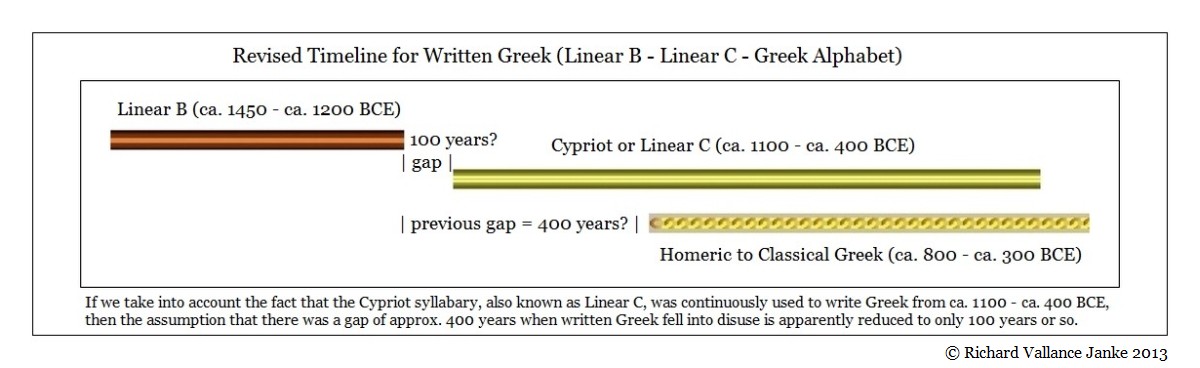
  • Revised Timeline for Written Greek (Linear B, Linear C and Greek alphabet)

    Revised Timeline for Written Greek (Linear B, Linear C and Greek alphabet): CLICK to enlarge:

    Revised Timeline for Written Greek (Linear B - Linear C - Greek Alphabet)
    Written Greek, Linear B, Cypriot Syllabary, Linear C, Homeric Greek, Classical Greek

    Until now, most historians have made the assumption that once Linear B fell into disuse around 1200 BCE, there were no more written Greek records until approximately some 400 years later, in around 800 BCE. However, as Wikipedia: Cypriot Syllabary: http://en.wikipedia.org/wiki/Cypriot_syllabary significantly points out, the Cypriot Syllabary, otherwise known as Linear C, was used to write Greek from ca. 1100 – ca. 400 BCE, when it finally lapsed into disuse, to be supplanted at that time in Cyprus by the Greek alphabet proper. Now, I for one am not about to make the rash claim that this necessarily means that written Greek was in constant use from ca. 1450 – ca. 1200 BCE, falling out of sight at that time, to be supplanted only a century  or so later by Linear C. (in use until ca. 400 BCE), thus overlapping with the Greek alphabet, which came into general use in around 800 BCE… or so it would appear.  The presumed historical gap of some 400 years is, however, fraught with pitfalls. For one thing, Hesiod mentions that there were poets even before Homer who wrote using the Greek alphabet. The problem is…. and it is a huge one… all of their works have been lost to the chasm of history. This should come as no surprise to anyone familiar with ancient Greek literature,  in so far as some 90% of all ancient Greek literature, even after 800 BCE, all the way through to 300 BCE and later, has also vanished in the abyss of history. To my mind, this raises all sorts of “red flags”, not the least of which is: how can we realistically define or even guestimate the so-called gap between pre-historic times, when there were no written records in Greek (including of course those written in Linear B) and the appearance of the Greek alphabet on the scene, when we do not even have the faintest notion when the earliest use of the Greek alphabet first manifested, by which I mean, in Greek literature.  When did Greek literature written with the most rudimentary forms of the Greek alphabet first appear?  In the 10th. century BCE?… in the 9th.? We shall never know, for the very reasons which I have just raised, let alone a whole host of other factors which come into play when we are forced to admit that we know from the ancient authors that there were writers before them, who were writing poetry with the Greek alphabet, poetry which was still extant in their day and time.  Hesiod must have read some of these authors (some of whom the ancient Greek authors cited by name).  Again, however, we run up against a brick wall, since the works the ancient Greeks had at hand, and were able to read, no longer exist. They have, as I have already made clear, simply vanished.

    Thus, it is my contention that it is really quite impossible to say for certain when (or even if) written Greek fell out of use, or if you prefer, into disuse, since it may never have lapsed into disuse. Of course, once again, I am going out on a limb. But I raise such questions simply to spur us, as historians, linguists and archeologists, to at least consider the possibility, however remote, that the apparent historical gap between that loss of Linear B writing and the assumption of the Greek alphabet may be somewhat or even significantly less than 4 centuries.  We must also always bear in mind that Linear C, a syllabary used in Cyprus, closely related to Linear B, was in fact in constant use from around the 12th. century to the 4th. century BCE.

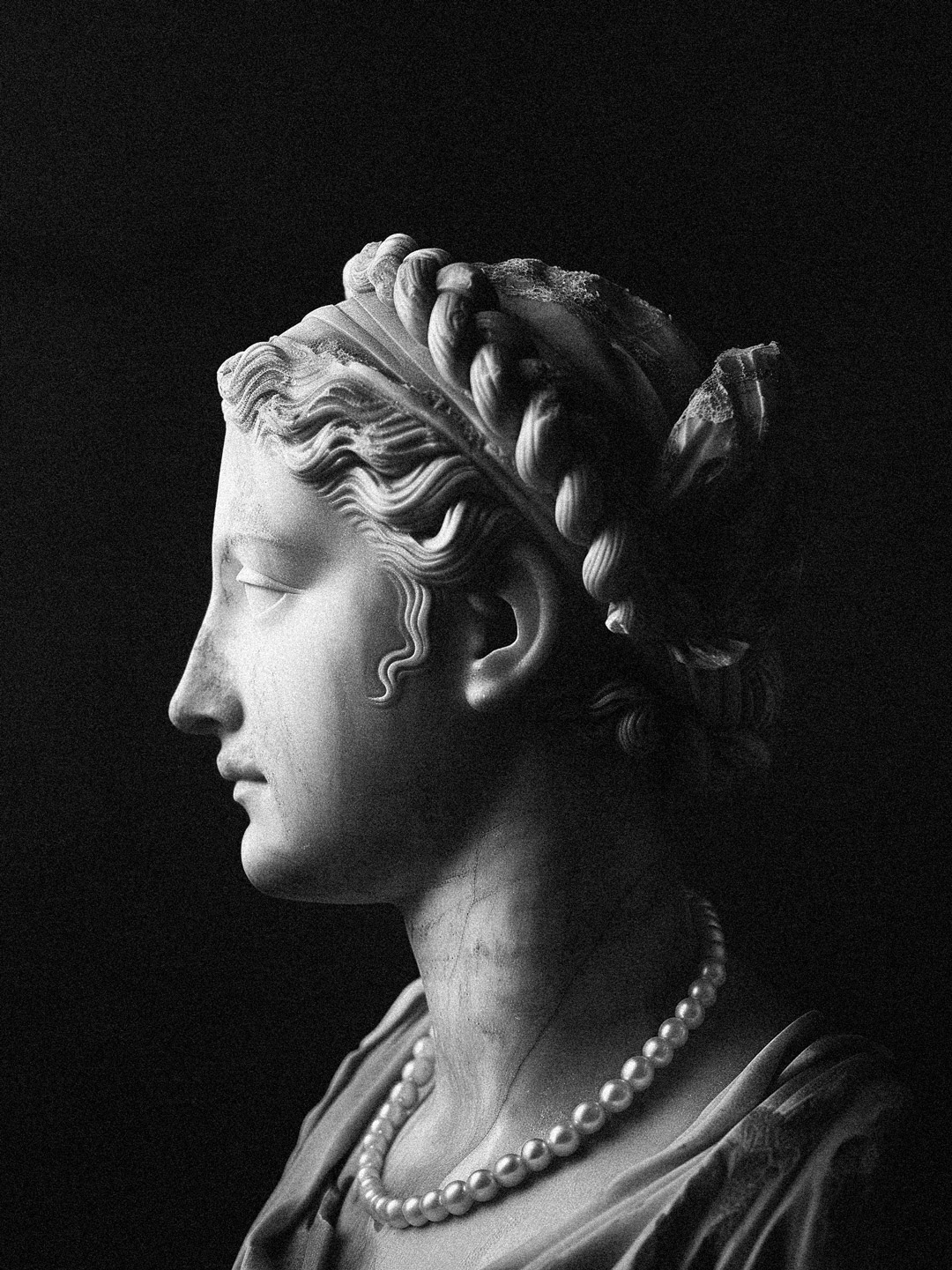
Sappho, spelled (in the dialect spoken by the poet) Psappho, (born c. 610, Lesbos, Greece — died c. 570 BCE). A lyric poet greatly admired in all ages for the beauty of her writing style.

Her language contains elements from Aeolic vernacular and poetic tradition, with traces of epic vocabulary familiar to readers of Homer. She has the ability to judge critically her own ecstasies and grief, and her emotions lose nothing of their force by being recollected in tranquillity.

Marble statue of Sappho on side profile.

Designed with WordPress