Tag: LinearB

  • Linear B Syllabary with Emmett L. Bennett’s Numerical Identifiers


    Linear B Syllabary with Emmett L. Bennett’s Numerical Identifiers: Click to ENLARGE
    
    Linear B Syllabary 2014 with Bennetts numbers
    
    Excerpt from Wikipedia: Emmett L. Bennett, Jr.
    
    WikipediaLinear
    
    Emmett Leslie Bennett, Jr. (July 12, 1918 – December 15, 2011) was an American classicist and philologist whose systematic catalog of its symbols led to the solution of the mystery of reading and interpreting Linear B, a syllabary used for writing Mycenaean Greek, a 3,300-year-old script that was used hundreds of years before the Greek alphabet was developed. Archaeologist Arthur Evans had discovered Linear B in 1900 during his excavations at Knossos on the Greek island of Crete who spent decades trying to comprehend its writings until his death in 1941. Bennett and Alice Kober cataloged the 80 symbols used in the script in his 1951 work The Pylos Tablets, which provided linguist John Chadwick and amateur scholar Michael Ventris with the vital clues needed to finally decipher Linear B in 1952.


  • Ancient Greek is Polytonic, but Mycenaean Greek in Linear B is not & How to Deal with the Whole Blasted Mess

    Ancient Greek is Polytonic, but Mycenaean Greek in Linear B is not & How to Deal with the Whole Blasted Mess: Click to ENLARGE
    
    Greekpolytonics
    Peering at this (apparently) complex chart of ancient Greek polytonic orthography, you are liable to want to jump off a cliff or at least take a valium. I know I did when I first learned ancient Greek, and to be quite frank, I still do have a great deal of difficulty remembering where stressed or unstressed accents (especially when subscripted) are supposed to fall, either on the first syllable or on one of three final syllables, which are linguistically stylized as antepenultimate (third last syllable), penultimate (second last syllable) & ultimate (last syllable), just to drive us even crazier. We can blithely (and safely) ignore these totally unnecessary definitions and just say last, second last & third last syllable, so that ordinary folks like you and me can understand what on earth all those linguists are on about.
    
    And I am the first to admit that, even though I learned ancient Greek all on my own (auto-didactically), and have learned to read it very well after 15 years, I always was and still am far too lazy to be bothered learning the niceties of all those polytonic “rules” anyway, because all you need to do, in order to write ancient Greek, is to look up the word you want to write in an excellent Greek dictionary, of which by far the best is Liddell & Scott, Greek-English Lexicon (1986), grab the correct polytonic accents from the entry, et voilà! And I know darn well right that plenty of folks do precisely this, because who can be bothered with silly details like that if in fact you already know the word for which you want to check its polytonics. This is above all true for those of us who have read plenty of ancient Greek texts, from at least Books I & II of Homer’s Iliad, several prominent ancient Greek poets such as Sappho (above all others), Anacreon & Alceus, historians such as Herodotus & Xenophon (ridiculously easy to read & my first introduction the ancient Greek), Plato, Strabo, Plutarch etc. etc. (all of whom I have read extensively, plus many other authors in several ancient Greek dialects – another maddening distraction, at least for the first five years or so). It is in fact the dialects, of which there at least 10 major ones, all of them treating polytonics in their own quirky way, which really mess things up! Trust me.
    
    Add to this the incontestable fact that ancient Greek has far more polytonics than any Occidental language, ancient or modern, and you can see exactly what I mean. Even French, which sports plenty of accents, is a cakewalk in comparison. As a Canadian, I speak and read French fluently, and I can and do remember precisely where any accent falls on any French word, all this in spite of the fact that French has a number of accents – though far, far less than ancient Greek.   
    
    And if you wish to write any text in ancient Greek, you just do the same thing (look it up) and copy it from the dictionary. This makes life a lot easier for those of us who are obliged to write ancient Greek. Another suggestion: if you need to write a whole sentence or a whole paragraph of some ancient Greek author, just go to a site like Perseus Digital Library:
    
    Perseus Digital Library
    
    look up the author and subsequently the passage you want to transcribe, and then copy and paste it into your word processor, simple as that. Well, not quite as simple as that. You have to make sure that you have first set your font to SPIonic (the best there is for most dialects – but not all – in ancient Greek), to make sure that it turns out as Greek in your word processor. Otherwise, all you will see is nothing but garbage.
    
    This situation gets far more frustrating for those of us who can also read and write Minoan Linear A (even if no-one has a clue what it means), Mycenaean Linear B & Arcado-Cypriot Linear C (all of which, thank God, have no polytonics!). Now if you wish to set the exact Greek equivalent of any Linear B text, for example, if you do not do as I advise, it will take you hours and hours just to type a few sentences. Who needs that like a hole in the head? Not me, let me tell you.
    
    But of course our chart above serves to save you hours and hours of totally needless fooling around with ancient Greek diacritics. Just print it out, laminate it if you like, and pin it on your wall. Then you can gaze at it in stunned awe any time you like.  
    
    Even without doing this, it takes me hours and hours to create a chart such as the one you see above. That one took me four hours! So I really would appreciate it if folks who visit our blog actually get this, and at least tag each post they really find fascinating with the number of STARS they would rate it as (top of the post) & LIKE (bottom of the post). Please! It makes Rita, my colleague and myself very happy to know you care.
    
    Best,
    
    Richard
    
    
  • In Linear B + The Daesh Have Death in Their Hands & Blood in Their Mouths

    In Linear B + The Daesh Have Death in Their Hands & Blood in Their Mouths: Click to ENLARGE:
    
    Daesh ISIS in LinearB
    
    Well before the dastardly terrorist attack on the Canadian Parliament today here in Ottawa, where I live, in which a Canadian soldier on guard at the Tomb of the Unknown Soldier was shot to death in the back 4 times, I was sick to death of these monsters, the Daesh, or so-called ISIS, which is a disgusting insult to the Egyptian goddess, Isis & her consort, Osiris; hence the title of my sonnet about these murderous thugs, who are even worse than Nazis, because they slaughter absolutely everyone who does not fall in line with their “brand of Islam”, a dreadful affront to Islam itself, and to all the Faiths of our harried world. I need say no more. My condemnation of these bloodthirsty barbarians cannot be harsh enough.
    
    The world must be rid of them, and the sooner the better... for the alternative is too hellish to dare imagine. But I will say it out loud. Europe and the nations of the world buried their heads & ignored Hitler before World War II. We do so again at our greatest peril. If World War III strikes – and to my mind, it looks almost imminent – it will be a long, drawn out, bloody, vicious war of attrition. I may last as long as a decade, for we are faced, not with open enemies as our ancestors were in the Second World War, enemies they could at least see, recognize and fight, but with sickening cowards who hide behind masks, rape women and children, and slaughter countless souls by crucifixion and the most bloodthirsty methods of beheading imaginable. I just saw some of the actual beheadings on the Internet, and they made me sick to my stomach. The Daesh actually saw off their victims’ heads with knives!  Nothing could be more barbaric! Even the Reign of Terror in the French Revolution (1792-1794) never descended to such a hellish pit. They used the guillotine, which was swift and clean, for all its horror. But these beasts see otherwise, and act in ways which heap such shame on them that their forfeit their own humanity for the devils they have become. May God have mercy on their souls, because I shall not, even if I am Christian.
    
    The sonnet is my own. I have been a poet all my life, although these days I write little poetry. This sonnet, however, came to me in a flash of lightning, and I mean every word of it.
    
    NOTE that the Greek text is in archaic Greek.
    
    Richard
    
    
  • Cross-Correlation of Linear A with Linear B Syllabograms. Does it all add up or not? What is Linear A? What if? We need to take a long hard look at this.

    Cross-Correlation of Linear A with Linear B Syllabograms. Does it all add up or not? What is Linear A? What if? We need to take a long hard look at this.
    
    Let’s take a look at this cross-comparative table of Linear A “syllabograms” which look (almost) identical to their Linear B counterparts, and let’s generously assume that they all have the same phonetic values in both syllabaries. Why not? Almost everyone has anyway. Click to ENLARGE:
    
    LinearA01-120 CF LinearB
    
    Still, ever since I first started comparing the Linear A with the Linear B syllabary, I found myself seriously questioning how and, more significantly, why most ancient language linguists specializing in these two scripts have assumed that, just because deciphered syllabograms in Linear B all bear a specific phonetic value, consequently the so-called “syllabograms” - if indeed all are just that, syllabograms – ought to or, if we push the envelope, must have the same values in Linear A. But, being the doubting Thomas I am, I have serious reservations about the hypothetical premises underlying such a tailor-made assumption. 
    
    My reasons are several:
    
    1. Since the Minoan language is completely undeciphered, and contains considerably more syllabograms, logograms & ideograms (or whatever else) than Linear B, how can we be reasonably sure that even those characters (whatever they are) in Linear A, which look (almost) identical to their Linear B counterparts, are in fact identical? Given that the Minoan language has stubbornly evaded any attempt whatsoever at decipherment, what is plainly unproven is just that, and nothing more. The fundamental assumption almost all researchers espouse, who posit value for equal value in both scripts as being unquestionably “correct”, is open to serious cross-examination. In the face of lack of scientific evidence, supportive or even partially supportive, this cannot possibly be confirmed with any degree of reasonable accuracy. I for one simply cannot accept on faith alone the hypothesis that comparison of specific values of a known syllabary should inevitably lead to the conclusion that in all instances A=A, B=B etc. Far from it. This is not to say that there is still a high probability that what strongly looks like a syllabogram in Linear A exactly corresponding to a known syllabogram in Linear B is in fact the same syllabogram in both scripts. I am more than willing to concede that in all probability A in Linear A is A in Linear B etc. But there is simply no way of proving this; so we have to take the whole matter with a grain of salt.
    
    2. Now if it ever turns out that evidence can be forwarded that even a few of the so-called “syllabograms” in Linear A which look exactly like their counterparts in linear B are in fact syllabograms, but with entirely different phonetic values or, in the worst case scenario, not syllabograms at all, such a turn of events would throw a huge wrench into the fundamental premise, widely espoused by the community of linguists specializing in Linear A and Linear B taken together, that they form a contiguous continuum. And that would be very bad news for future attempts at deciphering the Minoan language. Again, I stress, I am not at all saying that the current widely espoused theory is in essence wrong. In fact, it is probably I who am wrong, possibly even completely out of step. But there still remains a possibility, however slim (and I for one do not think it is that slim), that there are likely to be real problems with cross-correlation of Linear A characters (whatever they are) with their so-called counterparts in Linear B. In the meantime, I am more than willing to reserve judgement on this question, and to follow the herd, with this caveat, that I remain and shall always remain the doubting Thomas, until and unless I can be even somewhat assured that the presumed cross correlations can stand the acid test as they are.
    
    3. Now what really makes me wonder what on earth is going on with “everything is fine just as it is, so why reinvent the wheel?” is this. Some researchers already assign different phonetic values to the “same” characters in Linear A. That is worrisome in and of itself. Take for instance that the so-called syllabograms TE, TU & SI appear in more than one way in Linear A. Yes, it is true that the one version of TE looks a lot like the other. But when we come to TU & SI, things get positively messy. To illustrate my point, take a look at this chart: Click to ENLARGE
    
    Linear-A-base Minoan Language Blog
    
    Yes, a great many researchers delving into Linear A will say, “Well, that is to be expected. The script was bound to evolve over such a long period of time – more than a millennium.” Fair enough. But the difficulty remains that, whereas Linear A was apparently in use from ca. 2500-1500 BCE, neither Linear B nor Linear C evolved in any real sense, even though the former was in continual use from ca. 1600-1200 BCE & the latter from 1100-400 BCE (a much longer period!).
    
    Given the considerably longer timeline for Linear A, it is more than likely that the appearance and possibly even the phonetic values of certain characters was bound to change. This sort of scenario falls neatly in line with the significant changes Egyptian hieroglyphics underwent over their long history. The fact that Linear A is a much earlier script than either Linear B or Linear C lends further credence to its apparent fluidity. After all, the English alphabet changed dramatically over a relatively shorter timeline (ca. 700 AD – 1500 AD), some 300 years less. On the other hand, Linear C did not change at all over 700 years, almost as long as the evolution of the English alphabet. So I am not quite sure what to make of all this, except to say, once again, I remain the doubting Thomas.
    
    4. Is the Linear A Syllabary strictly a syllabary, or does it contain Hieroglyphics as well?
    
    Linear A has considerably more characters (syllabograms, homophones, logograms and ideograms, if indeed all of these are just those) than Linear B, which again raises the question, which characters are syllabograms, which homophones, which logograms and which ideograms. There is simply no way to substantiate which are which. Again, the monster rears its ugly head. Since there are quite a few more “ideograms” - if that is what they really all are – in Linear A than in Linear B, what on earth can the ideograms in Linear A which have no counterparts in Linear B possibly mean? And I have to ask out loud, are they even all ideograms, or could some of them even be hieroglyphics? This is no idle matter. Let us not conveniently “forget”, or more to the point, blithely brush aside the fact that the Linear A syllabary was immediately preceded by an even earlier Minoan script with one particularly telling characteristic: 
    
    AncientScripts.com logo
    Most early writing systems have their origins in iconographic systems and likewise Cretan Hieroglyphs most likely evolved out of non-linguistic symbols on seal stones from the late 3rd and early 2nd millennium BCE. Cretan Hieroglyphs was the first writing of the Minoans and predecessor to Linear A.
    
    And again:
    
    AncientGreece.org Logo
    
    The first written scripts of the Minoans resemble Egyptian hieroglyphs. The Phaistos Disk which is now exhibited in the Heraklion Archaeological Museum and dates back to 1700 BC, is an example of such (a) script.
    
    And again:
    
    Athena Review
    Minoan Hieroglyphic Scripts: The earliest Minoan writing is the Cretan hieroglyphic script used on seal stones and clay accounting documents (Packard 1974). This early syllabic script evolved by 1900 BC during the Middle Minoan period, and was used through the destruction of the Minoan palaces ca.1450 BC.
    
    Oh, and for your enlightenment – and mine too, here are a few examples of early Cretan-Minoan hieroglyphics: Click to ENLARGE
    
    Comparison of Cretan hieroglyphics with Linear A Characters
    
    Now isn’t this just a mind-bender? One of the Cretan-Minoan hieroglyphics [2] is identical to its Linear A counterpart (whatever it is), while the first Cretan-Minoan hieroglyphic [1] is flipped right side up in Linear A. The other two [3] & [4] are (almost) identical, except for degree orientation. But the most astonishing thing is that [3] = the syllabogram DA in Linear A & B and TA in Linear C, lasting with very little change for 2,100 years! (2,500 BCE – 400 BCE). In other words, what began as a Cretan-Minoan hieroglyphic gradually transformed into a syllabogram, at least in the later development of Linear A, and again as a syllabogram in both Linear B & Linear C. TA in Linear C is in fact the exact same syllabogram as DA in Minoan Linear A & Mycenaean Linear B, since Arcado-Cypriot Linear C has no D+vowel series.
    
    Now, let’s just carry my novel hypothesis to its all but inexorable conclusion. What if just a few of the hieroglyphics in the pre-Linear A hieroglyphic scripts just happened to slip into Linear A, without anyone caring much either way? If the earliest Linear A scribes still found it convenient to continue using even a few of the earlier Cretan-Minoan hieroglyphics, why wouldn’t they? After all, when the Linear B scribes devised their syllabary for Mycenaean Greek, they swiped scores and scores of characters, syllabograms and ideograms lock-stock-and-barrel from Linear A without even thinking twice of it.  So here is my hypothesis, for what it is worth – and that may very well be something – what if... again, I say, what if some of the Linear A characters are still hieroglyphic? Well, there is one sure way to test this hypothesis, and that is to directly compare, i.e. cross-correlate, every last character in the Linear A syllabary with the hieroglyphics in its immediate predecessor, the Cretan-Minoan hieroglyphs... which is exactly what I intend to do. But it does not even end there. 
     
    Has anyone ever bothered to compare the total number of Linear A characters – whatever they are – with the total number of Egyptian hieroglyphics, though there are plenty of the latter? If not, why not? Well, don’t worry, because I intend to do just that as well.  Now, if even two or three Linear A characters turn out to look (almost) exactly like certain Egyptian hieroglyphics, of which the phonetic values and the meaning are already known to us, we may be onto something, though I hasten to add that this does not at all mean that the Minoan language is related in any way to the Egyptian, or even that the similar characters in Linear A are still hieroglyphics. Dangerous assumption.... though of course they very well may be. Confused? That’s OK too, since confusion is the first step towards scepticism, and scepticism in turn the next step on the path to investigation.
    
    
    Richard
    
    
  • Generously retweet from fellow researchers and aficionados of ancient Greece and watch what happens!

    Generously retweet from fellow researchers and aficionados of ancient Greece and watch what happens! Click to ENLARGE:
    
    retweet
    Thanks to timely assistance from my colleague and fellow Linear B researcher, Rita Roberts in Herakleion, Crete, right next door to Knossos, who showed me how to insert photos, charts and translations of Linear B tablets, I was suddenly able to increase the number of photos etc. on my Twitter account:
    
    RichardVallanceTwitter
    from only 13 to 115 illustrations in just 3 days! This finally gave me the confidence to start retweeting similar tweets from fellow researchers into ancient Greece, ancient Greek and the ancient world in general, and even to post those illustrations of mine which I was quite sure would appeal to each person I retweeted, as well as favoriting their tweets. The result has been nothing short of astonishing! Suddenly, the number of my followers jumped from 620 to 668 in just 3 days, while the number of visits to our Blog have concomitantly risen from an average of about 60-75 per day to almost double that, clocking in at around 120-180 per day. I never expected that, but it sure is very encouraging. To the extent that we support our fellow researchers and aficionados of ancient Greece and Greek, we soon find ourselves rewarded by reciprocal endorsement from our new friends. Karma.
    
    Besides, 668 followers for something as esoteric and far-out as Mycenaean Linear B and Arcado-Cypriot Linear C is rather impressive, if you ask me. 
    
    So allow me, my new friends on Twitter, to extend my gratitude and thanks for your reciprocal support.
    
    
    Richard


  • Ceremonial Entrance to the Palace of Knossos, Late Minoan II (ca 1450 BCE) & Megaron of the Palace of Pylos (ca. 1300 BCE)

    A richly evocative painting of the Ceremonial Entrance to the Palace of Knossos, Late Minoan II (ca. 1450 BCE): Click to ENLARGE:
    
    CeremonialEntrancePalaceofKnossos
    
    Another lovely painting of the Megaron of the Mycenaean Palace of Pylos, ca. 1300-1200 BCE: Click to ENLARGE:
    
    Megaron of the Palace of Pylos
    
    Richard
    
    
  • My Translation of lines 474-510 of “The Catalogue of Ships” in Book II of the Iliad

    My Translation of lines 474-510 of “The Catalogue of Ships” in Book II of the Iliad: Click to ENLARGE
    
    Homer Iliad 2 Catalogue of Ships Lines 474-510 
    
    This is Part 1 of 9 Parts of my running translation of the “The Catalogue of Ships”, lines 474-815 in Book II of the Iliad. The cardinal aim of our translation is to underscore the close relationship between the most archaic vocabulary in the Iliad, almost all of which appears in Book II, and primarily in “The Catalogue of Ships”, with both of the earlier Mycenaean Greek & Arcado-Cypriot dialects. With this in mind, I expect to be able to regressively extrapolate derived (D) vocabulary in the Mycenaean Greek & Arcado-Cypriot dialects from archaic vocabulary found in “The Catalogue of Ships” in Book II of the Iliad. Derived vocabulary (DV) in Mycenaean Linear B and Arcado-Cypriot Linear C is not to be found on any extant tablets in either script. Vocabulary on extant tablets is designated as attested (AV).
    
    I am quite convinced that it will be possible for us to derive a considerable number of Mycenaean and Arcado-Cypriot words, which are presently nowhere attested. This derived vocabulary (DV) should appreciably expand the corpus of Mycenaean and Arcado-Cypriot vocabulary in Linear B and Linear C respectively. My research colleague, Rita Roberts, and I expect to eventually be able to compile a truly comprehensive topical English-Mycenaean Linear B & Arcado-Cypriot Linear C Lexicon, which may very well double the existing vocabulary in Mycenaean Greek, and supplement somewhat the already considerable vocabulary of Arcado-Cypriot, which appears in both in Linear C and in alphabetic Greek. Our Lexicon, which should appear in PDF sometime in 2016 will prove to be greatly superior to the Mycenaean (Linear B) – English Glossary, currently available on the Internet. This glossary should be consulted with the greatest caution and wariness, as it was so poorly proof-read that its entries in Linear B, alphabetic Greek and English are riddled with well over 100 errors. In fact, I would strictly advise anyone who is familiar with either or both Linear B & ancient Greek to double-check every single entry for errors. On the other hand, Chris Tselentis’ Linear B Lexicon, which can be downloaded in PDF format from the net, is a reliable source of considerable merit of Mycenaean Linear B vocabulary. It has the additional advantage of including a large number of eponyms and toponyms, which play a formative rôle on extant Linear B tablets, regardless of provenance.
    
    
    Richard


  • Linear B Syllabograms, Logograms & Ideograms Compared with Modern Chinese Ideograms

    Linear B Syllabograms, Logograms & Ideograms Compared with Modern Chinese Ideograms: Click to ENLARGE
    
    Modern Chinese and Linear B in common
    
    While I know nothing of modern Chinese, and consequently cannot understand what any of the ideograms on this sign mean, I decided to compare either whole Chinese ideograms or components of them with their Linear B counterparts, simply to illustrate how similar writing systems from two cultures as remotely spaced both in time and space can and often do make use of very similar, and even occasionally almost identical strokes to create their characters. It so turns out that my own boyfriend, Louis-Dominique, took this photo just for me, when he was in China at the end of September and beginning of October this year (2014). I have no intention of analyzing any of the characters or ideograms in either Linear B or in Chinese, except in so far as I am able to translate those that are in Linear B. The photograph pretty much illustrates the similarities without need for further comment, but some similarities leap right out.
    
    For our Oriental visitors who are unfamiliar with the first 2 scriptural phenomena, a syllabogram is merely a syllable consisting of one consonant followed by one vowel, as in YA, MO, NE, PO, QE, RE, SO & TO, all of which appear on the photograph. Logograms in Linear B & other syllabic scripts are a combination of two syllabograms, one superimposed on the other, as in MERI = “honey”, which appears in the previous post.  In both Linear B & Chinese, an ideogram is an ideogram is an ideogram. There are almost 150 ideograms in Linear B, which is a considerable number, considering that Linear B is primary a syllabary. In fact, there are more ideograms in Linear B than there are both syllabograms and logograms!
    
    To highlight just a few of the more remarkable similarities:
    [1] Especially striking is the Linear B syllabogram RE [2] on the photograph, which looks exactly like the four signs, two on top and two underneath the Chinese ideogram at the far right top of the sign. It also appears upside down on the Chinese ideogram immediately underneath.
    [2] Variants of the Linear B syllabogram MO appear as components 4 in Chinese ideograms, all tagged [9]. For those of you who are Chinese, if you refer yourself to the Linear B words tagged with [9] & [13], bottom left, you can actually see for yourself that the syllabogram MO closely resembles the ideogram component I have flagged.       
    [3] Likewise, a minor variant of the Linear B syllabogram TO [13] appears on one Chinese ideogram & in the Linear B word, bottom left. So that makes two components of Chinese ideograms incorporating elements strikingly alike Linear B syllabograms.
    [4] The component at the centre bottom of Chinese ideogram [24] closely resembles the Linear B syllabograms PO & SO in the 2 counterpart Linear B sentences [24], bottom right.
    [5] The Chinese ideogram component [19] looks exactly like the Greek alphabetic lambda (L), upside down. This is the sole instance in which a component of a Chinese ideogram looks like a Greek alphabetic letter rather than a Linear B syllabogram. Anyway, there are no L+vowel syllabograms in Linear B. 
    
    My whole point is simply this, that Chinese ideograms frequently use strokes which incorporate elements which are (almost) identical, primarily to Linear B syllabograms, and sometimes Linear B logograms or ideograms. Thus, a component of an ideogram in Chinese can either closely resemble or actually be almost identical to a Linear B syllabogram, which are two different scriptural phenomena in two entirely unrelated languages. Likewise, an entire Chinese ideogram, as for instance, that for “elephant” in the previous post can be, and in that instance, is practically identical to the Linear B logogram for “honey”. Finally, the Chinese ideogram for “month” is the mirror image of the exact same ideogram (“month”) in Mycenaean Linear B, again as seen the previous post.    
    
    Those of us who are Occidentals are going to draw own own conclusions reflecting the values of the West from the observations I have made above, while those who are Orientals will doubtless see things from a somewhat different perspective. I welcome any observations, comments or corrections from anyone fascinated by these correlations, especially from our Oriental friends who can translate the Chinese ideograms where these are (almost) identical to their Linear B counterparts. The stark differences in meaning can sometimes be hilarious, as for example in the previous post the logogram for “honey” In Mycenaean Greek looks almost identical to the Chinese ideogram which means “elephant”.
    
    This phenomenon recurs in alphabetical scripts, where for instance, both the Latin and Cyrillic alphabets are offshoots of the Greek alphabet. While most letters in these three alphabets are strikingly different, a number of letters are (almost) identical. I do not intend to illustrate these (dis)similarities here, since we are not concerned with alphabetic scripts. 
    
    Richard            
    
    
  • Completely Revised Mycenaean Linear B Basic Syllabograms, with 3 New Syllabograms JU (or YU), QA & ZU, Raising the Total from 58 to 61 with 1 less Homophone

    Completely Revised Mycenaean Linear B Basic Syllabograms, with 3 New Syllabograms JU (or YU), QA & ZU, Raising the Total from 58 to 61 with 1 less Homophone: Click to ENLARGE the Full Linear B Syllabary Revised 2014:
    
    Linear B Syllabary Completely Revised 2014
    
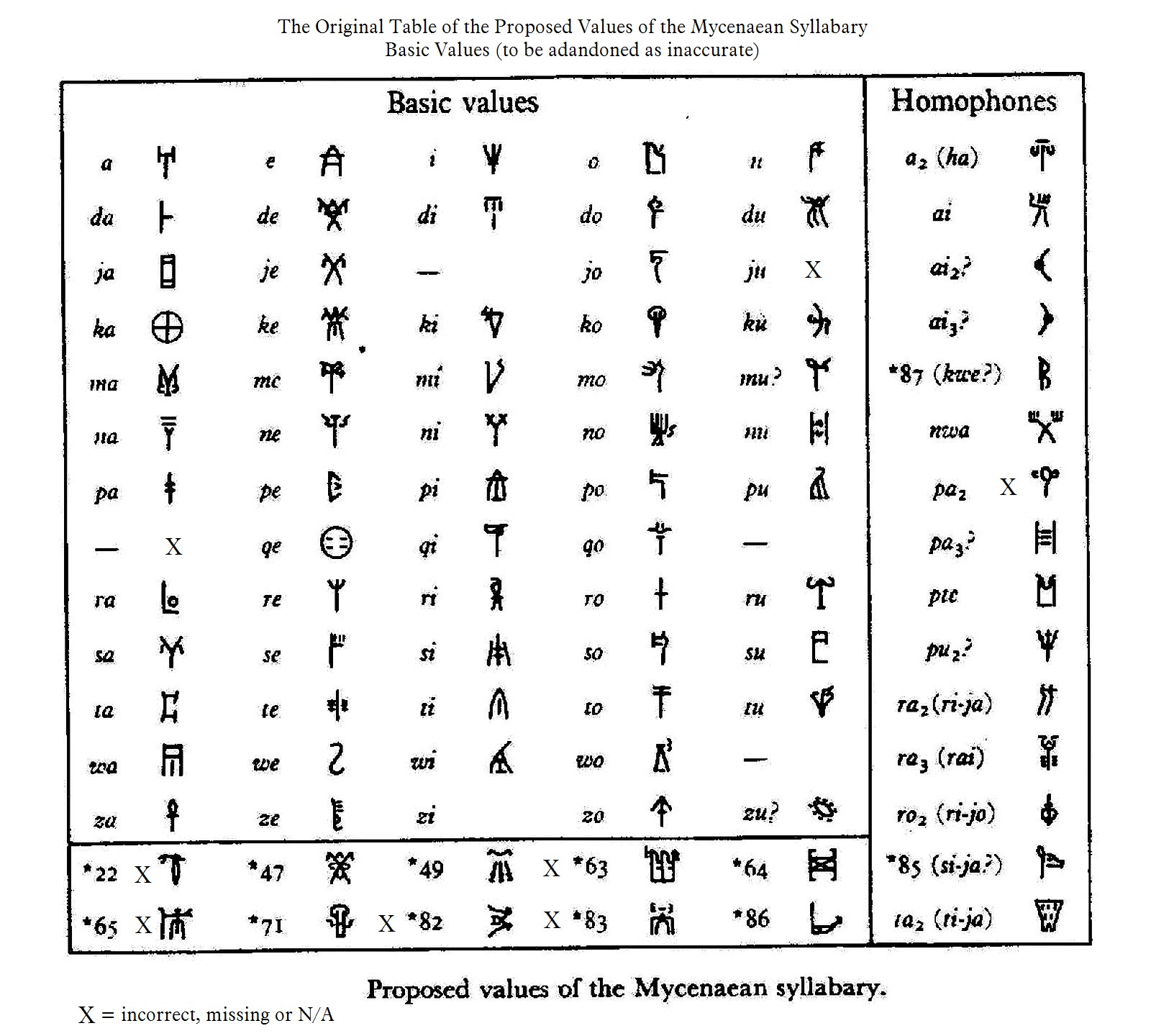
    NOTE! If you are using the standard chart of the Mycenaean syllabary currently available on the Internet, which looks like this:
    
    Linear B Basic Values INVALID
    
    you should discard it at once and replace it with our new Table of the Full Linear B Syllabary Revised 2014, as the former is completely out-of-date and inaccurate.
    
    Until recently, almost all charts of the Basic Syllabograms in Mycenaean Linear B accounted for only 58 syllabograms, but this number falls short of the actual total of 61 Syllabograms. In fact, there are three syllabograms which are unaccounted for in almost all previous charts of the basic syllabograms, these three (3) being JU (or YU), QA & ZU. The chart above does account for ZU. Both YU and ZU, although attested (A) on all extant Linear B tablets and fragments, regardless of provenance, are extremely rare, so we need not fuss over them.
    
    How did the Mycenaeans Pronounce the J series of Syllabograms (JA, JE, JO & JU)?
    
    The syllabogram JU (or YU) appears to be accurate. Of course, you are bound to ask me, “Why all this fuss over the Mycenaeans’ actual pronunciation of the syllabograms in the J+ vowel series?” Good question. Actually, the distinction is highly significant. If those of us who are allophone English speakers pronounce the syllabogram JE, it is inevitable that it is going to sound exactly like “je” in our word “jet”. However, I contend that this was almost certainly not the way the Mycenaeans would have pronounced it. They would much more likely have pronounced the entire J series of syllabograms (JA, JE, JO & JU) very much the way the French do today, as in “je” (I) or “justement” (precisely or exactly). If you are allophone English, there is really no way I can tell you how “j” sounds in French. But if you go to this site, you can hear it for yourself (scroll to the bottom of the light blue table):
    
    Wictionnaire
    
    Listen carefully. You can easily enough tell that the sound of the consonant “j” is much softer in French than it is in English. That is the whole point. As languages progress forward through their historical timeline, the pronunciation of certain letters changes. Sometimes, consonants actually end up as vowels. This is precisely what happened to the soft “j” in Mycenaean Greek. By the time of Homer, it had glided to the vowel “i”. Thus, the genitive singular masculine “ojo” in Mycenaean Greek was now pronounced “oio” in Homer’s Iliad. Now, the real problem here is simply this: when did the pronunciation start to imperceptibly shift from that soft “j” to the much softer vowel “i”? This question is in no way academic, but a reflection of the actual historical process of the gradual transformation, or glide (if you like) from soft “j” to the vowel “i”.  Given that Mycenaean Greek was the predominant Greek dialect almost everywhere in Greece from at least 1600 BCE until ca. 1200 BCE, the glide may have already been almost complete by the latter date. But we have no way of really knowing.
    
    However, I am one of many Linear B researchers and translators who believe this is indeed what happened, even as early as four centuries before Homer wrote the Iliad and the Odyssey (if ever he wrote it at all, rather than merely reciting aloud). So at least some of us prefer to list the J series of syllabograms (JA, JE, JO & JU) as the Y series (YA, YE, YO & YU), in our belief that the glide from the soft “j” to the purely vocalic “i” pronunciation of this series of 4 syllabograms was already well under way towards the end of the Mycenaean era. It is far more likely that the earlier soft “j” held sway in Knossos before its final demise ca. 1450-1425 BCE, so the choice of which pronunciation you personally prefer is entirely arbitrary. I have no problem being arbitrary myself. Take your pick.
    
    Why QA, Previously Classified as a Homophone Only, Should Properly be Considered a Syllabogram and Not a Homophone:
    
    The renowned Linear A & Linear B researcher, Prof. John G. Younger, was the first to recognize QA for what it is, a syllabogram. As Chris Tselentis makes it abundantly clear in his well-conceived Linear B Lexicon, he considers QA to be a syllabogram, and not a homophone. As he is Greek, he is in a much better position to have at it than those of us who are not Greek, which of course means almost all of us. This small extract from his Lexicon’s alphabetical list nicely illustrates the point – Click to ENLARGE:
    
    Linear B Syllabogram QA in the Linear B Lexicon by Chris Tselentis
    
    
    Linear B Syllabogram QA in the Linear B Lexicon by Chris Tselentis
    
    In his comprehensive Linear B Lexicon, Chris Tselentis places QA immediately after PTE and right before QE, which is precisely where it belongs alphabetically in the Linear B syllabary. To classify QA as being only a homophone is to strip it of its actual true value, which is patently unacceptable. Unfortunately, the primary chart, “Proposed Values of the Mycenaean Syllabary”, which is the one practically everyone studying Linear B resorts to, is inaccurate & totally out-of-date on two vital counts.
    
    [1] The new syllabograms (actually not so new), JU & QA are missing from that chart.
    [2] Past Linear B researchers and translators, from Michael Ventris through to his colleague, Prof. John Chadwick, were mistaken in their interpretation of the syllabogram QA as a homophone only. Since it is now known that in fact QA is an attested syllabogram (A), the previous phonetic value Ventris, Chadwick et. al. assigned to it is neither here nor there. In order not to confuse Linear B students and researchers, I cannot be bothered rehashing its former value. This in no way detracts from their splendid work in the successful decipherment. It just took a number of decades for later Linear B researchers to finally realize that there was (and is) more to this little beastie than was previously believed to be the case.
    
    Since the Linear B syllabary has no syllabogram to account for either a B+ vowel or G+vowel series, QA, QE, QO had to stand in for both “ba, be, bo...etc.” & “ga, ge,  go...”  in Mycenaean Greek.
    
    If you still wish to read an early, but truly excellent, extensive study on the conjectural pronunciation of of a great many syllabograms, download the PDF file, The Linear B Signs 8-A and 25-A2 (Remarks on the Problem of Mycenaean Doublets), by Antonín Bartonek, translated by S. Kostomlatský (1957). This study clearly illustrates the then current belief that PA2, i.e. QA, was strictly a homophone... a belief which has not stood the test of time. In Fact, Prof. John G. Younger, one of the most esteemed Linear A & Linear B researchers of our time, has this to say about the Mycenaean pronunciation of QA. 
    
    John G Younger’s reassignment of PA2 to QA. Click to ENLARGE:
    
    John G Youngers reassigment of PA2 to QA
    
    If you click on the Title Banner for Prof. Younger’s site below, you will be taken there, where you can view both the Linear A & B Grids. Scroll down to near the end of the page to view his complete chart of the Linear B grid. 
    
    Linear A Texts in phonetic transcription John G Younger
    
    
    Richard
    
    
  • Chinese Ideograms Compared to Linear B Syllabograms, Homophones, Logograms & Ideograms

    Chinese Ideograms Compared to Linear B Syllabograms, Homophones, Logograms & Ideograms: Click to ENLARGE:
    
    LinearB versus modern Chinesen
    
    Chinese (Oriental):
    
    Each Chinese character represents a monosyllabic Chinese word or morpheme. In 100 CE, the famed Han dynasty scholar Xu Shen classified characters into six categories, namely pictographs, simple ideographs, compound ideographs, phonetic loans, phonetic compounds and derivative characters. Click on the banner below to read this entry in full:
    
    Chinese person Linear B man woman
    
    Chinese Character Classification:
    
    Pictograms:
    
    Roughly 600 Chinese characters are pictograms (xiàng xíng "form imitation") — stylised drawings of the objects they represent. These are generally among the oldest characters. These pictograms became progressively more stylized and lost their pictographic flavor... passim...
    
    Ideograms:
    
    Ideograms (zh? shì, "indication") express an abstract idea through an iconic form, including iconic modification of pictographic characters. Low numerals are represented by the appropriate number of strokes, directions by an iconic indication above and below a line, and the parts of a tree by marking the appropriate part of a pictogram of a tree. Click on the banner below to read this entry in full:
    
    Chinese rain Linear B wine 
    
    The Relationship Between Minoan Linear A (unknown) + Mycenaean Linear B & Arcado-Cypriot Linear C (Occidental Greek):
    
    Both Linear A, which was used to write the undeciphered Minoan language & Linear B, its immediate descendent, which was used to write Mycenaean Greek, shared character sets which were uncannily similar and in the case of a fair number of syllabograms, identical. However, given that Mycenaean Greek did not require anywhere near as many characters as had the Minoan language, Linear B, all for the sake of greater simplicity, abandoned a great number of the more complex Linear A syllabograms, homophones, logograms and ideograms as plainly extraneous. When the Linear B scribes devised the new syllabary, they simply tossed out everything from Linear B which was of no further use in representing early ancient Mycenaean Greek.
    
    And we must never forget that these two syllabaries, Linear A and Linear B, its much simplified offshoot, were used to write two entirely unrelated languages. Because the first, Minoan, is undeciphered, we have no way of knowing to which class of languages it belongs, except that so far at least, it has utterly defied decipherment as anything like an Indo-European language. On the other hand, Linear B was used for early ancient Greek, which is an Indo-European language. The point I am trying to make is that these two syllabaries, which are so much alike not only in appearance but to a large extent in phonetic values, represent languages belonging to completely different classes. While the scripts look uncannily alike, the languages underlying them are entirely unalike. Conclusion: even scripts, in this case scripts which make use of a combination of syllabograms, logograms and ideograms by and large (nearly) equivalent, may easily represent languages which have nothing to do with one another.
    
    The direct opposite scenario can, and does often occur. Linear B and Linear C used completely different syllabaries to write two extremely closely related dialects of the same language, ancient Greek, the first, Linear B for Mycenaean and the second, Linear C, for Arcado-Cypriot. No two dialects in ancient Greek are nearly as closely related as are these two, not even Ionic and Attic Greek. In the majority of cases, in fact, although morphemes (words) in Linear B & Linear C of course look completely unalike in their respective syllabaries, their phonetic values, far more often than not, sound & are (almost) exactly the same, because they are phonetically (practically) one and the same Greek word. Moreover, Arcado-Cypriot was written using both Linear C and the Greek alphabet. Same document, different scripts. So in Arcado-Cypriot, regardless of the script, the words (morphemes) and their phonetic values are identical. Moreover, in a great many cases, any given Greek word written in Linear B, Linear C or in alphabetical Greek in either of these two germane dialects is, plainly and simply, the (exact) same word. This phenomenon is of vital, if not critical, significance to the translation of tablets composed in Linear B and in Linear C alike into alphabetical Greek. Phonetically, the results can often be astonishingly alike, if not identical, for all three scripts (Linear B, Linear C & alphabetical Arcado-Cypriot).
    
    A Comparison Between Chinese Pictograms/Ideograms and Linear B Syllabograms, Homophones, Logograms & Ideograms:
    
    Any attempt to make sense of any comparison between the ideograms of an oriental language such as Chinese and those of a script used for an Occidental language, in this case, Linear B for Mycenaean Greek, may seem to be an exercise in utter futility. Yet, in some senses, it turns out not to be so. This is quite clearly demonstrated in the chart of only 10 ideograms for Chinese words, compared with 10 similar looking syllabograms, homophones, logograms and ideograms in Linear B. The point I am trying to make here is simply this: as far as the assignation of ideograms is concerned, even languages as disparate and as geographically distant from one another as Mycenaean Greek and oriental Chinese, often end up using ideograms which either look almost exactly the same or are uncannily similar in appearance, even though the morphemic values underlying them are almost always completely unrelated, which goes without saying. Or does it?
    
    B. Same Ideogram, Same Meaning (a Rare Bird indeed, but...):
    
    In one case and one case only, the ideogram for “month” in Chinese is the exact mirror image of the same ideogram in Linear B! Can this be so surprising, that the Chinese and Linear B scribes alike took the cue for the symbolism for the ideogram, “month”, from the exact same astronomical phenomenon, the moon? Of course not, given that almost all ancient societies had recourse to the lunar, not the solar, month.
    
    I have made no effort here to compare the Linear B & Chinese ideograms in the chart above with the ideogram for “month” in any other ancient language, undeciphered or not, but of course there are scores of languages based either completely (ancient & modern Chinese, Korean & Japanese) or partially on ideograms (such as Linear A & B, but not Linear C). Rummage through as many of them as you like and you are bound to turn up ideograms very similar to those for “month” in both Linear B & Chinese. In a sense, this striking similarity is in part accidental, since anyone can use any symbol even remotely resembling the moon for “month”, yet at the same time, chances are good that people speaking languages as geographically and linguistically remote as ancient Mycenaean Greek and (ancient or modern) Chinese can and will come up with practically the same ideogram. This phenomenon of (striking) similarity in the appearance of ideograms between two entirely unrelated languages will (in the very rarest circumstances) result in the same meaning, but even then, of course, the pronunciation will be utterly different, because it must be. The ideograms for “month” in Linear B & Chinese look like mirror images of one another, but their pronunciation is totally alien, the Linear B for month being some variation on the Greek, “mein”, the Chinese being “yuè”.
    
    Same Ideogram, (Almost Always) an Entirely Different Meaning: 
    
    Of course, the obverse also holds true. Take one look at our chart above, and you can see right away that the very first ideogram in the Linear B column looks almost identical to its Chinese counterpart in column 1.1.  Yes, they look like kissing cousins. But they mean something entirely different. This can come as no surprise to anyone familiar with linguistics.
    
    C. One is an Ideogram, the Other is Not!
    
    C.1 A Chinese Ideogram looks like a Logogram in Linear B:
    
    Of course, in the vast, vast majority of cases, ideograms which look the same from one language to another almost always mean something entirely different. But there is more. The first example we see in the Linear B column is not an ideogram at all, but a logogram composed of two Linear B syllabograms, ME & RI, the one superimposed on the other. In other words, what is an ideogram in one language (Chinese) is not an ideogram at all in another (Mycenaean Greek), even though they look almost identical, as is the case with our first example in the chart above, the logogram for MERI “honey” in Linear B, which looks almost identical to the ideogram in Chinese for “elephant”! 
    
    C.2 A Chinese Ideogram looks like a Combination of Syllabograms & or Homophones & or Logograms in Linear B:
    
    Referring to Linear B entries 4. 6. & 7. in our chart above, we see that we have the syllabograms JA, SA & TE respectively. JA looks quite similar to the Chinese ideogram for “eye” (4.2) and SA + TE again like “sheep, ram” (10.2). Now of course, things get really messy, because Linear B uses two (2) ideograms, one for “ewe”, another for “ram”, and Chinese only one for both, with absolutely no resemblance between the Linear B & Chinese. This of course is the scenario for practically all syllabograms, homophones, logograms and ideograms on the one side (Linear B) and the ideograms on the other (Chinese), say 99.9 %. What is true for Linear B and Chinese is also true of any two languages which either use pictograms and ideograms almost exclusively (Chinese) or ideograms in combination with other signifiers such as syllabograms, homophones & logograms (Linear B).
    
    Conclusion:
    
    Many of you are surely asking, “What on the earth is the point of this, if not an exercise in futility?  Why even bother with it?” The answer is simple enough: why climb a mountain? - because it is there. A great many researchers specializing in comparative linguistics are fascinated by just this sort of thing... which is why I brought it up in the first place. But there is another reason, even more compelling than this, which I shall reveal to you in our next fascinating post, before we have done with this topic once and for all.
    
    Richard


  • Rita Robert’s Translation of Knossos Tablet KN 1115 E c 315

    Rita Robert’s Translation of Knossos Tablet KN 1115 E c 315: Click to ENLARGE
    
    Translation Knossos Tablet KN 1115 E c 315
    
    Rita’s comments on her translation:
    
    By consulting the huge Tselentis Linear B Lexicon, I found the place name Kytaistos where the 81 rams and 20 ewes were kept. I intuitively inserted “There is a total of”, because this would normally appear on a Linear B Tablet itemizing the number of animals or items. But of course, on this tablet as with so many others, the scribe omitted this because of the necessity to save space on such a small area. 
    
    Rita Roberts
    
    Comment by Richard:
    
    Here is yet another of Rita’s successful translations of moderately difficult Knossos tablets using ideograms (in this case, those for ram & ewe). Since Rita always excels at what she does and now that Rita has fully mastered this level of translation, she is moving onto advanced decipherment, which is going to present a lot more challenges to her.


  • Twitter Hash Tags #HashTags to be Used to Search Linear B, Linear A & Linear C

    Twitter Hash Tags #HashTags to be Used to Search Linear B, Linear A & Linear C: Click to ENLARGE:
    
    ChartofLinearAB&Ctwittersearchterms
    
    What is a Hash Tag #HashTag #hashtag?
    
    Strange as it may seem, so many people with Twitter accounts or using Twitter, and other boards, such as PINTEREST etc., do not know what a Hash Tag means. First of all, it looks like this: #HashTag #hashtag. Secondly, it can be defined simply as
    
    [A] the Google Search term, Subject or Topic or, more generally, the Area of Interest you as a Twitter account owner wish to get people to search for your #HashTag or search term you should input in any Twitter message you send to anyone, to ensure (at least to some extent) that anyone searching will find something almost exactly matching those topics of specific concern to both you and them or...
    
    [B] for someone who simply wishes to search a #HashTag #hashtag for the very same reason(s).
    
    Issues and Problems with #HashTag #hashtag Hash Tags to Keep in Mind:
    
    Before I proceed, allow me to explain: I am a professional librarian (MLS, Master of Library and Information Science, University of Western Ontario, 1975) and so I can safely say, in this sole instance, that I actually do KNOW what I am saying.   
    
    (1) Hash Tags (#HashTag #hashtag) can only find exactly what you wish folks to find in your + anyone else’s Twitter account if they exactly match your Google Search Term or Subject, and I mean exactly. And even then there will be false hits, as is always the case with stupid Google and equally stupid computers! For instance, the only #HashTags #hashtags which guarantee you will find Tweets on Linear A, B & C are: #MinoanlinearA, #MycenaeanLinearB, #supersyllabograms, #ArcadoCypriotLinearC & #Mycenaean Greek. Supersyllabograms exist in Linear B alone, and so if you use that search term you are guaranteed to get a lot of Tweets bang on for Linear B.
    
    The only ones which will return a high hit rate for Linear A, B & C are: #LinearA #LinearB & #LinearC + the other hash tags in the 80-90% range. However, the problem with these 3 Google Search terms is Google itself (big surprise, eh!). Not only will you find ALL #LinearA #LinearB & #LinearC, i.e. on Linear A, Linear B & Linear C, you will also find ALL on Linear A, Linear B & Linear C. What! Don’t be ridiculous! - you say. But this is no laughing matter. It just so happens that there are there are three (3) areas of advanced mathematics which use the exact same hash tags! Click Wikipedia banner for the article on Linear Algebra:
    
    WikipediaLinear 
    
    Wikipedia: 
    
    Linear algebra is the branch of mathematics concerning vector spaces and linear mappings between such spaces. 
    
    So be forewarned!
    
    
    (2) If you use Hash Tags (#HashTags #hashtags) which reasonably closely approximate what you wish folks to find in your + anyone else’s Twitter account (70-80%), you can use slightly less specific Hash Tags (#HashTag #hashtag) such as: #AncientGreek #ancientgreek #ArcadoCypriot. The problem here is that the first two will pick up anything having anything at all to do with Ancient Greek, while the last one will still pick everything on Linear C (#LinearC), but will also pick up everything on the ancient Greek Arcado-Cypriot dialect! Since Arcado-Cypriot was written both with the Linear C syllabary and with the ancient Greek alphabet, you see the problem.
    
    
    (3) If you Hash Tags (#HashTag #hashtag) dealing with ancient linguistics specifically concerned with Ancient Greek & closely related subjects, you will get all the Tweets on these topics! Now we are into the 1,000s! Your search will include all of the subjects above in [1] (80-90%), but you will also have to rummage through 1,000s of Tweets just to get 200 or so Tweets on anything in [2] above (70-80%). However, this is still an extremely useful way of approaching the dilemma, because that is what it is. Since so many people do not use #hashtags on Twitter, they will resort instead to writing out Linear A, Linear B, Linear C etc. in full for anything in (1) or (2) above. So you are bound to see anything in [2] above in the full text of many Tweets here for that reason. This is called a contextual search, and it is quite useful, but only if you have exhausted all your options in [2] above.
    
    (4) Some useful #hashtag search terms at level [2] (80-90%) above are: #Minoan #Knossos #Mycenae #Mycenaean #Pylos #Phaistos #syllabary #syllabicscripts #syllabograms #logograms #ideograms #AncientGreek #HomericGreek. But you will get a lot of false hits, because, for example, ideograms are the default script for so many oriental languages, Chinese, Japanese, Korean etc., but which account for only a little more than half of all the characters in either Minoan Linear A or Mycenaean Linear B.
    
    (5) Anything less specific than all of the search terms in [1][2] & [3] will lead to disastrous results.
    
    (6) Twitter Hash Tags #HashTag #HashTags #hashtag #hashtags must be input as follows:
    
    [a] There must be no spaces or extraneous punctuation between all of the words in the hash tag! So for example #MycenaeanGreek or #mycenaeangreek will find Tweets on Mycenaean Greek, but #Mycenaean Greek will chop off the word Greek, seeing it only as a word in the Tweet. In other words, ##Mycenaean Greek will find absolutely anything with #Mycenaean as a #hashtag. Another example: #ArcadoCypriot will find everything on Arcado-Cypriot, whereas #Arcado-Cypriot again chops off Cypriot, searching only #Arcado, an almost useless search, since hardly anyone would index a Tweet with that bizarre search term!
    
    [b] Twitter #HashTags #hashtags are CASE-sensitive so unfortunately you will have to use both UC & LC search terms, no matter how accurate they are. For example, if you want absolutely everything on #Mycenaean Greek you have to input #MycenaeanGreek & #mycenaeangreek, since so many people on the Internet cannot be bothered with CAPS.
    
    [c] If no one on Twitter has ever used a search term you are the first to use, i.e. to invent, such as my - #Supersyllabograms #Supersyllabogram #Supersyllabograms #supersyllabograms, no one will find your Tweets on that subject for quite some time, because at first no on knows what the hell a supersyllabogram even is, as if!... However, as time goes on, if your invented search term proves to be a big hit or big deal on the Internet, folks will begin to cotton on, and will start using it as a search terms. But this can take months, a year or years, so be patient. I recently searched – supersyllabograms – on Google, a term I invented a year ago, and found 3 pages of Google hits, all bang on because there are no synonyms for it whatsoever. So I am making progress, turtle-like, but what the heck eh...
    
    Richard 


  • Without further ado (or maybe with it!) let’s all wish Rita Happy Birthday with her WIPO & EREPATO!

    Without further ado (or maybe with it!) let’s all wish Rita Happy Birthday with her WIPO & EREPATO! Click to BLOW UP, eh...
    
    Linear B -001 -02
    
    I simply have not the faintest idea (though if I did, I probably would faint!) who designed this cluttered Birthday Card, but they must have been high on mushrooms, marijane or some kind of hallucinogen, eh. OMG! And the notes! They fairly shout at us, Hey READ ME, why don’t you, anyway, eh! (eh being Canajun for A, ha ha!, and since I am a Canajun, I know what THAT means, eh!... so do all other Canajuns, a few Brits, a few Aussies & a few Kiwis, but no Yanks, who for some bizarre reason insist on saying, HUH?, which unlike EH! sounds kinda stupid, eh!). I don’t know about YOU, but I am going to fly to Herakleion (& if you don’t know where that is or you are American & don’t know anyway, FORGET IT, EH!)
    
    So have a wonderful, stupendous, hyper-terrific, copacetic, ecstatic, far out, flighty, spacey, what planet are YOU from?, Plan 9 1/2 from Outer Space etc. etc. etc. Birthday, eh, Rita.... because WIPO simply does not have the graphic skills, let alone writing skills, to cobble together another Birthday Card like this for at least another year, eh. Anyway, it IS one astonishing CARD, totally unique on this little planet of ours full of HUGE ELEPHANTS and little WIPOs, don’t you think, eh?
    
    Yours most sincerely trying with all my might to avoid any nearby EREPATOS! Oh and of course Rita will have to Translate this great card for us, because no Canajun in his or her right mind would even dream of translating it, except for a million Euros... hint, hint, Rita, eh.
    
    Ton ami canadien (Canajun eh!) Click to ENLARGE, even if no-one has ever seen an enlarged beaver! They sure would not like that, and might nibble your finger nails off if you tried!
    
    Canajun eh!
    
    Richard EH!
        
    
  • The moment we’ve all been waiting for. This is it! Ideogram for “horse” IQO + Our First Supersyllabogram = ZE, “a team”: our First Concrete Example = “a team of horses”

    The moment we've all been waiting for. This is it! Ideogram for “horse” IQO + Our First Supersyllabogram = ZE, “a team”: our First Concrete Example = “a team of horses” 
    
    I honestly believe that this is the first time ever since Michael Ventris' successful decipherment of Linear B in July 1952 that a major step may have been taken in the further decipherment of those elements of Linear B which, at least until now, have been entirely recalcitrant to any meaningful decipherment. I have spent the past half year ploughing through 3,000+ tablets & fragments of the Scripta Minoa Catalogue of some 4,000+ fragments and tablets unearthed by Sir Arthur Evans between 1900 & 1903, with further excavations to follow in later years, prior and subsequent to World War I. This irreplaceable precious treasure trove of the largest collection of Linear B fragments ever discovered is available online in its entirety at Heidelberg University, Germany, here:
    
    Heidelberg University
    
    I fully expect that I will eventually be able to extract hundreds of examples all told of the potentially widespread use of an Ideogram immediately preceded or followed by a Syllabogram, and always in one of these two specific, invariable orders. In other words, we are speaking of a “formulaic phrase”, though of course, since the Linear B word in question is not spelled out in syllabograms as it “normally” would be, we are not strictly speaking of “phrases” here, but of a formulaic expression of an Ideogram immediately preceded or followed by a Syllabogram in every single instance, without exception, or as we choose to define it, a Supersyllabogram.
    
    Almost from the outset I was astounded to discover the recurrence of the exact same sequence of an Ideogram + Syllabogram no less than seven (7!) times on only two pages of the Scripta Minoa, i.e. pages 144 & 146. This formulaic expression of the Supersyllabogram ZE (plus a single instance of the SSY MO), I must underline, was only the first of scores and scores of Supersyllabograms I have since unearthed in several categories of tablets and fragments from the Scripta Minoa. My discovery of our very first Supersyllabogram in May of this year (2014) was, to say the very least, a real eye opener. For certain Linear B expressions compounded of a single ideogram invariably followed or preceded by the same syllabogram, which have utterly defied decipherment to date, suddenly became accessible for decipherment. The astonishing thing is that the very first two of these expressions involves the Linear B ideogram for IQO = horse + the syllabogram ZE, and always in the exact same order in every single instance, as you can judge for here yourself:
    
    7 Linear B Tablets & Fragments from Knossos Illustrating the Use of the Supersyllabogram ZE = a team (of horses) Click to ENLARGE:
    
    Linear B the Supersyllabogram SSY wheel ZE
    
    
    All this was almost too good to be true. But when I fell upon even more of these expressions for the second instance of the ideogram for “horse”, I could scarcely believe my eyes. But there it was, plain as the nose on my face. 
    
    Now, as you can see at once for yourselves from the first example of these seven fragments of Linear B, the ideogram(s) – 1 or 2, as the case may be – are always in the precise same order and always, without exception, immediately followed by the syllabogram ZE. But what, you are obviously asking, is that single syllabogram ZE supposed to mean? All by itself, it would mean precisely nothing. But in this specific, particular and often recurring formula, I originally deduced that ZE always meant “a halter” or “a yoke”, but I was dead wrong.
    
    An esteemed colleague of mine, Ms. Gretchen Leonhardt, who is also a highly competent decipherer and translator of Linear B tablets and fragments, soon enough set the record straight for me, convincing me beyond a shadow of a doubt that, in fact, the Supersyllabogram in the specific context of military matters could mean one thing and one thing only, “a pair of” (wheels etc.) or “a team of” (horses), and absolutely nothing else.
    
    Moreover, further research on my part has confirmed Ms. Leonhardt’s hypothesis beyond question. Chris Tselentis, near the end of his excellent Linear B Lexicon, has provided us with numerous examples of very well known Linear B tablets to illustrate the various problems which so often arise in our attempts to decipher or translate Linear B tablets and fragments. Among these tablets there is one which cracks the case wide open. Here it is:
    
    Zeugesi & KN So 4429 wheel ZE
    
    And Tselentis got it right bang on. He correctly translates the ideogram for wheel + the syllabogram ZE + the number 3 as “three pairs of wheels”, and this in spite of the fact that he did not quite get it right with the rest of the text. But no-one is perfect, so we can simply let that go. Anyway, I have corrected his own translation as illustrated above.  
    
    All that follows is my original text from May 2014, revised wherever necessary to reflect several new revelations on supersyllabograms since then:
    
    In the previous post illustrating Thomas G. Palaima's expert translation of Heidelberg Tablet FL 1994, we saw that he interpreted – and as it turns out, correctly — the syllabograms KO ZA PA PO & MU as being just the initial syllable of – and again, I must lay particular emphasis on this observation – the names of major Minoan/Mycenaean centres. Is this just a fluke? Far from it. The precise point is this, why would expert Linear B scribes bother with spelling out over and over the names of these cities and sites with all their syllabograms when “Everyone (meaning among all of us scribes) knows perfectly well that the first syllabogram, in other words, the first syllable alone, and nothing else, tells us in no uncertain terms that this is is the name of one of our important Minoan/Mycenaean centres, and if you cannot see that, you must be blind.” (So they say, the scribes).
    
    We do well to keep this firmly in mind: the Linear B scribes never inscribed their tablets for us, they did so for themselves and for the specific, sole function of annual accounting in the context of their own society. Nothing could be more obvious. That is the whole point to this marvellous adventure of deciphering ancient scripts! This was not only the lifetime mission the great Michael Ventris laid out for himself — it was nothing short of the love of his life. And since I love his work so dearly, can you be even remotely surprised that I will do absolutely anything to be able at last to decipher scores of of previously undecipherable Linear B tablets to honour his name?      
    
    Recasting this phenomenon as a general “rule”, Linear B scribes appear to have frequently resorted to using the first syllabogram, in other words, the first syllable alone of (sometimes long) place names, instead of wasting their time writing them out in full. Makes perfect sense to me. But this is only the tip of the iceberg. Not only are the full Linear B spellings of place names treated in this manner, but also several other key components of the Minoan/Mycenaean socio-economic infrastructure, including agriculture, crafts, household matters, trade, and of course, religious affairs. I shall amply illustrate this frequently recurring phenomenon in the coming months. In a nutshell, my premise is this: single syllabograms on fragments and tablets, which have defied decipherment to date, can in fact be contextually deciphered in a manner which makes perfect sense, no matter how you look at it, just as Thomas G. Palaima has so clearly illustrating in his masterful translation of Linear B Tablet Heidelberg FL 1994. 
    
    The fact that so many Linear B fragments and tablets, and I mean everywhere they have been found, and not just in Knossos, are liberally peppered with single syllabograms either immediately before or after the ideograms they modify must signify something of real import to us in the further decipherment of Linear B. Why?... well, because the Linear B palace scribes knew perfectly well what they were doing, which is to say, what they were writing, why they wrote it the way they did, and especially how they wrote it, when they consciously and deliberately so often had recourse to single syllabograms. This practically begs the question – what on earth were they up to?  Precisely this: they used the first syllabogram only, in other words the first syllable of vitally important Linear B words, which would otherwise have had to be spelled out, thereby wasting valuable space on what are for the most part, very small tablets measuring no more than 15-20 cm. at most. In other words, they were making liberal use of shorthand (at least as we would call it), and liberally using it thousands of years before we in the modern world finally cottoned onto it again in the late nineteenth century. Clever bunch of lads, weren't they?
    
    But, oh no, the Linear B scribes weren't even satisfied at stopping there. After all, “If we are going to use shorthand with initial syllabograms alone, why not go whole hog and use formulaic expressions of an ideogram (or even more than one ideogram!) + a syllabogram (or even more than one syllabogram!), and always in the same precise order, in other words, as a formula. Sound familiar? That is precisely what Homer did over and over and over in the Iliad? Co-incidence. I am now beginning to sincerely doubt that.
    
    So I have to ask, what is a big chunk of the corpus of Linear B if not, in essence, shorthand, pure and simple. And if this is the case, we have some serious rethinking to do about the very nature of Linear B. It may even mean going back to the drawing board in the re-decipherment of a considerable number of Linear B tablets and fragments. What a mind-boggling prospect! But, hey, sounds like fun to me. To put a fine point on it, this is going to be a truly daunting challenge, if we are to really get at the nitty-gritty of accurate contextual decipherment. This is something we can no longer afford to ignore.
    
    Why Supersyllabograms are What They are: 
     
    Allow me to explain why I call such syllabograms “Supersyllabograms”. It is really quite straightforward. Since such syllabograms always and invariably consist of the first syllable alone of an entire Linear B word, they must perforce be shorthand. Take this premise just one little step further, as I have in fact done and fully demonstrated in the table of 7 (almost) identical formulaic expressions of the syllabograms (chariot) + IQO (horse) + ZE in every single instance, and what do you get? - none other than the entire phrase, “a pair of chariot wheels” (since after all, chariots need two wheels, as if...) or, alternatively, whenever horses are involved, “a team of horses”. That is one big mouthful for 1 little ideogram + one little syllabogram in a standardized, invariable formula. The whole point is that these formulae recur so often on the Linear B fragments and tablets in the Scripta Minoa as to make it virtually impossible to ignore them, except at our own peril born of a frustratingly annoying inability to make any sense whatsoever of such expressions. Yet, as I shall illustrate many times over in the next year or so, such expressions not only exist, but recur very frequently on Linear B fragments and tablets, regardless of provenance, whether from Knossos, Pylos, Mycenae or anywhere else... (some original text erased, no longer being relevant). 
    
    Add all of these components together, and what do you get? ... the Supersyllabogram, a new term I have had to coin, simply because it fits the bill to a tee. And there you have it. At least for now.
    
    More to come. Much much more. I welcome and strongly encourage feedback and especially criticism of my basic premise here, and of its theoretical soundness or lack thereof, for otherwise, none of us can or will make any further headway in the eventual decipherment of a huge chunk of the Linear B corpus. But somehow, intuitively and through the process of inductive logic, I truly believe I am onto something, possibly even something big where the decipherment of large portions of Linear B “texts” - an inaccurate term if ever there was one, should my theory prove substantially sound.
    
    And to test my hypothesis against reality, which I am ethically and honour bound to do, I shall convey all of this information to Prof. Thomas G. Palaima, Prof. John G. Younger and to every other major Linear B scholar or researcher whose name comes to mind. If any of you who are reading this post, or know of anyone who is just such an expert, please identify the same to me immediately. And, if you yourself are a truly enthusiastic student of Linear B in any way, shape or form, please do not hesitate to contact me, or even better, to comment, in favour, against or neutrally, on this (potentially) ground-breaking post on our blog.
    
    Cheers
    
    Richard
    
    
  • All 9 Supersyllabograms for Amphorae & Vessels in Mycenaean Linear B

    All 9 Supersyllabograms for Amphorae & Vessels in Mycenaean Linear B – Click to ENLARGE:
    
    Mycenaean Linear B 9 Supersyllabograms for Vessels
    
    Of the 9 supersyllabograms for amphorae & vessels in Mycenaean Linear B, only one (1) is derived (D) = SORO (ancient Greek = soros) or “urn for the ashes of the dead” or “funerary urn” (Liddell & Scott, 1986, pg. 643). The rest are all attributed (A) on Linear B tablets, regardless of provenance. But this is the only entry in Liddell & Scott which closely matches amphorae, vessels, pots & urns, and it is so convincing that I feel quite sure it is the correct interpretation in this specific context.
    
    Following are two Linear B fragments which nicely illustrate the use of the supersyllabograms RO (crooked) & DI (dedicated to Zeus) Click to ENLARGE:
    
    Knossos fragments Crooked Pot and Amphora dedicated to Zeus
    
    This concludes our review of supersyllabograms related to amphorae, vessels, pots & urns in Mycenaean Linear B.
    
    It has become apparent to me that at least half or possibly even the majority of basic syllabograms and at least one logogram (for MERI = honey) are supersyllabograms. If this turns out to be the case (as I am quite sure it will), these results will serve to confirm my underlying hypothesis that the Mycenaean Linear B syllabary is shorthand to a considerable extent, given also the Linear B has around 100 ideograms as well, so many of which either contain attributive supersyllabograms inside them or have as many as three (3!) environmental supersyllabograms either preceding (proclitic) or following them (enclitic). 
    
    Richard


  • Brief Glossary of Linguistic Terms Used in Chapter 13, Mycenaean Greek, of A Companion to the Ancient Greek Language, by E.J. Bakker (2014)

    Brief Glossary of Linguistic Terms Used in Chapter 13, Mycenaean Greek, of A Companion to the Ancient Greek Language, by E.J. Bakker (2014) Click to ENLARGE Snapshot of the Beginning and End of this Chapter:
    
    Bakker 2014 Chapter13 Mycenaean Greek 
    
    Ablaut = The Indo-European ablaut is a system of apophony (regular vowel variations) in the Proto-Indo-European language that has significantly influenced both ancient and modern Indo-European languages. In English the strong verb sing, sang, sung and its related noun song illustrate this shift in vowels.
    
    Consonant cluster = a consonant cluster or consonant blend is a group of consonants which have no intervening vowel. In English, the groups /spl/ and /ts/ are consonant clusters in the word splits & /psy/ in psychology, psychiatry etc.
    
    Diaeresis = two adjacent vowels, in adjacent syllables, not separated by a consonant or pause and not merged into a diphthong & pronounced as a unit (one sound) as in “aisle” “aesthetic” or “oil”, i.e. pronounced separately, as in “coincidental” or “intuitive”.
    
    Enclitic = a word pronounced with so little emphasis that it is shortened and forms part of the preceding word, e.g., n't in can't + Proclitic = a word pronounced with so little emphasis that it is shortened and forms part of the following word, for example, you in y'all (American slang only).
    
    Eponym = a name or noun formed after a person's name. For example, the Odyssey is from the name Odysseus, and the Ames Test, which tests for carcinogens, from its inventor, Bruce Ames. It is back-formed from "eponymous", from the Greek "eponymos" meaning "giving name".  
    
    Grassmann's law = a dissimilatory phonological process in Ancient Greek and Sanskrit which states that if an aspirated consonant is followed by another aspirated consonant in the next syllable, the first one loses the aspiration.
    
    Intervocalic = an intervocalic consonant is a consonant between two vowels in the middle of a word. Intervocalic consonants are associated with lenition, a phonetic process that causes consonants to weaken and eventually disappear entirely.
    
    Haplography = (from Greek: haplo- 'single' + -graphy 'writing') is the act of writing once what should be written twice. For example, the English word idolatry, the worship of idols, comes from the Greek eidololatreia, but one syllable (lo) has been lost through haplography, and endontics loses one vowel from endodontics (do). Note that these vowels, which are later lost in almost all ancient Greek dialects, are almost always present in Mycenaean Greek.
    
    Isogloss = also called a heterogloss is the geographic boundary of a certain linguistic feature, such as the pronunciation of a vowel, the meaning of a word, or use of some syntactic feature. Major dialects are typically demarcated by groups of isoglosses. For instance, isoglosses in West Greek dialects, such as Doric Greek, are considerably different than those in East Greek dialects, such as Mycenaean, Arcado-Cypriot, Aeolic, Ionic & Attic Greek.
    
    Lexical diffusion =  is both a phenomenon and a theory. The phenomenon is that whereby a phoneme is modified in a subset of the lexicon, and spreads gradually to other lexical items. For example, in English, /u?/ has changed to /?/ in good and hood but not in food. The related theory, proposed by William Wang in 1969, is that all sound changes originate in a single word or a small group of words and then spread to other words with a similar phonological make-up, but may not spread to all words in which they potentially could apply.
    
    Morph =a word segment that represents one morpheme in sound or writing. For example, the word infamous is made up of three morphs – in-, fam(e), -eous--each of which represents one morpheme.
    
    Morpheme = an abstract unit of meaning, whereas a morph is a formal unit with a physical shape.
    
    Phoneme = any of the perceptually distinct units of sound in a specified language that distinguish one word from another, for example p, b, d, and t in the English words pad, pat, bad, and bat or o in cot, con, core.
    
    Prevocalic = occurring immediately before a vowel.
    
    Psilosis = Psilosis is the sound change in which Greek lost the consonant sound /h/ during antiquity. The term comes from the Greek psilosis ("smoothing, thinning out") & is related to the name of the smooth breathing (psilei), the sign for the absence of initial /h/ in a word. Dialects that have lost /h/ are called psilotic.
    
    Syncretism = the discrete identity of distinct morphological forms of a word, such as verb conjugations, and declensions of nouns, adjectives, pronouns etc. (mostly) in inflectional languages like Greek & Latin. In Attic Greek, nom. logos (word) changes to logou in the genitive & in Latin, nom. rex (king)changes to regis in the genitive.
    
    Toponym = a place name, e.g. Knossos, Mycenae, Pylos, Lasynthos, Zakros etc.
    
    Richard Vallance Janke, Oct. 6 2014
    
    
  • Rita Robert’s Excellent Translation of Knossos Tablet KN 1198 E x 205 “Tanaposo the shepherd”

    Rita Robert’s Excellent Translation of Knossos Tablet KN 1198 E x 205 “Tanaposo the shepherd” Click to ENLARGE:
    
    Knossos KN 1198 E x 205 Tanaposo
    
    I really have very little to say about this very fine translation Rita Roberts has made of Knossos Tablet KN 1198 E x 205. Now at the final stage of the Advanced Level of learning Mycenaean Linear B (Level 5), Rita has come very far indeed since she first started learning Linear B from me some 19 months ago. She has a true knack for intuiting what any Linear B tablet is really saying, in spite of the fact that the Minoan scribes at Knossos were notorious for omitting everything but the most essential information, given that they inscribed their tablets solely for inventorial purposes for the palace administration, and that, in so doing, they all knew perfectly well what each of their colleagues was saying, since they all adhered to the same code, so to speak, for tallying inventories. Inventories, after all, have to be standardized, and composed consistently across the board; otherwise, they are useless.
    
    Moreover, Rita has swiftly mastered the knack for intuiting the difference between Mycenaean vocabulary & Mycenaean names. She knew perfectly well that Tanaposo could not be a common Mycenaean word, but that it had to be a name. It matters little whether or not the word was later to enter standard Greek vocabulary. She even explains how that came about.
    
    She also correctly divined Tanaposo’s rôle as a shepherd, and correctly assumed that, since he was a shepherd, he had to be tending to his flocks... hence her excellent translation. In a word, the difference between a fair or a good and an excellent translation of any Linear B tablet consists in just this ability, to be able to coax out of the tablet what the Linear B scribe must have actually meant it to say. And I think she has it pretty much bang on.
    
    Richard
       
    
  • A Female Slave Brings Honey to be Poured into an Amphora (Knossos Tablet KN 713 M a 01) Click to ENLARGE:

    A Female Slave Brings Honey to be Poured into an Amphora (Knossos Tablet KN 713 M a 01) Click to ENLARGE:
    
    KN 713 M a 01 meri DERA amphora A
    
    This is an intriguing little Linear B fragment. Although the actual Linear B text is sparse, with the logogram MERI for “honey” and the ideogram for “amphora” clearly taking precedence over the Linear B word DOERA for “slave”, we must not and we dare not underestimate her essential rôle in the “script” for the play, so to speak, of this fragment. What fascinates me to no end is the fact that the logogram MERI is no closer to the ideogram for “amphora” than to the Linear B word for “slave”. This surely must imply something of the intent of the scribe who wrote this tablet (or fragment). And I think it does. It implies the notion of action, which can only be realistically rendered into Greek (if the Linear B text were used instead of the logogram MERI alone) as an active verb, and in this case, that verb would almost certainly have to be “to bring”, followed by the infinitive of the verb “to pour” or “to be poured”, in other words two verbs in succession!
    
    This is precisely one of the paramount features or characteristics of Mycenaean Greek as it actually appears (or not!) on so many Linear B tablets. I have stressed this over and over again on our blog, and I shall never tire of doing so. Since supersyllabograms, ideograms and logograms, taken together as a phenomenon, should be interpreted as being abbreviations or better yet, shorthand, for actual Mycenaean words in Linear B, and since they occur so very frequently on Linear B tablets, regardless of provenance (Knossos, Pylos, Phaistos etc.), it would be unwise to ignore them, and downright obtuse to dismiss them as minor factors in the decipherment and translation of Mycenaean Greek. In fact, the precise opposite scenario obtains.
    
    As Gretchen Leonhardt, another highly adept translator of Linear B, has frequently pointed out to me, what is the point of deciphering Linear B tablets, if we do not use our imaginations in endeavouring to unveil, as it were, the actual intent of the scribes who wrote them in the first place? Failure to do so simply suggests we are wasting our time even bothering to translate the tablets in the first place.
    
    However much I disagree with Ms. Leonhardt’s fundamental assumptions and hypotheses over how to go about using one’s imagination bent to this exacting task (my own views being almost diametrically opposed to hers), I completely agree with her notion that the Linear B tablets, at least those in which shorthand techniques take marked precedence over Linear B text, must be deciphered with a generous dose of imagination. Otherwise, they simply defy decipherment at all.
    
    This is precisely why I have invented the concept of “supersyllabograms”, in an informed and logically driven attempt to account as fully as possible for the huge textual gaps which riddle so many Linear B tablets, again regardless of provenance. Taking this approach to the decipherment of Linear B tablets consisting mainly of logograms, ideograms and supersyllabograms clearly justifies the kind of translation I came up with for this particular tablet alone. And trust me, I myself, Rita Roberts and Gretchen Leonhardt all take the same approach to translating such tablets, even though Rita and I share approximately the same perspective on what a viable translation should look like, as opposed to Ms. Leonhardt, who views decipherment based on this technique through an altogether different prism. So be it. Ainsi soit-il.
    
    Again, as my colleague, Rita Roberts, stresses in her translation of another Linear B tablet (which we shall be posting very shortly),
    
    ... clay tablets were so small that it was impossible to write every detail on them. However his fellow scribes would have known and understood what he meant, they certainly would not have thought about future readers, as they were concerned only with the current fiscal year,...
    
    I could not have put it better. The Linear B scribes compiled their annual fiscal inventories for the sole use of the palace administration, period. It ends right there. Any thought of preserving the tablets for future generations would never have even entered their minds. So before we even dream of translating any Linear B tablet whatsoever, whether or not it sports plenty of text, we had better make sure we are putting ourselves in the head space of the scribes themselves, in so far as this is possible. It is scarcely easy to do so, in fact, it is downright mind-boggling, given that we are separated from their own civilization by over 35 centuries (!), so that any attempt to try and get into their frame of mind is bound to be fraught with hazards galore. But this does not mean we should not try. 
    
    So here we have it. As far as I am concerned, this tablet does in fact mean:
    
    The female slave is bringing honey to be poured into an amphora.
    
    And why not? Plenty of professional Linear B translators are bound to object to our somewhat more imaginative approach to translating Linear B tablets with little text, but plenty of ambiguous logograms, ideograms and supersyllabograms, or any combination of these, but when they do, I expect them to come up with translations of their own which are likely to hold as much water as ours, when they are held up to the scrutiny, not only of the Linear B research community at large, but of folks who neither know Greek, ancient or modern, nor Linear B, but who are more than intelligent enough to decide for themselves what they decide any particular tablet means, thank you very much.
    
    Richard
  • The Various Kinds of Vessels (Amphorae, Pots etc.) in Linear B with their Supersyllabograms (SSYs)

    The Various Kinds of Vessels (Amphorae, Pots etc.) in Linear B with their Supersyllabograms (SSYs)
    
    As with any category of common ideograms in Linear B, whether it be livestock (primarily and almost always sheep, rams and ewes, (i.e. on over 20 % or 700 + on all 3,000 Linear B tablets from Knossos I have closely examined), other livestock (cows, bulls, goats, billy goats and she goats etc.), horses, textiles & vessels, among others we have not yet posted on this blog, a large number of ideograms are either preceded or followed by a single syllabogram or contain the single syllabogram inside them.
    
    This single syllabogram we call a supersyllabogram since it is always the first syllabogram, hence, the first syllable of a specific Linear B word of which it is, for all intents and purposes, the Linear B abbreviation. Another way of interpreting this phenomenon is to view each and every supersyllabogram as a kind of shorthand for specific Linear B words, shorthand which the Linear B scribes frequently resorted to to save valuable space on the very small clay tablets they were obliged to write on.
    
    One of the primary considerations to keep firmly in mind is that, with the sole exception of the SSY NE, which always means “new”, regardless of category, identical syllabograms standing in as supersyllabograms never mean the same thing from one category to the next. Allow me to illustrate with a few examples. For instance, the SSY PE for sheep, rams & ewes and other livestock always = PERIQORO, the Linear B word for the ancient Greek “peribolos”, which means “an enclosure”, or more accurately in Mycenaean Greek, “a sheep pen” or “cattle pen” etc., and nothing else whatsoever. In this category, vessels, the sypersyllabogram A = “amphora(e)” is as plain as the nose on your face.
    
    Cross-correlation of the ostensibly “same” supersyllabogram yields predictable results. As illustrated by Linear B Tablet Heidelburg HE FL 1994, all of the SSYs are toponyms, each corresponding to the name of a single Minoan or Mycenaean city or settlement. For instance, the SSY PU = Pylos. On the other hand, the SSY PU in textiles has an entirely different meaning = PUKATARIYA, “a kind of cloth”. Likewise, on the Heidelburg tablet, PA = Palaikastro, whereas in textiles it means PARAKUYA “died textiles or cloth”, and nothing else.
    
    Supersyllabograms for Vessels, Amphorae, Libation Vessels etc – Click to ENLARGE:
    
    All Ideograms & Supersyllabograms for vessles and MERI honey
    
    There are only 3 supersyllabograms for vessels, A, NE and PO, as illustrated above. A & NE are self-explanatory. As I have frequently pointed out, NE is the one and only SSY which never changes meaning across categories. It always means NEWO (masc.) or NEWA (fem.) = “new”. On the other hand, the supersyllabogram PO for vessels initially posed a problem for me. It was an enigma. What on earth could it mean? My first reaction was to run to Liddell & Scott, 1986, where I found the obvious entry (to me at any rate), “poteos-a-on”, meaning, of course, “drinkable”.  Yes, I exclaimed, Eureka! It has to be that. No. No way. Why? Unfortunately, the SSY PO does not simply refer to water, wine or even water turned into wine, or wine or anything else we would consider as “drinkable” as opposed to “undrinkable” or polluted. Sorry. Unfortunately, it is also & frequently, at that, applied to to “honey”, and honey is not exactly what we would refer to as “drinkable”. It is a bit too sticky for that!
    
    Now what? I despaired. But, wait, hold on a sec. Before I could even think twice, the solution leaped right into my mind. That’s it! I (somewhat triumphantly) exclaimed. The SSY PO clearly refers to “a libation to POtiniya”, perhaps the most famous of all Minoan goddesses. Now, since the Minoans were a matriarchal society, at least in so far as deities were concerned, this had to be it. But no, not quite. There is another possibility, which we cannot and must not overlook. PO could just as well refer to “a libation to POseidon”, written as POSEDAO in Linear B. OK, that suits the bill just fine. But which one is it?  To my mind, at least, given the marked propensity of Minoan religion for female deities, I expect the odds are something like 70/30 for POTINIYA. Take your pick. If you are macho, you will probably go for Poseidon. Otherwise, the rest of us will likely opt for Potiniya.
    
    And there you have it.
    
    One final note. I cannot for the life of me understand why the Linear B scribes appended the logogram MERI for “honey”, sometimes to the left of the ideogram for “amphora”, sometimes to the top left, and sometimes squarely on top of it. It seems really bizarre to me. There two possible explanations for this. Either (a) they did not care where they put the logogram MERI, since it was after all rather complex and clumsy to write anyway or (b) they did care, because they intended the logogram to have a different meaning in relation to the ideogram for “amphora”, depending on where the logogram MERI was located relative to the ideogram. But what these alternate meanings are we cannot really say. I can at least hazard educated guesses. It seems to me that when the logogram MERI is directly to the left of the ideogram for “amphora”, that amphora is used solely for wine, and nothing else. This interpretation fits neatly with my other translations of similar SSYs which precede or follow their ideogram, especially in the field (pardon the pun) of sheep. When MERI appears to the top left of the ideogram for amphora, this may mean that wine is being poured into the amphora, whereas when MERI appears at the top of the ideogram for amphora, it may mean that the amphora has just been filled to the top. But who knows? I am probably getting a little too specific for my own good. If a Linear B scribe were to come back from the dead as a revenant, he would probably laugh me out of the room for these so-called “explanations” or on the other hand, he might not, and instead say something like this, “Hey, man, you got it bang on”. Fat chance of that.
    
    Richard
    
    
  • The Newly Unearthed Minoan Winnie the Pooh Tablet (from Knossos? I wish it weren’t)

    The Newly Unearthed Minoan Winnie the Pooh Tablet (from Knossos? I wish it weren’t) Click to BLOW UP TO ELEPHANT SIZE if you dare!:
    
    KN 00 PO meri 00
    
    I really don’t want to say anything more about this astonishing tablet, except to say that I can’t believe Rita and I found it last Hallowe’en while all the other archaeologists in Herakleion were either out trick or treating with their better halves, or sitting morosely in Greek bars sipping, of all the disgusting things, Retsina! Rita pleaded and begged and pleaded again for me to re-bury it, but I would have nothing of it, informing her in no uncertain terms that this was the Linear B find of the century, if not the entire millennium, given that it is so incredibly unlike any other Linear B tablet she and I have ever, ever, ever seen... let alone anyone else. How it came to be is anyone’s guess, though I do believe that the scribe’s signature, WIPO, is a dead giveaway. Plus, although he had no brains, Minoan Winnie the Pooh was a clever little bugger, riding into the city market, no less, on an ELEPHANT, no less, just to make sure everyone (especially the already burnt-out scribes!) got the hell out of their way... or else... or else what I cringe to imagine. And although our “scribe’s” scratches and scrawls are almost illegible, even for Linear B, which is almost illegible most of the time anyway, only this time round far worse, the text is utterly charming in the extreme, once you can figure out how to decipher it.
    
    I wonder how many elephants he has. I wonder whether or not he shares (at least one pot of) honey with his elephants. I suspect he has to, unless he also wants to get squashed underfoot. I wonder why the scribes just don’t give up, toss in the towel (though there probably no towels as such in ancient Knossos), and run off in all directions screaming like maniacs (which is what they would have been by this time!). I wonder why Rita and I ever decided to keep this silly tablet, except that maybe, just maybe, we want to set the entire Linear B research community, and especially Linear B translators, on their heads, aghast at this new, entirely unexpected and entirely earth-shattering tablet... earth-shattering, not because there was another one of those nasty earthquakes at Knossos when it was composed, but because elephants really do shatter the earth when they come stomping by or, worse yet, stomping into the scribes’ HQ.
    
    This is of course the primary reason why so many Linear B tablets were never unearthed by Sir Arthur Evans in the first place, since the poor bloke was entirely oblivious of the Elephantine Factor (see shattering above). It is almost certainly a historical given that Minoan Winnie the Pooh ordered his pet elephants to destroy as many tablets as they could on any subject but honey pots and honey amphorae, except that the stupid elephants got it all the wrong way around, and destroyed thousands upon thousands of honey-pot and honey amphorae tablets, upon which the entire Minoan economy depended for its survival. When I rummaged through 3,000 + tablets from Knossos, I could find only 7 or 8 honey-pot tablets (and fragments, of course, given those elephant feet!), a horrific loss to posterity, especially to all those honey-sweet Pooh Bears who have lived on this lovely earth of ours since then, Winnie Ille Pooh, the Roman Pooh, Winnie Lou Pou, the Provençal Pou, and so on and so forth, all the way up to Winnie the Pooh today. 
    
    What a terrible loss indeed! Small wonder that the Minoan economy collapsed in a heap of rubble! Those meany ole’ scribes just didn’t get it! Their entire economy was stuck on honey. No honey, no economy. Poof, no Knossos!
    
    Richard 


Sappho, spelled (in the dialect spoken by the poet) Psappho, (born c. 610, Lesbos, Greece — died c. 570 BCE). A lyric poet greatly admired in all ages for the beauty of her writing style.

Her language contains elements from Aeolic vernacular and poetic tradition, with traces of epic vocabulary familiar to readers of Homer. She has the ability to judge critically her own ecstasies and grief, and her emotions lose nothing of their force by being recollected in tranquillity.

Marble statue of Sappho on side profile.

Designed with WordPress