Tag: Ancient Greek

  • UD: The Real Problems with Gretchen E. Leonhardt’s Commentary on the Rôle of the Syllabogram WE in Linear B as Representative of the final “s” or sigma stem in Mycenaean Greek.

    UD: The Real Problems with Gretchen E. Leonhardt’s Commentary on the Rôle of the Syllabogram WE in Linear B as Representative of the final “s” or sigma stem in Mycenaean Greek.
    
    With reference to our previous post, I now fully acknowledge her unique contributions to the use of the syllabogram WE in Mycenaean Greek as follows:
    
    Many Mycenaean Linear B [words] ending with “WE” indicate that “WE” as the last syllable of such Mycenaean words is actually the consonant “S”. Unfortunately, at the time of that post, I entirely neglected to credit Ms. Leonhardt for her professed “discovery” that the syllabogram WE in the ultimate position in Mycenaean Linear B words can and often does exactly correspond with a final sigma or “s” stem. I hereby correct my oversight.
    
    Click this banner to read it in its entirety:
    
    Lexicon post 1
    
    However, on her own Linear A, Linear B & Linear C blog, Ms. Leonhardt makes this telling observation on the rôle of the syllabogram WE in Linear B as being the exact equivalent of final “s” or sigma stem in Mycenaean Greek when it is in the ultimate position in a Mycenaean Greek word stem (relevant parts underlined):
    
    POST  Konosos.net re WE ultimate
    
    Now this I believe to be a significant contribution to our ongoing understanding of the phonetic values of syllabograms in Mycenaean Linear B, in this particular instance of the possible of the final sigma stem to the syllabogram WE in the ultimate.
    
    But I am obliged to set the record straight, reserving full copyright to Ms. Leonhardt on this account, with the strict provisos I underline below.
    
    I am in fact, not at all in accord with with Ms. Leonhardt’s theory in this regard. Quite to the contrary. I understand that if Ms. Leonhardt wishes to take this stance, she is perfectly entitled to do so. But I respectfully disagree. In her observations on the syllabogram WE in the ultimate as acting as the sigma stem, I find myself greatly at odds with her conclusion on several key counts. Moreover, she flatly contradicts herself when she asserts that,These suggest that the inclusion of the final consonant * without a vowel nucleus was either a later development or was a contemporaneous dialectical development.” (where “final consonant * ” refers specifically to the sigma stem).  Apart from that fact that she unnecessarily repeats the word “development” the statement is clearly misleading on several counts:
    
    (a) Why has Ms. Leonhardt omitted a specific reference to the consonant “sigma” in this summary statement? It is always preferable to repeat the actual consonant under consideration than not to, just to be certain readers clearly understand what that consonant is. I fully realize that Ms. Leonhardt will flatly disagree with me on this count, but I would much rather repeat the direct reference to sigma as the consonant stem in question than needlessly repeat the word “development”. In other words, I would have phrased the statement as follows:
    
    These Linear B pairs suggest that the inclusion of the final consonant sigma without a vowel nucleus was either a later or a contemporaneous dialectical development.
    
    ... except that even with these changes, the statement is still unclear and quite misleading.  
       
    (b) If Ms. Leonhardt means to say that this phenomenon was a later development (in Mycenaean Greek), this presupposes that in early Mycenaean Greek the inclusion of the final consonant sigma without a vowel nucleus did not in fact exist, and that the only phonetic attribution that could have been assigned to the syllabogram WE in early Mycenaean was, quite simply, WE.
    
    (c) I am quite at a loss with reference to her claim that, on the other hand, it (meaning the assignment of ultimate sigma as consonant stem) was – as she calls it - “a contemporaneous dialectical development”. Contemporaneous with what? - with the early Mycenaean Greek value of WE, in which case WE would have simultaneously meant WE (i.e. itself ) and ultimate sigma as consonant stem in early Mycenaean Greek – OR -
    
    that the evolution of the early Mycenaean phonetic value of WE as itself and nothing more than that into WE + ultimate sigma as consonant stem was in fact contemporaneous with the appearance of the latter in later Mycenaean Greek. But this constitutes a flat-out contradiction in terms. Either WE always stood for WE + ultimate sigma as consonant stem from the very beginning of Mycenaean Greek in Linear B, or it never did. You cannot have it both ways. Languages do not fundamentally and arbitrarily change the principle(s) upon which word stems are formed in mid-stream.
    
    Languages simply do not arbitrarily change any of their grammatical underpinnings in mid-stream, without becoming another, entirely new language. This is the case with ancient Greek versus modern Greek. Modern Greek is a different and entirely new linguistic phenomenon, in other words, a new language, simply because it has fundamentally re-written wholesale so many of the grammatical principles underlying it, abandoning lock-stock-and-barrel huge chunks of the linguistic structural foundation(s) of ancient Greek. For instance, there are no infinitives as such in modern Greek. That is one huge departure from ancient Greek.
    
    I am certain that Ms. Leonhardt certainly surely did not mean to imply anything like this, but her statement is so unclear that it begs the issue. This is precisely why I always spell out any observation whatsoever I make on Linear B down to the very last detail – even it entails repetition – because I must be certain that I have clearly and unequivocally made myself clear to my readers, most of whom are not familiar with Linear B at all, let alone with the notion of a syllabary.
    
    (d)... and that is precisely where Ms. Leonhardt’s all too brief and all too terse statement falls flat on its face. She unfailingly assumes that her readers are familiar – even intimately so – with the concept of a syllabary. But if the majority of her readers do not know what a syllabary is (and we can be quite sure they do not), then how on earth she expects them to be familiar with the very arcane Minoan Linear A, the complex syllabary, Mycenaean Linear B, or with the slightly less arcane Arcade-Cypriot Linear C simply stumps me. Such an assumption leaves her wide open to misunderstanding, misinterpretation, if not complete bafflement, on the part of her readers, the majority whom are not even necessarily versed in linguistics. In fact, even among linguistics who are profoundly versed in Minoan Linear & Mycenaean Linear B, there are are almost none who have any understanding of Cypro-Minoan Linear C, by far the easiest of the three syllabaries to master. Apart from the Egyptologist, Samuel Birch, who, with the assistant of other researchers, deciphered Arcado-Cypriot Linear C in the first place in the 1870s, very few linguists these days can even read Linear C, apart from Ms. Leonhardt and myself. Summa in veritate, who says they should? Certainly not I. Yes, even we linguists have plenty to learn from one another. I for one am still struggling to unravel the the subtle niceties of both Mycenaean Linear B and Arcado-Cypriot Linear C. I have a long long road ahead of me just trying to cope with these two syllabaries, let alone any other!
    
    e) She then rounds up her observations on the syllabogram WE by noting (correctly) that “As for /we/ in the initial and medial positions, the tentative conclusion is that /we/ shifts to /e/” (My apologies for being unable to reproduce epsilon in the body of my post). The problem here is that /we/ does not shift at all, because it never did in the first place. WE is WE is WE. A rose is a rose is a rose.     
    
    (f) All of my observations above are absolutely critical to a clear-cut understanding the actual rôle the syllabogram WE plays in the ultimate in Mycenaean Linear B as merely an indicator of the unseen presence of a final “s” or sigma stem. I say, “unseen” or invisible, because – and I repeat - WE in Mycenaean Greek is just that WE, i.e. digamma followed by the vowel epsilon or eita ... and nothing else. Since Linear B, being an open-ended vowel-based syllabary, forbids the presence of a consonant in the ultimate of any syllabogram, and more to the point, since no-one in any language ever pronounces the ultima word stem alone without the addition of a proper inflection (verb conjugation or nominal/adjectival declension), the whole argument implodes on itself.
    
    So while Ms. Leonhardt most assuredly holds the copyright on her own professed theory that the syllabogram WE in the ultimate is the exact equivalent of final “s” or sigma indicating the stem of the word in question, for all of the reasons I have cited above, I simply cannot agree with her hypothesis.
    
    My counter-hypothesis, which I shall presently post in great detail, is firmly and roundly based on my regressive-progressive extrapolation of the declension of all nouns in adjectives in the Athematic Third Declension of Mycenaean Linear B I have just posted on our blog. My extrapolated declension of such adjectives and nouns makes it perfectly clear that, even if the syllabograms WE, as well as – I must also add - WA in the ultimate, might both be indicators of the presence of a final “s” or sigma stem pronounced in spoken Mycenaean Greek, this does not mean that WA & WE actually contain within themselves this putatively pronounced final “s” or sigma, simply because they cannot. In fact, the syllabogram WE in the ultimate position in the dative/locative/instrumental singular presupposes the total absence of any final “s” or sigma stem, clearly marking instead the actual presence of an ultimate “i”, the tell-tale indicator of that (those) case(s). The ultimate “i” in the dative/locative/instrumental was always present in archaic Greek dialects, and subscripted into the iota subscript much later in ancient Greek, as in the Attic dialect.
    
    In other words, my own hypothesis of the actual rôle of ultimate WA & WE in Mycenaean Linear B is at marked variance with that of Ms. Leonhardt on the same issue.
    
    Keep posted.
    
    Richard
    
    
  • REVISED: Archaic Declensions in “eu” in Mycenaean Greek = “eus” in Homeric Greek: Click to ENLARGE

    REVISED: Archaic Declensions in “eu” in Mycenaean Greek = “eus” in Homeric Greek: Click to ENLARGE
    
    Mycenaean Linear B Third Declension in EU
    
    One of the most archaic declensions in ancient Greek is the Athematic Third Declension in which nouns in the nominative end in “eus” in Homeric Greek or “eu” in Mycenaean Greek, as illustrated by the complete declension table above of the noun “qasireu” = “viceroy” in Mycenaean Linear B, and of “basileus” = “(lesser) king” in Homeric Greek. The process whereby I can reasonably reconstruct any verb conjugation or any nominal or adjectival declension from the Homeric Greek of The Catalogue of Ships in Book II of the Iliad or, failing that, from Book II of the Iliad, I call regressive extrapolation. In the table of the athematic third declension above for “qasireu” = “viceroy” in Mycenaean Linear B, very few forms are already attested on the tablets (mainly the nominative singular), but all of the cases, singular, dual and plural, can be reconstructed with almost complete accuracy by means of regressive extrapolation. It is critical in this regard to understand that, if at all possible, the forms derived in this manner must reflect their most archaic equivalents in Homer, which is why I always resort to The Catalogue of Ships in Book II, and also why I have taken it upon myself to translate The Catalogue in its entirety (although I still have 4 more sequential sections to translate).
    
    Once I have reconstructed any conjugation or declension, and the table is complete, as seen above, the process of reconstruction in Mycenaean Linear B forward through all the cases (nominative, genitive, dative/locative/instrumental & accusative) and all three numbers (singular, dual & plural) I call progressive extrapolation. Starting this month, and working through the spring of 2015, I shall attempt to reconstruct as many declensions of nouns and adjectives as I am convinced can stand the test of regressive-progressive extrapolation, without resulting in absurdities, i.e. without falling into the trap of reductio ab adsurdum. Unfortunately, such reconstruction can be and sometimes is open to precisely that pitfall. So where it is impossible to reconstruct any verbal conjugation or nominal/ adjectival declension without unsubstantiated Homeric or Arcado-Cypriot forms, I shall not do so.
    
    Last year (2014), we successfully reconstructed verb tables for the present, future, imperfect, aorist & perfect tenses of the active voice of both thematic and athematic verbs in Mycenaean Linear B, of which the complete tables can be consulted in the CATEGORY, PROGESSIVE LINEAR B, of this blog.
    
    In the next post, I shall provide a reasonably comprehensive list of nouns and adjectives in the Athematic Third Declension, ending in “eu” in Mycenaean Greek.
    
    The likelihood that the Mycenaean Linear B syllabogram for WE is indicative of the nominative plural of certain Mycenaean nouns and adjectives of the athematic third declension was first brought to my attention by Ms. Gretchen Leonhardt, whose site is: Click on this Banner to visit -
    
    Konosos.net
    By extapolation, the same principle can be applied to the Mycenaean Linear B syllabogram for WA, which is reperesentative of the accusative plural of certain nouns and adjectives of the athematic third declension, among others. 
    
    Richard    
    
    
  • Interdisciplinary CONFERENCE on “Thinking Symbols”, Pultusk, Poland, June 30 June 30 – July 2 2015: Click to ENLARGE the Announcement:

    Interdisciplinary CONFERENCE on “Thinking Symbols”, Pultusk, Poland, June 30 June 30 - July 2 2015: Click to ENLARGE the Announcement:
    
    A Koryvantes Announcement Symbolism Poland June-July 2015
    
    an interdisciplinary conference on “Thinking Symbols” under the auspices of the Pultusk Academy of Humanities, Pultusk, Poland, June 30 - July 2 2015 & with the participation of speakers Mrs. Christy Emilio Ioannidou & Mr. Spyros Bakas from The Association of Historical Studies: KORYVANTES, Athens, Greece: click on their banner to visit them:
    
    
    Koryvanteslogo
    
    
    Richard
    
    
  • All About Sypersyllabograms: Their Enormous Impact on the Nature of Linear B – Everything you ever wanted to know, but were afraid to ask!

    All About Sypersyllabograms: Their Enormous Impact on the Nature of Linear B – Everything you ever wanted to know, but were afraid to ask!

    Given that supersyllabograms invariably display the characteristics highlighted in the previous post, they must also be formulaic by nature. The several restrictions placed on their disposition next to or inside ideograms, the invariability of their meanings within each sector, and other such considerations means they are always formulaic. Although the language of Homer is also very often formulaic in the Iliad, especially in The Catalogue of Ships in Book II, there is probably little or no relationship between the formulaic nature of supersyllabograms in Mycenaean Linear B and his archaic formulae. Nevertheless, it cannot be denied that formulaic language is a particular characteristic of both Mycenaean Linear B and of Homer’s own so-called Epic Greek. However, the nature of the formulaic language of Linear B and that of Homeric Greek are of a different order.
    
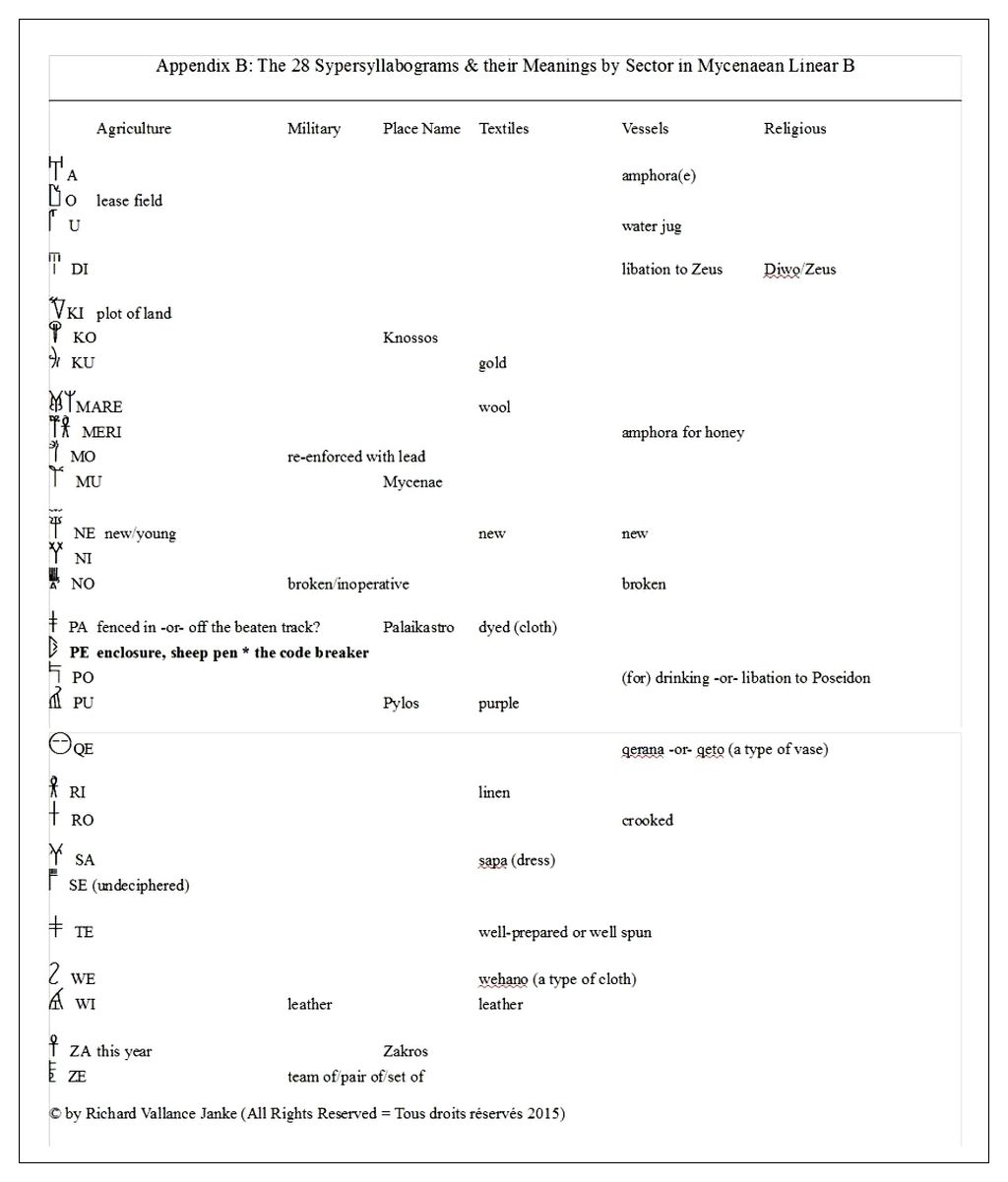
    In the chart which follows, we see for the first time ever on our blog the disposition of each supersyllabogram in each sector of Minoan/Mycenaean society, with repetitions of certain supersyllabograms, which re-appear in different sectors, usually with different meanings from one sector to the next, with the exception of the supersyllabogram “newo/newa”, which always means “new”, regardless of sector. It alone appears in three sectors: agriculture (livestock, mainly sheep, rams & ewes), textiles & vessels, as seen in the chart here: Click to ENLARGE
    
    AppendixB
    
    While the meanings of some supersyllabograms are firmly established, due primarily to their high frequency on Linear B tablets from Knossos, others are less firmly demonstrable. For instance, in the sector, agriculture, sub-sector sheep husbandry, the meanings of the supersyllabograms O = lease field, KI = plot of land , NE = new & PE = enclosure or sheep pen, are firmly established with a very high degree of probability, if not total accuracy. In the case of PE, the definition is 100 % confirmed, since on one of the tablets in that series, the scribe conveniently spelled out the word in full, instead of using the simple superyllabogram PE. It is this very tablet which establishes beyond a doubt the authenticity of supersyllabograms as a phenomenon innate to Linear B alone, and not found in Arcado-Cypriot Linear C. As for Minoan Linear A, no-one knows whether SSYLS exist, because the language remains recalcitrant to decipherment.
    
    In the military sector, the supersyllabogram ZE almost certainly means “a pair of..” or “a team of...”, with a 90 % or greater probability. However, once we get past the two primary sectors in which supersyllabograms are used extremely frequently, given that there are so many tablets to be found in these two primary sectors of Minoan/Mycenaean society, the situation devolves by degrees into less certainty.
    
    Supersyllabograms found adjacent to any ideogram, as for instance those with the ideograms for sheep, ram, ewe (livestock), or horse or chariot (military) are considered to be associative. Associative Supersyllabograms are those which define characteristics of the environment or specific context in which their associative ideograms appear. For instance, it is natural and logical to associate sheep with lease fields, plots of land & sheep enclosures. The same goes for military ideograms. The ideograms for horse and chariot naturally associate with pairs or teams of... (fill in the blanks).    
    
    There are still quite a large number of tablets in the textiles sector; so the meanings of most of the supersyllabograms in that sector are more than likely still very reliable, not the least because each of them still makes good sense: KU = gold cloth, PA = dyed cloth, PU = purple or Phoenician cloth (amounting to pretty much the same thing, anyway) & RI = linen. I would assign at least a 70 % to 90 % degree of probability to each of the definitions I have deduced for each of these supersyllabograms in textiles. The supersyllabograms in the sector of vessels (amphorae, drinking cups, water jugs etc.) may be a little less firm, but I am still convinced that I deduced most of them accurately, yielding a probability of 70 % - 80 %.
    
    Supersyllabograms in the textile and vessels sector are another kettle of fish. Since they appear inside the ideograms they modify, they are attributive in nature. In other words, they describe attributes of the textiles or vessels which they modify, and are, in almost all instances, adjectival in nature. Their placement inside the ideograms makes it quite clear that this is what the scribes actually indented, since a symbol inside another always describes attributes of the ideogram in which it appears. Should anyone doubt this, we have only to appeal to symbols appearing inside others as they are found in today’s world, since they follow the exact same principle. For instance, we have: click to ENLARGE:
    
    Modern Superalphabetical Symbols
    
    Need I say more?     
    
    On the other hand, I have been quite unable to decipher at least one supersyllabogram, SE, which sadly appears only 3 times on extant tablets from Knossos. For this reason alone, I dare not assign it a meaning, since I am quite sure that if I did, I would probably be (way) off the mark.
    
    There remain the supersyllabograms for place names, which are in a category of their own, since none of them appear with ideograms, and all of them are found on only 1 tablet, Heidelburg HE Fl 1994, which Prof. Thomas G. Palaima so expertly deciphered in 1994. Click on this banner to read his translation and my explanatory POST in its entirety:
    
    SSYLS POST Palaima
    
    There can be no question whatsoever that these are in fact supersyllabograms, the very first ever to have been isolated, for which we owe Prof. Palaima full credit. Of course, he did not define them as supersyllabograms, as he was unaware of the high frequency of the rest of them as adduced above in this post. Nevertheless, they are what they are, supersyllabograms. We have KO for Konoso (Knossos), MU for Mukene (Mycenae), ZA for Zakros etc.
    
    And if a few of you are still in doubt as to the viability of supersyllabograms in Mycenaean Linear B, remember: the very same phenomenon applies to internationally standardized signs nowadays.
    
    Once again, nowadays, we have a symbol within a symbol, or if you like, a symbol inside an ideogram. It is truly amazing how such a practice has resurfaced after at least 32 centuries, even if it was only the Minoan/Mycenaean scribes in the ancient world who figured out the system in the first place, leaving it interred for 32 centuries before it re-appeared in the twentieth century. So once again, we find ourselves face to face with a very ancient script, namely the Linear B syllabary, which was so systematic, formulaic and logical that it can only be considered as a brilliant breakthrough in the art of writing. After all, supersyllabograms are not the only phenomenon Linear B sported with such bravado. Ideograms in and of themselves abounded (over 100 of them!). They even used ideograms as the equivalent of subject headings as they resurfaced in nineteenth century libaries, in the Dewey Decimal & Library of Congress systems.
    
    Witness just one tablet alone, namely, Pylos 641-1952 (Ventris), the very first tablet ever translated with complete success by none other than the great Michael Ventris himself, and you can see these “subject headings” for yourself, plastered all over that amazing tablet! Why did the scribes use so many ideograms for vessel types on this single tablet? The answer was obvious, at least to them... the ideograms for vessels were the signposts or indexing markers of this tablet which instantly allowed the scribes to identify the precise type of vessel described in the full text immediately preceding each one, even before they bothered reading the descriptive text. That this is a very clever indexing system goes without saying. And it re-appears over and over on so many tablets that it is without question one of the hallmarks of the Linear B syllabary. Finally, their numeric accounting system was the most efficient ever devised in the ancient world. Summarizing all of the streamlined characteristics of Linear B we have just enumerated, it becomes obvious that Linear B was, first and foremost, a carefully devised form of shorthand for Mycenaean Greek. Once again, the Mycenaean scribes anticipated a methodology for writing business transactions which would not re-appear as modern shorthand – you guessed it – until the nineteenth century AD.
    
    All of this adds up to one inescapable conclusion: Linear B was the world’s fist ever commercial shorthand, and until the nineteenth and twentieth centuries, there was nothing even remotely as efficient, logical and practical ever to be found throughout history until... the modern era. This is precisely why I am so in awe of Linear B, a script which was millennia ahead of its time. It is also why I refuse to characterize Linear B as being prehistoric. It is nothing of the sort. It is in a word, a proto-historic writing and accounting system, leading me to the inexorable conclusion that Minoan/Mycenaean society was in fact not prehistoric at all, but proto-historic. I am not the first linguist specializing in ancient linguistics to have asserted this claim, but I am the first to speak up as emphatically and unequivocally as this.        
    
    This then has been a brief summary of the functions and the key rôle supersyllabograms play in the decipherment of Mycenaean Linear B.
    
    
    Richard   


  • TBP spring 2015: English — Mycenaean Linear B Lexicon of Military Affairs A — cargo (Draft): Click to ENLARGE

    TBP spring 2015: English — Mycenaean Linear B Lexicon of Military Affairs A — cargo (Draft): Click to ENLARGE
    
    INTROtoLexiconofMilitaryAffairs
    
    Here you see the very first draft of the English — Mycenaean Linear B Lexicon of Military Affairs, covering only the entries from A to cargo. Moreover, in this draft, only the English, Linear B and latinized Linear B are given, whereas in the final version of the English — Mycenaean Linear B Lexicon of Military Affairs, when it is published, each entry will contain:
    
    English — Mycenaean Linear B + latinized Linear B + archaic ancient Greek + modern Greek
    
    In other words, what you see here is only the SKELETON ENTRY for each word you see in this draft of the Lexicon.  
    
    The actual English — Mycenaean Linear B Lexicon of Military Affairs will contain at least twice as many words as found in the first draft, of which this is only the first part. For the moment, all words here are derived only from the:
    
    MYCENAEAN (Linear B) — ENGLISH Glossary
    
    - with numerous corrections, since this glossary is replete with errors and unreliable.
    
    KEY:
    
    (AME) = attested Linear B word from the MYCENAEAN (Linear B) — ENGLISH Glossary
    (D) = derived Mycenaean Linear B words, not found anywhere on any Linear B tablets
    NOTE: indicates that the original MYCENAEAN (Linear B) — ENGLISH Glossary entry is erroneous.
    
    * The special use of “WE” as the final syllabogram of SOME Mycenaean Linear B words:
    
    Many Mycenaean Linear B ending with “WE” indicate that “WE” as the last syllable of such Mycenaean words is actually the consonantS”, for the plural form. I have deduced this from several Linear B entries from several sources. This is the one and only instance in Mycenaean Linear B where a syllabogram, i.e. “WE” can also be construed as the consonant “S”, but only at the end of a word to indicate its plural. There are many examples of this phenomenon in Mycenaean Linear B: for instance, in this draft,
    
    TARAWANUWE = beams (plural)
    So also:
    APOREWE = amphorae or amphoras (plural)
    KAKEWE = coppersmiths
    KERAMEWE = workers of ceramics.
    
    If this strikes you as peculiar, or even peculiar to Mycenaean Linear B, it is not. In fact, this phenomenon is far more common in Arcado-Cypriot Linear C, in which several syllabograms ending in “E”, such as ME RE (especially) SE & TE append the “E” as a filler vowel. Moreover, it is always a silent “E”. When these same words are written in the Arcado-Cypriot alphabet instead, the silent “E” disappears.   
    
    WARNING! With the aforementioned exception, “WE” as the last syllable of any Mycenaean Linear B usually means “WE”. 
    
    ** is a special note on declension...    
        
    What is the English — Mycenaean Linear B Lexicon of Military Affairs?
    
    When it is published in the spring of 2015, the English — Mycenaean Linear B Lexicon of Military Affairs will be at least twice as long as the first draft, which is already 10 pages single-spaced.
    
    The English — Mycenaean Linear B Lexicon of Military Affairs is also the first section ONLY of the much more comprehensive English — Mycenaean Linear B Lexicon, which we will publish sometime in 2017-2018, and which will be modeled to some extent on Liddell & Scott, Greek-English Lexicon. The full Lexicon will also contain the following sections:
    
    AGRICULTURE
    ARCHITECTURE & TOWN PLANNING
    COMMERCE, ECONOMY & TRADE, including MARITIME AFFAIRS 
    HOUSEHOLD AFFAIRS
    MILITARY AFFAIRS
    RELIGIOUS AFFAIRS
    EPONYMS
    TOPONYMS
    PARTS OF SPEECH (adjectives, nouns, adverbs, verbs, prepositions & conjunctions etc.) + NOTES on CONJUGATIONS & DECLENSIONS where applicable
    
    The final English — Mycenaean Linear B Lexicon (2017-2018) should run to at least 150 pages, possibly as many as 200. There will be nothing even remotely like it in print, online or in PDF format. 
    
    When it is finally published, our English — Mycenaean Linear B Lexicon will be by far the largest Mycenaean Linear B lexicon, dictionary or glossary ever published in print, online or in PDF. It should at least double the current Mycenaean vocabulary of some 2,500 Attested (A) words to 5,000 or even as much as 7,000 Attested (A) and Derived (D) words, from the following sources, in order of precedence:
    
    (a) Attested (A) Mycenaean Linear B vocabulary;
    (b) Mycenaean Linear B vocabulary Derived (D) from Attested (A) Mycenaean Linear B vocabulary;
    (c) Mycenaean Linear B vocabulary Derived (D) from Arcado-Cypriot Linear C or Arcado-Cypriot alphabetic vocabulary. Arcado-Cypriot takes precedence even over (d) because of all ancient Greek dialects, no two are more closely allied than are the Mycenaean & Arcado-Cypriot. They are in fact “kissing cousins”.  Even Ionic and Attic Greek are much less intimately related. 
    (d) The most archaic Greek found only in The Catalogue of Ships in Book II of The Iliad.
    
    NO OTHER ancient sources will be considered, as almost all other ancient Greek dialects arrived on the scene too late for serious consideration for the derivation (D) of Mycenaean Linear B vocabulary. 
    
    
    Richard
       
    
  • SHARP rise in VISITS to our blog in January 2015: from an average of ca. 3,500 in the autumn of 2014 to 5,000 this month: Click to ENLARGE the BANNER:

    SHARP rise in VISITS to our blog in January 2015: from an average of ca. 3,500 in the autumn of 2014 to 5,000 this month: Click to ENLARGE the BANNER:
    
    LBK&M VISITS POST 700 012015
    
    This is a lot for something as esoteric as Mycenaean Linear B.  With our profoundest gratitude and thanks.
    
    We have even more great news coming very soon! We have had a major breakthrough which very few Internet sites are privileged to receive. Keep posted. 
    
    
    Richard and Rita
    
    
  • FIVE SECOND STORIES: Theseus and the Minotaur & many more hilarious stories!

    FIVE SECOND STORIES: Theseus and the Minotaur & many more hilarious stories!
     
    Theseus and the Minotaur: Click to ENLARGE:
    
    minotaur15
    
    Robert Clear does have a very clear name after all.
    
    And click on this BANNER to go to his Blog where you can find his wonderful story:
    
    five second stories MINOTAUR
    
    You will note that I have added the Mycenaean Linear B Greek & ancient Greek for some of the key words in this wonderful story. What truly amazes me is that Robert translated “Minotaur” correctly, as “mino” = small + “taur” = bull, although the spelling of “mino” in Mycenaean Linear B is usually “meno”, but that is fine with me. If it makes Robert and all of his readers happy, that is all that matters.
    
    So I hope you like it as much as I do.
    
    Also, Robert Clear’s home page is here: Click on the BANNER: 
    
    five second stories
    
    He has plenty more 5 second stories on his home page. His 5 second stories are very funny, and some of them hilarious. My personal favourites are:
    
    ELECTRO HENS
    ETIQUETTE, HOW IT WORKS
    A HYENA, a cross between a cat and a dog! (absolutely hilarious! I should get one. I already have 4 cats)
    CEDRIC is convinced that everyone thinks he is DULL. 
    
    
    Richard


  • Haiku: “peri rimeni Aminisi anemo paidio pasi” = “all around the port of Amnisos the wind is everyone’s child”

    Haiku: “peri rimeni Aminisi anemo paidio pasi” = “all around the port of Amnisos the wind is everyone’s child”
    
    Haiku of Amnisos in Linear B, ancient Greek, English and French =
    Haïkou d’Amnisos en linéaire B, en grec antique, en anglais et en français
    
    Click to ENLARGE
    
    peri rimeni Aminiso anemo paidio pasi
    
    This is the one haiku in Linear B which appeals to my sensibilities more than any other I have composed en Mycenaean Greek. The reason is simple: the Linear B of this haiku, which anyone can read in its Latinized version beneath the original in Linear B, has an entrancing rhythm, a melody about it that truly appeals to the ear, evoking a light sea breeze wafting around the sunny harbour of Amnisos. The language of the haiku is simple and direct. The alliteration, assonance and onomatopoeia are almost Italianate and so very appealing. In a word, I love it.
    
    I elected to use the miniature Minoan frieze of the harbour of Thera, rather than a frieze of Amnisos, for its exquisite beauty.
    
    I sincerely hope you love it as much as I do, and that you will tag it with LIKE. I would also appreciate your comments.
    
    Thank you
    
    Grâce à sa musicalité innée qui se déroule si aisément à travers les lignes, ce haïkou est assurément celui qui plaît à mes sensibilités avant tous les autres que j’ai jamais composé en grec mycénien. La version du haïkou en lettrage latin de l’intégral en linéaire B a un charme tout particulier, une mélodie qui nous hante l’oreille, comme si une brise maritime légère s’élèvait sur le havre ensoleillé d’Amnisos. Son langage est simple et direct. Il y en a une allitération, une assonance et une onomatopée quasi italiennes qui s’y harmonisent si parfaitement. En un mot, je m’en raffole.
    
    Au lieu de choisir une fresque d’Amnisos, j’ai pris la frise miniature minoenne du havre de Thère, grâce à sa beauté exquise.
    
    J’espère donc qu’il vous plaise autant qu’à moi, et que vous l’évalueriez selon sa qualité poétique.  Je serais également reconnaissant de vos commentaires, si’il y en a.
    
    Richard


  • Our own Page in PARTNERSHIP on Koryvantes, The Association of Historical Studies (Greece)

    Our own Page in PARTNERSHIP on Koryvantes, The Association of Historical Studies (Greece)
    
    Click here to visit our own page in our professional partnership with Koryvantes, Koryvantes, The Association of Historical Studies:
    
    KORYVANTES Category Linear B & The Iliad
    
    Koryvantes has done an extremely professional job of designing our page on his magnificent site, and we hope we have done the same for his Association on ours, here:
    
    Koryvanteslogopng
    
    We URGE all of our visitors to visit Koryvantes, The Association of Historical Studies, in Greece, as often as possible, since their research into ancient Greek warfare and weaponry is of the very highest order. Koryvantes discusses Greek warfare and weaponry from all historical eras, right down from the Mycenaean to the Byzantine, accompanied b magnificent illustrations of Greek warriors and weapons. His site is a must see! 
    
    Koryvantes is a MAJOR contributor and attendee at numerous International Conferences and Meetings all over Europe!
    
    Richard
    
    
  • The Famous “Dolphin Fresco” at Knossos on Papyrus! Minoan Literature? Did any Exist? Religious? Military?

    The Famous “Dolphin Fresco” at Knossos on Papyrus! Minoan Literature? Did any Exist?
    
    Click to ENLARGE
    
    Replica of the Dolphin Fresco Knossos on papyrus
    
    Here you see a magnificent reproduction of the famous “Dolphin Fresco” at Knossos reprinted on Papyrus, which I purchased for the astonishing price of 10 euros while I was visiting the site on May 2, 2012. The colours on this papyrus version are so vibrant no photograph can fully do justice to them. Nevertheless, the photo turned out wonderfully, and if you would like to use it yourself, please feel free to do so. I even framed it to enhance it.
    
    Papyrus in Minoan/Mycenaean Crete?
    
    The very idea of reprinting one of the amazing Knossos frescoes onto papyrus may seem blasphemous to some, but certainly not to me. It raises the very astute question: did the Minoans, writing in Linear A or in Linear B, ever produce any literature as such? Consent is almost unanimous on the Internet and in print – No! They did not write any literature. But not so fast! It strikes me as peculiar - indeed very peculiar – that a civilization as advanced and sophisticated as that of Knossos, in both the Minoan Linear A eras (Middle Minoan – early Late Minoan) and in the Mycenaean Linear B era (Late Minoan), may very well have had a literature of its own, for these reasons, if none other:
    
    (a) Creation Myths:
    
    Ancient Egypt, Babylon, Assyria, the Hittites and other proto-literate civilizations, at least had a religious literature, whether or not it was composed on papyrus (as with Egypt), here at Wikipedia:
    
    The sun rises over the circular mound of creation as goddesses pour out the primeval waters around it
    
    Egyptian Creation Myth Sunrise_at_Creation 
    
    or on baked clay tablets, as with the Babylonians, here:
    
    The Enûma_Eliš Epic (Creation Myth) ca. 1,000 lines long on 7 tablets: 
    
    Enûma_Eliš Creation Myth
    
    Proemium:
    
    When on high the heaven had not been named,
    Firm ground below had not been called by name,
    When primordial Apsu, their begetter,
    And Mummu-Tiamat, she who bore them all,
    Their waters mingled as a single body,
    No reed hut had sprung forth, no marshland had appeared,
    None of the gods had been brought into being,
    And none bore a name, and no destinies determined--
    Then it was that the gods were formed in the midst of heaven.
    Lahmu and Lahamu were brought forth, by name they were called.
    
    
    the famous Sumerian Myth of Gilgamesh on 7 Tablets here:
    
    Epic of Gilgamesh
    
    and the Sumerian & Akkadian Myths, including that of Gilgamesh, here:
    
    Akkadian Gilgamesh:
    
    Akkadian cuneiform-gilgamesh
    
    (b) The implications of the astounding achievements of the highly advanced Minoan Civilization for a putative literature of their own:
    
    Just because the Minoans, writing in Linear A or in Linear B, left behind no literature as such on their administrative inventory tablets, does not necessarily mean that they never wrote any literature at all. That strikes me as bordering on nonsensical, since Knossos always had the closest economic and cultural ties with Egypt and with all of the other great civilizations contemporaneous with her. Egypt, above all, set great store on the inestimable value of Knossian, Minoan and Mycenaean artifacts such as gold, in which the Mycenaean artisans were especially gifted, lapis lazuli, of which the finest quality in the entire known world issued from Knossos; Minoan & Mycenaean pottery and wares, which again were of the most splendid designs; Minoan textiles and dyes, again the finest to be found, and on and on. In fact, the Minoans were rightly renowned as the among the very best dyers in the entire known world.
    
    But why stop there? Why should such an obviously advanced civilization as the Minoan, with its understanding of the basic principles of hydraulics, quite beyond the ken of any other contemporary civilization, and with its utterly unique airy architecture, based on the the most elegant geometric principles, again quite unlike anything else to found in the then-known world, not have a literature of its own? To me, the idea seems almost preposterous.
    
    (c) If the Minoans & Mycenaeans did write any literature, what medium would they most likely have used for it?
    
    The question remains, if they did have a literature of their own, it too was most likely religious in nature. But on what medium would they have written it down? - certainly not on their minuscule tablets, as these were so tiny as to virtually exclude the composition of any religious literature such as that of the origin of mankind (very much in currency at that era in the other civilizations mentioned above). Again, the Minoan scribes writing in Linear B used their tiny tablets solely for ephemeral annual accounting and inventories. Still, I can hear some of you objecting, “But the Babylonians and other civilizations wrote down their creation myths on tablets!” Fair enough. Yet those tablets were larger, and they were deliberately baked to last as long as possible (and they have!), quite unlike the Minoan & Mycenaean ephemeral administrative tablets, which were never baked.  And, as if it isn’t obvious, one civilization is not necessary like another, not even in the same historical era. This is especially so when it comes to the Minoan civilization – and to a very large extent to its cousin, the Mycenaean, versus all others at the time, since clearly the socio-cultural, architectural and artistic defining characteristics of the former (Minoan/Mycenaean) were largely very much at odds with those of the latter, (Egypt, Babylon, Assyria etc.), much more ostentatious than the Minoans... except for one thing...
    
    We are still left with the question of medium. If the Minoans, writing in Linear A and later in Linear B, did have a literature, and let us assume for the sake of argument that they did, which medium would they have used? Before I get right down to that, allow me to point out the Knossos was, as it were, the New York City of the Bronze Age, the metropolis at the very hub of all international trade and commerce on the Mediterranean Sea. All you need to do is look at any map of the Mediterranean, and you can see at a glance that Knossos was located smack dab in the centre of all trade routes to all other great civilizations of her day and age, as we quite clearly see on this composite map: Click to ENLARGE
    
    Minoan Trade Routes 1600-1400 BCE
    
    Is it any wonder that no-one was particularly bent on attacking her, or any other city on the island of Crete, such as Phaistos, since after all everyone everywhere strictly depended on Knossos as the very nexus of international trade? No wonder the city was never fortified. This pretty much how Knossos looked at her height: Click to ENLARGE
    
    role-of-knossos-in-the-trojan-war-according-to-homer
    
    No walls or fortifications of any kind in evidence! That alone is a very powerful indicator of the critical commercial value of Knossos as the very hub of international commerce in her era. But more than anywhere else, the archaeological evidence powerfully evinces a very close trade relationship between Knossos and Egypt, since Minoan jewelry, textiles, pottery and wares have shown up in considerable amounts – sometimes even hordes - in Egyptian archaeological sites. The Egyptians clearly placed extreme value on Minoan goods, as exquisitely crafted as they were. So what? - I hear you exclaim.
    
    So what indeed. These major trading partners each must have had something to trade with the other that the other was in desperate need of. And in the case of Knossos and the Minoans, the Egyptian commodity they would probably have needed most of all would be, you have it, papyrus. The Cretan climate was not dry enough for them to produce it themselves. So they would have had to rely exclusively on Egypt for what was, after all, one of the most precious commodities of the entire Bronze Age.
    
    If we accept this hypothesis – and I see no reason why we should not at least seriously entertain it – then the Minoans may very well have used papyrus and ink to record their religious literature. There is some evidence, however second-hand and circumstantial, that they may have composed religious texts, and possibly even a religious epic, on papyrus.
    
    This evidence, although only secondary, if we are inclined to accept it as such – is the high incidence of the names of Minoan and Mycenaean deities and priestesses, and even of religious rites, on the Linear B accounting and inventory tablets from Pylos, over all other Minoan/Mycenaean sites. Why on earth even bother mentioning the names of so many gods so frequently on minuscule tablets otherwise dealing almost exclusively with anything as boring – yet naturally economically vital - as statistics and inventories of livestock, crops, military equipment, vases and pottery, and the like? There was nothing economically useful about religious rites or babbling on about deities. So why bother, unless it was a matter of real significance to the Minoans and Mycenaeans? But ostensibly, it was. Chuck economics, at least where religion is concerned, they apparently believed. This cannot come as any surprise in the ancient world, and of course, in the Bronze Age itself, where religions and superstitious beliefs were rampant, playing an enormous and absolutely essential rôle in virtually every civilization, every society, great or small. This composite of Minoan/Mycenaean deities, which were were found in droves on every single Minoan/Mycenaean site, makes this blatantly obvious: Click to ENLARGE 
    
    Minoan goddesses TOP Mycenaean goddesses B
    
    (d) The implications of a putative Minoan & Mycenaean military literature in The Catalogue of Ships in Book II of the Iliad: 
      
    Given this scenario, I am seriously inclined to believe that not only did the Minoan and Mycenaean scribes writing in Linear B (leaving Minoan Linear A aside for the time being) keep track of religious rites, and possibly even compose a creation myth of their own on papyrus, but that they may very well have also written down a stripped down written version of their oral military epic, their own story of the Trojan War, and if so, the most accurate version of the events of that war. Their original history of the Trojan war would have almost certainly been much more factual than the version of The Catalogue of Ships in Book II of The Iliad, which must have been derived from it, had it existed. This would go a long way to explaining why the Greek of The Catalogue of Ships in Book II of The Iliad is written in the most archaic, and the most-Mycenaean like Greek in the entire Iliad – not to say that Mycenaean Greek does not appear elsewhere in both the Iliad and the Odyssey, because, surprise, surprise, it most certainly does.  
    
    There is one passage in The Catalogue of Ships which really brings this sort of scenario to the fore. I refer specifically to lines 645-652, which read as follows in the original Greek and in my translation: Click to ENLARGE
    
    Iliad II Catalogue of Ships Role of Knossos and Crete in the Trojan Wariliad-2-615-652 (1)
    
    It is passingly strange that Homer bluntly states, in no uncertain terms, that Knossos and Crete were major contributors to the Achaean fleet in the Trojan War, since everyone these days, archaeologists and literati alike, assume without question that Knossos fell long before the Trojan War (ca. 1450-1425 BCE). So who is right?  Homer? - us? -anyone? How on earth can we resolve the blatant discrepancy? We cannot, nor shall we ever. But the fact remains that this extremely important passage in The Catalogue of Ships in Book II of The Iliad leaves me quite unsettled. Since Homer is obviously convinced that Knossos and some 100(!) Cretan cities did figure prominently in the Trojan War, where on earth did he get his information from? I for one believe it is quite conceivable that rewrites on papyrus of some Minoan documents from Knossos and possibly even Phaistos may still have been in existence when Homer wrote the Iliad, or that at least stories of their prior existence were still in circulation. If you think correlatively as I always do, this hypothesis cannot simply be dismissed out of hand.
    
    For my in-depth discussion of this very important question, please refer to this post:
    
    RipleyBelieveitorNot Knossos in the Trojan War
    
    (e) If the Minoans and Mycenaeans wrote some sort of religious and/military literature of their own on papyrus, there is absolutely no evidence that they did! 
    
    This leaves us with only one final consideration. If the Minoans and Mycenaeans actually did compose documents on papyrus, where are they all? The answer to that stares us in the face. While the scribes would have taken great pains to assiduously preserve documents on papyrus in dry storage while the city of Knossos was still flourishing, these same documents would all have rotted away entirely and in no time flat, once Knossos and the Minoan civilization had collapsed. Crete was not Egypt. Egypt’s climate was bone dry; the climate of Crete was, and still is, Mediterranean. Ergo, the whole argument against the Minoans and Mycenaeans ever having had a literature of their own, composed on papyrus scrolls is de natura sua tautological, as is the argument they did. 50/50. Take your choice. But since I am never one to leave no stone unturned, I much prefer the latter scenario.
    
    NOTE: This post took me over 8 (!) hours to compile. So I would appreciate if at least some of you would tag it LIKE, comment on it, or better still, reblog it!
    For all the intense work Rita and I put into this great blog of ours, it often shocks me that so few people seem to take much interest in some of our most compelling posts. I am merely letting you know how I feel. Thanks so much. 
    
    
    Richard


  • MAJOR Announcement! PARTNERSHIP with KORYVANTES: Association of Historical Studies: A World-Renowned Historical Greek site: Click to visit KORYVANTES:

    MAJOR Announcement! PARTNERSHIP with KORYVANTES: Association of Historical Studies: A World-Renowned Historical Greek site: Click to visit KORYVANTES:
    
    Koryvanteslogopng
    
    KORYVANTES: Who we are
    
    KORYVANTES”, The Association of Historical Studies, is a Cultural Organization, researching and applying experimentally the Military Heritage of the Greeks from the Bronze Age to the late Byzantium.Koryvantes” has participated in Academic conferences of Experimental Archaeology (University of Warsaw 2011, Academy of Pultusk 2012, University of Belgrade 2012, Organization Exarc / Denmark 2013 ), while our studies have been published in academic literature (British Archaeology Report Series) and Special International Journals (Ancient Warfare Magazine ).Koryvates” has participated in International Archaeological Festivals (Biskupin / Poland 2011 , Lyon / France , 2012 ) and International Traditional Archery Festivals ( Istanbul 2013 Amasya 2013 , Biga 2013 , Kiev 2013) , presenting high quality shows to thousands of viewers.Koryvantes” has participated in major international TV Productions (History Channel, BBC2, BBC 4, ITV), on the thematics of warfare and culture of ancient Greece.
    
    Since 2008, we have spearheaded research and the practical study of Greek Warfare at an international level, reconstructing and testing weapons, armour and fighting techniques of 3,300 years of Greek History.
    
    The Major Concerns & Areas of Research of our Site are: Experimental Archaeology, Academic Research, MYCENAEAN EQUETA, Archaic Hoplite, Classical Hoplite, Byzantine Vandon, Traditional Archery, 33 Centuries of History (CAPS for MYCENAEAN EQUETA by Richard Vallance Janke) Click on this banner to visit ALL CATEGORIES:
    
    ourcategories
    
    For photos of people arrayed in the armour of the Mycenaean Equeta, Click on this photo to visit the page:
    
    
    Equeta
    Text minimally revised by Richard Vallance Janke to reflect Canadian English. 
    
    TO CONTACT US:
    
    contactus
    
    For more information on the KORYVANTES, visit WIKIPEDIA: Korybantes
    
    Kadmos_dragon_Louvre_E707
    
    You may also visit KORYVANTES on Twitter here:
    
    Koryvantes Twitter
    
    and follow them if your are a student, researcher, professor or an aficionado of Mycenaean History and Linear B, Arcado-Cypriot Linear C, ancient Greek Military History, and Homer’s Iliad and Odyssey. I fully expect that KORYVANTES will be profoundly interested in my translation of the entire Catalogue of Ships, which I expect to finish by spring 2015.
    
    KORYVANTES IS WITHOUT QUESTION THE MOST IMPORTANT PARTNER SITE LINEAR B, KNOSSOS & MYCENAE HAS EVER PARTNERED WITH! We shall be reblogging a great many posts from KORYVANTES, and we are certain that they shall be doing the same with many of ours.
    
    English-Myceneaen Linear B & Arcado-Cypriot Linear C Greek Lexicon:
    
    My research colleague, Rita Roberts and I, shall soon be compiling the first major LEXICON of our all-new, extremely comprehensive English-Mycenaean Linear B & Arcado-Cypriot Linear C Greek Lexicon which is to be published in its entirety sometime in 2018. When it is published, it will be by far the largest and most comprehensive Linear B & Linear C Lexicon on Mycenaean Linear B and the first ever on Arcado-Cypriot Linear C ever published.  Published FREE in PDF format, it is bound to at least double the currently attested (A) Mycenaean vocabulary of some 2,500 words, logograms and ideograms to at least twice that many attested (A) and derived (D) lexical entries, to at least 5,000, if not 6,000 – 7,000 words.
    
    The Military section of this Lexicon is to be published first, meaning that KORYVANTES, The Association of Historical Studies, will benefit fully from the largest vocabulary of Mycenaean Linear B Military Terminology ever assembled online or in print. It will be published on its own sometime later this year as a prelude to our full lexicon, under the title, An English-Mycenaean Linear B/Mycenaean Linear B-English Lexicon of Military Terminology (PDF).      
    
    Richard 
    
    
  • Surprise, surprise! What rôle does Formulaic Language play in Linear B Tablets, and does it have anything to do with Homer’s archaic Greek?

    Surprise, surprise! What rôle does Formulaic Language play in Linear B Tablets, and does it have anything to do with Homer’s archaic  Greek?  
    
    Does that surprise you, if you are a Linear B translator? It surprised my translator colleague, Rita  Roberts, and myself, for quite some time – well over a year. But not any more. There are two inescapable reasons why we have been able to come to the conclusions we have reached. These are:
    (a) that the Linear B scribes very frequently used what Rita and I call supersyllabograms, a term which describes a peculiar phenomenon common to only a subset of syllabograms which have defied decipherment for the past 63 years since 1952. We shall be deciphering almost all of the 31 supersyllabograms, a substantial subset of the full set of 61 syllabograms (over 50 %). Only a very few supersyllabograms still defy decipherment, at least for us, but someone in the near future may find the keys to even those ones. Enough of that for now. We will be publishing our complete peer-reviewed research paper later on this year. So folks will just have to wait.
    (b) that the Linear B scribes very often left unsaid (i.e. omitted) from their tablets what was perfectly obvious to them (see my Comments on Knossos tablet M 10 E x 233 below for the full text), since they all assiduously followed the same strict guidelines for transcribing accounts and inventories, and all used the same formulaic language for their transcriptions. To visualize how all this directly influences Rita Roberts’ methodical and accurate translation of Knossos Tablet M 10 E x 233, click on this image of the tablet to ENLARGE it:
    
    KN M 10 E x 233 fragmenrt  one Ram
    
    From the red outline to the right, you can see that I have filled in the rest of the missing section of this Linear B tablet. I am confident that the tablet in its entirely did in fact look almost exactly as you see here, because there is only 1 ideogram (for ram) only partially missing, while the word, SURI on the second line is clearly the Mycenaean place name, SURIMO, or in Greek, Syrimos. Since this tablet is clearly all about an offering TO the god Dikataro (dative!) or Zeus, and no one in their right mind would sacrifice more than one ram or animal to any of the gods, livestock being indispensable to their livelihood, it follows that one ram and one ram only was sacrificed to the god. Ergo, there cannot possibly be much more on the truncated right side of this fragment than the outline in red I have tacked on to its end.      
    
    Does Formulaic Language in Mycenaean Linear B Tablets Have Anything to do with Formulaic Archaic Greek in Homer’s Iliad and Odyssey?
    
    Surprise, surprise. It does. And so does Arcado-Cypriot in its alphabet or in Linear C.
    
    My Hypothesis runs as follows.
    
    If this premise does not hold water for some translators of Linear B, recall that Homer also heavily relied on formulaic phrases. He appears to have picked up that habit, not only from the Mycenaean Greek scribes who preceded him by 400-600 years, but also from the Arcado-Cypriot scribes, who wrote in the Linear C syllabary and in the Arcado-Cypriot Greek alphabet at the very same time as he was composing the Iliad – a fact that all too many historians and linguists completely overlook. 
    
    Recall that Linear C had already evolved from the almost exclusively accounting and inventorial syllabary (Linear B ) to a literary one, with many of their tablets simultaneously composed in both Linear C and in alphabetic Arcado-Cypriot Greek. The lengthy legal document, the famous Idalion tablet, ca. 400 BCE, was one such tablet, written in both Linear C and alphabetic Greek. But Linear C had been in constant use from ca. 1100 BCE (long before Homer!) non-stop all the way through to ca. 400 BCE, when the Arcado-Cypriots finally abandoned it in favour of the Greek alphabet alone. 
    
    My point is simply this: I for one cannot believe that Homer was not even remotely familiar with documents in the Arcado-Cypriot alphabet or possibly even in Linear C, because there were plenty of them around at the time he wrote the Iliad and the Odyssey (if he did). So even if he was not at all familiar with Mycenaean Linear B, he certainly must have known about, and may very well have read documents in Arcado-Cypriot. But that is not all. In spite of the fact that he almost certainly did not know Linear B, being familiar as he most likely was with the vocabulary and grammar of Arcado-Cypriot meant that he automatically had some inkling of Mycenaean Greek. Why so? - simply because of all the ancient Greek dialects (archaic or not), no two were more closely related than Mycenaean and Arcado-Cypriot, not even Ionic and Attic Greek – not by a long shot. This alone implies that even if Homer consciously knew nothing about Mycenaean Greek, its vocabulary and grammar, unconsciously he did, because every time he borrowed formulaic language from Arcado-Cypriot, he was in effect borrowing almost exactly the same vocabulary and phrases from Mycenaean Greek.
    
    But there is more – much more – to this than superficially meets the eye. Homer was in fact very familiar with Mycenaean society, and with Mycenaean warfare, because he mentions both so often in the Iliad, especially in The Catalogue of Ships in Book II, and even occasionally in the Odyssey, that is obvious to all but the most recalcitrant translators of ancient Greek that he frequently resorts to Mycenaean vocabulary, phrases and even grammar (especially for the genitive and dative cases), even if he is not conscious of it. It stares us in the face. To illustrate my point, allow me to draw your attention to the numerous instance Mycenaean & Arcado-Cypriot vocabulary and grammar in just one of the serial passages of Book II of the Iliad I have already meticulously translated into twenty-first century English. Click to ENLARGE:
    
    Iliad II Catalogue of Ships 565-610 Linear B Linear C
    
    Now if you compare my scholia on the word, thalassa, on line 614 with the Linear B tablet below from Knossos, you can instantly see they are one and the same word! Since Linear B had no L+vowel series of syllabograms, the scribes had to substitute the R+vowel syllabograms for Mycenaean words which would have otherwise begun with L. Also, Linear B never repeats consonants, as that is impossible in a syllabary. Similarly, Linear B was unable to distinguish between variants of consonants, such as we find T & TH in the Greek alphabet. So the Mycenaean tarasa is in fact equivalent to the Homeric thalassa, given that on Linear B fragment KN 201 X a 26:
    
    Knossos fragment KN 201 X TARASA the SEA
    
    t = th, r = l & s = ss, hence tarasa = thalassa, down to the last letter.  
    
    Anyway, for the time being, I rest my case. But with respect to the relationship between formulaic language in Mycenaean Linear B and Arcado-Cypriot, whether in Linear C or alphabetic on the one hand, and Homer’s use of formulaic language on the other, there is more to come on our blog this year – much more. It is highly advisable for all of you who are experienced translators of either or both Mycenaean Linear B and Homeric Greek to read all of my translations in series of the entire Catalogue of Ships in Book II of the Iliad, wherein he uses the most archaic Greek in all of the Iliad. Otherwise, you may experience some difficulty following my thesis on formulaic language and the hypotheses upon which it is based.
    
    As for the rest of you folks, who are not translators, but who frequently read the posts on our blog, just enjoy and assimilate the essentials, and forget the rest, because all of the technical stuff I delve so deeply into doesn’t matter anyway unless you are a translator. Still, you may be asking, why delve into so much detail in the first place? Great question. It is all for the benefit of our fellow translators and decipherers, to whom we absolutely must address so many of the posts on our pointedly technical blog. Nevertheless, our blog is open to all to enjoy and read, as far as each of you wishes to take yourself. As I said just now, keep what you like and leave the rest. You will always learn at least something truly valuable to yourself. Otherwise, why would you be a regular visitor to our blog in the first place?           
    
    Keep posted.
    
    Richard
    
    
  • Thank you so much, Adonis Koryvantes, for not only inviting me to join your blog, but for allowing me to be an author

    Fantastic new Blog on the Internet all about #ancient #Greek #warriors & #weapons including #Mycenaean. You simply HAVE to check it out! Richard

  • Linear B “To all the gods… ” There is much more than meets the eye in Rita Roberts’ Astute Translation

    Linear B “To all the gods... ” There is much more than meets the eye in Rita Roberts’ Astute Translation: Click to ENLARGE
    
    Rita Roberts Translation Linear B tablet to all the gods
    
    Now that Rita has been translating tablets from Linear B into English for well over a year, she has come to learn quite a few tricks of the trade, and is well aware of the numerous pitfalls that beset translators of Mycenaean Greek, who can and all too often do fail to “read” everything that the scribes meant to convey, leaving unsaid what they all knew perfectly well they actually were saying to one another, regardless of inventorial context. This phenomenon occurs over and over on the majority of Linear B tablets, and always for the same reason: the scribes were forced to save as much valuable space as they possibly could on a very small, cramped medium, the Linear B tablet. They quickly became extremely adept at finding clever little shortcuts around the problem of cramming as much essential – versus inessential - information as they could into the little space afforded them.  
    
    What Rita has assumed in the specific context of this text, which happens to be uncharacteristically religious for Linear B, is just this: the text does not merely read, “to all the gods oil 1”. That is a patently ridiculous, semantically stripped translation. This would be tantamount to an inventory nowadays stating something silly like, “for the car oil 1”, when we really mean,“1 refill can of type XX oil for our car.”
    
    She is fully aware that the Linear B scribe who wrote this text was actually saying much more than that. The scribe was able to telescope or abstract the full content of his message into just 2 Linear B words + 1 ideogram + the numeral 1. So what exactly was he saying? Today, we no longer know, nor can we. But rest assured that all his fellow scribes knew exactly what he was saying, because they all followed the same “script”, consisting of the same formulaic, usually partial, phrases; the same logograms and ideograms; and the same supersyllabograms repeated over and over, from Knossos to Phaistos to Pylos to Mycenae to Thebes, you name it, anywhere where Mycenaean Greek was written down in Linear B. The Mycenaean Greek as composed in Linear B was by far the most uniform ancient Greek script, because it was an inventorial language, and nothing more, in other words, a finely telescoped subset of the Mycenaean dialect. No one has ever seen the Mycenaean dialect per se actually written out in full sentences, paragraphs and documents, because it never was. I repeat, Linear B is a small statistical inventorial subset of Mycenaean Greek. To view it any other way is tantamount to forcing it far beyond its clearly defined, restricted boundaries, and to twist it into something it was never meant to be, i.e. a dialectical script.
    
    However, just because we can no longer really be sure nowadays what the formulaic language the Minoan/Mycenaean scribes actually conveyed in each and every specific context (agricultural, textiles, military, religious etc.), this does at all not imply that we cannot hazard various tenable reconstructions of their original intent... because in fact we can. In some cases, the underlying full context lies closely enough to the surface that only a few, possibly as many as four, truly tenable translations are likely to arise. That is the case with this tablet. Rita and I discussed at some length the putative meanings that could possibly be assigned to this text, and we could only come up with four. These are:
    
    (a) Rita’s own translation, “To all the (our) gods an offering * of one gift of oil.”
    (b) “To all the (our) gods one vessel (vial) of oil.”     
    (c) “To all the (our) gods an offering * of one vessel (vial) of olive oil.”
    (d) “To all the (our) gods a gift of one vessel (vial) of oil.”
    
    OMITTED: any of these words: our, offering, gift, vessel, vial, olive oil & anyway, just who are “all the gods”! The scribes all knew. We don’t. Too bad. Tough.
    
    The reason for the insertion of the Mycenaean Linear B word, * APUDOSIS * (offering) is transparent enough. It was frequently used on Linear B tablets in contexts just such as this, and so, if omitted, it can still be supplied. Secondly, the oil used by the Greeks was almost always olive oil, which of course had to be contained in some type of vessel. There are well over 20 Linear B ideograms for vessels. But why mention the vessel when (as I am sure any scribe would have told you) it is obvious to any idiot that you put olive oil in a vessel. Omit what it obvious to “everyone” (us scribes) & save lots of space. Great! Ergo... one thing is pretty much certain. At least one of the translations above has to be almost spot on, regardless of word order, which does not amount to much more than a hill of beans in Mycenaean Greek anyway, given that as much is left unsaid as is spelled out.
    
    In our next post, we shall discuss in greater detail the profound implications this methodology of interpretation has on the decipherment and translation of practically all Linear B tablets right acrossthe board.
    
    Richard
     
    
  • Je suis Charlie – in French, English & Greek + 11 modern languages & 3 ancient Greek dialects!

    Je suis Charlie - in French, English & Greek + 11 modern languages & 3 ancient Greek dialects!
    
    JESUISCHARLIE
    
    I beg you, please be sure to RETWEET this, folks! As a polyglot Canadian, fluent in English and French, conversant with both modern languages and ancient, especially ancient Greek, with some 20 dialects under my belt, including Mycenaean Linear B & Arcado-Cypriot Linear C, I hope to reach not only everyone alive now, but as many of our ancestors as possible. I do this out of love for all the millions upon millions of people who have been slaughtered by warmongers, manaics, religious fanatics & terrorists, past, present and... God forbid... future!
    
    Je vous prie de tout mon coeur de faire des RETWEETs de ce message des plus urgents! Tout en étant canadien parfaitement bilingue, je suis également polyglotte, connaisseur de plusieurs langues modernes et anciennes, dont une vingtaine de dialèctes grecs tels que le mycénien en linéaire B et le chypro-arcadien en linéaire C. Dans ce but, j’espère communiquer ce message de solidarité bienveillante à tous ceux qui sont encore vivants autant qu’à tous nos ancêtres, dont d’innombrables millions qui ont perdu la vie, tous massacrés par des bellicistes, des maniaques, des fanatiques religieuses et des terroristes d’antan, de nos jours et... à Dieu ne plaise ... incontournablement à l’avenir.
    
    Richard Vallance Janke,
    Ottawa, Ontario, Canada


  • Rita Roberts’ Translation of Knossos Tablet K 1092, Rams at Eksonos & Sygrita

    Rita Roberts’ Translation of Knossos Tablet K 1092, Rams at Eksonos & Sygrita: Click to ENLARGE
    
    Rams at Ekoso
    Rita Roberts, my Linear B student who is now at the advanced stage of learning Mycenaean Greek, and I had quite a field day discussing the implications of various interpretations which might be lent to this tablet in translation. What especially intrigued me was the possibility that one could interpret the toponym Eksonos as meaning “outside the belt”, where “belt” refers to a belt of arable agricultural land. Rita, who lives near Heraklion and Knossos in Crete, put me onto this scent, as she explained to me that even to this day sheep are raised on non-arable land in Crete and Greece, which makes perfect sense when you come to think of it... except that, being Canadian and living in the “Great White North”, the idea never crossed my mind. It takes a native to know the lay of the land. As soon as she said that, I instantly recognized the possibility of parsing Eksonos into the Greek preposition “eks” + the genitive adjectival “zonos” (of a belt), which may or may not have been current in Mycenaean Greek. The point is that Prof. John Chadwick and other Mycenaean Greek researchers since have often enough noted that Mycenaean toponyms and eponyms can sometimes be parsed into Greek words which, taken together, make semiological sense. Interpretations such as this are of course susceptible to plenty of criticism, because there is no real evidence that the Mycenaeans and Minoan scribes who worked for them were necessarily conscious of such connotations. But the idea is intriguing nevertheless.
    
    Once you accept the notion that Eksonos has this notion built-in, then you can extrapolate this meaning to other Minoan/Mycenaean sites for sheep husbandry on pasture land, which is why we did this for Sygrita on this tablet. Anyway, whether or not the toponym Eksonos carries this connotation with it, sheep were raised in antiquity and are still raised today in Greece (let alone pretty much anywhere else in the world) on non-arable land, which is to say, outside the fertile agricultural belt for crops.
    
    On the other hand, we should probably not read too much into (or more like it, out of) the tablets, since that sort of practice can and often does lead to mis-interpretations. Still, since Linear B is by and large a shorthand script for Mycenaean Greek, the tiny size of the tablets necessitating such drastic shortcuts, it is by no means inconceivable that the scribes, who knew perfectly well what the tablets meant to themselves, and who could care less what they might mean to future generations, given that the tablets were devised for annual accounts only, and nothing more than that, did not see any need to bother with explaining away the contents of their ephemeral annual accounts, destroyed at the end of every “wetos” or fiscal year. Prof. John Chadwick himself, in his ground-breaking book, The Decipherment of Linear B (Cambridge University Press, © 1958), makes this perfectly clear, when he notes:
    
    By contrast there are several mentions in the tablets of ‘this year’ (toto wetos), ‘next year’ (hateron wetos) and  ‘last year’s’ (perusinwos). These phrases would be meaningless, unless the tablets were current only for a year. This seems to imply that at the beginning of every year the clay tablets were scrapped and a new series started. (pg. 128, italics Chadwick’s)
    
    and again, that Linear B “is rather like shorthand; the man who wrote it would have little difficulty reading it back...” to other scribes, “But a total stranger might well be puzzled, unless he knew what the contents were likely to be.”  (pg. 131, italics mine). 
    
    I can easily carry Prof. Chadwick’s conclusions one step further. I can now assert with confidence that a great deal of Linear B is precisely that, shorthand, and in fact far more of it is shorthand than has been assumed until now. Logograms and ideograms play a significant rôle in the frequent application of shorthand to Linear B. But supersyllabograms, which are an entirely new phenomenon which I myself discovered only last year, come into play and in a much bigger way than logograms and ideograms, as we shall soon enough see this year. There are in fact so many supersyllabograms (31) that it astonishes me that no-one actually isolated them in the past 64 years since the successful decipherment of some 90 % of the Linear B syllabary by our dear friend, the genius, Michael Ventris, in June 1952. 
    
    PS I invite anyone who is adept at translating Linear B tablets to contest our rather unusual translation of this one, since after all, we may have strayed too far from the proverbial aurea mediocritas, “the golden mean”, just as the splendid Roman poet, Horace (65-27 BCE) characterized it so long ago:
    
    Auream quisquis mediocritatem diligit, tutus caret obsoleti sordibus tecti, caret invidenda sobrius aula. “Whoever cherishes the golden mean is sober, safe and secure from the filthiness of a mansion fallen into disrepair, and free of palace intrigues.” (Translation mine)
    
    Richard 
    
    
  • Linear B, Knossos & Mycenae 2014: The Year in Review and then some, our new blog, Transcendence and The Singularity, in 2015

    Linear B, Knossos & Mycenae 2014: The Year in Review and then some, our new blog, Transcendence and The Singularity, in 2015
    
    Although our blog is only 20 months old, it has assumed a prominent rôle as one of the Internet’s primary resources on current research into Mycenaean Linear B and much more besides. We are also the fist and foremost source for the ongoing study of Arcado-Cypriot Linear C, for which until now very few adequate resources have existed on the Internet. We have carefully classified our blog into several main Categories, which appear right at the top of the Home Page of our blog, as you see here: Click to ENLARGE
    
    Linear B Knossos & Mycenae Categories 2014
    The Categories of PRIMARY concern to ourselves and, we hope, to all of us worldwide who are deeply committed to the furtherance of research into Mycenaean Greek & Linear B, as well as into Arcado-Cypriot and Linear C, are highlighted in UPPER CASE. This does not imply that the other Categories are not important. They are. It is just that we devote less of our time and resources to them than to the PRIMARY Categories. 
    
    In our first full year of operation, 2014, we set out to reach certain goals, and we are pleased to announce that we have attained or exceeded them all.
    
    These are prioritized as follows:
    
    1. The theory and practical implementation of the new theory of SUPERSYLLABOGRAMS in Mycenaean Linear B. While Prof. John Chadwick, Michael Ventris, Prof. Thomas G. Palaima and Chris Tselentis were all aware of the existence of supersyllabograms in one form or another, and while the latter three had each isolated certain instances of their appearance in Linear B, none of them actually “defined” them as such, since none of them was aware of all of the practical applications of supersyllabograms in Linear B, of which there are three, as we shall soon enough see in 2015. It is my intention to publish, in concert with my research colleague, Rita Roberts, a full-length research article in PDF format, The Theory and Applications of Sypersyllabograms in Mycenaean Linear B, sometime in 2015, probably no earlier than the summer, as we fully intend to have it peer-reviewed by at least 2 of the world’s leading experts or institutions intimately involved with Linear B prior to publication, among whom we can hopefully count on Prof. Thomas G. Palaima, Chris Tselentis and the Heraklion Museum: Click to ENLARGE
    
    2007-02-16 23.56.22
    2. The translation of as many extant Linear B tablets as we could reasonably hope to handle, without over-stretching our human resources. There are two translators of Linear B on our Blog, my now advanced student of Linear B, Rita Roberts, and myself. Between us, we have managed to translate into English scores of Linear B tablets from Knossos, four from Pylos, and one each from Mycenae and Thebes. You can review all of our translations for yourself by clicking on the Categories SCRIPTA MINOA for tablets from Knossos and Tablets for Linear A, B & C tablets and fragments from anywhere else.
       
    3. Throughout the spring of 2014, I also began reconstructing the grammar of Mycenaean Greek from the ground up, successfully building complete verb conjugations for the active voice in all of the these tenses of both thematic and athematic verbs: present, future, imperfect, aorist & perfect, leaving other tenses aside for reasons which will be made clear later in 2015: Click to ENLARGE
    
    Mycenaean Greek active voice tenses thematic athematic verbs
    I intend to continue with the reconstitution of derived forms for the declensions of nouns and adjectives, and for the use of cases with prepositions, including the early instrumental case which fell into disuse by the time alphabetic Greek came to the fore in the eighth century BCE.
    
    4. We also believe that a successful decipherment of Minoan Linear A may be around the corner (i.e. within the next five years or so), for reasons which will become apparent with the creation of our new blog, TRANSCENDENCE, as of early 2015:
    
    Transcendence the Singularity
    The title of our new blog is, of course, based on the movie of the same name, Transcendence & The Singularity, 2014, starring Johnny Depp and Rebecca Hall. Our new Blog is to serve as an international online forum for the sharing of novel ideas, new theories and advances in the following areas of scientific research now dominating the world scene: the implications of the Curiosity Project on Mars and of the search for exoplanets for the potential and probable discovery if life elsewhere in the universe; the active involvement of NASA, other major international Space agencies and organizations in extraterrestrial communication; the emergence of cosmic consciousness beyond our earthly sphere of knowledge for the first time in human history and, of course, the search for the practical application of artificial intelligence and its implications for human affairs in all spheres of life, with reference to the likelihood that the well-touted Singularity will occur sometime in our century, possibly as early as 2025-2030, more likely around 2040-2050. These will be our primary concerns on that blog. It is not so much a question of I myself sharing my own knowledge, pitifully limited as it is, of these critical advancements in the sphere of our scientific knowledge-base as of seeking as much input and as variegated feedback from the scientific and technological community worldwide, as well as from amateurs such as ourselves, on these amazing developments now sweeping over the planet.
    
    5. Concurrent with the creation of our Blog, Transcendence and the Singularity, we shall be pursuing the possibilities for the practical application of Mycenaean Linear B & Arcado-Cypriot Linear C on this blog to extraterrestrial communication, a project which is already well underway here under the rubric, NASA at the top of our home page. Click on the NASA banner to read more about this truly fascinating research project:
    
    NASA
    
    6. We shall also be taking our first steps towards the compilation of the most comprehensive vocabulary of Mycenaean Linear B ever yet developed, A Topical English-Mycenaean Greek Lexicon. We intend to double the Mycenaean Greek lexicon of some 2,500 attested (A) words currently known to 5,000 attested (A) and derived (D) at the very minimum, with a large number of derived (D) words regressively extrapolated from these sources in descending order of priority:
    (a) the extant vocabulary of Arcado-Cypriot, in both Linear C and in the alphabetical Arcado-Cypriot dialect, since this dialect is more closely related to Mycenaean Greek than even Attic Greek is to Ionic;
    (b) The Catalogue of Ships in Book II of Homer’s Iliad, in which we find the most archaic Greek after the Arcado-Cypriot dialect, a Greek which still contains a number of grammatical elements left over from Mycenaean Greek. I shall have translated the entire Catalogue of Ships into English before the end of winter 2015 as the framework or template, if you like, for the regressive extrapolation of derived (D) Mycenaean Greek;
    (c) from the rest of the Iliad and (d) from the early Aeolic, Ionic and Attic dialects, prior to the fifth century BCE. I must lay particular stress on the fact that Mycenaean Greek vocabulary can only be derived (D) from these dialects alone, since all are East Greek dialects, right on down from Mycenaean to Attic Greek. Mycenaean Greek words emphatically cannot be derived (D) from West Greek dialects such as the Doric, as these are not directly related to it.
    
    Richard
    
    
  • The Implications of the Geometric Economy of Linear C versus that of Linear B

    The Implications of the Geometric Economy of Linear C versus that of Linear B
    
    I have compiled here a geometric analysis of the Geometric Economy of the Arcado-Cypriot Linear C Syllabary: Click to ENLARGE
    
    Linear C geometric
    If you are already familiar with Mycenaean Linear B, you will quickly realize that the Linear C syllabary is even more streamlined for its geometric economy than is Linear B. The Linear C syllabary consists of only 5 geometric shapes: the dot, the straight line, the circle, the tear & the oval, even fewer than we find in Linear B.
    
    The implications of this further streamlining are clear enough, even superficially. Since the Linear C syllabary simply abandoned all logograms, homophones and ideograms once and for all, it is in fact a much more elegant syllabary than its forebear, with only 56 syllabograms versus the 61 we find in Linear B (leaving aside the 100+ homophones, logograms & ideograms cluttering up the latter). Mycenaean Linear B in turn has considerably fewer syllabograms, logograms and ideograms than Minoan Linear A. With only 56 characters, the Linear C syllabary is the simplest syllabary, ancient or modern. Compare this count with the number of letters in the Cyrillic alphabet, as in Russian = 32, and we can readily see that Linear C has taken the practical application of a syllabary about as far as it can be.
    
    We shall be returning to a more in-depth cross-correlation of the Linear B & Linear C Syllabaries early in 2015, when we shall be discussing their potential application to extraterrestrial communication, reflecting our own developing perspectives on an article on this very topic recently written for NASA by Prof. Richard Saint-Gelais. To read that post, please click on this BANNER:
    
    NASA 
    
    
    Richard
    
    
  • Translation of the Silver Spoon Inscription in Linear C, “Clotho, the Spinner” at the British Museum

    Translation of the Silver Spoon Inscription in Linear C, “Clotho, the Spinner” at the British Museum: Click to ENLARGE
    
    spoon amusekatateteketaitioitakolokiai
    

    This is a truly difficult inscription to translate. In the first place, we cannot be sure that the subject is a person actually called “Ammus”, a name, apparently Egyptian, which sounds suspiciously like that of the Egyptian deity Amun Ra, King of the gods, god of the wind and patron deity of Thebes, who rose to prominence in the 11th. dynasty in the twenty-first century BCE (ca.  4,200 years ago): Click on the image of Amun-Ra for the Wikipedia article on him:

    Amun Ra

    It is also abundantly clear that the Linear C syllabary, which was frequently used alongside the Arcado-Cypriot dialectical Greek alphabet, had made huge strides over Mycenaean Linear B, especially by the 6th. century BCE, when the inscription you see on this spoon was composed. As for the silver spoon itself, the inscription appears only in Linear C; so it is impossible to cross-correlate with an equivalent in the Arcado-Cypriot Greek alphabet. Had there been a version of this inscription in alphabetic Greek, we would have been certain of an unequivocal, indisputable translation of the text on this silver spoon. As it stands, with the inscription appearing only in Linear C, we are left to our best devices. The translation you see here is my own interpretation, and is at least in part subject to dispute. As you can see, I have interpreted the verb as the Arcado-Cypriot aorist middle corresponding to the same tense of the Attic Greek verb, kathisteimi. I had serious problems interpreting the last word in the sentence, but I finally settled on what I suspect is probably the Arcado-Cypriot dative singular for the Attic name of the Muse, Clotho, the youngest of the three Fates or Moirai, the same who spun the thread of life: click to ENLARGE her image

    Clotho by William Russell Smith 1880-1969 Scottish

    Structural and Grammatical Considerations:

    It is immediately obvious to anyone familiar with ancient Greek dialects contemporaneous with the 6th. century BCE Ionic and Attic, that Linear C had made huge strides over the much older Mycenaean Linear B syllabary. First off, the Linear C syllabary was from the outset in the 11th. century BCE, structurally much simpler than Linear B, having abandoned once and for all time all logograms and ideograms characteristic of both Minoan Linear A & Mycenaean Linear B. Linear C is simply a syllabary and nothing more. Grammatical Considerations: While we can be pretty much certain that the earliest Arcado-Cypriot documents in Linear C could not possibly have made use of the definite article, the typical later ancient Greek construction of a verb + ta (these things) in the neuter plural, the advanced dative singular with the definite article or the use of the definite article preceding names of gods and abstract words, all of these characteristics are firmly in place on this tablet, which was after all composed in the sixth century BCE, some 500 years after the first appearance of Linear C on the scene.

    These developments are extremely significant. In the first place, even if we did not know the precise dating for this inscription, we would still know that it had to have been written no earlier than the sixth century BCE, since all of the grammatical elements we have flagged in the notes on the tablet above only appeared in ancient Greek (regardless of dialect) from that century onwards. The telltale signs for this dating are:

    (a) Whereas in Mycenaean Linear B it is not possible to clearly identify the gender of the nominative singular for nouns which are either masculine or neuter, such is not the case in Linear C. All nouns of any gender end in “se” in the nominative singular.

    (b) the use of the definite article twice in the same inscription. The definite article never appeared in early Greek writings, not even in the Iliad and the Odyssey of Homer.

    (c) Radically unlike texts on in Mycenaean Linear B, inscriptions in latter-day Linear C not only sported the definite article, but made frequent use of the typical Ionic-Attic verbal construction of a verb (in any tense) + the definite article in the neuter plural (ta) to denote abstract constructions, i.e. abstract thought. Abstractions are almost totally absent from Mycenaean Linear B tablets.

    (d) Finally, the dative singular, again used with the definite article for the names of gods & goddesses, city names and the like, was a huge leap forward from equivalent constructions in the dative singular on tablets in Mycenaean Linear C, where it is often difficult at best even to identify the dative singular, let alone distinguish it from the nominative singular. The same holds true for the nominative and dative plural, and indeed for all the cases. It is easy to isolate cases in Arcado-Cypriot Linear C, not only because the syllabary clearly demarcates them, but also because the definite article frequently appears in all cases. The same can scarcely be said of tablets or inscriptions in Mycenaean Linear B, in which the cases are all too often ambiguous, making it difficult to determine which is subject, which is direct and which is indirect object. Note that in the last instance of the dative singular on the silver spoon, I have translate the Greek for – the = + the feminine dative sing. of the number one as: for the one and only, because – miai – uncharacteristically follows the noun, i.e. the name of the muse, Clotho, adding extra emphasis to it.  Although she is only one of the three Fates or Moiroi, she is in her own right the one and only of her kind. An earlier translation of this tablet which I found on the Internet tells us that the dedication is to the Golgian goddess, whoever that is supposed to be. Yet my own translation makes much more sense, given the century in which this inscription was composed, the 6th. cent. BCE, when the Three Fates or Moiroi were familiar fare to Greeks everywhere.      

    The only case which is clearly demarcated in Linear B is the genitive, which appears as “oyo” in the masculine singular, “oya” in the feminine singular & “isi” in the plural. Otherwise, we are left to our own devices. The same cannot be said of inscriptions in Linear C, unless they are very early. There is only one such inscription that I know of, which I have already translated, dating from the eleventh century BCE. The Profound Implications of Cross-Correlation of Equivalent Vocabulary in Mycenaean Greek Arcado-Cypriot: All other extant inscriptions in Arcado-Cypriot Linear C date from the sixth to the fourth centuries BCE. Of these, the extremely long Idalion Tablet, an official decree, leaves little or no room for doubt with respect to the grammatical clarity or the vocabulary of documents written in the Arcado-Cypriot dialect. The vocabulary of such inscriptions cannot be in doubt in those instances where the inscription exists both in Linear C and in the Arcado-Cypriot alphabet, as is the case with the Idalion tablet. The vocabulary on that tablet cannot be interpreted as meaning anything other than what it says in the alphabetic version, leaving no room for alternative interpretations in the Linear C version.

    This fact alone has immense implications for tablets and inscriptions in Mycenaean Linear B, on which there appears any word which has an exact or nearly equivalent Linear C version. In such cases, the meaning of the Mycenaean word equivalent to its Arcado-Cypriot counterpart is relatively fixed, once and for all. Once put into practical application, this development will have a profound impact on the interpretation of many Mycenaean words which have (near) exact equivalents in Arcado-Cypriot, leaving little or no room for interpretations of their meanings, and effectively invalidating such interpretations where they clearly clash with their Arcado-Cypriot equivalents, either in Linear C or in the Arcado-Cypriot Greek alphabet. Recall that these two dialects are far more closely related than any other ancient Greek dialects, even the Ionic and Attic. Once you know and accept this fact, it becomes next to impossible to deny the evidence of Arcado-Cypriot words for which there are (exact) equivalents in Mycenaean Linear B. We intend to carry this hypothesis to its logical terminus, settling once and for all at least some of the disputes that have occurred over the “meanings” of a number of Mycenaean Greek words since the decipherment of the syllabary by the genius, Michael Ventris, in 1952-1953. Any word which says what it clearly says in Linear C or in the Arcado-Cypriot alphabet must almost certainly mean (almost) precisely the same thing in Mycenaean Greek. A rose is a rose is a rose.

    Richard 

Sappho, spelled (in the dialect spoken by the poet) Psappho, (born c. 610, Lesbos, Greece — died c. 570 BCE). A lyric poet greatly admired in all ages for the beauty of her writing style.

Her language contains elements from Aeolic vernacular and poetic tradition, with traces of epic vocabulary familiar to readers of Homer. She has the ability to judge critically her own ecstasies and grief, and her emotions lose nothing of their force by being recollected in tranquillity.

Marble statue of Sappho on side profile.

Designed with WordPress