The Linear B Ideogram for “wheat” = SITO. Ideograms are fun! (Click to ENLARGE):I don’t know about you, but I think learning Linear B ideograms is fun. Since there are so many of them (at least 100!), it makes for easier translation of a lot of Linear B tablets. As is their usual practice, Linear B scribes writing Mycenaean Greek frequently resorted to ideograms, since they were a great way to save precious space on those small tablets they used. Once again, we see Linear B scribes resorting to what I prefer to call Linear B shorthand. Ideograms are only 1 way to achieve this goal. Logograms and supersyllabograms are another. Scribes also routinely did not even bother with nominal and adjectival declensions and verb conjugations, because what was the point when (yes, here we go again!) they could save valuable space on the tablets. These scribes were a clever bunch, who had the routine down pat, following strict standard universal guidelines which apply to tablets, no matter what their provenance (Knossos, Phaistos, Pylos etc.). The use of a script, in this case, a syllabary as shorthand is a highly unusual trait for ancient writing systems, unless of course they are hieroglyphic, in which case they are automatically shorthand. We must nevertheless make a clear distinction between so-called hieroglyphic “shorthand”, since the Egyptian scribes almost certainly were not conscious that this is what hieroglyphics actually are. Since the entire system of Egyptian writing was hieroglyphic, from top to bottom, it was simply writing to them, and nothing more. On the other hand, it is quite clear that the Minoan scribes writing Mycenaean Greek in Linear B almost certainly were conscious that they were using shorthand, because they deliberately mixed logograms, ideograms and supersyllabograms with regular text spelled out, a practice totally unheard of in Egyptian writing, or for that matter in cuneiform and other earlier scripts prior to Linear B. Whether Linear A shared this characteristic with Linear B is an open question, but if it did, this would give us yet another clue to the eventual decipherment of Linear A. We note also that when the Greek alphabet was finally adopted ca. 900 – 800 BCE, shorthand, as practised in Linear B, disappeared, because it was no longer needed, being impractical and redundant in the earliest alphabetic system. In fact, I am now quite confident to postulate that Linear B is in fact to a large extent a shorthand for Mycenaean Greek. Yes, the scribes did spell out words, but they just as often did not, resorting instead to the totally innovative, clever tricks I have mentioned above. It also strikes me that the practice of cultivating grain and wheat right at the port of Knossos, Amnisos, was a truly intelligent economic practice. By so doing, the Minoans were able to expedite the international shipping of grain and wheat supplies, especially in the case of emergencies or famine abroad. This is yet another reminder that the Minoans were eminently practical businessmen, familiar at least with some of the fundamental principles of economics, as we understand that term nowadays. Incidentally, my translation “cultivation practices for grain” is entirely speculative, and probably wrong. But as is my usual practice, I would much rather take a shot at some sort of translation that at least makes contextual sense than not try at all. After all, nobody’s going to shoot me for doing this... I hope! Richard
Tag: verbs
-
CONSOLIDATION OF MYCENAEAN GRAMMAR: Part 1 – Verbs in the Active Voice
CONSOLIDATION OF MYCENAEAN GRAMMAR: Part 1 – Verbs in the Active Voice: Click to ENLARGE:
 NOTE: if you are already very familiar with Mycenaean Linear B grammar, or if you are a serious student of the same, it is highly advisable to print out this Consolidated Table & keep it for your records.
Just as I promised in our last post, the time has come for us to start consolidating Mycenaean Grammar in Linear B, beginning with the Conjugations of both Thematic and Athematic Verbs in the Active Voice for all of these tenses: Present, Future, Imperfect, First & Second Aorist & Perfect tenses.
The obvious question many of you will be asking is: why on earth has Richard omitted the Future Perfect & Pluperfect, let alone any other oblique tenses... and the answer is as simple as Mycenaean Greek on the extant tablets practically and logically permits. Nowhere on the tables will we find any usage of even the future & perfect tenses (at least so far as I know), so the inclusion of these tenses might seem a bit of a stretch. But is it really? I for one emphatically say, not so. Why so? It is a quite straightforward, and indeed, highly plausible hypothesis to assume, and on fair evidence, that the Mycenaean Greeks made us of all of these tenses liberally in the spoken language. What evidence can I possibly have for that? The evidence we have is in the frequent recurrence of participles in all of these tenses on extant tablets, circumstantial evidence which, by association, fairly well confirms that the Mycenaeans spoke all of these tenses all the time.
This conclusion I have drawn is further buttressed by the fact that some of the aforementioned tenses do occur, even if only in partial conjugation(s) on extant tablets, and here of course, I speak of the present tense (extensively used on the tablets, to no-one’s great surprise, given that the vast majority of the tablets are accounting records for the current year ("weto”) or, as we call it the "current fiscal year”.
But the scribes also had to make reference to (recent) historical events, especially in the realms of trade and commerce (for which there exist scores of tablets, some of them very extensive, especially from Pylos), to the trades & crafts, to agricultural production and certainly to military matters and war. Thus the aorist plays a real role on the extant tablets. But what about the perfect tense? What evidence is there for it? Plenty. Even the most cursory look through even the smallest Mycenaean glossary, namely, The Mycenaean (Linear B) – English Glossary, reveals 3 examples of uses of perfect participles passive (dedemeno = corded, kekaumeno = burnt, muyomeno = initiates (part. as a noun), and there are plenty of examples pf present participles active and passive, which you can root out for yourself, by consulting this meagre glossary. However, we can easily ferret out plenty more participles from the much larger and more comprehensive glossary by Chris Tselentis, Athens, Greece, Linear B, 149 pp. long! My point is simply this: if the Mycenaeans were so "into” having recourse to participles, both active and passive, especially in the present, aorist and perfect tenses, it practically goes without saying that they used those tenses liberally in their spoken language... to my mind at least.
Richard
NOTE: if you are already very familiar with Mycenaean Linear B grammar, or if you are a serious student of the same, it is highly advisable to print out this Consolidated Table & keep it for your records.
Just as I promised in our last post, the time has come for us to start consolidating Mycenaean Grammar in Linear B, beginning with the Conjugations of both Thematic and Athematic Verbs in the Active Voice for all of these tenses: Present, Future, Imperfect, First & Second Aorist & Perfect tenses.
The obvious question many of you will be asking is: why on earth has Richard omitted the Future Perfect & Pluperfect, let alone any other oblique tenses... and the answer is as simple as Mycenaean Greek on the extant tablets practically and logically permits. Nowhere on the tables will we find any usage of even the future & perfect tenses (at least so far as I know), so the inclusion of these tenses might seem a bit of a stretch. But is it really? I for one emphatically say, not so. Why so? It is a quite straightforward, and indeed, highly plausible hypothesis to assume, and on fair evidence, that the Mycenaean Greeks made us of all of these tenses liberally in the spoken language. What evidence can I possibly have for that? The evidence we have is in the frequent recurrence of participles in all of these tenses on extant tablets, circumstantial evidence which, by association, fairly well confirms that the Mycenaeans spoke all of these tenses all the time.
This conclusion I have drawn is further buttressed by the fact that some of the aforementioned tenses do occur, even if only in partial conjugation(s) on extant tablets, and here of course, I speak of the present tense (extensively used on the tablets, to no-one’s great surprise, given that the vast majority of the tablets are accounting records for the current year ("weto”) or, as we call it the "current fiscal year”.
But the scribes also had to make reference to (recent) historical events, especially in the realms of trade and commerce (for which there exist scores of tablets, some of them very extensive, especially from Pylos), to the trades & crafts, to agricultural production and certainly to military matters and war. Thus the aorist plays a real role on the extant tablets. But what about the perfect tense? What evidence is there for it? Plenty. Even the most cursory look through even the smallest Mycenaean glossary, namely, The Mycenaean (Linear B) – English Glossary, reveals 3 examples of uses of perfect participles passive (dedemeno = corded, kekaumeno = burnt, muyomeno = initiates (part. as a noun), and there are plenty of examples pf present participles active and passive, which you can root out for yourself, by consulting this meagre glossary. However, we can easily ferret out plenty more participles from the much larger and more comprehensive glossary by Chris Tselentis, Athens, Greece, Linear B, 149 pp. long! My point is simply this: if the Mycenaeans were so "into” having recourse to participles, both active and passive, especially in the present, aorist and perfect tenses, it practically goes without saying that they used those tenses liberally in their spoken language... to my mind at least.
RichardShare this:
-
Significance of the Statistical Frequency of Syllabograms in % according to Michael Ventris (1952)
Significance of the Statistical Frequency of Syllabograms in % according to Michael Ventris (1952) Michael Ventris was on to much more than even he imagined when he began to unravel the mysteries of the Linear B script by the spring of 1952, when he constructed the following table, in which he extrapolated the statistical frequency in percentage (%) of most of the syllabograms [Click to ENLARGE]:
 What he didn't realize then, and what has become not only apparent but of paramount importance to myself and, I sincerely hope, to other researchers in the field of Linear B today is that most of the syllabograms with high or moderate frequencies (in %) play an enormous role in the progressive-regressive reconstruction of Mycenaean grammar and vocabulary alike. I cannot stress this point too much.
Some syllabograms, in fact, play such a decisive role in the grammar and vocabulary of Mycenaean Greek that they cannot be safely ignored in the reconstruction of the language. Of these, for the time being, the most significant for our purposes are, above all, JO (genitive sing. masc. & neut. adjs. & nouns) and SI (dative plural & endings for several forms of verb conjugations, as well as U (nom. sing. masc. nouns), YA (fem. sing. nom. & gen. adjs. & nouns), TA (fem. sing. nom. & neut. pl. nom.) and TE (verb conjugations).
Keep posted for our analyses of the contextual significance of each of these syllabograms in turn, beginning with the 2 most relevant to the reconstruction of both Mycenaean grammar & vocabulary, i.e. JO & SI.
We shall address the rest of the high and moderate frequency syllabograms late this year.
Richard
What he didn't realize then, and what has become not only apparent but of paramount importance to myself and, I sincerely hope, to other researchers in the field of Linear B today is that most of the syllabograms with high or moderate frequencies (in %) play an enormous role in the progressive-regressive reconstruction of Mycenaean grammar and vocabulary alike. I cannot stress this point too much.
Some syllabograms, in fact, play such a decisive role in the grammar and vocabulary of Mycenaean Greek that they cannot be safely ignored in the reconstruction of the language. Of these, for the time being, the most significant for our purposes are, above all, JO (genitive sing. masc. & neut. adjs. & nouns) and SI (dative plural & endings for several forms of verb conjugations, as well as U (nom. sing. masc. nouns), YA (fem. sing. nom. & gen. adjs. & nouns), TA (fem. sing. nom. & neut. pl. nom.) and TE (verb conjugations).
Keep posted for our analyses of the contextual significance of each of these syllabograms in turn, beginning with the 2 most relevant to the reconstruction of both Mycenaean grammar & vocabulary, i.e. JO & SI.
We shall address the rest of the high and moderate frequency syllabograms late this year.
Richard
Share this:
-
First and Second Persons Singular of Athematic Verbs Fully Restored in Mycenaean Linear B!
First and Second Persons Singular of Athematic Verbs Fully Restored in Mycenaean Linear B! While sitting out on my patio sipping tea this afternoon for the first time this spring, I was astonished to discover that the archaic second person singular of Athematic verbs ended in in “si”, while the third person singular ended in “ti”, in other words, in a syllable, the second person singular ending having precisely the same value as the Linear B syllabogram SI & the third person singular ending having precisely the same value as the Linear B syllabogram TI, as illustrated here (Click to ENLARGE):
 To my mind, this is a significant step forward in the genesis of a comprehensive Mycenaean Greek grammar, lending further weight to my hypothesis that archaic Greek conjugations seem to be virtually identical to their Mycenaean forerunners. But there is even more to this than first meets the eye. This is no mere happenstance. It confirms almost beyond a shadow of a doubt that certain verb conjugations and adjectival/nominal declensions in archaic (or Homeric) Greek were (almost) exactly the same as their predecessors in Mycenaean Greek some 400-700 years earlier. And the more archaic the alphabetic Greek grammatical form, the more likely it is that it will be (almost) identical to its Mycenaean “ancestor”.
This raises the appurtenant question whether Mycenaean Greek is all that different from archaic Greek, and even whether they are one and the same dialect, the latter being a later avatar of the former. A striking parallel is found in the proximity of Ionic Greek with Attic, even though the former dates to ca. 800 – 700 BCE, somewhat earlier the latter, ca. 600 BCE – 450 BCE. One could possibly even make a case for a historical (quasi-) linear continuity right on through from the Mycenaean and Arcado-Cypriot dialects, to the early Ionic Greek we find in Homer, to Attic, Hellenic and, finally the “koine” Greek of the New Testament. In other words, the timeline from Mycenaean Greek to the “koine” Greek of the New Testament may indeed constitute a continuum in the evolution of the Greek language. Given that modern Greek is the “terminus post quem” of “koine” Greek, one might even hypothesize that modern Greek is the “final” stage in the evolution of East Greek dialects from Mycenaean Greek to the present (ca. 1500 BCE – 2014 AD), i.e. some 3,500 years. Of course, while all this is, at least tentatively, pure speculation on my part, you have to wonder why the conjugation of “didomi” in Mycenaean Greek is so astonishingly similar to the “koine” conjugation of the New Testament, some 1,600 years in the future (Click to ENLARGE):
To my mind, this is a significant step forward in the genesis of a comprehensive Mycenaean Greek grammar, lending further weight to my hypothesis that archaic Greek conjugations seem to be virtually identical to their Mycenaean forerunners. But there is even more to this than first meets the eye. This is no mere happenstance. It confirms almost beyond a shadow of a doubt that certain verb conjugations and adjectival/nominal declensions in archaic (or Homeric) Greek were (almost) exactly the same as their predecessors in Mycenaean Greek some 400-700 years earlier. And the more archaic the alphabetic Greek grammatical form, the more likely it is that it will be (almost) identical to its Mycenaean “ancestor”.
This raises the appurtenant question whether Mycenaean Greek is all that different from archaic Greek, and even whether they are one and the same dialect, the latter being a later avatar of the former. A striking parallel is found in the proximity of Ionic Greek with Attic, even though the former dates to ca. 800 – 700 BCE, somewhat earlier the latter, ca. 600 BCE – 450 BCE. One could possibly even make a case for a historical (quasi-) linear continuity right on through from the Mycenaean and Arcado-Cypriot dialects, to the early Ionic Greek we find in Homer, to Attic, Hellenic and, finally the “koine” Greek of the New Testament. In other words, the timeline from Mycenaean Greek to the “koine” Greek of the New Testament may indeed constitute a continuum in the evolution of the Greek language. Given that modern Greek is the “terminus post quem” of “koine” Greek, one might even hypothesize that modern Greek is the “final” stage in the evolution of East Greek dialects from Mycenaean Greek to the present (ca. 1500 BCE – 2014 AD), i.e. some 3,500 years. Of course, while all this is, at least tentatively, pure speculation on my part, you have to wonder why the conjugation of “didomi” in Mycenaean Greek is so astonishingly similar to the “koine” conjugation of the New Testament, some 1,600 years in the future (Click to ENLARGE):
 If confirmed, my hypothesis would be a real revelation! It would at least appear that Mycenaean Greek grammar changed very little over the 400 years after the fall of Mycenae itself in 1200 BCE to the first appearance of archaic alphabetical Greek around 800 BCE. If this is the case, it follows that we will be able to reconstruct a good deal more Mycenaean Greek grammar in Linear B than I had first imagined possible. However, a word of warning! I must test this hypothesis over and over with practical applications (paradigms) for as many categories of Mycenaean grammar as I can possibly survey and reconstruct, including above all else verb conjugations and nominal and adjectival declensions. If the results turn out to be as I presently project them in my busy-bee mind, the implications and ramifications for a truly comprehensive reconstructed grammar will be enormous, if not revolutionary. If nothing else, we may discover that there is a far greater affinity between grammar behind the Linear B syllabary and and that of archaic alphabetical Greek than we ever imagined to date.
On the other hand, the affinity may be weaker than I imagine, hence, probably invalid.
It will take me at least a year to carry this hypothesis to its “logical” outcome. In the meantime, I shall have to completely revise the complete conjugational tables for Athematic Verbs (present, future, imperfect, first & second aorist and perfect) I previously posted. These necessary revisions will affect both the Athematic conjugational tables and at least some of the text of that post.
Richard
If confirmed, my hypothesis would be a real revelation! It would at least appear that Mycenaean Greek grammar changed very little over the 400 years after the fall of Mycenae itself in 1200 BCE to the first appearance of archaic alphabetical Greek around 800 BCE. If this is the case, it follows that we will be able to reconstruct a good deal more Mycenaean Greek grammar in Linear B than I had first imagined possible. However, a word of warning! I must test this hypothesis over and over with practical applications (paradigms) for as many categories of Mycenaean grammar as I can possibly survey and reconstruct, including above all else verb conjugations and nominal and adjectival declensions. If the results turn out to be as I presently project them in my busy-bee mind, the implications and ramifications for a truly comprehensive reconstructed grammar will be enormous, if not revolutionary. If nothing else, we may discover that there is a far greater affinity between grammar behind the Linear B syllabary and and that of archaic alphabetical Greek than we ever imagined to date.
On the other hand, the affinity may be weaker than I imagine, hence, probably invalid.
It will take me at least a year to carry this hypothesis to its “logical” outcome. In the meantime, I shall have to completely revise the complete conjugational tables for Athematic Verbs (present, future, imperfect, first & second aorist and perfect) I previously posted. These necessary revisions will affect both the Athematic conjugational tables and at least some of the text of that post.
Richard
Share this:
-
KEY POST! Complete Conjugations in the Active Voice of Thematic Verbs in Mycenaean Linear B
KEY POST! Complete Conjugations in the Active Voice of Thematic Verbs in Mycenaean Linear B (Click to ENLARGE):
 It is of vital importance to researchers and serious students of Mycenaean Linear B grammar to carefully read and study this post, as it serves as the basis and starting point for the complete reconstruction of both Mycenaean Linear B grammar & vocabulary, following the tenets of my Theory of Regressive-Progressive Linear B Grammar, by the end of 2015. This reconstruction encompasses, but is not necessarily limited to, the recovery of:
1 All tenses in all voices of Mycenaean verbs, active, middle & passive, and of the optative and (possibly) the subjunctive moods.
2 The recovery of as much of the system of participles as can be reasonably achieved.
3 The restoration of as many adverbs as can be reasonably expected.
4 The restoration of the first, second & third declensions of adjectives and nouns, in so far and to the extent that this is feasible. There are several roadblocks and gaping holes in declensions which I will address later this year or early in 2015.
5 The use of prepositions and the cases they govern.
6 Any other aspects of Mycenaean grammar which I have not addressed here.
7 A considerable increase in the corpus of Mycenaean vocabulary, both attributed and derived, from the current 2,500 words or so to at least double that, i.e. at least 5,000 words.
Richard
It is of vital importance to researchers and serious students of Mycenaean Linear B grammar to carefully read and study this post, as it serves as the basis and starting point for the complete reconstruction of both Mycenaean Linear B grammar & vocabulary, following the tenets of my Theory of Regressive-Progressive Linear B Grammar, by the end of 2015. This reconstruction encompasses, but is not necessarily limited to, the recovery of:
1 All tenses in all voices of Mycenaean verbs, active, middle & passive, and of the optative and (possibly) the subjunctive moods.
2 The recovery of as much of the system of participles as can be reasonably achieved.
3 The restoration of as many adverbs as can be reasonably expected.
4 The restoration of the first, second & third declensions of adjectives and nouns, in so far and to the extent that this is feasible. There are several roadblocks and gaping holes in declensions which I will address later this year or early in 2015.
5 The use of prepositions and the cases they govern.
6 Any other aspects of Mycenaean grammar which I have not addressed here.
7 A considerable increase in the corpus of Mycenaean vocabulary, both attributed and derived, from the current 2,500 words or so to at least double that, i.e. at least 5,000 words.
Richard
Share this:
-
CRITICAL POST: The Present and Imperfect Tenses of Reduplicating – MI – Verbs in Linear B
CRITICAL POST: The Present and Imperfect Tenses of Reduplicating – MI – Verbs in Linear B [Click to ENLARGE):
 NOTE: If you are a researcher in Linear B, it is highly advisable that you read and thoroughly digest this post in its entirety, as it constitutes a major milestone in the exegesis of my Theory of Regressive Linear B Grammar & Vocabulary. Failure to read this post may result in an inability to further confirm or reject, either in whole or in part, the premises upon which my entire theory rests.
Athematic – MI –verbs are shared in large part by Greek and and Sanskrit, respectively the Occidental & Oriental agnates or close/near descendents of the same extremely ancient (proto-) Indo-European class. All verbs of this athematic class invariably share the standard ending – mi – in the 1st. person sing. of the present tense.
Ancient Greek and Indic (Sanskrit) are similar in many respects, which may strike some as surprising since they cross the hypothetical “satem/centum” line, which the Occidental sub-class (all ancient Greek dialects & Latin & its dialects) treats the Proto IE gutturals as hard (Gr.e9kato/n Lat. centum = 100,) as against Sanscrit, chatam, and Old Persian, satem. But there are so many structural affinities, from parallel verb forms down to musical pitches, that some special connections must have existed between and prior to these two groups, which appear to have almost certainly sprung from the same Proto IE ancestral language. On the other hand, while Sanskrit is normally considered solidly IE, less than 40% of Greek vocabulary and grammar appears to derive directly from Proto IE roots, giving rise to the hypothesis that other extra-structural factors are surely involved in the evolution of ancient Greek. This phenomenon, peculiar to Greek alone, may also have significant implications for the eventual decipherment of Linear A. But this is mere speculation on my part. Still... you never know. At any rate, I intend eventually to follow this avenue of approach, my small contribution to the eventual decipherment of at least a tiny substrate (superstrate?) of Linear A sometime in 2016.
Seminal Characteristics of Athematic MI Verbs:
Athematic MI verbs are characterized, for the most part, by their own unique set of endings, although the 2nd. and 3rd. plurals are virtually the same as those of the Thematic so-called “regular” verbs in ancient Greek. It would appear, then, that “regular” verbs retained the athematic 2nd. and 3rd. plurals of their ancestors, the athematic Mi verbs, while casting all other athematic endings aside.
Reduplication in the Present Tense:
The most striking phenomenon of MI verbs is reduplication in the present tense, which is restricted to perfect formations of “regular” thematic verbs in ancient Greek. This state of affairs raises two critical questions in my mind: [1] are so-called “regular” verbs in ancient Greek derived from the more ancient athematic MI verbs, or did they simply borrow the athematic endings of the athematic 2nd. and 3rd. plurals the ancestral MI verbs? Later this year, I shall demonstrate the apparent yet quite possibly significant link between the SI endings of the present indicative and san endings of the perfect indicative in both classes of verbs, thematic and athematic. Another truly striking similarity between the more archaic and early “regular” forms in Homeric Greek is the sharing of the SI ending in the dative plural. I am highly inclined to stress the statistically probable significance of these endings, in both their verbal and nominal forms, shared by their more ancestral and and early “regular” forms in both Mycenaean and Homeric Greek.
This phenomenon will re-appear frequently in both the attested [A] and derivative [D] forms of the 3rd. person plural of all verbs, thematic or athematic regardless and in the SI ending of the dative plural, not only in Homeric, but also in Mycenaean Linear B, which attests to their extreme antiquity in ancient Greek. The fact that these forms were already fully developed in Mycenaean Greek strongly points to the likelihood that they arose from the earliest ancestral (proto-) Greek of Mycenaean and Homeric Greek alike (above all in the Catalogue of Ships in Book II of the Iliad). All of these grammatical constructs are already firmly rooted in Mycenaean and Homeric Greek, giving rise to my hypothesis that it is not only possible, but highly feasible to regressively reconstruct huge chunks of Mycenaean Greek grammar and vocabulary from their (quasi-direct) descendent, the Homeric Greek of (the Catalogue of Ships) of the second Book of the Iliad.
All of this raises another hypothetical question in my mind: did there exist ancestral forms of thematic verbs in ancient Greek which shared all or most of their endings, in all tenses, with their (apparently) more ancient MI counterparts, giving rise to the hypothesis that both athematic and thematic verbs were derived from even more ancient verbal constructs, in which all remotely ancient (proto-) Greek verbs were in fact athematic? That this is possible, and even probable, is reinforced by the uncontested fact that in Sanskrit both MI and O verbs alike share reduplication, meaning there is no marked distinction between “thematic” and “athematic” verbs in Sanskrit, in other words, they are of one and the same class. This phenomenon then reappears in a restricted number of Latin perfects, like tutudi from tundo "beat", old tetuli from thw stem tul- which supplements the forms of Latin. fero (Gr.fe/rw ). Since Latin developed in parallel with ancient Greek, but independently from the latter, this then raises the question yet again, how on earth can it be that such reduplication occurs in Latin but not in Greek, unless there is a possibility (however remote) that reduplication occurred in both thematic and athematic verbs of their proto-Greek and proto-Latin ancestors?
If indeed that is the case, then it would appear that proto-Greek and proto-Latin shared this seminal characteristic with not only Sanskrit, but proto-Sanskrit, and hence, by inference, with the proto IE ancestor of all three of these languages. If this is that case, it necessarily follows that both the thematic O endings and athematic MI endings share one and the same singular ancestor, which must have been neither thematic nor athematic, but one and the very same root of both classes. So I have to wonder out loud whether thematic O and athematic MI verbs in Sanskrit, Mycenaean Greek and Homeric Greek alike all derive from a single class of verbs, embodying the characteristics of both of these classes of verbs. If that is even remotely a possibility, then we cannot afford to ignore it, since it allows us to regressivly reconstruct, to some degree at least, even some of the tenses of the Proto-IE ancestor of all of these languages. Wouldn't that be a revelation? Of course, all this is speculation on my part, but I love to indulge in speculative hypotheses, if there is even a remote chance that someday some of them may prove to be sound.
Only time and future refinements in the science of linguistics may lend some credence to the hypotheses I am making here. If anything, computational linguistics and the great leaps in the application of artificial intelligence to linguistic theory (-ies) are likely to give rise to even more speculative hypotheses, hypotheses which may yet prove to rest on a much more solid foundation in applied linguistics than we can hope to approach at present. We shall see.
In other words, the foundation of my theory of the Regressive Reconstruction of Mycenaean Linear B grammar and vocabulary rests firmly on the regressive extrapolation of all such forms from he Homeric Greek of (the Catalogue of Ships) of the second Book of the Iliad or from any of the following dialects, Cypriot Linear C (above all others), Aeolic, Arcadian and early Ionic Greek, all of which appear to have been (quasi-) direct descendents of Mycenaean Greek. Doric Greek does not properly enter into the equation.
Conclusions:
On thing, however, is certain: the athematic – mi – verbs, in all tenses & moods, and in the all-pervasive participial constructions in ancient Homeric Greek must have been already firmly entrenched in Mycenaean Greek, from the simple observation of the facts, namely, that at least some these forms of all tenses, moods and participles are already almost all attested [A] on Mycenaean Linear B tablets. And even where some forms of all tenses, moods and participles in verbs are not to be found on any Linear B tablets, enough of them are attested for us to be able to reasonably reconstruct them in their entirety or at least in part from the attested forms.
And what applies to verbs, applies also to all other parts of speech in Mycenaean Linear B (nouns, adjectives, adverbs, prepositions and even formulaic phrases shared with Homeric Greek). These happily fortuitous antecedents in Linear B to their later counterparts in Homeric Greek recur quite frequently enough for me to be able to regressively reconstitute the Linear B forms from their subsequent Homeric forms. This, in a nutshell, is the entire premise of the Theory of Regressive Linear B as I intend to clearly demonstrate in the reconstruction of large chunks of ancestral Mycenaean Greek grammar and vocabulary, both attributed [A] and derivative [D] from its direct descent, Homeric Greek, and in particular the frequent occurrences of archaic Greek in Book II of the Iliad, in which in turn even more archaic forms frequently recur in the Catalogue of Ships (lines 484-789), the most reliable source for ancestral Mycenaean Greek grammar and vocabulary in the entire Iliad. Concomitantly, and once again happily, any of the following dialects, Cypriot Linear C (above all others), Aeolic, Arcadian and early Ionic Greek also well serve the purpose as direct and indirect descendents of Mycenaean Greek, from which it is feasible to regressively extrapolate grammatical and terminological constructs in Linear B. Doric Greek, however, does not enter into the equation, since the Dorian invasion transpired after the fall of Mycenaean civilization.
Richard
NOTE: If you are a researcher in Linear B, it is highly advisable that you read and thoroughly digest this post in its entirety, as it constitutes a major milestone in the exegesis of my Theory of Regressive Linear B Grammar & Vocabulary. Failure to read this post may result in an inability to further confirm or reject, either in whole or in part, the premises upon which my entire theory rests.
Athematic – MI –verbs are shared in large part by Greek and and Sanskrit, respectively the Occidental & Oriental agnates or close/near descendents of the same extremely ancient (proto-) Indo-European class. All verbs of this athematic class invariably share the standard ending – mi – in the 1st. person sing. of the present tense.
Ancient Greek and Indic (Sanskrit) are similar in many respects, which may strike some as surprising since they cross the hypothetical “satem/centum” line, which the Occidental sub-class (all ancient Greek dialects & Latin & its dialects) treats the Proto IE gutturals as hard (Gr.e9kato/n Lat. centum = 100,) as against Sanscrit, chatam, and Old Persian, satem. But there are so many structural affinities, from parallel verb forms down to musical pitches, that some special connections must have existed between and prior to these two groups, which appear to have almost certainly sprung from the same Proto IE ancestral language. On the other hand, while Sanskrit is normally considered solidly IE, less than 40% of Greek vocabulary and grammar appears to derive directly from Proto IE roots, giving rise to the hypothesis that other extra-structural factors are surely involved in the evolution of ancient Greek. This phenomenon, peculiar to Greek alone, may also have significant implications for the eventual decipherment of Linear A. But this is mere speculation on my part. Still... you never know. At any rate, I intend eventually to follow this avenue of approach, my small contribution to the eventual decipherment of at least a tiny substrate (superstrate?) of Linear A sometime in 2016.
Seminal Characteristics of Athematic MI Verbs:
Athematic MI verbs are characterized, for the most part, by their own unique set of endings, although the 2nd. and 3rd. plurals are virtually the same as those of the Thematic so-called “regular” verbs in ancient Greek. It would appear, then, that “regular” verbs retained the athematic 2nd. and 3rd. plurals of their ancestors, the athematic Mi verbs, while casting all other athematic endings aside.
Reduplication in the Present Tense:
The most striking phenomenon of MI verbs is reduplication in the present tense, which is restricted to perfect formations of “regular” thematic verbs in ancient Greek. This state of affairs raises two critical questions in my mind: [1] are so-called “regular” verbs in ancient Greek derived from the more ancient athematic MI verbs, or did they simply borrow the athematic endings of the athematic 2nd. and 3rd. plurals the ancestral MI verbs? Later this year, I shall demonstrate the apparent yet quite possibly significant link between the SI endings of the present indicative and san endings of the perfect indicative in both classes of verbs, thematic and athematic. Another truly striking similarity between the more archaic and early “regular” forms in Homeric Greek is the sharing of the SI ending in the dative plural. I am highly inclined to stress the statistically probable significance of these endings, in both their verbal and nominal forms, shared by their more ancestral and and early “regular” forms in both Mycenaean and Homeric Greek.
This phenomenon will re-appear frequently in both the attested [A] and derivative [D] forms of the 3rd. person plural of all verbs, thematic or athematic regardless and in the SI ending of the dative plural, not only in Homeric, but also in Mycenaean Linear B, which attests to their extreme antiquity in ancient Greek. The fact that these forms were already fully developed in Mycenaean Greek strongly points to the likelihood that they arose from the earliest ancestral (proto-) Greek of Mycenaean and Homeric Greek alike (above all in the Catalogue of Ships in Book II of the Iliad). All of these grammatical constructs are already firmly rooted in Mycenaean and Homeric Greek, giving rise to my hypothesis that it is not only possible, but highly feasible to regressively reconstruct huge chunks of Mycenaean Greek grammar and vocabulary from their (quasi-direct) descendent, the Homeric Greek of (the Catalogue of Ships) of the second Book of the Iliad.
All of this raises another hypothetical question in my mind: did there exist ancestral forms of thematic verbs in ancient Greek which shared all or most of their endings, in all tenses, with their (apparently) more ancient MI counterparts, giving rise to the hypothesis that both athematic and thematic verbs were derived from even more ancient verbal constructs, in which all remotely ancient (proto-) Greek verbs were in fact athematic? That this is possible, and even probable, is reinforced by the uncontested fact that in Sanskrit both MI and O verbs alike share reduplication, meaning there is no marked distinction between “thematic” and “athematic” verbs in Sanskrit, in other words, they are of one and the same class. This phenomenon then reappears in a restricted number of Latin perfects, like tutudi from tundo "beat", old tetuli from thw stem tul- which supplements the forms of Latin. fero (Gr.fe/rw ). Since Latin developed in parallel with ancient Greek, but independently from the latter, this then raises the question yet again, how on earth can it be that such reduplication occurs in Latin but not in Greek, unless there is a possibility (however remote) that reduplication occurred in both thematic and athematic verbs of their proto-Greek and proto-Latin ancestors?
If indeed that is the case, then it would appear that proto-Greek and proto-Latin shared this seminal characteristic with not only Sanskrit, but proto-Sanskrit, and hence, by inference, with the proto IE ancestor of all three of these languages. If this is that case, it necessarily follows that both the thematic O endings and athematic MI endings share one and the same singular ancestor, which must have been neither thematic nor athematic, but one and the very same root of both classes. So I have to wonder out loud whether thematic O and athematic MI verbs in Sanskrit, Mycenaean Greek and Homeric Greek alike all derive from a single class of verbs, embodying the characteristics of both of these classes of verbs. If that is even remotely a possibility, then we cannot afford to ignore it, since it allows us to regressivly reconstruct, to some degree at least, even some of the tenses of the Proto-IE ancestor of all of these languages. Wouldn't that be a revelation? Of course, all this is speculation on my part, but I love to indulge in speculative hypotheses, if there is even a remote chance that someday some of them may prove to be sound.
Only time and future refinements in the science of linguistics may lend some credence to the hypotheses I am making here. If anything, computational linguistics and the great leaps in the application of artificial intelligence to linguistic theory (-ies) are likely to give rise to even more speculative hypotheses, hypotheses which may yet prove to rest on a much more solid foundation in applied linguistics than we can hope to approach at present. We shall see.
In other words, the foundation of my theory of the Regressive Reconstruction of Mycenaean Linear B grammar and vocabulary rests firmly on the regressive extrapolation of all such forms from he Homeric Greek of (the Catalogue of Ships) of the second Book of the Iliad or from any of the following dialects, Cypriot Linear C (above all others), Aeolic, Arcadian and early Ionic Greek, all of which appear to have been (quasi-) direct descendents of Mycenaean Greek. Doric Greek does not properly enter into the equation.
Conclusions:
On thing, however, is certain: the athematic – mi – verbs, in all tenses & moods, and in the all-pervasive participial constructions in ancient Homeric Greek must have been already firmly entrenched in Mycenaean Greek, from the simple observation of the facts, namely, that at least some these forms of all tenses, moods and participles are already almost all attested [A] on Mycenaean Linear B tablets. And even where some forms of all tenses, moods and participles in verbs are not to be found on any Linear B tablets, enough of them are attested for us to be able to reasonably reconstruct them in their entirety or at least in part from the attested forms.
And what applies to verbs, applies also to all other parts of speech in Mycenaean Linear B (nouns, adjectives, adverbs, prepositions and even formulaic phrases shared with Homeric Greek). These happily fortuitous antecedents in Linear B to their later counterparts in Homeric Greek recur quite frequently enough for me to be able to regressively reconstitute the Linear B forms from their subsequent Homeric forms. This, in a nutshell, is the entire premise of the Theory of Regressive Linear B as I intend to clearly demonstrate in the reconstruction of large chunks of ancestral Mycenaean Greek grammar and vocabulary, both attributed [A] and derivative [D] from its direct descent, Homeric Greek, and in particular the frequent occurrences of archaic Greek in Book II of the Iliad, in which in turn even more archaic forms frequently recur in the Catalogue of Ships (lines 484-789), the most reliable source for ancestral Mycenaean Greek grammar and vocabulary in the entire Iliad. Concomitantly, and once again happily, any of the following dialects, Cypriot Linear C (above all others), Aeolic, Arcadian and early Ionic Greek also well serve the purpose as direct and indirect descendents of Mycenaean Greek, from which it is feasible to regressively extrapolate grammatical and terminological constructs in Linear B. Doric Greek, however, does not enter into the equation, since the Dorian invasion transpired after the fall of Mycenaean civilization.
Richard
Share this:
-
Derivative [D] Reconstruction of the First Aorist in Linear B
Derivative [D] Reconstruction of the First Aorist in Linear B (Click to ENLARGE):
 Taking the First Aorist conjugation (EKAUSA) of the verb KAUO “to burn” from the Homeric Greek as our point of departure for regression to the same tense in Linear B, we end up with the paradigm illustrated in the table above.
It is impossible for me to reconstruct the 2nd. person sing. or the 3rd. person pl. of this verb in Linear B with any degree of certainty, as the Homeric conjugation necessitates that these persons end with a consonant, for which Linear B, consisting of syllabograms and vowels only, cannot account.
We have now successfully reconstructed (for the most part) the following tenses of Linear B verbs: the present, the future & the first aorist of active verbs. We shall eventually proceed to regressively reconstruct the imperfect & perfect tenses (leaving aside the pluperfect, as it is very rare even in ancient alphabetical Greek). Afterwards, we shall move onto the same conjugations for middle & passive verbs. Finally, later this year, we shall attempt to reconstruct at least some of the conjugations in the subjunctive and optative, in so far as this is feasible.
Once we have reconstructed the conjugations of Linear B verbs in all tenses, voices & moods, we shall move onto the reconstruction of the declensions of nouns & adjectives, probably in the summer of 2014. As we can already glean, the reconstruction of Linear B grammar is a highly labour-intensive project, but this is, after all,the whole point of this blog.
Richard
Taking the First Aorist conjugation (EKAUSA) of the verb KAUO “to burn” from the Homeric Greek as our point of departure for regression to the same tense in Linear B, we end up with the paradigm illustrated in the table above.
It is impossible for me to reconstruct the 2nd. person sing. or the 3rd. person pl. of this verb in Linear B with any degree of certainty, as the Homeric conjugation necessitates that these persons end with a consonant, for which Linear B, consisting of syllabograms and vowels only, cannot account.
We have now successfully reconstructed (for the most part) the following tenses of Linear B verbs: the present, the future & the first aorist of active verbs. We shall eventually proceed to regressively reconstruct the imperfect & perfect tenses (leaving aside the pluperfect, as it is very rare even in ancient alphabetical Greek). Afterwards, we shall move onto the same conjugations for middle & passive verbs. Finally, later this year, we shall attempt to reconstruct at least some of the conjugations in the subjunctive and optative, in so far as this is feasible.
Once we have reconstructed the conjugations of Linear B verbs in all tenses, voices & moods, we shall move onto the reconstruction of the declensions of nouns & adjectives, probably in the summer of 2014. As we can already glean, the reconstruction of Linear B grammar is a highly labour-intensive project, but this is, after all,the whole point of this blog.
RichardShare this:
-
Progressive Linear B Grammar: was there a Future Tense?
Progressive Linear B Grammar: the Conjectural Future Tense (Click to ENLARGE):
 Progressive Linear B Grammar: was there a Future Tense? Well, yes and no...
The first thing we need to clear up before we go any further with the conjectural derived future tense in Linear B is this: there are absolutely no instances of the future tense attested anywhere on any extant Linear B tablets (at least to date), and I doubt there ever will be any. Why so? It is actually quite simple: the Linear B scribes were accountants, solely concerned with record-keeping and fiscal accounts for the current year only, and nothing else. Linear B scribes never kept records or accounts for more than one fiscal year (so-called, since that is scarcely what they would have called it, being as it is modern terminology). They routinely destroyed all accounting records for the previous year by wiping their clay tablets clean and reusing them all over again, year after year, until of course they (the tablets, not the scribes!) were no longer usable, and had to be replaced.
In other words, their total preoccupation with records for the current year, or as they called it, WETO or the “running year” precluded any concern at all for what lay ahead in the future, near or far, not even the next “running year”, a contradiction in terms per se, since only the current year can be “running”. So I must conclude that it is unlikely that the Linear B scribes ever used the future tense for their strictly administrative tabular accounts.
This does not mean, however, that the Mycenaeans did not use the spoken future tense, as that too is an absurd proposition. Like all peoples speaking almost any Occidental IE language, they had to use the future tense, and do so frequently, which is why I have reconstructed it regressively from Homeric Greek (or if not possible, from other early Greek dialectical forms). Once I have derived the conjugation for any tense, present, future, aorist, perfect, etc. it is a simple matter to reconstruct progressively the conjugation in its quasi-entirety, omitting the second person singular in the present & future tenses, since I am unable to reconstruct it with any degree of certainty... as I have pointed out numerous times before on this Blog.
CONCLUSION: Just because the future tense is not attested anywhere on extant Linear B tablets does not mean it did not exist. In fact, the contrary must be the case, since an IE (Indo-European) language (in almost all cases) must have a future tense. Had the Mycenaeans ever had reason to write in the future tense, they most surely would have. But they didn’t – at least we have not seen it so far. Linear B tablets unearthed sometime in the future may possibly give instances of the use of the future tense in writing, but once again, I sincerely doubt it, for the reasons elucidated above.
Richard
Progressive Linear B Grammar: was there a Future Tense? Well, yes and no...
The first thing we need to clear up before we go any further with the conjectural derived future tense in Linear B is this: there are absolutely no instances of the future tense attested anywhere on any extant Linear B tablets (at least to date), and I doubt there ever will be any. Why so? It is actually quite simple: the Linear B scribes were accountants, solely concerned with record-keeping and fiscal accounts for the current year only, and nothing else. Linear B scribes never kept records or accounts for more than one fiscal year (so-called, since that is scarcely what they would have called it, being as it is modern terminology). They routinely destroyed all accounting records for the previous year by wiping their clay tablets clean and reusing them all over again, year after year, until of course they (the tablets, not the scribes!) were no longer usable, and had to be replaced.
In other words, their total preoccupation with records for the current year, or as they called it, WETO or the “running year” precluded any concern at all for what lay ahead in the future, near or far, not even the next “running year”, a contradiction in terms per se, since only the current year can be “running”. So I must conclude that it is unlikely that the Linear B scribes ever used the future tense for their strictly administrative tabular accounts.
This does not mean, however, that the Mycenaeans did not use the spoken future tense, as that too is an absurd proposition. Like all peoples speaking almost any Occidental IE language, they had to use the future tense, and do so frequently, which is why I have reconstructed it regressively from Homeric Greek (or if not possible, from other early Greek dialectical forms). Once I have derived the conjugation for any tense, present, future, aorist, perfect, etc. it is a simple matter to reconstruct progressively the conjugation in its quasi-entirety, omitting the second person singular in the present & future tenses, since I am unable to reconstruct it with any degree of certainty... as I have pointed out numerous times before on this Blog.
CONCLUSION: Just because the future tense is not attested anywhere on extant Linear B tablets does not mean it did not exist. In fact, the contrary must be the case, since an IE (Indo-European) language (in almost all cases) must have a future tense. Had the Mycenaeans ever had reason to write in the future tense, they most surely would have. But they didn’t – at least we have not seen it so far. Linear B tablets unearthed sometime in the future may possibly give instances of the use of the future tense in writing, but once again, I sincerely doubt it, for the reasons elucidated above.
Richard
Share this:
-
Conjugations in the present Active and Middle voices of 9 common Mycenaean Greek verbs in Linear B
Conjugations in the present active and middle of 9 common Greek verbs in Linear B:
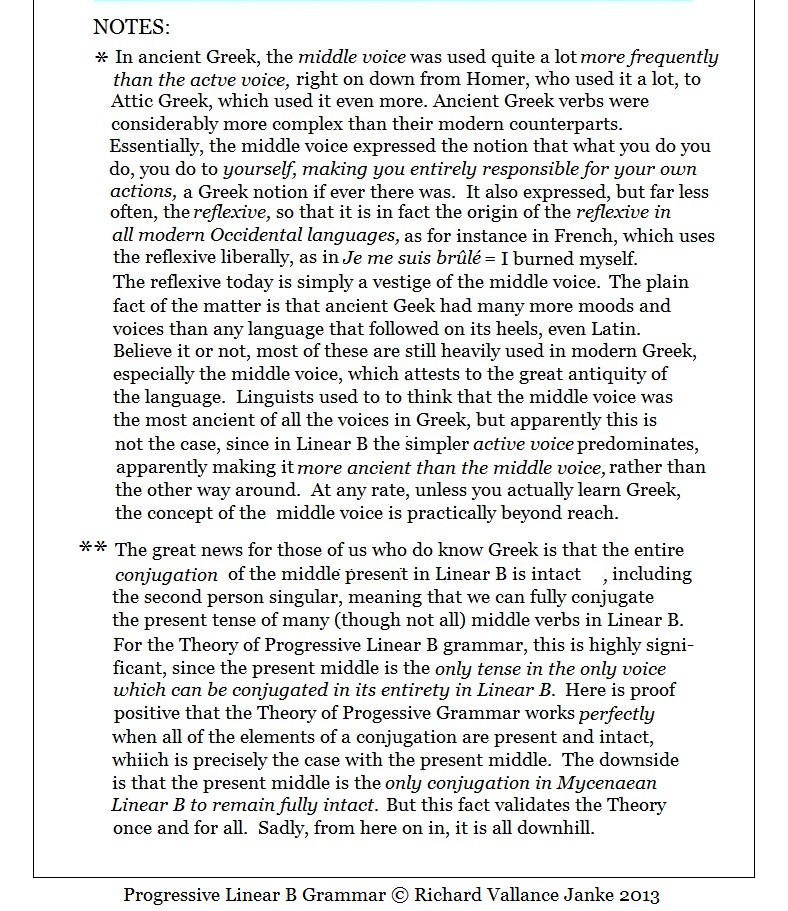
Introduction: we now take the Theory of Progressive Linear B one step further, by illustrating its eminently successful application to the Greek Middle Voice in the present tense. This is the one and only conjugation in Linear B which remains fully intact, and as such it fundamentally serves to validate the Theory of Progressive Linear B Grammar, and it does so nicely, thank you very much. For those of you who are not familiar with ancient Greek, I suggest once again that it is probably better for your sanity not to read this post, as it discusses the minutiae of one of the most convoluted grammatical concepts in Greek, ancient or modern, the function of the Middle Voice, which unless you already know Greek, is so maddeningly difficult to get a handle on that is probably not worth your trouble. But I know that, regardless of what I say, some of you more adventurous “curious cats” will storm right ahead anyway… and who can blame you for that? If you do manage a basic understanding of the notion of the Middle Voice, all the more power to you. In fact, leave me a comment bragging about your marvelous feat. It took me three months (!) to really get a grip on the Middle Voice when I first learned Greek. Finally, one day the light came on, I shouted the proverbial “EUREKA!”, and ever since then there’s been no looking back ! Anyway, here is the table of conjugations of the present tense of 9 of the most common verbs in Mycenaean Linear B, one of which just so happens to be in the Middle Voice, either a disaster or a blessing, depending. So why not give it yourself a shot? Here we go! CLICK to ENLARGE:

I offer up another of my typically copious and convoluted “notes” (much like the labyrinth of Knossos) for your entertainment, enlightenment or nervous breakdown, as the case may be. A bit of humour never hurt anyone, eh? I know it practically drove me mad to compile them in the first place. So here we go again! CLICK to ENLARGE:

Richard
Share this:



You must be logged in to post a comment.