Tentative Translation of Knossos Tablet KN 686 E X 321 as “spinning a carpet”... or something like that, a bit of a stretch no matter how you look at it. Here is my tentative translation of this tablet (Click to ENLARGE):But, as per my usual approach to Linear B translations, I would much rather make an attempt at it, however bizarre the translation may seem, because not to do so is simply to cop out, which I never do. Here is my translation of this truly recalcitrant tablet, a translation which does make sense IF you take it at its face value, since all of the words I have preselected meet my own needs to make sense of it. But all this of course, is a nice little exercise in tautology, as indeed are quite a number of translations of Linear B tablets, the presumed (yet plausible) texts of which are ambiguous at best. This problem of ambiguity plagues our attempts at deciphering or translating so many tablets for a number of obvious reasons, among which we count, as I have mentioned several times already in our blog, 1. A large number of Linear B syllabograms are ambiguous in and of themselves, as they must do service for more than one Greek alphabetic consonant + more than 1 Greek vowel. This tablet makes this all too painfully obvious. TEKI is NOT teki but texnh&, omitting the “n”, a common practice in Linear B, while the Linear B K is equivalent to Greek x in this case. Instances of such glides abound in Linear B, and we must always be on our guard not to interpret Linear B syllabograms being literally what they look like. 2. So many Linear B tablets are truncated, i.e. chopped off, on either or both the left and/or right that it we should practically count on this being the case, rather than vice versa, i.e. assuming that the tablet is complete, which is, more often than not, not the case. 3. Ideograms further complicate matters. What is the grammatical relationship between 1 or more ideograms with the other words on any tablet whatsoever? Since pretty much all ideograms are nouns, I mean by this, What is the case relationship between the ideogram(s) and the other word(s) on the tablet or fragment? This is no idle matter, and it must always be kept uppermost in mind when translating any tablet or fragment whatsoever; otherwise, the translation is likely to be false. 4. When a tablet or fragment (this one is definitely a fragment) ends with an ideogram, there may very well be followed by other ideograms or logograms. If we accept something like my translation as being even partially tenable, then there is no reason at all not to assume that, in this context, the logogram for “wool” may just follow the ideogram for “ram”, at least in the context of my tentative translation on this particular tablet alone, and nowhere else. I could go on, but you get the point. I have raised these issues and others relevant to the same problem so many times in our blog that I feel I am beating a dead horse. But I must insist on raising them again and again, to make certain that would-be students of Linear B get the picture, so to speak. Richard
Tag: syllabograms
-
The Wisconsin U.S.A. Tablet – Is it Minoan? PART B: Cross-Linguistic Comparison with the Indus Valley Harappan Script, 2,600 BCE
The Wisconsin U.S.A. Tablet – Is it Minoan? PART B: Cross-Linguistic Comparison with the Indus Valley Harappan Script, 2,600 BCE Firmly keeping in mind, and if at all possible, downloading and displaying my annotated version of the Wisconsin Tablet, so that you can view it alongside my annotated illustration of the Harappan script, I urge you to carefully consider the points I raise below, with reference to them both, as well as yet again to the early Cretan script, and to Linear A, B & C, allowing for a cross-comparative symbolic linguistic analysis of a total of no less than 6 ancient scripts, of which 3 are syllabic, 2 are in ancient Greek (Linear B and C), and 4 are undeciphered, the Wisconsin Tablet, the Harappan ad early Cretan scripts and the Linear a syllabary, all of which span an enormous historical timeline of 2,200 years, from ca. 2,600 – ca 400 BCE. Before we proceed any further, let us take a good close look at the Harappan script (Click to ENLARGE):
 which predates all of the other scripts, except for the Wisconsin Tablet, which itself apparently is not even approximately dated for a timeline, by at least 500 years (from 2,600 BCE onwards), the early Cretan script running as it does from ca 1,900 – ca. 1,600 BCE. I have resorted to invoking the Indus Valley or Harappan script for precisely this reason, that I wanted to be certain that we end up dealing with various scripts and syllabaries spanning a huge timeline of some 2,200 years, making it literally impossible to correlate the symbols or syllabograms in any of these scripts, including the Wisconsin, in any meaningful fashion, without trapping ourselves in a quagmire of irresolvable contradictions and in a blatant reductio ad absurdum. It is abundantly clear that all 6 of these scripts share at least a couple of symbols, if not several, in common, while at the same time, these very same symbols are totally undecipherable in 4 of the scripts, the Wisconsin, Harappan, early Cretan scripts, and in the Linear A syllabary, for which we know most of the values, these being either close to identical or identical to those in Linear B, at least where they overlap. And that is not always, given that Linear A has considerably more syllabograms and ideograms than Linear B. Unfortunately, this means that a large portion of Linear A is not only undecipherable, but that many of its syllabograms and ideograms are still totally impermeable to us at the present juncture.
Of course, all of this amounts to, shall we say, one hell of a mess, given that even where the some of symbols, syllabograms and ideograms in any of these 6 scripts either closely resemble one another or are identical to one another, they are either completely undecipherable and beyond our ken, or have been almost completely deciphered (with a few queer exceptions in the 2 Greek scripts, Mycenaean Linear B, ca. 1500 – 1200 BCE, and its closest historical cousin or offspring, if you will, Arcado-Cypriot, written in Linear C from ca. 1100 – ca. 400 BCE). My point is simply this, that it is very nearly impossible arrive at any reasonable correlation of any of these symbols or syllabograms in any of these 6 scripts, even when they match up perfectly, with the sole exception of Linear A & B, which after all were employed by one and the same civilization, the Minoan, without a perceptible break, from ca. 1,800 to ca. 1,200 BCE, i.e. over 600 years, and – get this! - even though though they actually overlap, undeciphered Linear A being in continual use from ca. 1,800 – ca. 1,400 BCE, and Linear B, which was the syllabary for the earliest East Greek dialect, Mycenaean Greek, from ca. 1,500 – ca. 1,200 BCE, making for a century or so when they were in bed together.
This throws yet another wrench into our linguistic equation. Since it makes perfect sense for the Minoan scribes to continue using a simpler variant of Linear A in Linear B, why on earth would the same scribes continue to resort to Linear A alongside of Linear B for a period of at least a century (1,500 – 1,400 BCE)? This might appear to be a flat contradiction in terms, but in fact, it is highly doubtful that it is, since after all, nowadays we use the Latin script for many European languages, some of which held sway over all the others for considerable periods, for instance, Italian from ca. 1200 – ca. 1550 AD, French from ca. 1500 to ca. 1700 AD (again overlapping), and English, from ca. 1500 AD to the present, once again overlapping with Italian and French. In other words, all three of these modern languages held the ascendancy in tandem with at least one other at the same time, while English has been at the top of the heap since at least the beginning of the 20th. century.
Likewise, there were eminently practical reasons for Minoan Linear A and Mycenaean Linear B to have been in use concomitantly for about 100 years or so, since after all, they used pretty much the same script, even if the former is undeciphered today, and I emphasize today. However, There can be no doubt whatsoever that the Minoan scribes were perfectly bilingual in this period of about a century, when the two scripts overlapped, and it is perfectly reasonable to assume that the Minoans and Mycenaeans clearly understood one another’s language, which they surely must have. Otherwise, why continue using Linear A alongside Linear B for at least a century? There was no question of their having to decipher the Minoan language, because there was nothing to decipher. The language was then a known one, spoken and written, all during that period. Some scribes and some literates must have not only been familiar with both languages, but perfectly bilingual in both. What a shame we have lost the Minoan language to the Lethe of history, while our dear genius Michael Ventris succeeded, against all odds, in deciphering Linear B as Greek!
But, you are probably asking yourselves, why am I bringing this point up in the first place? Well, it is pretty obvious, I think. We can clearly see that the same syllabary, common to Linear A & B, with minor variations and with a shift to greater simplicity in Linear B, can be used to write two completely unrelated languages, just as the modern Latin script is used for several Indo-European languages, English, French, Spanish, German and so forth, and even some Slavic languages to boot, while at the same time doing perfect service for the Finno-Ugaric languages, Finnish, Estonian, Latvian and Hungarian, which are not Indo-European at all.
On the other hand, as can clearly be observed in our cross-correlation of 6 scripts from Harappan on down to Arcado-Cypriot Linear C, even though a few symbols and syllabograms appear to be in common with at least some of these 6 languages, the pattern is totally haphazard, the result being a meaningless crazy-quilt. The same scenario exists for modern Indo-European languages, of which the majority use the Latin alphabet, while Greek has its own peculiar alphabet predating the Latin, and almost all of the Slavic languages use the Cyrillic (though not all). While the Latin and Cyrillic (accidentally) share some letters in common, Cyrillic has far more in common with Greek. Once again, we find ourselves up against a hodge-podge of alphabets, all of which have some, but scarcely all, letters in common, just as our 6 ancient scripts share some, but scarcely all, of the symbols and syllabograms they – and here again, I lay particular stress on this point – accidentally have in common, with the sole exception of Linear A and Linear B, which form a clear continuum.
Taken to its extreme, this observation leads us to the inevitable conclusion that, regardless or not whether or not any 2 or more languages share the same pictographs, hieroglyphics, ideograms, logograms, syllabograms or alphabets in common, whether almost totally or in more or less part, there is absolutely no guarantee whatsoever that these languages are related in any meaningful way by linguistic family or sub-class. For instance, early Mediterranean, such as early Cretan and Linear A, appear to be closely related, but may very well not be. Meanwhile Linear A, which is used for the Minoan language, remains undeciphered, and in all probability, is in no way related to Greek, including Mycenaean, written in Linear B,even though these scripts are almost identical. We find the same scenario with modern Occidental Indo-European languages versus their Finno-Ugaric counterparts, which are not Indo-European at all, and yet which share the same alphabet, just as Linear A and Linear B share the same syllabary, for all intents and purposes.
What then does all this imply if not this? - that any and all ancient, including prehistoric, scripts must be deciphered within the ambit of their own hieroglyphics, ideograms, syllabograms or alphabet, whether or not these look (even exactly) like the hieroglyphics, ideograms, syllabograms or alphabet of any other language whatsoever. In other words, forget about the nature of the script in which any undeciphered language is written, whether hieroglyphic, ideogrammatic, syllabogrammatic or alphabetical, and concentrate solely and entirely on endeavouring to decipher it in its own right sui generis, without reference at all to any other language, dead or living. That this is surely the case is made abundantly clear by the co-existence, indeed, entente cordiale, that comfortably existed between the syllabary used for the undeciphered Minoan language written in Linear A and the linguistically completely unrelated language, Mycenaean Greek, written in Linear B, the syllabary which for all intents and purposes was the brain-child of Linear A, which the Minoan scribes clearly adapted to suit their own eminently practical purposes. After all, why re-invent the wheel, and why fix something when it isn’t even broken in the first place? It is precisely for the same reason that the Greek alphabet, which has been in continual use for at least 2,800 years (ca. 800 BCE to the present), the Latin alphabet for at least 2,750 years (from the time of the time of the founding of Rome if not before), and last, but far from least, the much younger Cyrillic alphabet, from the ninth century AD onwards, are all still going gang-busters.
This is precisely why the presence of even a few symbols which look like Linear A or Linear B syllabograms on the Wisconsin Tablet is utterly meaningless.
You could cross-correlate the symbols in God knows how many pre-historic or ancient languages, and still come up with matches or near-matches, but these would be, and in fact, are utterly meaningless, especially where one language dates from as early as 10,000 or 5,000 BCE, having symbols in common with any one or more languages from a (far) later historical period. And they all too frequently do. In a word, the whole exercise of cross-comparing identical, near identical or similar looking symbols, pictographs, hieroglyphics, ideograms, syllabograms or alphabets, whether prehistoric, ancient or modern, is entirely meaningless in determining the nature or linguistic class of any and all of these languages whatsoever.
So any attempt to cross-correlate symbols from one language to another, even where they leap out at us, yelling, hey, I am the “same” symbol in such and such language (for instance that of the Wisconsin Tablet) as in another (for instance, Minoan in Linear A or Mycenaean Greek in Linear B), I regret to say, sadly amounts to a hill of beans, and nothing more.
Richard
which predates all of the other scripts, except for the Wisconsin Tablet, which itself apparently is not even approximately dated for a timeline, by at least 500 years (from 2,600 BCE onwards), the early Cretan script running as it does from ca 1,900 – ca. 1,600 BCE. I have resorted to invoking the Indus Valley or Harappan script for precisely this reason, that I wanted to be certain that we end up dealing with various scripts and syllabaries spanning a huge timeline of some 2,200 years, making it literally impossible to correlate the symbols or syllabograms in any of these scripts, including the Wisconsin, in any meaningful fashion, without trapping ourselves in a quagmire of irresolvable contradictions and in a blatant reductio ad absurdum. It is abundantly clear that all 6 of these scripts share at least a couple of symbols, if not several, in common, while at the same time, these very same symbols are totally undecipherable in 4 of the scripts, the Wisconsin, Harappan, early Cretan scripts, and in the Linear A syllabary, for which we know most of the values, these being either close to identical or identical to those in Linear B, at least where they overlap. And that is not always, given that Linear A has considerably more syllabograms and ideograms than Linear B. Unfortunately, this means that a large portion of Linear A is not only undecipherable, but that many of its syllabograms and ideograms are still totally impermeable to us at the present juncture.
Of course, all of this amounts to, shall we say, one hell of a mess, given that even where the some of symbols, syllabograms and ideograms in any of these 6 scripts either closely resemble one another or are identical to one another, they are either completely undecipherable and beyond our ken, or have been almost completely deciphered (with a few queer exceptions in the 2 Greek scripts, Mycenaean Linear B, ca. 1500 – 1200 BCE, and its closest historical cousin or offspring, if you will, Arcado-Cypriot, written in Linear C from ca. 1100 – ca. 400 BCE). My point is simply this, that it is very nearly impossible arrive at any reasonable correlation of any of these symbols or syllabograms in any of these 6 scripts, even when they match up perfectly, with the sole exception of Linear A & B, which after all were employed by one and the same civilization, the Minoan, without a perceptible break, from ca. 1,800 to ca. 1,200 BCE, i.e. over 600 years, and – get this! - even though though they actually overlap, undeciphered Linear A being in continual use from ca. 1,800 – ca. 1,400 BCE, and Linear B, which was the syllabary for the earliest East Greek dialect, Mycenaean Greek, from ca. 1,500 – ca. 1,200 BCE, making for a century or so when they were in bed together.
This throws yet another wrench into our linguistic equation. Since it makes perfect sense for the Minoan scribes to continue using a simpler variant of Linear A in Linear B, why on earth would the same scribes continue to resort to Linear A alongside of Linear B for a period of at least a century (1,500 – 1,400 BCE)? This might appear to be a flat contradiction in terms, but in fact, it is highly doubtful that it is, since after all, nowadays we use the Latin script for many European languages, some of which held sway over all the others for considerable periods, for instance, Italian from ca. 1200 – ca. 1550 AD, French from ca. 1500 to ca. 1700 AD (again overlapping), and English, from ca. 1500 AD to the present, once again overlapping with Italian and French. In other words, all three of these modern languages held the ascendancy in tandem with at least one other at the same time, while English has been at the top of the heap since at least the beginning of the 20th. century.
Likewise, there were eminently practical reasons for Minoan Linear A and Mycenaean Linear B to have been in use concomitantly for about 100 years or so, since after all, they used pretty much the same script, even if the former is undeciphered today, and I emphasize today. However, There can be no doubt whatsoever that the Minoan scribes were perfectly bilingual in this period of about a century, when the two scripts overlapped, and it is perfectly reasonable to assume that the Minoans and Mycenaeans clearly understood one another’s language, which they surely must have. Otherwise, why continue using Linear A alongside Linear B for at least a century? There was no question of their having to decipher the Minoan language, because there was nothing to decipher. The language was then a known one, spoken and written, all during that period. Some scribes and some literates must have not only been familiar with both languages, but perfectly bilingual in both. What a shame we have lost the Minoan language to the Lethe of history, while our dear genius Michael Ventris succeeded, against all odds, in deciphering Linear B as Greek!
But, you are probably asking yourselves, why am I bringing this point up in the first place? Well, it is pretty obvious, I think. We can clearly see that the same syllabary, common to Linear A & B, with minor variations and with a shift to greater simplicity in Linear B, can be used to write two completely unrelated languages, just as the modern Latin script is used for several Indo-European languages, English, French, Spanish, German and so forth, and even some Slavic languages to boot, while at the same time doing perfect service for the Finno-Ugaric languages, Finnish, Estonian, Latvian and Hungarian, which are not Indo-European at all.
On the other hand, as can clearly be observed in our cross-correlation of 6 scripts from Harappan on down to Arcado-Cypriot Linear C, even though a few symbols and syllabograms appear to be in common with at least some of these 6 languages, the pattern is totally haphazard, the result being a meaningless crazy-quilt. The same scenario exists for modern Indo-European languages, of which the majority use the Latin alphabet, while Greek has its own peculiar alphabet predating the Latin, and almost all of the Slavic languages use the Cyrillic (though not all). While the Latin and Cyrillic (accidentally) share some letters in common, Cyrillic has far more in common with Greek. Once again, we find ourselves up against a hodge-podge of alphabets, all of which have some, but scarcely all, letters in common, just as our 6 ancient scripts share some, but scarcely all, of the symbols and syllabograms they – and here again, I lay particular stress on this point – accidentally have in common, with the sole exception of Linear A and Linear B, which form a clear continuum.
Taken to its extreme, this observation leads us to the inevitable conclusion that, regardless or not whether or not any 2 or more languages share the same pictographs, hieroglyphics, ideograms, logograms, syllabograms or alphabets in common, whether almost totally or in more or less part, there is absolutely no guarantee whatsoever that these languages are related in any meaningful way by linguistic family or sub-class. For instance, early Mediterranean, such as early Cretan and Linear A, appear to be closely related, but may very well not be. Meanwhile Linear A, which is used for the Minoan language, remains undeciphered, and in all probability, is in no way related to Greek, including Mycenaean, written in Linear B,even though these scripts are almost identical. We find the same scenario with modern Occidental Indo-European languages versus their Finno-Ugaric counterparts, which are not Indo-European at all, and yet which share the same alphabet, just as Linear A and Linear B share the same syllabary, for all intents and purposes.
What then does all this imply if not this? - that any and all ancient, including prehistoric, scripts must be deciphered within the ambit of their own hieroglyphics, ideograms, syllabograms or alphabet, whether or not these look (even exactly) like the hieroglyphics, ideograms, syllabograms or alphabet of any other language whatsoever. In other words, forget about the nature of the script in which any undeciphered language is written, whether hieroglyphic, ideogrammatic, syllabogrammatic or alphabetical, and concentrate solely and entirely on endeavouring to decipher it in its own right sui generis, without reference at all to any other language, dead or living. That this is surely the case is made abundantly clear by the co-existence, indeed, entente cordiale, that comfortably existed between the syllabary used for the undeciphered Minoan language written in Linear A and the linguistically completely unrelated language, Mycenaean Greek, written in Linear B, the syllabary which for all intents and purposes was the brain-child of Linear A, which the Minoan scribes clearly adapted to suit their own eminently practical purposes. After all, why re-invent the wheel, and why fix something when it isn’t even broken in the first place? It is precisely for the same reason that the Greek alphabet, which has been in continual use for at least 2,800 years (ca. 800 BCE to the present), the Latin alphabet for at least 2,750 years (from the time of the time of the founding of Rome if not before), and last, but far from least, the much younger Cyrillic alphabet, from the ninth century AD onwards, are all still going gang-busters.
This is precisely why the presence of even a few symbols which look like Linear A or Linear B syllabograms on the Wisconsin Tablet is utterly meaningless.
You could cross-correlate the symbols in God knows how many pre-historic or ancient languages, and still come up with matches or near-matches, but these would be, and in fact, are utterly meaningless, especially where one language dates from as early as 10,000 or 5,000 BCE, having symbols in common with any one or more languages from a (far) later historical period. And they all too frequently do. In a word, the whole exercise of cross-comparing identical, near identical or similar looking symbols, pictographs, hieroglyphics, ideograms, syllabograms or alphabets, whether prehistoric, ancient or modern, is entirely meaningless in determining the nature or linguistic class of any and all of these languages whatsoever.
So any attempt to cross-correlate symbols from one language to another, even where they leap out at us, yelling, hey, I am the “same” symbol in such and such language (for instance that of the Wisconsin Tablet) as in another (for instance, Minoan in Linear A or Mycenaean Greek in Linear B), I regret to say, sadly amounts to a hill of beans, and nothing more.
Richard
Share this:
-
The Wisconsin U.S.A. Tablet — Is it Minoan? PART A: Comparison with 4 Ancient Northern Mediterranean Scripts
The Wisconsin U.S.A. Tablet — Is it Minoan? PART A: Comparison with 4 Ancient Northern Mediterranean Scripts A Thorough Linguistic Analysis of the Wisconsin Tablet (Click to ENLARGE):
 When I first saw the Wisconsin Tablet, which our friend, E.J. Heath, posted here on our blog, I stood amazed. Staring me in the face were 3 symbols, 2 of which which looked uncannily like 2 syllabograms (B, C&F) common to Linear A & B, and one of which (H) looked like the number 20, again in common with Linear A & B. Well now, that’s a real find, or so it would appear.
But my wonderment quickly faded as I began to closely, then more meticulously, examine its symbols, discovering as I did that only 1 other symbol looked anything like symbols in any early (pre-historic) Northern Mediterranean scripts, that being symbol A on the Wisconsin Tablet, which is identical to the same symbol in the early Cretan script, and closely resembles 2 similar symbols, called syllabograms, in Linear C, the latter being the vowels a & e in that script. But Linear C is a far later historical Greek script, in use continually from ca. 1100 BCE to 400 BCE, alongside the ancient Greek alphabet. And that period is more than likely to be much later than the Wisconsin Tablet. As for the rest of the symbols on the Wisconsin tablet, they bear little or no resemblance at all to the symbols in early Cretan (an undeciphered pictographic or ideographic script), or to the syllabograms in Linear A (which, though undeciphered, shares a great many of its syllabograms in common with deciphered Linear B, or at least shares some features of these), to the 200 or so syllabograms and ideograms in Linear B or yet again to any syllabograms other than the vowels a & e in deciphered Cypro-Minoan Linear C.
All this leaves me at a complete impasse, and opens a real can of worms. Questions, which are not hypothetical, but historically pregnant, pop up left, right and centre. For instance:
1. How on earth can a tablet unearthed in the north-western U.S.A. reasonably be considered to be Minoan, when its shares symbols in common with 4 different ancient scripts, 2 of them similar to one another (Linear A & B), but one being undeciphered and the other decidedly Greek (Mycenaean), and the other two completely dissimilar, not only to one another, but also to Linear A & B. Even granted that the 2 symbols (and only 2), and the apparent “number 20” which I can clearly see on the Wisconsin Tablet, which apparently look like their Linear A & B counterparts, are, for the sake of argument, actually those very syllabograms in Linear A & B, this raises another thorny question, how can we be even remotely sure that this is in fact the case, when all of the other symbols on the Wisconsin – I repeat – bear no resemblance with any syllabograms or ideograms in either Linear A or B (and that means 100s of them!). We have landed in a real quagmire. In short, we cannot decipher it under these conditions. Here is a chart summarizing my findings (Click to ENLARGE):
When I first saw the Wisconsin Tablet, which our friend, E.J. Heath, posted here on our blog, I stood amazed. Staring me in the face were 3 symbols, 2 of which which looked uncannily like 2 syllabograms (B, C&F) common to Linear A & B, and one of which (H) looked like the number 20, again in common with Linear A & B. Well now, that’s a real find, or so it would appear.
But my wonderment quickly faded as I began to closely, then more meticulously, examine its symbols, discovering as I did that only 1 other symbol looked anything like symbols in any early (pre-historic) Northern Mediterranean scripts, that being symbol A on the Wisconsin Tablet, which is identical to the same symbol in the early Cretan script, and closely resembles 2 similar symbols, called syllabograms, in Linear C, the latter being the vowels a & e in that script. But Linear C is a far later historical Greek script, in use continually from ca. 1100 BCE to 400 BCE, alongside the ancient Greek alphabet. And that period is more than likely to be much later than the Wisconsin Tablet. As for the rest of the symbols on the Wisconsin tablet, they bear little or no resemblance at all to the symbols in early Cretan (an undeciphered pictographic or ideographic script), or to the syllabograms in Linear A (which, though undeciphered, shares a great many of its syllabograms in common with deciphered Linear B, or at least shares some features of these), to the 200 or so syllabograms and ideograms in Linear B or yet again to any syllabograms other than the vowels a & e in deciphered Cypro-Minoan Linear C.
All this leaves me at a complete impasse, and opens a real can of worms. Questions, which are not hypothetical, but historically pregnant, pop up left, right and centre. For instance:
1. How on earth can a tablet unearthed in the north-western U.S.A. reasonably be considered to be Minoan, when its shares symbols in common with 4 different ancient scripts, 2 of them similar to one another (Linear A & B), but one being undeciphered and the other decidedly Greek (Mycenaean), and the other two completely dissimilar, not only to one another, but also to Linear A & B. Even granted that the 2 symbols (and only 2), and the apparent “number 20” which I can clearly see on the Wisconsin Tablet, which apparently look like their Linear A & B counterparts, are, for the sake of argument, actually those very syllabograms in Linear A & B, this raises another thorny question, how can we be even remotely sure that this is in fact the case, when all of the other symbols on the Wisconsin – I repeat – bear no resemblance with any syllabograms or ideograms in either Linear A or B (and that means 100s of them!). We have landed in a real quagmire. In short, we cannot decipher it under these conditions. Here is a chart summarizing my findings (Click to ENLARGE):
 Here are two Linear A tablets, which shed further light on the issue of the Wisconsin tablet sharing (or not) symbols with Linear A syllabograms (Click to ENLARGE):
 Refer back to the Wisconsin Tablet above for 2 of the symbols highlighted with the same letters (E & H) on both it and these two Linear A tablets.
2. On the other hand, if we take the stance that the 3 so-called “Minoan” symbols on the Wisconsin Tablet are not Linear A or B syllabograms or numerics – which is a perfectly reasonable assumption to proceed from – then what on earth are they? Are they even syllabograms or numerics? Or are they any one of the following: pictographs, such as we see in the famous Peterborough Pictographs, unearthed near Peterborough, Ontario, Canada, some time ago, or perhaps hieroglyphics, or yet again logographic, ideogrammatic, syllabogrammatic or even, as far fetched as it may seem (and it is) alphabetic? This stretches my poor imagination and my powers of reason almost beyond bearing.
3. When was the Wisconsin Tablet composed? This is an absolutely critical question, because, failing any knowledge of even the approximate date of its composition, the whole thing remains a complete mystery. There are, of course, two tried-and-tested archaeological approaches to getting closer to resolving this vital question, at least to some extent. First of all, has the Wisconsin Tablet been carbon-dated? If it has not, the mystery remains just that, and nothing more. If it has (which apparently seems not to be the case, but hopefully E.J. Heath can enlighten me on this matter), then the carbon-dating is entirely capable of determining whether or not it falls at least somewhere near or within the historical timeline of both Linear A and Linear BC together, i.e. 1,800 – 1,200 BCE. If the carbon-dating proves this to be the case, then at least our friend has a leg to stand on, however shaky. On the other hand, if the carbon-dating should prove that the Wisconsin tablet pre-dates or post-dates the Minoan/Mycenaean era (ca. 1,900 – 1,200 BCE), then it is, even in the very best scenario, highly unlikely that the Wisconsin Tablet is composed in anything like or near to Linear A or B, and the whole hypothesis falls apart like a house of cards.
4. Another way of establishing the approximate timeline of the Wisconsin tablet is to submit it to as many as possible eminently qualified North American, as well as European and Mediterranean, archaeologists, and eventually to draw up a team of archaeologist to address this sticky issue head on, by which I mean in conference or in writing and online or better still, all. All this would take considerable time, conceivably close to a decade.
It goes entirely without saying that both of these approaches to attempting to establish the approximate dating of the Wisconsin tablet are absolutely essential to the process of identifying in any way what it is, and can in no wise be omitted. I leave it to our friend E.J. Heath to get in touch with at least a few archaeologists in the field (pardon the pun!) in the U.S.A, first and foremost at the University of Wisconsin itself, to establish the credentials of the Wisconsin Tablet, as it were.
5. On yet another level, I am forcibly struck by the curious absence of any other tablet(s), especially in light of the fact that the Minoan scribes writing in both Minoan Linear A and in Mycenaean Greek in Linear B, were completely obsessed with record-keeping, inventories and statistics. While there is a dearth of Linear A tablets still in existence compared with Linear B tablets, there are still plenty enough of them. We can only assume that those Linear A tablets which have disappeared in the maelstrom of history have done so for various reasons bearing on lack of archaeological findings or evidence, which may nevertheless may be corrected, at least to some degree, by potential findings in the future. But there can be no assurance of this. So if we have a few hundred Linear A tablets at our disposal, why is there only 1 single tablet to be found in Wisconsin, when we know perfectly well that the Linear A and Linear B scribes were concerned with one thing and one thing only, keeping exhaustive records, inventories and statistics on absolutely anything and everything that affected their economy? This surely begs the question: why has only 1 and one only so-called “Minoan” tablet been unearthed in Wisconsin? If as E.J. Heath claims, this tablet is likely to be just that, Minoan, then surely at least a few, if not a few scores of other tablets, or ideally hundreds just like it, should have been unearthed with it. Since none have, the question is why – and it is a question that must eventually bear answering in some way or another, sooner or later.
On the other hand, there are literally 1,000s of Linear B Tablets (close to 6,000 at last count), and we can read them! Even if the 3 so-called Linear A & B look-alikes on the Wisconsin Tablet were in fact either Linear A or Linear B, we would still be stuck in the mud, right where we are. Since Linear A is undeciphered, even if 2 of the symbols on the Wisconsin Tablet are in Linear A (which I highly doubt), they too remain undecipherable (with the possible exception of the so-called number 20. For more in this, see infra).
If on the other hand, these are Linear B symbols, i.e. the 2 syllabograms ZO (B) and NO (C& F), along with the apparent numeric = 20?, the tablet is still undecipherable, because we can make no sense of any of the other symbols on it, and in order to decipher it, we must place the apparent Linear B ZO & NO strictly in context with all of the symbols immediately preceding and following them, if indeed these other symbols are syllabograms (which I highly doubt). Remember what I said above, that the symbols on the Wisconsin tablet must all either be pictographics, hieroglyphics, ideograms or (very unlikely) syllabograms, and almost inconceivably letters, but never an admixture of any one of the above, with the possible sole exception of syllabograms and ideograms, which do in fact co-exist happily in Linear A & B. At least we can admit of that. Yet, even with this single exception at our disposal, we will have practically backed ourselves up against a solid brick wall, given that there is a substantial likelihood of the symbols on the Wisconsin Tablet being either pictographs or hieroglyphics.
6. As for that presumed number 20, even if it is a number, is it the number 20, i.. in the tens, or is it a single digit, i.e. 2? This is no small matter. In several of the ancient and not so ancient scripts, single digit numbers are either denoted by parallel horizontal lines, in which case the tens are designated by parallel vertical lines (if at all), or vice versa, i.e. single digits are vertical parallels and 10s horizontal. The easiest way to illustrate this is by invoking the numbers 1, 2 & 3 in (ichi, ni & san) in Japanese Kanji, which are the exact reverse of the paradigms for numerics in Linear A & B. Whereas Linear A & B denote single digits with vertical parallel lines and 10s with horizontal, Japanese Kanji resorts to the horizontal for single digits, as seen here:
Refer back to the Wisconsin Tablet above for 2 of the symbols highlighted with the same letters (E & H) on both it and these two Linear A tablets.
2. On the other hand, if we take the stance that the 3 so-called “Minoan” symbols on the Wisconsin Tablet are not Linear A or B syllabograms or numerics – which is a perfectly reasonable assumption to proceed from – then what on earth are they? Are they even syllabograms or numerics? Or are they any one of the following: pictographs, such as we see in the famous Peterborough Pictographs, unearthed near Peterborough, Ontario, Canada, some time ago, or perhaps hieroglyphics, or yet again logographic, ideogrammatic, syllabogrammatic or even, as far fetched as it may seem (and it is) alphabetic? This stretches my poor imagination and my powers of reason almost beyond bearing.
3. When was the Wisconsin Tablet composed? This is an absolutely critical question, because, failing any knowledge of even the approximate date of its composition, the whole thing remains a complete mystery. There are, of course, two tried-and-tested archaeological approaches to getting closer to resolving this vital question, at least to some extent. First of all, has the Wisconsin Tablet been carbon-dated? If it has not, the mystery remains just that, and nothing more. If it has (which apparently seems not to be the case, but hopefully E.J. Heath can enlighten me on this matter), then the carbon-dating is entirely capable of determining whether or not it falls at least somewhere near or within the historical timeline of both Linear A and Linear BC together, i.e. 1,800 – 1,200 BCE. If the carbon-dating proves this to be the case, then at least our friend has a leg to stand on, however shaky. On the other hand, if the carbon-dating should prove that the Wisconsin tablet pre-dates or post-dates the Minoan/Mycenaean era (ca. 1,900 – 1,200 BCE), then it is, even in the very best scenario, highly unlikely that the Wisconsin Tablet is composed in anything like or near to Linear A or B, and the whole hypothesis falls apart like a house of cards.
4. Another way of establishing the approximate timeline of the Wisconsin tablet is to submit it to as many as possible eminently qualified North American, as well as European and Mediterranean, archaeologists, and eventually to draw up a team of archaeologist to address this sticky issue head on, by which I mean in conference or in writing and online or better still, all. All this would take considerable time, conceivably close to a decade.
It goes entirely without saying that both of these approaches to attempting to establish the approximate dating of the Wisconsin tablet are absolutely essential to the process of identifying in any way what it is, and can in no wise be omitted. I leave it to our friend E.J. Heath to get in touch with at least a few archaeologists in the field (pardon the pun!) in the U.S.A, first and foremost at the University of Wisconsin itself, to establish the credentials of the Wisconsin Tablet, as it were.
5. On yet another level, I am forcibly struck by the curious absence of any other tablet(s), especially in light of the fact that the Minoan scribes writing in both Minoan Linear A and in Mycenaean Greek in Linear B, were completely obsessed with record-keeping, inventories and statistics. While there is a dearth of Linear A tablets still in existence compared with Linear B tablets, there are still plenty enough of them. We can only assume that those Linear A tablets which have disappeared in the maelstrom of history have done so for various reasons bearing on lack of archaeological findings or evidence, which may nevertheless may be corrected, at least to some degree, by potential findings in the future. But there can be no assurance of this. So if we have a few hundred Linear A tablets at our disposal, why is there only 1 single tablet to be found in Wisconsin, when we know perfectly well that the Linear A and Linear B scribes were concerned with one thing and one thing only, keeping exhaustive records, inventories and statistics on absolutely anything and everything that affected their economy? This surely begs the question: why has only 1 and one only so-called “Minoan” tablet been unearthed in Wisconsin? If as E.J. Heath claims, this tablet is likely to be just that, Minoan, then surely at least a few, if not a few scores of other tablets, or ideally hundreds just like it, should have been unearthed with it. Since none have, the question is why – and it is a question that must eventually bear answering in some way or another, sooner or later.
On the other hand, there are literally 1,000s of Linear B Tablets (close to 6,000 at last count), and we can read them! Even if the 3 so-called Linear A & B look-alikes on the Wisconsin Tablet were in fact either Linear A or Linear B, we would still be stuck in the mud, right where we are. Since Linear A is undeciphered, even if 2 of the symbols on the Wisconsin Tablet are in Linear A (which I highly doubt), they too remain undecipherable (with the possible exception of the so-called number 20. For more in this, see infra).
If on the other hand, these are Linear B symbols, i.e. the 2 syllabograms ZO (B) and NO (C& F), along with the apparent numeric = 20?, the tablet is still undecipherable, because we can make no sense of any of the other symbols on it, and in order to decipher it, we must place the apparent Linear B ZO & NO strictly in context with all of the symbols immediately preceding and following them, if indeed these other symbols are syllabograms (which I highly doubt). Remember what I said above, that the symbols on the Wisconsin tablet must all either be pictographics, hieroglyphics, ideograms or (very unlikely) syllabograms, and almost inconceivably letters, but never an admixture of any one of the above, with the possible sole exception of syllabograms and ideograms, which do in fact co-exist happily in Linear A & B. At least we can admit of that. Yet, even with this single exception at our disposal, we will have practically backed ourselves up against a solid brick wall, given that there is a substantial likelihood of the symbols on the Wisconsin Tablet being either pictographs or hieroglyphics.
6. As for that presumed number 20, even if it is a number, is it the number 20, i.. in the tens, or is it a single digit, i.e. 2? This is no small matter. In several of the ancient and not so ancient scripts, single digit numbers are either denoted by parallel horizontal lines, in which case the tens are designated by parallel vertical lines (if at all), or vice versa, i.e. single digits are vertical parallels and 10s horizontal. The easiest way to illustrate this is by invoking the numbers 1, 2 & 3 in (ichi, ni & san) in Japanese Kanji, which are the exact reverse of the paradigms for numerics in Linear A & B. Whereas Linear A & B denote single digits with vertical parallel lines and 10s with horizontal, Japanese Kanji resorts to the horizontal for single digits, as seen here:
 All this still leaves us with one unanswered question, which is very much moot. Are these 2 parallel horizontal lines on the Wisconsin tablet either the number 20 or the number 2, or are they numbers at all? Pending decipherment, we can never really know.
To Summarize:
Given all the issues I have raised with respect to the Wisconsin Tablet, I sincerely doubt that it is composed in Linear A or Linear B, or anything remotely like that. This leaves the tablet not only undecipherable, but for now highly resistant to any attempt at decipherment. On the other hand, its discovery is significant. Writing as such, if indeed this is writing we have here on the Wisconsin Tablet, is almost unheard of in the annals of North American aboriginal tribes. Pictographs, such as the Peterborough Pictographs, occasionally appear, and they do contribute to the continuing search for symbolic evidence of North American aboriginal settlements. What strikes me about this particular tablet is that it does not appear to be composed of simple pictographs, but of something – I cannot imagine what – more sophisticated... hieroglyphics or ideograms or... heavens no what? In this light, I greatly encourage E. J. Heath and any and all researchers or aficionados of ancient scripts to pour their efforts into attempting to figure out the nature of the symbols on this fascinating tablet, if not to decipher it outright.
In the next post, I shall raise even more issues and concerns I have with the Wisconsin tablet, or for that matter with any tablet in any undeciphered language anywhere in the ancient pre-historic world. To do so, I shall have recourse to the 417 symbols of the ancient Harappan script of the Indus Valley civilization, which considerably predates by several centuries – ca. 2,600 to ca. 2,000 BCE -all four of the scripts we have held under consideration here (early Cretan, Linear A, Linear B and the historical Greek script, Arcado-Cypriot Linear C). What we will discover with this script is bound to increase, not decrease, the shock we all to often encounter, however valiantly we struggle to decipher any undeciphered ancient pre-historic script, let alone the Wisconsin Tablet.
That said, the fact that the Wisconsin Tablet remains a baffling mystery warrants more than its fair share of attention (whatever that might be), and so I applaud E. J. Heath for posting it here on our blog, and I invite him to counter each of the issues and objections I have raised here, and more of which I shall raise again in the next post, as he feels inclined.
Richard
All this still leaves us with one unanswered question, which is very much moot. Are these 2 parallel horizontal lines on the Wisconsin tablet either the number 20 or the number 2, or are they numbers at all? Pending decipherment, we can never really know.
To Summarize:
Given all the issues I have raised with respect to the Wisconsin Tablet, I sincerely doubt that it is composed in Linear A or Linear B, or anything remotely like that. This leaves the tablet not only undecipherable, but for now highly resistant to any attempt at decipherment. On the other hand, its discovery is significant. Writing as such, if indeed this is writing we have here on the Wisconsin Tablet, is almost unheard of in the annals of North American aboriginal tribes. Pictographs, such as the Peterborough Pictographs, occasionally appear, and they do contribute to the continuing search for symbolic evidence of North American aboriginal settlements. What strikes me about this particular tablet is that it does not appear to be composed of simple pictographs, but of something – I cannot imagine what – more sophisticated... hieroglyphics or ideograms or... heavens no what? In this light, I greatly encourage E. J. Heath and any and all researchers or aficionados of ancient scripts to pour their efforts into attempting to figure out the nature of the symbols on this fascinating tablet, if not to decipher it outright.
In the next post, I shall raise even more issues and concerns I have with the Wisconsin tablet, or for that matter with any tablet in any undeciphered language anywhere in the ancient pre-historic world. To do so, I shall have recourse to the 417 symbols of the ancient Harappan script of the Indus Valley civilization, which considerably predates by several centuries – ca. 2,600 to ca. 2,000 BCE -all four of the scripts we have held under consideration here (early Cretan, Linear A, Linear B and the historical Greek script, Arcado-Cypriot Linear C). What we will discover with this script is bound to increase, not decrease, the shock we all to often encounter, however valiantly we struggle to decipher any undeciphered ancient pre-historic script, let alone the Wisconsin Tablet.
That said, the fact that the Wisconsin Tablet remains a baffling mystery warrants more than its fair share of attention (whatever that might be), and so I applaud E. J. Heath for posting it here on our blog, and I invite him to counter each of the issues and objections I have raised here, and more of which I shall raise again in the next post, as he feels inclined.
Richard
Share this:
-
A brief history of the Wisconsin Stone Tablet region
This area of Wisconsin, prior to any European explorers; was known to have abundant minerals. This fact was noted by the explorer Champlain and his protégé Etienne Brule. Both explorers were versed in Native American language and listened to and conveyed the stories of the aboriginals about the mines having already been dug. The Native Woodland Americans did not use these minerals as a common practice, in this region of Wisconsin. Their first experience with the use of lead was when the explorers demonstrated the thunderous power of the gun. There were lead, copper and zinc mines in this area.
Also observed by the explorers were well established roads along ridges and rivers. When the local inhabitants were asked who built the roads and what were they for, they replied; the Spanish built them. This conversation was with E. Brule.
Were they referencing an unknown tribe as we here in the U.S. refer to Canadians or Latinos, which would be a very vague usage, rather than narrowing the locale of the citizen to Ottawa or Durango? But my question would be, why would the locals allow another tribe to construct roads in their territory. The construction had to be quite lengthy and what mode of transportation would require the use of such roads. What beast of burden were being used?
I find quite odd that five towns along the Wisconsin river have Roman or Latin names.I’m not saying those towns were begun by the Romans, it’s just odd.
So, in my wild imagination; I suggest the Minoan culture inhabited this area of the Great Lakes, but I don’t know when. I will persist in defining a timeline for the script on the tablet, based on the differences between evolutions of script of the Minoan, Cuneiforms, local natives and anything else I can find. Right now I’m suggesting the period the script was written prior to the 5th century BCE and after the 20th century BCE, based on symbol changes. Let me know your thoughts.
The Minoan culture were extremely skilled in metallurgy and they could have had symbols of these noble metals within their language. Perhaps they were never found, until now.
Absence of evidence is not evidence of absence.
James R Heath
Share this:
-
Spice from 11 boughs of a terebinth tree (Knossos Tablet KN 1530 R t 01)… rather romantic
Spice from 11 boughs of a terebinth tree (Knossos Tablet KN 1530 R t 01)... rather romantic Click to ENLARGE:
 In my valiant, though not necessarily entirely successful, attempt to recover syllagograms and lost text from at least some of Knossos Tablet KN 1530 R t 01, a badly damaged Linear B Tablet, I have taken my cue from Andras Zeke and his splendid blog, the Minoan Language Blog, which unfortunately has been mysteriously idle ever since September 2012. For some reason unknown to me, Andras Zeke has simply disappeared from the scene, and his disappearance is a terrible loss to the research community devoted to the eventual decipherment of Linear A, in which he was making considerable headway. The Minoan Language Blog is also an excellent source for the advancement of the further decipherment of those areas of Linear B, which have to date defied decipherment. I strongly recommend this blog to anyone involved in any capacity in research into Linear A or Linear B.
There are several instances of (some seriously) damaged Linear A tablets on the Minoan Language Blog, which Andras Zeke has valiantly attempted to restore, usually with a remarkable degree of success, as illustrated for instance by this consummate restoration of a Linear A tablet which he effected (Click to jump to the entry for this tablet in the Minoan Language Blog:
In my valiant, though not necessarily entirely successful, attempt to recover syllagograms and lost text from at least some of Knossos Tablet KN 1530 R t 01, a badly damaged Linear B Tablet, I have taken my cue from Andras Zeke and his splendid blog, the Minoan Language Blog, which unfortunately has been mysteriously idle ever since September 2012. For some reason unknown to me, Andras Zeke has simply disappeared from the scene, and his disappearance is a terrible loss to the research community devoted to the eventual decipherment of Linear A, in which he was making considerable headway. The Minoan Language Blog is also an excellent source for the advancement of the further decipherment of those areas of Linear B, which have to date defied decipherment. I strongly recommend this blog to anyone involved in any capacity in research into Linear A or Linear B.
There are several instances of (some seriously) damaged Linear A tablets on the Minoan Language Blog, which Andras Zeke has valiantly attempted to restore, usually with a remarkable degree of success, as illustrated for instance by this consummate restoration of a Linear A tablet which he effected (Click to jump to the entry for this tablet in the Minoan Language Blog:
 I cannot claim to have achieved anywhere near the proficiency Andras Zeke has mastered in recovering lost portions of damaged tablets, but I have made my best efforts to fill in at least some of the gaps on Knossos Tablet KN 1530 R t 01, much of which has been effaced beyond restoration.
Perhaps the single factor which lends some credence to my so-called “decipherment” is that it hangs together, that it is somehow coherent, all the retrieved parts matching up like the pieces in a jigsaw puzzle. This does not mean that my partial translation is in any sense of the word the “right” one, whatever that is supposed to mean, any more than it is any conceivable variant on the “wrong” ones. It is just the decipherment I was able to pull from the ashes, whatever its supposed merits. I invite any and all researchers/accomplished translators of Linear B to come up with their own versions of “decipherments” of this intriguing tablet, however much they may be at variance with my own.
Richard
I cannot claim to have achieved anywhere near the proficiency Andras Zeke has mastered in recovering lost portions of damaged tablets, but I have made my best efforts to fill in at least some of the gaps on Knossos Tablet KN 1530 R t 01, much of which has been effaced beyond restoration.
Perhaps the single factor which lends some credence to my so-called “decipherment” is that it hangs together, that it is somehow coherent, all the retrieved parts matching up like the pieces in a jigsaw puzzle. This does not mean that my partial translation is in any sense of the word the “right” one, whatever that is supposed to mean, any more than it is any conceivable variant on the “wrong” ones. It is just the decipherment I was able to pull from the ashes, whatever its supposed merits. I invite any and all researchers/accomplished translators of Linear B to come up with their own versions of “decipherments” of this intriguing tablet, however much they may be at variance with my own.
Richard
Share this:
-
Linear B Basic Values & the 13 Supersyllabograms
Linear B Basic Values & the 13 Supersyllabograms (Click to ENLARGE):
 This table is a modified version of the Linear B Basic Values table, with which many of you are already familiar. I have flagged in green font all 13 of the supersyllabograms isolated so far. There may be more, and there probably are. Complementing the supersyllabograms are the meanings, some of them firm, some of them likely to be correct, and others putative (at best).
You should keep this table on hand if you are at all interested in learning supersyllabograms.
All of the supersyllabograms have been fully illustrated by tablets bearing them in previous posts, so if you are serious about actually mastering sypersyllabograms yourself, you probably should read all of these posts, infra.
Richard
This table is a modified version of the Linear B Basic Values table, with which many of you are already familiar. I have flagged in green font all 13 of the supersyllabograms isolated so far. There may be more, and there probably are. Complementing the supersyllabograms are the meanings, some of them firm, some of them likely to be correct, and others putative (at best).
You should keep this table on hand if you are at all interested in learning supersyllabograms.
All of the supersyllabograms have been fully illustrated by tablets bearing them in previous posts, so if you are serious about actually mastering sypersyllabograms yourself, you probably should read all of these posts, infra.
Richard
Share this:
-
Prof. Thomas G. Palaima Isolates 5 Single Syllabograms as Cities & Settlement Names
Prof. Thomas G. Palaima Isolates 5 Single Syllabograms as Cities & Settlement Names (Click to ENLARGE):
 When Prof. Thomas G. Palaima translated Heidelburg Tablet HE FL 1994, he hit upon something truly revelatory, namely, that 5 syllabograms in a row, as illustrated in the facsimile of this tablet above, were single syllabograms, which were in actuality the first syllable of the word each represented, and that each of these words was to prove to be the name of a major Minoan/Mycenaean city or settlement. These places, Knossos, Zakros, Palaikastro (or possibly Phaistos), Pulos & Mycenae, all played a key role in Minoan/Mycenaean economy and society.
The real question is, why did the scribe who inscribed this tablet, use abbreviations consisting of the first syllabogram, which is always the first syllable of a Linear B word to represent the entire word? Was this a phenomenon limited to Heidelburg tablet HE FL 1994, or could it be found on other tablets, and if so, how many... just a few or many? As it turns out, I have discovered this phenomenon occurring on not just a few Linear B tablets, not even a fairly wide cross-section, but — hold your breath — on literally hundreds of tablets. So what is going on here? Why would the Linear B scribes resorted to using single syllabograms on hundreds of tablets over and over again, unless they had very good reason to do so? But that is exactly what they did, and with astounding frequency. It is critical to recognize here that no Linear B scribe alone, let alone so many scribes, would resort to using just one single syllabogram just for the fun of it. That single syllabogram must have meant something, in fact, must have meant a very great deal, and have been a big deal; otherwise, the scribes would not have used them so very often.
The next obvious question is why did they resort to using single syllabograms so often?... & to represent what? Prof. Palaima’s translation of Heidelburg Tablet HE FL 1994 makes it abundantly clear that what these syllabograms represent is entire words, in the case of this tablet, names of Minoan/Mycenaean cities and settlements.
But, as it turns out, when I went to investigate several other single syllabograms (8 in all), I discovered to my astonishment that they could and did represent much more than just the names of cities and settlements. Of the 8 new syllabograms of this type or class, I was able to at least tentatively decipher 6 of them, and I found that none of these represented merely city or settlement names, but something quite different. I recognized a specific word, one word and one word only, in a specific context, in that context and that context alone, for each and every one of the syllabograms I was able to decipher, even if my decipherment was not necessarily “correct”, whatever that is supposed to mean. What was astounding was this: in the specific context which each of these syllabograms appeared in, the word they represented always fits the context like a glove. For instance, the syllabogram for O stands for the word “onaton” = lease field, the syllabogram for KI stands for “kitimena” = plot of land & the syllabogram PE for “periqoro” = enclosure or pen, i.e. a sheep pen, and I emphatically stress, all three of them in the specific context of sheep. In this context and this context alone all three of these translations fit like a glove. For this reason, although my decipherment or translation of each one of these syllabograms (O, KI & PE) may be viewed as tentative by some, I truly believe that they have gone beyond that point, and may in fact be entirely sound, having the very meaning which I have assigned them.
Now, since single syllabograms such as these are all, without exception, the first syllable by default of the Mycenaean Greek word in Linear B which of which they are the abbreviation, I feel obliged to assign them a name, calling them “supersyllabograms”. As it now stands, my co-researcher and I have isolated 8 sypersyllabograms, of which we have managed to tentatively decipher 6, in addition to the 5 sypersyllabograms identified by Prof. Thomas G. Palaima, for a total of 13.
Richard
When Prof. Thomas G. Palaima translated Heidelburg Tablet HE FL 1994, he hit upon something truly revelatory, namely, that 5 syllabograms in a row, as illustrated in the facsimile of this tablet above, were single syllabograms, which were in actuality the first syllable of the word each represented, and that each of these words was to prove to be the name of a major Minoan/Mycenaean city or settlement. These places, Knossos, Zakros, Palaikastro (or possibly Phaistos), Pulos & Mycenae, all played a key role in Minoan/Mycenaean economy and society.
The real question is, why did the scribe who inscribed this tablet, use abbreviations consisting of the first syllabogram, which is always the first syllable of a Linear B word to represent the entire word? Was this a phenomenon limited to Heidelburg tablet HE FL 1994, or could it be found on other tablets, and if so, how many... just a few or many? As it turns out, I have discovered this phenomenon occurring on not just a few Linear B tablets, not even a fairly wide cross-section, but — hold your breath — on literally hundreds of tablets. So what is going on here? Why would the Linear B scribes resorted to using single syllabograms on hundreds of tablets over and over again, unless they had very good reason to do so? But that is exactly what they did, and with astounding frequency. It is critical to recognize here that no Linear B scribe alone, let alone so many scribes, would resort to using just one single syllabogram just for the fun of it. That single syllabogram must have meant something, in fact, must have meant a very great deal, and have been a big deal; otherwise, the scribes would not have used them so very often.
The next obvious question is why did they resort to using single syllabograms so often?... & to represent what? Prof. Palaima’s translation of Heidelburg Tablet HE FL 1994 makes it abundantly clear that what these syllabograms represent is entire words, in the case of this tablet, names of Minoan/Mycenaean cities and settlements.
But, as it turns out, when I went to investigate several other single syllabograms (8 in all), I discovered to my astonishment that they could and did represent much more than just the names of cities and settlements. Of the 8 new syllabograms of this type or class, I was able to at least tentatively decipher 6 of them, and I found that none of these represented merely city or settlement names, but something quite different. I recognized a specific word, one word and one word only, in a specific context, in that context and that context alone, for each and every one of the syllabograms I was able to decipher, even if my decipherment was not necessarily “correct”, whatever that is supposed to mean. What was astounding was this: in the specific context which each of these syllabograms appeared in, the word they represented always fits the context like a glove. For instance, the syllabogram for O stands for the word “onaton” = lease field, the syllabogram for KI stands for “kitimena” = plot of land & the syllabogram PE for “periqoro” = enclosure or pen, i.e. a sheep pen, and I emphatically stress, all three of them in the specific context of sheep. In this context and this context alone all three of these translations fit like a glove. For this reason, although my decipherment or translation of each one of these syllabograms (O, KI & PE) may be viewed as tentative by some, I truly believe that they have gone beyond that point, and may in fact be entirely sound, having the very meaning which I have assigned them.
Now, since single syllabograms such as these are all, without exception, the first syllable by default of the Mycenaean Greek word in Linear B which of which they are the abbreviation, I feel obliged to assign them a name, calling them “supersyllabograms”. As it now stands, my co-researcher and I have isolated 8 sypersyllabograms, of which we have managed to tentatively decipher 6, in addition to the 5 sypersyllabograms identified by Prof. Thomas G. Palaima, for a total of 13.
Richard
Share this:
-
The Supersyllabogram PA… a huge challenge but… (Click to ENLARGE):
The Supersyllabogram PA... a huge challenge but... (Click to ENLARGE):
 If I thought the other supersyllabograms we have “deciphered” to date (O, DI, KI, PE, ZA & ZE) were a challenge, I had better think again! Before I show you the possible “translations” for this sypersyllabogram (PA) — there are 3 of them — I should first explain my somewhat unorthodox methodology. Faced with the fact that nowhere does there appear the full word which this pesky little sypersyllabogram (PA) can account for on any extant Linear B tablets or in any currently available Linear B Lexicon, I was completely stumped... at first. But then the light came on. I simply had to bite the bullet, and thoroughly scan every single entry in Liddell È& Scott, 1986, beginning with the Greek letters transliterated into Latin as PA, and encompassing no less than 37 pages of this voluminous lexicon (pp. 511-538), in the desperate hope that something, anything, might miraculously pop up and rescue me from my conundrum. And a few, a very few, words did. These are all to be found on the illustration of this tablet above.
Although all of these alternatives make at least some sense in the specific context of sheep (rams and ewes), I eventually had to narrow down my choices from 6 (actually 5) to 3. This is how I did it. The putative translation “furnishing, supplying” is, after all, a bit of a stretch in the context of sheep, unless of course someone has supplied all of the sheep listed on this tablet (i.e. 300 of them all told), not just 3 of them. That doesn’t really make much sense. It is either all of them or none of them supplied, at least as far as I am concerned. The translation “by the sea” must also fall by the wayside, for the same reason. Why would 3 rams be by the sea, and the other 297 not?
That leaves: [1] rams who have wandered off, wandered back, and are thus safely recovered, combining the first two meanings in the list below the tablet (see above) into one, since in effect they do constitute one meaning, amounting one and the same thing: if the 3 rams have wandered off and wandered back, then they are safely recovered. [2] then we have 3 rams enclosed by a fence, which makes an awful lot of sense in the context of sheep, especially when we recall the supersyllabogram PE, PERIQORO, which means virtually the same thing, (in) an enclosure or a pen or sheep pen. This is the most tenable translation, as it almost perfectly matches the translation we easily found for all the tablets using the supersyllabogram PE (and there are plenty of them). [3] off a trodden or beaten way or beaten path. This translation matches up well with [1], and is therefore admissible. In fact the tablet could feasibly be saying that these 3 little rams had wandered off on a trodden or beaten path, and wandered back safe & sound. Makes perfect sense in the context. However, given a choice, I prefer [2], for the simple reason that it matches the 2 syllabograms PA & PE into a unified field (pardon the pun!).
We should also be sure to take note that on all of the Linear tablets using this syllabogram PA,s the number of sheep (all rams) it refers to is always very small (no more than 10), usually out of 100s, which makes the preceding translations all the more tenable.
However, in spite of the apparent cleverness of all three of these translations, all of which nicely fit the bill, a strong word of caution. Caveat: since there exists no word in the extant Linear B lexicon, whether from the extant tablets themselves, or in the two major lexicons currently available online, this opens my interpretations or so-called “translations” to (serious) doubt. I can perfectly understand that a considerable number of researchers in the field of Linear B will protest my choices (some somewhat loudly). This is perfectly reasonable. On the other hand, I would have been remiss, had I not made a valiant attempt to come up with any kind of feasible translation(s) in the context of sheep. But I did this, because that is my way. Better venture into unknown territory, and possibly be right (on 1 of 3 counts, but which one is anybody’s guess). After all, someone can and, I believe, should take this risk, and that someone is me.
On the other hand, we should take into account that the discovery of new Linear B tablets in the future may just possibly supply a word or two to fill the gap and truly account for our little faux PAs, in a funny sort of way. Folks will surely object, the chances of that ever happening are pretty slim, if you ask me. And again, they would be right. But nothing ventured, nothing gained, I always say.
Anyway, of these 3 translations, the one referring to our 3 little rams being fenced in has a remarkable ring of plausibility to it, especially in light of the much sounder translation of the sypersyllabogram PE, infra:
https://linearalinearblinearc.ca/2014/08/03/a-major-milestone-in-the-further-decipherment-of-linear-b-the-supersyllabogram-defined/
Richard
If I thought the other supersyllabograms we have “deciphered” to date (O, DI, KI, PE, ZA & ZE) were a challenge, I had better think again! Before I show you the possible “translations” for this sypersyllabogram (PA) — there are 3 of them — I should first explain my somewhat unorthodox methodology. Faced with the fact that nowhere does there appear the full word which this pesky little sypersyllabogram (PA) can account for on any extant Linear B tablets or in any currently available Linear B Lexicon, I was completely stumped... at first. But then the light came on. I simply had to bite the bullet, and thoroughly scan every single entry in Liddell È& Scott, 1986, beginning with the Greek letters transliterated into Latin as PA, and encompassing no less than 37 pages of this voluminous lexicon (pp. 511-538), in the desperate hope that something, anything, might miraculously pop up and rescue me from my conundrum. And a few, a very few, words did. These are all to be found on the illustration of this tablet above.
Although all of these alternatives make at least some sense in the specific context of sheep (rams and ewes), I eventually had to narrow down my choices from 6 (actually 5) to 3. This is how I did it. The putative translation “furnishing, supplying” is, after all, a bit of a stretch in the context of sheep, unless of course someone has supplied all of the sheep listed on this tablet (i.e. 300 of them all told), not just 3 of them. That doesn’t really make much sense. It is either all of them or none of them supplied, at least as far as I am concerned. The translation “by the sea” must also fall by the wayside, for the same reason. Why would 3 rams be by the sea, and the other 297 not?
That leaves: [1] rams who have wandered off, wandered back, and are thus safely recovered, combining the first two meanings in the list below the tablet (see above) into one, since in effect they do constitute one meaning, amounting one and the same thing: if the 3 rams have wandered off and wandered back, then they are safely recovered. [2] then we have 3 rams enclosed by a fence, which makes an awful lot of sense in the context of sheep, especially when we recall the supersyllabogram PE, PERIQORO, which means virtually the same thing, (in) an enclosure or a pen or sheep pen. This is the most tenable translation, as it almost perfectly matches the translation we easily found for all the tablets using the supersyllabogram PE (and there are plenty of them). [3] off a trodden or beaten way or beaten path. This translation matches up well with [1], and is therefore admissible. In fact the tablet could feasibly be saying that these 3 little rams had wandered off on a trodden or beaten path, and wandered back safe & sound. Makes perfect sense in the context. However, given a choice, I prefer [2], for the simple reason that it matches the 2 syllabograms PA & PE into a unified field (pardon the pun!).
We should also be sure to take note that on all of the Linear tablets using this syllabogram PA,s the number of sheep (all rams) it refers to is always very small (no more than 10), usually out of 100s, which makes the preceding translations all the more tenable.
However, in spite of the apparent cleverness of all three of these translations, all of which nicely fit the bill, a strong word of caution. Caveat: since there exists no word in the extant Linear B lexicon, whether from the extant tablets themselves, or in the two major lexicons currently available online, this opens my interpretations or so-called “translations” to (serious) doubt. I can perfectly understand that a considerable number of researchers in the field of Linear B will protest my choices (some somewhat loudly). This is perfectly reasonable. On the other hand, I would have been remiss, had I not made a valiant attempt to come up with any kind of feasible translation(s) in the context of sheep. But I did this, because that is my way. Better venture into unknown territory, and possibly be right (on 1 of 3 counts, but which one is anybody’s guess). After all, someone can and, I believe, should take this risk, and that someone is me.
On the other hand, we should take into account that the discovery of new Linear B tablets in the future may just possibly supply a word or two to fill the gap and truly account for our little faux PAs, in a funny sort of way. Folks will surely object, the chances of that ever happening are pretty slim, if you ask me. And again, they would be right. But nothing ventured, nothing gained, I always say.
Anyway, of these 3 translations, the one referring to our 3 little rams being fenced in has a remarkable ring of plausibility to it, especially in light of the much sounder translation of the sypersyllabogram PE, infra:
https://linearalinearblinearc.ca/2014/08/03/a-major-milestone-in-the-further-decipherment-of-linear-b-the-supersyllabogram-defined/
Richard
Share this:
-
The Supersyllabogram ZA with no less than 3 others, O, KI & PE! Knossos Tablet KN 927 F s 01
The Supersyllabogram ZA with no less than 3 others, O, KI & PE! Knossos Tablet KN 927 F s 01 (Click to ENLARGE):
 Although this tablet looks a little confusing (messy?) at first, it really is not all that difficult to translate, when you come down to it. We just need to separate the men from the boys, or the mature rams from the young ones, so to speak. This tablet (above) illustrates exactly how I accomplished this without too much fuss. A small word of explanation: if 3 rams have just been introduced to the flock this year, I presume that that they are young rams, otherwise why would there be so few of them to introduce. And that is why I rendered the text the way I did.
It is astonishing but also really space saving, that the scribe had the presence of mind to use 4 supersyllabograms on one tablet! Now that is what I call saving precious space on what is admittedly a small tablet, as most Linear B tablets are. Yet again, this tablet is a superb example of how (some) Linear B scribes resorted to sypersyllabograms in a big way, as a shorthand, making shorthand a notable characteristic of Linear B (let alone with its prolific use of logograms and ideograms).
Richard
Although this tablet looks a little confusing (messy?) at first, it really is not all that difficult to translate, when you come down to it. We just need to separate the men from the boys, or the mature rams from the young ones, so to speak. This tablet (above) illustrates exactly how I accomplished this without too much fuss. A small word of explanation: if 3 rams have just been introduced to the flock this year, I presume that that they are young rams, otherwise why would there be so few of them to introduce. And that is why I rendered the text the way I did.
It is astonishing but also really space saving, that the scribe had the presence of mind to use 4 supersyllabograms on one tablet! Now that is what I call saving precious space on what is admittedly a small tablet, as most Linear B tablets are. Yet again, this tablet is a superb example of how (some) Linear B scribes resorted to sypersyllabograms in a big way, as a shorthand, making shorthand a notable characteristic of Linear B (let alone with its prolific use of logograms and ideograms).
Richard
Share this:
-
ISS Panels, Telegraph Poles, Pot, Table, Poodles & Teepee: More Fun Learning Syllabograms in Linear B
ISS Panels, Telegraph Poles, Pot, Table, Poodles & Teepee: More Fun Learning Syllabograms in Linear B Want to have fun learning syllabograms in Linear B? It’s easy with mnemonics (memory cues). Take for instance these little teasers Click to ENLARGE:
 Enjoy!
Richard
Enjoy!
Richard
Share this:
-
Introducing the Supersyllabogram O (ONATO) lease field
Introducing the Supersyllabogram O (ONATO) lease field (Click to ENLARGE):
 We have now come to our sixth supersyllabogram, O. Again, I hear you protesting, “Aren’t you being quite arbitrary assigning this value (this word) to the supersyllabogram O?” And again, my answer has to be, “Not really, not at all”. Once again, by the simple process of elimination of absurdities and irrelevant words having nothing to do with agriculture, let alone, rams (or sheep), we are able to narrow down our choices for the actual meaning of this syllabogram to the following:
1 According to the Mycenaean Linear B – ENGLISH Glossary, only the following words are potentially sound candidates for the Mycenaean Greek word the supersyllabogram O is meant to convey. These are, onato (lease field), opiara2 (coastal), oriko (few), oudidosi (not giving), ouqe (neither) and ouruto (guard). However, from all of these choices, ONATO alone appears to be best fit in the specific context of sheep (rams & ewes), especially in light of the fact that we already know that the supersyllabograms KI means KITIMENA, plot of land, and PE means PERIQORO = enclosure or pen (i.e. sheep pen). Given those interpretations, ONATO, lease field, fits like a glove.
2 Turning to Chris Tselentis’s much more substantial linear B Lexicon, we find, in addition to the words already mentioned above, and excluding the numerous names of places and persons, the following: onatere (leasees), ono (payment), opero (debt, liability), orei (mountain) and ouwoze (not working). Here again, most of these words make some sense in the context of sheep, but still the best best by far is ONATO (lease field), and this is precisely why I have assigned this value to the sypersyllabogram O, given (a) the specific context of sheep & (b) our previously defined sypersyllabograms KI = KITIMENA or plot of land & PE = PERIQORO or enclosure or pen. I should also point out in passing that variations on the actually acceptable word a supersyllabogram stands in for are also possible, provided that they are directly derived from the accepted word (root). Thus, in this case, the word onatere (leasees) is probably also valid as an alternative to onato (lease land).
Not only that, you are about to discover, in the next post, that these sypersyllabograms are often combined to produce an even more specific meaning to the context. We have already seen this anyway with the combination of NE = newa (new) & KI = kitimena (plot of land). In that instance, the two sypersyllabograms work in tandem to give us the very precise phrase, “a new plot of land.”
Richard
We have now come to our sixth supersyllabogram, O. Again, I hear you protesting, “Aren’t you being quite arbitrary assigning this value (this word) to the supersyllabogram O?” And again, my answer has to be, “Not really, not at all”. Once again, by the simple process of elimination of absurdities and irrelevant words having nothing to do with agriculture, let alone, rams (or sheep), we are able to narrow down our choices for the actual meaning of this syllabogram to the following:
1 According to the Mycenaean Linear B – ENGLISH Glossary, only the following words are potentially sound candidates for the Mycenaean Greek word the supersyllabogram O is meant to convey. These are, onato (lease field), opiara2 (coastal), oriko (few), oudidosi (not giving), ouqe (neither) and ouruto (guard). However, from all of these choices, ONATO alone appears to be best fit in the specific context of sheep (rams & ewes), especially in light of the fact that we already know that the supersyllabograms KI means KITIMENA, plot of land, and PE means PERIQORO = enclosure or pen (i.e. sheep pen). Given those interpretations, ONATO, lease field, fits like a glove.
2 Turning to Chris Tselentis’s much more substantial linear B Lexicon, we find, in addition to the words already mentioned above, and excluding the numerous names of places and persons, the following: onatere (leasees), ono (payment), opero (debt, liability), orei (mountain) and ouwoze (not working). Here again, most of these words make some sense in the context of sheep, but still the best best by far is ONATO (lease field), and this is precisely why I have assigned this value to the sypersyllabogram O, given (a) the specific context of sheep & (b) our previously defined sypersyllabograms KI = KITIMENA or plot of land & PE = PERIQORO or enclosure or pen. I should also point out in passing that variations on the actually acceptable word a supersyllabogram stands in for are also possible, provided that they are directly derived from the accepted word (root). Thus, in this case, the word onatere (leasees) is probably also valid as an alternative to onato (lease land).
Not only that, you are about to discover, in the next post, that these sypersyllabograms are often combined to produce an even more specific meaning to the context. We have already seen this anyway with the combination of NE = newa (new) & KI = kitimena (plot of land). In that instance, the two sypersyllabograms work in tandem to give us the very precise phrase, “a new plot of land.”
Richard
Share this:
-
Introducing the Supersyllabograms KI (KITIMENA, plot of land) & NE (NEWA, new)
Introducing the Supersyllabograms KI (KITIMENA, plot of land) & NE (NEWA, new): I have assigned the values KITIMENA (plot of land) to the sypersyllabogram KI and NEWA (new) to the sypersyllabogram NE. I can hear you protesting, “How can you get away with that? You are just guessing.” Not really, not at all. Due to the paucity of the extant Mycenaean Greek vocabulary, or if you will, lexicon, it was actually quite easy to come to this conclusion by the simple process of elimination. Consulting both The Mycenaean Linear B – ENGLISH Glossary and the much more comprehensive Linear B Lexicon by Chris Tselentis, and putting all the words I found under KI and PE in the specific context of sheep, I was quickly able to determine which words to automatically eliminate, since they did not make any sense whatsoever in this particular context. As if turns out, it was to prove to be almost all of the Mycenaean Greek words beginning with KI and PE in Linear B. As for Ki, the only viable candidates remaining after winnowing out the obviously ridiculous or non relevant words are: kitita (barley), kitano (terebinth tree), kitiyesi (they cultivate) & finally, kitimena (plot of land). Under NE, in both of these sources, all I could find was a single word, newa (new), all the other words under NE being nothing but personal names. So that narrows our choices down potentially to only 1 adjective and 1 of 3 nouns and 1 verb. However, our choices are even more circumscribed by the fact that “newa” is feminine, meaning that we must eliminate kitano and kitiyesi. That leaves only newa “newa kitita”, new barley and “newa kitimena”, new plot of land. Now I have rarely ever heard of anyone talking of “new barley” as such... fresh barley, harvested barley etc., yes, but not new barley. Besides, in the specific context of sheep, the only remaining word that makes sound sense with the feminine adjective “newa” is the feminine noun “kitimena”, giving us the completely transparent phrase “newa kitimena”, a new plot land. If anything makes perfect sense in the context of sheep, it has to be this. So be it. Thus, as far as I am concerned, the supersyllabograms KI and NE almost certainly mean “new” and “plot of land” respectively, Given these values, this translation of the tablet makes perfect sense. Click to ENLARGE:
 This brings the number of supersyllabograms we have so far defined to 5: DI, KI, NE, PE & ZE. Richard
 Share this:
-
A Major Milestone in the Further Decipherment of Linear B – the Supersyllabogram Defined
A Major Milestone in the Further Decipherment of Linear B – the Supersyllabogram Defined In this post, I shall first illustrate the use of the supersyllabogram PE with 4 Linear B tablets from Knossos in Scripta Minoa, and then provide a basic definition of the supersyllabogram. The first of these tablets, KN 1232 E d 462, Rams & Ewes in their Sheep Pens, spells out the word PERIQORO peri/boloj an enclosure or pen (nominative) and peri/boloio archaic Greek genitive, “of or from an enclosure or pen”. So on this tablet, there is no problem. We know that we are dealing with enclosures or pens for rams and ewes, i.e. sheep pens, because that is what the word means. Click to ENLARGE this tablet:
 However, in the next three tablets, the story is different. Instead of spelling out PERIQORO (nominative) or PERIQOROYO (genitive) in full, the scribe replaces this word with its first syllable only, PE. But the meaning is clear, since all 4 of these tablets appear very closely together in the 1200 E series, with 2 more in the 1300 E series, and since all 11 of these tablets, of which one, KN 1232 E d 462, spells out PERIQOROYO in full, and the other 10 substitute the sypersyllabogram PE, all are formatted identically, with the sypersyllabogram PE on the second line only, not on the first. This implies that only the rams & ewes on the second line are in their sheep pens, while those in the first are not. In other words, the rams and ewes in the first line are free range, as clearly shown by all 3 of the tablets here substituting PE for PERIQORO(Y0). Note also that it is impossible to tell what case PERIOQORO is in on these 3 tablets (or for that matter on the other 7 not posted here), since the first syllable alone of that word gives no hint of the declension.
Click to ENLARGE each of these tablets in turn:
However, in the next three tablets, the story is different. Instead of spelling out PERIQORO (nominative) or PERIQOROYO (genitive) in full, the scribe replaces this word with its first syllable only, PE. But the meaning is clear, since all 4 of these tablets appear very closely together in the 1200 E series, with 2 more in the 1300 E series, and since all 11 of these tablets, of which one, KN 1232 E d 462, spells out PERIQOROYO in full, and the other 10 substitute the sypersyllabogram PE, all are formatted identically, with the sypersyllabogram PE on the second line only, not on the first. This implies that only the rams & ewes on the second line are in their sheep pens, while those in the first are not. In other words, the rams and ewes in the first line are free range, as clearly shown by all 3 of the tablets here substituting PE for PERIQORO(Y0). Note also that it is impossible to tell what case PERIOQORO is in on these 3 tablets (or for that matter on the other 7 not posted here), since the first syllable alone of that word gives no hint of the declension.
Click to ENLARGE each of these tablets in turn:


 The question is, what on earth is a sypersyllabogram? Our examples make this clear enough. A supersyllabogram is the first syllable only of a specific Mycenaean Greek word in Linear B, standing in for that word and that word only, to the exclusion of all other extant Mycenaean Greek words in Linear B on any tablets, regardless of provenance, or in any Mycenaean Greek – English lexicon. With very few exceptions, supersyllabograms appear immediately before or after a Linear B ideogram, modifying its meaning by narrowing it down to a specific context, one context only and no other. In the case of the supersyllabogram PE, the meaning is clear. PE modifies the ideograms for either ram or ewe (or both) to designate specifically the enclosure or pen in which they are kept, i.e. a sheep pen, and nothing else. This is the beauty and the power of sypersyllabograms. They operate something like our abbreviations today, but not quite the same way, as abbreviations rarely are expressed by the first syllable only of a word. One thing you can bet on is this: the supersyllabogram is always the first syllable of the unique word for which it stands.
Supersyllabograms are far more common in Linear B than we could have ever imagined. I discovered this, to my amazement, as I went ploughing through some 3,000 Linear B tablets from Knossos in Scripta Minoa. At least 1,000 of them use sypersyllabograms, and what is more, several syllabograms qualify as supersyllabograms. Among these we count these 12 syllabograms U, KO, MA, MU, NE, PA, PE, PU, TE, WE, ZA and ZE, all of which operate as sypersyllabograms in several tablets. And this list is not complete. In other words, not only are supersyllabograms very common, they constitute another kind of shorthand to which Linear B so often has recourse to (as with logograms and ideograms). In fact, we may safely say, at this point in time, that the Linear B syllabary incorporates to a significant extant the characteristics of a shorthand.
Richard
The question is, what on earth is a sypersyllabogram? Our examples make this clear enough. A supersyllabogram is the first syllable only of a specific Mycenaean Greek word in Linear B, standing in for that word and that word only, to the exclusion of all other extant Mycenaean Greek words in Linear B on any tablets, regardless of provenance, or in any Mycenaean Greek – English lexicon. With very few exceptions, supersyllabograms appear immediately before or after a Linear B ideogram, modifying its meaning by narrowing it down to a specific context, one context only and no other. In the case of the supersyllabogram PE, the meaning is clear. PE modifies the ideograms for either ram or ewe (or both) to designate specifically the enclosure or pen in which they are kept, i.e. a sheep pen, and nothing else. This is the beauty and the power of sypersyllabograms. They operate something like our abbreviations today, but not quite the same way, as abbreviations rarely are expressed by the first syllable only of a word. One thing you can bet on is this: the supersyllabogram is always the first syllable of the unique word for which it stands.
Supersyllabograms are far more common in Linear B than we could have ever imagined. I discovered this, to my amazement, as I went ploughing through some 3,000 Linear B tablets from Knossos in Scripta Minoa. At least 1,000 of them use sypersyllabograms, and what is more, several syllabograms qualify as supersyllabograms. Among these we count these 12 syllabograms U, KO, MA, MU, NE, PA, PE, PU, TE, WE, ZA and ZE, all of which operate as sypersyllabograms in several tablets. And this list is not complete. In other words, not only are supersyllabograms very common, they constitute another kind of shorthand to which Linear B so often has recourse to (as with logograms and ideograms). In fact, we may safely say, at this point in time, that the Linear B syllabary incorporates to a significant extant the characteristics of a shorthand.
Richard
Share this:
-
Knossos Tablet KN 1233 E n 244, Rams & Ewes in their Sheep Pens. Boy oh boy, the beans are spilled!
Knossos Tablet KN 1233 E n 244, Rams & Ewes in their Sheep Pens. Boy oh boy, the beans are spilled! Click to ENLARGE):
 If you thought the previous post was a winner, as the old saying goes, “You ain’t seen nothing yet.” With this tablet, we run right smack up with the phenonemon of the sypersyllabogram, in this instance in the guise of the syllabogram PE, which in this tablet, KN 1233 E n 244, stands in as the first syllable of the word, PERIQORO(YO), spelled out in full on the tablet in the previous post, KN 1232 E d 462, Rams & Ewes in their Sheep Pens, where we learned that PERIQORO is the Mycenaean equivalent of the Greek word,peri/boloj, an enclosure, or in this context (as for all tablets in the KN 1200 E series) a pen or sheep pen. When a single syllabogram, as in this case PE, is actually the first syllable of an entire Mycenaean Greek word in Linear B, and is used all on its own to represent or stand in for that entire word, I call this a supersyllabogram. A supersyllabogram, as we shall see in the next post, in which the term is defined in full, operates much like an abbreviation, except that unlike an abbreviation, it per se always the first syllable of one and only one Mycenaean Greek word, to the exclusion of all other words or vocabulary. I stress. A supersyllabogram can stand in for one and only one Mycenaean Greek word, and no other. If it were to replace any old word beginning with itself as the first syllable, in this case, PE, it would not and could not be a sypersyllabogram, and in fact would be meaningless gibberish.
All of this begs the question, why are those so many, and I mean 100s of instances, of single syllabograms plastered all over 100s of tablets, unless they mean something and something quite specific? Yet I have just clearly demonstrated that this very Knossos Tablet, KN 1233 E n 244, in fact uses the sypersyllabogram PE all on its own to stand in for PERIQORO(YO), which our obliging scribe spelled out in full in Knossos Tablet KN 1232 E d 462. Although this is the sole instance among some 3,000 Linear B tablets I have scanned from Scripta Minoa, in which the scribe was kind enough to spell out the word the sypersyllabogram represents, at least on one tablet, by so doing, he gave the whole show away.
This circumstantial evidence is very strong, for the following reasons:
1. All 9 of the tablets in the PE 1200 E series & 2 in the 1300 E series all deal specifically with numbers of rams & ewes;
2. Of these 11 tablets, 10 use the sypersyllabogram PE, and always in the same position on the tablet. The 11th. Tablet, KN 1232 E d 462, spells the word out in full, PERIQOROYO (archaic genitive). The word may be PERIQORO(nominative) in some of the other tablets, since they all use the supersyllabogram PE, which cannot indicate case.
3. All 11 of these tablets, even in the 1300 E series, are by same scribe’s hand, and his writing is neat and clear, so there can be no doubt of the text.
It is for this reason that I now feel confident to announce that Linear B frequently resorts to sypersyllabograms to stand for, fill in or represent an entire specific Linear B word, that word and no other. In other words, sypersyllabograms constitute yet again another example of the shorthand to which Linear B so frequently resorts.
As we shall see over the next year or so, not only can the syllabogram PE be a sypersyllabogram, but many others as well. For instance, I am already aware of PA, TA, TE and ZE operating as sypersyllabograms, and there are plenty of other examples I have noticed on the 3,000 or so Knossos tablets I have closely examined.
Richard
If you thought the previous post was a winner, as the old saying goes, “You ain’t seen nothing yet.” With this tablet, we run right smack up with the phenonemon of the sypersyllabogram, in this instance in the guise of the syllabogram PE, which in this tablet, KN 1233 E n 244, stands in as the first syllable of the word, PERIQORO(YO), spelled out in full on the tablet in the previous post, KN 1232 E d 462, Rams & Ewes in their Sheep Pens, where we learned that PERIQORO is the Mycenaean equivalent of the Greek word,peri/boloj, an enclosure, or in this context (as for all tablets in the KN 1200 E series) a pen or sheep pen. When a single syllabogram, as in this case PE, is actually the first syllable of an entire Mycenaean Greek word in Linear B, and is used all on its own to represent or stand in for that entire word, I call this a supersyllabogram. A supersyllabogram, as we shall see in the next post, in which the term is defined in full, operates much like an abbreviation, except that unlike an abbreviation, it per se always the first syllable of one and only one Mycenaean Greek word, to the exclusion of all other words or vocabulary. I stress. A supersyllabogram can stand in for one and only one Mycenaean Greek word, and no other. If it were to replace any old word beginning with itself as the first syllable, in this case, PE, it would not and could not be a sypersyllabogram, and in fact would be meaningless gibberish.
All of this begs the question, why are those so many, and I mean 100s of instances, of single syllabograms plastered all over 100s of tablets, unless they mean something and something quite specific? Yet I have just clearly demonstrated that this very Knossos Tablet, KN 1233 E n 244, in fact uses the sypersyllabogram PE all on its own to stand in for PERIQORO(YO), which our obliging scribe spelled out in full in Knossos Tablet KN 1232 E d 462. Although this is the sole instance among some 3,000 Linear B tablets I have scanned from Scripta Minoa, in which the scribe was kind enough to spell out the word the sypersyllabogram represents, at least on one tablet, by so doing, he gave the whole show away.
This circumstantial evidence is very strong, for the following reasons:
1. All 9 of the tablets in the PE 1200 E series & 2 in the 1300 E series all deal specifically with numbers of rams & ewes;
2. Of these 11 tablets, 10 use the sypersyllabogram PE, and always in the same position on the tablet. The 11th. Tablet, KN 1232 E d 462, spells the word out in full, PERIQOROYO (archaic genitive). The word may be PERIQORO(nominative) in some of the other tablets, since they all use the supersyllabogram PE, which cannot indicate case.
3. All 11 of these tablets, even in the 1300 E series, are by same scribe’s hand, and his writing is neat and clear, so there can be no doubt of the text.
It is for this reason that I now feel confident to announce that Linear B frequently resorts to sypersyllabograms to stand for, fill in or represent an entire specific Linear B word, that word and no other. In other words, sypersyllabograms constitute yet again another example of the shorthand to which Linear B so frequently resorts.
As we shall see over the next year or so, not only can the syllabogram PE be a sypersyllabogram, but many others as well. For instance, I am already aware of PA, TA, TE and ZE operating as sypersyllabograms, and there are plenty of other examples I have noticed on the 3,000 or so Knossos tablets I have closely examined.
Richard
Share this:
-
Linear B Fragment Knossos KN 1484 X a 131 SAMARA from SAMA = Grave Circle or Burial Circle
Linear B Fragment Knossos KN 1484 X a 131 SAMARA from SAMA = Grave Circle or Burial Circle (Click to ENLARGE):
 The NOTES in the illustration of KN 1484 X a 131 provide ample explanation of the most likely meaning of this fragment. However, some clarification is in order. By consulting both the Mycenaean (Linear B) – ENGLISH Glossary and Chris Tselentis’ much longer Linear B Lexicon (ca. 150 pp.) I was able to narrow down the most likely meaning of this fragment by the simple process of elimination. Since neither lexicon gave any other Linear B words beginning with the syllabograms SAMA. Thus, the only possible rendering of this fragment is either, simply SAMA, or the word which both of these Lexicons give, i.e. SAMARA, which is a place name only. Now, since these are the only two major Linear B lexicons currently available online, and they both attempt to account for all possible extant Linear B words on extant tablets and fragments, there can be no other extant word(s) other than these two, at least until such time, if ever it comes, as new Linear B fragments are unearthed, beginning with the syllabograms SAMA, but longer than 2 syllables, and with an entirely different meaning. But as of the present, no such words exist in Linear B.
Thus, SAMA almost certainly means what Liddell & Scott. 1986, pg. 633, say it means, namely: a sign, mark, token, portent; mound, burial mound; device on a shield etc. Consult Liddell & Scott.
Now, in the context of Mycenaean Greek, I think we can safely narrow down the meaning to either a device on a shield or a burial mound. Since there are very few abstract words in Mycenaean Greek, the other meanings given in Liddell & Scott are pretty much precluded. But Liddell & Scott neither does nor can account for Mycenaean Greek, in which other possible meanings may arise. The other candidate in Mycenaean Greek for SAMA is in fact a “burial circle”, as there is an enormous burial circle right inside the fortress of Mycenae. So in Mycenaean Greek, both of these meanings are tenable: burial mound & burial circle, but the latter carries more weight. Now, since there is a large burial circle right inside Mycenae, then SAMARA almost certainly means the place of the burial circle, i.e. precisely where it is located in the fortress of Mycenae or in any other Myceanean fortress or sites.
Mycenaean Burial Circle (Click to ENLARGE):
The NOTES in the illustration of KN 1484 X a 131 provide ample explanation of the most likely meaning of this fragment. However, some clarification is in order. By consulting both the Mycenaean (Linear B) – ENGLISH Glossary and Chris Tselentis’ much longer Linear B Lexicon (ca. 150 pp.) I was able to narrow down the most likely meaning of this fragment by the simple process of elimination. Since neither lexicon gave any other Linear B words beginning with the syllabograms SAMA. Thus, the only possible rendering of this fragment is either, simply SAMA, or the word which both of these Lexicons give, i.e. SAMARA, which is a place name only. Now, since these are the only two major Linear B lexicons currently available online, and they both attempt to account for all possible extant Linear B words on extant tablets and fragments, there can be no other extant word(s) other than these two, at least until such time, if ever it comes, as new Linear B fragments are unearthed, beginning with the syllabograms SAMA, but longer than 2 syllables, and with an entirely different meaning. But as of the present, no such words exist in Linear B.
Thus, SAMA almost certainly means what Liddell & Scott. 1986, pg. 633, say it means, namely: a sign, mark, token, portent; mound, burial mound; device on a shield etc. Consult Liddell & Scott.
Now, in the context of Mycenaean Greek, I think we can safely narrow down the meaning to either a device on a shield or a burial mound. Since there are very few abstract words in Mycenaean Greek, the other meanings given in Liddell & Scott are pretty much precluded. But Liddell & Scott neither does nor can account for Mycenaean Greek, in which other possible meanings may arise. The other candidate in Mycenaean Greek for SAMA is in fact a “burial circle”, as there is an enormous burial circle right inside the fortress of Mycenae. So in Mycenaean Greek, both of these meanings are tenable: burial mound & burial circle, but the latter carries more weight. Now, since there is a large burial circle right inside Mycenae, then SAMARA almost certainly means the place of the burial circle, i.e. precisely where it is located in the fortress of Mycenae or in any other Myceanean fortress or sites.
Mycenaean Burial Circle (Click to ENLARGE):
 Richard
Share this:
-
Haiku, The Sea! The Sea! in Linear B, ancient Greek, English & French …which I am sure you will love
Haiku, The Sea! The Sea in Linear B, ancient Greek, English & French ...which I am sure you will love (Click to ENLARGE):
 Richard
Share this:
-
Knossos Fragment, KN 201 X a 26, TARASA “The Sea”, a Surprise Find! & a Fresco! CLICK TO ENLARGE:
Knossos Fragment, KN 201 X a 26, TARASA “The Sea”, a Surprise Find! & a Fresco! CLICK TO ENLARGE:
 Although you would think that there should be references to the sea (of all places!) on Linear B tablets and fragments, until now at least such references simply have not appeared. It is a good thing I have slogged through at least 2,000 of the Scripta Minoa fragments and tablets, because at last I found one mentioning the sea, and even if this fragment is truncated on the right, as it surely appears to be, I am still convinced that this is an entire word, and if so, then it can mean only one thing, the sea. The chances of ever finding another Linear B fragment or tablet with this word, the sea, seem very slim indeed, although you never know. One thing you can be sure of, I shall keep on looking.
Minoan Fresco depicting Minoan ships at the island of Thera: Click to ENLARGE:
Although you would think that there should be references to the sea (of all places!) on Linear B tablets and fragments, until now at least such references simply have not appeared. It is a good thing I have slogged through at least 2,000 of the Scripta Minoa fragments and tablets, because at last I found one mentioning the sea, and even if this fragment is truncated on the right, as it surely appears to be, I am still convinced that this is an entire word, and if so, then it can mean only one thing, the sea. The chances of ever finding another Linear B fragment or tablet with this word, the sea, seem very slim indeed, although you never know. One thing you can be sure of, I shall keep on looking.
Minoan Fresco depicting Minoan ships at the island of Thera: Click to ENLARGE: Richard
Share this:
-
POST 300! A Sampling of Linear B Fragments on Amnisos, the Harbour of Knossos, in Scripta Minoa
POST 300! A Sampling of Linear B Fragments on Amnisos, the Harbour of Knossos, in Scripta Minoa (Click to ENLARGE):
 In this set of Linear B fragments from Scripta Minoa, we feature even more fragments on Amnisos, the harbour of Knossos. Like fragments and sometimes whole tablets dealing with Knossos, there are scores dealing with Amnisos, and sometimes the same fragment or tablet deals with both Amnisos and Knossos, which should come as no surprise, considering the extreme importance of these two locales to the thriving Minoan economy. One fragment in particular, KN 410 X (top right) is of particular significance, because it reveals more about the Minoan economy than might be assumed at first sight. This fragment states, “to Amnisos”. The only question is, from where? There can only be 2 possibilities, either (a) from Knossos itself or (b) from overseas, since Amnisos was the international trading port of Knossos. If this distinction sounds a bit academic, I would put it to you that it is not, because either meaning fits the bill supremely. And in any case, the missing portions of some fragments would have said, “from Knossos”, while others would have said “from overseas/from Mycenae/from Egypt” etc. I think we can probably take that much for granted. To summarize, what I am getting at here is simply this, that the Linear B fragments can often reveal something valuable, i.e. at least some information about their context, even where that context is missing. In those instances, such as in this case, where this is not entirely a matter of conjecture, we may find ourselves learning something new about the Minoan/Mycenaean society and economy, however sparse that new information may be.
Richard
In this set of Linear B fragments from Scripta Minoa, we feature even more fragments on Amnisos, the harbour of Knossos. Like fragments and sometimes whole tablets dealing with Knossos, there are scores dealing with Amnisos, and sometimes the same fragment or tablet deals with both Amnisos and Knossos, which should come as no surprise, considering the extreme importance of these two locales to the thriving Minoan economy. One fragment in particular, KN 410 X (top right) is of particular significance, because it reveals more about the Minoan economy than might be assumed at first sight. This fragment states, “to Amnisos”. The only question is, from where? There can only be 2 possibilities, either (a) from Knossos itself or (b) from overseas, since Amnisos was the international trading port of Knossos. If this distinction sounds a bit academic, I would put it to you that it is not, because either meaning fits the bill supremely. And in any case, the missing portions of some fragments would have said, “from Knossos”, while others would have said “from overseas/from Mycenae/from Egypt” etc. I think we can probably take that much for granted. To summarize, what I am getting at here is simply this, that the Linear B fragments can often reveal something valuable, i.e. at least some information about their context, even where that context is missing. In those instances, such as in this case, where this is not entirely a matter of conjecture, we may find ourselves learning something new about the Minoan/Mycenaean society and economy, however sparse that new information may be.
Richard
Share this:
-
Translation of Knossos Fragment KN 190 B with the Sypersyllabogram DI by Rita Roberts
Translation of Knossos Fragment KN 190 B with the Sypersyllabogram DI by Rita Roberts

Well over a year ago I became interested in the ancient script writings of the Minoans. These scripts are written on clay tablets and were discovered by Sir Arthur Evans whilst excavating the grand Palace of Knossos in Crete. It was Evans who named these scripts Linear B.

My Linear B teacher and mentor Richard Vallance Janke is extremely helpful in guiding me through what would be a difficult course for me to follow. However, with Richards humour and patience and his unique way of teaching I have found this subject a delight to learn in so much that I have now completed levels 1-4 (Basic to Advanced, Part 1).

Now Richard has given me my first assignment in translating Linear B fragments into English. These fragments seemed simple at a first glance as all of them contained the words KOWA for girl and KOWO for boy, so I thought, this should be reasonably easy. However, when I looked at what I thought was a simple translation where the first word was KOWA followed by the single syllabogram DI this confused me, I had no idea what this could possibly mean.

I know that Richard has been working hard on his new theory of Sypersyllabograms. I call them Supergrams to myself, so I knew he would advise me to consult the Linear B English Glossary and the Linear B Lexicon a much larger dictionary where I most likely would find what the Syllabogram DI might mean, this I did and to my astonishment there I found an entry which made sense " diwiya" alternately spelled "diwiyaya" meaning "a or the Priestess of the god Zeus".
This Sypersyllabogram DI meaning is to me a logical translation since the three most important deities the Minoans worshipped were Pipituna, the Snake Goddess and Zeus, hence my translation as follows: Translation of Knossos Fragment KN 190 B with the Sypersyllabogram DI by Rita Roberts (Click to ENLARGE):
 Rita Roberts
NOTE by Richard Vallance Janke.
Folks, this is Rita’s firs major contribution as an official translator of Linear B fragments. Considering that Rita only just began learning Linear B in the spring of 2013, she has come a very, very long way indeed. The task of translating this recalcitrant fragment placed enormous intellectual demands on Rita, and she has surpassed herself in the sheer ingenuity of her translation, which I would never have dreamt of myself, in spite of my extensive knowledge of Linear B, and a translation which I consider to be not only second to none, but highly accurate. Congratulations, Rita. We look forward to more fine translations from your expert hand.
Richard
Rita Roberts
NOTE by Richard Vallance Janke.
Folks, this is Rita’s firs major contribution as an official translator of Linear B fragments. Considering that Rita only just began learning Linear B in the spring of 2013, she has come a very, very long way indeed. The task of translating this recalcitrant fragment placed enormous intellectual demands on Rita, and she has surpassed herself in the sheer ingenuity of her translation, which I would never have dreamt of myself, in spite of my extensive knowledge of Linear B, and a translation which I consider to be not only second to none, but highly accurate. Congratulations, Rita. We look forward to more fine translations from your expert hand.
RichardShare this:


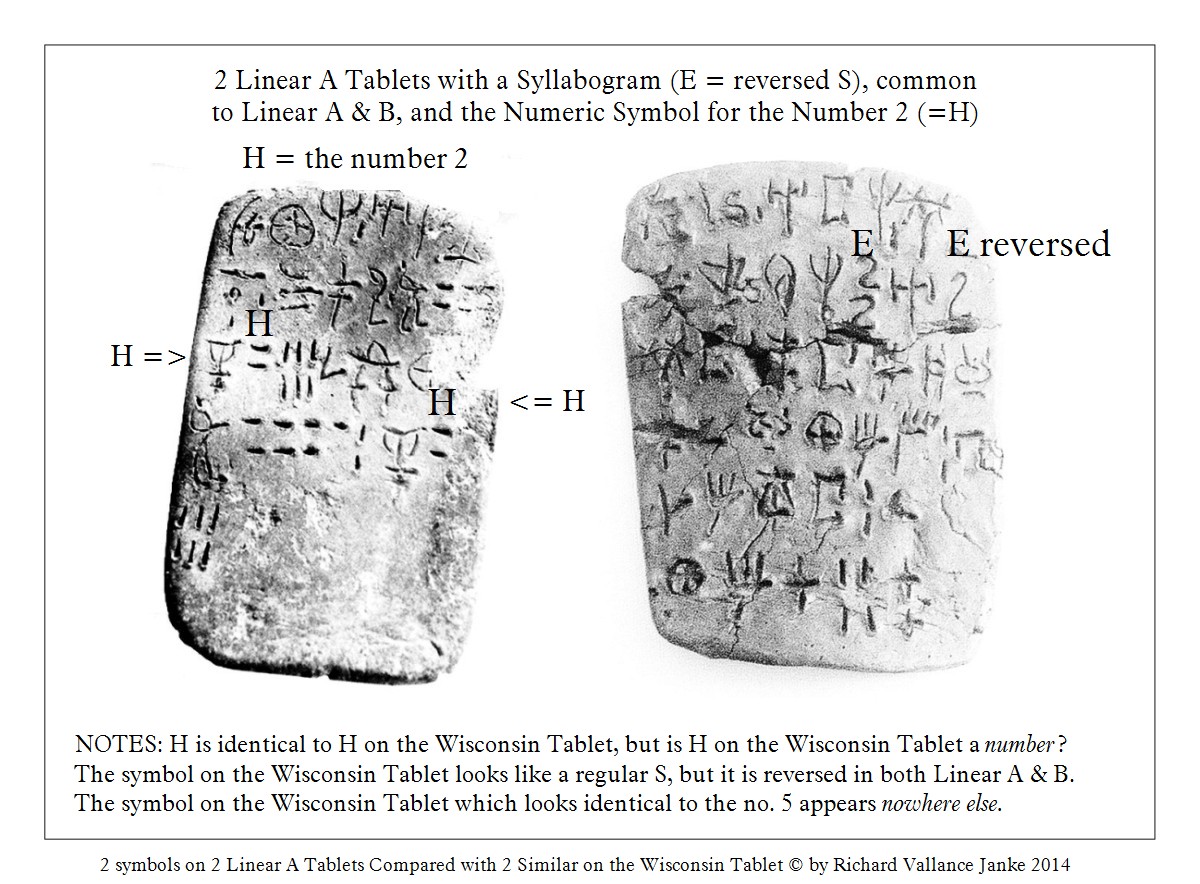


You must be logged in to post a comment.