Mycenaean Linear B Units of Measurement (Liquid, Dry & Weight): Click to ENLARGEThis table illustrates the syllabograms, logograms & ideograms used to represent units of measurement, liquid, dry and by weight. As can clearly be seen, the exact values many of the units are uncertain. I have hazarded a guess that the unit of measurement in this table which is represented by the ideogram for sheep may very well be the agricultural unit, a hogshead, in which case it is a liquid unit of measurement. Even that unit is variable, ranging anywhere from 46 to 65 US imperial gallons, with several stops in between. So if the Mycenaean measurement is anything like a hogshead, then it is probably just as unreliable, especially in light of the fact that the Mycenaean unit is ancient. Ancient units of measurement were notoriously variable. After all, if merchants could cheat, they would. There is nothing new in that practice! The following units of measurement, which are syllabograms – RO, PE, ZE, MO & O, are all also supersyllabograms (more on this in subsequent posts). The meanings of ZE, MO & O are clear, and well established. ZE always means “a pair of” (wheels etc.) or “a team of” (horses, oxen etc.), while MO always means “a single” wheel etc., and O always refers to “deficit”. The meaning of PE is unclear. The meaning of PE as a supersyllabogram varies from sector to sector of the Mycenaean economy. In the field of agriculture, sub-field livestock/sheep, it is periqoro in Mycenaean Linear B Latinized, which means “an enclosure, i.e. a sheep pen”, whereas in the wine-making sector it appears as perusinowo (Latinized), meaning “last year’s (wine)”. Prof. Lynne Ribaud, who initially compiled this table of units of measurement in Mycenaean Linear B, assigned the value “a bunch of...”, presumably referring to “a bunch of grapes”, but this meaning is very uncertain. Since these accounting terms are extremely common in Linear B inventories, anyone wishing to truly master Linear B must become familiar with all of them. Andras Zeke of Hungary, the owner of the now defunct
(a terrible pity, since it was such a magnificent blog) has taken a further step in the right direction, by hazarding more exact estimates of the values of several of the these measurement units, as illustrated here: Click to ENLARGE
I have always greatly admired his extremely meticulous logical approach to the analysis of both the Linear A and Linear B syllabaries, and so I am inclined to accept the measurement values he assigns at their approximate face value, although I have no way of verifying his overall accuracy. Other Linear B researchers must have already cross-checked his findings, but as of now I am unaware of the results of any such findings. If anyone reading our blog is aware of other research into the units of measurement in Mycenaean Linear B, please advise me as soon as possible. Richard
Tag: syllabograms
-
Table of Athematic Third Declension Nouns & Adjectives in “eu” in Mycenaean Linear B: Click to ENLARGE
Table of Athematic Third Declension Nouns & Adjectives in “eu” in Mycenaean Linear B: Click to ENLARGE
 NOTE: this table took me 12 hours (!) to compile. I sincerely hope that some of our visitors will acknowledge this in some way or other, by tagging the post with LIKE, assigning it the numbers of STARS they believe it merits, by re-blogging it, posting it on Facebook, tweeting it, posting it on Scoopit, whatever...
Based on the template declension of the noun qasireu = “viceroy” in Mycenaean Linear B, itself derived in large part from extant archaic forms in The Catalogue of Ships of Book II of the Iliad by Homer, we have here all of the nouns, including proper, and adjectives I have been able to cull from various sources, all of which are referenced in the KEY at the top of the table.
There are a few items in particular we need to take into consideration:
(a) Apart from proper nouns, there are very few extant or derived nouns or adjectives in “eu” in Mycenaean Linear B;
(b) The astonishing thing about the extant proper nouns is that a considerable number of them are also found in The Catalogue of Ships of Book II of the Iliad, in the most archaic Greek, hence, the most reliable source for derived Mycenaean proper names. While some proper names which are found in the Linear B Lexicon by Chris Tselentis are not found in The Catalogue of Ships, they are nevertheless Homeric. When I say “Homeric”, I refer specifically to proper names solely from The Catalogue of Ships, as those which are found elsewhere in the Iliad or the Odyssey may not be authentic Mycenaean eponymns or names, unless of course they are replicated in The Catalogue of Ships. I am, in short, extremely reticent to accept proper names as Mycenaean, unless they occur in The Catalogue of Ships.
(c) On the other hand, the rest of the proper names found in this table may very well be, and some of them must be authentic Mycenaean proper names. Given this, it is quite probable that at least some of these names not to be found anywhere in Homer are nevertheless the names of original Mycenaean heroes and warriors, which might have been mentioned in an original Mycenaean epic of the Trojan War, almost certainly oral. It is absolutely critical in this scenario to underscore one point in particular: that if there ever did exist a Mycenaean epic upon which the Iliad was based, such a (stripped-down) epic could only have seeded The Catalogue of Ships, and no other part of the Iliad or Odyssey, since it is in The Catalogue of Ships alone that we find far and away the greatest number of occurrences of archaic Greek, and not in the remainder of the Iliad or the Odyssey. Some will of course argue that some archaic remnants still pop up here and there in the the remainder of the Iliad and Odyssey, but it is important to realize in this particular that Homer most likely – indeed, almost certainly – (unconsciously) carried over the habit of using bits and pieces of archaic Greek, much more common in The Catalogue of Ships, to the rest of the epic cycle.
In fact, there is real doubt that he ever did compose outright The Catalogue of Ships. Rather, it appears, he may very well have had access to an earlier, archaic epic, which had indeed been copied from its original Mycenaean template. He then in turn copied the whole thing lock-stock-and-barrel, embellishing it with his own peculiar style in so-called Epic Greek, as he went along. That seems the more likely scenario to me. At any rate, the more simplistic structure, and above all other considerations, the characteristically Mycenaean inventory have stamped themselves prominently on The Catalogue of Ships alone. If nothing else, there can be little or no doubt that the entire Catalogue of Ships (exclusive of the rest of Book II of the Iliad, which was a later addition) was composed well before the rest of the Iliad, and long before the Odyssey.
So the question remains, Who were all those Mycenaean warriors? Which ones had Homer forgotten, or conveniently omitted from The Catalogue of Ships? One thing appears almost undeniable. The proper names we see in this table, which are not in The Catalogue of Ships, are very likely those of Mycenaean wanaka or kings, qasirewe or viceroys, heroes and other assorted warriors. Why they do not appear anywhere in the Iliad is beyond our reckoning. But they do appear on extant Mycenaean Linear B tablets, and this constitutes enough evidence for me that they were important figures to the Mycenaeans.
Richard
NOTE: this table took me 12 hours (!) to compile. I sincerely hope that some of our visitors will acknowledge this in some way or other, by tagging the post with LIKE, assigning it the numbers of STARS they believe it merits, by re-blogging it, posting it on Facebook, tweeting it, posting it on Scoopit, whatever...
Based on the template declension of the noun qasireu = “viceroy” in Mycenaean Linear B, itself derived in large part from extant archaic forms in The Catalogue of Ships of Book II of the Iliad by Homer, we have here all of the nouns, including proper, and adjectives I have been able to cull from various sources, all of which are referenced in the KEY at the top of the table.
There are a few items in particular we need to take into consideration:
(a) Apart from proper nouns, there are very few extant or derived nouns or adjectives in “eu” in Mycenaean Linear B;
(b) The astonishing thing about the extant proper nouns is that a considerable number of them are also found in The Catalogue of Ships of Book II of the Iliad, in the most archaic Greek, hence, the most reliable source for derived Mycenaean proper names. While some proper names which are found in the Linear B Lexicon by Chris Tselentis are not found in The Catalogue of Ships, they are nevertheless Homeric. When I say “Homeric”, I refer specifically to proper names solely from The Catalogue of Ships, as those which are found elsewhere in the Iliad or the Odyssey may not be authentic Mycenaean eponymns or names, unless of course they are replicated in The Catalogue of Ships. I am, in short, extremely reticent to accept proper names as Mycenaean, unless they occur in The Catalogue of Ships.
(c) On the other hand, the rest of the proper names found in this table may very well be, and some of them must be authentic Mycenaean proper names. Given this, it is quite probable that at least some of these names not to be found anywhere in Homer are nevertheless the names of original Mycenaean heroes and warriors, which might have been mentioned in an original Mycenaean epic of the Trojan War, almost certainly oral. It is absolutely critical in this scenario to underscore one point in particular: that if there ever did exist a Mycenaean epic upon which the Iliad was based, such a (stripped-down) epic could only have seeded The Catalogue of Ships, and no other part of the Iliad or Odyssey, since it is in The Catalogue of Ships alone that we find far and away the greatest number of occurrences of archaic Greek, and not in the remainder of the Iliad or the Odyssey. Some will of course argue that some archaic remnants still pop up here and there in the the remainder of the Iliad and Odyssey, but it is important to realize in this particular that Homer most likely – indeed, almost certainly – (unconsciously) carried over the habit of using bits and pieces of archaic Greek, much more common in The Catalogue of Ships, to the rest of the epic cycle.
In fact, there is real doubt that he ever did compose outright The Catalogue of Ships. Rather, it appears, he may very well have had access to an earlier, archaic epic, which had indeed been copied from its original Mycenaean template. He then in turn copied the whole thing lock-stock-and-barrel, embellishing it with his own peculiar style in so-called Epic Greek, as he went along. That seems the more likely scenario to me. At any rate, the more simplistic structure, and above all other considerations, the characteristically Mycenaean inventory have stamped themselves prominently on The Catalogue of Ships alone. If nothing else, there can be little or no doubt that the entire Catalogue of Ships (exclusive of the rest of Book II of the Iliad, which was a later addition) was composed well before the rest of the Iliad, and long before the Odyssey.
So the question remains, Who were all those Mycenaean warriors? Which ones had Homer forgotten, or conveniently omitted from The Catalogue of Ships? One thing appears almost undeniable. The proper names we see in this table, which are not in The Catalogue of Ships, are very likely those of Mycenaean wanaka or kings, qasirewe or viceroys, heroes and other assorted warriors. Why they do not appear anywhere in the Iliad is beyond our reckoning. But they do appear on extant Mycenaean Linear B tablets, and this constitutes enough evidence for me that they were important figures to the Mycenaeans.
Richard
Share this:
-
UD: The Real Problems with Gretchen E. Leonhardt’s Commentary on the Rôle of the Syllabogram WE in Linear B as Representative of the final “s” or sigma stem in Mycenaean Greek.
UD: The Real Problems with Gretchen E. Leonhardt’s Commentary on the Rôle of the Syllabogram WE in Linear B as Representative of the final “s” or sigma stem in Mycenaean Greek. With reference to our previous post, I now fully acknowledge her unique contributions to the use of the syllabogram WE in Mycenaean Greek as follows: Many Mycenaean Linear B [words] ending with “WE” indicate that “WE” as the last syllable of such Mycenaean words is actually the consonant “S”. Unfortunately, at the time of that post, I entirely neglected to credit Ms. Leonhardt for her professed “discovery” that the syllabogram WE in the ultimate position in Mycenaean Linear B words can and often does exactly correspond with a final sigma or “s” stem. I hereby correct my oversight. Click this banner to read it in its entirety:
 However, on her own Linear A, Linear B & Linear C blog, Ms. Leonhardt makes this telling observation on the rôle of the syllabogram WE in Linear B as being the exact equivalent of final “s” or sigma stem in Mycenaean Greek when it is in the ultimate position in a Mycenaean Greek word stem (relevant parts underlined):

Now this I believe to be a significant contribution to our ongoing understanding of the phonetic values of syllabograms in Mycenaean Linear B, in this particular instance of the possible of the final sigma stem to the syllabogram WE in the ultimate.

But I am obliged to set the record straight, reserving full copyright to Ms. Leonhardt on this account, with the strict provisos I underline below.

I am in fact, not at all in accord with with Ms. Leonhardt’s theory in this regard. Quite to the contrary. I understand that if Ms. Leonhardt wishes to take this stance, she is perfectly entitled to do so. But I respectfully disagree. In her observations on the syllabogram WE in the ultimate as acting as the sigma stem, I find myself greatly at odds with her conclusion on several key counts. Moreover, she flatly contradicts herself when she asserts that,

“These suggest that the inclusion of the final consonant * without a vowel nucleus was either a later development or was a contemporaneous dialectical development.” (where “final consonant * ” refers specifically to the sigma stem).  Apart from that fact that she unnecessarily repeats the word “development” the statement is clearly misleading on several counts:

(a) Why has Ms. Leonhardt omitted a specific reference to the consonant “sigma” in this summary statement? It is always preferable to repeat the actual consonant under consideration than not to, just to be certain readers clearly understand what that consonant is. I fully realize that Ms. Leonhardt will flatly disagree with me on this count, but I would much rather repeat the direct reference to sigma as the consonant stem in question than needlessly repeat the word “development”. In other words, I would have phrased the statement as follows:

These Linear B pairs suggest that the inclusion of the final consonant sigma without a vowel nucleus was either a later or a contemporaneous dialectical development.

... except that even with these changes, the statement is still unclear and quite misleading.

(b) If Ms. Leonhardt means to say that this phenomenon was a later development (in Mycenaean Greek), this presupposes that in early Mycenaean Greek the inclusion of the final consonant sigma without a vowel nucleus did not in fact exist, and that the only phonetic attribution that could have been assigned to the syllabogram WE in early Mycenaean was, quite simply, WE.

(c) I am quite at a loss with reference to her claim that, on the other hand, it (meaning the assignment of ultimate sigma as consonant stem) was – as she calls it - “a contemporaneous dialectical development”. Contemporaneous with what? - with the early Mycenaean Greek value of WE, in which case WE would have simultaneously meant WE (i.e. itself ) and ultimate sigma as consonant stem in early Mycenaean Greek – OR -

that the evolution of the early Mycenaean phonetic value of WE as itself and nothing more than that into WE + ultimate sigma as consonant stem was in fact contemporaneous with the appearance of the latter in later Mycenaean Greek. But this constitutes a flat-out contradiction in terms. Either WE always stood for WE + ultimate sigma as consonant stem from the very beginning of Mycenaean Greek in Linear B, or it never did. You cannot have it both ways. Languages do not fundamentally and arbitrarily change the principle(s) upon which word stems are formed in mid-stream.

Languages simply do not arbitrarily change any of their grammatical underpinnings in mid-stream, without becoming another, entirely new language. This is the case with ancient Greek versus modern Greek. Modern Greek is a different and entirely new linguistic phenomenon, in other words, a new language, simply because it has fundamentally re-written wholesale so many of the grammatical principles underlying it, abandoning lock-stock-and-barrel huge chunks of the linguistic structural foundation(s) of ancient Greek. For instance, there are no infinitives as such in modern Greek. That is one huge departure from ancient Greek.

I am certain that Ms. Leonhardt certainly surely did not mean to imply anything like this, but her statement is so unclear that it begs the issue. This is precisely why I always spell out any observation whatsoever I make on Linear B down to the very last detail – even it entails repetition – because I must be certain that I have clearly and unequivocally made myself clear to my readers, most of whom are not familiar with Linear B at all, let alone with the notion of a syllabary.

(d)... and that is precisely where Ms. Leonhardt’s all too brief and all too terse statement falls flat on its face. She unfailingly assumes that her readers are familiar – even intimately so – with the concept of a syllabary. But if the majority of her readers do not know what a syllabary is (and we can be quite sure they do not), then how on earth she expects them to be familiar with the very arcane Minoan Linear A, the complex syllabary, Mycenaean Linear B, or with the slightly less arcane Arcade-Cypriot Linear C simply stumps me. Such an assumption leaves her wide open to misunderstanding, misinterpretation, if not complete bafflement, on the part of her readers, the majority whom are not even necessarily versed in linguistics. In fact, even among linguistics who are profoundly versed in Minoan Linear & Mycenaean Linear B, there are are almost none who have any understanding of Cypro-Minoan Linear C, by far the easiest of the three syllabaries to master. Apart from the Egyptologist, Samuel Birch, who, with the assistant of other researchers, deciphered Arcado-Cypriot Linear C in the first place in the 1870s, very few linguists these days can even read Linear C, apart from Ms. Leonhardt and myself. Summa in veritate, who says they should? Certainly not I. Yes, even we linguists have plenty to learn from one another. I for one am still struggling to unravel the the subtle niceties of both Mycenaean Linear B and Arcado-Cypriot Linear C. I have a long long road ahead of me just trying to cope with these two syllabaries, let alone any other!

e) She then rounds up her observations on the syllabogram WE by noting (correctly) that “As for /we/ in the initial and medial positions, the tentative conclusion is that /we/ shifts to /e/” (My apologies for being unable to reproduce epsilon in the body of my post). The problem here is that /we/ does not shift at all, because it never did in the first place. WE is WE is WE. A rose is a rose is a rose.

(f) All of my observations above are absolutely critical to a clear-cut understanding the actual rôle the syllabogram WE plays in the ultimate in Mycenaean Linear B as merely an indicator of the unseen presence of a final “s” or sigma stem. I say, “unseen” or invisible, because – and I repeat - WE in Mycenaean Greek is just that WE, i.e. digamma followed by the vowel epsilon or eita ... and nothing else. Since Linear B, being an open-ended vowel-based syllabary, forbids the presence of a consonant in the ultimate of any syllabogram, and more to the point, since no-one in any language ever pronounces the ultima word stem alone without the addition of a proper inflection (verb conjugation or nominal/adjectival declension), the whole argument implodes on itself.

So while Ms. Leonhardt most assuredly holds the copyright on her own professed theory that the syllabogram WE in the ultimate is the exact equivalent of final “s” or sigma indicating the stem of the word in question, for all of the reasons I have cited above, I simply cannot agree with her hypothesis.

My counter-hypothesis, which I shall presently post in great detail, is firmly and roundly based on my regressive-progressive extrapolation of the declension of all nouns in adjectives in the Athematic Third Declension of Mycenaean Linear B I have just posted on our blog. My extrapolated declension of such adjectives and nouns makes it perfectly clear that, even if the syllabograms WE, as well as – I must also add - WA in the ultimate, might both be indicators of the presence of a final “s” or sigma stem pronounced in spoken Mycenaean Greek, this does not mean that WA & WE actually contain within themselves this putatively pronounced final “s” or sigma, simply because they cannot. In fact, the syllabogram WE in the ultimate position in the dative/locative/instrumental singular presupposes the total absence of any final “s” or sigma stem, clearly marking instead the actual presence of an ultimate “i”, the tell-tale indicator of that (those) case(s). The ultimate “i” in the dative/locative/instrumental was always present in archaic Greek dialects, and subscripted into the iota subscript much later in ancient Greek, as in the Attic dialect.

In other words, my own hypothesis of the actual rôle of ultimate WA & WE in Mycenaean Linear B is at marked variance with that of Ms. Leonhardt on the same issue.

Keep posted.

Richard
Share this:
-
REVISED: Archaic Declensions in “eu” in Mycenaean Greek = “eus” in Homeric Greek: Click to ENLARGE
REVISED: Archaic Declensions in “eu” in Mycenaean Greek = “eus” in Homeric Greek: Click to ENLARGE
 One of the most archaic declensions in ancient Greek is the Athematic Third Declension in which nouns in the nominative end in “eus” in Homeric Greek or “eu” in Mycenaean Greek, as illustrated by the complete declension table above of the noun “qasireu” = “viceroy” in Mycenaean Linear B, and of “basileus” = “(lesser) king” in Homeric Greek. The process whereby I can reasonably reconstruct any verb conjugation or any nominal or adjectival declension from the Homeric Greek of The Catalogue of Ships in Book II of the Iliad or, failing that, from Book II of the Iliad, I call regressive extrapolation. In the table of the athematic third declension above for “qasireu” = “viceroy” in Mycenaean Linear B, very few forms are already attested on the tablets (mainly the nominative singular), but all of the cases, singular, dual and plural, can be reconstructed with almost complete accuracy by means of regressive extrapolation. It is critical in this regard to understand that, if at all possible, the forms derived in this manner must reflect their most archaic equivalents in Homer, which is why I always resort to The Catalogue of Ships in Book II, and also why I have taken it upon myself to translate The Catalogue in its entirety (although I still have 4 more sequential sections to translate).
Once I have reconstructed any conjugation or declension, and the table is complete, as seen above, the process of reconstruction in Mycenaean Linear B forward through all the cases (nominative, genitive, dative/locative/instrumental & accusative) and all three numbers (singular, dual & plural) I call progressive extrapolation. Starting this month, and working through the spring of 2015, I shall attempt to reconstruct as many declensions of nouns and adjectives as I am convinced can stand the test of regressive-progressive extrapolation, without resulting in absurdities, i.e. without falling into the trap of reductio ab adsurdum. Unfortunately, such reconstruction can be and sometimes is open to precisely that pitfall. So where it is impossible to reconstruct any verbal conjugation or nominal/ adjectival declension without unsubstantiated Homeric or Arcado-Cypriot forms, I shall not do so.
Last year (2014), we successfully reconstructed verb tables for the present, future, imperfect, aorist & perfect tenses of the active voice of both thematic and athematic verbs in Mycenaean Linear B, of which the complete tables can be consulted in the CATEGORY, PROGESSIVE LINEAR B, of this blog.
In the next post, I shall provide a reasonably comprehensive list of nouns and adjectives in the Athematic Third Declension, ending in “eu” in Mycenaean Greek.
The likelihood that the Mycenaean Linear B syllabogram for WE is indicative of the nominative plural of certain Mycenaean nouns and adjectives of the athematic third declension was first brought to my attention by Ms. Gretchen Leonhardt, whose site is: Click on this Banner to visit -
One of the most archaic declensions in ancient Greek is the Athematic Third Declension in which nouns in the nominative end in “eus” in Homeric Greek or “eu” in Mycenaean Greek, as illustrated by the complete declension table above of the noun “qasireu” = “viceroy” in Mycenaean Linear B, and of “basileus” = “(lesser) king” in Homeric Greek. The process whereby I can reasonably reconstruct any verb conjugation or any nominal or adjectival declension from the Homeric Greek of The Catalogue of Ships in Book II of the Iliad or, failing that, from Book II of the Iliad, I call regressive extrapolation. In the table of the athematic third declension above for “qasireu” = “viceroy” in Mycenaean Linear B, very few forms are already attested on the tablets (mainly the nominative singular), but all of the cases, singular, dual and plural, can be reconstructed with almost complete accuracy by means of regressive extrapolation. It is critical in this regard to understand that, if at all possible, the forms derived in this manner must reflect their most archaic equivalents in Homer, which is why I always resort to The Catalogue of Ships in Book II, and also why I have taken it upon myself to translate The Catalogue in its entirety (although I still have 4 more sequential sections to translate).
Once I have reconstructed any conjugation or declension, and the table is complete, as seen above, the process of reconstruction in Mycenaean Linear B forward through all the cases (nominative, genitive, dative/locative/instrumental & accusative) and all three numbers (singular, dual & plural) I call progressive extrapolation. Starting this month, and working through the spring of 2015, I shall attempt to reconstruct as many declensions of nouns and adjectives as I am convinced can stand the test of regressive-progressive extrapolation, without resulting in absurdities, i.e. without falling into the trap of reductio ab adsurdum. Unfortunately, such reconstruction can be and sometimes is open to precisely that pitfall. So where it is impossible to reconstruct any verbal conjugation or nominal/ adjectival declension without unsubstantiated Homeric or Arcado-Cypriot forms, I shall not do so.
Last year (2014), we successfully reconstructed verb tables for the present, future, imperfect, aorist & perfect tenses of the active voice of both thematic and athematic verbs in Mycenaean Linear B, of which the complete tables can be consulted in the CATEGORY, PROGESSIVE LINEAR B, of this blog.
In the next post, I shall provide a reasonably comprehensive list of nouns and adjectives in the Athematic Third Declension, ending in “eu” in Mycenaean Greek.
The likelihood that the Mycenaean Linear B syllabogram for WE is indicative of the nominative plural of certain Mycenaean nouns and adjectives of the athematic third declension was first brought to my attention by Ms. Gretchen Leonhardt, whose site is: Click on this Banner to visit -
 By extapolation, the same principle can be applied to the Mycenaean Linear B syllabogram for WA, which is reperesentative of the accusative plural of certain nouns and adjectives of the athematic third declension, among others.
Richard
By extapolation, the same principle can be applied to the Mycenaean Linear B syllabogram for WA, which is reperesentative of the accusative plural of certain nouns and adjectives of the athematic third declension, among others.
Richard
Share this:
-
Linear B Ideogram for Wheel + ZE = a set of wheels on axle – Distinctions, Distinctions! Fussy, Fussy
Linear B Ideogram for Wheel + ZE = a set of wheels on axle - Distinctions, Distinctions! Fussy, fussy Since the use of the supersyllabogram ZE, which invariably means “a pair of/a team of” or minor variants thereof in the military sector of Minoan/Mycenaean society, was the first supersyllabogram we ever discovered, when we deciphered the ideogram for horse IQO + ZE as meaning “a team of horses” back in the spring of 2014, we really ought to have followed that post up right away with our discussion of this combination of ideogram + supersyllabogram, the ideogram for “wheel(s)” + the supersyllabogram ZE. But we did not. This situation we now rectify. We should have posted our observations on these two combinations the other way around, i.e. the ideogram for “wheel(s)” + ZE before the ideogram for horse IQO + ZE, since to be perfectly honest, it was not I who discovered the meaning of the former, but Chris Tselentis, in the Appendix of Linear B Tablets he translated at the end of his excellent Linear B Lexicon, as clearly illustrated here with my first three examples of the usage of the ideogram for “wheel(s)” + ZE: Click to ENLARGE
 There is absolutely no doubt about it. Chris Tselentis hit the nail right on the head. In addition, he also cleverly intuited the meaning of the second supersyllabogram appearing right after the first (ZE) on the same tablet, i.e. MO which he correctly translated as “monos”, meaning “only 1, 1 only or – single- ”. However, he did not take his insight any further. This is undoubtedly due to the fact that he must not have had the occasion or the chance to do as I have had, i.e. to trudge through some 3,000 tablets in the Scripta Minoa from Knossos. Missing that opportunity, he could not have realistically been expected to discover that there were 24 other Linear B tablets from Knossos sporting the precise same formula, the ideogram for “wheel(s)” + ZE. Nor could he have possibly known that there were not just scores, but hundreds of other Scripta Minoa tablets, on which scores of other formulae, constructed on the exact same principles, recurred over and over and over.
I need only cite a few examples of these to underscore my hypothesis beyond the point of no return, or more to the point, if you will pardon the pun, to the very point where returns have richly rewarded our exhaustive efforts to dig up the truth about supersyllabograms. And what an amazing phenomenon they have proven to be, in the most practical terms and in their application in the realm of attested Linear B. The most common supersyllabograms by far are found in the agricultural sector of Minoan/Mycenaean society. Of the 3,000 tablets from Knossos I meticulously examined, 800 tablets (27%!) contain supersyllabograms, all of them following the exact same formulaic structure as the military supersyllabograms IQO + ZE & wheel + ZE. Even more astonishingly, some 700 (23%!) of these tablets refer to sheep husbandry (of rams and ewes) alone and to nothing else, attesting to the extreme significance of the sheep raising sector of the Minoan/Mycenaean economy, the one single sector with which the scribes were obsessed far beyond all others, even the military. Here are just a few examples of supersyllabogram + ideogram formulae in the sheep husbandry sector of the economy, which follow precisely the template established by IQO + ZE & wheel + ZE to the letter. In order to clearly illustrate the formulaic function of supersyllabograms for those of you who are not familiar at all with Mycenaean Linear B, we have, for instance:
We have for the Military:
Ideogram for horse (IQO) + ZE = a team of horses
Ideogram for X wheels + ZE = X sets of wheels on axle ready to be mounted
Ideogram for X chariots + wheels + ZE = X sets of wheels on axle mounted on chariots
We have for Sheep Husbandry:
Ideogram for X Rams or Ewes + vowel O = X Rams or Ewes on a lease field (Onaton)
Ideogram for X Rams or Ewes + syllabogram KI = X Rams or Ewes on a plot of land (KItimena)
Ideogram for X Rams or Ewes + syllabogram PE = X Rams or Ewes in an enclosure or sheep pen (PEriqoro)
Ideogram for X Rams or Ewes + syllabogram ZA = X Rams or Ewes of this year (ZAweto), meaning X young Rams or Ewes
We have for textiles:
Ideogram for textile or cloth + syllabogram KU = gold cloth (KUruso)
Ideogram for textile or cloth + syllabogram RI = linen (RIno)
Ideogram for textile or cloth + syllabogram TE = well-prepared, well-spun (TEtukowoa)
Even if you have no prior knowledge of Mycenaean Linear B, the latinized forms of the ideograms and supersyllabograms you see above make it crystal clear that the template for the formula for ideogram-dependent supersyllabograms is invariable, from one sector to another of Minoan/Mycenaean society. The very inflexibility of the formula = ideogram + syllabogram, in all cases, clearly serves to underscore its authenticity throughout the range of some 800 of 3,000 tablets in Scripta Minoa, where it so frequently re-appears with the absolute consistency you see illustrated above.
As I have demonstrated over and over on this blog, the same formulae invariably apply to all sectors of Minoan/Mycenaean society, agricultural, military, textiles, pottery and vessels, and religious, without exception. If the formulae work in one sector, they will work in the next. And since the overall structure of the formulae, i.e. ideogram + supersyllabogram, is always invariable and always in that particular order, we have hit upon a phenomenon in Mycenaean Linear B which has been staring us in the face ever since 1952, when our genius, Michael Ventris, first deciphered the vast majority of the Linear B syllabary, but which no-one, not even Prof. John Chadwick or Chris Tselentis, has ever isolated for extrapolation, at least until now. I must however give both of these brilliant researchers, Prof. John Chadwick & Chris Tselentis, the full credit that is without question due to them, for without their invaluable insights into two specific examples of the appearance of supersyllabograms, one by Prof. Chadwick, and the other by Chris Tselentis (as illustrated by the presence of the supersyllabogram ZE with the ideogram for – wheel – in Knossos Tablet KN SO 4439 above), I would have never been able to extrapolate their discoveries of these two specific occurrences into the general hypothesis of the signal contribution of supersyllabograms, which occur at high enough a frequency (800 times in 3,000 tablets) to warrant their inclusion as actual Linear B words and phrases in the lexicon of extant Mycenaean Linear B vocabulary. What once seemed merely to be stray single syllabograms on so many tablets have turned out not to be simple syllabograms at all, but the first syllabogram i.e. the first syllable of scores of words and even entire phrases in Mycenaean Greek.
If this is not a major step forward in the decipherment of Mycenaean Linear B, I don’t know what is.
Richard
There is absolutely no doubt about it. Chris Tselentis hit the nail right on the head. In addition, he also cleverly intuited the meaning of the second supersyllabogram appearing right after the first (ZE) on the same tablet, i.e. MO which he correctly translated as “monos”, meaning “only 1, 1 only or – single- ”. However, he did not take his insight any further. This is undoubtedly due to the fact that he must not have had the occasion or the chance to do as I have had, i.e. to trudge through some 3,000 tablets in the Scripta Minoa from Knossos. Missing that opportunity, he could not have realistically been expected to discover that there were 24 other Linear B tablets from Knossos sporting the precise same formula, the ideogram for “wheel(s)” + ZE. Nor could he have possibly known that there were not just scores, but hundreds of other Scripta Minoa tablets, on which scores of other formulae, constructed on the exact same principles, recurred over and over and over.
I need only cite a few examples of these to underscore my hypothesis beyond the point of no return, or more to the point, if you will pardon the pun, to the very point where returns have richly rewarded our exhaustive efforts to dig up the truth about supersyllabograms. And what an amazing phenomenon they have proven to be, in the most practical terms and in their application in the realm of attested Linear B. The most common supersyllabograms by far are found in the agricultural sector of Minoan/Mycenaean society. Of the 3,000 tablets from Knossos I meticulously examined, 800 tablets (27%!) contain supersyllabograms, all of them following the exact same formulaic structure as the military supersyllabograms IQO + ZE & wheel + ZE. Even more astonishingly, some 700 (23%!) of these tablets refer to sheep husbandry (of rams and ewes) alone and to nothing else, attesting to the extreme significance of the sheep raising sector of the Minoan/Mycenaean economy, the one single sector with which the scribes were obsessed far beyond all others, even the military. Here are just a few examples of supersyllabogram + ideogram formulae in the sheep husbandry sector of the economy, which follow precisely the template established by IQO + ZE & wheel + ZE to the letter. In order to clearly illustrate the formulaic function of supersyllabograms for those of you who are not familiar at all with Mycenaean Linear B, we have, for instance:
We have for the Military:
Ideogram for horse (IQO) + ZE = a team of horses
Ideogram for X wheels + ZE = X sets of wheels on axle ready to be mounted
Ideogram for X chariots + wheels + ZE = X sets of wheels on axle mounted on chariots
We have for Sheep Husbandry:
Ideogram for X Rams or Ewes + vowel O = X Rams or Ewes on a lease field (Onaton)
Ideogram for X Rams or Ewes + syllabogram KI = X Rams or Ewes on a plot of land (KItimena)
Ideogram for X Rams or Ewes + syllabogram PE = X Rams or Ewes in an enclosure or sheep pen (PEriqoro)
Ideogram for X Rams or Ewes + syllabogram ZA = X Rams or Ewes of this year (ZAweto), meaning X young Rams or Ewes
We have for textiles:
Ideogram for textile or cloth + syllabogram KU = gold cloth (KUruso)
Ideogram for textile or cloth + syllabogram RI = linen (RIno)
Ideogram for textile or cloth + syllabogram TE = well-prepared, well-spun (TEtukowoa)
Even if you have no prior knowledge of Mycenaean Linear B, the latinized forms of the ideograms and supersyllabograms you see above make it crystal clear that the template for the formula for ideogram-dependent supersyllabograms is invariable, from one sector to another of Minoan/Mycenaean society. The very inflexibility of the formula = ideogram + syllabogram, in all cases, clearly serves to underscore its authenticity throughout the range of some 800 of 3,000 tablets in Scripta Minoa, where it so frequently re-appears with the absolute consistency you see illustrated above.
As I have demonstrated over and over on this blog, the same formulae invariably apply to all sectors of Minoan/Mycenaean society, agricultural, military, textiles, pottery and vessels, and religious, without exception. If the formulae work in one sector, they will work in the next. And since the overall structure of the formulae, i.e. ideogram + supersyllabogram, is always invariable and always in that particular order, we have hit upon a phenomenon in Mycenaean Linear B which has been staring us in the face ever since 1952, when our genius, Michael Ventris, first deciphered the vast majority of the Linear B syllabary, but which no-one, not even Prof. John Chadwick or Chris Tselentis, has ever isolated for extrapolation, at least until now. I must however give both of these brilliant researchers, Prof. John Chadwick & Chris Tselentis, the full credit that is without question due to them, for without their invaluable insights into two specific examples of the appearance of supersyllabograms, one by Prof. Chadwick, and the other by Chris Tselentis (as illustrated by the presence of the supersyllabogram ZE with the ideogram for – wheel – in Knossos Tablet KN SO 4439 above), I would have never been able to extrapolate their discoveries of these two specific occurrences into the general hypothesis of the signal contribution of supersyllabograms, which occur at high enough a frequency (800 times in 3,000 tablets) to warrant their inclusion as actual Linear B words and phrases in the lexicon of extant Mycenaean Linear B vocabulary. What once seemed merely to be stray single syllabograms on so many tablets have turned out not to be simple syllabograms at all, but the first syllabogram i.e. the first syllable of scores of words and even entire phrases in Mycenaean Greek.
If this is not a major step forward in the decipherment of Mycenaean Linear B, I don’t know what is.
Richard
Share this:
-
All About Sypersyllabograms: Their Enormous Impact on the Nature of Linear B – Everything you ever wanted to know, but were afraid to ask!
All About Sypersyllabograms: Their Enormous Impact on the Nature of Linear B – Everything you ever wanted to know, but were afraid to ask!
Given that supersyllabograms invariably display the characteristics highlighted in the previous post, they must also be formulaic by nature. The several restrictions placed on their disposition next to or inside ideograms, the invariability of their meanings within each sector, and other such considerations means they are always formulaic. Although the language of Homer is also very often formulaic in the Iliad, especially in The Catalogue of Ships in Book II, there is probably little or no relationship between the formulaic nature of supersyllabograms in Mycenaean Linear B and his archaic formulae. Nevertheless, it cannot be denied that formulaic language is a particular characteristic of both Mycenaean Linear B and of Homer’s own so-called Epic Greek. However, the nature of the formulaic language of Linear B and that of Homeric Greek are of a different order. In the chart which follows, we see for the first time ever on our blog the disposition of each supersyllabogram in each sector of Minoan/Mycenaean society, with repetitions of certain supersyllabograms, which re-appear in different sectors, usually with different meanings from one sector to the next, with the exception of the supersyllabogram “newo/newa”, which always means “new”, regardless of sector. It alone appears in three sectors: agriculture (livestock, mainly sheep, rams & ewes), textiles & vessels, as seen in the chart here: Click to ENLARGE
 While the meanings of some supersyllabograms are firmly established, due primarily to their high frequency on Linear B tablets from Knossos, others are less firmly demonstrable. For instance, in the sector, agriculture, sub-sector sheep husbandry, the meanings of the supersyllabograms O = lease field, KI = plot of land , NE = new & PE = enclosure or sheep pen, are firmly established with a very high degree of probability, if not total accuracy. In the case of PE, the definition is 100 % confirmed, since on one of the tablets in that series, the scribe conveniently spelled out the word in full, instead of using the simple superyllabogram PE. It is this very tablet which establishes beyond a doubt the authenticity of supersyllabograms as a phenomenon innate to Linear B alone, and not found in Arcado-Cypriot Linear C. As for Minoan Linear A, no-one knows whether SSYLS exist, because the language remains recalcitrant to decipherment.
In the military sector, the supersyllabogram ZE almost certainly means “a pair of..” or “a team of...”, with a 90 % or greater probability. However, once we get past the two primary sectors in which supersyllabograms are used extremely frequently, given that there are so many tablets to be found in these two primary sectors of Minoan/Mycenaean society, the situation devolves by degrees into less certainty.
Supersyllabograms found adjacent to any ideogram, as for instance those with the ideograms for sheep, ram, ewe (livestock), or horse or chariot (military) are considered to be associative. Associative Supersyllabograms are those which define characteristics of the environment or specific context in which their associative ideograms appear. For instance, it is natural and logical to associate sheep with lease fields, plots of land & sheep enclosures. The same goes for military ideograms. The ideograms for horse and chariot naturally associate with pairs or teams of... (fill in the blanks).
There are still quite a large number of tablets in the textiles sector; so the meanings of most of the supersyllabograms in that sector are more than likely still very reliable, not the least because each of them still makes good sense: KU = gold cloth, PA = dyed cloth, PU = purple or Phoenician cloth (amounting to pretty much the same thing, anyway) & RI = linen. I would assign at least a 70 % to 90 % degree of probability to each of the definitions I have deduced for each of these supersyllabograms in textiles. The supersyllabograms in the sector of vessels (amphorae, drinking cups, water jugs etc.) may be a little less firm, but I am still convinced that I deduced most of them accurately, yielding a probability of 70 % - 80 %.
Supersyllabograms in the textile and vessels sector are another kettle of fish. Since they appear inside the ideograms they modify, they are attributive in nature. In other words, they describe attributes of the textiles or vessels which they modify, and are, in almost all instances, adjectival in nature. Their placement inside the ideograms makes it quite clear that this is what the scribes actually indented, since a symbol inside another always describes attributes of the ideogram in which it appears. Should anyone doubt this, we have only to appeal to symbols appearing inside others as they are found in today’s world, since they follow the exact same principle. For instance, we have: click to ENLARGE:
While the meanings of some supersyllabograms are firmly established, due primarily to their high frequency on Linear B tablets from Knossos, others are less firmly demonstrable. For instance, in the sector, agriculture, sub-sector sheep husbandry, the meanings of the supersyllabograms O = lease field, KI = plot of land , NE = new & PE = enclosure or sheep pen, are firmly established with a very high degree of probability, if not total accuracy. In the case of PE, the definition is 100 % confirmed, since on one of the tablets in that series, the scribe conveniently spelled out the word in full, instead of using the simple superyllabogram PE. It is this very tablet which establishes beyond a doubt the authenticity of supersyllabograms as a phenomenon innate to Linear B alone, and not found in Arcado-Cypriot Linear C. As for Minoan Linear A, no-one knows whether SSYLS exist, because the language remains recalcitrant to decipherment.
In the military sector, the supersyllabogram ZE almost certainly means “a pair of..” or “a team of...”, with a 90 % or greater probability. However, once we get past the two primary sectors in which supersyllabograms are used extremely frequently, given that there are so many tablets to be found in these two primary sectors of Minoan/Mycenaean society, the situation devolves by degrees into less certainty.
Supersyllabograms found adjacent to any ideogram, as for instance those with the ideograms for sheep, ram, ewe (livestock), or horse or chariot (military) are considered to be associative. Associative Supersyllabograms are those which define characteristics of the environment or specific context in which their associative ideograms appear. For instance, it is natural and logical to associate sheep with lease fields, plots of land & sheep enclosures. The same goes for military ideograms. The ideograms for horse and chariot naturally associate with pairs or teams of... (fill in the blanks).
There are still quite a large number of tablets in the textiles sector; so the meanings of most of the supersyllabograms in that sector are more than likely still very reliable, not the least because each of them still makes good sense: KU = gold cloth, PA = dyed cloth, PU = purple or Phoenician cloth (amounting to pretty much the same thing, anyway) & RI = linen. I would assign at least a 70 % to 90 % degree of probability to each of the definitions I have deduced for each of these supersyllabograms in textiles. The supersyllabograms in the sector of vessels (amphorae, drinking cups, water jugs etc.) may be a little less firm, but I am still convinced that I deduced most of them accurately, yielding a probability of 70 % - 80 %.
Supersyllabograms in the textile and vessels sector are another kettle of fish. Since they appear inside the ideograms they modify, they are attributive in nature. In other words, they describe attributes of the textiles or vessels which they modify, and are, in almost all instances, adjectival in nature. Their placement inside the ideograms makes it quite clear that this is what the scribes actually indented, since a symbol inside another always describes attributes of the ideogram in which it appears. Should anyone doubt this, we have only to appeal to symbols appearing inside others as they are found in today’s world, since they follow the exact same principle. For instance, we have: click to ENLARGE:
 Need I say more?
On the other hand, I have been quite unable to decipher at least one supersyllabogram, SE, which sadly appears only 3 times on extant tablets from Knossos. For this reason alone, I dare not assign it a meaning, since I am quite sure that if I did, I would probably be (way) off the mark.
There remain the supersyllabograms for place names, which are in a category of their own, since none of them appear with ideograms, and all of them are found on only 1 tablet, Heidelburg HE Fl 1994, which Prof. Thomas G. Palaima so expertly deciphered in 1994. Click on this banner to read his translation and my explanatory POST in its entirety:
Need I say more?
On the other hand, I have been quite unable to decipher at least one supersyllabogram, SE, which sadly appears only 3 times on extant tablets from Knossos. For this reason alone, I dare not assign it a meaning, since I am quite sure that if I did, I would probably be (way) off the mark.
There remain the supersyllabograms for place names, which are in a category of their own, since none of them appear with ideograms, and all of them are found on only 1 tablet, Heidelburg HE Fl 1994, which Prof. Thomas G. Palaima so expertly deciphered in 1994. Click on this banner to read his translation and my explanatory POST in its entirety:
 There can be no question whatsoever that these are in fact supersyllabograms, the very first ever to have been isolated, for which we owe Prof. Palaima full credit. Of course, he did not define them as supersyllabograms, as he was unaware of the high frequency of the rest of them as adduced above in this post. Nevertheless, they are what they are, supersyllabograms. We have KO for Konoso (Knossos), MU for Mukene (Mycenae), ZA for Zakros etc.
And if a few of you are still in doubt as to the viability of supersyllabograms in Mycenaean Linear B, remember: the very same phenomenon applies to internationally standardized signs nowadays.
Once again, nowadays, we have a symbol within a symbol, or if you like, a symbol inside an ideogram. It is truly amazing how such a practice has resurfaced after at least 32 centuries, even if it was only the Minoan/Mycenaean scribes in the ancient world who figured out the system in the first place, leaving it interred for 32 centuries before it re-appeared in the twentieth century. So once again, we find ourselves face to face with a very ancient script, namely the Linear B syllabary, which was so systematic, formulaic and logical that it can only be considered as a brilliant breakthrough in the art of writing. After all, supersyllabograms are not the only phenomenon Linear B sported with such bravado. Ideograms in and of themselves abounded (over 100 of them!). They even used ideograms as the equivalent of subject headings as they resurfaced in nineteenth century libaries, in the Dewey Decimal & Library of Congress systems.
Witness just one tablet alone, namely, Pylos 641-1952 (Ventris), the very first tablet ever translated with complete success by none other than the great Michael Ventris himself, and you can see these “subject headings” for yourself, plastered all over that amazing tablet! Why did the scribes use so many ideograms for vessel types on this single tablet? The answer was obvious, at least to them... the ideograms for vessels were the signposts or indexing markers of this tablet which instantly allowed the scribes to identify the precise type of vessel described in the full text immediately preceding each one, even before they bothered reading the descriptive text. That this is a very clever indexing system goes without saying. And it re-appears over and over on so many tablets that it is without question one of the hallmarks of the Linear B syllabary. Finally, their numeric accounting system was the most efficient ever devised in the ancient world. Summarizing all of the streamlined characteristics of Linear B we have just enumerated, it becomes obvious that Linear B was, first and foremost, a carefully devised form of shorthand for Mycenaean Greek. Once again, the Mycenaean scribes anticipated a methodology for writing business transactions which would not re-appear as modern shorthand – you guessed it – until the nineteenth century AD.
All of this adds up to one inescapable conclusion: Linear B was the world’s fist ever commercial shorthand, and until the nineteenth and twentieth centuries, there was nothing even remotely as efficient, logical and practical ever to be found throughout history until... the modern era. This is precisely why I am so in awe of Linear B, a script which was millennia ahead of its time. It is also why I refuse to characterize Linear B as being prehistoric. It is nothing of the sort. It is in a word, a proto-historic writing and accounting system, leading me to the inexorable conclusion that Minoan/Mycenaean society was in fact not prehistoric at all, but proto-historic. I am not the first linguist specializing in ancient linguistics to have asserted this claim, but I am the first to speak up as emphatically and unequivocally as this.
This then has been a brief summary of the functions and the key rôle supersyllabograms play in the decipherment of Mycenaean Linear B.
Richard
There can be no question whatsoever that these are in fact supersyllabograms, the very first ever to have been isolated, for which we owe Prof. Palaima full credit. Of course, he did not define them as supersyllabograms, as he was unaware of the high frequency of the rest of them as adduced above in this post. Nevertheless, they are what they are, supersyllabograms. We have KO for Konoso (Knossos), MU for Mukene (Mycenae), ZA for Zakros etc.
And if a few of you are still in doubt as to the viability of supersyllabograms in Mycenaean Linear B, remember: the very same phenomenon applies to internationally standardized signs nowadays.
Once again, nowadays, we have a symbol within a symbol, or if you like, a symbol inside an ideogram. It is truly amazing how such a practice has resurfaced after at least 32 centuries, even if it was only the Minoan/Mycenaean scribes in the ancient world who figured out the system in the first place, leaving it interred for 32 centuries before it re-appeared in the twentieth century. So once again, we find ourselves face to face with a very ancient script, namely the Linear B syllabary, which was so systematic, formulaic and logical that it can only be considered as a brilliant breakthrough in the art of writing. After all, supersyllabograms are not the only phenomenon Linear B sported with such bravado. Ideograms in and of themselves abounded (over 100 of them!). They even used ideograms as the equivalent of subject headings as they resurfaced in nineteenth century libaries, in the Dewey Decimal & Library of Congress systems.
Witness just one tablet alone, namely, Pylos 641-1952 (Ventris), the very first tablet ever translated with complete success by none other than the great Michael Ventris himself, and you can see these “subject headings” for yourself, plastered all over that amazing tablet! Why did the scribes use so many ideograms for vessel types on this single tablet? The answer was obvious, at least to them... the ideograms for vessels were the signposts or indexing markers of this tablet which instantly allowed the scribes to identify the precise type of vessel described in the full text immediately preceding each one, even before they bothered reading the descriptive text. That this is a very clever indexing system goes without saying. And it re-appears over and over on so many tablets that it is without question one of the hallmarks of the Linear B syllabary. Finally, their numeric accounting system was the most efficient ever devised in the ancient world. Summarizing all of the streamlined characteristics of Linear B we have just enumerated, it becomes obvious that Linear B was, first and foremost, a carefully devised form of shorthand for Mycenaean Greek. Once again, the Mycenaean scribes anticipated a methodology for writing business transactions which would not re-appear as modern shorthand – you guessed it – until the nineteenth century AD.
All of this adds up to one inescapable conclusion: Linear B was the world’s fist ever commercial shorthand, and until the nineteenth and twentieth centuries, there was nothing even remotely as efficient, logical and practical ever to be found throughout history until... the modern era. This is precisely why I am so in awe of Linear B, a script which was millennia ahead of its time. It is also why I refuse to characterize Linear B as being prehistoric. It is nothing of the sort. It is in a word, a proto-historic writing and accounting system, leading me to the inexorable conclusion that Minoan/Mycenaean society was in fact not prehistoric at all, but proto-historic. I am not the first linguist specializing in ancient linguistics to have asserted this claim, but I am the first to speak up as emphatically and unequivocally as this.
This then has been a brief summary of the functions and the key rôle supersyllabograms play in the decipherment of Mycenaean Linear B.
Richard
Share this:
-
KEY POST: A Résumé of the Rôle of Supersyllabograms in Mycenaean Linear B
KEY POST: A Résumé of the Rôle of Supersyllabograms in Mycenaean Linear B This post, which is of supreme importance, has been a long time coming. I will be making a MAJOR ANNOUNCEMENT concerning this post in the next few days, as this constitutes the most significant breakthrough for us here at Linear B, Knossos & Mycenae since its inception 22 months ago. The résumé as submitted to the institutions concerned is illustrated in the visual .jpg text here: Click to ENLARGE
 This résumé, which I repeat below in a slightly less compressed format, but without the examples of supersyllabograms in Linear B, serves as the basis of a much more in-depth institutionally sponsored paper, The Rôle of Supersyllabograms in Mycenaean Linear B, which is to be published before the end of this year, and which may even appear in other venues.
***
A supersyllabogram (SSYL) is defined as the first syllabogram or vowel, i.e. the first syllable of a Linear B word or phrase, and it is always found adjacent to or inside an ideogram, and always with the same invariable meaning in a particular sector of Minoan/ Mycenaean society. Sectors include agriculture, military, textiles, vessels & religious. If the ideogram or the sector changes, so does the meaning of the supersyllabogram.
Here is an example of a Linear B tablet from Knossos which uses three (4)! supersyllabograms with the ideogram for RAM. Click to ENLARGE:
This résumé, which I repeat below in a slightly less compressed format, but without the examples of supersyllabograms in Linear B, serves as the basis of a much more in-depth institutionally sponsored paper, The Rôle of Supersyllabograms in Mycenaean Linear B, which is to be published before the end of this year, and which may even appear in other venues.
***
A supersyllabogram (SSYL) is defined as the first syllabogram or vowel, i.e. the first syllable of a Linear B word or phrase, and it is always found adjacent to or inside an ideogram, and always with the same invariable meaning in a particular sector of Minoan/ Mycenaean society. Sectors include agriculture, military, textiles, vessels & religious. If the ideogram or the sector changes, so does the meaning of the supersyllabogram.
Here is an example of a Linear B tablet from Knossos which uses three (4)! supersyllabograms with the ideogram for RAM. Click to ENLARGE:
 “What!”, I hear you saying. “I thought you said that super- syllabograms always appeared singly adjacent to or inside an ideogram in any sector of Minoan/Mycenaean society.” But if you re-read what I said above, that is not quite what I said. I pointed out that a supersyllabogram is always a single syllabogram or vowel, and the first syllable only of any Mycenaean word or phrase in Linear B. I did not claim that more than one supersyllabogram could not appear adjacent to or inside an ideogram. To the contrary. Scribes frequently resorted to using as many as four (4) SSYLS on one tablet, thereby eliminating all extraneous text, which would have otherwise wasted much valuable space on what were (and are) extremely small tablets. Few tablets exceed 30 cm. in width or 15 cm. in depth. Some are so tiny you have to look at them through a magnifying glass to read them! The scribes knew exactly what they were doing. The fewer words or phrases they had to write out, the more space they saved on the tablets... which is precisely why some 800 of 3,000 tablets (27%) from Knossos, which I examined and read meticulously use supersyllabograms to replace words and even entire phrases in Mycenaean Greek.
Scribes would never have written single syllabograms unless they meant something! - with ideograms, they do. SSYLs are a form of shorthand.
See the visual post above for examples of Supersyllabograms.
28 of 61 syllabograms (46 percent) are supersyllabograms. About 800/3000 tablets from Knossos I meticulously examined use supersyllabograms.
In the next post, we shall discuss the idiosyncratic characteristics of supersyllabograms.
Richard
“What!”, I hear you saying. “I thought you said that super- syllabograms always appeared singly adjacent to or inside an ideogram in any sector of Minoan/Mycenaean society.” But if you re-read what I said above, that is not quite what I said. I pointed out that a supersyllabogram is always a single syllabogram or vowel, and the first syllable only of any Mycenaean word or phrase in Linear B. I did not claim that more than one supersyllabogram could not appear adjacent to or inside an ideogram. To the contrary. Scribes frequently resorted to using as many as four (4) SSYLS on one tablet, thereby eliminating all extraneous text, which would have otherwise wasted much valuable space on what were (and are) extremely small tablets. Few tablets exceed 30 cm. in width or 15 cm. in depth. Some are so tiny you have to look at them through a magnifying glass to read them! The scribes knew exactly what they were doing. The fewer words or phrases they had to write out, the more space they saved on the tablets... which is precisely why some 800 of 3,000 tablets (27%) from Knossos, which I examined and read meticulously use supersyllabograms to replace words and even entire phrases in Mycenaean Greek.
Scribes would never have written single syllabograms unless they meant something! - with ideograms, they do. SSYLs are a form of shorthand.
See the visual post above for examples of Supersyllabograms.
28 of 61 syllabograms (46 percent) are supersyllabograms. About 800/3000 tablets from Knossos I meticulously examined use supersyllabograms.
In the next post, we shall discuss the idiosyncratic characteristics of supersyllabograms.
Richard
Share this:
-
TBP spring 2015: English — Mycenaean Linear B Lexicon of Military Affairs A — cargo (Draft): Click to ENLARGE
TBP spring 2015: English — Mycenaean Linear B Lexicon of Military Affairs A — cargo (Draft): Click to ENLARGE
 Here you see the very first draft of the English — Mycenaean Linear B Lexicon of Military Affairs, covering only the entries from A to cargo. Moreover, in this draft, only the English, Linear B and latinized Linear B are given, whereas in the final version of the English — Mycenaean Linear B Lexicon of Military Affairs, when it is published, each entry will contain:
English — Mycenaean Linear B + latinized Linear B + archaic ancient Greek + modern Greek
In other words, what you see here is only the SKELETON ENTRY for each word you see in this draft of the Lexicon.
The actual English — Mycenaean Linear B Lexicon of Military Affairs will contain at least twice as many words as found in the first draft, of which this is only the first part. For the moment, all words here are derived only from the:
MYCENAEAN (Linear B) — ENGLISH Glossary
- with numerous corrections, since this glossary is replete with errors and unreliable.
KEY:
(AME) = attested Linear B word from the MYCENAEAN (Linear B) — ENGLISH Glossary
(D) = derived Mycenaean Linear B words, not found anywhere on any Linear B tablets
NOTE: indicates that the original MYCENAEAN (Linear B) — ENGLISH Glossary entry is erroneous.
* The special use of “WE” as the final syllabogram of SOME Mycenaean Linear B words:
Many Mycenaean Linear B ending with “WE” indicate that “WE” as the last syllable of such Mycenaean words is actually the consonant “S”, for the plural form. I have deduced this from several Linear B entries from several sources. This is the one and only instance in Mycenaean Linear B where a syllabogram, i.e. “WE” can also be construed as the consonant “S”, but only at the end of a word to indicate its plural. There are many examples of this phenomenon in Mycenaean Linear B: for instance, in this draft,
TARAWANUWE = beams (plural)
So also:
APOREWE = amphorae or amphoras (plural)
KAKEWE = coppersmiths
KERAMEWE = workers of ceramics.
If this strikes you as peculiar, or even peculiar to Mycenaean Linear B, it is not. In fact, this phenomenon is far more common in Arcado-Cypriot Linear C, in which several syllabograms ending in “E”, such as ME RE (especially) SE & TE append the “E” as a filler vowel. Moreover, it is always a silent “E”. When these same words are written in the Arcado-Cypriot alphabet instead, the silent “E” disappears.
WARNING! With the aforementioned exception, “WE” as the last syllable of any Mycenaean Linear B usually means “WE”.
** is a special note on declension...
What is the English — Mycenaean Linear B Lexicon of Military Affairs?
When it is published in the spring of 2015, the English — Mycenaean Linear B Lexicon of Military Affairs will be at least twice as long as the first draft, which is already 10 pages single-spaced.
The English — Mycenaean Linear B Lexicon of Military Affairs is also the first section ONLY of the much more comprehensive English — Mycenaean Linear B Lexicon, which we will publish sometime in 2017-2018, and which will be modeled to some extent on Liddell & Scott, Greek-English Lexicon. The full Lexicon will also contain the following sections:
AGRICULTURE
ARCHITECTURE & TOWN PLANNING
COMMERCE, ECONOMY & TRADE, including MARITIME AFFAIRS
HOUSEHOLD AFFAIRS
MILITARY AFFAIRS
RELIGIOUS AFFAIRS
EPONYMS
TOPONYMS
PARTS OF SPEECH (adjectives, nouns, adverbs, verbs, prepositions & conjunctions etc.) + NOTES on CONJUGATIONS & DECLENSIONS where applicable
The final English — Mycenaean Linear B Lexicon (2017-2018) should run to at least 150 pages, possibly as many as 200. There will be nothing even remotely like it in print, online or in PDF format.
When it is finally published, our English — Mycenaean Linear B Lexicon will be by far the largest Mycenaean Linear B lexicon, dictionary or glossary ever published in print, online or in PDF. It should at least double the current Mycenaean vocabulary of some 2,500 Attested (A) words to 5,000 or even as much as 7,000 Attested (A) and Derived (D) words, from the following sources, in order of precedence:
(a) Attested (A) Mycenaean Linear B vocabulary;
(b) Mycenaean Linear B vocabulary Derived (D) from Attested (A) Mycenaean Linear B vocabulary;
(c) Mycenaean Linear B vocabulary Derived (D) from Arcado-Cypriot Linear C or Arcado-Cypriot alphabetic vocabulary. Arcado-Cypriot takes precedence even over (d) because of all ancient Greek dialects, no two are more closely allied than are the Mycenaean & Arcado-Cypriot. They are in fact “kissing cousins”. Even Ionic and Attic Greek are much less intimately related.
(d) The most archaic Greek found only in The Catalogue of Ships in Book II of The Iliad.
NO OTHER ancient sources will be considered, as almost all other ancient Greek dialects arrived on the scene too late for serious consideration for the derivation (D) of Mycenaean Linear B vocabulary.
Richard
Here you see the very first draft of the English — Mycenaean Linear B Lexicon of Military Affairs, covering only the entries from A to cargo. Moreover, in this draft, only the English, Linear B and latinized Linear B are given, whereas in the final version of the English — Mycenaean Linear B Lexicon of Military Affairs, when it is published, each entry will contain:
English — Mycenaean Linear B + latinized Linear B + archaic ancient Greek + modern Greek
In other words, what you see here is only the SKELETON ENTRY for each word you see in this draft of the Lexicon.
The actual English — Mycenaean Linear B Lexicon of Military Affairs will contain at least twice as many words as found in the first draft, of which this is only the first part. For the moment, all words here are derived only from the:
MYCENAEAN (Linear B) — ENGLISH Glossary
- with numerous corrections, since this glossary is replete with errors and unreliable.
KEY:
(AME) = attested Linear B word from the MYCENAEAN (Linear B) — ENGLISH Glossary
(D) = derived Mycenaean Linear B words, not found anywhere on any Linear B tablets
NOTE: indicates that the original MYCENAEAN (Linear B) — ENGLISH Glossary entry is erroneous.
* The special use of “WE” as the final syllabogram of SOME Mycenaean Linear B words:
Many Mycenaean Linear B ending with “WE” indicate that “WE” as the last syllable of such Mycenaean words is actually the consonant “S”, for the plural form. I have deduced this from several Linear B entries from several sources. This is the one and only instance in Mycenaean Linear B where a syllabogram, i.e. “WE” can also be construed as the consonant “S”, but only at the end of a word to indicate its plural. There are many examples of this phenomenon in Mycenaean Linear B: for instance, in this draft,
TARAWANUWE = beams (plural)
So also:
APOREWE = amphorae or amphoras (plural)
KAKEWE = coppersmiths
KERAMEWE = workers of ceramics.
If this strikes you as peculiar, or even peculiar to Mycenaean Linear B, it is not. In fact, this phenomenon is far more common in Arcado-Cypriot Linear C, in which several syllabograms ending in “E”, such as ME RE (especially) SE & TE append the “E” as a filler vowel. Moreover, it is always a silent “E”. When these same words are written in the Arcado-Cypriot alphabet instead, the silent “E” disappears.
WARNING! With the aforementioned exception, “WE” as the last syllable of any Mycenaean Linear B usually means “WE”.
** is a special note on declension...
What is the English — Mycenaean Linear B Lexicon of Military Affairs?
When it is published in the spring of 2015, the English — Mycenaean Linear B Lexicon of Military Affairs will be at least twice as long as the first draft, which is already 10 pages single-spaced.
The English — Mycenaean Linear B Lexicon of Military Affairs is also the first section ONLY of the much more comprehensive English — Mycenaean Linear B Lexicon, which we will publish sometime in 2017-2018, and which will be modeled to some extent on Liddell & Scott, Greek-English Lexicon. The full Lexicon will also contain the following sections:
AGRICULTURE
ARCHITECTURE & TOWN PLANNING
COMMERCE, ECONOMY & TRADE, including MARITIME AFFAIRS
HOUSEHOLD AFFAIRS
MILITARY AFFAIRS
RELIGIOUS AFFAIRS
EPONYMS
TOPONYMS
PARTS OF SPEECH (adjectives, nouns, adverbs, verbs, prepositions & conjunctions etc.) + NOTES on CONJUGATIONS & DECLENSIONS where applicable
The final English — Mycenaean Linear B Lexicon (2017-2018) should run to at least 150 pages, possibly as many as 200. There will be nothing even remotely like it in print, online or in PDF format.
When it is finally published, our English — Mycenaean Linear B Lexicon will be by far the largest Mycenaean Linear B lexicon, dictionary or glossary ever published in print, online or in PDF. It should at least double the current Mycenaean vocabulary of some 2,500 Attested (A) words to 5,000 or even as much as 7,000 Attested (A) and Derived (D) words, from the following sources, in order of precedence:
(a) Attested (A) Mycenaean Linear B vocabulary;
(b) Mycenaean Linear B vocabulary Derived (D) from Attested (A) Mycenaean Linear B vocabulary;
(c) Mycenaean Linear B vocabulary Derived (D) from Arcado-Cypriot Linear C or Arcado-Cypriot alphabetic vocabulary. Arcado-Cypriot takes precedence even over (d) because of all ancient Greek dialects, no two are more closely allied than are the Mycenaean & Arcado-Cypriot. They are in fact “kissing cousins”. Even Ionic and Attic Greek are much less intimately related.
(d) The most archaic Greek found only in The Catalogue of Ships in Book II of The Iliad.
NO OTHER ancient sources will be considered, as almost all other ancient Greek dialects arrived on the scene too late for serious consideration for the derivation (D) of Mycenaean Linear B vocabulary.
Richard
Share this:
-
SHARP rise in VISITS to our blog in January 2015: from an average of ca. 3,500 in the autumn of 2014 to 5,000 this month: Click to ENLARGE the BANNER:
SHARP rise in VISITS to our blog in January 2015: from an average of ca. 3,500 in the autumn of 2014 to 5,000 this month: Click to ENLARGE the BANNER:
 This is a lot for something as esoteric as Mycenaean Linear B. With our profoundest gratitude and thanks.
We have even more great news coming very soon! We have had a major breakthrough which very few Internet sites are privileged to receive. Keep posted.
Richard and Rita
This is a lot for something as esoteric as Mycenaean Linear B. With our profoundest gratitude and thanks.
We have even more great news coming very soon! We have had a major breakthrough which very few Internet sites are privileged to receive. Keep posted.
Richard and Rita
Share this:
-
Haiku: “peri rimeni Aminisi anemo paidio pasi” = “all around the port of Amnisos the wind is everyone’s child”
Haiku: “peri rimeni Aminisi anemo paidio pasi” = “all around the port of Amnisos the wind is everyone’s child” Haiku of Amnisos in Linear B, ancient Greek, English and French = Haïkou d’Amnisos en linéaire B, en grec antique, en anglais et en français Click to ENLARGE
 This is the one haiku in Linear B which appeals to my sensibilities more than any other I have composed en Mycenaean Greek. The reason is simple: the Linear B of this haiku, which anyone can read in its Latinized version beneath the original in Linear B, has an entrancing rhythm, a melody about it that truly appeals to the ear, evoking a light sea breeze wafting around the sunny harbour of Amnisos. The language of the haiku is simple and direct. The alliteration, assonance and onomatopoeia are almost Italianate and so very appealing. In a word, I love it.
I elected to use the miniature Minoan frieze of the harbour of Thera, rather than a frieze of Amnisos, for its exquisite beauty.
I sincerely hope you love it as much as I do, and that you will tag it with LIKE. I would also appreciate your comments.
Thank you
Grâce à sa musicalité innée qui se déroule si aisément à travers les lignes, ce haïkou est assurément celui qui plaît à mes sensibilités avant tous les autres que j’ai jamais composé en grec mycénien. La version du haïkou en lettrage latin de l’intégral en linéaire B a un charme tout particulier, une mélodie qui nous hante l’oreille, comme si une brise maritime légère s’élèvait sur le havre ensoleillé d’Amnisos. Son langage est simple et direct. Il y en a une allitération, une assonance et une onomatopée quasi italiennes qui s’y harmonisent si parfaitement. En un mot, je m’en raffole.
Au lieu de choisir une fresque d’Amnisos, j’ai pris la frise miniature minoenne du havre de Thère, grâce à sa beauté exquise.
J’espère donc qu’il vous plaise autant qu’à moi, et que vous l’évalueriez selon sa qualité poétique. Je serais également reconnaissant de vos commentaires, si’il y en a.
Richard
This is the one haiku in Linear B which appeals to my sensibilities more than any other I have composed en Mycenaean Greek. The reason is simple: the Linear B of this haiku, which anyone can read in its Latinized version beneath the original in Linear B, has an entrancing rhythm, a melody about it that truly appeals to the ear, evoking a light sea breeze wafting around the sunny harbour of Amnisos. The language of the haiku is simple and direct. The alliteration, assonance and onomatopoeia are almost Italianate and so very appealing. In a word, I love it.
I elected to use the miniature Minoan frieze of the harbour of Thera, rather than a frieze of Amnisos, for its exquisite beauty.
I sincerely hope you love it as much as I do, and that you will tag it with LIKE. I would also appreciate your comments.
Thank you
Grâce à sa musicalité innée qui se déroule si aisément à travers les lignes, ce haïkou est assurément celui qui plaît à mes sensibilités avant tous les autres que j’ai jamais composé en grec mycénien. La version du haïkou en lettrage latin de l’intégral en linéaire B a un charme tout particulier, une mélodie qui nous hante l’oreille, comme si une brise maritime légère s’élèvait sur le havre ensoleillé d’Amnisos. Son langage est simple et direct. Il y en a une allitération, une assonance et une onomatopée quasi italiennes qui s’y harmonisent si parfaitement. En un mot, je m’en raffole.
Au lieu de choisir une fresque d’Amnisos, j’ai pris la frise miniature minoenne du havre de Thère, grâce à sa beauté exquise.
J’espère donc qu’il vous plaise autant qu’à moi, et que vous l’évalueriez selon sa qualité poétique. Je serais également reconnaissant de vos commentaires, si’il y en a.
Richard
Share this:
-
Our own Page in PARTNERSHIP on Koryvantes, The Association of Historical Studies (Greece)
Our own Page in PARTNERSHIP on Koryvantes, The Association of Historical Studies (Greece) Click here to visit our own page in our professional partnership with Koryvantes, Koryvantes, The Association of Historical Studies:
 Koryvantes has done an extremely professional job of designing our page on his magnificent site, and we hope we have done the same for his Association on ours, here:
 We URGE all of our visitors to visit Koryvantes, The Association of Historical Studies, in Greece, as often as possible, since their research into ancient Greek warfare and weaponry is of the very highest order. Koryvantes discusses Greek warfare and weaponry from all historical eras, right down from the Mycenaean to the Byzantine, accompanied b magnificent illustrations of Greek warriors and weapons. His site is a must see!
Koryvantes is a MAJOR contributor and attendee at numerous International Conferences and Meetings all over Europe!
Richard
We URGE all of our visitors to visit Koryvantes, The Association of Historical Studies, in Greece, as often as possible, since their research into ancient Greek warfare and weaponry is of the very highest order. Koryvantes discusses Greek warfare and weaponry from all historical eras, right down from the Mycenaean to the Byzantine, accompanied b magnificent illustrations of Greek warriors and weapons. His site is a must see!
Koryvantes is a MAJOR contributor and attendee at numerous International Conferences and Meetings all over Europe!
Richard
Share this:
-
MAJOR Announcement! PARTNERSHIP with KORYVANTES: Association of Historical Studies: A World-Renowned Historical Greek site: Click to visit KORYVANTES:
MAJOR Announcement! PARTNERSHIP with KORYVANTES: Association of Historical Studies: A World-Renowned Historical Greek site: Click to visit KORYVANTES:
KORYVANTES: Who we are
“KORYVANTES”, The Association of Historical Studies, is a Cultural Organization, researching and applying experimentally the Military Heritage of the Greeks from the Bronze Age to the late Byzantium.
“Koryvantes” has participated in Academic conferences of Experimental Archaeology (University of Warsaw 2011, Academy of Pultusk 2012, University of Belgrade 2012, Organization Exarc / Denmark 2013 ), while our studies have been published in academic literature (British Archaeology Report Series) and Special International Journals (Ancient Warfare Magazine ).
“Koryvates” has participated in International Archaeological Festivals (Biskupin / Poland 2011 , Lyon / France , 2012 ) and International Traditional Archery Festivals ( Istanbul 2013 Amasya 2013 , Biga 2013 , Kiev 2013) , presenting high quality shows to thousands of viewers.
“Koryvantes” has participated in major international TV Productions (History Channel, BBC2, BBC 4, ITV), on the thematics of warfare and culture of ancient Greece.
Since 2008, we have spearheaded research and the practical study of Greek Warfare at an international level, reconstructing and testing weapons, armour and fighting techniques of 3,300 years of Greek History.
The Major Concerns & Areas of Research of our Site are: Experimental Archaeology, Academic Research, MYCENAEAN EQUETA, Archaic Hoplite, Classical Hoplite, Byzantine Vandon, Traditional Archery, 33 Centuries of History (CAPS for MYCENAEAN EQUETA by Richard Vallance Janke) Click on this banner to visit ALL CATEGORIES:
 For photos of people arrayed in the armour of the Mycenaean Equeta, Click on this photo to visit the page:
 Text minimally revised by Richard Vallance Janke to reflect Canadian English.
TO CONTACT US:
Text minimally revised by Richard Vallance Janke to reflect Canadian English.
TO CONTACT US:
 For more information on the KORYVANTES, visit WIKIPEDIA: Korybantes
 You may also visit KORYVANTES on Twitter here:
 and follow them if your are a student, researcher, professor or an aficionado of Mycenaean History and Linear B, Arcado-Cypriot Linear C, ancient Greek Military History, and Homer’s Iliad and Odyssey. I fully expect that KORYVANTES will be profoundly interested in my translation of the entire Catalogue of Ships, which I expect to finish by spring 2015.
KORYVANTES IS WITHOUT QUESTION THE MOST IMPORTANT PARTNER SITE LINEAR B, KNOSSOS & MYCENAE HAS EVER PARTNERED WITH! We shall be reblogging a great many posts from KORYVANTES, and we are certain that they shall be doing the same with many of ours.
English-Myceneaen Linear B & Arcado-Cypriot Linear C Greek Lexicon:
My research colleague, Rita Roberts and I, shall soon be compiling the first major LEXICON of our all-new, extremely comprehensive English-Mycenaean Linear B & Arcado-Cypriot Linear C Greek Lexicon which is to be published in its entirety sometime in 2018. When it is published, it will be by far the largest and most comprehensive Linear B & Linear C Lexicon on Mycenaean Linear B and the first ever on Arcado-Cypriot Linear C ever published. Published FREE in PDF format, it is bound to at least double the currently attested (A) Mycenaean vocabulary of some 2,500 words, logograms and ideograms to at least twice that many attested (A) and derived (D) lexical entries, to at least 5,000, if not 6,000 – 7,000 words.
The Military section of this Lexicon is to be published first, meaning that KORYVANTES, The Association of Historical Studies, will benefit fully from the largest vocabulary of Mycenaean Linear B Military Terminology ever assembled online or in print. It will be published on its own sometime later this year as a prelude to our full lexicon, under the title, An English-Mycenaean Linear B/Mycenaean Linear B-English Lexicon of Military Terminology (PDF).
Richard
and follow them if your are a student, researcher, professor or an aficionado of Mycenaean History and Linear B, Arcado-Cypriot Linear C, ancient Greek Military History, and Homer’s Iliad and Odyssey. I fully expect that KORYVANTES will be profoundly interested in my translation of the entire Catalogue of Ships, which I expect to finish by spring 2015.
KORYVANTES IS WITHOUT QUESTION THE MOST IMPORTANT PARTNER SITE LINEAR B, KNOSSOS & MYCENAE HAS EVER PARTNERED WITH! We shall be reblogging a great many posts from KORYVANTES, and we are certain that they shall be doing the same with many of ours.
English-Myceneaen Linear B & Arcado-Cypriot Linear C Greek Lexicon:
My research colleague, Rita Roberts and I, shall soon be compiling the first major LEXICON of our all-new, extremely comprehensive English-Mycenaean Linear B & Arcado-Cypriot Linear C Greek Lexicon which is to be published in its entirety sometime in 2018. When it is published, it will be by far the largest and most comprehensive Linear B & Linear C Lexicon on Mycenaean Linear B and the first ever on Arcado-Cypriot Linear C ever published. Published FREE in PDF format, it is bound to at least double the currently attested (A) Mycenaean vocabulary of some 2,500 words, logograms and ideograms to at least twice that many attested (A) and derived (D) lexical entries, to at least 5,000, if not 6,000 – 7,000 words.
The Military section of this Lexicon is to be published first, meaning that KORYVANTES, The Association of Historical Studies, will benefit fully from the largest vocabulary of Mycenaean Linear B Military Terminology ever assembled online or in print. It will be published on its own sometime later this year as a prelude to our full lexicon, under the title, An English-Mycenaean Linear B/Mycenaean Linear B-English Lexicon of Military Terminology (PDF).
Richard
Share this:
-
Surprise, surprise! What rôle does Formulaic Language play in Linear B Tablets, and does it have anything to do with Homer’s archaic Greek?
Surprise, surprise! What rôle does Formulaic Language play in Linear B Tablets, and does it have anything to do with Homer’s archaic Greek? Does that surprise you, if you are a Linear B translator? It surprised my translator colleague, Rita Roberts, and myself, for quite some time – well over a year. But not any more. There are two inescapable reasons why we have been able to come to the conclusions we have reached. These are: (a) that the Linear B scribes very frequently used what Rita and I call supersyllabograms, a term which describes a peculiar phenomenon common to only a subset of syllabograms which have defied decipherment for the past 63 years since 1952. We shall be deciphering almost all of the 31 supersyllabograms, a substantial subset of the full set of 61 syllabograms (over 50 %). Only a very few supersyllabograms still defy decipherment, at least for us, but someone in the near future may find the keys to even those ones. Enough of that for now. We will be publishing our complete peer-reviewed research paper later on this year. So folks will just have to wait. (b) that the Linear B scribes very often left unsaid (i.e. omitted) from their tablets what was perfectly obvious to them (see my Comments on Knossos tablet M 10 E x 233 below for the full text), since they all assiduously followed the same strict guidelines for transcribing accounts and inventories, and all used the same formulaic language for their transcriptions. To visualize how all this directly influences Rita Roberts’ methodical and accurate translation of Knossos Tablet M 10 E x 233, click on this image of the tablet to ENLARGE it:
 From the red outline to the right, you can see that I have filled in the rest of the missing section of this Linear B tablet. I am confident that the tablet in its entirely did in fact look almost exactly as you see here, because there is only 1 ideogram (for ram) only partially missing, while the word, SURI on the second line is clearly the Mycenaean place name, SURIMO, or in Greek, Syrimos. Since this tablet is clearly all about an offering TO the god Dikataro (dative!) or Zeus, and no one in their right mind would sacrifice more than one ram or animal to any of the gods, livestock being indispensable to their livelihood, it follows that one ram and one ram only was sacrificed to the god. Ergo, there cannot possibly be much more on the truncated right side of this fragment than the outline in red I have tacked on to its end.
Does Formulaic Language in Mycenaean Linear B Tablets Have Anything to do with Formulaic Archaic Greek in Homer’s Iliad and Odyssey?
Surprise, surprise. It does. And so does Arcado-Cypriot in its alphabet or in Linear C.
My Hypothesis runs as follows.
If this premise does not hold water for some translators of Linear B, recall that Homer also heavily relied on formulaic phrases. He appears to have picked up that habit, not only from the Mycenaean Greek scribes who preceded him by 400-600 years, but also from the Arcado-Cypriot scribes, who wrote in the Linear C syllabary and in the Arcado-Cypriot Greek alphabet at the very same time as he was composing the Iliad – a fact that all too many historians and linguists completely overlook.
Recall that Linear C had already evolved from the almost exclusively accounting and inventorial syllabary (Linear B ) to a literary one, with many of their tablets simultaneously composed in both Linear C and in alphabetic Arcado-Cypriot Greek. The lengthy legal document, the famous Idalion tablet, ca. 400 BCE, was one such tablet, written in both Linear C and alphabetic Greek. But Linear C had been in constant use from ca. 1100 BCE (long before Homer!) non-stop all the way through to ca. 400 BCE, when the Arcado-Cypriots finally abandoned it in favour of the Greek alphabet alone.
My point is simply this: I for one cannot believe that Homer was not even remotely familiar with documents in the Arcado-Cypriot alphabet or possibly even in Linear C, because there were plenty of them around at the time he wrote the Iliad and the Odyssey (if he did). So even if he was not at all familiar with Mycenaean Linear B, he certainly must have known about, and may very well have read documents in Arcado-Cypriot. But that is not all. In spite of the fact that he almost certainly did not know Linear B, being familiar as he most likely was with the vocabulary and grammar of Arcado-Cypriot meant that he automatically had some inkling of Mycenaean Greek. Why so? - simply because of all the ancient Greek dialects (archaic or not), no two were more closely related than Mycenaean and Arcado-Cypriot, not even Ionic and Attic Greek – not by a long shot. This alone implies that even if Homer consciously knew nothing about Mycenaean Greek, its vocabulary and grammar, unconsciously he did, because every time he borrowed formulaic language from Arcado-Cypriot, he was in effect borrowing almost exactly the same vocabulary and phrases from Mycenaean Greek.
But there is more – much more – to this than superficially meets the eye. Homer was in fact very familiar with Mycenaean society, and with Mycenaean warfare, because he mentions both so often in the Iliad, especially in The Catalogue of Ships in Book II, and even occasionally in the Odyssey, that is obvious to all but the most recalcitrant translators of ancient Greek that he frequently resorts to Mycenaean vocabulary, phrases and even grammar (especially for the genitive and dative cases), even if he is not conscious of it. It stares us in the face. To illustrate my point, allow me to draw your attention to the numerous instance Mycenaean & Arcado-Cypriot vocabulary and grammar in just one of the serial passages of Book II of the Iliad I have already meticulously translated into twenty-first century English. Click to ENLARGE:
From the red outline to the right, you can see that I have filled in the rest of the missing section of this Linear B tablet. I am confident that the tablet in its entirely did in fact look almost exactly as you see here, because there is only 1 ideogram (for ram) only partially missing, while the word, SURI on the second line is clearly the Mycenaean place name, SURIMO, or in Greek, Syrimos. Since this tablet is clearly all about an offering TO the god Dikataro (dative!) or Zeus, and no one in their right mind would sacrifice more than one ram or animal to any of the gods, livestock being indispensable to their livelihood, it follows that one ram and one ram only was sacrificed to the god. Ergo, there cannot possibly be much more on the truncated right side of this fragment than the outline in red I have tacked on to its end.
Does Formulaic Language in Mycenaean Linear B Tablets Have Anything to do with Formulaic Archaic Greek in Homer’s Iliad and Odyssey?
Surprise, surprise. It does. And so does Arcado-Cypriot in its alphabet or in Linear C.
My Hypothesis runs as follows.
If this premise does not hold water for some translators of Linear B, recall that Homer also heavily relied on formulaic phrases. He appears to have picked up that habit, not only from the Mycenaean Greek scribes who preceded him by 400-600 years, but also from the Arcado-Cypriot scribes, who wrote in the Linear C syllabary and in the Arcado-Cypriot Greek alphabet at the very same time as he was composing the Iliad – a fact that all too many historians and linguists completely overlook.
Recall that Linear C had already evolved from the almost exclusively accounting and inventorial syllabary (Linear B ) to a literary one, with many of their tablets simultaneously composed in both Linear C and in alphabetic Arcado-Cypriot Greek. The lengthy legal document, the famous Idalion tablet, ca. 400 BCE, was one such tablet, written in both Linear C and alphabetic Greek. But Linear C had been in constant use from ca. 1100 BCE (long before Homer!) non-stop all the way through to ca. 400 BCE, when the Arcado-Cypriots finally abandoned it in favour of the Greek alphabet alone.
My point is simply this: I for one cannot believe that Homer was not even remotely familiar with documents in the Arcado-Cypriot alphabet or possibly even in Linear C, because there were plenty of them around at the time he wrote the Iliad and the Odyssey (if he did). So even if he was not at all familiar with Mycenaean Linear B, he certainly must have known about, and may very well have read documents in Arcado-Cypriot. But that is not all. In spite of the fact that he almost certainly did not know Linear B, being familiar as he most likely was with the vocabulary and grammar of Arcado-Cypriot meant that he automatically had some inkling of Mycenaean Greek. Why so? - simply because of all the ancient Greek dialects (archaic or not), no two were more closely related than Mycenaean and Arcado-Cypriot, not even Ionic and Attic Greek – not by a long shot. This alone implies that even if Homer consciously knew nothing about Mycenaean Greek, its vocabulary and grammar, unconsciously he did, because every time he borrowed formulaic language from Arcado-Cypriot, he was in effect borrowing almost exactly the same vocabulary and phrases from Mycenaean Greek.
But there is more – much more – to this than superficially meets the eye. Homer was in fact very familiar with Mycenaean society, and with Mycenaean warfare, because he mentions both so often in the Iliad, especially in The Catalogue of Ships in Book II, and even occasionally in the Odyssey, that is obvious to all but the most recalcitrant translators of ancient Greek that he frequently resorts to Mycenaean vocabulary, phrases and even grammar (especially for the genitive and dative cases), even if he is not conscious of it. It stares us in the face. To illustrate my point, allow me to draw your attention to the numerous instance Mycenaean & Arcado-Cypriot vocabulary and grammar in just one of the serial passages of Book II of the Iliad I have already meticulously translated into twenty-first century English. Click to ENLARGE:
 Now if you compare my scholia on the word, thalassa, on line 614 with the Linear B tablet below from Knossos, you can instantly see they are one and the same word! Since Linear B had no L+vowel series of syllabograms, the scribes had to substitute the R+vowel syllabograms for Mycenaean words which would have otherwise begun with L. Also, Linear B never repeats consonants, as that is impossible in a syllabary. Similarly, Linear B was unable to distinguish between variants of consonants, such as we find T & TH in the Greek alphabet. So the Mycenaean tarasa is in fact equivalent to the Homeric thalassa, given that on Linear B fragment KN 201 X a 26:
 t = th, r = l & s = ss, hence tarasa = thalassa, down to the last letter.
Anyway, for the time being, I rest my case. But with respect to the relationship between formulaic language in Mycenaean Linear B and Arcado-Cypriot, whether in Linear C or alphabetic on the one hand, and Homer’s use of formulaic language on the other, there is more to come on our blog this year – much more. It is highly advisable for all of you who are experienced translators of either or both Mycenaean Linear B and Homeric Greek to read all of my translations in series of the entire Catalogue of Ships in Book II of the Iliad, wherein he uses the most archaic Greek in all of the Iliad. Otherwise, you may experience some difficulty following my thesis on formulaic language and the hypotheses upon which it is based.
As for the rest of you folks, who are not translators, but who frequently read the posts on our blog, just enjoy and assimilate the essentials, and forget the rest, because all of the technical stuff I delve so deeply into doesn’t matter anyway unless you are a translator. Still, you may be asking, why delve into so much detail in the first place? Great question. It is all for the benefit of our fellow translators and decipherers, to whom we absolutely must address so many of the posts on our pointedly technical blog. Nevertheless, our blog is open to all to enjoy and read, as far as each of you wishes to take yourself. As I said just now, keep what you like and leave the rest. You will always learn at least something truly valuable to yourself. Otherwise, why would you be a regular visitor to our blog in the first place?
Keep posted.
Richard
t = th, r = l & s = ss, hence tarasa = thalassa, down to the last letter.
Anyway, for the time being, I rest my case. But with respect to the relationship between formulaic language in Mycenaean Linear B and Arcado-Cypriot, whether in Linear C or alphabetic on the one hand, and Homer’s use of formulaic language on the other, there is more to come on our blog this year – much more. It is highly advisable for all of you who are experienced translators of either or both Mycenaean Linear B and Homeric Greek to read all of my translations in series of the entire Catalogue of Ships in Book II of the Iliad, wherein he uses the most archaic Greek in all of the Iliad. Otherwise, you may experience some difficulty following my thesis on formulaic language and the hypotheses upon which it is based.
As for the rest of you folks, who are not translators, but who frequently read the posts on our blog, just enjoy and assimilate the essentials, and forget the rest, because all of the technical stuff I delve so deeply into doesn’t matter anyway unless you are a translator. Still, you may be asking, why delve into so much detail in the first place? Great question. It is all for the benefit of our fellow translators and decipherers, to whom we absolutely must address so many of the posts on our pointedly technical blog. Nevertheless, our blog is open to all to enjoy and read, as far as each of you wishes to take yourself. As I said just now, keep what you like and leave the rest. You will always learn at least something truly valuable to yourself. Otherwise, why would you be a regular visitor to our blog in the first place?
Keep posted.
Richard
Share this:
-
Our Twitter Followers up to 801 Jan. 2015 from 500 Jan. 2014! With our thanks – Richard
Our Twitter Followers up to 801 Jan. 2015 from 500 Jan. 2014! With our thanks - Richard Here is my own Twitter account: Click to visit
 If you too wish to follow us, we would be most obliged. Given the esoteric nature of Mycenaean Linear B, Arcado-Cypriot Linear C & Minoan Linear A, it is a wonder we have so many followers.
Here is the Twitter account of my research colleague, Rita Roberts: Click to visit
If you too wish to follow us, we would be most obliged. Given the esoteric nature of Mycenaean Linear B, Arcado-Cypriot Linear C & Minoan Linear A, it is a wonder we have so many followers.
Here is the Twitter account of my research colleague, Rita Roberts: Click to visit
 This means that between us, we now have 1164 followers. That really pleases me.
Richard
This means that between us, we now have 1164 followers. That really pleases me.
Richard
Share this:
-
Ideal Demands for ZERO-TOLERANCE in Accounting & Inventories from Mycenaean Greece, to Classical Athens, Imperial Rome, the House of Medici and beyond – References to Wikipedia Articles & Several Illustrations
Ideal Demands for ZERO-TOLERANCE in Accounting & Inventories from Mycenaean Greece, to Classical Athens, Imperial Rome, the House of Medici and beyond – References to Wikipedia Articles & Several Illustrations Inventorial Accounting Demand for ZERO-TOLERANCE Applied to the Translation of the Tricky Linear B Tablet KN 1507 E d 231 by Rita Roberts: Click to ENLARGE
 Our working hypothesis for Rita carefully considered translation of Knossos tablet KN 1507 E d 231.
Before proceeding to the genesis of our hypothesis for a realistic and practical translation of this very tricky Linear B tablet, allow me to inform you all that Rita is now being confronted with mind-bending challenges in the decipherment of really difficult Linear B tablets. Had I known this when I initially assigned Rita this tablet and the next one to be posted, I would have surely left them for her first year of her university level curriculum. However, as it turns out, the fact that she had to force herself to stretch her logical powers of observation to the extreme means that she is more than ready to rise to the even more daunting challenges facing her in the next month or so, when she finally embarks on her first year of university level studies. The fact that she was eventually able to translate this tough tablet, the two of using working together, speaks to her mastery of Linear B, which is already very considerable.
Working Hypothesis:
Since Linear B is first and foremost an accounting language for Mycenaean Greek, in other words, a subset of this archaic Greek dialect, we should expect that all accounting and inventorial records would have to be completely accurate, both with respect with line items and with total, zero-tolerance in arithmetical calculation in any Linear B tablet in this sphere, and that means something like 90-95 % of all tablets in Linear B, regardless of provenance. While there are quite a few tablets dealing with religious matters, meaning that in that case Linear B cannot be considered as an accounting subset of Mycenaean Greek, but must be construed as a religious affairs subset of the dialect, we leave this aside for future consideration.
Meanwhile, there are critical problems with not only this tablet, but plenty of others in the sphere of inventorial accounting, which simply must be addressed, and if possible, resolved. Based on the criteria our hypothesis for accounting and inventories demands in any society in any historical era, we should take into consideration several eras in succession, from the most ancient Babylonian through Egyptian, Mycenaean, the Athenian Treasury at Delphi: 507-470 BCE (Wikipedia) - a reasonably efficient financial system
Our working hypothesis for Rita carefully considered translation of Knossos tablet KN 1507 E d 231.
Before proceeding to the genesis of our hypothesis for a realistic and practical translation of this very tricky Linear B tablet, allow me to inform you all that Rita is now being confronted with mind-bending challenges in the decipherment of really difficult Linear B tablets. Had I known this when I initially assigned Rita this tablet and the next one to be posted, I would have surely left them for her first year of her university level curriculum. However, as it turns out, the fact that she had to force herself to stretch her logical powers of observation to the extreme means that she is more than ready to rise to the even more daunting challenges facing her in the next month or so, when she finally embarks on her first year of university level studies. The fact that she was eventually able to translate this tough tablet, the two of using working together, speaks to her mastery of Linear B, which is already very considerable.
Working Hypothesis:
Since Linear B is first and foremost an accounting language for Mycenaean Greek, in other words, a subset of this archaic Greek dialect, we should expect that all accounting and inventorial records would have to be completely accurate, both with respect with line items and with total, zero-tolerance in arithmetical calculation in any Linear B tablet in this sphere, and that means something like 90-95 % of all tablets in Linear B, regardless of provenance. While there are quite a few tablets dealing with religious matters, meaning that in that case Linear B cannot be considered as an accounting subset of Mycenaean Greek, but must be construed as a religious affairs subset of the dialect, we leave this aside for future consideration.
Meanwhile, there are critical problems with not only this tablet, but plenty of others in the sphere of inventorial accounting, which simply must be addressed, and if possible, resolved. Based on the criteria our hypothesis for accounting and inventories demands in any society in any historical era, we should take into consideration several eras in succession, from the most ancient Babylonian through Egyptian, Mycenaean, the Athenian Treasury at Delphi: 507-470 BCE (Wikipedia) - a reasonably efficient financial system
 and Roman Imperial Finances, the aerarium or state treasury under Augustus Caesar (62-14 BCE) and beyond (an exceedingly inefficient and corrupt financial system):
Roman Finance: Wikipedia (Click on the cameo of Augustus Caesar):
and Roman Imperial Finances, the aerarium or state treasury under Augustus Caesar (62-14 BCE) and beyond (an exceedingly inefficient and corrupt financial system):
Roman Finance: Wikipedia (Click on the cameo of Augustus Caesar):
 to those of the Middle Ages, and above all else, the much more efficient accounting and banking procedures established by the Medici family in Florence in the 14th. And 15th. Centuries AD. ALL THIS IS NOT TO SAY THAT ACCOUNTING SYSTEMS WERE IN UNIVERSAL CONFORMITY IN EVERY HISTORICAL ERA, because they were not. This is especially true of the late Medieval era and the early Renaissance, when the sloppy Medieval accounting procedures in most European nations other than Italy seriously clashed with the extremely efficient banking system of the Medici in Florence.
The House of Medici (Wikipedia): Click on their Coat of Arms - ZERO-TOLERANCE Banking System
to those of the Middle Ages, and above all else, the much more efficient accounting and banking procedures established by the Medici family in Florence in the 14th. And 15th. Centuries AD. ALL THIS IS NOT TO SAY THAT ACCOUNTING SYSTEMS WERE IN UNIVERSAL CONFORMITY IN EVERY HISTORICAL ERA, because they were not. This is especially true of the late Medieval era and the early Renaissance, when the sloppy Medieval accounting procedures in most European nations other than Italy seriously clashed with the extremely efficient banking system of the Medici in Florence.
The House of Medici (Wikipedia): Click on their Coat of Arms - ZERO-TOLERANCE Banking System
 In fact, it was the Medici who invented the modern system of banking. Further developments and refinements ran through to the establishment of the Exchequer in Renaissance England: Click on the image of Thomas Cromwell - corrupt financial system
 Thomas Cromwell (1485-1540) Chancellor of
the Exchequer under Henry VIII (1533-1540)
and Ministries of Finance in the Renaissance and the 17th.
Thomas Cromwell (1485-1540) Chancellor of
the Exchequer under Henry VIII (1533-1540)
and Ministries of Finance in the Renaissance and the 17th.
 Superintendent of Finances
(France: 1561-1661) - reasonably accurate
and 18th. centuries
Superintendent of Finances
(France: 1561-1661) - reasonably accurate
and 18th. centuries
 Comptroller General of Finances
(France: 1681-1791) - extremely corrupt
on to the rigorous banking system of the late nineteenth and early 20th. Centuries to the most modern stock market software systems, it is patently obvious that they all should ideally demand the following basic criteria:
(a) line items in accounts and inventories must be completely accurate, and precisely named, down to the most specific details;
(b) line and summary calculations cannot and must not contain any errors whatsoever. Zero tolerance;
(c) accounting and inventorial procedures must be completely standardized across the board, from one site to another, from one city to another and one nation to another, regardless of historical period. Otherwise, the accounting system in place in that historical era collapses for lack of complete conformity. And all too many did! See above. We know that Mycenaean Linear B was consistent across the board, regardless of the site were the scribes used it, whether Knossos, Phaistos, Pylos, Thebes, Mycenae or elsewhere.
(d) Accounting systems, if they are be at all effective and rendered zero-tolerance, must be subject to audit, regardless of the historical era in which they are in use. Rita Roberts and I are convinced that such an auditing system was securely in place in Minoan/Mycenaean society in which Linear B was the standard language of accounting and inventory.
This is the administrative palatial accounting and inventorial system which Rita and I believe was operative in the Minoan/Mycenaean era when Linear B was the standard accounting language. Regardless of site, Knossos, Phaistos, Pylos, Thebes, Mycenae or elsewhere, it would appear that the administrative palatial accounting and inventorial offices were configured as follows:
The Efficient Audited ZERO-TOLERANCE Minoan + Mycenaean Palatial Office of Inventories and Accounting:
There was a large administrative palatial accounting and inventorial office (or room, if you must insist), especially at the metropolis of Knossos (pop. ca. 55,000), in which a relatively large number of scribes (possibly 10-40) ranged themselves for their daily work along a very long table or tables, all of them on the same side of each table, for the simple reason that each of the scribes must have had each of his tablets audited, either by the scribe to his left or right, or by both, to ensure zero-tolerance for line itemization and mathematical accuracy. If scribes had been seated on opposite sides of their table or tables, it would have been much more difficult to audit one another’s inventorial tablets, as they would have had to pass their work across the table(s), thereby adding to the risk of error, when zero-tolerance is demanded. That would have been an unacceptable scenario. Think of it this way: would anyone in their right mind nowadays allow for any deviance from the standardized international online stock market system? Never! Likewise, the Mycenaean system must have been based on the same general principles, and the pretty much the same specific accounting criteria put into practice. Otherwise, the system would have collapsed. Such a system makes perfect sense, especially for Mycenae an Greeks who were, after all, Greek. The ancient Greeks were notorious for their insistence on accuracy and logic, right from the outset, all the way through to the rise of their astonishingly consistent philosophical systems in the age of Plato and Aristotle, and far beyond.
Zero-Tolerance on any Linear B Inventorial Accounting tablet based on the template of Knossos Linear B Tablet KN 1507 E d 231:
Given the strict criteria for Mycenaean accounting procedures we have proposed above, Knossos Linear B Tablet KN 1507 E d 231 must stand up to scrutiny down to the very last detail. But there are problems with it which immediately leap to the fore. The scribe has scratched out, i.e. erased all the text to the left of the and below the number 2 (if it is the number 2). What does this tell us? If we assume our hypothesis is correct, and we are pretty much convinced it is, it tells us a great deal. First, it tells us that he was aware he had made a gaffe, and a big one at that. But how did he become aware of this? He was audited by another scribe or scribes, and according to the standard office procedure we have outlined above, by the scribe to his left or right, or by both of them. Take your pick. But the principle of zero-tolerance must apply. Perhaps he fell asleep at the switch after a long day slogging through numerous accounts, and writing down inventories on at least 5 tablets. Very demanding and exhausting work. Any accountant, past or present, can tell you that. However, if the standard practice was for fellow scribes to audit every single tablet they inscribed, zero-tolerance would prevail.
So the next step in our decipherment of this extremely tricky tablet (one among countless hundreds or thousands in any given fiscal year or “weto” in Mycenaean Greek) is to make a supreme effort to put ourselves in the same place as any Linear B scribe having to make a full inventory of anything anywhere in the Mycenaean Empire, and not only that, to assume one of our fellow accounts has caught us out and put us squarely on spot. Let us imagine the conversation:
Scribe A (the fellow who inscribed this tablet, KN 1507 E d 231) to Scribe B:
Well, I am done with this tablet. It is the end of a long day, and I am getting very tired. I may have made a mistake. Audit it.
Scribe B:
Hmmm. Let’s see. (reads the original figures on the tablet). Good gods, you wrote the same number for both the rams and the ewes! 38! That seems a remote possibility. Yes, you do look tired, and I can hardly blame you. What is the number of ewes? We have to get it right.
Scribe A:
Oh my gods, it is just 2 ewes! How could I have missed that!
So he scratches out all the Linear B numeric strokes for tens, i.e. 3 horizontal strokes & 6 for units (vertical strokes), leaving the number 2 (2 vertical strokes). Voilà. The calculation is completely accurate. We have zero-tolerance.
Scribe B:
Good! It is fine now. Maybe we should go for a beer or two as soon as work is over, which is pretty soon.
Scribe A:
Great Idea!
To all our VISITORS: it took me 6 HOURS to compile this complex post. Please show your appreciation by tagging it with LIKE, assigning the number of STARS it deserves, or even re-blogging it!
Richard
Comptroller General of Finances
(France: 1681-1791) - extremely corrupt
on to the rigorous banking system of the late nineteenth and early 20th. Centuries to the most modern stock market software systems, it is patently obvious that they all should ideally demand the following basic criteria:
(a) line items in accounts and inventories must be completely accurate, and precisely named, down to the most specific details;
(b) line and summary calculations cannot and must not contain any errors whatsoever. Zero tolerance;
(c) accounting and inventorial procedures must be completely standardized across the board, from one site to another, from one city to another and one nation to another, regardless of historical period. Otherwise, the accounting system in place in that historical era collapses for lack of complete conformity. And all too many did! See above. We know that Mycenaean Linear B was consistent across the board, regardless of the site were the scribes used it, whether Knossos, Phaistos, Pylos, Thebes, Mycenae or elsewhere.
(d) Accounting systems, if they are be at all effective and rendered zero-tolerance, must be subject to audit, regardless of the historical era in which they are in use. Rita Roberts and I are convinced that such an auditing system was securely in place in Minoan/Mycenaean society in which Linear B was the standard language of accounting and inventory.
This is the administrative palatial accounting and inventorial system which Rita and I believe was operative in the Minoan/Mycenaean era when Linear B was the standard accounting language. Regardless of site, Knossos, Phaistos, Pylos, Thebes, Mycenae or elsewhere, it would appear that the administrative palatial accounting and inventorial offices were configured as follows:
The Efficient Audited ZERO-TOLERANCE Minoan + Mycenaean Palatial Office of Inventories and Accounting:
There was a large administrative palatial accounting and inventorial office (or room, if you must insist), especially at the metropolis of Knossos (pop. ca. 55,000), in which a relatively large number of scribes (possibly 10-40) ranged themselves for their daily work along a very long table or tables, all of them on the same side of each table, for the simple reason that each of the scribes must have had each of his tablets audited, either by the scribe to his left or right, or by both, to ensure zero-tolerance for line itemization and mathematical accuracy. If scribes had been seated on opposite sides of their table or tables, it would have been much more difficult to audit one another’s inventorial tablets, as they would have had to pass their work across the table(s), thereby adding to the risk of error, when zero-tolerance is demanded. That would have been an unacceptable scenario. Think of it this way: would anyone in their right mind nowadays allow for any deviance from the standardized international online stock market system? Never! Likewise, the Mycenaean system must have been based on the same general principles, and the pretty much the same specific accounting criteria put into practice. Otherwise, the system would have collapsed. Such a system makes perfect sense, especially for Mycenae an Greeks who were, after all, Greek. The ancient Greeks were notorious for their insistence on accuracy and logic, right from the outset, all the way through to the rise of their astonishingly consistent philosophical systems in the age of Plato and Aristotle, and far beyond.
Zero-Tolerance on any Linear B Inventorial Accounting tablet based on the template of Knossos Linear B Tablet KN 1507 E d 231:
Given the strict criteria for Mycenaean accounting procedures we have proposed above, Knossos Linear B Tablet KN 1507 E d 231 must stand up to scrutiny down to the very last detail. But there are problems with it which immediately leap to the fore. The scribe has scratched out, i.e. erased all the text to the left of the and below the number 2 (if it is the number 2). What does this tell us? If we assume our hypothesis is correct, and we are pretty much convinced it is, it tells us a great deal. First, it tells us that he was aware he had made a gaffe, and a big one at that. But how did he become aware of this? He was audited by another scribe or scribes, and according to the standard office procedure we have outlined above, by the scribe to his left or right, or by both of them. Take your pick. But the principle of zero-tolerance must apply. Perhaps he fell asleep at the switch after a long day slogging through numerous accounts, and writing down inventories on at least 5 tablets. Very demanding and exhausting work. Any accountant, past or present, can tell you that. However, if the standard practice was for fellow scribes to audit every single tablet they inscribed, zero-tolerance would prevail.
So the next step in our decipherment of this extremely tricky tablet (one among countless hundreds or thousands in any given fiscal year or “weto” in Mycenaean Greek) is to make a supreme effort to put ourselves in the same place as any Linear B scribe having to make a full inventory of anything anywhere in the Mycenaean Empire, and not only that, to assume one of our fellow accounts has caught us out and put us squarely on spot. Let us imagine the conversation:
Scribe A (the fellow who inscribed this tablet, KN 1507 E d 231) to Scribe B:
Well, I am done with this tablet. It is the end of a long day, and I am getting very tired. I may have made a mistake. Audit it.
Scribe B:
Hmmm. Let’s see. (reads the original figures on the tablet). Good gods, you wrote the same number for both the rams and the ewes! 38! That seems a remote possibility. Yes, you do look tired, and I can hardly blame you. What is the number of ewes? We have to get it right.
Scribe A:
Oh my gods, it is just 2 ewes! How could I have missed that!
So he scratches out all the Linear B numeric strokes for tens, i.e. 3 horizontal strokes & 6 for units (vertical strokes), leaving the number 2 (2 vertical strokes). Voilà. The calculation is completely accurate. We have zero-tolerance.
Scribe B:
Good! It is fine now. Maybe we should go for a beer or two as soon as work is over, which is pretty soon.
Scribe A:
Great Idea!
To all our VISITORS: it took me 6 HOURS to compile this complex post. Please show your appreciation by tagging it with LIKE, assigning the number of STARS it deserves, or even re-blogging it!
Richard
Share this:
-
Announcing Another Breakthrough in Linear B Decipherment since 1952: The Decipherment of Linear B Supersyllabograms: Part A: Prof. Thomas G. Palaima’s Translation of Heidelburg Tablet HE Fl 1994
Announcing Another Breakthrough in Linear B since 1952: The Decipherment of Linear B Supersyllabograms: Part A: Prof. Thomas G. Palaima’s Translation of Heidelburg Tablet HE Fl 1994 Introduction: Since the successful decipherment of Mycenaean Linear B by the genius cryptographer, Michael Ventris, in 1952, some 10 % of Linear B has defied decipherment. Why? That is the very question which has haunted me ever since I began learning Linear B in the winter of 2012. Although I have made enormous strides since then, and have effectively mastered Linear B, and have made significant inroads to learning the Linear C syllabary, in use from ca. 1100- 400 BCE for the Arcado-Cypriot dialect, the closest cousin to Mycenaean Linear B, that remaining 10 % of Linear B as yet undeciphered remained an elusive mystery to me until the spring of 2014, when something altogether unexpected and extraordinary happened. It was this. By early 2014, I had a pretty solid grasp of the syllabary. However, certain elements and aspects of Linear B still mystified me. I encountered considerable difficulty mastering some of the ideograms, especially those which appeared in one and the same series, such as the numerous ones for vessels and military affairs, some of which seemed rather too vague for my taste. Why this vagueness? Were the Mycenaean scribes sloppy in their usage of ideograms? I found that notion extremely hard to swallow. On the other hand, the fact that some 10 % of the Linear B syllabary had stubbornly resisted decipherment in the 63 years since Michael Ventris had cracked the script left some reason for hope. I was convinced that the key for the eventual decipherment of at least a discrete subset of the remaining 10 % of undeciphered Linear B, if such a thing were ever possible, lay hidden somewhere beneath the surface of that elusive 10 %. The fact that no one in the past 63 years had ever bothered to ask this very question seemed utterly inconceivable to me. Yet I was quite sure that we had all overlooked something absolutely critical to the decipherment of a good chunk of the remaining 10 % of Linear B still apparently out of bounds. I was also persuaded that, however small or large the “missing link” was, it did in fact constitute a discrete logical block of Linear B, itself conditioned by clear “rules”, in other words, by an underpinning logically sound hypothesis that simply had to hold water. But what that hypothesis could possibly be utterly escaped me. As an inventorial script for Mycenaean Greek, Linear B demands precision: If anything, the Linear B scribes at Knossos, Pylos, Phaistos, Mycenae, Thebes and elsewhere surely must have been aiming for precision in their recording of inventories, which I knew by then was the primary reason why they kept records in Linear B in the first place. Yet, in spite of the need for complete accuracy which inventorial accounting demands, most of the tablets which I translated seemed anything but precise. Text in Mycenaean Greek actually written out in full, word by word, was more the exception than the rule. Regardless of provenance, more was left unsaid on the majority of Linear B tablets than was expressly transcribed. How could this possibly be, in light of the absolute prerequisites of accounting systems, ancient or modern: (a) the totally accurate transcription of line items and (b) zero tolerance for errors in calculation? I was stumped. The tablets were, if anything, even more abstruse and more susceptible to various plausible interpretations, often at odds with one another, than anyone should have realistically expected. Scribes routinely replaced complete words and even phrases in Mycenaean Greek with single logograms and ideograms, and what was still worse, they frequently – indeed all too often — inscribed single syllabograms all by themselves on hundreds and hundreds of tablets, especially in the Scripta Minoa series from Knossos. I failed to grasp why the Linear B accountants could be possibly be so careless – sloppy, if you like – in transcribing their accounts onto the tablets. It simply made no sense to me. Stumped as I was, I let sleeping dogs lie, all the while continually haunted by the commonsense notion that accounting records cannot and must not be inaccurate, and perfectly aware that the Linear B scribes, who were, first and foremost, accountants, would not and could not have committed that cardinal sin. Something was surely amiss, not in the methodology of their accounting procedures or in the way they transcribed their inventorial accounts onto the tablets, but in our understanding, in other words, in our interpretations of them in the twenty- and twenty-first centuries. Note that I say interpretations, plural, rather than interpretation, singular. But to the Linear B scribes themselves, who all used the same repetitive formulaic accounting language (Linear B), there was only one possible interpretation for each inventorial category (agriculture, industry and crafts, trade, military, religious etc.) What that was we can and shall never precisely know. But we can and we must make a supreme effort to get as close as we possibly can to the actual content the Linear B scribes routinely conveyed to one another with an unerring formulaic consistency in their inventorial tablets, from geographic location to another, Knossos, Phaistos, Pylos, Mycenae etc. In this light, I stress and stress again, the Linear B scribes never intended to compile their inventorial accounts for anyone else but their palace administrations, and at that, for the current fiscal year or “wetos” (running year) only. So it is our responsibility to master as much of their accounting language (Linear B) as we possibly can. Until 2014, the logical substrate or template, if you like, of their accounting system had been lost to us, but that was soon to change. I knew it had to. But I could not figure out how to even begin to take a stab at a workable approach to the irksome dilemma staring me in the face. What the proverbial “missing link” was in this mysterious apparent paradox, I could not even begin to guess, until... Prof. Thomas G. Palaima’s Translation of Heidelburg Tablet HE Fl 1994: In the early spring of 2014, as I was rummaging through as many of the major Linear B tablets online that I could lay my hands on, I fortuitously stumbled on the one you see here: Click to ENLARGE
 and to my utter astonishment, I discovered something quite unexpected and very peculiar in its text. And it was this discovery that set me on the scent for the trail that was eventually to lead me straight to the key to the decipherment of that mysterious block of Linear B which had eluded decipherment for the past 62 years.
If you are to benefit fully from my discussion of Prof. Palaima’s article, A Linear B Tablet from Heidelburg (PDF), I strongly urge you to download it from References & notes [1] at the end of this article.
5 Single Syllabograms in a Row!
Since Prof. Thomas G. Palaima has done a superb job of translating this tablet, there is no point in re-translating it. But there is one critical point in Prof. Palaima’s astute translation to which I would like to draw to your undivided attention. It occurs on the fifth line of this tablet, where we find 5 single syllabograms in a row. This struck me as a singular occurrence, in both senses of the word. Why one earth would this scribe – or for that matter – any Linear B scribe – use single syllabograms in a row, rather than spelling out all of the words in Mycenaean Greek on a tablet in Linear B, as we might have expected? Was this not the routine scribal practice – to spell out every word and phrase on every tablet? Until I ran across Heidelburg Tablet HE Fl 1994, that is what I had rather blithely assumed to be the case, in spite of my misgivings to the contrary, even in the face of my own conviction that one should never rely on assumptions, since they were bound to disappoint, sooner or later. Assumptions are, in a word, made to be disproved. And before I knew what had hit me, the assumption I had made that the scribes always wrote out in full all the Mycenaean words in Linear on all of their tablets crumbled in a flash before my eyes. This discovery would eventually prove to have profound implications for the 4,000 + tablets in Linear B at Knossos, Phaistos and elsewhere in Crete and for the 1000 + more from Mycenae, Pylos, Thebes and elsewhere in the Mycenaean Empire outside of Crete itself.
What was going on here? Until I ran across this critical tablet, I had never seen any Linear B tablet containing not just one or two, but several single syllabograms in a row, which if spelled out as word, meant nothing at all. Yet, one glance at the contiguous placement of these 5 syllabograms in a series on Heidelburg Tablet HE Fl 1994 made one thing perfectly clear to me. They did not constitute a single Mycenaean word, but were in fact merely the first syllable of a series of Mycenaean words. But what words? And in what context? At least as far as Thomas G. Palaima was concerned, that context was clear enough. As soon as I saw his translations of these single syllabograms, I agreed with him at once, and I still do... only far more so, and not simply because of their function in the specific context of this tablet in particular, but for reasons generic.
As we can see from his translation, Prof. Palaima correctly concluded that all of these syllabograms were the first syllable only of the names of 5 Mycenaean cities and settlements, which he was able to rattle off with no effort at all: KO = Konoso, ZA = Zakoro, PA = Parakastro, PU = Puro & MU = Mukene in Linear B (which I have transcribed in full in the illustration above), or as they would appear in English orthography corresponding to their ancient Greek alphabetic names: Knossos, Zakros, Palaikastro, Pulos & Mukenai.
I thought I could let sleeping dogs lie. But I just couldn’t get it out of my head. The dogs awoke over and over, startling me awake in the middle of the night. There dawned on my the sneaky suspicion that in fact there was far more to this apparently stray phenomenon than I could ever have suspected. I simply had to pursue the trail this tablet might put me onto, if any there was. Here was a phenomenon which was much more significant than what it looked like superficially. In fact, I swiftly became convinced that this tablet had handed me the master key I was looking for. Although, as it was soon to turn, it was not the master key, but merely the key to one of the “rooms”, it was one of the several keys for which I was eventually to find the master key. To say that I was excited by this discovery is an understatement.
And so, by May 2014, I decided to take the next step, which was to prove instrumental in my search for what were then merely syllabograms as the first syllable of 5 Mycenaean toponyms. Although I call the new term by its name in the subject line of this post, I am leaving it undefined in the text of this post, as I do not wish to run ahead of myself. It would just add to confusion for you, my readers. So please be patient.
One thing I can tell you is that by August 2014 I had rummaged through no less than 3,000 of the Scripta Minoa tablets from Knossos. The shock I got from this thorough-going investigation of so many Linear B tablets was to revolutionize my perception of what the Linear B syllabary was all about, as we shall see in the next post, Part B of our Search for our Subject,“ Supersyllabograms” [2], to come online sometime later this month or in early February 2015.
Each successive part of our investigation into the phenomenon of supersyllabograms will add more and more clarity to their meaning and the immense implications they will prove to have on the whole notion of what Linear B is all about. I cannot yet say how many parts (A,B,C... ). I shall need to lay out the entire Theory and Practical Applications of Supersyllabograms to the Linear B Syllabary, but rest assured that when we come to end of our search, you will know everything you need to know about them, and you will end up as astonished as I was in early 2014, when you too finally come to realize that they, supersyllabograms, are the very key to the decipherment of at least 5 % of the 10 % or so of Linear B which has remained recalcitrant to interpretation in the 63 years since Michael Ventris first cracked the vast majority of the syllabary in June-July 1952.
In effect, what we are proposing is the first major step forward in the further decipherment of Linear B since 1952, a breakthrough which is bound to have a profound impact on our current and future understanding of the script.
REFERENCES & NOTES:
[1] Palaima, Thomas G. A Linear B Tablet from Heidelburg (PDF)
and to my utter astonishment, I discovered something quite unexpected and very peculiar in its text. And it was this discovery that set me on the scent for the trail that was eventually to lead me straight to the key to the decipherment of that mysterious block of Linear B which had eluded decipherment for the past 62 years.
If you are to benefit fully from my discussion of Prof. Palaima’s article, A Linear B Tablet from Heidelburg (PDF), I strongly urge you to download it from References & notes [1] at the end of this article.
5 Single Syllabograms in a Row!
Since Prof. Thomas G. Palaima has done a superb job of translating this tablet, there is no point in re-translating it. But there is one critical point in Prof. Palaima’s astute translation to which I would like to draw to your undivided attention. It occurs on the fifth line of this tablet, where we find 5 single syllabograms in a row. This struck me as a singular occurrence, in both senses of the word. Why one earth would this scribe – or for that matter – any Linear B scribe – use single syllabograms in a row, rather than spelling out all of the words in Mycenaean Greek on a tablet in Linear B, as we might have expected? Was this not the routine scribal practice – to spell out every word and phrase on every tablet? Until I ran across Heidelburg Tablet HE Fl 1994, that is what I had rather blithely assumed to be the case, in spite of my misgivings to the contrary, even in the face of my own conviction that one should never rely on assumptions, since they were bound to disappoint, sooner or later. Assumptions are, in a word, made to be disproved. And before I knew what had hit me, the assumption I had made that the scribes always wrote out in full all the Mycenaean words in Linear on all of their tablets crumbled in a flash before my eyes. This discovery would eventually prove to have profound implications for the 4,000 + tablets in Linear B at Knossos, Phaistos and elsewhere in Crete and for the 1000 + more from Mycenae, Pylos, Thebes and elsewhere in the Mycenaean Empire outside of Crete itself.
What was going on here? Until I ran across this critical tablet, I had never seen any Linear B tablet containing not just one or two, but several single syllabograms in a row, which if spelled out as word, meant nothing at all. Yet, one glance at the contiguous placement of these 5 syllabograms in a series on Heidelburg Tablet HE Fl 1994 made one thing perfectly clear to me. They did not constitute a single Mycenaean word, but were in fact merely the first syllable of a series of Mycenaean words. But what words? And in what context? At least as far as Thomas G. Palaima was concerned, that context was clear enough. As soon as I saw his translations of these single syllabograms, I agreed with him at once, and I still do... only far more so, and not simply because of their function in the specific context of this tablet in particular, but for reasons generic.
As we can see from his translation, Prof. Palaima correctly concluded that all of these syllabograms were the first syllable only of the names of 5 Mycenaean cities and settlements, which he was able to rattle off with no effort at all: KO = Konoso, ZA = Zakoro, PA = Parakastro, PU = Puro & MU = Mukene in Linear B (which I have transcribed in full in the illustration above), or as they would appear in English orthography corresponding to their ancient Greek alphabetic names: Knossos, Zakros, Palaikastro, Pulos & Mukenai.
I thought I could let sleeping dogs lie. But I just couldn’t get it out of my head. The dogs awoke over and over, startling me awake in the middle of the night. There dawned on my the sneaky suspicion that in fact there was far more to this apparently stray phenomenon than I could ever have suspected. I simply had to pursue the trail this tablet might put me onto, if any there was. Here was a phenomenon which was much more significant than what it looked like superficially. In fact, I swiftly became convinced that this tablet had handed me the master key I was looking for. Although, as it was soon to turn, it was not the master key, but merely the key to one of the “rooms”, it was one of the several keys for which I was eventually to find the master key. To say that I was excited by this discovery is an understatement.
And so, by May 2014, I decided to take the next step, which was to prove instrumental in my search for what were then merely syllabograms as the first syllable of 5 Mycenaean toponyms. Although I call the new term by its name in the subject line of this post, I am leaving it undefined in the text of this post, as I do not wish to run ahead of myself. It would just add to confusion for you, my readers. So please be patient.
One thing I can tell you is that by August 2014 I had rummaged through no less than 3,000 of the Scripta Minoa tablets from Knossos. The shock I got from this thorough-going investigation of so many Linear B tablets was to revolutionize my perception of what the Linear B syllabary was all about, as we shall see in the next post, Part B of our Search for our Subject,“ Supersyllabograms” [2], to come online sometime later this month or in early February 2015.
Each successive part of our investigation into the phenomenon of supersyllabograms will add more and more clarity to their meaning and the immense implications they will prove to have on the whole notion of what Linear B is all about. I cannot yet say how many parts (A,B,C... ). I shall need to lay out the entire Theory and Practical Applications of Supersyllabograms to the Linear B Syllabary, but rest assured that when we come to end of our search, you will know everything you need to know about them, and you will end up as astonished as I was in early 2014, when you too finally come to realize that they, supersyllabograms, are the very key to the decipherment of at least 5 % of the 10 % or so of Linear B which has remained recalcitrant to interpretation in the 63 years since Michael Ventris first cracked the vast majority of the syllabary in June-July 1952.
In effect, what we are proposing is the first major step forward in the further decipherment of Linear B since 1952, a breakthrough which is bound to have a profound impact on our current and future understanding of the script.
REFERENCES & NOTES:
[1] Palaima, Thomas G. A Linear B Tablet from Heidelburg (PDF)
 [2] A point in passing: as it was eventually to turn out, supersyllabograms are never logograms, as I had erroneously assumed when first I posted this tablet with the table of Mycenaean settlements on this blog. But I have left it as is, to illustrate that one’s initial assumptions can often be way off the mark.
[3] The successive Parts (B, C, D...) to this article will all be found under the Category, SUPERSYLLABOGRAMS, third entry in at the top of this page.
© by Richard Vallance Janke 2015 (All Rights Reserved = Tous droits réservés)
This post, either as a whole or in part, cannot be reposted, or republished on the Internet or in any other media format (in print, on UTube etc.) without the express permission of the author.
Reblogging is permitted, but I would greatly appreciate full acknowledgment of authorship.
[2] A point in passing: as it was eventually to turn out, supersyllabograms are never logograms, as I had erroneously assumed when first I posted this tablet with the table of Mycenaean settlements on this blog. But I have left it as is, to illustrate that one’s initial assumptions can often be way off the mark.
[3] The successive Parts (B, C, D...) to this article will all be found under the Category, SUPERSYLLABOGRAMS, third entry in at the top of this page.
© by Richard Vallance Janke 2015 (All Rights Reserved = Tous droits réservés)
This post, either as a whole or in part, cannot be reposted, or republished on the Internet or in any other media format (in print, on UTube etc.) without the express permission of the author.
Reblogging is permitted, but I would greatly appreciate full acknowledgment of authorship.
Share this:
-
Knossos Tablet KN 1171 E k 232, “A foal and sheep at Phaistos” by Rita Roberts
Knossos Tablet KN 1171 E k 232, “A foal and sheep at Phaistos” by Rita Roberts: Click to ENLARGE
 The difficulty in any translation of this famous Linear B tablet lies solely with the rôle the foal plays, i.e. with his relationship to the sheep inventoried here at Phaistos. The key to this relationship might lie in the supersyllabogram PA preceding the ideogram for sheep (8) on the second line of the tablet. The problem with the SSY PA is that, even though it is attested (A) on several Linear B tablets dealing with sheep husbandry, there exists no translation for it in any current Mycenaean Greek-English glossary or lexicon, either online or off. Thus, although the SYY PA itself is attested (A), its meaning is lost to us, i.e. unattested. The only way to recover it, if this is even possible, is to attempt to derive it. I went to great lengths to try and decipher the SSY PA last year, but I came up with mixed results. I tried finding a Homeric Greek word which might fill the bill, but I could not. I tried to ferret out a correlative word in Linear C and in alphabetic Arcado-Cypriot, but again I could not. Finally, I had no choice but to have recourse to Liddell and Scott’s Greek-English Lexicon (1986), in which I found several possible candidates for a complete Mycenaean word beginning with the syllabogram PA, of which the supersyllabogram might the first syllable. You can read the results of my exhaustive research on this elusive supersyllabogram in this post here:
 In that post, I deduced that there could only be 6 possible meanings for the supersyllabogram PA, and of these, only 3 really looked like what the linear B scribes must have meant it to stand for. The problem is that we do not know which meaning (if any of these 6 at all) the scribes actually assigned to the SSY PA. In fact, none of the potential meanings I assigned to PA in the original post can possibly account for the relationship between the foal and the sheep on this tablet, which in turn can only mean one of two things: either (a) since the meaning of PA with respect to the foal on this particular tablet cannot be determined, this casts doubt on the 3-6 meanings I assigned last year or (b) there is another meaning which can be assigned that suitably correlates “foal” with “sheep”. But even in the latter case, we are still left high and dry, reverting to the first option (a). Thus, I am forced to conclude that the meaning of the supersyllabogram PA must remain unconfirmed until further notice, or until such time as a Linear B tablet is unearthed with confirms with certainty the semantic value of the SSY PA.
The other difficulty with the SSY PA which haunts me is the fact that it appears on the second line of this tablet, at some remove from the word PORO or “foal”. This may very well imply that the scribes did not intend that there should be any direct relationship between the little foal and the sheep on this tablet. I am more inclined to this hypothesis than to attempt to force the word PORO to relate to the sheep in this context. If this is the case, then one of the the putative meanings I assigned to the SSY PA in 2014 may eventually still very well stand the test for validity. It is vital to understand that all supersyllabograms can mean one thing and one thing only in any particular context on Linear B tablets. We shall just have to wait and see whether or not future finds of Linear B tablets will yield the actual semantic value of PA. But even if we did know what the SSY PA meant in the context of sheep husbandry, this would still leave us high and dry with respect to the rôle played by the foal, because of its physical distance from the SSY PA on this tablet. So the mystery remains sealed.
It is therefore pointless to attempt to try to translate the supersyllabogram PA on this tablet or on any other Linear B tablet on which it is found – and there are several. However, I must emphasize again: the Linear B scribes all knew perfectly well what the SSY PA meant. It is only we who do not.
Richard
In that post, I deduced that there could only be 6 possible meanings for the supersyllabogram PA, and of these, only 3 really looked like what the linear B scribes must have meant it to stand for. The problem is that we do not know which meaning (if any of these 6 at all) the scribes actually assigned to the SSY PA. In fact, none of the potential meanings I assigned to PA in the original post can possibly account for the relationship between the foal and the sheep on this tablet, which in turn can only mean one of two things: either (a) since the meaning of PA with respect to the foal on this particular tablet cannot be determined, this casts doubt on the 3-6 meanings I assigned last year or (b) there is another meaning which can be assigned that suitably correlates “foal” with “sheep”. But even in the latter case, we are still left high and dry, reverting to the first option (a). Thus, I am forced to conclude that the meaning of the supersyllabogram PA must remain unconfirmed until further notice, or until such time as a Linear B tablet is unearthed with confirms with certainty the semantic value of the SSY PA.
The other difficulty with the SSY PA which haunts me is the fact that it appears on the second line of this tablet, at some remove from the word PORO or “foal”. This may very well imply that the scribes did not intend that there should be any direct relationship between the little foal and the sheep on this tablet. I am more inclined to this hypothesis than to attempt to force the word PORO to relate to the sheep in this context. If this is the case, then one of the the putative meanings I assigned to the SSY PA in 2014 may eventually still very well stand the test for validity. It is vital to understand that all supersyllabograms can mean one thing and one thing only in any particular context on Linear B tablets. We shall just have to wait and see whether or not future finds of Linear B tablets will yield the actual semantic value of PA. But even if we did know what the SSY PA meant in the context of sheep husbandry, this would still leave us high and dry with respect to the rôle played by the foal, because of its physical distance from the SSY PA on this tablet. So the mystery remains sealed.
It is therefore pointless to attempt to try to translate the supersyllabogram PA on this tablet or on any other Linear B tablet on which it is found – and there are several. However, I must emphasize again: the Linear B scribes all knew perfectly well what the SSY PA meant. It is only we who do not.
Richard
Share this:
-
Positive Review of Gretchen E. Leonhardt’s “The Phonetic Method in Linear A Decipherment”
Positive Review of Gretchen E. Leonhardt’s “The Phonetic Method in Linear A Decipherment” My fellow researcher in Linear A, Linear B & Linear C, Gretchen E. Leonhardt, has just posted a truly fascinating approach to possibilities for the eventual decipherment on her blog, here: Click to READ
 If you are at all familiar with the problems surrounding the possibilities for the eventual decipherment of Minoan Linear A, which are legion, I urge you to studiously read this post in its entirety. Before I get to my review, allow me to give you a bit of background on the extensive skills and achievements Ms. Leonhardt has brought to the field of decipherment and translation of Minoan Linear A, Mycenaean Linear B, and most recently, to Arcado-Cypriot Linear C, interests which she and I share on so many levels. Ms. Leonhardt takes a novel approach to research into these all-important syllabaries. Her methodology is quite unlike anything I have ever encountered from any other decipherer or translator, past or present, of Mycenaean Linear B. I have to say that she is a refreshing breeze in the field of ancient linguistics, precisely because of her daring, yet utterly consistent, methodology, even if it flies in the face of convention.
While she and I do not entertain even remotely close hypotheses on the theoretical underpinnings for the decipherment of any of these syllabaries, and are often very much at odds with one another in our approaches to the innumerable problems besetting research in this field, we do agree to disagree, if only for this reason, that we are both well aware that each of us is taking a unique approach to the problems we encounter. Gretchen’s methodology, just as my own, flies in the face of convention, but for reasons almost diametrically opposed. But this precisely why she fascinates me so much. I am little concerned what anyone else thinks of my own approach to the decipherment of these syllabaries, just as I believe Gretchen is. The only thing that really matters is that we, she and I, and for that matter, any researcher in this recondite field, must perforce follow the dictates or his or her conscience and intuitive hunches, and the rational constructs underpinning the methodology pursued. All else is of little or no consequence. After all, Michael Ventris followed his intuition and his rational procedures, which inexorably led him to the discovery he was bound to make, that the Linear B syllabary was the first ever script used to write a Greek dialect, notably Mycenaean Greek. I say, the first script, because there were in fact three of them, Linear B for Mycenaean Greek, Linear C for Arcado-Cypriot, and the ancient Greek alphabet in its various avatars. Gretchen Leonhardt and I share a profound dedication to research into all three of these ancient Greek scripts.
A Review of Gretchen E. Leonhardt’s “The Phonetic Method in Linear A Decipherment”
Having a cursory acquaintance with the Japanese Kanji system of ideograms, I have enough of a background in this regard to at least appreciate what implications Gretchen Leonhardt’s novel approach might potentially have on the eventual decipherment of Minoan Linear A. While it was manifestly difficult for me to follow Ms. Leonhardt’s analytical breakdown of Japanese Kanji for personal names personal names (anthroponyms), surnames, and place names (toponyms), I did manage to struggle through it. The moment she mentioned the Kanji KA, which as she points out, can yield up to 25 definitions and 52 names, as per above, I knew what she was up to. KA is a very common syllabogram in each of the syllabaries, Minoan Linear A, Mycenaean Linear B & Arcado-Cypriot Linear C.
Characteristically, Ms. Leonhardt notes that “I also pay attention to rare kanji as well as to words with archaic and obscure definitions.” If there is one thing Ms. Leonhardt and I have in common, it is this: a strict attention to details, however esoteric. That is the first thing about her phonetic method for the decipherment Linear A which seized my attention... though certainly not the last. She goes on to consider the ramifications of other kanji, RI, RU & MA, which once again parallel other very common syllabograms in all three of the Centum syllabaries mentioned above.
Then came the second lightning bolt. Again, with an eye for the minutest detail for even the rarest and most obsolete kanji, what would she happen upon but the definition of “gem, precious stone; lapis lazuli”. Lapis lazuli. Now that caught my attention! The Minoans were among the very finest crafts workers of lapis lazuli in the entire ancient world, whether in their own time or later. We note also that Ms. Leonhardt cross-correlates the nominal Kanji forms lapis lazuli with its verbal counterparts, “chafe, grind, rub, polish, scrape”, finally taking the last step to the logical combination of the nominal and verbal forms into the sense of “polished lapis lazuli gem”. It is precisely this sort of cross-correlative reasoning which impresses me most with Ms. Leonhardt.
Having drawn the conclusions she did from her Kanji sources, she moves onto the Linear A tablet from Haghia Triada, HT 118, which she believes to be a ship manifest. Given that the import and export of lapis lazuli as a major precious commodity was so important to practically all ancient economies, this comes as no surprise to me. We know for instance that the Minoans exported their fine lapis lazuli jewelry and products to their major contemporary trade partners such as Egypt, where Minoan crafts and ware of all kinds were in great demand for their superior quality. To underscore my point, we need only view a few samples of their magnificent work as we do in this composite of Minoan lapis lazuli products: click to ENLARGE:
If you are at all familiar with the problems surrounding the possibilities for the eventual decipherment of Minoan Linear A, which are legion, I urge you to studiously read this post in its entirety. Before I get to my review, allow me to give you a bit of background on the extensive skills and achievements Ms. Leonhardt has brought to the field of decipherment and translation of Minoan Linear A, Mycenaean Linear B, and most recently, to Arcado-Cypriot Linear C, interests which she and I share on so many levels. Ms. Leonhardt takes a novel approach to research into these all-important syllabaries. Her methodology is quite unlike anything I have ever encountered from any other decipherer or translator, past or present, of Mycenaean Linear B. I have to say that she is a refreshing breeze in the field of ancient linguistics, precisely because of her daring, yet utterly consistent, methodology, even if it flies in the face of convention.
While she and I do not entertain even remotely close hypotheses on the theoretical underpinnings for the decipherment of any of these syllabaries, and are often very much at odds with one another in our approaches to the innumerable problems besetting research in this field, we do agree to disagree, if only for this reason, that we are both well aware that each of us is taking a unique approach to the problems we encounter. Gretchen’s methodology, just as my own, flies in the face of convention, but for reasons almost diametrically opposed. But this precisely why she fascinates me so much. I am little concerned what anyone else thinks of my own approach to the decipherment of these syllabaries, just as I believe Gretchen is. The only thing that really matters is that we, she and I, and for that matter, any researcher in this recondite field, must perforce follow the dictates or his or her conscience and intuitive hunches, and the rational constructs underpinning the methodology pursued. All else is of little or no consequence. After all, Michael Ventris followed his intuition and his rational procedures, which inexorably led him to the discovery he was bound to make, that the Linear B syllabary was the first ever script used to write a Greek dialect, notably Mycenaean Greek. I say, the first script, because there were in fact three of them, Linear B for Mycenaean Greek, Linear C for Arcado-Cypriot, and the ancient Greek alphabet in its various avatars. Gretchen Leonhardt and I share a profound dedication to research into all three of these ancient Greek scripts.
A Review of Gretchen E. Leonhardt’s “The Phonetic Method in Linear A Decipherment”
Having a cursory acquaintance with the Japanese Kanji system of ideograms, I have enough of a background in this regard to at least appreciate what implications Gretchen Leonhardt’s novel approach might potentially have on the eventual decipherment of Minoan Linear A. While it was manifestly difficult for me to follow Ms. Leonhardt’s analytical breakdown of Japanese Kanji for personal names personal names (anthroponyms), surnames, and place names (toponyms), I did manage to struggle through it. The moment she mentioned the Kanji KA, which as she points out, can yield up to 25 definitions and 52 names, as per above, I knew what she was up to. KA is a very common syllabogram in each of the syllabaries, Minoan Linear A, Mycenaean Linear B & Arcado-Cypriot Linear C.
Characteristically, Ms. Leonhardt notes that “I also pay attention to rare kanji as well as to words with archaic and obscure definitions.” If there is one thing Ms. Leonhardt and I have in common, it is this: a strict attention to details, however esoteric. That is the first thing about her phonetic method for the decipherment Linear A which seized my attention... though certainly not the last. She goes on to consider the ramifications of other kanji, RI, RU & MA, which once again parallel other very common syllabograms in all three of the Centum syllabaries mentioned above.
Then came the second lightning bolt. Again, with an eye for the minutest detail for even the rarest and most obsolete kanji, what would she happen upon but the definition of “gem, precious stone; lapis lazuli”. Lapis lazuli. Now that caught my attention! The Minoans were among the very finest crafts workers of lapis lazuli in the entire ancient world, whether in their own time or later. We note also that Ms. Leonhardt cross-correlates the nominal Kanji forms lapis lazuli with its verbal counterparts, “chafe, grind, rub, polish, scrape”, finally taking the last step to the logical combination of the nominal and verbal forms into the sense of “polished lapis lazuli gem”. It is precisely this sort of cross-correlative reasoning which impresses me most with Ms. Leonhardt.
Having drawn the conclusions she did from her Kanji sources, she moves onto the Linear A tablet from Haghia Triada, HT 118, which she believes to be a ship manifest. Given that the import and export of lapis lazuli as a major precious commodity was so important to practically all ancient economies, this comes as no surprise to me. We know for instance that the Minoans exported their fine lapis lazuli jewelry and products to their major contemporary trade partners such as Egypt, where Minoan crafts and ware of all kinds were in great demand for their superior quality. To underscore my point, we need only view a few samples of their magnificent work as we do in this composite of Minoan lapis lazuli products: click to ENLARGE:
 You may also click here to visit Prof. John G. Younger’s site, Linear A Texts in phonetic transcription,
 where you fill find the transcription into Latin characters of the Linear A text of HT 118, just as it appears here: Click to ENLARGE
 It is Ms. Leonhardt’s intuitive grasp of the extreme importance of lapis lazuli to the pre-Mycenaean Minoan economy which most impresses me, all the more so in light of the fact that the export of their superior lapis lazuli products continued on unabated right through the early Mycenaean Era, when Knossos was at its acme (ca. 1450-1400 BCE). That this is the case is clearly attested in specific references to lapis lazuli on Linear B tablets. If it figured largely enough to warrant a place of merit on Liner B tablets, then surely, we might well conjecture, it should, strictly speaking, have also held place on honour on Minoan Linear A tablets.
So in summary, Ms. Leonhardt’s approach to a potentially sound decipherment of at least part of HT 118 holds up on several counts: given that its contents probably refer to lapis lazuli in some manner, it makes sense that the tablet is in fact a ship manifest, for reasons of trade as cited above. Secondly, the happy co-incidence with the interpretations which she was able to coax from the Kanji characters she has researched in this context with the possibility that HT 118 might in fact deal with this very gemstone may not be fortuitous at all, but actually (indirectly) linguistically related.
Ms. Leonhardt is not the first linguistic researcher to correlate Japanese Kanji with Minoan Linear A, but she has taken the potential parallelisms further than anyone else before her. I will never be the one to decipher Minoan Linear A, but I certainly hope Ms. Leonhardt will be.
NOTE: For just one example of other research into the possible connection of Minoan Linear A with Japanese Kanji,please visit:
It is Ms. Leonhardt’s intuitive grasp of the extreme importance of lapis lazuli to the pre-Mycenaean Minoan economy which most impresses me, all the more so in light of the fact that the export of their superior lapis lazuli products continued on unabated right through the early Mycenaean Era, when Knossos was at its acme (ca. 1450-1400 BCE). That this is the case is clearly attested in specific references to lapis lazuli on Linear B tablets. If it figured largely enough to warrant a place of merit on Liner B tablets, then surely, we might well conjecture, it should, strictly speaking, have also held place on honour on Minoan Linear A tablets.
So in summary, Ms. Leonhardt’s approach to a potentially sound decipherment of at least part of HT 118 holds up on several counts: given that its contents probably refer to lapis lazuli in some manner, it makes sense that the tablet is in fact a ship manifest, for reasons of trade as cited above. Secondly, the happy co-incidence with the interpretations which she was able to coax from the Kanji characters she has researched in this context with the possibility that HT 118 might in fact deal with this very gemstone may not be fortuitous at all, but actually (indirectly) linguistically related.
Ms. Leonhardt is not the first linguistic researcher to correlate Japanese Kanji with Minoan Linear A, but she has taken the potential parallelisms further than anyone else before her. I will never be the one to decipher Minoan Linear A, but I certainly hope Ms. Leonhardt will be.
NOTE: For just one example of other research into the possible connection of Minoan Linear A with Japanese Kanji,please visit:
 Richard Vallance Janke
Share this:
-
Linear B “To all the gods… ” There is much more than meets the eye in Rita Roberts’ Astute Translation
Linear B “To all the gods... ” There is much more than meets the eye in Rita Roberts’ Astute Translation: Click to ENLARGE
 Now that Rita has been translating tablets from Linear B into English for well over a year, she has come to learn quite a few tricks of the trade, and is well aware of the numerous pitfalls that beset translators of Mycenaean Greek, who can and all too often do fail to “read” everything that the scribes meant to convey, leaving unsaid what they all knew perfectly well they actually were saying to one another, regardless of inventorial context. This phenomenon occurs over and over on the majority of Linear B tablets, and always for the same reason: the scribes were forced to save as much valuable space as they possibly could on a very small, cramped medium, the Linear B tablet. They quickly became extremely adept at finding clever little shortcuts around the problem of cramming as much essential – versus inessential - information as they could into the little space afforded them.
What Rita has assumed in the specific context of this text, which happens to be uncharacteristically religious for Linear B, is just this: the text does not merely read, “to all the gods oil 1”. That is a patently ridiculous, semantically stripped translation. This would be tantamount to an inventory nowadays stating something silly like, “for the car oil 1”, when we really mean,“1 refill can of type XX oil for our car.”
She is fully aware that the Linear B scribe who wrote this text was actually saying much more than that. The scribe was able to telescope or abstract the full content of his message into just 2 Linear B words + 1 ideogram + the numeral 1. So what exactly was he saying? Today, we no longer know, nor can we. But rest assured that all his fellow scribes knew exactly what he was saying, because they all followed the same “script”, consisting of the same formulaic, usually partial, phrases; the same logograms and ideograms; and the same supersyllabograms repeated over and over, from Knossos to Phaistos to Pylos to Mycenae to Thebes, you name it, anywhere where Mycenaean Greek was written down in Linear B. The Mycenaean Greek as composed in Linear B was by far the most uniform ancient Greek script, because it was an inventorial language, and nothing more, in other words, a finely telescoped subset of the Mycenaean dialect. No one has ever seen the Mycenaean dialect per se actually written out in full sentences, paragraphs and documents, because it never was. I repeat, Linear B is a small statistical inventorial subset of Mycenaean Greek. To view it any other way is tantamount to forcing it far beyond its clearly defined, restricted boundaries, and to twist it into something it was never meant to be, i.e. a dialectical script.
However, just because we can no longer really be sure nowadays what the formulaic language the Minoan/Mycenaean scribes actually conveyed in each and every specific context (agricultural, textiles, military, religious etc.), this does at all not imply that we cannot hazard various tenable reconstructions of their original intent... because in fact we can. In some cases, the underlying full context lies closely enough to the surface that only a few, possibly as many as four, truly tenable translations are likely to arise. That is the case with this tablet. Rita and I discussed at some length the putative meanings that could possibly be assigned to this text, and we could only come up with four. These are:
(a) Rita’s own translation, “To all the (our) gods an offering * of one gift of oil.”
(b) “To all the (our) gods one vessel (vial) of oil.”
(c) “To all the (our) gods an offering * of one vessel (vial) of olive oil.”
(d) “To all the (our) gods a gift of one vessel (vial) of oil.”
OMITTED: any of these words: our, offering, gift, vessel, vial, olive oil & anyway, just who are “all the gods”! The scribes all knew. We don’t. Too bad. Tough.
The reason for the insertion of the Mycenaean Linear B word, * APUDOSIS * (offering) is transparent enough. It was frequently used on Linear B tablets in contexts just such as this, and so, if omitted, it can still be supplied. Secondly, the oil used by the Greeks was almost always olive oil, which of course had to be contained in some type of vessel. There are well over 20 Linear B ideograms for vessels. But why mention the vessel when (as I am sure any scribe would have told you) it is obvious to any idiot that you put olive oil in a vessel. Omit what it obvious to “everyone” (us scribes) & save lots of space. Great! Ergo... one thing is pretty much certain. At least one of the translations above has to be almost spot on, regardless of word order, which does not amount to much more than a hill of beans in Mycenaean Greek anyway, given that as much is left unsaid as is spelled out.
In our next post, we shall discuss in greater detail the profound implications this methodology of interpretation has on the decipherment and translation of practically all Linear B tablets right acrossthe board.
Richard
Now that Rita has been translating tablets from Linear B into English for well over a year, she has come to learn quite a few tricks of the trade, and is well aware of the numerous pitfalls that beset translators of Mycenaean Greek, who can and all too often do fail to “read” everything that the scribes meant to convey, leaving unsaid what they all knew perfectly well they actually were saying to one another, regardless of inventorial context. This phenomenon occurs over and over on the majority of Linear B tablets, and always for the same reason: the scribes were forced to save as much valuable space as they possibly could on a very small, cramped medium, the Linear B tablet. They quickly became extremely adept at finding clever little shortcuts around the problem of cramming as much essential – versus inessential - information as they could into the little space afforded them.
What Rita has assumed in the specific context of this text, which happens to be uncharacteristically religious for Linear B, is just this: the text does not merely read, “to all the gods oil 1”. That is a patently ridiculous, semantically stripped translation. This would be tantamount to an inventory nowadays stating something silly like, “for the car oil 1”, when we really mean,“1 refill can of type XX oil for our car.”
She is fully aware that the Linear B scribe who wrote this text was actually saying much more than that. The scribe was able to telescope or abstract the full content of his message into just 2 Linear B words + 1 ideogram + the numeral 1. So what exactly was he saying? Today, we no longer know, nor can we. But rest assured that all his fellow scribes knew exactly what he was saying, because they all followed the same “script”, consisting of the same formulaic, usually partial, phrases; the same logograms and ideograms; and the same supersyllabograms repeated over and over, from Knossos to Phaistos to Pylos to Mycenae to Thebes, you name it, anywhere where Mycenaean Greek was written down in Linear B. The Mycenaean Greek as composed in Linear B was by far the most uniform ancient Greek script, because it was an inventorial language, and nothing more, in other words, a finely telescoped subset of the Mycenaean dialect. No one has ever seen the Mycenaean dialect per se actually written out in full sentences, paragraphs and documents, because it never was. I repeat, Linear B is a small statistical inventorial subset of Mycenaean Greek. To view it any other way is tantamount to forcing it far beyond its clearly defined, restricted boundaries, and to twist it into something it was never meant to be, i.e. a dialectical script.
However, just because we can no longer really be sure nowadays what the formulaic language the Minoan/Mycenaean scribes actually conveyed in each and every specific context (agricultural, textiles, military, religious etc.), this does at all not imply that we cannot hazard various tenable reconstructions of their original intent... because in fact we can. In some cases, the underlying full context lies closely enough to the surface that only a few, possibly as many as four, truly tenable translations are likely to arise. That is the case with this tablet. Rita and I discussed at some length the putative meanings that could possibly be assigned to this text, and we could only come up with four. These are:
(a) Rita’s own translation, “To all the (our) gods an offering * of one gift of oil.”
(b) “To all the (our) gods one vessel (vial) of oil.”
(c) “To all the (our) gods an offering * of one vessel (vial) of olive oil.”
(d) “To all the (our) gods a gift of one vessel (vial) of oil.”
OMITTED: any of these words: our, offering, gift, vessel, vial, olive oil & anyway, just who are “all the gods”! The scribes all knew. We don’t. Too bad. Tough.
The reason for the insertion of the Mycenaean Linear B word, * APUDOSIS * (offering) is transparent enough. It was frequently used on Linear B tablets in contexts just such as this, and so, if omitted, it can still be supplied. Secondly, the oil used by the Greeks was almost always olive oil, which of course had to be contained in some type of vessel. There are well over 20 Linear B ideograms for vessels. But why mention the vessel when (as I am sure any scribe would have told you) it is obvious to any idiot that you put olive oil in a vessel. Omit what it obvious to “everyone” (us scribes) & save lots of space. Great! Ergo... one thing is pretty much certain. At least one of the translations above has to be almost spot on, regardless of word order, which does not amount to much more than a hill of beans in Mycenaean Greek anyway, given that as much is left unsaid as is spelled out.
In our next post, we shall discuss in greater detail the profound implications this methodology of interpretation has on the decipherment and translation of practically all Linear B tablets right acrossthe board.
Richard
Share this:
-
An Easy Guide to Learning the Linear C Syllabary for Arcado-Cypriot & a Plea to our Followers
An Easy Guide to Learning the Linear C Syllabary for Arcado-Cypriot & a Plea to our Followers: Click to ENLARGE
 I have just spent 3 hours compiling this Easy Guide to Learning the Linear C Syllabary for Arcado-Cypriot. There is nothing like it on the entire Internet. I have obviously done this for the benefit of those of you who wish to learn the syllabary, and for those of you who are already familiar with it, but who would like to see for yourselves just how elegant the geometric economy of Linear C is, even in comparison with Linear B for Mycenaean Greek. Linear C contains only syllabograms, whereas Linear B has 61 syllabograms, numerous homophones, logograms something like 100 ideograms, which makes for a much more challenging learning curve. In fact, Linear C represents the final step in the two syllabic scripts (B & C) before the various avatars of the ancient Greek alphabet were adopted ca. 800-700 BCE. And we must remember that the relative simplicity of Linear C allowed it to last from ca. 1100 BCE to at least 400 BCE, since the Arcadians and Cypriots could see no real reason to abandon what was after all a very easy syllabary for the Greek alphabet, although they did start using the Greek alphabet alongside the syllabary by about the seventh century BCE. The Idalion Tablet, for instance, is composed in both Linear C and in the Greek alphabet, the latter acting as a check on the accuracy of the Linear C syllabograms, and in turn, as we shall see later on this year, as a check on the Linear B syllabograms as well, facilitating more accurate translations of tablets in the latter syllabary.
Michael Ventris & Prof. John Chadwick were fully aware of the urgent need for cross-correlation of the values of the Linear C syllabary used for writing Arcado-Cypriot Greek as a check on the correctness of the Linear B syllabary for Mycenaean Greek. We must always keep in mind that of all the ancient dialects, no two were more intimately related than the Mycenaean and the Arcado-Cypriot, which were in fact, kissing cousins, much more closely related even than Ionic and Attic Greek. Here is what Prof. Chadwick so aptly points out in The Decipherment of Linear B (Second Edition) Cambridge University Press, © 1970:
“The conclusion was already advanced that the new dialect was most closely related to Arcadian and Cypriot, as had been predicted...” (pg. 78) & again, “We know not only that the Mycenaeans were Greeks, but also what sort of Greek they spoke. They were not Dorians,... passim... But at least we can say that linguistically their nearest relatives were the Arcadians and Cypriots, and next to them the Ionians.” Thus, any attempt to correlate the East Greek Mycenaean and Arcado-Cypriot dialects with the West Greek Dorian dialect is bound to prove a failure.
I WOULD LIKE TO NOTE IN PASSING THAT, AFTER ALMOST TWO YEARS OF MARKED SUCCESS WITH OUR BLOG ON THE INTERNET, ALMOST NO-BODY EVER TAGS OUR POSTS WITH “LIKE” OR FAVORITES THEM, OR FOR THAT MATTER EVEN BOTHERS TO RETWEET THEM MORE THAN A COUPLE OF TIMES, ALL THIS IN SPITE OF THE FACT THAT THERE IS NO RICHER SOURCE FOR SO MANY ASPECTS OF MYCENAEAN LINEAR B, ARCADO-CYPRIOT LINEAR C & THE TRANSLATION OF THE ENTIRE CATALOGUE OF SHIPS IN BOOK TWO OF THE ILIAD ON THE INTERNET. That this is a huge disappointment and source of discouragement to both myself and my research colleague, Rita Roberts, is an understatement, to say the very least. I sincerely hope that our devoted followers and other folks involved in research into Linear B & C will rectify this sad state of affairs all through this year, 2015.
Thank you
Richard
I have just spent 3 hours compiling this Easy Guide to Learning the Linear C Syllabary for Arcado-Cypriot. There is nothing like it on the entire Internet. I have obviously done this for the benefit of those of you who wish to learn the syllabary, and for those of you who are already familiar with it, but who would like to see for yourselves just how elegant the geometric economy of Linear C is, even in comparison with Linear B for Mycenaean Greek. Linear C contains only syllabograms, whereas Linear B has 61 syllabograms, numerous homophones, logograms something like 100 ideograms, which makes for a much more challenging learning curve. In fact, Linear C represents the final step in the two syllabic scripts (B & C) before the various avatars of the ancient Greek alphabet were adopted ca. 800-700 BCE. And we must remember that the relative simplicity of Linear C allowed it to last from ca. 1100 BCE to at least 400 BCE, since the Arcadians and Cypriots could see no real reason to abandon what was after all a very easy syllabary for the Greek alphabet, although they did start using the Greek alphabet alongside the syllabary by about the seventh century BCE. The Idalion Tablet, for instance, is composed in both Linear C and in the Greek alphabet, the latter acting as a check on the accuracy of the Linear C syllabograms, and in turn, as we shall see later on this year, as a check on the Linear B syllabograms as well, facilitating more accurate translations of tablets in the latter syllabary.
Michael Ventris & Prof. John Chadwick were fully aware of the urgent need for cross-correlation of the values of the Linear C syllabary used for writing Arcado-Cypriot Greek as a check on the correctness of the Linear B syllabary for Mycenaean Greek. We must always keep in mind that of all the ancient dialects, no two were more intimately related than the Mycenaean and the Arcado-Cypriot, which were in fact, kissing cousins, much more closely related even than Ionic and Attic Greek. Here is what Prof. Chadwick so aptly points out in The Decipherment of Linear B (Second Edition) Cambridge University Press, © 1970:
“The conclusion was already advanced that the new dialect was most closely related to Arcadian and Cypriot, as had been predicted...” (pg. 78) & again, “We know not only that the Mycenaeans were Greeks, but also what sort of Greek they spoke. They were not Dorians,... passim... But at least we can say that linguistically their nearest relatives were the Arcadians and Cypriots, and next to them the Ionians.” Thus, any attempt to correlate the East Greek Mycenaean and Arcado-Cypriot dialects with the West Greek Dorian dialect is bound to prove a failure.
I WOULD LIKE TO NOTE IN PASSING THAT, AFTER ALMOST TWO YEARS OF MARKED SUCCESS WITH OUR BLOG ON THE INTERNET, ALMOST NO-BODY EVER TAGS OUR POSTS WITH “LIKE” OR FAVORITES THEM, OR FOR THAT MATTER EVEN BOTHERS TO RETWEET THEM MORE THAN A COUPLE OF TIMES, ALL THIS IN SPITE OF THE FACT THAT THERE IS NO RICHER SOURCE FOR SO MANY ASPECTS OF MYCENAEAN LINEAR B, ARCADO-CYPRIOT LINEAR C & THE TRANSLATION OF THE ENTIRE CATALOGUE OF SHIPS IN BOOK TWO OF THE ILIAD ON THE INTERNET. That this is a huge disappointment and source of discouragement to both myself and my research colleague, Rita Roberts, is an understatement, to say the very least. I sincerely hope that our devoted followers and other folks involved in research into Linear B & C will rectify this sad state of affairs all through this year, 2015.
Thank you
Richard
Share this:


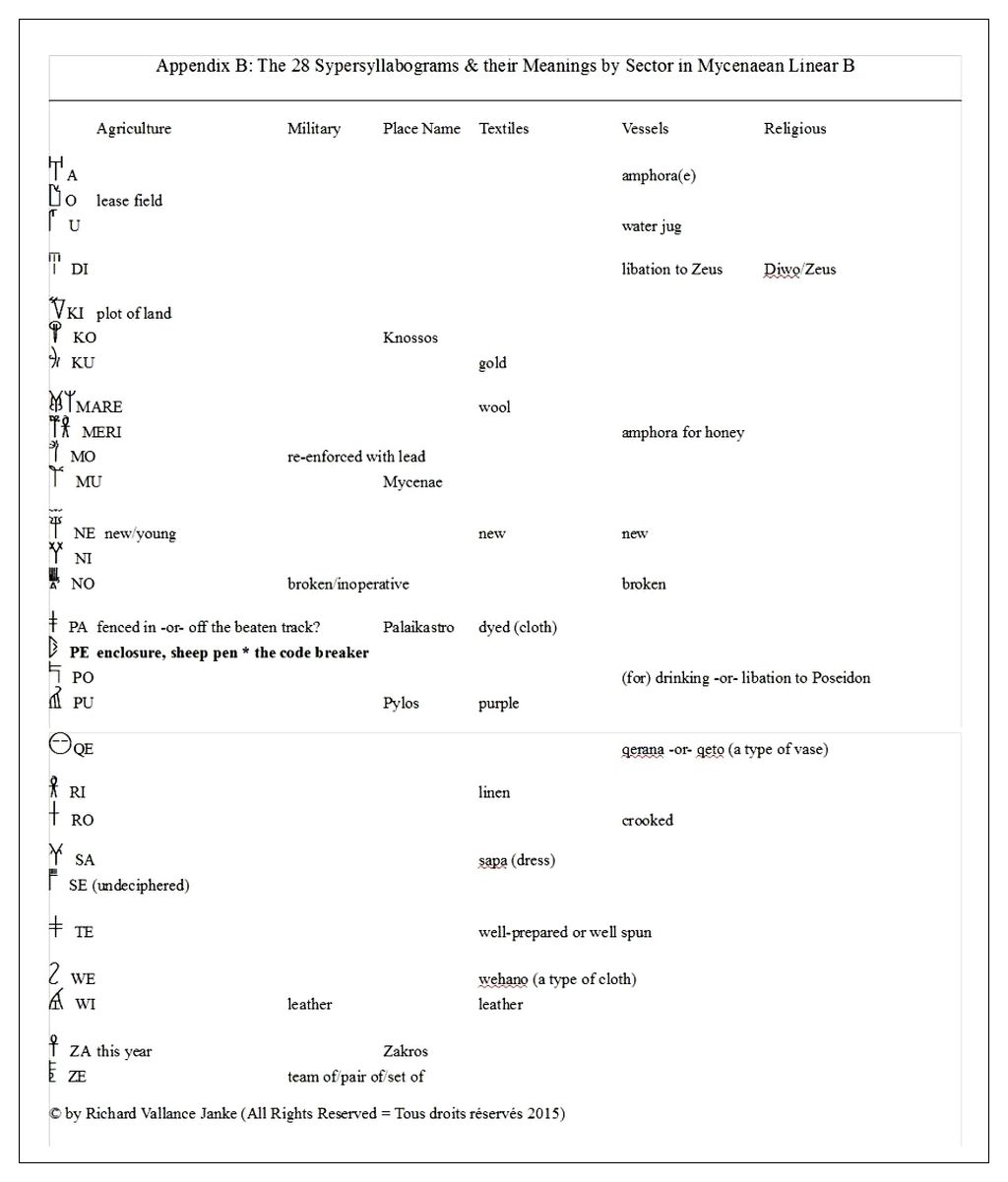


You must be logged in to post a comment.