When SETI showed us this amazing photo from space, I could not resist defining it in ancient Greek & Linear B + this fractal, also in French! Image shown to us by SETI on Twitter:What it means in ancient Greek and in Mycenaean Linear B:
What can you see (or not) in the image they posted? Oh and what about this? What is it a fractal of?
If you can read Greek, Mycenaean Linear B or French, you will know; otherwise you will have to guess. Let me know what you think it means & I will tell you if you are right. Richard
Tag: regressive extrapolation
-
My Twitter account completely updated, new header new photo, and new, wider perspectives: Click to ENLARGE
My Twitter account completely updated, new header new photo, and new, wider perspectives: Click to Visit:
 I have just updated and completely revised not only the appearance but the contents of my Twitter account, to reflect my widely expanding interests as related, either directly or indirectly, to Mycenaean Linear B, Minoan Linear A, Arcado-Cypriot Linear C, ancient Greek etc. etc. I have posted a new header, which you see above, incorporating the Linear B word for Knossos, and part of the stunning dolphins fresco in the Queen’s Megaron at Knossos, which you can see here: Click to ENLARGE
 As it now stands, in its short lifetime of less than two years, our Linear B (A & C) blog has become one of the primary Linear B resources on the entire Internet, with visits already running into the tens of thousands (an astounding figure for something as bizarre and esoteric as Linear B!). Soon approaching 40K, we expect at least 60K hits by our second anniversary, if not more. The reasons for this are obvious to anyone with even a passing interest in Linear B (A &C). Nothing is off-limits on our blog. Neither Rita Roberts, my research colleague, nor I, take anything for granted. We are both “doubting Thomases” to the core, casting doubt not only on translations of Linear B tablets by other Linear B researchers, but on one anothers as well, given that neither of us is in the least impervious to committing errors, sometimes egregious. Such errors must be drawn to our attention, come what may. If you are an expert in Linear B decipherment, and you do not like any translation either of us has made, feel free to give us a shout.
The other principal concerns and issues our blog frequently focuses on are:
1. keeping the Linear B syllabary right up to date. The syllabary chart most commonly used on the Internet is way out-of-date, and must be replaced by this one: Click to ENLARGE
As it now stands, in its short lifetime of less than two years, our Linear B (A & C) blog has become one of the primary Linear B resources on the entire Internet, with visits already running into the tens of thousands (an astounding figure for something as bizarre and esoteric as Linear B!). Soon approaching 40K, we expect at least 60K hits by our second anniversary, if not more. The reasons for this are obvious to anyone with even a passing interest in Linear B (A &C). Nothing is off-limits on our blog. Neither Rita Roberts, my research colleague, nor I, take anything for granted. We are both “doubting Thomases” to the core, casting doubt not only on translations of Linear B tablets by other Linear B researchers, but on one anothers as well, given that neither of us is in the least impervious to committing errors, sometimes egregious. Such errors must be drawn to our attention, come what may. If you are an expert in Linear B decipherment, and you do not like any translation either of us has made, feel free to give us a shout.
The other principal concerns and issues our blog frequently focuses on are:
1. keeping the Linear B syllabary right up to date. The syllabary chart most commonly used on the Internet is way out-of-date, and must be replaced by this one: Click to ENLARGE
 2. the introduction of the completely new theory of Supersyllabograms in Mycenaean Linear B, of which there are at least 30 from the store of 61 syllabograms. We have plenty of posts on our theory on our blog. Rita Roberts and I shall be publishing a major research article on supersyllabograms sometime in 2015 or 2016. If tenable, it should prove to be a revolutionary step forward in the decipherment of the remaining 10% or so of the Linear B syllabary, its homophones, logograms and ideograms as yet undeciphered over the past 62 years since Michael Ventris successfully and amazingly deciphered the other 90%. Our research will be widely available in PDF format on the Internet, and although copyrighted, will be free for use by any Linear B aficionados. Here is an example of just a few supersyllabograms, all dealing with sheep, rams & ewes, the primary concern of Linear B scribes by a long shot: Click to ENLARGE
 3. Progressive Linear B Vocabulary and Grammar, another all-new approach to the study of Linear B, whereby I intend to re-construct as much of the lost grammar of Mycenaean Greek as I possibly can. I have already completely mapped the active voice of both Thematic and Athematic verbs in Mycenaean Greek. Nouns, adjectives, adverbs and prepositions with cases are to follow in 2015. To view all posts on this topic, visit our PINTEREST Board, Mycenaean Linear B Grammar and Vocabulary:
 4. Rita Roberts and I shall be constructing an all new English-Linear B Lexicon sometimes between 2016 & 2018, which will be vastly superior to the currently available Mycenaean (Linear B) – ENGLISH Glossary on the Internet, of which the less said the better, as it is riddled with at least 100 errors! I strongly dis-advise anyone using it. If you must use a Mycenaean dictionary, be sure to avail yourselves of Chris Tselentsis’ far superior Linear B Lexicon.
5. the all new field of the feasibility of the possible application of the Linear syllabaries, especially B & C but also, to a lesser extent, Linear A, to the emerging field of extraterrestrial communication, by which I mean serious research as undertaken by NASA: Click to read the entire PDF
4. Rita Roberts and I shall be constructing an all new English-Linear B Lexicon sometimes between 2016 & 2018, which will be vastly superior to the currently available Mycenaean (Linear B) – ENGLISH Glossary on the Internet, of which the less said the better, as it is riddled with at least 100 errors! I strongly dis-advise anyone using it. If you must use a Mycenaean dictionary, be sure to avail yourselves of Chris Tselentsis’ far superior Linear B Lexicon.
5. the all new field of the feasibility of the possible application of the Linear syllabaries, especially B & C but also, to a lesser extent, Linear A, to the emerging field of extraterrestrial communication, by which I mean serious research as undertaken by NASA: Click to read the entire PDF
 and other space administration, research facilities and professional online sites, and not crackpot nonsense such as UFOs, alien abductions and the like. Here are a few comic strips just to make it clear exactly what I think of extraterrestrial crackpots: Click to ENLARGE
 followed by this famous quotation by Werner Karl Heisenburg: Click to read the Wikipedia article on him:
 These are just the 5 major ventures we are undertaking on our blog, but we do not shy away from anything whatsoever which advances our knowledge of Linear B in general and in particular.
My Twitter account has expanded its scope to include not only my primary pursuits, research into Linear A, B & C and ancient Greek, especially the archaic Greek of the Catalogue of Ships in book II of Homer’s Iliad, which I am in the process of translating in its entirety, as you can see here: Click to ENLARGE
These are just the 5 major ventures we are undertaking on our blog, but we do not shy away from anything whatsoever which advances our knowledge of Linear B in general and in particular.
My Twitter account has expanded its scope to include not only my primary pursuits, research into Linear A, B & C and ancient Greek, especially the archaic Greek of the Catalogue of Ships in book II of Homer’s Iliad, which I am in the process of translating in its entirety, as you can see here: Click to ENLARGE
 but also the following areas of great interest to me:
1. posting of major research articles, not only in English, but in French and Italian as well, the latter two of which I shall translate into English whenever I deem it necessary for our blog readers;
2. ancient Greek vocabulary, but exclusively in the East Greek dialects, Mycenaean Greek, Arcado-Cypriot, Aeolian, Ionic and Attic;
3. Decipherment of ancient languages in general, insofar as these related, either directly or indirectly, to Linear syllabaries;
4. Cryptology, such as the Bletchley Circle project in World War Two, and the key rôle the brilliant genius, Alan Turing, the equal of Michael Ventris in intellect, played in the decipherment of the Enigma Code, especially as this astounding achievement relates to...
5. thorough investigation and in-depth analysis of the possible suitability of of syllabic scripts such as Linear A, B & C into extraterrestrial communication (NOT UFO’s, which are crackpot nonsense suitable only to... I will not fill in the blanks!);
6. astronomy, Mars, exoplanets etc. (not reflected on this blog, of course, except insofar as it may possibly relate to Linear syllabaries), linguistics in general, including translation from one language to another, especially between English & French, in which as a Canadian I am fluent, Latin & Greek and Italian, which I read very well & Spanish, fairly well. I have forgotten my Russian, which I learned 50 years ago, but I can still read the Cyrillic alphabet with no difficulty. Linguistics and translation posts on this blog must in some way be related to Linear syllabaries, but not on my Twitter account, where anything important about linguistics in general is just fine with me.
Richard
but also the following areas of great interest to me:
1. posting of major research articles, not only in English, but in French and Italian as well, the latter two of which I shall translate into English whenever I deem it necessary for our blog readers;
2. ancient Greek vocabulary, but exclusively in the East Greek dialects, Mycenaean Greek, Arcado-Cypriot, Aeolian, Ionic and Attic;
3. Decipherment of ancient languages in general, insofar as these related, either directly or indirectly, to Linear syllabaries;
4. Cryptology, such as the Bletchley Circle project in World War Two, and the key rôle the brilliant genius, Alan Turing, the equal of Michael Ventris in intellect, played in the decipherment of the Enigma Code, especially as this astounding achievement relates to...
5. thorough investigation and in-depth analysis of the possible suitability of of syllabic scripts such as Linear A, B & C into extraterrestrial communication (NOT UFO’s, which are crackpot nonsense suitable only to... I will not fill in the blanks!);
6. astronomy, Mars, exoplanets etc. (not reflected on this blog, of course, except insofar as it may possibly relate to Linear syllabaries), linguistics in general, including translation from one language to another, especially between English & French, in which as a Canadian I am fluent, Latin & Greek and Italian, which I read very well & Spanish, fairly well. I have forgotten my Russian, which I learned 50 years ago, but I can still read the Cyrillic alphabet with no difficulty. Linguistics and translation posts on this blog must in some way be related to Linear syllabaries, but not on my Twitter account, where anything important about linguistics in general is just fine with me.
Richard
Share this:
-
NASA: Linear B and Extraterrestrial Communication: article in French by Prof. Richard Saint-Gelais of Laval University, Quebec
NASA: Linear B and Extraterrestrial Communication: article in French by Prof. Richard Saint-Gelais of Laval University, Quebec Linear B and Extraterrestrial Communication: E-mail in English I sent to Prof. Richard Saint-Gelais (Laval University) informing him that I will eventually translate his article into English: Archéologie, anthropologie et communication interstellaire 2 : Au-delà de Linéaire B - Le défi de la communication métasémiotique avec une intelligence Extraterrestre Richard Saint-Gelais, I congratulate you on your extraordinary perspective in French on the possibility of the application, however provisional, of the Mycenaean Linear B syllabary to extraterrestrial communication. Click on this banner to read the full research article in French by Prof. Richard Saint-Gelais:
 When I came upon the English translation of your translation of your article, somewhat abridged, in PDF format, I read it with great interest (See below).
As far as I can tell, your perspective is clearly unique and, in my opinion, quite the mind-boggling revelation on the prospects for the practical application of human scripts by nature essentially geometric to extraterrestrial communication. In fact, your research study, which takes an approach heretofore unheard of to this topic, fascinates me to no end, especially in light of my own in-depth research into any and all aspects of these syllabaries: Minoan Linear A, Mycenaean Linear B and Arcado-Cypriot Linear C. If you care to visit my blog, Linear B, Knossos & Mycenae, one of the key sites Linear B on the Internet, you can see for yourself that, taken in their own proper context, our theories, hypotheses and the practical applications of them play a key role in our numerous scrupulous translations of Linear B tablets, each and every one of which in turn significantly contributes to the timely dissemination of the most up-to-date academic research of the highest order into Linear B above all else, but also into the other two scripts referenced above. In addition, I just now sent you an e-mail of paramount importance, whereby I have let you in on my own primary concerns dealing with this very subject, revolutionary as it is likely to prove. It is my sincere hope that you will quite soon be open to further, more in-depth, discussion with me, with our mutual research interests in mind. Meanwhile, I must truly congratulate you. Yours, Richard Vallance Janke, Ottawa, Ontario, Canada.Or if you are allophone English, you can read the shorter, less detailed and less informative version of the original French article from NASA in PDF format here:
 ORIGINAL E-MAIL in French / premier courriel en français :
Je vous félicite, Richard Saint-Gelais, pour votre excellente perspective sur les possibilités d’application provisoire du syllabaire Linéaire B du Grec mycénéain à la communication exraterrestre, dont j’ai lu le texte intégral raccourci en anglais en format PDF ici:
Cette perspective est évidemment unique et, à mon avis, tout à fait époustouflante quant à la mise en pratique potentielle des écritures humaines de nature géometrique à la communication extraterrestre. En effet, votre étude de recherche sur une telle approche jusqu’ici inouïe me fascine énormément, surtout à la lumière de mes propres recherches approfondies sur tous les aspects des syllabaires, le Linéaire A minoen, le Linéaire B mycénéain et le Linéaire C arcade-chypriote. Si vous consultez mon blog, Linear B, Knossos and Mycenae, l’un des sites les plus importants en ligne sur le Linéaire B, vous verrez que le contexte de nos théories, de nos hypothèses, de la mise en oeuvre pratique de celles-là, ainsi que nos traductions considérables servent toutes et chacune à la dissémination la plus actualisée de la recherche dans le domaine des études académiques de première ordre sur le Linéaire B avant tout, mais également sur les deux autres écritures mentionnées ci-dessus. De plus, je viens de vous envoyer un courriel important qui vous communique mes propre préoccupations les plus significatives portant sur ce sujet révolutionnaire, tout en espérant que vous et moi, nous serons prêts à communiquer réciproquement à base plus profonde dans le prochain avenir. Entretemps, je vous salue sincèrement. Bien à vous. Richard Vallance Janke, Ottawa, Ontario, Canada.
NOTES:
1. Since this original article in French is significantly more comprehensive than the English article authored by Richard Saint-Gelais at NASA (see above), I shall eventually be translating the full text of this seminal article on the feasibility of syllabaries such as Linear B for extraterrestrial communication. This translation is bound to prove difficult, even for someone such as myself who, as a Canadian, is fluently bilingual English-French. So do not expect my translation online anytime soon. It is most likely to appear sometime in the winter of 2015.
2. For our francophone and bilingual English-French readers. You can read the full text of Richard Saint-Gelais’ original research article in French, which preceded his PDF study at NASA (link above) here:
Archéologie, Anthropologie et Communication Interstellaire 2 :
ORIGINAL E-MAIL in French / premier courriel en français :
Je vous félicite, Richard Saint-Gelais, pour votre excellente perspective sur les possibilités d’application provisoire du syllabaire Linéaire B du Grec mycénéain à la communication exraterrestre, dont j’ai lu le texte intégral raccourci en anglais en format PDF ici:
Cette perspective est évidemment unique et, à mon avis, tout à fait époustouflante quant à la mise en pratique potentielle des écritures humaines de nature géometrique à la communication extraterrestre. En effet, votre étude de recherche sur une telle approche jusqu’ici inouïe me fascine énormément, surtout à la lumière de mes propres recherches approfondies sur tous les aspects des syllabaires, le Linéaire A minoen, le Linéaire B mycénéain et le Linéaire C arcade-chypriote. Si vous consultez mon blog, Linear B, Knossos and Mycenae, l’un des sites les plus importants en ligne sur le Linéaire B, vous verrez que le contexte de nos théories, de nos hypothèses, de la mise en oeuvre pratique de celles-là, ainsi que nos traductions considérables servent toutes et chacune à la dissémination la plus actualisée de la recherche dans le domaine des études académiques de première ordre sur le Linéaire B avant tout, mais également sur les deux autres écritures mentionnées ci-dessus. De plus, je viens de vous envoyer un courriel important qui vous communique mes propre préoccupations les plus significatives portant sur ce sujet révolutionnaire, tout en espérant que vous et moi, nous serons prêts à communiquer réciproquement à base plus profonde dans le prochain avenir. Entretemps, je vous salue sincèrement. Bien à vous. Richard Vallance Janke, Ottawa, Ontario, Canada.
NOTES:
1. Since this original article in French is significantly more comprehensive than the English article authored by Richard Saint-Gelais at NASA (see above), I shall eventually be translating the full text of this seminal article on the feasibility of syllabaries such as Linear B for extraterrestrial communication. This translation is bound to prove difficult, even for someone such as myself who, as a Canadian, is fluently bilingual English-French. So do not expect my translation online anytime soon. It is most likely to appear sometime in the winter of 2015.
2. For our francophone and bilingual English-French readers. You can read the full text of Richard Saint-Gelais’ original research article in French, which preceded his PDF study at NASA (link above) here:
Archéologie, Anthropologie et Communication Interstellaire 2 :Voici quelques illustrations tirées de son article (A Few Illustrations from his article): Cliquer pour élargir : Click to ENLARGE
 Excerpts in French from his article: Au-delà de Linéaire B - Le défi de la communication métasémiotique avec une intelligence Extraterrestre Par Richard Saint-Gelais - Chapitre 5 Perspectives sémiotiques sur SETI
La Communication, comme nous le savons tous, est une entreprise délicate entre les êtres humains. Donc, il y a des raisons de douter que ce serait une chose facile à travers l'univers. Dans cet essai, je vais essayer de décrire un ensemble de problèmes théoriques qui pourraient affecter la communication avec des intelligences extraterrestres... passim ... Je dois dire d'emblée que ma position est similaire au scepticisme épistémique que je viens de mentionner. Mais mon point de vue sera légèrement différent de ça, mais pas incompatible avec la perspective épistémique. Je vais appliquer les théories et les méthodes d'analyses sémiotiques au problème de la communication interstellaire, en mettant l'accent sur les signes, le langage, le sens et l'interprétation... passim... Les conséquences que ces considérations ont pour la communication interstellaire sont tout à fait évidentes. Cette communication, si elle est couronnée de succès, doit surmonter les difficultés inhérentes à un échange où l'expéditeur et le destinataire ne partagent pas un langage commun; ce dernier ne peut se prévaloir d'une compétence linguistique déjà établies avec laquelle travailler sur le sens du message, mais doit plutôt commencer avec le message lui-même et essayer d'en déduire, par conjecture, les règles lexicales et syntaxiques qui lui confèrent une signification. Du point de vue de l'expéditeur, le défi est de concevoir un message qui comprendra, en quelque sorte, le contexte d'interprétation nécessaires pour lui donner un sens. En d'autres termes, l'expéditeur doit, apparemment, produire ce paradoxe sémiotique: un message d'auto-interprétation... passim ... Décrypter d'Ancient Scripts La question, bien sûr, est : dans quelle mesure est-ce possible ? Une comparaison avec l'inverse, une situation de non coopération - le déchiffrement de messages codés ou d'inscriptions écrites en langues éteintes - peuvent apporter un regard neuf sur les problèmes invoqués. .. passim ... Sur le plan sémiotique, la similitude entre les trois types de situations est évidente. Décrypter des inscriptions dans des langues inconnues ou des messages en codes secrets implique à faire face à des chaînes de signes, sans avoir aucune connaissance préalable des règles de codage, de sorte que la reconnaissance de ces règles devient l'une des finalités (à la place des moyens, comme c'est généralement le cas) du processus de l'interprétation. Le déchiffreur des langues inconnues tente d'établir la valeur phonétique et / ou sémantique des symboles. Le décrypteur de messages secrets cherche à identifier le principe régissant le remplacement et / ou la permutation de lettres. Donc, les deux activités peuvent être comparées à la réception d'un message interstellaire et pour tenter d'interpréter sans avoir une idée préalable des règles de codage, le cas échéant, concernant la production des signaux... passim ... Prenons, par exemple, les types de systèmes d'écriture que les cultures humaines ont développé. Il est possible de déterminer, à partir du nombre de caractères différents que possède une langue, le type de système d'écriture qu'il soutient. S'il n'y a que entre 20 et 40 caractères, c'est un système alphabétique; si il y a environ 100 caractères, nous avons un système syllabique dans lequel chaque symbole traduit une syllabe (par exemple, ta, te, ti, à). l'appareil phonologique des êtres extraterrestres peut être tout à fait différent du nôtre; leurs langues peuvent avoir des unités plus ou moins phonétiques par rapport aux nôtres ou peuvent reposer sur une base physiologique sans rapport avec son articulation... passim ... Le plus célèbre d'entre eux est le cas du linéaire B, un système d'écriture trouvé sur des tablettes d'argile sur l'île de Crète, déchiffré par Michael Ventris dans les années 1950, sur la base d'un important travail visionnaire que Alice Kober avait fait avant lui. Ventris a utilisé une méthode purement formelle, regroupant ensemble les mots ayant le même début et puis d'en déduire, ou plutôt enlever, à quelles variations grammaticales les différentes terminaisons correspondaient (par exemple, le sexe, le chiffre, etc.). Finalement, il a produit une grille sur laquelle la valeur phonétique de chaque signe a été enregistré. Cette grille a conduit à la découverte inattendue de Ventris, que les symboles linéaire B traduisaient une forme très ancienne de Grec. Cette conclusion de l'histoire sape un promettant abord sur une comparaison entre les écritures anciennes et une communication extraterrestre. Ventris ne savait pas à l'avance quelle langue était «derrière» le linéaire B, mais bien sûr, il ne pouvait le reconnaître, car il était différent du grec classique, quand il le "perçu", il l'a dit lorsque suffisamment de preuves ont été accumulées pour révéler le lien. Nous ne pouvons pas, bien sûr, s'attendre à une telle reconnaissance à travers des distances inter-stellaires... passim ... Cette discussion sur les symboles, les icônes et les indices ne conduit pas inévitablement à la conclusion que les messages interstellaires doivent inclure uniquement des types de signes plus faciles à interpréter. Nous devons nous rappeler que le message ne se compose pas d'un signe isolé, mais de (parfois complexes) combinaisons de signes, qui peuvent contribuer à leur élucidation réciproque... passim... Ce qui peut aider de façon décisive ce destinataire final est l'interprétation mutuelle que des parties du message proviennent d'un autre (mais une interprétation qui doit encore être sous-entendue, c'est-à-dire interprétée comme telle) et le jeu systématique de la répétition et de la variation entre les images, qui donnera aux destinataires la possibilité de faire des conjectures et enlèvements, que les images suivantes peuvent confirmer ou infirmer, dans ce dernier cas en appuyant pour que les bénéficiaires lecteurs révisent leurs hypothèses précédentes... passim ... Linéaire B et autres Dans son livre sur les langues éteintes, Johannes Friedrich souligne que la direction dans laquelle un script doit être lu peut parfois être déduite de l'espace vide à la fin de la dernière ligne d'une inscription. Ici nous avons un indice, un signe causé par son objet : la direction de la rédaction est concrètement responsable de quel côté la dernière ligne est vide. Mais ce n'est pas un signe très remarquable qu'il ne nécessite pas un raisonnement abductif (d'enlèvement). Aussi étrange que cela puisse paraître, je vois dans ce petit exemple des raisons d'espérer en ce qui concerne la communication interstellaire. Nous avons tendance à conceptualiser la communication avec des intelligences extraterrestres en termes de transmission réussie dans le sens voulu. Mais la production et la réception de signes ne peuvent pas être limités à un plan intentionnel. Une caractéristique importante de la plupart des indices est leur nature involontaire. Cela s'applique non seulement en des signes naturels, tels que la fumée, mais aussi dans les productions conscientes des signes, qui comprennent toujours un aspect indiciel provenant d'ailleurs de ce que l'expéditeur a voulu dire. Le touriste est confronté à une anomalie, comme nous l'avons vu, qui peut le mener à conclure à tort que c'est une erreur; mais cette hypothèse devient de moins en moins plausible lorsqu'il ou elle rencontre plus d'anomalies. Pour moi, la répétition devient un indice de la nature régulière de ce signe, même si cette indication n'a jamais traversé l'esprit des auteurs des textes. Cet exemple montre une fois de plus le rôle central de l'interprétation. L'insistance de Peirce sur le rôle de l'interprétant implique qu'un signe, dès qu'il est reconnu comme tel (ce qui est déjà le résultat d'une interprétation), est soumis à un processus d'interprétations sans fin et souvent inattendues. Ce sera certainement le cas si, par hasard, nos signaux sont reçus par des êtres intelligents, quelles que soient leur physiologie ou leur culture. Nous pouvons compter, jusqu'à un certain point, sur l'ingéniosité des bénéficiaires. Bien qu'ils ne peuvent pas comprendre les choses particulières que nous voulons communiquer, ils peuvent au moins reconnaître et interpréter, peut-être même de manière fructueuse, certains indices laissés tout à fait involontairement. Le scribe sumérien qui a laissé une partie de la ligne vide ne pouvait pas imaginer qu'il quittait un signe qui serait lu et utilisé plusieurs siècles plus tard par un archéologue. La situation de SETI n'est pas vraiment très différente. De l'expérience des décrypteurs de langues éteintes, il semble que l'envoi du plus grand nombre et de différents messages que possible est la meilleure stratégie, celle qui offre le plus de chance au destinataire. Le contenu de nos messages peut être beaucoup moins important que le nombre et la variété des messages que nous envoyons, mais seulement parce qu'ils donneront aux bénéficiaires plus de possibilités de comparer et tester leurs enlèvements sur les messages passés contre de nouveaux exemples. En l'absence de commentaires, c'est peut-être le meilleur plan d'action pour une élaboration de nos "messages dans une bouteille interstellaire." par Richard Saint-Gelais,Université Laval, Québec, Québec
Share this:
-
The Implications of the Linear B Geometric Syllabary for the Search for Extraterrestrial Intelligence: Part 1 — The Biggest Bang you will ever have seen from this blog!… so far… stay tuned!
The Implications of the Linear B Geometric Syllabary for the Search for Extraterrestrial Intelligence: Part 1 — The Biggest Bang you will ever have seen from this blog!... so far... stay tuned! Before I go any further, allow me to state categorically that this message the Voyager Space Capsules launched in 1977 with one of their missions being to search out suppositional extraterrestrials, is primitive at best, and ludicrous at its worst. Click to ENLARGE:
 As far as I can figure it out (which isn’t very much at all - not that it matters), the message on this disc is difficult even for most humans to interpret, unless they happen to be astrophysicists, mathematicians or some sort of scientific geek. Unless the reader is human, it is probably impossible to make to make head or tails of it. And I for one, even though I am human and hopefully intelligent, cannot even begin to imagine how any target extraterrestrial civilization could even begin to out how to play the damn thing, unless they had a record player (ahem, as if!), a device already obsolete even to us! One of the fundamentally flawed assumptions of this analog device is that you have to play it on a device the human race alone has invented. The very concept of playing an analog recorded medium could very well be completely impenetrable to even the most advanced extraterrestrial civilizations, who might find the whole thing so laughable they would toss it out “the window”, assuming they even had windows, which is a helluva stretch in and of itself.
In the Wikipedia article on this mission, we read this:
Voyager 1 and 2 both carry with them a golden record that contains pictures and sounds of Earth, along with symbolic directions for playing the record and data detailing the location of Earth.
This patently assumes that whoever or whatever intelligence eventually (!) receives this message will look a great deal like us (i.e. be anthropomorphic) and will think almost exactly as we do, and so will understand human music, and will be able to interpret the capsule’s human historical, photographic archives & over a thousand human languages... probably so much gibberish to our poor benighted recipients some countless millennia hence, assuming it arrives in one piece, if at all. So as far as I am concerned, this mission is paramount to a futile exercise in pipe-dreaming. Even in 1977, when I was only 32 years old, I considered the whole thing a complete waste of time, money and human resources. If anything is a near-perfect example of “thinking inside the box, with the lid closed and sealed”, that project had to be it. This will all become all too painfully obvious as we proceed through our discussion of the truly formidable, quite possibly even insurmountable challenges of interstellar communication. Of course, since then, in the past 37 years, humankind has apparently begun to grow up from mid- to late-adolescence, to burst the chains of the outer limits of human consciousness as it then manifested itself, and quite literally gone cosmic. We appear to be on the cusp of our next leap in human consciousness, and if it is indeed transpiring at this very moment in our history, we are in for one helluva roller-coaster ride, the likes of which humankind has never come close to imagining in the past, right up to and including the twentieth century.
Richard Saint-Gelais’ Survey of the Potential Implications of the Application of the Linear B Syllabary as a Cipher for Extraterrestrial Communication:
In the first of our two previous posts we introduced the proposals that Richard Saint-Gelais of NASA set forth in the potentially theoretical, if not quite yet practical, application of the Mycenaean Greek Linear B Geometric Syllabary to the search for extraterrestrial intelligence. In the second of these posts, I myself posited some of the assumptions, principles and hypotheses underpinning a search of such tremendous magnitude that it stretches the powers of human reasoning practically beyond its outer limits.
Still, history has repeatedly demonstrated that our intellect and powers of reasoning can be, and at certain junctures in the timeline of human evolution, are stretched another notch up the ladder beyond the presumptive limits of our previously adduced levels of abstractive powers, finally allowing us today, for the first time in human history, to think more and more, and more and more swiftly “outside the box” than ever before prior to the twenty-first century.
The Ancient Greeks Take the First Great Leap of the Human Intellect onto the Higher Plane of Abstract Reasoning:
The first great leap onto the purely abstract plane of reasoning was taken by the ancient Greeks, in two discreet stages:
(A) the complete overhaul of the Minoan Linear A syllabary into the Mycenaean Greek Linear B syllabary, which swiftly and unceremoniously tossed overboard the most complicated and abstruse Linear B syllabograms, homophones & ideograms (some 1/4 of some 300), in less than 50 years, an incredibly rapid turnover in terms of socio-linguistic change, which otherwise nearly always occurred at a snail’s pace in the ancient world.
But there is even more to this picture than we can possibly have imagined before the 1990s at the very earliest. Despite the proliferation of puissant supercomputers and the quasi-instantaneous communication afforded by the World Wide Web, a much better semiotic signifier for what it actually is than the word, “Internet”, which is significantly lamer, I say again, in spite of all these extremely recent massive technological advances at our disposal, the Minoan Linear A syllabary, which for a human language was already a quasi-geometric script complete with the base set of 5 vowels for the first time in history, has utterly defied any and all attempts whatsoever at decipherment since Sir Arthur Evans first excavated the ruins of Knossos in the spring of 1900. It just won’t budge a single centimetre. Now, if we are utterly incapable of deciphering a human language, Minoan in Linear A, even with all of our technological gadgets and goodies at our instant command, including The University of California Berkeley Campus’ newly conceived automated “time machine” to reconstruct ancient languages, Click to visit the site:
As far as I can figure it out (which isn’t very much at all - not that it matters), the message on this disc is difficult even for most humans to interpret, unless they happen to be astrophysicists, mathematicians or some sort of scientific geek. Unless the reader is human, it is probably impossible to make to make head or tails of it. And I for one, even though I am human and hopefully intelligent, cannot even begin to imagine how any target extraterrestrial civilization could even begin to out how to play the damn thing, unless they had a record player (ahem, as if!), a device already obsolete even to us! One of the fundamentally flawed assumptions of this analog device is that you have to play it on a device the human race alone has invented. The very concept of playing an analog recorded medium could very well be completely impenetrable to even the most advanced extraterrestrial civilizations, who might find the whole thing so laughable they would toss it out “the window”, assuming they even had windows, which is a helluva stretch in and of itself.
In the Wikipedia article on this mission, we read this:
Voyager 1 and 2 both carry with them a golden record that contains pictures and sounds of Earth, along with symbolic directions for playing the record and data detailing the location of Earth.
This patently assumes that whoever or whatever intelligence eventually (!) receives this message will look a great deal like us (i.e. be anthropomorphic) and will think almost exactly as we do, and so will understand human music, and will be able to interpret the capsule’s human historical, photographic archives & over a thousand human languages... probably so much gibberish to our poor benighted recipients some countless millennia hence, assuming it arrives in one piece, if at all. So as far as I am concerned, this mission is paramount to a futile exercise in pipe-dreaming. Even in 1977, when I was only 32 years old, I considered the whole thing a complete waste of time, money and human resources. If anything is a near-perfect example of “thinking inside the box, with the lid closed and sealed”, that project had to be it. This will all become all too painfully obvious as we proceed through our discussion of the truly formidable, quite possibly even insurmountable challenges of interstellar communication. Of course, since then, in the past 37 years, humankind has apparently begun to grow up from mid- to late-adolescence, to burst the chains of the outer limits of human consciousness as it then manifested itself, and quite literally gone cosmic. We appear to be on the cusp of our next leap in human consciousness, and if it is indeed transpiring at this very moment in our history, we are in for one helluva roller-coaster ride, the likes of which humankind has never come close to imagining in the past, right up to and including the twentieth century.
Richard Saint-Gelais’ Survey of the Potential Implications of the Application of the Linear B Syllabary as a Cipher for Extraterrestrial Communication:
In the first of our two previous posts we introduced the proposals that Richard Saint-Gelais of NASA set forth in the potentially theoretical, if not quite yet practical, application of the Mycenaean Greek Linear B Geometric Syllabary to the search for extraterrestrial intelligence. In the second of these posts, I myself posited some of the assumptions, principles and hypotheses underpinning a search of such tremendous magnitude that it stretches the powers of human reasoning practically beyond its outer limits.
Still, history has repeatedly demonstrated that our intellect and powers of reasoning can be, and at certain junctures in the timeline of human evolution, are stretched another notch up the ladder beyond the presumptive limits of our previously adduced levels of abstractive powers, finally allowing us today, for the first time in human history, to think more and more, and more and more swiftly “outside the box” than ever before prior to the twenty-first century.
The Ancient Greeks Take the First Great Leap of the Human Intellect onto the Higher Plane of Abstract Reasoning:
The first great leap onto the purely abstract plane of reasoning was taken by the ancient Greeks, in two discreet stages:
(A) the complete overhaul of the Minoan Linear A syllabary into the Mycenaean Greek Linear B syllabary, which swiftly and unceremoniously tossed overboard the most complicated and abstruse Linear B syllabograms, homophones & ideograms (some 1/4 of some 300), in less than 50 years, an incredibly rapid turnover in terms of socio-linguistic change, which otherwise nearly always occurred at a snail’s pace in the ancient world.
But there is even more to this picture than we can possibly have imagined before the 1990s at the very earliest. Despite the proliferation of puissant supercomputers and the quasi-instantaneous communication afforded by the World Wide Web, a much better semiotic signifier for what it actually is than the word, “Internet”, which is significantly lamer, I say again, in spite of all these extremely recent massive technological advances at our disposal, the Minoan Linear A syllabary, which for a human language was already a quasi-geometric script complete with the base set of 5 vowels for the first time in history, has utterly defied any and all attempts whatsoever at decipherment since Sir Arthur Evans first excavated the ruins of Knossos in the spring of 1900. It just won’t budge a single centimetre. Now, if we are utterly incapable of deciphering a human language, Minoan in Linear A, even with all of our technological gadgets and goodies at our instant command, including The University of California Berkeley Campus’ newly conceived automated “time machine” to reconstruct ancient languages, Click to visit the site:
 imagine how much more alarmingly daunting must be the gargantuan task of beginning to scratch even the surface of communicating anything sensible to any extraterrestrial civilization whatsoever. But is the task really all that hopeless?
Although the Linear B syllabary was used by the scribes at Knossos, Pylos, Mycenae, Phaistos, Thebes (in Greece) and in several other Mycenaean locales, almost solely for accounting and inventories, which function primarily on a concrete and semi-abstract level, the script itself, being fundamentally and almost exclusively geometric in nature, was by far the most abstract script ever developed in the ancient world until that time (ca. 1450 BCE). Geometric abstraction is also one of the outstanding characteristics of Minoan & Mycenaean architecture, as illustrated in these two examples:
Knossos: Click to ENLARGE
imagine how much more alarmingly daunting must be the gargantuan task of beginning to scratch even the surface of communicating anything sensible to any extraterrestrial civilization whatsoever. But is the task really all that hopeless?
Although the Linear B syllabary was used by the scribes at Knossos, Pylos, Mycenae, Phaistos, Thebes (in Greece) and in several other Mycenaean locales, almost solely for accounting and inventories, which function primarily on a concrete and semi-abstract level, the script itself, being fundamentally and almost exclusively geometric in nature, was by far the most abstract script ever developed in the ancient world until that time (ca. 1450 BCE). Geometric abstraction is also one of the outstanding characteristics of Minoan & Mycenaean architecture, as illustrated in these two examples:
Knossos: Click to ENLARGE
 Here we can instantly isolate the perfectly Circular Frieze Motif shown here on one of the two buildings at Knossos, a motif which appears over and over on several Minoan and Mycenaean structures. Notice also that the other edifice is perfectly straight in every plane, including the then revolutionary liberal use of skylights for interior illumination. You can readily see that the building reminds us of the architecture of Frank Lloyd Wright (1867-1959), the first true pioneer in the advent of modern architecture. This is no accident. Lloyd Wright took much of his inspiration for the foundation of his architectural constructs from Japanese and, yes, Minoan architecture. Once again, this should not come as any surprise to anyone familiar with the amazing achievements of one of the most brilliant architects in the history of humankind, an architect whose applied principles fundamentally relied on the application of geometry to his buildings and structures.
 Mycenae:
Even more astounding are the near perfect geometric proportions of the Mycenaean Tesoro Atreoyo (Treasury of Atreus), which the Mycenaeans constructed with astonishing mathematical accuracy hundreds of years before the great Greek mathematicians finally came round to working out the complex geometric and algebraic theorems underlying the elegant geometric proportions of this magnificent structure: Click to ENLARGE
Mycenae:
Even more astounding are the near perfect geometric proportions of the Mycenaean Tesoro Atreoyo (Treasury of Atreus), which the Mycenaeans constructed with astonishing mathematical accuracy hundreds of years before the great Greek mathematicians finally came round to working out the complex geometric and algebraic theorems underlying the elegant geometric proportions of this magnificent structure: Click to ENLARGE
 SOURCE: Metron Ariston (Greek for “The Ideal Mean” (from: Liddell & Scott, 1986, pg. 442)
 What can I say? The Mycenaeans were Greeks down to their very marrow.
As anyone with even a passing acquaintance with the Linear B syllabary can attest, its geometric elegance and economy is second-to-none.
Are Ancient Scripts Primitive?
When modern writers and the occasional deluded linguist refer to ancient scripts as “primitive”, as compared with so-called “modern” alphabets, which for Occidental languages (Greek & Latin) are ancient anyway, they do a great disservice to the former, propagating totally false misconceptions on that account alone. In point of fact, there is no such thing as a “primitive” script, which leads me almost inexorably to my next observation: if there are no primitive scripts, there are no modern, all scripts (ideographies, syllabaries & alphabets) ancient or modern being as sound as any other. It follows logically then that any and all future scripts as yet uninvented will also serve as well as, but no better than, the thousands of scripts humankind has dabbled in over the past 10 millennia at least, including any which we may devise for extraterrestrial communication. The implications of this factor alone are profound. They inform us that any language whatsoever we use for communication, terrestrial or otherwise is, and can only be, human, whoever tautological this may sound... or so it may appear.
Now, the implications of this scenario for the potential transmission of some sort of set of signals susceptible to possible decipherment by extraterrestrial intelligences are profound. My point is simply this: if the historical timeline in the (apparent) “evolution” of human scripts is not sufficiently impressive even for us to make a big deal out of it, and if the transmission of any one or more of humankind’s most mathematically elegant scripts, past or present – and eventually future – are deemed by some to be just the right recipe, then why not try them? What have we got to lose? Nothing... to gain? - cosmic communication = cosmic consciousness. Now there’s something to put in your pipe & smoke.
(B) Then the very same people, the Greeks, went plunging ahead, completely abandoning the Mycenaean Linear B syllabary for the even more elegant Greek alphabet, but significantly not casting aside the Arcado-Cypriot Linear C syllabary (even more geometrically economic than Linear B), which held its own right down to 400 BCE! No use re-inventing the wheel, or so the Arcadians and Cypriots believed. But, and here is the wringer. Now get this! The Linear C syllabary was no longer used merely for record keeping and inventory purposes, in fact, far from it. Its primary use was for publication of much more abstract legal and constitutional documents. Abstract geometric syllabary, abstract thought. That’s the next big leap forward. And the next: abstract geometric syllabary --> abstract communication --> abstract extraterrestrial communication.
What about the Greek Alphabet, and its Widespread Use for Algebraic Notation?
Now, of course, the Greek alphabet itself is not characteristically geometric, so we can pretty much eliminate it, and for that matter any other Occidental alphabet (Latin or Cyrillic) as suitable for interstellar communication. This includes our Arabic numerals, which you can be pretty much sure no extraterrestrial civilization would be able to distinguish from letters in an alpha-numeric system, since all characters in such a system would look the same to them, and almost certainly far too complex for them to take seriously.
We can also be pretty well assured that no extraterrestrial civilization, even if they too used alphabets, would have the faintest idea what human alphabets were supposed to be signifiers of. But does that really matter? My short answer is simply, not at all. If we were to transmit from the source (ourselves) for instance just these rectilinear & circular 10 Linear B symbols &/or 10 Linear C symbols – for a potential total of 20 — as simple signals and nothing more (10 supposedly being a universally recognizable number), all kinds of wacky scenarios are likely to transpire at the target (them, whoever or whatever they are).
What can I say? The Mycenaeans were Greeks down to their very marrow.
As anyone with even a passing acquaintance with the Linear B syllabary can attest, its geometric elegance and economy is second-to-none.
Are Ancient Scripts Primitive?
When modern writers and the occasional deluded linguist refer to ancient scripts as “primitive”, as compared with so-called “modern” alphabets, which for Occidental languages (Greek & Latin) are ancient anyway, they do a great disservice to the former, propagating totally false misconceptions on that account alone. In point of fact, there is no such thing as a “primitive” script, which leads me almost inexorably to my next observation: if there are no primitive scripts, there are no modern, all scripts (ideographies, syllabaries & alphabets) ancient or modern being as sound as any other. It follows logically then that any and all future scripts as yet uninvented will also serve as well as, but no better than, the thousands of scripts humankind has dabbled in over the past 10 millennia at least, including any which we may devise for extraterrestrial communication. The implications of this factor alone are profound. They inform us that any language whatsoever we use for communication, terrestrial or otherwise is, and can only be, human, whoever tautological this may sound... or so it may appear.
Now, the implications of this scenario for the potential transmission of some sort of set of signals susceptible to possible decipherment by extraterrestrial intelligences are profound. My point is simply this: if the historical timeline in the (apparent) “evolution” of human scripts is not sufficiently impressive even for us to make a big deal out of it, and if the transmission of any one or more of humankind’s most mathematically elegant scripts, past or present – and eventually future – are deemed by some to be just the right recipe, then why not try them? What have we got to lose? Nothing... to gain? - cosmic communication = cosmic consciousness. Now there’s something to put in your pipe & smoke.
(B) Then the very same people, the Greeks, went plunging ahead, completely abandoning the Mycenaean Linear B syllabary for the even more elegant Greek alphabet, but significantly not casting aside the Arcado-Cypriot Linear C syllabary (even more geometrically economic than Linear B), which held its own right down to 400 BCE! No use re-inventing the wheel, or so the Arcadians and Cypriots believed. But, and here is the wringer. Now get this! The Linear C syllabary was no longer used merely for record keeping and inventory purposes, in fact, far from it. Its primary use was for publication of much more abstract legal and constitutional documents. Abstract geometric syllabary, abstract thought. That’s the next big leap forward. And the next: abstract geometric syllabary --> abstract communication --> abstract extraterrestrial communication.
What about the Greek Alphabet, and its Widespread Use for Algebraic Notation?
Now, of course, the Greek alphabet itself is not characteristically geometric, so we can pretty much eliminate it, and for that matter any other Occidental alphabet (Latin or Cyrillic) as suitable for interstellar communication. This includes our Arabic numerals, which you can be pretty much sure no extraterrestrial civilization would be able to distinguish from letters in an alpha-numeric system, since all characters in such a system would look the same to them, and almost certainly far too complex for them to take seriously.
We can also be pretty well assured that no extraterrestrial civilization, even if they too used alphabets, would have the faintest idea what human alphabets were supposed to be signifiers of. But does that really matter? My short answer is simply, not at all. If we were to transmit from the source (ourselves) for instance just these rectilinear & circular 10 Linear B symbols &/or 10 Linear C symbols – for a potential total of 20 — as simple signals and nothing more (10 supposedly being a universally recognizable number), all kinds of wacky scenarios are likely to transpire at the target (them, whoever or whatever they are).
 Now, of course, since our target extraterrestrial civilization will not have the faintest idea what these symbols mean to us, as humans – if they see them as symbols as such at all – or whether or not they simply see them as geometric signals, the latter will do the trick just fine, thank you very much. So in this case, it does not matter a hill of beans which syllabograms from which syllabary we as the source civilization transmit to them, the target civilization, since they are going to interpret these 20 signals – if we decide to send that many – whatever damn well way suits them just fine, regardless of who we are, since they could care less anyway. All that would matter to them is that someone or some entity or entities from somewhere in our (meaning, their) galactic neighbourhood sent them a signal that meant something significant to themselves (the targets), though God only knows what. And why should we care any more than they do anyway? Come to think of it, they do not even have to live on a planet such as we construe it. If they do not, they might just as easily assume that whoever or whatever sent the signal would not live on a “planet” either. Any scenario is possible. So for this reason alone, if it were up to me to send the signal, I would simply mix-and-match Linear B & Linear C geometric signifiers any old way I felt like, and be damned the consequences... well, that might be a bit of an overstatement in case they turn out to be hostiles, we piss them rightly off and they invade us! But the chances of that ever happening are so extremely remote as to approach quantum zero.
Still, we have to admit that the Linear B & Linear C syllabaries have a helluva lot going for them. If anything, both are eminently suited for extraterrestrial communication, for the following reasons (as I see it):
1. What is the “Message” in the Extraterrestrial Communication Medium? What does it signify? Does it matter to “them”? Should it matter to us? Whose “Message” is it anyway? Woah!
As Richard Saint-Gelais correctly points out, any attempt on our part to communicate with extraterrestrial intelligences cannot, and must not, be based on what we as humans understand as being signifier(s) and signified, but rather on (hopefully) recognizable patterned sequences, by which I mean either digital (0 1), decimal or geometric, but not algebraic (see above). In fact, I posit that it does not matter a hill of beans whether signals of these three mathematical orders mean anything at all like what they clearly signify to us, but not clearly at all to our extraterrestrial compeers, other than what they signify to them, and in that light, applying reverse logic, almost certainly not to us. All that matters is that they, our extraterrestrial buddies, understand that the constructs mean whatever the hell they mean to them. If they do meaning anything, anything at all, then we will have established communication.
Funny Things Happened on the Way to the Extraterrestrial Conference:
Let us imagine a few ludicrous sounding examples. Say, for instance, we transmit a circle in the source signal, and our extraterrestrial friends at the target “read it”. Well, what if the circle we send is not abstract at all to them, but concrete only? What if they cannot even think on the abstract, connotative plane? Don’t laugh. Maybe to them the circle is just one of a thousand polka dots on one of their pet five-legged orgathonics with two heads and four arms, but no legs, just flippers instead. Again, take the straight line. Same scenario. If the language of that particular extraterrestrial civilization is concrete and denotative only, it would not matter how many straight lines we transmitted to them. They simply would not recognize them as such. But they would recognize them as something concrete, such as, for instance, a pole sticking in the ground.
2. The exact reverse scenario may just as easily obtain, namely that a particular extraterrestrial intelligence we sloppily target and by sheer accident hit (there is after all no other way we would hit them, if we ever could... imagine trying to hit the Earth with a pin-pong ball from 1,000 light years away!) uses a language or languages which are absolutely abstract and connotative, and not concrete and denotative at all. I hear someone shouting, “Eureka! We’re in luck!” Not so fast. To such a civilization a circle may be far more than just a circle or a straight line as we envision them. To them, a circle might automatically mean a sphere, if even their language is entirely three-dimensional on the abstract plane. Woops! As for a straight line, God forbid! It would at the very least probably be that naughty old straight line drawn out to infinity, and looping back in a circle to the point where it started to bite them in the conjectural ass. Then they would really get confused!
To them, a circle and a straight line might even be paramount to one & the same phenomenon, so I can hear them asking themselves, “Why would anyone or any entity such as ourselves bother sending the same exact symbol as two discrete symbols – unless of course they were stupid?” If that were the case, I suspect that they would not even bother communicating with us, targeting us with their far more intelligent signals, because they would (rightly) see us as utterly incapable of interpreting them, not having even the minimal intellectual resources to tackle their “message”, or rather I should say, the signals in their “medium”, whatever that happens to be. Your guess is as good as mine.
So we end up with at least two scenarios, and plenty more besides, I strongly suspect. Either our abstract geometric symbols are interpreted as signals of concrete objects alone or they are considered to be far too primitive for our hyper-intelligence recipients, who would probably just laugh them off as some sort of hopelessly dumb joke from the equivalent of what we would generously refer to as apes!
The Enigma Code:
3. There is yet another highly fruitful source for food for thought in the massively daunting challenge facing us in the apparently Quixotic search for potential solutions to the problem of extraterrestrial communication. This is, leaving aside the absolutely monumental achievement of the decipherment of Linear B by Michael Ventris, the astonishing work of another genius of decipherment in the mid-twentieth century. I speak of course of Alan Turing (1912-1954), who not only was the first person in history to actually correctly conceptualize the theoretical base of the digital computer, based on the 0-1 binary construct, but who successfully cracked both versions of the German Enigma Code in World War II (the earlier easier & later more difficult one). Click on his photo for his biography:
Now, of course, since our target extraterrestrial civilization will not have the faintest idea what these symbols mean to us, as humans – if they see them as symbols as such at all – or whether or not they simply see them as geometric signals, the latter will do the trick just fine, thank you very much. So in this case, it does not matter a hill of beans which syllabograms from which syllabary we as the source civilization transmit to them, the target civilization, since they are going to interpret these 20 signals – if we decide to send that many – whatever damn well way suits them just fine, regardless of who we are, since they could care less anyway. All that would matter to them is that someone or some entity or entities from somewhere in our (meaning, their) galactic neighbourhood sent them a signal that meant something significant to themselves (the targets), though God only knows what. And why should we care any more than they do anyway? Come to think of it, they do not even have to live on a planet such as we construe it. If they do not, they might just as easily assume that whoever or whatever sent the signal would not live on a “planet” either. Any scenario is possible. So for this reason alone, if it were up to me to send the signal, I would simply mix-and-match Linear B & Linear C geometric signifiers any old way I felt like, and be damned the consequences... well, that might be a bit of an overstatement in case they turn out to be hostiles, we piss them rightly off and they invade us! But the chances of that ever happening are so extremely remote as to approach quantum zero.
Still, we have to admit that the Linear B & Linear C syllabaries have a helluva lot going for them. If anything, both are eminently suited for extraterrestrial communication, for the following reasons (as I see it):
1. What is the “Message” in the Extraterrestrial Communication Medium? What does it signify? Does it matter to “them”? Should it matter to us? Whose “Message” is it anyway? Woah!
As Richard Saint-Gelais correctly points out, any attempt on our part to communicate with extraterrestrial intelligences cannot, and must not, be based on what we as humans understand as being signifier(s) and signified, but rather on (hopefully) recognizable patterned sequences, by which I mean either digital (0 1), decimal or geometric, but not algebraic (see above). In fact, I posit that it does not matter a hill of beans whether signals of these three mathematical orders mean anything at all like what they clearly signify to us, but not clearly at all to our extraterrestrial compeers, other than what they signify to them, and in that light, applying reverse logic, almost certainly not to us. All that matters is that they, our extraterrestrial buddies, understand that the constructs mean whatever the hell they mean to them. If they do meaning anything, anything at all, then we will have established communication.
Funny Things Happened on the Way to the Extraterrestrial Conference:
Let us imagine a few ludicrous sounding examples. Say, for instance, we transmit a circle in the source signal, and our extraterrestrial friends at the target “read it”. Well, what if the circle we send is not abstract at all to them, but concrete only? What if they cannot even think on the abstract, connotative plane? Don’t laugh. Maybe to them the circle is just one of a thousand polka dots on one of their pet five-legged orgathonics with two heads and four arms, but no legs, just flippers instead. Again, take the straight line. Same scenario. If the language of that particular extraterrestrial civilization is concrete and denotative only, it would not matter how many straight lines we transmitted to them. They simply would not recognize them as such. But they would recognize them as something concrete, such as, for instance, a pole sticking in the ground.
2. The exact reverse scenario may just as easily obtain, namely that a particular extraterrestrial intelligence we sloppily target and by sheer accident hit (there is after all no other way we would hit them, if we ever could... imagine trying to hit the Earth with a pin-pong ball from 1,000 light years away!) uses a language or languages which are absolutely abstract and connotative, and not concrete and denotative at all. I hear someone shouting, “Eureka! We’re in luck!” Not so fast. To such a civilization a circle may be far more than just a circle or a straight line as we envision them. To them, a circle might automatically mean a sphere, if even their language is entirely three-dimensional on the abstract plane. Woops! As for a straight line, God forbid! It would at the very least probably be that naughty old straight line drawn out to infinity, and looping back in a circle to the point where it started to bite them in the conjectural ass. Then they would really get confused!
To them, a circle and a straight line might even be paramount to one & the same phenomenon, so I can hear them asking themselves, “Why would anyone or any entity such as ourselves bother sending the same exact symbol as two discrete symbols – unless of course they were stupid?” If that were the case, I suspect that they would not even bother communicating with us, targeting us with their far more intelligent signals, because they would (rightly) see us as utterly incapable of interpreting them, not having even the minimal intellectual resources to tackle their “message”, or rather I should say, the signals in their “medium”, whatever that happens to be. Your guess is as good as mine.
So we end up with at least two scenarios, and plenty more besides, I strongly suspect. Either our abstract geometric symbols are interpreted as signals of concrete objects alone or they are considered to be far too primitive for our hyper-intelligence recipients, who would probably just laugh them off as some sort of hopelessly dumb joke from the equivalent of what we would generously refer to as apes!
The Enigma Code:
3. There is yet another highly fruitful source for food for thought in the massively daunting challenge facing us in the apparently Quixotic search for potential solutions to the problem of extraterrestrial communication. This is, leaving aside the absolutely monumental achievement of the decipherment of Linear B by Michael Ventris, the astonishing work of another genius of decipherment in the mid-twentieth century. I speak of course of Alan Turing (1912-1954), who not only was the first person in history to actually correctly conceptualize the theoretical base of the digital computer, based on the 0-1 binary construct, but who successfully cracked both versions of the German Enigma Code in World War II (the earlier easier & later more difficult one). Click on his photo for his biography:
 Now there is a term I can latch onto, Enigma Code. In fact, I fairly burst to leap on it, because I can think of no other term that more aptly exemplifies the fundamental precepts and hypotheses underlying the search for some way, any way, to communicate with any kind of extraterrestrial intelligence. It is no longer a question of us, or to put it bluntly, of the nature of our own human intelligence.
Speaking frankly, I for one do not believe it matters one jot what kind of intelligence is at the source and the target of extraterrestrial communication, provided that there is at least some common universal signal substrate which may (or may not) be susceptible to an interpretation, any interpretation of the source message by the target recipient, even if their understanding of what the “message” actually says (to them) differs drastically from what it means to us.
The only thing that matters at all is that the extraterrestrial target recipients of the signals we transmit are able to recognize a clearly repetitive pattern of sufficient variations on a “theme” to the point that it is intelligible to them (not us), in the fundamental framework of their own intelligence (not ours), however much it differs from our own human paradigm(s) for what we ourselves call “intelligence”. That is what I mean by a potentially universal signal, an Enigma Code which, although it remains an Enigma Code to our target recipients, is at least an enigma with a clearly recognizable pattern.
They certainly do not need to decipher it as we understand the principle of “decipherment” in human terms, any more than we need to actually decipher the Minoan language in Linear A to recognize highly repetitive morphemic and semiotic patterns and even oblique declensions, which we in fact do recognize as essential markers of human languages. But even a partial decipherment can serve well enough to convince us that we are on the right track. We know this because signifiers-signified are universal in human languages. Moreover, the entire Linear A numeric system has been successfully deciphered, and a great many toponyms we know in Linear B have (nearly) exact counterparts in Linear A.
Yet even if the fundamental construct of the intelligence of our extraterrestrial buddies contains neither the signifier “language” nor “decipherment”, their intelligence, if at least as advanced as ours (and that is not very advanced) will be able to derive some sort of “sense” from our “signal”, because for them, just as for us, the medium would be the message. The clue would be McLuhanesque, even if they could never have a clue what a McLuhan is. So the situation is far from hopeless.
The Enigma Machine:
Now there is a term I can latch onto, Enigma Code. In fact, I fairly burst to leap on it, because I can think of no other term that more aptly exemplifies the fundamental precepts and hypotheses underlying the search for some way, any way, to communicate with any kind of extraterrestrial intelligence. It is no longer a question of us, or to put it bluntly, of the nature of our own human intelligence.
Speaking frankly, I for one do not believe it matters one jot what kind of intelligence is at the source and the target of extraterrestrial communication, provided that there is at least some common universal signal substrate which may (or may not) be susceptible to an interpretation, any interpretation of the source message by the target recipient, even if their understanding of what the “message” actually says (to them) differs drastically from what it means to us.
The only thing that matters at all is that the extraterrestrial target recipients of the signals we transmit are able to recognize a clearly repetitive pattern of sufficient variations on a “theme” to the point that it is intelligible to them (not us), in the fundamental framework of their own intelligence (not ours), however much it differs from our own human paradigm(s) for what we ourselves call “intelligence”. That is what I mean by a potentially universal signal, an Enigma Code which, although it remains an Enigma Code to our target recipients, is at least an enigma with a clearly recognizable pattern.
They certainly do not need to decipher it as we understand the principle of “decipherment” in human terms, any more than we need to actually decipher the Minoan language in Linear A to recognize highly repetitive morphemic and semiotic patterns and even oblique declensions, which we in fact do recognize as essential markers of human languages. But even a partial decipherment can serve well enough to convince us that we are on the right track. We know this because signifiers-signified are universal in human languages. Moreover, the entire Linear A numeric system has been successfully deciphered, and a great many toponyms we know in Linear B have (nearly) exact counterparts in Linear A.
Yet even if the fundamental construct of the intelligence of our extraterrestrial buddies contains neither the signifier “language” nor “decipherment”, their intelligence, if at least as advanced as ours (and that is not very advanced) will be able to derive some sort of “sense” from our “signal”, because for them, just as for us, the medium would be the message. The clue would be McLuhanesque, even if they could never have a clue what a McLuhan is. So the situation is far from hopeless.
The Enigma Machine:
 At the crux of the problem, however, there is this: what is universal to human language constructs is almost certainly bound to be far from being universal even for any single target extraterrestrial “language”, let alone any number of them, whatever their intrinsic nature, it being almost certainly equally enigmatic to us. Ah the old double-blind scenario.
The Germans knew what their Enigma Codes meant, because they could decipher them by reverse extrapolation at the source. But until Bletchley Park and its brightest star, Alan Turing, could get a grip on it – and it took years of the most backbreaking analysis – it remained just what it was to the Allies, an Enigma Code. Still, they knew perfectly well that the code itself, however massively complex it was (and it was!) overlay relatively simple original military messages in perfectly intelligible German. They new it was an artificial human means of communication. And that was all they needed to know. Let us never forget that those clever bastards at Bletchley Park cracked the Enigma Code without the benefit of computers, which says far more for them than it does for us today!
A Universal Enigma Code for Extraterrestrial Communication?
“Are you completely bonkers?” I hear you protest. Not so fast. Yes, the irksome question still remains, and refuses to just go away in a puff of smoke: would any extraterrestrial communication system or “language”, if we must insist on calling it that, even be able to begin to crack a human Extraterrestrial Enigma Code we so blithely sent buzzing off into interstellar space at the speed of light, unless their communication system were in fact a “language” something along the lines of what we understand a language to be? Conceivably they might, but their “language” would have to be a language fairly approximating the universal construct of what we call human language for them to be able to do so. Otherwise... fill in the blanks. Rather, do not fill in the blanks. Firing off blanks does not kill anyone. Firing off blank “blank” messages does not “mean” anything to any higher intelligence which has no need of language as we understand it. In fact, they might even toss our medium, forget the “message” into the “garbage”, considering it as nothing more significant than “dog poop” or whatever they call “it”.
One thing is pretty obvious to me at least: sending a code which would be interpreted as an Enigma Code by some extraterrestrial civilization would probably be more like child’s play to them than vainly struggling trying to decipher what the silly messages on the Voyager spacecraft mean, simply because the latter are plainly and solely human, nothing more or less & next nothing else at all. But as I have said over and over, the “message” or more properly the signals we transmit cannot & must not be simply human in nature, they must at least make a stab at being cosmically universal, at least to one extraterrestrial civilization whose communication system bears attributes roughly equivalent to what we deem to call language – excuse me, human language. Oh and by the way, good luck finding it, because the odds are almost certainly stacked trillions to one against us.
4. The problem gets far more complex, if we just pause for even a moment and allow the scary realization to sink in that any signals we send at the source, particularly geometric, even if they are entirely abstract to us, may run the full gamut from concrete to semi-abstract to abstract and, yes, even beyond abstract and consequently beyond our ken. Just stop and consider for a second what would happen if we sent our silly geometric symbols to a four-dimensional extraterrestrial civilization? I cringe to think of it. And let’s not forget what I just said above: what if another three-dimensional extraterrestrial civilization interpreted absolutely all of our signals, even the two-dimensional, as three-dimensional only? Then there are nuances within nuances within nuances of every shade between these extremes. Beyond these scenarios I have just outlined, my mind simply explodes.
So I will end it there before it does.
However, stay tuned. There’s more, a lot more. I have scarcely begun. Stay tuned for more on extraterrestrial communication. And stay tuned for a possible breakthrough on an entirely new approach to the first baby steps in deciphering Linear A. We’re taking the ball where it wants to take us.
Richard
At the crux of the problem, however, there is this: what is universal to human language constructs is almost certainly bound to be far from being universal even for any single target extraterrestrial “language”, let alone any number of them, whatever their intrinsic nature, it being almost certainly equally enigmatic to us. Ah the old double-blind scenario.
The Germans knew what their Enigma Codes meant, because they could decipher them by reverse extrapolation at the source. But until Bletchley Park and its brightest star, Alan Turing, could get a grip on it – and it took years of the most backbreaking analysis – it remained just what it was to the Allies, an Enigma Code. Still, they knew perfectly well that the code itself, however massively complex it was (and it was!) overlay relatively simple original military messages in perfectly intelligible German. They new it was an artificial human means of communication. And that was all they needed to know. Let us never forget that those clever bastards at Bletchley Park cracked the Enigma Code without the benefit of computers, which says far more for them than it does for us today!
A Universal Enigma Code for Extraterrestrial Communication?
“Are you completely bonkers?” I hear you protest. Not so fast. Yes, the irksome question still remains, and refuses to just go away in a puff of smoke: would any extraterrestrial communication system or “language”, if we must insist on calling it that, even be able to begin to crack a human Extraterrestrial Enigma Code we so blithely sent buzzing off into interstellar space at the speed of light, unless their communication system were in fact a “language” something along the lines of what we understand a language to be? Conceivably they might, but their “language” would have to be a language fairly approximating the universal construct of what we call human language for them to be able to do so. Otherwise... fill in the blanks. Rather, do not fill in the blanks. Firing off blanks does not kill anyone. Firing off blank “blank” messages does not “mean” anything to any higher intelligence which has no need of language as we understand it. In fact, they might even toss our medium, forget the “message” into the “garbage”, considering it as nothing more significant than “dog poop” or whatever they call “it”.
One thing is pretty obvious to me at least: sending a code which would be interpreted as an Enigma Code by some extraterrestrial civilization would probably be more like child’s play to them than vainly struggling trying to decipher what the silly messages on the Voyager spacecraft mean, simply because the latter are plainly and solely human, nothing more or less & next nothing else at all. But as I have said over and over, the “message” or more properly the signals we transmit cannot & must not be simply human in nature, they must at least make a stab at being cosmically universal, at least to one extraterrestrial civilization whose communication system bears attributes roughly equivalent to what we deem to call language – excuse me, human language. Oh and by the way, good luck finding it, because the odds are almost certainly stacked trillions to one against us.
4. The problem gets far more complex, if we just pause for even a moment and allow the scary realization to sink in that any signals we send at the source, particularly geometric, even if they are entirely abstract to us, may run the full gamut from concrete to semi-abstract to abstract and, yes, even beyond abstract and consequently beyond our ken. Just stop and consider for a second what would happen if we sent our silly geometric symbols to a four-dimensional extraterrestrial civilization? I cringe to think of it. And let’s not forget what I just said above: what if another three-dimensional extraterrestrial civilization interpreted absolutely all of our signals, even the two-dimensional, as three-dimensional only? Then there are nuances within nuances within nuances of every shade between these extremes. Beyond these scenarios I have just outlined, my mind simply explodes.
So I will end it there before it does.
However, stay tuned. There’s more, a lot more. I have scarcely begun. Stay tuned for more on extraterrestrial communication. And stay tuned for a possible breakthrough on an entirely new approach to the first baby steps in deciphering Linear A. We’re taking the ball where it wants to take us.
Richard
Share this:
-
Astounding Discovery! NASA: Interstellar Communication & Linear B Part 2: The Geometric Economy of Linear B. This is a Mind-Blower!
Astounding Discovery! NASA: Interstellar Communication & Linear B Part 2: The Geometric Economy of Linear B. This is a Mind-Blower! For the original article by Richard Saint-Gelais, click here:
Before I even begin to address the possibilities of interstellar communication based on the fundamental properties of the Linear B script, I would like to refer you to a sequential series of very early posts on our Blog, in which I formulated the basic thesis that, in fact, the Linear B script for Mycenaean Greek is based on the fundamental principle of Geometric Economy, a highly unusual, if not outright exceptional characteristic of the Linear B central construct of a syllabary+logography+ideography:
 And moving onto Numerics:
 Extended Set: Linear & Circular:
 Application of the Extended Set to Linear B Syllabograms and Supersyllabograms: Click to ENLARGE
 Note that, even though Michael Ventris and Prof. John Chadwick, his intimate colleague & mentor, successfully deciphered some 90% of the Mycenaean Linear B syllabary, neither was aware of the existence of Supersyllabograms, of which there at least 30, all of them a subset of the basic set of Linear B syllabograms. Moreover, even though I myself hit upon the hypothesis and the principle that Supersyllabograms do indeed exist, some of them still defy decipherment, even at a human level, let alone extraterrestrial, which only adds further fuel to the raging fire that awaits us when we take even our first baby steps into the putatively impossible task of interstellar communications reliant on syllabaries similar to Minoan Linear A, Mycenaean Linear B & Arcado-Cypriot Linear C. For my initial post announcing the existence of Supersyllabograms in Linear B and their profound ramifications in the further simplification of the syllabary, click here:
 At the time I first posted these Paradigmatic Tables of the Geometric Economy of Linear B, I already suspected I was onto something really big, and even that the very hypothesis of the Geometric Economy of Linear B might and indeed could have potentially colossal ramifications for any operative semiotic base for devising altogether new scripts, scripts that have never been used either historically or in the present, but which could be successfully applied to dynamically artificial intelligence communications systems. However inchoate my musings were at that time that Linear B, being as geometrically economic as it obviously was, at least to my mind, might and could also apply to extra-human communication systems, i.e. communication with extraterrestrials, the thought did pass through my mind, in spite of its apparent absurdity. That is how my mind works. I have repeatedly asserted in this blog that I am forever “the doubting Thomas”, extremely prone not to believe anything that passes before the videographic panorama of my highly associative intellect. Put another way, I recall a fellow researcher of mine, Peter Fletcher, informing me that I had a “lateral mindset”. I had never considered it from that angle before, but even with this truly insightful observation, Peter had not quite hit the mark. Not only does my reasoning process tend to be highly associative and lateral, but also circular, with all of the tautological implications that carries with it.
I devised this paradigm chart of (approximately) rectangular syllabograms and supersyllabograms in Linear B to illustrate how such symbols could conceivably be transmitted to interstellar civilizations in the implausible hope that we might, just might, be able to transmit something vaguely intellgible, however miniscule, to such imagined aliens. But as you might easily imagine, even from a chart of only a small subset of the 61 syllabograms alone in Linear B (another herculean task not yet completed), the dilemma is fraught with almost insurmountable difficulties, even at the theoretical, conjectural level.
In fact, I am a firm believer in the precept that all human rational thought-process are in fact just that, tautological, which is the fundamental reason why it is so utterly perplexing for us as mere humans to even begin to imagine anything at all otherwise, i.e. to think outside the box. But we can if we must. Otherwise, any attempt to communicate on a semiotic basis with extraterrestrial intelligence(s) is simply doomed to failure. The reason is obvious: the semiotic ground and its spinoff framework of signifiers and signified of every single extraterrestrial intelligence (if indeed any such beast exists... see doubting Thomas above) is almost certainly and (inevitably) bound to be completely unlike, or to put it even more accurately, completely alien to any other. And this is precisely where we are on extremely slippery grounds. We may be skating on the surface of the ice, but the ice is thin and is bound almost certainly to crack, before any given extraterrestrial intelligence can even begin to decipher the semiotic framework of our own unique structure of signals, as Richard Saint-Gelais nicely points out in Chapter 5 of his study of the principles underlying the possible communication, however remote, with any single given extraterrestrial intelligence. I cannot stress this enough. The snares and traps we can so easily slip into far outweigh any practical framework even remotely potentially applicable to the (far-fetched) possibility of extraterrestrial communication. But this does not necessarily imply that such communication is impossible. Extremely improbable, yes, but impossible, no. See Infinite Improbability Drive in the Spaceship, Heart of Gold, Wikipedia:
At the time I first posted these Paradigmatic Tables of the Geometric Economy of Linear B, I already suspected I was onto something really big, and even that the very hypothesis of the Geometric Economy of Linear B might and indeed could have potentially colossal ramifications for any operative semiotic base for devising altogether new scripts, scripts that have never been used either historically or in the present, but which could be successfully applied to dynamically artificial intelligence communications systems. However inchoate my musings were at that time that Linear B, being as geometrically economic as it obviously was, at least to my mind, might and could also apply to extra-human communication systems, i.e. communication with extraterrestrials, the thought did pass through my mind, in spite of its apparent absurdity. That is how my mind works. I have repeatedly asserted in this blog that I am forever “the doubting Thomas”, extremely prone not to believe anything that passes before the videographic panorama of my highly associative intellect. Put another way, I recall a fellow researcher of mine, Peter Fletcher, informing me that I had a “lateral mindset”. I had never considered it from that angle before, but even with this truly insightful observation, Peter had not quite hit the mark. Not only does my reasoning process tend to be highly associative and lateral, but also circular, with all of the tautological implications that carries with it.
I devised this paradigm chart of (approximately) rectangular syllabograms and supersyllabograms in Linear B to illustrate how such symbols could conceivably be transmitted to interstellar civilizations in the implausible hope that we might, just might, be able to transmit something vaguely intellgible, however miniscule, to such imagined aliens. But as you might easily imagine, even from a chart of only a small subset of the 61 syllabograms alone in Linear B (another herculean task not yet completed), the dilemma is fraught with almost insurmountable difficulties, even at the theoretical, conjectural level.
In fact, I am a firm believer in the precept that all human rational thought-process are in fact just that, tautological, which is the fundamental reason why it is so utterly perplexing for us as mere humans to even begin to imagine anything at all otherwise, i.e. to think outside the box. But we can if we must. Otherwise, any attempt to communicate on a semiotic basis with extraterrestrial intelligence(s) is simply doomed to failure. The reason is obvious: the semiotic ground and its spinoff framework of signifiers and signified of every single extraterrestrial intelligence (if indeed any such beast exists... see doubting Thomas above) is almost certainly and (inevitably) bound to be completely unlike, or to put it even more accurately, completely alien to any other. And this is precisely where we are on extremely slippery grounds. We may be skating on the surface of the ice, but the ice is thin and is bound almost certainly to crack, before any given extraterrestrial intelligence can even begin to decipher the semiotic framework of our own unique structure of signals, as Richard Saint-Gelais nicely points out in Chapter 5 of his study of the principles underlying the possible communication, however remote, with any single given extraterrestrial intelligence. I cannot stress this enough. The snares and traps we can so easily slip into far outweigh any practical framework even remotely potentially applicable to the (far-fetched) possibility of extraterrestrial communication. But this does not necessarily imply that such communication is impossible. Extremely improbable, yes, but impossible, no. See Infinite Improbability Drive in the Spaceship, Heart of Gold, Wikipedia:
 If you have not yet read The Hitchhikers Guide to the Galaxy by Douglas Adams, I urge you to do so, at least if you have a sense of humour as nutty as mine. I swear to God it will leave you laughing out loud.
But I have not yet done with the possibility, however, remote, of extraterrestrial communication. There is another ancient syllabary, the younger cousin of Mycenaean Linear B, namely, Arcado-Cypriot Linear C, of which the Geometric Economy is even more streamlined and considerably less complex than that of Linear B. I have neither the energy nor the time to even begin approaching that huge undertaking, but you can be sure that I shall eventually take a firm aim at the possibilities for extraterrestrial communication inherent in Arcado-Cypriot Linear C, probably sometime in the winter of 2015. Meanwhile, I would like you all to seriously entertain this notion, which has fascinated me to no end for years and years, namely, that the Greeks, brilliant as they were, were far beyond their contemporaries, including the Romans, by inventing the Linear B & Linear C syllabaries, and consequently the ancient Greek alphabet, all of which sported at the very least the five basic vowels. The whole point is that no other Occidental or Centum ancient writing system prior to ancient Greek, had even dreamt of the concept of vowels – although of course, Oriental Sanskrit, the Satem Indo-European cousin of Greek, had done precisely the same thing! No huge surprise there either, given that the Sanskrit scribes and philosophers were as intellectually refined as the Greeks.
For my previous discussion of The Present and Imperfect Tenses of Reduplicating – MI – Verbs in Linear B & the Centum (Greek) – Satem (Sanskrit) branches of ancient Indo-European languages, click on this banner:
Now let’s take my assumption one step further. What I am saying, to put it as plainly as the nose on my face, is that the invention of the ancient Greek & Sanskrit writing systems was as enormous a leap in the intellectual progress of humankind as were the equally astounding invention of printing by the Germans & Italians in the early Renaissance, and of computers & the spectacular explosion of the space race in the latter part of the twentieth century, to say nothing of the swift global propagation of the World Wide Web from ca. 1990 to the present. Each of these intellectual leaps have been absolutely pivotal in the advancement of human thinking from concrete to abstract to, we might as well say it out loud, to cosmic, which we are already the cusp of. Three greatest historical revolutions in the expansion of human consciousness, without which we would never have even been capable to rising to the cosmic consciousness which is dawning on humanity at this very moment in our historical timeline.
But, here lies the real crux: without the first great leap the Greeks took in their astonishing invention of Linear B, Linear C & the Greek alphabet, neither of the next two revolutions in human thought could possibly have manifested themselves. But of course, all three did, because all three were inevitable, given the not-so-manifest, but intrinsic destiny humankind has always had access to to, however little we may have been conscious of it “at the time”. But what is time in the whirlpool of infinity? Apparently, not nothing. Far from it. Time is a construct of infinity itself. Einstein is the password. Given this scenario, cosmic consciousness is bound to toss us unceremoniously even out of the box. What a mind-boggling prospect! But someday, possibly even in the not too distance future, we will probably be up to it. We can only hope and pray that we will. It is after all the only way out of the ridiculously paradoxical conundrums which presently face us in the herculean task of communicating at all with alien intelligences.
Richard Vallance Janke, November 2014
If you have not yet read The Hitchhikers Guide to the Galaxy by Douglas Adams, I urge you to do so, at least if you have a sense of humour as nutty as mine. I swear to God it will leave you laughing out loud.
But I have not yet done with the possibility, however, remote, of extraterrestrial communication. There is another ancient syllabary, the younger cousin of Mycenaean Linear B, namely, Arcado-Cypriot Linear C, of which the Geometric Economy is even more streamlined and considerably less complex than that of Linear B. I have neither the energy nor the time to even begin approaching that huge undertaking, but you can be sure that I shall eventually take a firm aim at the possibilities for extraterrestrial communication inherent in Arcado-Cypriot Linear C, probably sometime in the winter of 2015. Meanwhile, I would like you all to seriously entertain this notion, which has fascinated me to no end for years and years, namely, that the Greeks, brilliant as they were, were far beyond their contemporaries, including the Romans, by inventing the Linear B & Linear C syllabaries, and consequently the ancient Greek alphabet, all of which sported at the very least the five basic vowels. The whole point is that no other Occidental or Centum ancient writing system prior to ancient Greek, had even dreamt of the concept of vowels – although of course, Oriental Sanskrit, the Satem Indo-European cousin of Greek, had done precisely the same thing! No huge surprise there either, given that the Sanskrit scribes and philosophers were as intellectually refined as the Greeks.
For my previous discussion of The Present and Imperfect Tenses of Reduplicating – MI – Verbs in Linear B & the Centum (Greek) – Satem (Sanskrit) branches of ancient Indo-European languages, click on this banner:
Now let’s take my assumption one step further. What I am saying, to put it as plainly as the nose on my face, is that the invention of the ancient Greek & Sanskrit writing systems was as enormous a leap in the intellectual progress of humankind as were the equally astounding invention of printing by the Germans & Italians in the early Renaissance, and of computers & the spectacular explosion of the space race in the latter part of the twentieth century, to say nothing of the swift global propagation of the World Wide Web from ca. 1990 to the present. Each of these intellectual leaps have been absolutely pivotal in the advancement of human thinking from concrete to abstract to, we might as well say it out loud, to cosmic, which we are already the cusp of. Three greatest historical revolutions in the expansion of human consciousness, without which we would never have even been capable to rising to the cosmic consciousness which is dawning on humanity at this very moment in our historical timeline.
But, here lies the real crux: without the first great leap the Greeks took in their astonishing invention of Linear B, Linear C & the Greek alphabet, neither of the next two revolutions in human thought could possibly have manifested themselves. But of course, all three did, because all three were inevitable, given the not-so-manifest, but intrinsic destiny humankind has always had access to to, however little we may have been conscious of it “at the time”. But what is time in the whirlpool of infinity? Apparently, not nothing. Far from it. Time is a construct of infinity itself. Einstein is the password. Given this scenario, cosmic consciousness is bound to toss us unceremoniously even out of the box. What a mind-boggling prospect! But someday, possibly even in the not too distance future, we will probably be up to it. We can only hope and pray that we will. It is after all the only way out of the ridiculously paradoxical conundrums which presently face us in the herculean task of communicating at all with alien intelligences.
Richard Vallance Janke, November 2014
Share this:
-
Astounding Discovery! Look What I Found from NASA on Linear B! You’ll be amazed! PART 1
Astounding Discovery! Look What I Found from NASA on Linear B! You’ll be amazed! PART 1

Click this banner to read the entire Chapter:


Once you open the NASA PDF file, just scroll down the Table of Contents to Chapter 5: Beyond Linear B. You will then need to continue scrolling until you reach page 79. You can then scroll page by page through the whole of Chapter 5. I am willing to bet this is going to be as mind-blowing a read for you as it was for me. Here are just a few tantalizing excerpts from Chapter 5:

Excerpts from Chapter 5, by Richard Saint-Gelais

pg. 81:
... the deciphering of coded messages or inscriptions written in extinct languages — may provide a fresh look at the problems involved.

pg. 82:
At first glance, the difficulties involved in the decipherment of coded messages or ancient scripts suggest a rather pessimistic view of the interstellar communication challenge, for if it took specialists many years to solve the enigma of writing systems devised by human beings... passim ... it seems unrealistic to imagine that our messages could be easily understood by beings whose culture, history, and even biology will differ vastly from ours. How can we be sure that some well-meaning interpreter will not misread our intended message?

On a semiotic level, the similarity between the three kinds of situations is readily apparent. Deciphering inscriptions in unknown languages or messages in secret codes implies coping with strings of signs without having any prior knowledge of the encoding rules, so recognizing these rules become one of the ends (instead of the means, as is usually the case) of the interpretive process. The decipherer of unknown languages tries to establish the phonetic and/or semantic value of symbols... passim ...

I use the word signal instead of sign because at the early stage of interpretation, decipherers must still identify the relevant semiotic units. They are confronted with signals — i.e., material manifestations of some kind (strokes on clay tablets, microwaves of a certain frequency) — that may be signs. A sign is more abstract in nature: it is a semiotic configuration that is relatively independent of the concrete signals that embody it because it is defined by a limited number of relevant features,...

pg. 89:
The second way is to think up self-contextualizing messages — or, in other words, self-interpreting signs. A self-interpreting sign is easier conceptualized than created. Let’s consider, for instance, the pictograms imagined by H. W. Nieman and C. Wells Nieman, which would be sent as sequences of pulses that correspond to the dots into which an image has been decomposed. In order to reconstruct the correct image, the recipients would need first to convert the linear signal into a bi-dimensional structure and then to interpret that structure to determine what it might signify or represent... passim ... Frank Drake imagined an easy and ingenious way to point to this, by making the total number of dots equal the product of two prime numbers, say 17 and 23, so that the transmitted message can be construed only as a 17-by-23-cell grid. Such a signal is as close as we may come to a message embodying an interpretive instruction. It assumes only a basic knowledge of prime numbers, which is not asking too much. So this instruction looks promising, but only insofar as the recipient deduces that the signal corresponds to a rectangular grid (See next post for more).

pg. 91:
We must remember that a message is composed not of one isolated sign but of (sometimes complex) combinations of signs, which may contribute to their mutual elucidation. This is precisely the idea behind Vakoch’s proposal of a sequence of frames, each of which would contain six distinct areas: one for the picture; four for different parts of speech (nouns, verbs, adjectives, and adverbs); and one for the interrelationship between two successive frames (a meta-sign, then). Here we have a combination of icons (the shape of a human body, or of parts of it) and symbols: nouns for what is shown in the picture, adjectives for properties of that object (e.g., high, low, etc.), verbs for actions performed by the character between two successive frames, and adverbs for characteristics of that action (fast, slow). At first it may seem dubious that a recipient could establish a correlation between a given symbol and what it is intended to designate, or even that this recipient could identify it as a symbol and not as part of the picture. What may decisively help this eventual recipient is the mutual interpretation that parts of the message provide for one another ... passim... and the systematic interplay of repetition and variation between frames, which will give recipients the opportunity to make conjectures — abductions — that the subsequent frames may either confirm or inform... passim...

What we know of interpretation shows that this inability to control reception is always the case anyway, and that it is not necessarily a bad thing. A widespread conception of communication rests on the premise that successful reception of a message is one that recovers the meaning its sender meant to convey through it. But the history of the decipherment of unknown languages shows that things are never so simple, and that oblique ways of reading sometimes lead to unexpected breakthroughs. In his book on extinct languages, Johannes Friedrich points out that the direction in which a script should be read can sometimes be deduced from the pp. 92-93 (ff.) empty space at the end of an inscription’s last line. Here we have an index, a sign caused by its object: the direction of writing is concretely responsible for which side of the last line is left blank. But this is not so conspicuous a sign that it does not require a piece of abductive reasoning. Strange as it may seem, I see in this small example some grounds for hope regarding interstellar communication. We tend to conceptualize communication with extraterrestrial intelligences in terms of the successful transmission of intended meanings. But the production and reception of signs cannot be restricted to an intentional plane. An important feature of most indices is their unintentional nature.

Richard Saint-Gelais
Share this:
-
My Translation of lines 474-510 of “The Catalogue of Ships” in Book II of the Iliad
My Translation of lines 474-510 of “The Catalogue of Ships” in Book II of the Iliad: Click to ENLARGE
 This is Part 1 of 9 Parts of my running translation of the “The Catalogue of Ships”, lines 474-815 in Book II of the Iliad. The cardinal aim of our translation is to underscore the close relationship between the most archaic vocabulary in the Iliad, almost all of which appears in Book II, and primarily in “The Catalogue of Ships”, with both of the earlier Mycenaean Greek & Arcado-Cypriot dialects. With this in mind, I expect to be able to regressively extrapolate derived (D) vocabulary in the Mycenaean Greek & Arcado-Cypriot dialects from archaic vocabulary found in “The Catalogue of Ships” in Book II of the Iliad. Derived vocabulary (DV) in Mycenaean Linear B and Arcado-Cypriot Linear C is not to be found on any extant tablets in either script. Vocabulary on extant tablets is designated as attested (AV).
I am quite convinced that it will be possible for us to derive a considerable number of Mycenaean and Arcado-Cypriot words, which are presently nowhere attested. This derived vocabulary (DV) should appreciably expand the corpus of Mycenaean and Arcado-Cypriot vocabulary in Linear B and Linear C respectively. My research colleague, Rita Roberts, and I expect to eventually be able to compile a truly comprehensive topical English-Mycenaean Linear B & Arcado-Cypriot Linear C Lexicon, which may very well double the existing vocabulary in Mycenaean Greek, and supplement somewhat the already considerable vocabulary of Arcado-Cypriot, which appears in both in Linear C and in alphabetic Greek. Our Lexicon, which should appear in PDF sometime in 2016 will prove to be greatly superior to the Mycenaean (Linear B) – English Glossary, currently available on the Internet. This glossary should be consulted with the greatest caution and wariness, as it was so poorly proof-read that its entries in Linear B, alphabetic Greek and English are riddled with well over 100 errors. In fact, I would strictly advise anyone who is familiar with either or both Linear B & ancient Greek to double-check every single entry for errors. On the other hand, Chris Tselentis’ Linear B Lexicon, which can be downloaded in PDF format from the net, is a reliable source of considerable merit of Mycenaean Linear B vocabulary. It has the additional advantage of including a large number of eponyms and toponyms, which play a formative rôle on extant Linear B tablets, regardless of provenance.
Richard
This is Part 1 of 9 Parts of my running translation of the “The Catalogue of Ships”, lines 474-815 in Book II of the Iliad. The cardinal aim of our translation is to underscore the close relationship between the most archaic vocabulary in the Iliad, almost all of which appears in Book II, and primarily in “The Catalogue of Ships”, with both of the earlier Mycenaean Greek & Arcado-Cypriot dialects. With this in mind, I expect to be able to regressively extrapolate derived (D) vocabulary in the Mycenaean Greek & Arcado-Cypriot dialects from archaic vocabulary found in “The Catalogue of Ships” in Book II of the Iliad. Derived vocabulary (DV) in Mycenaean Linear B and Arcado-Cypriot Linear C is not to be found on any extant tablets in either script. Vocabulary on extant tablets is designated as attested (AV).
I am quite convinced that it will be possible for us to derive a considerable number of Mycenaean and Arcado-Cypriot words, which are presently nowhere attested. This derived vocabulary (DV) should appreciably expand the corpus of Mycenaean and Arcado-Cypriot vocabulary in Linear B and Linear C respectively. My research colleague, Rita Roberts, and I expect to eventually be able to compile a truly comprehensive topical English-Mycenaean Linear B & Arcado-Cypriot Linear C Lexicon, which may very well double the existing vocabulary in Mycenaean Greek, and supplement somewhat the already considerable vocabulary of Arcado-Cypriot, which appears in both in Linear C and in alphabetic Greek. Our Lexicon, which should appear in PDF sometime in 2016 will prove to be greatly superior to the Mycenaean (Linear B) – English Glossary, currently available on the Internet. This glossary should be consulted with the greatest caution and wariness, as it was so poorly proof-read that its entries in Linear B, alphabetic Greek and English are riddled with well over 100 errors. In fact, I would strictly advise anyone who is familiar with either or both Linear B & ancient Greek to double-check every single entry for errors. On the other hand, Chris Tselentis’ Linear B Lexicon, which can be downloaded in PDF format from the net, is a reliable source of considerable merit of Mycenaean Linear B vocabulary. It has the additional advantage of including a large number of eponyms and toponyms, which play a formative rôle on extant Linear B tablets, regardless of provenance.
Richard
Share this:
-
Initial Confirmation for Strong Evidence of the Extremely Close Relationship Between the Mycenaean & Arcado-Cypriot Dialects and Their Vocabulary & the Profound Implications for Linear B Research and Translation
Initial Confirmation for Strong Evidence of the Extremely Close Relationship Between the Mycenaean & Arcado-Cypriot Dialects and Their Vocabulary & the Profound Implications for Linear B Research and Translation – Click to ENLARGE:
 This chart of only six (6) words, the same in the Mycenaean & Arcado-Cypriot dialects, make it painfully obvious, with the possible exception of the word for “city”, which is nowhere attested in Linear B, and hence open to serious doubt, that their vocabulary is, in the vast majority of cases, almost virtually identical. Once I have mastered Linear C by early next year (2015), I shall be able to translate the famous Idalion Tablet, which you see here:
 This tablet, which is very long, and in splendid condition, being cast in bronze, is a legal decree composed in the fifth century BCE. Although its publication comes much later than the fall of Mycenae ca. 1200 BCE, it is well known that the Arcado-Cypriot dialect was written in Linear C as early as 1100 BCE, a mere 100 years later (!) than the sudden disappearance of Linear B, even though there are no extant documents from that time. The vital point here is that neither Mycenaean Greek nor Arcado-Cypriot underwent any significant changes at all during their primacy, the former between ca. 1600 & 1200 BCE, the latter between 1100 & 400 BCE. They remained almost virtually unchanged, the latter in spite of the Dorian invasions around 1200-1100 BCE, which had no visible effect whatsoever on either Arcado-Cypriot or its slightly older forbear and kissing cousin, Mycenaean Greek, both firmly encamped in the family of East Greek dialects. Dorian Greek was an entirely different kettle of fish, being strictly a West Greek dialect. Linguists, experts in ancient Greek dialects, have confirmed this over and over throughout the twentieth century into the twenty-first. In fact, the consensus is universal on the extremely close bond between these two East Greek, proto-Ionic dialects, because how on earth can it be otherwise? An orange is an orange, and a tangerine is a tangerine. They are both in the same class. But Dorian, a West Greek dialect, is no more related to our East Greek cousins than an apple is to either an orange or a tangerine. Yes, they are both fruit, but that is where the similarity ends.
If you are in any doubt over the extreme similarities between Mycenaean & Arcado-Cypriot, I refer you to this post:
This tablet, which is very long, and in splendid condition, being cast in bronze, is a legal decree composed in the fifth century BCE. Although its publication comes much later than the fall of Mycenae ca. 1200 BCE, it is well known that the Arcado-Cypriot dialect was written in Linear C as early as 1100 BCE, a mere 100 years later (!) than the sudden disappearance of Linear B, even though there are no extant documents from that time. The vital point here is that neither Mycenaean Greek nor Arcado-Cypriot underwent any significant changes at all during their primacy, the former between ca. 1600 & 1200 BCE, the latter between 1100 & 400 BCE. They remained almost virtually unchanged, the latter in spite of the Dorian invasions around 1200-1100 BCE, which had no visible effect whatsoever on either Arcado-Cypriot or its slightly older forbear and kissing cousin, Mycenaean Greek, both firmly encamped in the family of East Greek dialects. Dorian Greek was an entirely different kettle of fish, being strictly a West Greek dialect. Linguists, experts in ancient Greek dialects, have confirmed this over and over throughout the twentieth century into the twenty-first. In fact, the consensus is universal on the extremely close bond between these two East Greek, proto-Ionic dialects, because how on earth can it be otherwise? An orange is an orange, and a tangerine is a tangerine. They are both in the same class. But Dorian, a West Greek dialect, is no more related to our East Greek cousins than an apple is to either an orange or a tangerine. Yes, they are both fruit, but that is where the similarity ends.
If you are in any doubt over the extreme similarities between Mycenaean & Arcado-Cypriot, I refer you to this post:
 which you should read in its entirety. In it, two eminent linguists in ancient Greek, virtually agree on every single point, even though they are writing 60 years apart, the one, C.D. Buck, in 1955, and the other, E.J. Bakker, whose intensive study of the ancient Greek dialects was just released this year (2014). This is the consensus pretty much across the board. It is extremely difficult, if not downright impossible, to divorce these two dialects from one another. If anything, there is only annulment between West Greek Dorian, and East Greek Mycenaean and Arcado-Cypriot. The former, which only gained the ascendancy in its own sphere of influence, the Peloponnese, after the Dorian invasions ca. 1200 BCE, had virtually no effect at all on Mycenaean Greek, simply because that is impossible, Mycenaean Greek having predated Dorian Greek by at least 400 years! Besides, Mycenae fell either before the Dorians arrived on the scene, or because the Dorians themselves destroyed their civilization.
But even this latter scenario is highly improbable, for this sole reason if none other. Since all of the Mycenaean cities collapsed at the same time (give or take a few years), I have to seriously question how the Dorians could possibly have toppled all of them, when for instance, Thebes, in far-flung north-eastern Greece, was so far away from the Peloponnese that they, the Dorians, would have had to trek all across Greece just to get there. An improbability, if not an impossibility, considering the horrendously difficult conditions for long distance travel in those days, even – or should I say – except at a snail’s pace.
Once I have mastered Linear C, which is going to be very soon (early 2015), I shall translate the entire Idalion tablet, and at least 3 other Linear C tablets into English, and even supply the alphabetical Cypriot text of the tablet. Oh, and by the way, if anyone questions the even tighter relationship between the northern Arcadian dialect on the Peloponnese, and its far-flung sister, Cypriot, on Cyprus, in the south-east Mediterranean, think again. With the exception of a few piddly differences, they are virtually identical, all the more astonishingly that their locales are so far apart (See travel in the ancient world above). But it does not end there. Mycenaean Greek & Arcado-Cypriot, both East Greek dialects, are even more similar than Ionic & Attic Greek! That is one tough act to follow.
There is at least one modern researcher and translator of Linear B tablets who attempts to correlate Mycenaean with Doric Greek vocabulary, and at that, quite frequently. This is a dangerous path to pursue, fraught with hazards from which it would be difficult, even in the best of scenarios, to extricate oneself without becoming mired in blatant contradictions leading inexorably to a reductio ad absurdum. I have the greatest respect for this linguist, who has roundly criticized me and soundly corrected me on at least three of my more dubious, if not down-right silly translations of Linear B tablets, and for this I am truly grateful.
Yet to pursue a path that will lead nowhere but to an irresolvable impasse seems very much like Don Quixote’s tilting at windmills. While I applaud, though with some serious reservations, this person’s highly imaginative approach to deciphering Linear B, the methodology is bound to turn all Linear B research on its head, and to largely invalidate the corpus of Linear B translations to date almost in its entirety... let alone the astonishing achievements of Michael Ventris in the first place. I am certainly not advocating that any researcher-translator of Linear B cannot do precisely that, but if he or she does, that person will have a heck of a lot of explaining & justifications to advance, and above all, will have to provide proof-positive (no loopholes please!) that his or her hypotheses or, if you like, entire theory, flies or crashes. Not only that, such a translator would have to convince the vast majority of contemporary linguists expert in Linear B decipherment and translation that such a drastic shift in the tectonics of the translation of Linear B does in fact constitute a truly significant, meaningful revolution in our understanding of the script and of the East Greek dialect, Mycenaean Greek, which is its underpinning.
I sincerely believe that my own research, which goes in the exact opposite direction, directly correlating the (striking) similarities between a relatively large cross-section of Mycenaean vocabulary in Linear B and Arcado-Cypriot in Linear C (I expect at least 100-200 words), will serve to throw a huge wrench into any approach which attempts to correlate Mycenaean East Greek in any significant way with Dorian West Greek, and which is highly likely to invalidate said approach once and for all. Of course, my approach, my hypotheses, my theory and my methodology must also stand the test of sound critical appraisal from the international community of Linear B linguists. If my theory does not pass muster with the majority of Linear B experts, so be it. There it ends.
As an aside, allow me to point out that I shall be pursuing a very similar route starting in October, and continuing on through the end of this year and probably beyond, as I translate the entire Catalogue of Ships from Book II of the Iliad, the very section of that astonishing Epic in which Homer makes frequent use of the most archaic Greek in the entire Iliad. This translation will confirm (because all others have to date) that a strong correlation also exists between his archaic Greek, almost certainly harkening back to at least the ninth century BCE, if not beyond, and Mycenaean Greek, upon which it is firmly founded. That exercise, in and of itself, will serve just as well as the present on Mycenaean & Arcado-Cypriot, to confirm that Mycenaean Greek has strong bonds, not only with Arcado-Cypriot, but with the most archaic Greek in the Iliad. And it does not end there either. If confirmation is pending between the close affinity of Homer’s archaic Greek and Arcado-Cypriot, that circumstance alone will only serve to strengthen my hypotheses, and the theory underpinning them, as outlined above. I sincerely believe and confidently trust it will.
Richard
which you should read in its entirety. In it, two eminent linguists in ancient Greek, virtually agree on every single point, even though they are writing 60 years apart, the one, C.D. Buck, in 1955, and the other, E.J. Bakker, whose intensive study of the ancient Greek dialects was just released this year (2014). This is the consensus pretty much across the board. It is extremely difficult, if not downright impossible, to divorce these two dialects from one another. If anything, there is only annulment between West Greek Dorian, and East Greek Mycenaean and Arcado-Cypriot. The former, which only gained the ascendancy in its own sphere of influence, the Peloponnese, after the Dorian invasions ca. 1200 BCE, had virtually no effect at all on Mycenaean Greek, simply because that is impossible, Mycenaean Greek having predated Dorian Greek by at least 400 years! Besides, Mycenae fell either before the Dorians arrived on the scene, or because the Dorians themselves destroyed their civilization.
But even this latter scenario is highly improbable, for this sole reason if none other. Since all of the Mycenaean cities collapsed at the same time (give or take a few years), I have to seriously question how the Dorians could possibly have toppled all of them, when for instance, Thebes, in far-flung north-eastern Greece, was so far away from the Peloponnese that they, the Dorians, would have had to trek all across Greece just to get there. An improbability, if not an impossibility, considering the horrendously difficult conditions for long distance travel in those days, even – or should I say – except at a snail’s pace.
Once I have mastered Linear C, which is going to be very soon (early 2015), I shall translate the entire Idalion tablet, and at least 3 other Linear C tablets into English, and even supply the alphabetical Cypriot text of the tablet. Oh, and by the way, if anyone questions the even tighter relationship between the northern Arcadian dialect on the Peloponnese, and its far-flung sister, Cypriot, on Cyprus, in the south-east Mediterranean, think again. With the exception of a few piddly differences, they are virtually identical, all the more astonishingly that their locales are so far apart (See travel in the ancient world above). But it does not end there. Mycenaean Greek & Arcado-Cypriot, both East Greek dialects, are even more similar than Ionic & Attic Greek! That is one tough act to follow.
There is at least one modern researcher and translator of Linear B tablets who attempts to correlate Mycenaean with Doric Greek vocabulary, and at that, quite frequently. This is a dangerous path to pursue, fraught with hazards from which it would be difficult, even in the best of scenarios, to extricate oneself without becoming mired in blatant contradictions leading inexorably to a reductio ad absurdum. I have the greatest respect for this linguist, who has roundly criticized me and soundly corrected me on at least three of my more dubious, if not down-right silly translations of Linear B tablets, and for this I am truly grateful.
Yet to pursue a path that will lead nowhere but to an irresolvable impasse seems very much like Don Quixote’s tilting at windmills. While I applaud, though with some serious reservations, this person’s highly imaginative approach to deciphering Linear B, the methodology is bound to turn all Linear B research on its head, and to largely invalidate the corpus of Linear B translations to date almost in its entirety... let alone the astonishing achievements of Michael Ventris in the first place. I am certainly not advocating that any researcher-translator of Linear B cannot do precisely that, but if he or she does, that person will have a heck of a lot of explaining & justifications to advance, and above all, will have to provide proof-positive (no loopholes please!) that his or her hypotheses or, if you like, entire theory, flies or crashes. Not only that, such a translator would have to convince the vast majority of contemporary linguists expert in Linear B decipherment and translation that such a drastic shift in the tectonics of the translation of Linear B does in fact constitute a truly significant, meaningful revolution in our understanding of the script and of the East Greek dialect, Mycenaean Greek, which is its underpinning.
I sincerely believe that my own research, which goes in the exact opposite direction, directly correlating the (striking) similarities between a relatively large cross-section of Mycenaean vocabulary in Linear B and Arcado-Cypriot in Linear C (I expect at least 100-200 words), will serve to throw a huge wrench into any approach which attempts to correlate Mycenaean East Greek in any significant way with Dorian West Greek, and which is highly likely to invalidate said approach once and for all. Of course, my approach, my hypotheses, my theory and my methodology must also stand the test of sound critical appraisal from the international community of Linear B linguists. If my theory does not pass muster with the majority of Linear B experts, so be it. There it ends.
As an aside, allow me to point out that I shall be pursuing a very similar route starting in October, and continuing on through the end of this year and probably beyond, as I translate the entire Catalogue of Ships from Book II of the Iliad, the very section of that astonishing Epic in which Homer makes frequent use of the most archaic Greek in the entire Iliad. This translation will confirm (because all others have to date) that a strong correlation also exists between his archaic Greek, almost certainly harkening back to at least the ninth century BCE, if not beyond, and Mycenaean Greek, upon which it is firmly founded. That exercise, in and of itself, will serve just as well as the present on Mycenaean & Arcado-Cypriot, to confirm that Mycenaean Greek has strong bonds, not only with Arcado-Cypriot, but with the most archaic Greek in the Iliad. And it does not end there either. If confirmation is pending between the close affinity of Homer’s archaic Greek and Arcado-Cypriot, that circumstance alone will only serve to strengthen my hypotheses, and the theory underpinning them, as outlined above. I sincerely believe and confidently trust it will.
Richard
Share this:
-
A Map of the Mycenaean Empire (ca.. 1600-1200 BCE), with Major Locales, Attested (A) & Derived (D) Named in Linear B for the First Time
A Map of the Mycenaean Empire (ca.. 1600-1200 BCE), with Major Locales, Attested (A) & Derived (D) Named in Linear B for the First Time: Click to ENLARGE:
 Whereas we find only attested (A) Minoan & Mycenaean city and settlement names on the map of the Mycenaean Empire in the previous post, the majority of the Mycenaean settlement names for which I managed to find room to translate on this map are derived (D). Attested (A) Linear B words and toponyms are those found on any extant Linear B tablet, regardless of provenance. Derived (D) Linear B words and place names are precisely that, derived, which is to say regressively extrapolated from their ancient Greek counterparts (if any) or where no alphabetical Greek toponym can be found, directly from their English names. This of course implies that a few of them may not be quite accurate, and where there was any real doubt in my mind, I assigned alternative spellings, just in case. At any rate, the orthography of most of the derived (D) toponyms on this map is probably pretty much on target, but only if you go along with Mycenaean orthographic conventions as I interpret them, as follows:
1. When the settlement name ends in “ria” in English, as in the case of Agios Ilias, I translate it into Linear B as Akio Iriya, not Akio Iria, since the latter is not what you would really expect in a Linear B toponym, whereas the termination YA is extremely common in Linear B vocabulary regardless.
2. When the settlement name ends in “sios/sion” or “ios/ion” in English, here again I translate it as YO, since that termination is also extremely common in Linear B vocabulary regardless. Examples are (a) Korifasion which translates as Koriwasiyo in Linear B, the “f” being of course the digamma, otherwise known as “wau”, which was always rendered in Linear B words by the W+ vowel series of syllabograms, i.e. WA WE WI & WO & (b) Aigion, which translates as Aikiyo in Linear B. In fact, the syllabograms YA & YO are at the very highest frequency level of use among all the Linear B syllabograms, another extremely sound reason for preferring them as word terminations over the simple “ria” and “rio” endings, which just do not wash with me.
3. As illustrated by Korifasion = Koriwasiyo in Linear B, so also Linear B Epidawo for Epidauros. In other words, the cluster “auro” in the Greek equivalent of this site is regressively extrapolated to “awo” in Linear B, the intervocalic “r” disappearing altogether. This is standard Mycenaean orthography.
4. Likewise, standard Mycenaean orthography stipulates, in fact, demands that filler vowels be inserted in any Greek word, toponym or not, in which there are two or more consecutive consonants (called consonant clusters). Since Linear B is a syllabary, in which all the syllabogams are either pure vowels (a, e, i, o & u) or a consonant + any of these vowels (a, e, i, o & u), it is patently impossible (with only a couple of bizarre exceptions, such as the homophone PTE) for Linear B words to allow for clusters of two or more consonants. So, when confronted with a place name such as this, Kastri, we must somehow fill in the blank spaces, so to speak, or more properly speaking fill them out, by inserting vowels after both the interior “s” & “t”, thus: Kasatiri or Kasitiri. In the case of this place name, I was uncertain which of these variants was likely to be more accurate, so I have given both versions. Linear B linguists of some note will soon enough straighten me out on this account, I am sure. Other simpler examples are Linear B Atene for Athens & Katarakiti for Greek Katarraktis (notice also that double consonants are also forbidden in Mycenaean, for the very same reason)
5. Since Mycenaean words never end in consonants, even though they are Greek, all consonant terminations in place names must be dropped, as in Linear B Puro for Pylos, Orokomeno for Orchomenos & Aikio Tepano for Agios Stephanos. Note also that the initial “S” in Stephanos must be dropped, again for the same reason, namely, that Mycenaean Greek forbids two consecutive consonants. So where there are two of them, the vocally weaker of them must be eliminated, in this case, the weaker sibilant “s” yielding to the stronger plosive “t”.
I know, I know. Practically all of you who are well versed in ancient Greek are going to (loudly) protest, “But so many ancient Greek words end in a consonant!” True enough. But you will just have to swallow your pride, and accept the fact that, even if Mycenaean Greek words were pronounced with consonant endings (which is highly likely to have been the case), the Linear B syllabary is utterly and hopelessly incapable of accounting for them. So you will have to do the same thing as the (rest of us) Linear B specialists, get over it and get used to it, frustrating as it is. Even after two years of reading 3,000 + Linear B tablets, I myself am often still unable to wrap my poor skull around this phenomenon, let alone around several other apparent vagaries of Linear B spelling.
But there are plenty of reasons why Linear B orthography is the way it is, not the least of which is that the Linear B syllabary is the child or direct spinoff of Linear A, a syllabary which was never meant to be used to spell Greek in the first place. And please do not protest again. The Mycenaeans had to use Linear A or some sort of syllabary, because the blasted (Greek) alphabet hadn’t been invented yet! So give the poor blokes a break. They did a pretty bang-up job of it, if you ask me, considering the insane odds they were up against just trying to make Linear A square syllabograms fit into round holes in Mycenaean Greek. I would like to see you try to do that. Good luck. Fat chance.
So there you have it, a neat little lesson in the apparent vagaries of Mycenaean orthography. I say apparent, because in fact they are not. But I can tell you one thing. They sure cause a lot of headaches to translators who wish to regressively extrapolate ancient alphabetical Greek words to their Mycenaean forbears.
Remember! The derived Mycenaean toponyms on this map are precisely that, and nothing more. While their Linear B equivalents are my own, they are not even close to mere guesses. Given the Mycenaean orthographic conventions I have outlined above (at least as I see them), these spellings are perfectly sound... except of course in those instances where some Linear B experts might take exception to some of the conventions as I have outlined them above, which some of them are bound to do. If anyone does take exception to any of the derivative (D) place names I have assigned, for heaven’s sake, let me know!
Nothing is cast in stone (or even clay, for that matter) where it comes to translating into or from Linear B. Trust me on that one. Never believe any Linear B translator, myself included, of course, or should I say, especially myself, has a monopoly on translating any Greek word from certain ancient Greek dialects (but not all of them, by a long shot) into Mycenaean Greek in Linear B, or vice versa. Anyone who does make such a claim is leaving him- or herself wide open as a target for being roundly, and dare I say, soundly criticized.
And the more I am criticized, the better. I have always been the doubting Thomas, anyway.
Richard
Whereas we find only attested (A) Minoan & Mycenaean city and settlement names on the map of the Mycenaean Empire in the previous post, the majority of the Mycenaean settlement names for which I managed to find room to translate on this map are derived (D). Attested (A) Linear B words and toponyms are those found on any extant Linear B tablet, regardless of provenance. Derived (D) Linear B words and place names are precisely that, derived, which is to say regressively extrapolated from their ancient Greek counterparts (if any) or where no alphabetical Greek toponym can be found, directly from their English names. This of course implies that a few of them may not be quite accurate, and where there was any real doubt in my mind, I assigned alternative spellings, just in case. At any rate, the orthography of most of the derived (D) toponyms on this map is probably pretty much on target, but only if you go along with Mycenaean orthographic conventions as I interpret them, as follows:
1. When the settlement name ends in “ria” in English, as in the case of Agios Ilias, I translate it into Linear B as Akio Iriya, not Akio Iria, since the latter is not what you would really expect in a Linear B toponym, whereas the termination YA is extremely common in Linear B vocabulary regardless.
2. When the settlement name ends in “sios/sion” or “ios/ion” in English, here again I translate it as YO, since that termination is also extremely common in Linear B vocabulary regardless. Examples are (a) Korifasion which translates as Koriwasiyo in Linear B, the “f” being of course the digamma, otherwise known as “wau”, which was always rendered in Linear B words by the W+ vowel series of syllabograms, i.e. WA WE WI & WO & (b) Aigion, which translates as Aikiyo in Linear B. In fact, the syllabograms YA & YO are at the very highest frequency level of use among all the Linear B syllabograms, another extremely sound reason for preferring them as word terminations over the simple “ria” and “rio” endings, which just do not wash with me.
3. As illustrated by Korifasion = Koriwasiyo in Linear B, so also Linear B Epidawo for Epidauros. In other words, the cluster “auro” in the Greek equivalent of this site is regressively extrapolated to “awo” in Linear B, the intervocalic “r” disappearing altogether. This is standard Mycenaean orthography.
4. Likewise, standard Mycenaean orthography stipulates, in fact, demands that filler vowels be inserted in any Greek word, toponym or not, in which there are two or more consecutive consonants (called consonant clusters). Since Linear B is a syllabary, in which all the syllabogams are either pure vowels (a, e, i, o & u) or a consonant + any of these vowels (a, e, i, o & u), it is patently impossible (with only a couple of bizarre exceptions, such as the homophone PTE) for Linear B words to allow for clusters of two or more consonants. So, when confronted with a place name such as this, Kastri, we must somehow fill in the blank spaces, so to speak, or more properly speaking fill them out, by inserting vowels after both the interior “s” & “t”, thus: Kasatiri or Kasitiri. In the case of this place name, I was uncertain which of these variants was likely to be more accurate, so I have given both versions. Linear B linguists of some note will soon enough straighten me out on this account, I am sure. Other simpler examples are Linear B Atene for Athens & Katarakiti for Greek Katarraktis (notice also that double consonants are also forbidden in Mycenaean, for the very same reason)
5. Since Mycenaean words never end in consonants, even though they are Greek, all consonant terminations in place names must be dropped, as in Linear B Puro for Pylos, Orokomeno for Orchomenos & Aikio Tepano for Agios Stephanos. Note also that the initial “S” in Stephanos must be dropped, again for the same reason, namely, that Mycenaean Greek forbids two consecutive consonants. So where there are two of them, the vocally weaker of them must be eliminated, in this case, the weaker sibilant “s” yielding to the stronger plosive “t”.
I know, I know. Practically all of you who are well versed in ancient Greek are going to (loudly) protest, “But so many ancient Greek words end in a consonant!” True enough. But you will just have to swallow your pride, and accept the fact that, even if Mycenaean Greek words were pronounced with consonant endings (which is highly likely to have been the case), the Linear B syllabary is utterly and hopelessly incapable of accounting for them. So you will have to do the same thing as the (rest of us) Linear B specialists, get over it and get used to it, frustrating as it is. Even after two years of reading 3,000 + Linear B tablets, I myself am often still unable to wrap my poor skull around this phenomenon, let alone around several other apparent vagaries of Linear B spelling.
But there are plenty of reasons why Linear B orthography is the way it is, not the least of which is that the Linear B syllabary is the child or direct spinoff of Linear A, a syllabary which was never meant to be used to spell Greek in the first place. And please do not protest again. The Mycenaeans had to use Linear A or some sort of syllabary, because the blasted (Greek) alphabet hadn’t been invented yet! So give the poor blokes a break. They did a pretty bang-up job of it, if you ask me, considering the insane odds they were up against just trying to make Linear A square syllabograms fit into round holes in Mycenaean Greek. I would like to see you try to do that. Good luck. Fat chance.
So there you have it, a neat little lesson in the apparent vagaries of Mycenaean orthography. I say apparent, because in fact they are not. But I can tell you one thing. They sure cause a lot of headaches to translators who wish to regressively extrapolate ancient alphabetical Greek words to their Mycenaean forbears.
Remember! The derived Mycenaean toponyms on this map are precisely that, and nothing more. While their Linear B equivalents are my own, they are not even close to mere guesses. Given the Mycenaean orthographic conventions I have outlined above (at least as I see them), these spellings are perfectly sound... except of course in those instances where some Linear B experts might take exception to some of the conventions as I have outlined them above, which some of them are bound to do. If anyone does take exception to any of the derivative (D) place names I have assigned, for heaven’s sake, let me know!
Nothing is cast in stone (or even clay, for that matter) where it comes to translating into or from Linear B. Trust me on that one. Never believe any Linear B translator, myself included, of course, or should I say, especially myself, has a monopoly on translating any Greek word from certain ancient Greek dialects (but not all of them, by a long shot) into Mycenaean Greek in Linear B, or vice versa. Anyone who does make such a claim is leaving him- or herself wide open as a target for being roundly, and dare I say, soundly criticized.
And the more I am criticized, the better. I have always been the doubting Thomas, anyway.
Richard
Share this:
-
20 Greek Words in the Arcadian Dialect Translated into Tentative & Actual Linear B
20 Greek Words in the Arcadian Dialect Translated into Tentative & Actual Linear B: (Click to ENLARGE):
 As I just did in our previous post with a much larger vocabulary of the Cypriot dialect, from which I extracted as many putative or hypothetical Linear B concrete and semi-abstract words as I could, leaving purely abstract words aside (as they almost never appear in in Linear B in Mycenaean Greek), I am providing 20 hypothetical Linear B equivalents to everyone on our blog or on the Internet fascinated by the near intimate relationship between the Mycenaean and Arcado-Cypriot dialects, written in Linear B and C respectively, with a vocabulary in the Arcadian dialect, somewhat briefer than that I posted for the Cypriot.
By way of introduction, I should like to draw your attention to some highly pertinent facts. In his ground-breaking exhaustive survey of all of the ancient Greek dialects, C. D. Buck, in The Greek Dialects (a), has this to say about the relationship of the Arcadian and Cypriot dialects, which are fact but minor variants on the same dialect (all italics mine):
“No two dialects, not even Attic and Ionic, belong together more obviously than do those of Arcadia and the distant Cyprus. They share in a number of notable peculiarities which are unknown elsewhere. See 189 and Chart I. This is to be accounted for by the fact that Cyprus was colonized, not necessarily or probably from Arcadia itself, as tradition states, but from the Peloponnesian coast, at a time when its speech was like that which in Arcadia survived the Doric migration. This group represents, beyond question, the pre-Doric speech of most of the Peloponnesus whatever we choose to call it... passim...
... There are in fact notable points of agreement between Arcado-Cypriot and Aeolic (see 190.3-6 and Chart I,) which cannot be accidental... passim... and there are certain points of agreement with Attic-Ionic...”
C.D. Buck’s comments pretty much speak for themselves. But it is extremely important to stress the very intimate relationship between Arcado-Cypriot Greek (being the natural conflagration of the Arcadian and Cypriot dialects into one almost seamless continuum) on the one hand to Aeolic and Attic-Ionic on the other, all of these dialects inclusive falling squarely within the orbit of East Greek, as we move chronologically forward in time. On the other hand, along the same timeline, only in reverse chronological order, we can confirm that (proto-)Arcadian and Mycenaean Greek also unquestionably belong to the same class of ancient Greek dialects, namely, the East Greek. This is precisely why I choose to term both Mycenaean and (proto-)Arcadian as proto-Ionic, since that is in fact what these dialects were.
In this perspective, we need to add one more critical comment, again quoting directly from C.D. Buck (although he and I would certainly mirror one another, if we either of us were to say this, even without knowing the other one had. He did say this, and I do.) So allow me to steal the words right out of his mouth, in the sure realization that this is precisely what I, and for that matter, all linguists worldwide would say about the relationship between the ancient Greek dialects would assert... save for a few lone renegades, whom I won’t even bother with, as it is a waste of my breath and our time. C.D. Buck has this to say:
“The most fundamental division of the Greek dialects is that into the West Greek and the East Greek dialects, the terms referring to their location prior to the great migrations. The East Greek are the “the old Hellenic” dialects, that is, those employed by the peoples who held the stage almost exclusively in the period represented by the Homeric poems, when the West Greek peoples remained in obscurity in the northwest. To the East Greek belong the Attic and Aeolic groups... passim... And to the East Greek (dialects) also belong the Arcado-Cyprian.” And, of course, just to be certain we have the whole picture clearly in focus, we must also include Mycenaean Greek and early Arcadian as proto-Ionic, both of which dialects held sway “prior to the great migrations.” Here C.D. Buck is referring specifically to the great Doric invasion of the Greek peninsula ca. 1200-1100 BCE or thereabouts.
The following summary can be drawn with relative ease from C.D. Buck’s linguistic analysis:
1. The division between the East Greek dialects, among which we count the Arcado-Cypriot (subsumed by its slightly different Arcadian and Cypriot variants) plus the Aeolic, Ionic and Attic dialects, as representative, there being others as well... and the West Greek dialects, under the generic, Doric, is clear and distinct. Never the twain shall meet.
2. Since Mycenaean, proto-Arcado-Cypriot and its later metamorphoses, Arcadian and Cypriot, are all in the same dialectical class, i.e. East Greek, any consideration of the function(s), historical rôle and influences of any and all of these dialects in particular play, must be decisively distinguished from the rôle the Doric dialects played, since the former were all firmly in place and fully operative all over the Greek peninsula well before the Doric invasions ca. 1200-1100 BCE. In fact, in the case of Mycenaean Greek, that dialect held sway for at least 300 years prior to the Doric invasions, so that any putative influence or impact of the latter on the former is de facto impossible.
3. The proto-Arcado-Cypriot dialect is clearly the younger cousin of Mycenaean Greek, as is its later evolution into literary Arcado-Cypriot (Arcadian/Cypriot) as found on the Idalion tablet (fifth century BCE). This fact alone serves to reinforce beyond a shadow of a doubt that Doric Greek could have had no influence on Mycenaean Greek any more than it did on Arcado-Cypriot, as both of the latter were, as C.D. Buck underlines, the “the old Hellenic” dialects. Thus, the intimate relationship between Mycenaean and Arcado-Cypriot doubly reinforces the total exclusion of Doric influences, however meagre.
4. It naturally follows from 3., as day follows night, that documents composed in Mycenaean Linear B and in Arcado-Cypriot Linear C are soundly ensconced in the framework of the very same class of ancient Greek dialects, the East Greek.
Henceforth, in this blog, any discussion of the intimate relationship between the Mycenaean and Arcado-Cypriot dialects and of the application of their respective scripts, Linear B and Linear C is firmly set in the framework of this hypothesis, which bears extensive historical linguistic evidence mitigating strongly in its favour.
A few final comments are in order with respect to the actual Linear B correlatives of Arcadian words in the vocabulary above. These observations revolve around the methodological process of cross-correlation between Arcadian documents, in this case in alphabetical Greek, with those in Linear B. What we have already discovered, to our great astonishment and delight, even without taking the requisite step of a thorough methodology of cross-correlation, as discussed at length in our previous post on the relationship between Cypriot and Mycenaean Greek, is that at least one of the words in Linear B extracted from this vocabulary of Arcadian, and very probably two, are clearly and indisputably real attested (A) Linear B words. They are, of course, the Linear B for “and” (QE) and for “girl” (KOWA).
By extension, we may as well add a third, “boy” KOWO, since it is simply the masculine of the former. KOWA appears both in Linear B and in Linear C, and is therefore, by default, attested (A) in both.
As I just did in our previous post with a much larger vocabulary of the Cypriot dialect, from which I extracted as many putative or hypothetical Linear B concrete and semi-abstract words as I could, leaving purely abstract words aside (as they almost never appear in in Linear B in Mycenaean Greek), I am providing 20 hypothetical Linear B equivalents to everyone on our blog or on the Internet fascinated by the near intimate relationship between the Mycenaean and Arcado-Cypriot dialects, written in Linear B and C respectively, with a vocabulary in the Arcadian dialect, somewhat briefer than that I posted for the Cypriot.
By way of introduction, I should like to draw your attention to some highly pertinent facts. In his ground-breaking exhaustive survey of all of the ancient Greek dialects, C. D. Buck, in The Greek Dialects (a), has this to say about the relationship of the Arcadian and Cypriot dialects, which are fact but minor variants on the same dialect (all italics mine):
“No two dialects, not even Attic and Ionic, belong together more obviously than do those of Arcadia and the distant Cyprus. They share in a number of notable peculiarities which are unknown elsewhere. See 189 and Chart I. This is to be accounted for by the fact that Cyprus was colonized, not necessarily or probably from Arcadia itself, as tradition states, but from the Peloponnesian coast, at a time when its speech was like that which in Arcadia survived the Doric migration. This group represents, beyond question, the pre-Doric speech of most of the Peloponnesus whatever we choose to call it... passim...
... There are in fact notable points of agreement between Arcado-Cypriot and Aeolic (see 190.3-6 and Chart I,) which cannot be accidental... passim... and there are certain points of agreement with Attic-Ionic...”
C.D. Buck’s comments pretty much speak for themselves. But it is extremely important to stress the very intimate relationship between Arcado-Cypriot Greek (being the natural conflagration of the Arcadian and Cypriot dialects into one almost seamless continuum) on the one hand to Aeolic and Attic-Ionic on the other, all of these dialects inclusive falling squarely within the orbit of East Greek, as we move chronologically forward in time. On the other hand, along the same timeline, only in reverse chronological order, we can confirm that (proto-)Arcadian and Mycenaean Greek also unquestionably belong to the same class of ancient Greek dialects, namely, the East Greek. This is precisely why I choose to term both Mycenaean and (proto-)Arcadian as proto-Ionic, since that is in fact what these dialects were.
In this perspective, we need to add one more critical comment, again quoting directly from C.D. Buck (although he and I would certainly mirror one another, if we either of us were to say this, even without knowing the other one had. He did say this, and I do.) So allow me to steal the words right out of his mouth, in the sure realization that this is precisely what I, and for that matter, all linguists worldwide would say about the relationship between the ancient Greek dialects would assert... save for a few lone renegades, whom I won’t even bother with, as it is a waste of my breath and our time. C.D. Buck has this to say:
“The most fundamental division of the Greek dialects is that into the West Greek and the East Greek dialects, the terms referring to their location prior to the great migrations. The East Greek are the “the old Hellenic” dialects, that is, those employed by the peoples who held the stage almost exclusively in the period represented by the Homeric poems, when the West Greek peoples remained in obscurity in the northwest. To the East Greek belong the Attic and Aeolic groups... passim... And to the East Greek (dialects) also belong the Arcado-Cyprian.” And, of course, just to be certain we have the whole picture clearly in focus, we must also include Mycenaean Greek and early Arcadian as proto-Ionic, both of which dialects held sway “prior to the great migrations.” Here C.D. Buck is referring specifically to the great Doric invasion of the Greek peninsula ca. 1200-1100 BCE or thereabouts.
The following summary can be drawn with relative ease from C.D. Buck’s linguistic analysis:
1. The division between the East Greek dialects, among which we count the Arcado-Cypriot (subsumed by its slightly different Arcadian and Cypriot variants) plus the Aeolic, Ionic and Attic dialects, as representative, there being others as well... and the West Greek dialects, under the generic, Doric, is clear and distinct. Never the twain shall meet.
2. Since Mycenaean, proto-Arcado-Cypriot and its later metamorphoses, Arcadian and Cypriot, are all in the same dialectical class, i.e. East Greek, any consideration of the function(s), historical rôle and influences of any and all of these dialects in particular play, must be decisively distinguished from the rôle the Doric dialects played, since the former were all firmly in place and fully operative all over the Greek peninsula well before the Doric invasions ca. 1200-1100 BCE. In fact, in the case of Mycenaean Greek, that dialect held sway for at least 300 years prior to the Doric invasions, so that any putative influence or impact of the latter on the former is de facto impossible.
3. The proto-Arcado-Cypriot dialect is clearly the younger cousin of Mycenaean Greek, as is its later evolution into literary Arcado-Cypriot (Arcadian/Cypriot) as found on the Idalion tablet (fifth century BCE). This fact alone serves to reinforce beyond a shadow of a doubt that Doric Greek could have had no influence on Mycenaean Greek any more than it did on Arcado-Cypriot, as both of the latter were, as C.D. Buck underlines, the “the old Hellenic” dialects. Thus, the intimate relationship between Mycenaean and Arcado-Cypriot doubly reinforces the total exclusion of Doric influences, however meagre.
4. It naturally follows from 3., as day follows night, that documents composed in Mycenaean Linear B and in Arcado-Cypriot Linear C are soundly ensconced in the framework of the very same class of ancient Greek dialects, the East Greek.
Henceforth, in this blog, any discussion of the intimate relationship between the Mycenaean and Arcado-Cypriot dialects and of the application of their respective scripts, Linear B and Linear C is firmly set in the framework of this hypothesis, which bears extensive historical linguistic evidence mitigating strongly in its favour.
A few final comments are in order with respect to the actual Linear B correlatives of Arcadian words in the vocabulary above. These observations revolve around the methodological process of cross-correlation between Arcadian documents, in this case in alphabetical Greek, with those in Linear B. What we have already discovered, to our great astonishment and delight, even without taking the requisite step of a thorough methodology of cross-correlation, as discussed at length in our previous post on the relationship between Cypriot and Mycenaean Greek, is that at least one of the words in Linear B extracted from this vocabulary of Arcadian, and very probably two, are clearly and indisputably real attested (A) Linear B words. They are, of course, the Linear B for “and” (QE) and for “girl” (KOWA).
By extension, we may as well add a third, “boy” KOWO, since it is simply the masculine of the former. KOWA appears both in Linear B and in Linear C, and is therefore, by default, attested (A) in both.
 This is a rare jewel of a find, and to my mind, it is the very first instance of actual confirmation of any word in the vocabulary of Linear B & C common to Mycenaean and Arcado-Cypriot. This in effect constitutes our very first, albeit baby, step in the cross-correlation of Mycenaean and Arcado-Cypriot vocabulary by means of a tried-and-tested linguistic methodology. How many Mycenaean and Arcado-Cypriot will eventually (nearly) match up, whether scores, some or just a few, I cannot possibly predict right now. But it is certain that we shall eventually be able to compile at least a small vocabulary of equivalent Mycenaean & Arcado-Cypriot words, and as soon as we can (b), I shall be sure to let you know. Such a vocabulary will prove of inestimable value in going a long way to confirming attested Linear C = derivative Linear B words (ALC+DLB), as explained in the previous post.
NOTES:
(a) Buck, C.D. The Greek Dialects. London: Bristol Classical Press, © 1955, 1998. ISBN 1-85399-566-8. xvi, 373 pp.
(b) sometime in 2015 or at the latest, early 2016.
(c) All italics mine.
This is a rare jewel of a find, and to my mind, it is the very first instance of actual confirmation of any word in the vocabulary of Linear B & C common to Mycenaean and Arcado-Cypriot. This in effect constitutes our very first, albeit baby, step in the cross-correlation of Mycenaean and Arcado-Cypriot vocabulary by means of a tried-and-tested linguistic methodology. How many Mycenaean and Arcado-Cypriot will eventually (nearly) match up, whether scores, some or just a few, I cannot possibly predict right now. But it is certain that we shall eventually be able to compile at least a small vocabulary of equivalent Mycenaean & Arcado-Cypriot words, and as soon as we can (b), I shall be sure to let you know. Such a vocabulary will prove of inestimable value in going a long way to confirming attested Linear C = derivative Linear B words (ALC+DLB), as explained in the previous post.
NOTES:
(a) Buck, C.D. The Greek Dialects. London: Bristol Classical Press, © 1955, 1998. ISBN 1-85399-566-8. xvi, 373 pp.
(b) sometime in 2015 or at the latest, early 2016.
(c) All italics mine.
Share this:
-
A Short Vocabulary of Arcado-Cypriot in Alphabetic Cypriot, with Numerous Putative Linear B Transliterations
A Short Vocabulary of Arcado-Cypriot in Alphabetic Cypriot, with Numerous Putative Linear B Transliterations (Click to ENLARGE):
 ... and a cry for help! You will have to read this entire post thoroughly if you expect to be able to assist me in any way with this prodigious project.
Preparatory to our in-depth study of the Arcado-Cypriot Linear C syllabary, it is probably wise for us to give you a clear idea of exactly how Linear C words actually look once they have been transliterated from the Linear C syllabary into (in this case) Cypriot words in alphabetic Greek.
A few comments are in order. The first thing you will notice is that I have translated many of the Cypriot words in alphabetic Greek straightaway into their putative Linear B counterparts, and not from their original C. There are two reasons for this, the first unavoidable, as there is no font available for Arcado-Cypriot Linear C. What a drag! And there is no way on earth that I am going to drive myself nuts trying to write all of these words in Linear C.
The second reason is eminently practical and linguistically sound (I sincerely hope). Because my eventual goal in the study of Arcado-Cypriot Linear C is not simply to learn the syllabary, which would be nice in and of itself but hardly necessary, unless I simply had to learn it for an ulterior reason. Unfortunately — or more to the point, fortunately — I have no other choice but to learn it since I am roundly obliged to read the famous legal decree in Linear C, the Idalion Tablet, illustrated here:
Why obliged? I must learn it if I wish to cross-correlate any and all words in Linear C on the Idalion tablet, which have an exact or near exact match, or a very similar counterpart in Mycenaean Linear B. This exercise could conceivably be characterized as regressive extrapolation from a later Greek dialect, Arcado-Cypriot and its syllabary (Linear C) to an earlier, Mycenaean Greek and its own (Linear B), although to term the extrapolation as regressive is a bit of a misnomer here, since only one century or so separates these two East Greek proto-Ionic dialects, from the fall of Mycenae ca. 1200 BCE & the sudden disappearance of Linear B from the scene to the equally sudden, dramatic appearance virtually out of nowhere of its younger cousin, Arcado-Cypriot and its syllabary (Linear C). Astonishingly (and for my purposes, very conveniently) these two proto-Ionic dialects are as closely allied as their natural descendents, Ionic and Attic Greek, which rose to prominence some 5 centuries after Linear C first popped up out of the clear blue.
Don’t think for a moment that Linear C was to fall by the wayside as precipitously as did its slightly older cousin, Linear B. Not for the world. Linear C in fact tenaciously held its own for at least 700 years (!) after its first appearance ca. 1100 BCE, i.e. until at least 400 BCE, when the Cypriots finally caved in and accepted the (by then) standardized Greek alphabet for Attic Greek. And it does not even end there. The Cypriots cherished the Idalion tablet in Linear C as one of the key documents of their society and its literature, and above all, as a legal document of the highest import. So of course, they translated the whole thing word-for-word, from the Linear C of Idalion tablet, much larger than any in Linear B, and a tablet cast in bronze, no less, into the Greek alphabetic version... for their descendants who would no longer be able to read Linear C, once it fell into disuse almost as abruptly as had Linear B.
The preservation of this invaluable and priceless historical literary heritage was absolutely de rigueur to the Cypriots. As a result, the bronze Idalion has survived 2,500 years virtually intact and in very fine condition, unlike so many Linear B tablets, which were all cast in clay, and furnace fired, saved only by the lucky (for us!) happenstance that Knossos burned to the ground ca. 1450 BCE, charring and hardening some 4,000 tablets and fragments, while being unceremoniously buried by the huge volcanic eruption of the Thera volcano... or at least as many historians believe to have happened in that particular timeline. As a mere Linear B linguist, who am I to question the chronology of the Thera eruption, whether it was (reputedly) ca. 1600 or 1500 or 1450 BCE? Besides, it suits us linguists just fine, thank you. We gladly accept 1450 BCE or thereabouts as the time of the eruption, since that is when so many Linear B tablets got buried, along with almost all of the 55,000 or so inhabitants of the city of Knossos... a horrible tragedy for them, but a real stroke of good luck for us. Makes you think of Pompeii. But I am rambling.
As I mentioned above, Linear C held its own for 7 centuries, as the preferred literary script for the Arcadians and Cypriots, alongside the Greek alphabet, and no one thought anything of it. It worked fine, so that was that. No point re-inventing the wheel.
In fact, for my own purposes, one of the three primary missions of our blog, that of cross-correlating every single Linear C word on the Idalion tablet for which there is an exact, near exact or very similar counterpart in Mycenaean Linear B is obligatory, whether I like it or not. So as I always say, I might as well like it and have fun. The over-riding purpose for this unavoidable exercise will become crystal clear to our blog members in the next few months. Just hang in there, folks.
Still, for the time being, I have done a big favour to everyone who is the slightest bit fascinated by the extremely close relationship of these two proto-Ionic East Greek dialects, Mycenaean & Arcado-Cypriot Greek, by extrapolating the (exact?... hardly!) Linear B counterparts of a great many concrete and semi-abstract words in the alphabetic Greek vocabulary we see above, entirely skipping the absolute requirement of first cross-correlating the actual Linear C words on the Idalion tablet and any other Linear C tablet I can lay my hands on with their Linear B counterparts, before attempting to cross-correlate the Linear B words with the alphabetical counterparts of the Linear C words.
In other words, for the time being, I have reversed the process, flipping it on its head. I must emphatically stress, however, that this is not even remotely a valid experimental approach to the exercise. To clearly illustrate my point, there are two approaches, the first being largely invalid, the second being largely valid. Please understand, and do not forget, that every single one of the Linear B words you see in the vocabulary above is entirely derivative (D), and nothing more, if it even qualifies as that.
1. (as I have done the extrapolation from the Greek alphabet directly into Linear B, illustrated above), entirely missing the obligatory steps:
Linear B words < -------------- (from) the same words in alphabetic Greek)
versus
2. Extrapolation from the vocabulary in Linear C on the Idalion Tablet and any other, first from Linear C into its alphabetic counterpart, and then regressively extrapolating every single word on the Idalion tablet from its Greek alphabetic version directly into its (putative) equivalent in Mycenaean Linear B, and then taking the final third step of double-checking my translations of every single word transliterated into Linear B, by cross-correlating the Linear B versions with their original Linear C counterparts and (yet again) with their alphabetic counterparts in the Cypriot alphabet (which differs somewhat from the Attic), like this:
From the Linear C words --------------> to the same words in alphabetic Cypriot Greek --------------> to their (putative) counterparts in Linear B, then reversing the entire process: Linear B --------------> Linear C --------------> alphabetic Cypriot,
as a confirmation that I have not made any egregious errors, and if necessary (as is certain to be the case) to repeat the entire process all over again,
Linear C --------------> alphabetic Cypriot Greek --------------> (putative) Linear B, (flip) Linear B --------------> Linear C --------------> alphabetic Cypriot
This procedure is far sounder than the first, which hardly qualifies as a procedure at all. However, 1. above is surely better than nothing, as it gives those of us who are really familiar with Linear B a bit of a handle on what the Cypriot words in this vocabulary might look like in Linear B. I say, might, because the second approach, which is linguistically sound, is the only way to confirm or at least to firm up the (putative) Linear B words you see in the Cypriot vocabulary above.
Every single one of the Linear B words flagged in this Cypriot vocabulary is entirely derivative (D), and not attested (A) in any way whatsoever. Any (close) match with an attested Linear B word (A), i.e. an actual Mycenaean word on any extant Linear B tablet is entirely accidental and fortuitous. This means that even if any of the words I have transliterated from the Cypriot vocabulary using (the sloppy) method 1. above look like (real) words in Linear B, their validity as attributed Linear B words cannot be confirmed in the least. After all, the so-called Linear B words I have cross-correlated with their alphabetic counterparts in this vocabulary are merely astute guesses, nothing more. So it would be inadvisable, if not downright stupid, to assume that in fact any of the Linear B words you see in the vocabulary above are in fact really exactly the same as any real, i.e. attested (A) Mycenaean word in Linear B, even if they look identical. There is simply no way to confirm this, unless we follow the strict methodology in 2. above, and there is no way I can do that right now. I have not even mastered Linear C. It is going to take quite some time, probably six months to a year, so don’t hold your breath.
On the other hand, I would be only too happy to receive feedback from my fellow Linear B translators on whether or not any of my guestimates of (putative) Linear B words is potentially well-grounded or just some fanciful notion I have cooked up in my head. So why not share what you have cooked in your head, so that I can compile a list or alternatives for each word. That way, when I finally get around to completing exercise 2. above, we shall all know which version(s) of any so-called Mycenaean word in Linear B any of us have cooked up really can be cooked and please our linguistic palates. One of 4 things is bound to happen with each derived (D) word in Linear B at the end of our research:
1. one of the versions of any word in Linear B in this vocabulary will prove to be correct (but whose we cannot say yet) or
2. one of the versions of any word in Linear B in this vocabulary may prove to be a reasonable candidate as a derived (D) Linear B word or
3 none of the versions we have cooked up will amount to anything but a hill of beans or
4 one (or possibly even more than 1) of the versions of any derived (D) Linear B word will prove to be (a near) exact match with its Linear C counterpart, in which case that word can be reclassified as derivative Mycenaean, attested Linear C, as follows: word (LBD+LCA). Such a word will come a long way from being merely derivative (D), and a long shot at that, to being a sure candidate for a Mycenaean word that probably did exist, even though it is not attested on any Linear B tablet or fragment. But, since it has proven to be attested on the Idalion tablet or any other in Linear C, we have at least a half-confirmation or better that there is a high probably that this word was Mycenaean. So at the culmination of this long process, while none of the so-called Mycenaean words in Linear B we have successfully cross-correlated with their Linear B counterparts can strictly be classified as attributed (D) in Mycenaean Greek, several, possibly even a great many will, I trust, be classified as partially derivative (D), and partially attributed (A), but only if they are definitely attributed (A) in Linear C (not in alphabetical Greek!) These words will then be classified as LBD+LCA, and tentatively added to the vocabulary of Mycenaean Greek, pending confirmation from future archeological finds. To my mind, such confirmation from attested (A) vocabulary on new tablets or fragments in the future is one heck of an exciting prospect, because even if 2 or 3 words match up perfectly with newly discovered attested (A) Mycenaean words, that circumstantial evidence alone will set in actual context some of my own discoveries of certain LBD+LCA words which match up (almost) perfectly with newly discovered Mycenaean words. What an exciting prospect indeed!
And there you have it, my methodology in a nutshell. If anyone can find any way(s) to improve on this methodology any time in the next six months or so, fire away. Please do not be shy, even if you are just learning Linear B. It would be disastrous for this project if the methodology were full of loopholes. There is no real way I can determine this for myself, because I am looking at it subjectively from the inside out, whereas any of you can at least lend some objectivity to the procedure by helping me iron out the bugs. If you do not come forward, there is simply no way I can be sure I have got this down pretty much pat.
Thanks so much.
Richard
... and a cry for help! You will have to read this entire post thoroughly if you expect to be able to assist me in any way with this prodigious project.
Preparatory to our in-depth study of the Arcado-Cypriot Linear C syllabary, it is probably wise for us to give you a clear idea of exactly how Linear C words actually look once they have been transliterated from the Linear C syllabary into (in this case) Cypriot words in alphabetic Greek.
A few comments are in order. The first thing you will notice is that I have translated many of the Cypriot words in alphabetic Greek straightaway into their putative Linear B counterparts, and not from their original C. There are two reasons for this, the first unavoidable, as there is no font available for Arcado-Cypriot Linear C. What a drag! And there is no way on earth that I am going to drive myself nuts trying to write all of these words in Linear C.
The second reason is eminently practical and linguistically sound (I sincerely hope). Because my eventual goal in the study of Arcado-Cypriot Linear C is not simply to learn the syllabary, which would be nice in and of itself but hardly necessary, unless I simply had to learn it for an ulterior reason. Unfortunately — or more to the point, fortunately — I have no other choice but to learn it since I am roundly obliged to read the famous legal decree in Linear C, the Idalion Tablet, illustrated here:
Why obliged? I must learn it if I wish to cross-correlate any and all words in Linear C on the Idalion tablet, which have an exact or near exact match, or a very similar counterpart in Mycenaean Linear B. This exercise could conceivably be characterized as regressive extrapolation from a later Greek dialect, Arcado-Cypriot and its syllabary (Linear C) to an earlier, Mycenaean Greek and its own (Linear B), although to term the extrapolation as regressive is a bit of a misnomer here, since only one century or so separates these two East Greek proto-Ionic dialects, from the fall of Mycenae ca. 1200 BCE & the sudden disappearance of Linear B from the scene to the equally sudden, dramatic appearance virtually out of nowhere of its younger cousin, Arcado-Cypriot and its syllabary (Linear C). Astonishingly (and for my purposes, very conveniently) these two proto-Ionic dialects are as closely allied as their natural descendents, Ionic and Attic Greek, which rose to prominence some 5 centuries after Linear C first popped up out of the clear blue.
Don’t think for a moment that Linear C was to fall by the wayside as precipitously as did its slightly older cousin, Linear B. Not for the world. Linear C in fact tenaciously held its own for at least 700 years (!) after its first appearance ca. 1100 BCE, i.e. until at least 400 BCE, when the Cypriots finally caved in and accepted the (by then) standardized Greek alphabet for Attic Greek. And it does not even end there. The Cypriots cherished the Idalion tablet in Linear C as one of the key documents of their society and its literature, and above all, as a legal document of the highest import. So of course, they translated the whole thing word-for-word, from the Linear C of Idalion tablet, much larger than any in Linear B, and a tablet cast in bronze, no less, into the Greek alphabetic version... for their descendants who would no longer be able to read Linear C, once it fell into disuse almost as abruptly as had Linear B.
The preservation of this invaluable and priceless historical literary heritage was absolutely de rigueur to the Cypriots. As a result, the bronze Idalion has survived 2,500 years virtually intact and in very fine condition, unlike so many Linear B tablets, which were all cast in clay, and furnace fired, saved only by the lucky (for us!) happenstance that Knossos burned to the ground ca. 1450 BCE, charring and hardening some 4,000 tablets and fragments, while being unceremoniously buried by the huge volcanic eruption of the Thera volcano... or at least as many historians believe to have happened in that particular timeline. As a mere Linear B linguist, who am I to question the chronology of the Thera eruption, whether it was (reputedly) ca. 1600 or 1500 or 1450 BCE? Besides, it suits us linguists just fine, thank you. We gladly accept 1450 BCE or thereabouts as the time of the eruption, since that is when so many Linear B tablets got buried, along with almost all of the 55,000 or so inhabitants of the city of Knossos... a horrible tragedy for them, but a real stroke of good luck for us. Makes you think of Pompeii. But I am rambling.
As I mentioned above, Linear C held its own for 7 centuries, as the preferred literary script for the Arcadians and Cypriots, alongside the Greek alphabet, and no one thought anything of it. It worked fine, so that was that. No point re-inventing the wheel.
In fact, for my own purposes, one of the three primary missions of our blog, that of cross-correlating every single Linear C word on the Idalion tablet for which there is an exact, near exact or very similar counterpart in Mycenaean Linear B is obligatory, whether I like it or not. So as I always say, I might as well like it and have fun. The over-riding purpose for this unavoidable exercise will become crystal clear to our blog members in the next few months. Just hang in there, folks.
Still, for the time being, I have done a big favour to everyone who is the slightest bit fascinated by the extremely close relationship of these two proto-Ionic East Greek dialects, Mycenaean & Arcado-Cypriot Greek, by extrapolating the (exact?... hardly!) Linear B counterparts of a great many concrete and semi-abstract words in the alphabetic Greek vocabulary we see above, entirely skipping the absolute requirement of first cross-correlating the actual Linear C words on the Idalion tablet and any other Linear C tablet I can lay my hands on with their Linear B counterparts, before attempting to cross-correlate the Linear B words with the alphabetical counterparts of the Linear C words.
In other words, for the time being, I have reversed the process, flipping it on its head. I must emphatically stress, however, that this is not even remotely a valid experimental approach to the exercise. To clearly illustrate my point, there are two approaches, the first being largely invalid, the second being largely valid. Please understand, and do not forget, that every single one of the Linear B words you see in the vocabulary above is entirely derivative (D), and nothing more, if it even qualifies as that.
1. (as I have done the extrapolation from the Greek alphabet directly into Linear B, illustrated above), entirely missing the obligatory steps:
Linear B words < -------------- (from) the same words in alphabetic Greek)
versus
2. Extrapolation from the vocabulary in Linear C on the Idalion Tablet and any other, first from Linear C into its alphabetic counterpart, and then regressively extrapolating every single word on the Idalion tablet from its Greek alphabetic version directly into its (putative) equivalent in Mycenaean Linear B, and then taking the final third step of double-checking my translations of every single word transliterated into Linear B, by cross-correlating the Linear B versions with their original Linear C counterparts and (yet again) with their alphabetic counterparts in the Cypriot alphabet (which differs somewhat from the Attic), like this:
From the Linear C words --------------> to the same words in alphabetic Cypriot Greek --------------> to their (putative) counterparts in Linear B, then reversing the entire process: Linear B --------------> Linear C --------------> alphabetic Cypriot,
as a confirmation that I have not made any egregious errors, and if necessary (as is certain to be the case) to repeat the entire process all over again,
Linear C --------------> alphabetic Cypriot Greek --------------> (putative) Linear B, (flip) Linear B --------------> Linear C --------------> alphabetic Cypriot
This procedure is far sounder than the first, which hardly qualifies as a procedure at all. However, 1. above is surely better than nothing, as it gives those of us who are really familiar with Linear B a bit of a handle on what the Cypriot words in this vocabulary might look like in Linear B. I say, might, because the second approach, which is linguistically sound, is the only way to confirm or at least to firm up the (putative) Linear B words you see in the Cypriot vocabulary above.
Every single one of the Linear B words flagged in this Cypriot vocabulary is entirely derivative (D), and not attested (A) in any way whatsoever. Any (close) match with an attested Linear B word (A), i.e. an actual Mycenaean word on any extant Linear B tablet is entirely accidental and fortuitous. This means that even if any of the words I have transliterated from the Cypriot vocabulary using (the sloppy) method 1. above look like (real) words in Linear B, their validity as attributed Linear B words cannot be confirmed in the least. After all, the so-called Linear B words I have cross-correlated with their alphabetic counterparts in this vocabulary are merely astute guesses, nothing more. So it would be inadvisable, if not downright stupid, to assume that in fact any of the Linear B words you see in the vocabulary above are in fact really exactly the same as any real, i.e. attested (A) Mycenaean word in Linear B, even if they look identical. There is simply no way to confirm this, unless we follow the strict methodology in 2. above, and there is no way I can do that right now. I have not even mastered Linear C. It is going to take quite some time, probably six months to a year, so don’t hold your breath.
On the other hand, I would be only too happy to receive feedback from my fellow Linear B translators on whether or not any of my guestimates of (putative) Linear B words is potentially well-grounded or just some fanciful notion I have cooked up in my head. So why not share what you have cooked in your head, so that I can compile a list or alternatives for each word. That way, when I finally get around to completing exercise 2. above, we shall all know which version(s) of any so-called Mycenaean word in Linear B any of us have cooked up really can be cooked and please our linguistic palates. One of 4 things is bound to happen with each derived (D) word in Linear B at the end of our research:
1. one of the versions of any word in Linear B in this vocabulary will prove to be correct (but whose we cannot say yet) or
2. one of the versions of any word in Linear B in this vocabulary may prove to be a reasonable candidate as a derived (D) Linear B word or
3 none of the versions we have cooked up will amount to anything but a hill of beans or
4 one (or possibly even more than 1) of the versions of any derived (D) Linear B word will prove to be (a near) exact match with its Linear C counterpart, in which case that word can be reclassified as derivative Mycenaean, attested Linear C, as follows: word (LBD+LCA). Such a word will come a long way from being merely derivative (D), and a long shot at that, to being a sure candidate for a Mycenaean word that probably did exist, even though it is not attested on any Linear B tablet or fragment. But, since it has proven to be attested on the Idalion tablet or any other in Linear C, we have at least a half-confirmation or better that there is a high probably that this word was Mycenaean. So at the culmination of this long process, while none of the so-called Mycenaean words in Linear B we have successfully cross-correlated with their Linear B counterparts can strictly be classified as attributed (D) in Mycenaean Greek, several, possibly even a great many will, I trust, be classified as partially derivative (D), and partially attributed (A), but only if they are definitely attributed (A) in Linear C (not in alphabetical Greek!) These words will then be classified as LBD+LCA, and tentatively added to the vocabulary of Mycenaean Greek, pending confirmation from future archeological finds. To my mind, such confirmation from attested (A) vocabulary on new tablets or fragments in the future is one heck of an exciting prospect, because even if 2 or 3 words match up perfectly with newly discovered attested (A) Mycenaean words, that circumstantial evidence alone will set in actual context some of my own discoveries of certain LBD+LCA words which match up (almost) perfectly with newly discovered Mycenaean words. What an exciting prospect indeed!
And there you have it, my methodology in a nutshell. If anyone can find any way(s) to improve on this methodology any time in the next six months or so, fire away. Please do not be shy, even if you are just learning Linear B. It would be disastrous for this project if the methodology were full of loopholes. There is no real way I can determine this for myself, because I am looking at it subjectively from the inside out, whereas any of you can at least lend some objectivity to the procedure by helping me iron out the bugs. If you do not come forward, there is simply no way I can be sure I have got this down pretty much pat.
Thanks so much.
Richard
Share this:
-
EREPATO in Mycenaean Greek. Is this the word for “ivory” or “slain in war”? Extensive Circumstantial Evidence for the case against the latter
EREPATO in Mycenaean Greek. Is this the word for “ivory” or “slain in war”? Extensive Circumstantial Evidence for the case against the latter Here we have Gretchen Leonhardt’s translation of Knossos tablet KN V 684 (Click to ENLARGE):
 From the very outset, when I ran across Ms. Gretchen Leonhardt’s highly unusual, irregular translation for the Mycenaean Greek word in Linear B, EREPATO (here latinized for most folks visiting our blog, who cannot read Linear B), my first reaction was to be totally confused, bordering on dazed. I just couldn’t wrap this decidedly esoteric translation around my head. I was stumped. Was Ms. Leonhardt on to something no other researcher has even remotely entertained as a possible translation of EREPATO in the past 62 years since the decipherment of Linear B by the brilliant Michael Ventris? OK, I thought, I will give her the benefit of the doubt, but when my own doubts starting piling up one on top of the other, the benefit of the doubt simply vanished in a puff of smoke. I hasten to add that my doubts as a Linear B researcher and translator, hopefully as adept as Ms. Leonhardt most certainly is, over her newly coined decipherment of this one word alone are founded, not on mere speculation, but on truly practical, experimental and logical factors which together conspire to cast serious doubt on, if not almost certain evidence strongly mitigating against such a translation.
To put a fine point on it, either one or the other of our translations, but not both, can reasonably be said to be close to the mark if not on it.
My reservations are based on the following factors impinging on Ms. Leonhardt’s highly imaginative – and I stress, imaginative – decipherment of EREPATO, and subsequently on the huge impact her translation has on the entire text, warping the meaning of the tablet way out of kilter. Since I have spent months on end ruminating over her translation, I have come up with more and more practical and/or logical objections to it, and there are many. So please bear with me. These are:
[1] Given the minimal context surrounding the word EREPATO on this tablet, it would seem, at least on the surface, that Ms. Leonhardt is perfectly justified in entertaining a newly coined translation that makes sense, once it passes closer scrutiny. So where context is minimal, I must grant Ms. Leonhardt the prerogative to translate this word as she sees fit.
However, there is one Linear B tablet from Pylos containing the very same word, EREPATO, in which context is not minimal at all, but extremely precise. And here it is Click to ENLARGE:
From the very outset, when I ran across Ms. Gretchen Leonhardt’s highly unusual, irregular translation for the Mycenaean Greek word in Linear B, EREPATO (here latinized for most folks visiting our blog, who cannot read Linear B), my first reaction was to be totally confused, bordering on dazed. I just couldn’t wrap this decidedly esoteric translation around my head. I was stumped. Was Ms. Leonhardt on to something no other researcher has even remotely entertained as a possible translation of EREPATO in the past 62 years since the decipherment of Linear B by the brilliant Michael Ventris? OK, I thought, I will give her the benefit of the doubt, but when my own doubts starting piling up one on top of the other, the benefit of the doubt simply vanished in a puff of smoke. I hasten to add that my doubts as a Linear B researcher and translator, hopefully as adept as Ms. Leonhardt most certainly is, over her newly coined decipherment of this one word alone are founded, not on mere speculation, but on truly practical, experimental and logical factors which together conspire to cast serious doubt on, if not almost certain evidence strongly mitigating against such a translation.
To put a fine point on it, either one or the other of our translations, but not both, can reasonably be said to be close to the mark if not on it.
My reservations are based on the following factors impinging on Ms. Leonhardt’s highly imaginative – and I stress, imaginative – decipherment of EREPATO, and subsequently on the huge impact her translation has on the entire text, warping the meaning of the tablet way out of kilter. Since I have spent months on end ruminating over her translation, I have come up with more and more practical and/or logical objections to it, and there are many. So please bear with me. These are:
[1] Given the minimal context surrounding the word EREPATO on this tablet, it would seem, at least on the surface, that Ms. Leonhardt is perfectly justified in entertaining a newly coined translation that makes sense, once it passes closer scrutiny. So where context is minimal, I must grant Ms. Leonhardt the prerogative to translate this word as she sees fit.
However, there is one Linear B tablet from Pylos containing the very same word, EREPATO, in which context is not minimal at all, but extremely precise. And here it is Click to ENLARGE:
 I posit that in the context of the Pylos tablet, bearing on craftsmanship alone, EREPATO can mean one thing and one thing only, “ivory”. Certainly not “slain in war” or “slain by Ares” or more properly “slain by Ares in war”, unless the translator of the Pylos tablet consciously sets out to radically change the meaning of almost all the other words, to force them to conform with his or her pet decipherment of just one single word on the Pylos tablet. But this is patently a very risky, if not outright dangerous, route to pursue, since it is bound to warp huge chunks of Mycenaean vocabulary way out of joint, the more and more one relies on it and pursues it to the exclusion of most if not all other impinging factors for any and all Linear B tablets one intends to translate.
In this light, I would like to ask Ms. Leonhardt if she truly believes the Pylos tablet, of which the context is very precise, namely, the fine craftsmanship of chariot wheels, can be rendered any other way than it has already been. Is it even possible, let alone feasible and – I fear I must say it again - practical or logical to pursue this method of decipherment of this particular tablet?
With all this in mind, I really have no other choice but to invite her to do precisely that, i.e. to decipher this detailed tablet as she sees fit, and to come up with a really convincing alternate translation. When I say “convincing”, I certainly do not mean to me alone (even if it does convince me, even partially) but convincing as a practical alternative substantial version to the community of Linear B translators at large of the very kinds of things Linear B scribes were so bent on tallying, almost exclusively in the domain of inventories or statistics.
[2] This brings us right to our next point, the overarching rôle of inventory keeping and statistical analysis which the Linear B scribes were fixated on, to the exclusion of practically any other consideration, almost without exception. I can hear Ms. Leonhardt proclaim, “But my translation is an inventory.” Fair enough. But here lies the rub... an inventory of precisely what? To her mind, it seems pretty obvious – to a strictly military matter. But it is surely in this regard that the entire translation, let alone the rendering of EREPATO as “slain in war” or “slain by Ares” simply crumbles to pieces. And here is why. It is not a question of tabular context at all, since Ms. Leonhardt has frequently informed me that, to her mind at least, context is not an over-riding factor in the decipherment of any Linear B tablet. Again, fair enough. I’ll buy that, at least for the time-being.
But what Ms. Leonhardt has failed to seriously take into account is the level or frequency of occurrence of Linear B tablets specifically and solely concerned with military matters as their primary focus. And I hate to say this, there is not one single tablet or fragment in the 3,000 (give or take a few) that I have meticulously examined from Scripta Minoa that deals with anything like something as specific as Ms. Leonhardt’s translation, relating - and I emphatically stress – to sweeping up the spoils of war from the battlefield. Not even remotely. But there is more, a lot more to take into account.
[3] In my recent exhaustive statistical analysis of the occurrence of the primary, over-riding concern of the huge cross-section of 3,000 of the Linear B tablets out of some 4,000+ (i.e. 75 %!) I closely examined from Knossos, I was astonished to discover that no fewer than 700+! or 20 %+ of all of them put together deal exclusively with sheep, rams and ewes, and nothing else. Here are the published results of my survey of sheepish tablets (pardon the pun!) Click to ENLARGE:
I posit that in the context of the Pylos tablet, bearing on craftsmanship alone, EREPATO can mean one thing and one thing only, “ivory”. Certainly not “slain in war” or “slain by Ares” or more properly “slain by Ares in war”, unless the translator of the Pylos tablet consciously sets out to radically change the meaning of almost all the other words, to force them to conform with his or her pet decipherment of just one single word on the Pylos tablet. But this is patently a very risky, if not outright dangerous, route to pursue, since it is bound to warp huge chunks of Mycenaean vocabulary way out of joint, the more and more one relies on it and pursues it to the exclusion of most if not all other impinging factors for any and all Linear B tablets one intends to translate.
In this light, I would like to ask Ms. Leonhardt if she truly believes the Pylos tablet, of which the context is very precise, namely, the fine craftsmanship of chariot wheels, can be rendered any other way than it has already been. Is it even possible, let alone feasible and – I fear I must say it again - practical or logical to pursue this method of decipherment of this particular tablet?
With all this in mind, I really have no other choice but to invite her to do precisely that, i.e. to decipher this detailed tablet as she sees fit, and to come up with a really convincing alternate translation. When I say “convincing”, I certainly do not mean to me alone (even if it does convince me, even partially) but convincing as a practical alternative substantial version to the community of Linear B translators at large of the very kinds of things Linear B scribes were so bent on tallying, almost exclusively in the domain of inventories or statistics.
[2] This brings us right to our next point, the overarching rôle of inventory keeping and statistical analysis which the Linear B scribes were fixated on, to the exclusion of practically any other consideration, almost without exception. I can hear Ms. Leonhardt proclaim, “But my translation is an inventory.” Fair enough. But here lies the rub... an inventory of precisely what? To her mind, it seems pretty obvious – to a strictly military matter. But it is surely in this regard that the entire translation, let alone the rendering of EREPATO as “slain in war” or “slain by Ares” simply crumbles to pieces. And here is why. It is not a question of tabular context at all, since Ms. Leonhardt has frequently informed me that, to her mind at least, context is not an over-riding factor in the decipherment of any Linear B tablet. Again, fair enough. I’ll buy that, at least for the time-being.
But what Ms. Leonhardt has failed to seriously take into account is the level or frequency of occurrence of Linear B tablets specifically and solely concerned with military matters as their primary focus. And I hate to say this, there is not one single tablet or fragment in the 3,000 (give or take a few) that I have meticulously examined from Scripta Minoa that deals with anything like something as specific as Ms. Leonhardt’s translation, relating - and I emphatically stress – to sweeping up the spoils of war from the battlefield. Not even remotely. But there is more, a lot more to take into account.
[3] In my recent exhaustive statistical analysis of the occurrence of the primary, over-riding concern of the huge cross-section of 3,000 of the Linear B tablets out of some 4,000+ (i.e. 75 %!) I closely examined from Knossos, I was astonished to discover that no fewer than 700+! or 20 %+ of all of them put together deal exclusively with sheep, rams and ewes, and nothing else. Here are the published results of my survey of sheepish tablets (pardon the pun!) Click to ENLARGE:
 In fact, the pre-occupation of the Linear B scribes with sheep at Knossos and everywhere else is nothing short of obsessive. Once we get past sheep — I stress again — every other agricultural, economic area of Minoan society, in short, any and all concerns otherwise addressed by the Linear B scribes, at least at Knossos, all come a very distant second to sheep. The Linear B scribes were utterly obsessed with sheep, and the reason is obvious. Sheep raising and husbandry was squarely at the heart of the Minoan/Mycenaean economy. It was, plainly put, the underpinning of their entire socio-economic platform. Now, what really amazes is that not even the consideration of wool, which is the end-product of sheep raising, plays anywhere near the rôle as do the sheep themselves on the 3,000 tablets and fragments I examined. There are only about 100 tablets or 3.3% zeroing in on wool in the entire inventory of 3,000. The situation gets worse and worse, even where other areas of the agricultural economy are concerned, which is after all the real underpinning of Minoan society (however huge the sheep subset is). This includes all other livestock, pigs, bulls and cows etc. regardless. These tablets and fragments account for something like 50 or a mere 1.65 % of all Linear B media.
When it comes to military matters, the situation is positively dismal. Of the 3,000 tablets and fragments at Knossos, only about 125 or a little over 4% deal with military matters whatsoever, all inclusively, from top to bottom, leaving nothing out, including the inventory of chariots as such, some 25 or about 0.8%, and then falling dramatically where the tablets and fragments deal specifically with things such as chariot wheels in working order or in need of repair, chariot bodies (5 as far as I can recall), horses etc. etc. And of all the tablets specifically dealing with military matters, there is not a single one which zeroes in on gathering the trophies and spoils of war. Not one.
Why is this so? Well, I think one of the reasons for this state of affairs is that Knossos itself was a peaceful city, rarely, if ever involved in any wars (except when conquered by the Mycenaeans, if it ever was in the first place), to the extent that it was unwalled and practically undefended. Granted, even if we still allow for Ms. Leonhardt’s highly imaginative translation, the Minoan Linear B scribes at Knossos would have inventoried the spoils or war only for their Mycenaean overlords (if that is even who they were) and for no other reason. Inventories of the actual spoils of war would be of such little concern to the scribes at Knossos that the whole business would have amounted to nothing more than a hill of beans, if that. Yet nowhere else than on this single tablet KN V 684, if we are to grant Ms. Leonhardt’s translation the benefit of the doubt, are military matters the subject of any great concern on any Linear B tablet, except for fixing broken wheels and chariots and boring things like that.
Come to think of it, practically everything the Linear B scribes so loved to inventory (at least at Knossos, where by far the greatest trove of extant tablets is found) sounds crashingly boring to us nowadays. But I put it to you, are not all inventories boring, even ours today? Yet the sole purpose of the Linear B tablets (with paltry exceptions few and far between) was to keep inventories on absolutely everything pertaining to the Minoan agri-economy. I have to say I was not prepared at all for their overwhelming obsession with sheep to the exclusion of so much else in their social fabric. In fact, I was astonished. But there you have it. Boring, yes, but to the Minoan scribes at Knossos, absolutely essential to the smooth functioning of their entire economy from top to bottom. Unfortunately, concern for inventory keeping for military matters was practically at the bottom of the barrel.
Such statistical evidence, if we are to put our faith in statistics, and in the case of Mycenaean Linear B literacy, there is nothing else to rely on, greatly mitigates against the possibility, even remote, of the decipherment Ms. Leonhardt attributes to KN V 684.
So what does this tablet really say? Linear B translators, including myself, decipher it as follows (give or take a few picayune variations). This is my own translation, which in fact Ms. Leonhardt challenged to me decipher (Click to ENLARGE):
In fact, the pre-occupation of the Linear B scribes with sheep at Knossos and everywhere else is nothing short of obsessive. Once we get past sheep — I stress again — every other agricultural, economic area of Minoan society, in short, any and all concerns otherwise addressed by the Linear B scribes, at least at Knossos, all come a very distant second to sheep. The Linear B scribes were utterly obsessed with sheep, and the reason is obvious. Sheep raising and husbandry was squarely at the heart of the Minoan/Mycenaean economy. It was, plainly put, the underpinning of their entire socio-economic platform. Now, what really amazes is that not even the consideration of wool, which is the end-product of sheep raising, plays anywhere near the rôle as do the sheep themselves on the 3,000 tablets and fragments I examined. There are only about 100 tablets or 3.3% zeroing in on wool in the entire inventory of 3,000. The situation gets worse and worse, even where other areas of the agricultural economy are concerned, which is after all the real underpinning of Minoan society (however huge the sheep subset is). This includes all other livestock, pigs, bulls and cows etc. regardless. These tablets and fragments account for something like 50 or a mere 1.65 % of all Linear B media.
When it comes to military matters, the situation is positively dismal. Of the 3,000 tablets and fragments at Knossos, only about 125 or a little over 4% deal with military matters whatsoever, all inclusively, from top to bottom, leaving nothing out, including the inventory of chariots as such, some 25 or about 0.8%, and then falling dramatically where the tablets and fragments deal specifically with things such as chariot wheels in working order or in need of repair, chariot bodies (5 as far as I can recall), horses etc. etc. And of all the tablets specifically dealing with military matters, there is not a single one which zeroes in on gathering the trophies and spoils of war. Not one.
Why is this so? Well, I think one of the reasons for this state of affairs is that Knossos itself was a peaceful city, rarely, if ever involved in any wars (except when conquered by the Mycenaeans, if it ever was in the first place), to the extent that it was unwalled and practically undefended. Granted, even if we still allow for Ms. Leonhardt’s highly imaginative translation, the Minoan Linear B scribes at Knossos would have inventoried the spoils or war only for their Mycenaean overlords (if that is even who they were) and for no other reason. Inventories of the actual spoils of war would be of such little concern to the scribes at Knossos that the whole business would have amounted to nothing more than a hill of beans, if that. Yet nowhere else than on this single tablet KN V 684, if we are to grant Ms. Leonhardt’s translation the benefit of the doubt, are military matters the subject of any great concern on any Linear B tablet, except for fixing broken wheels and chariots and boring things like that.
Come to think of it, practically everything the Linear B scribes so loved to inventory (at least at Knossos, where by far the greatest trove of extant tablets is found) sounds crashingly boring to us nowadays. But I put it to you, are not all inventories boring, even ours today? Yet the sole purpose of the Linear B tablets (with paltry exceptions few and far between) was to keep inventories on absolutely everything pertaining to the Minoan agri-economy. I have to say I was not prepared at all for their overwhelming obsession with sheep to the exclusion of so much else in their social fabric. In fact, I was astonished. But there you have it. Boring, yes, but to the Minoan scribes at Knossos, absolutely essential to the smooth functioning of their entire economy from top to bottom. Unfortunately, concern for inventory keeping for military matters was practically at the bottom of the barrel.
Such statistical evidence, if we are to put our faith in statistics, and in the case of Mycenaean Linear B literacy, there is nothing else to rely on, greatly mitigates against the possibility, even remote, of the decipherment Ms. Leonhardt attributes to KN V 684.
So what does this tablet really say? Linear B translators, including myself, decipher it as follows (give or take a few picayune variations). This is my own translation, which in fact Ms. Leonhardt challenged to me decipher (Click to ENLARGE):
 As you can see, it is just another boring inventory, in this case of smashed ivory, as opposed to the perfectly intact ivory on the Pylos tablet. But that is what inventories always are, nothing more or less, dull as concrete. This does not mean that they are not significant! They are in fact the only real-time indicators of the Minoan agri-economy we have to go on. I say, thank God the Minoan scribes at Knossos were hell-bent on inventories. The reason is apparent. The King or “wanax” of Knossos and his own subalterns, the overseers of the scribal community, positively demanded it.
[4] I am far from finished. Regressive extrapolation of archaic Greek vocabulary from the Catalogue of Ships in Book II of the Iliad, where the most archaic Greek in the entire Iliad appears, backwards to Mycenaean Greek actually seems to confirm (if we are to accept the premise of regressive extrapolation, and I do) that the word EREPATO in Mycenaean Greek is the exact counterpart of “elephantos” in Homer, which meant only one thing, “ivory” and not “elephant”. If you want to assign it the meaning of elephant too, that is fine with me. But in the context of the Pylos tablet above, that translation is silly. Given the strict application of “ivory” to EREPATO, I am strongly inclined to reject Ms. Leonhardt’s hypothetical “slain in war” or “slain by Ares” out of hand.
[5] And there is even more. In the entire lexicon of the extant Mycenaean vocabulary, there are almost no abstract words. This cannot come as the least surprise, since after all the entire purpose of keeping records in Linear B was to inventory everything and anything the Minoan scribes were obliged by their overseers to keep track of at all cost. The very presence of several words for overseer in Mycenaean Linear B (wanaka = king, damokoro = village overseer or mayor, qasireu = viceroy, korete = governor, opidamiyo = accountable village administrator, rawaketa = general & tereta = master of ceremonies, among others) serves to firmly underscore this phenomenon.
Unfortunately, however, Leonhardt’s “slain in war” or “slain by Ares” flirts almost too closely, if not actually crossing the line, with the semi-abstract. In and of itself, this factor again mitigates against her translation of EREPATO.
[6] But it does much more than just that. It practically invalidates her entire translation, from top to bottom, because she makes the whole thing hinge exclusively on one word only, EREPATO, as she envisions it. The result is that her translation warps the meaning of the integral text of KN V 684 way out of whack.
What particularly disturbs me is the summative, indirect way she translates the tablet. She does not translate it word by word, but instead comes up with a summary, an ideal translation as she envisages it, “I envision the scribe, or another person, roaming the battlefield to loot bodies and to gather... passim... (Greek words omitted) ‘lost things on the ground’ detritus such as weapons, armor and personal items.” OK, let us take a good hard look at this translation, which strikes me far more like a quotation from Homer than an inventory.
(a) Why on earth would a Minoan scribe working exclusively at Knossos, just doing his job, which was solely to keep inventories, be wandering around in a battlefield to loot bodies and to gather detritus? This fanciful scene stretches my powers of reason beyond credulity. And since the Linear B tablets are concerned only with statistical inventories, and nothing else whatsoever, why would the scribes even bother to mention booty they themselves might have pilfered off some bloody battlefield (which, as I say, they never would have done), let alone from soldiers slain by Ares? What on earth did Ares have to do with looting battle fields?... and here I mean, in the scribe’s own mind, not mine. Probably bugger all, if you don’t mind my saying (and even if you do, I am just having a bit of fun). By the way, the word Ares does not appear in Tselentis’ huge Linear B Lexicon.
(b) Can we really imagine that some bloodied, possibly injured, messenger or soldier from the battlefield would come barging into the office of a bunch of bureaucratic scribes half bored out of their skulls to report such esoteric, if not insignificant, information to them? They would either have been horrified at the intrusion, and summarily kicked him out or laughed at him. Not a pretty picture.
(c) Such a herald or messenger would have been completely illiterate (analphabetic), and a member of a lower stratum of Minoan society. The scribes were the only literate people in that society, apart (possibly) from the nobility, and their sole function was to serve their overseers without question, not to kowtow to their own subalterns.
(d) Now here the waters get really muddy. Why does Ms. Leonhardt tell us that she envisions, i.e. imagines this entire scenario, when all we are asked for is a straightforward decipherment and translation of what is ostensibly an inventory, period? The whole exercise of decipherment and translation of Linear B tablets cannot and must not be the demonstrable result of some imagined or fanciful notion of what the tablet appears to say to the mind of the translator, but instead must be the ostensible result of a thorough-going practical, logical contextual and, if at all possible, cross-correlated analysis of any and all tablets referring to any single Mycenaean word one wishes to translate. Otherwise, the whole exercise invalidates itself in a hopeless cycle of purely hypothetical, tautological reasoning, even if it is reasoning at all. Poetry is fine, as poetry. I am a frequently published poet myself. But inventories are as far removed from poetry as a stone is from God.
[7] Compare my own crushingly boring translation with Ms. Leonhardt’s, and you will instantly observe the multiple practical and eminently logical processes I followed to arrive at the run-of-the-mill inventory of smashed ivory that I did. First off (a) given the sparse context of KN V 684, it was even pretty much impossible to verify that EREPATO meant “ivory”. So we had to have recourse to another extant tablet, if such exists, which provides plenty of sound context for the very same word... which is precisely what I did by digging up the Pylos tablet illustrated above.
And guess what? It means “ivory”. Period.
I put it to you that of our two translations, taken as a whole, one or the other must be right, but certainly not both.
I repeat: given the fact that Mycenaean words are almost exclusively concrete, preference for a concrete over an abstract translation of any Mycenaean word on any Linear B medium must take overwhelming if not absolute precedence over the (semi-)abstract. In fact, I would be willing to posit the relatively sound hypothesis, that translation of any Mycenaean word as semi-abstract or an abstract is fraught with so many difficulties, contradictions and loopholes that it is a risky venture at best.
Unfortunately, Ms. Leonhardt’s translation of EREPATO suffers from all of these defects, and because of this, it in turn tinctures the connotation of all the other words she translates, even though her translations are technically correct. The real issue here is that she has taken all of these concrete words, which admit only of denotation, and turned them on their heads, so that taken all together, as an ensemble, as a sentence, if you like, they end up transformed into semi-abstracts with inherent connotations, thus essentially violating their own concrete meaning. It is a flat-out contradiction in terms. This, I venture to say, is a decided step backwards in the decipherment of any medium in Mycenaean Greek written in Linear B. Just read her translation, and you can immediately see that it is the product of her own imagination, rather than of a thorough scientific, linguistic analysis of the actual text, based on such principles as (a)(absence of) context, (b) cross-correlation to contextually (more) precise Linear B media in which context sets the matter aright; (c) with the Idalion tablet in the slightly younger cousin dialect of East Greek Mycenaean Greek, Arcado-Cypriot, composed in Linear C and (d) regressive extrapolation from the Catalogue of Ships in Book II of the Iliad, and other similar procedures.
[8] There still lacks but one final step, which is bound to nip in the bud the matter of the precise meaning of a great many Linear B words once and for all, and that is to resort to cross-correlation between Linear B tablets in Mycenaean Greek and Linear C tablets in Arcado-Cypriot. There are several reasons to adopt this strategy, which I cannot as yet do, as I am still trying to master Linear C, yet another syllabary, which bears no physical resemblance to Linear B, but for which the values of almost every single syllabogram and every single word are either practically identical with their Linear B counterparts, or very similar to them. The fact of the matter is that East Greek proto-Ionic Mycenaean Greek and Arcado-Cypriot are as closely related and as strikingly similar as are Ionic and Attic Greek some five centuries later, give or take.
And there is more. Not only was Arcado-Cypriot written in Linear C (almost exclusively for about 700 years, from ca. 1100 – 400 BCE), it ended up being written solely in the Greek alphabet from ca. 400 BCE onwards, for reasons which we shall not enter into at this time. What happened then goes without saying. All of the Arcado-Cypriot Linear C tablets, including the extremely long famous Idalion tablet, a legal proclamation, were translated into alphabetical Greek. All of the vocabulary on the Idalion tablets and others instantly leaped into clear focus.
The impact of this revolutionary development on the completely accurate translation of the entire vocabulary of the Idalion tablet is enormous. Once we know the precise meaning of the 100s of words on this tablet it is but one small step for man and one huge leap for mankind to cross-correlate the precise meaning of each and every Arcado-Cypriot word which has an exact or close match to its Mycenaean counterpart (and these are in the clear majority), to settle once and for all time the precise denotation of a large number of concrete Mycenaean words, the meaning of which is currently somewhat or seriously ambiguous or in doubt. I can at least assure Ms. Leonhardt that EREPATO is not one of those words, so she is safe on that account... at least for that word, but not for any exclusively concrete Mycenaean word which I successfully match up with its Arcado-Cypriot counterpart. And rest assured, there will be plenty. I do happen to know that the word for “physician” in Arcado-Cypriot Linear C and Mycenaean Linear B (iyate) is practically identical. So no matter how much any Linear B translator struggles to decipher it otherwise, he or she is bound to fail by default. In anticipation of a counter argument I suspect Ms. Leonhardt will advance, that plenty of words on the Idalion tablet are bound to be (semi-)abstract, given that it is a legal decree, I have only this to say. I simply would not even bother to take these words into account, as they would perforce invalidate my own procedure of cross-correlation. A rose is a rose is a rose. I hasten to add that I have read the Idalion tablet in the Arcado-Cypriot Greek dialect.
I am astonished that for the last 62 years no Linear B researcher, expert in decipherment or translator has even bothered to take into consideration the extremely close relationship between these two pre-Ionic East Greek dialects in order to extract the precise meaning from a (large) number of concrete, denotative Mycenaean words, just as one would extract a tooth, let alone that anyone would take the next obvious step, take the trouble to learn Linear C, read the Idalion tablet in both Linear C and in Greek, and methodically have at it, surgically analyzing and cross-correlating every single concrete word on the Idalion tablet that (nearly) matches up with its Mycenaean Linear B equivalent.
This is precisely what I intend to do, to lay to rest any lingering doubts about the meaning of (hopefully) a substantial number of Mycenaean words, and again to cross-correlate the results of these translations to a great number of other (similar) Mycenaean words, based on the orthographic conventions & the syntactical structure (so often identical) of both of these dialects. Once we have the alphabetical version of any concrete Linear C word matched with its Linear B counterpart, it is but one small step to applying the same or similar orthography to its Mycenaean equivalent, let alone to firming up the precise meaning of the word in both dialects. This is going to be hard work, but a lot of fun, because I am more than just reasonably certain the overall results will shock the daylights out of the Linear B research community.
For the time being, I am not going to bother targeting Ms. Leonhardt’s heavy reliance on the West Greek Doric dialect, which bears little resemblance to the East Greek proto-Ionic dialects, Mycenaean Greek and Arcado-Cypriot, since this factor does not directly impinge on the validity or lack thereof of the translation in the context of the methodology by which we are here considering it. This analysis will have to wait until a later post, as it also will require my strictest attention to most of the vocabulary Ms. Leonhardt translates on at least one Linear B tablet.
Richard
As you can see, it is just another boring inventory, in this case of smashed ivory, as opposed to the perfectly intact ivory on the Pylos tablet. But that is what inventories always are, nothing more or less, dull as concrete. This does not mean that they are not significant! They are in fact the only real-time indicators of the Minoan agri-economy we have to go on. I say, thank God the Minoan scribes at Knossos were hell-bent on inventories. The reason is apparent. The King or “wanax” of Knossos and his own subalterns, the overseers of the scribal community, positively demanded it.
[4] I am far from finished. Regressive extrapolation of archaic Greek vocabulary from the Catalogue of Ships in Book II of the Iliad, where the most archaic Greek in the entire Iliad appears, backwards to Mycenaean Greek actually seems to confirm (if we are to accept the premise of regressive extrapolation, and I do) that the word EREPATO in Mycenaean Greek is the exact counterpart of “elephantos” in Homer, which meant only one thing, “ivory” and not “elephant”. If you want to assign it the meaning of elephant too, that is fine with me. But in the context of the Pylos tablet above, that translation is silly. Given the strict application of “ivory” to EREPATO, I am strongly inclined to reject Ms. Leonhardt’s hypothetical “slain in war” or “slain by Ares” out of hand.
[5] And there is even more. In the entire lexicon of the extant Mycenaean vocabulary, there are almost no abstract words. This cannot come as the least surprise, since after all the entire purpose of keeping records in Linear B was to inventory everything and anything the Minoan scribes were obliged by their overseers to keep track of at all cost. The very presence of several words for overseer in Mycenaean Linear B (wanaka = king, damokoro = village overseer or mayor, qasireu = viceroy, korete = governor, opidamiyo = accountable village administrator, rawaketa = general & tereta = master of ceremonies, among others) serves to firmly underscore this phenomenon.
Unfortunately, however, Leonhardt’s “slain in war” or “slain by Ares” flirts almost too closely, if not actually crossing the line, with the semi-abstract. In and of itself, this factor again mitigates against her translation of EREPATO.
[6] But it does much more than just that. It practically invalidates her entire translation, from top to bottom, because she makes the whole thing hinge exclusively on one word only, EREPATO, as she envisions it. The result is that her translation warps the meaning of the integral text of KN V 684 way out of whack.
What particularly disturbs me is the summative, indirect way she translates the tablet. She does not translate it word by word, but instead comes up with a summary, an ideal translation as she envisages it, “I envision the scribe, or another person, roaming the battlefield to loot bodies and to gather... passim... (Greek words omitted) ‘lost things on the ground’ detritus such as weapons, armor and personal items.” OK, let us take a good hard look at this translation, which strikes me far more like a quotation from Homer than an inventory.
(a) Why on earth would a Minoan scribe working exclusively at Knossos, just doing his job, which was solely to keep inventories, be wandering around in a battlefield to loot bodies and to gather detritus? This fanciful scene stretches my powers of reason beyond credulity. And since the Linear B tablets are concerned only with statistical inventories, and nothing else whatsoever, why would the scribes even bother to mention booty they themselves might have pilfered off some bloody battlefield (which, as I say, they never would have done), let alone from soldiers slain by Ares? What on earth did Ares have to do with looting battle fields?... and here I mean, in the scribe’s own mind, not mine. Probably bugger all, if you don’t mind my saying (and even if you do, I am just having a bit of fun). By the way, the word Ares does not appear in Tselentis’ huge Linear B Lexicon.
(b) Can we really imagine that some bloodied, possibly injured, messenger or soldier from the battlefield would come barging into the office of a bunch of bureaucratic scribes half bored out of their skulls to report such esoteric, if not insignificant, information to them? They would either have been horrified at the intrusion, and summarily kicked him out or laughed at him. Not a pretty picture.
(c) Such a herald or messenger would have been completely illiterate (analphabetic), and a member of a lower stratum of Minoan society. The scribes were the only literate people in that society, apart (possibly) from the nobility, and their sole function was to serve their overseers without question, not to kowtow to their own subalterns.
(d) Now here the waters get really muddy. Why does Ms. Leonhardt tell us that she envisions, i.e. imagines this entire scenario, when all we are asked for is a straightforward decipherment and translation of what is ostensibly an inventory, period? The whole exercise of decipherment and translation of Linear B tablets cannot and must not be the demonstrable result of some imagined or fanciful notion of what the tablet appears to say to the mind of the translator, but instead must be the ostensible result of a thorough-going practical, logical contextual and, if at all possible, cross-correlated analysis of any and all tablets referring to any single Mycenaean word one wishes to translate. Otherwise, the whole exercise invalidates itself in a hopeless cycle of purely hypothetical, tautological reasoning, even if it is reasoning at all. Poetry is fine, as poetry. I am a frequently published poet myself. But inventories are as far removed from poetry as a stone is from God.
[7] Compare my own crushingly boring translation with Ms. Leonhardt’s, and you will instantly observe the multiple practical and eminently logical processes I followed to arrive at the run-of-the-mill inventory of smashed ivory that I did. First off (a) given the sparse context of KN V 684, it was even pretty much impossible to verify that EREPATO meant “ivory”. So we had to have recourse to another extant tablet, if such exists, which provides plenty of sound context for the very same word... which is precisely what I did by digging up the Pylos tablet illustrated above.
And guess what? It means “ivory”. Period.
I put it to you that of our two translations, taken as a whole, one or the other must be right, but certainly not both.
I repeat: given the fact that Mycenaean words are almost exclusively concrete, preference for a concrete over an abstract translation of any Mycenaean word on any Linear B medium must take overwhelming if not absolute precedence over the (semi-)abstract. In fact, I would be willing to posit the relatively sound hypothesis, that translation of any Mycenaean word as semi-abstract or an abstract is fraught with so many difficulties, contradictions and loopholes that it is a risky venture at best.
Unfortunately, Ms. Leonhardt’s translation of EREPATO suffers from all of these defects, and because of this, it in turn tinctures the connotation of all the other words she translates, even though her translations are technically correct. The real issue here is that she has taken all of these concrete words, which admit only of denotation, and turned them on their heads, so that taken all together, as an ensemble, as a sentence, if you like, they end up transformed into semi-abstracts with inherent connotations, thus essentially violating their own concrete meaning. It is a flat-out contradiction in terms. This, I venture to say, is a decided step backwards in the decipherment of any medium in Mycenaean Greek written in Linear B. Just read her translation, and you can immediately see that it is the product of her own imagination, rather than of a thorough scientific, linguistic analysis of the actual text, based on such principles as (a)(absence of) context, (b) cross-correlation to contextually (more) precise Linear B media in which context sets the matter aright; (c) with the Idalion tablet in the slightly younger cousin dialect of East Greek Mycenaean Greek, Arcado-Cypriot, composed in Linear C and (d) regressive extrapolation from the Catalogue of Ships in Book II of the Iliad, and other similar procedures.
[8] There still lacks but one final step, which is bound to nip in the bud the matter of the precise meaning of a great many Linear B words once and for all, and that is to resort to cross-correlation between Linear B tablets in Mycenaean Greek and Linear C tablets in Arcado-Cypriot. There are several reasons to adopt this strategy, which I cannot as yet do, as I am still trying to master Linear C, yet another syllabary, which bears no physical resemblance to Linear B, but for which the values of almost every single syllabogram and every single word are either practically identical with their Linear B counterparts, or very similar to them. The fact of the matter is that East Greek proto-Ionic Mycenaean Greek and Arcado-Cypriot are as closely related and as strikingly similar as are Ionic and Attic Greek some five centuries later, give or take.
And there is more. Not only was Arcado-Cypriot written in Linear C (almost exclusively for about 700 years, from ca. 1100 – 400 BCE), it ended up being written solely in the Greek alphabet from ca. 400 BCE onwards, for reasons which we shall not enter into at this time. What happened then goes without saying. All of the Arcado-Cypriot Linear C tablets, including the extremely long famous Idalion tablet, a legal proclamation, were translated into alphabetical Greek. All of the vocabulary on the Idalion tablets and others instantly leaped into clear focus.
The impact of this revolutionary development on the completely accurate translation of the entire vocabulary of the Idalion tablet is enormous. Once we know the precise meaning of the 100s of words on this tablet it is but one small step for man and one huge leap for mankind to cross-correlate the precise meaning of each and every Arcado-Cypriot word which has an exact or close match to its Mycenaean counterpart (and these are in the clear majority), to settle once and for all time the precise denotation of a large number of concrete Mycenaean words, the meaning of which is currently somewhat or seriously ambiguous or in doubt. I can at least assure Ms. Leonhardt that EREPATO is not one of those words, so she is safe on that account... at least for that word, but not for any exclusively concrete Mycenaean word which I successfully match up with its Arcado-Cypriot counterpart. And rest assured, there will be plenty. I do happen to know that the word for “physician” in Arcado-Cypriot Linear C and Mycenaean Linear B (iyate) is practically identical. So no matter how much any Linear B translator struggles to decipher it otherwise, he or she is bound to fail by default. In anticipation of a counter argument I suspect Ms. Leonhardt will advance, that plenty of words on the Idalion tablet are bound to be (semi-)abstract, given that it is a legal decree, I have only this to say. I simply would not even bother to take these words into account, as they would perforce invalidate my own procedure of cross-correlation. A rose is a rose is a rose. I hasten to add that I have read the Idalion tablet in the Arcado-Cypriot Greek dialect.
I am astonished that for the last 62 years no Linear B researcher, expert in decipherment or translator has even bothered to take into consideration the extremely close relationship between these two pre-Ionic East Greek dialects in order to extract the precise meaning from a (large) number of concrete, denotative Mycenaean words, just as one would extract a tooth, let alone that anyone would take the next obvious step, take the trouble to learn Linear C, read the Idalion tablet in both Linear C and in Greek, and methodically have at it, surgically analyzing and cross-correlating every single concrete word on the Idalion tablet that (nearly) matches up with its Mycenaean Linear B equivalent.
This is precisely what I intend to do, to lay to rest any lingering doubts about the meaning of (hopefully) a substantial number of Mycenaean words, and again to cross-correlate the results of these translations to a great number of other (similar) Mycenaean words, based on the orthographic conventions & the syntactical structure (so often identical) of both of these dialects. Once we have the alphabetical version of any concrete Linear C word matched with its Linear B counterpart, it is but one small step to applying the same or similar orthography to its Mycenaean equivalent, let alone to firming up the precise meaning of the word in both dialects. This is going to be hard work, but a lot of fun, because I am more than just reasonably certain the overall results will shock the daylights out of the Linear B research community.
For the time being, I am not going to bother targeting Ms. Leonhardt’s heavy reliance on the West Greek Doric dialect, which bears little resemblance to the East Greek proto-Ionic dialects, Mycenaean Greek and Arcado-Cypriot, since this factor does not directly impinge on the validity or lack thereof of the translation in the context of the methodology by which we are here considering it. This analysis will have to wait until a later post, as it also will require my strictest attention to most of the vocabulary Ms. Leonhardt translates on at least one Linear B tablet.
Richard
Share this:
-
The New Linear B Ideogram TE: PARWEA = “well prepared, ready” … Another Nut Cracked: Knossos Tablets KN 552-557
The New Linear B Ideogram TE: PARWEA = “well prepared, ready” ... Another Nut Cracked: Knossos Tablets KN 552-557 (Click to ENLARGE):
 With the introduction of the new supersyllabogram/ideogram TE “well prepared, ready” in the context of the logogram for “wool”, the translations of these 5 tablets is pretty much straightforward. This is the first time we are confronted with a supersyllabogram inside an ideogram. There are many others. While the basic ideogram for “cloth” is blank, almost all others contain some syllabogram inside the ideogram. For instance, when the ideogram for “cloth” contains the sypersyllabogram TE inside it, the meaning of the ideogram is immediately altered to reflect the meaning of the entire word beginning with the syllabogram. Once again, Tselentis comes to the rescue.
It just so happens that the one and only Linear B word beginning with TE in his Linear B Lexicon which can possibly apply to cloth is TETUKOWOA, alternately spelled TETUKOWOA. It means “well prepared” or “ready”. This fits almost like a glove with the logogram “cloth”. The further we delve into new supersyllabograms, the more their tentative translations are firmed up. Since we first tentatively deciphered the supersyllabograms KI = KITIMENA (plot of land), MA = MARE (wool), ONATO (lease field), NE (new or young), PA (lost sheep, recovered or found? - very doubtful), PE (enclosure, sheep pen) & ZA (this year) in the context of “wheat”, not “wool”, the evidence appears to be confirming the semantic values consonant with the context, where context is defined as a specific area of the Minoan/Mycenaean agri-economy, trade and artisanship etc., such as sheep raising and husbandry, the underpinning of their entire social fabric. Tablets focusing directly on sheep raising and husbandry account for over 700 or 20+ % of 3,000 Linear B tablets at Knossos, for which I compiled complete statistics. This is an enormous sampling (75 %) of all 4,000 tablets at Knossos, so its accuracy is probably within the range of less than + / -.05 %. All other areas of the Minoan/Mycenaean agri-economy, trade and artisanship etc. fall a distant second to sheep raising and husbandry, including shearing the sheep for wool!
Since the supersyllabogram PE was spelled out as PERIQORO on just one Linear B tablet, we can be almost certain it means “enclosure or sheep pen”, regressively derived from the entry in Liddell & Scott, 1986, pg. 547, for “periobolos” (which is the Greek spelling of this very word) = compassing, encircling, and more specifically an enclosure. Since Mycenaean Greek consists almost exclusively of denotative, concrete nouns, I believe we can safely derive the Mycenaean for this word as enclosure. Additionally, the further back one goes in the historical timeline of pretty much any language, the much more likely the concrete/abstract and abstract meanings of words devolve retrospectively into the concrete alone.
It is but a small step from defining PERIQORO as “enclosure” to an even more remote definition “sheep pen”. This is precisely what I have done, in the confidence that the Mycenaean meaning of the word is highly likely to be “enclosure” and even “sheep pen.” Reversing the historical process to the normal chronological timeline, we note that languages do in fact evolve from the purely concrete to concrete/semi-abstract and finally to concrete/semi-abstract/abstract. For ancient Greek, this process starts with the Mycenaean proto-Ionic dialect and continues unbroken through Arcado-Cypriot to Ionic to Attic Greek. In this process, languages have a strong tendency to abandon the very earliest concrete values in their vocabulary, and replace them with less specific concrete meanings, as for instance in the case of the putative original Mycenaean PERIQORO sheep pen & enclosure to the Attic, enclosure alone, sheep pen having vanished in the dark recesses of the distant past. However, nothing in this process detracts from the definite possibility, even probability that the original Mycenaean, PERIQORO, does mean “sheep pen”, especially in light of the fact that sheep raising and husbandry was at the core of Minoan/Mycenaean society. The remarkable preeminence of sheep husbandry simply serves to reinforce the notion that PERIQORO means, not only enclosure, but also sheep pen. There you have it, the justification for the conclusions I have reached.
Now, taking my cue from the sypersyllabogram PE, I discovered, to my astonishment and delight, that the semantic values of the next 2 syllabograms I was able almost immediately to decipher, i.e. O, KI as ONATO (lease field), KITIMENA (plot of land), for the simple reason that (again) in the context of sheep husbandry alone, they practically leaped from Tselentis right in my face. Sure enough, when I came around to decipher almost 100 tablets with these 3 supersyllabograms, PE, O & KI, they all fit the context of sheep husbandry like a glove. Moreover, the Linear B scribes frequently used them in combination, 2 and even 3 together, so that, for instance, a tablet with all three of these SSYs (PE, O & KI) strung together in front of the ideogram for rams, ewes or sheep, still makes perfect sense. For example, O + KI + PE + 25 rams turns out to mean, “25 rams in a sheep pen (enclosure) on a leased plot of land”. Once the process of decipherment of syllabograms got up its steam, it swiftly yielded 16! more sypersyllabograms, of which we have either tentatively or pretty much firmly defined 12. And many more are yet to be investigated. I suspect that something like 25-30 syllabograms are also supersyllabograms! This startling discovery, if it ultimately proves to stand the test of further linguistic research, is nothing short of revolutionary where the decipherment of much of the remaining residue of Linear B which has defied decipherment to date.
This is nothing short of amazing! It very much appears to confirm my hypothesis that Linear B is in large part shorthand, which makes it utterly unlike any other ancient script. Shorthand, as the Linear B scribes appear to have practised with gusto, did not resurface in such complexity until the 19th. century AD!
None of this surprises me in the least, given the sophistication of Minoan/Mycenaean society. Take for example the fact that the Minoans at Knossos mastered the fundamentals of hydraulics to construct a water conservation and plumbing system that was never repeated in any ancient civilization, and did not resurface in such complexity until the end of the 19th. century (yet again!). What is going on here? I leave it to you to decide for yourself, but as far as I am concerned, the notion the commonly accepted notion that the Minoan/Mycenaean civilization during the extended period of dominance of Linear B (ca. 1450 – 1200 BCE) was prehistoric borders on the absurd. Flatly put, their civilization was not prehistoric, but proto-historic. And there lies a truly significant gap. It is but a small step from a proto-historic to a historic civilization.
Richard
With the introduction of the new supersyllabogram/ideogram TE “well prepared, ready” in the context of the logogram for “wool”, the translations of these 5 tablets is pretty much straightforward. This is the first time we are confronted with a supersyllabogram inside an ideogram. There are many others. While the basic ideogram for “cloth” is blank, almost all others contain some syllabogram inside the ideogram. For instance, when the ideogram for “cloth” contains the sypersyllabogram TE inside it, the meaning of the ideogram is immediately altered to reflect the meaning of the entire word beginning with the syllabogram. Once again, Tselentis comes to the rescue.
It just so happens that the one and only Linear B word beginning with TE in his Linear B Lexicon which can possibly apply to cloth is TETUKOWOA, alternately spelled TETUKOWOA. It means “well prepared” or “ready”. This fits almost like a glove with the logogram “cloth”. The further we delve into new supersyllabograms, the more their tentative translations are firmed up. Since we first tentatively deciphered the supersyllabograms KI = KITIMENA (plot of land), MA = MARE (wool), ONATO (lease field), NE (new or young), PA (lost sheep, recovered or found? - very doubtful), PE (enclosure, sheep pen) & ZA (this year) in the context of “wheat”, not “wool”, the evidence appears to be confirming the semantic values consonant with the context, where context is defined as a specific area of the Minoan/Mycenaean agri-economy, trade and artisanship etc., such as sheep raising and husbandry, the underpinning of their entire social fabric. Tablets focusing directly on sheep raising and husbandry account for over 700 or 20+ % of 3,000 Linear B tablets at Knossos, for which I compiled complete statistics. This is an enormous sampling (75 %) of all 4,000 tablets at Knossos, so its accuracy is probably within the range of less than + / -.05 %. All other areas of the Minoan/Mycenaean agri-economy, trade and artisanship etc. fall a distant second to sheep raising and husbandry, including shearing the sheep for wool!
Since the supersyllabogram PE was spelled out as PERIQORO on just one Linear B tablet, we can be almost certain it means “enclosure or sheep pen”, regressively derived from the entry in Liddell & Scott, 1986, pg. 547, for “periobolos” (which is the Greek spelling of this very word) = compassing, encircling, and more specifically an enclosure. Since Mycenaean Greek consists almost exclusively of denotative, concrete nouns, I believe we can safely derive the Mycenaean for this word as enclosure. Additionally, the further back one goes in the historical timeline of pretty much any language, the much more likely the concrete/abstract and abstract meanings of words devolve retrospectively into the concrete alone.
It is but a small step from defining PERIQORO as “enclosure” to an even more remote definition “sheep pen”. This is precisely what I have done, in the confidence that the Mycenaean meaning of the word is highly likely to be “enclosure” and even “sheep pen.” Reversing the historical process to the normal chronological timeline, we note that languages do in fact evolve from the purely concrete to concrete/semi-abstract and finally to concrete/semi-abstract/abstract. For ancient Greek, this process starts with the Mycenaean proto-Ionic dialect and continues unbroken through Arcado-Cypriot to Ionic to Attic Greek. In this process, languages have a strong tendency to abandon the very earliest concrete values in their vocabulary, and replace them with less specific concrete meanings, as for instance in the case of the putative original Mycenaean PERIQORO sheep pen & enclosure to the Attic, enclosure alone, sheep pen having vanished in the dark recesses of the distant past. However, nothing in this process detracts from the definite possibility, even probability that the original Mycenaean, PERIQORO, does mean “sheep pen”, especially in light of the fact that sheep raising and husbandry was at the core of Minoan/Mycenaean society. The remarkable preeminence of sheep husbandry simply serves to reinforce the notion that PERIQORO means, not only enclosure, but also sheep pen. There you have it, the justification for the conclusions I have reached.
Now, taking my cue from the sypersyllabogram PE, I discovered, to my astonishment and delight, that the semantic values of the next 2 syllabograms I was able almost immediately to decipher, i.e. O, KI as ONATO (lease field), KITIMENA (plot of land), for the simple reason that (again) in the context of sheep husbandry alone, they practically leaped from Tselentis right in my face. Sure enough, when I came around to decipher almost 100 tablets with these 3 supersyllabograms, PE, O & KI, they all fit the context of sheep husbandry like a glove. Moreover, the Linear B scribes frequently used them in combination, 2 and even 3 together, so that, for instance, a tablet with all three of these SSYs (PE, O & KI) strung together in front of the ideogram for rams, ewes or sheep, still makes perfect sense. For example, O + KI + PE + 25 rams turns out to mean, “25 rams in a sheep pen (enclosure) on a leased plot of land”. Once the process of decipherment of syllabograms got up its steam, it swiftly yielded 16! more sypersyllabograms, of which we have either tentatively or pretty much firmly defined 12. And many more are yet to be investigated. I suspect that something like 25-30 syllabograms are also supersyllabograms! This startling discovery, if it ultimately proves to stand the test of further linguistic research, is nothing short of revolutionary where the decipherment of much of the remaining residue of Linear B which has defied decipherment to date.
This is nothing short of amazing! It very much appears to confirm my hypothesis that Linear B is in large part shorthand, which makes it utterly unlike any other ancient script. Shorthand, as the Linear B scribes appear to have practised with gusto, did not resurface in such complexity until the 19th. century AD!
None of this surprises me in the least, given the sophistication of Minoan/Mycenaean society. Take for example the fact that the Minoans at Knossos mastered the fundamentals of hydraulics to construct a water conservation and plumbing system that was never repeated in any ancient civilization, and did not resurface in such complexity until the end of the 19th. century (yet again!). What is going on here? I leave it to you to decide for yourself, but as far as I am concerned, the notion the commonly accepted notion that the Minoan/Mycenaean civilization during the extended period of dominance of Linear B (ca. 1450 – 1200 BCE) was prehistoric borders on the absurd. Flatly put, their civilization was not prehistoric, but proto-historic. And there lies a truly significant gap. It is but a small step from a proto-historic to a historic civilization.
Richard
Share this:
-
CRITICAL POST! Basic Guide to the Arcado-Cypriot Linear C syllabary compared with Mycenaean Linear B & the Intimate Relationship Between these Two Dialects
CRITICAL POST! Basic Guide to the Arcado-Cypriot Linear C syllabary compared with Mycenaean Linear B & the Intimate Relationship Between these Two Dialects (Click to ENLARGE):
 The Linear C Syllabary used to write in the Arcado-Cypriot is entirely different from Linear B (except for a very few syllabograms, Linear C LO = Linear B RO, C NA = B NA, C PA = B PA, C SE = B SE & C TA = B DA, which look similar to or the same as their Linear B counterparts, but almost certainly by accident). It is very important not to be confused by the fact that Linear B has only a R+ vowel syllabogram series, while Linear C has only a L+vowel series, because in fact they are the very same series. Recall that the Japanese cannot pronounce a pure L or pure R. The same phenomenon occurs with the Mycenaean & Arcado-Cypriot dialects, but only half way. The Mycenaeans could not pronounce the consonant L, which clearly explains why they only had the R syllabary series, which had to make do for both L & R + the vowels a e i o u, while Linear C had the exact opposite problem, where the L syllabary series had to make do for both L & R + the vowels a e i o u. Again, a slight variation of the same phenomenon occurs with the Arcado-Cypriot T syllabary series, which which had to make do for both D & T + the vowels a e i o u, because the Arcado-Cypriots apparently could not pronounce the consonant D. Compare with Mycenaean Greek Linear B, which has both the D & T syllabogram series, for the simple reason that the Mycenaeans could pronounce both of these consonants, while apparently the Arcado-Cypriots could not.
All of this boils down to two things: (a) that the Linear B & Linear C syllabaries are entirely unrelated in appearance alone & (b) that, in spite of this, the syllabograms in both Linear B & Linear C all represent precisely the same consonants & vowels, in spite of minor differences in pronunciation (cf. above). This means that once you have learned the syllabograms for both Linear B & Linear C, the underlying morphemes or words must be (almost) the same in both dialects, again with minor differences in pronunciation. For instance, the word IYATE (or IJATE) has the exact same meaning in both dialects = “physician”, in spite of the fact that the syllabograms in Linear B bear no physical resemblance to those in Linear C. Note that there are no logograms or ideograms in Linear C. The scribes simply did away with them as spurious.
But this has no effect whatsoever on the phonemic values of the syllabograms in both dialects & in both syllabaries, which are almost always identical, except in those cases where pronunciation in one dialect prohibits the exact same pronunciation in the other, as explained above. Yet even where the pronunciation differs in each of these dialects, this difference is of no real consequence.
Take for instance, this. Any possible ambiguity in the meaning of the word, IYATE, in Mycenaean Greek, has now been resolved once and for all, and simply vanishes. I happen to know this for a fact, because I took the trouble to learn and read the Linear C version of this word in Arcado-Cypriot, which just so happens to be identical to its Linear B counterpart. And in case anyone chooses to protest, “But how can you be sure that the Linear C word does mean ‘physician’?” The answer to that is as plain as the nose on my face. The Idalion tablet was translated, word-for-word, from Linear C into alphabetic Greek in the fifth century BCE. Problem solved. No hay más problema nada. The ambiguity is resolved once and for all. It simply vanishes. You can see where I am going with the ball.
The Historical Evolution of the Scripts used for Arcado-Cypriot and their Impact on Semantic Meaning in Mycenaean Greek:
It is absolutely essential to understand four things about the Arcado-Cypriot dialect before we proceed any further. These are:
[1] The Arcado-Cypriot dialect is the younger cousin of the Mycenaean Greek. They are both East Greek Proto-Ionic dialects as closely allied to one another as the much later Ionic and Attic dialects were. The implications of this extreme similarity are bound to be nothing short of definitive where the clarification of (much) more accurate definitions of Mycenaean words is concerned. More on this below.
[2] In spite of everything that almost all historians in ancient history and linguists specializing in ancient linguistics have been asserting since the successful decipherment of Linear B in 1952, that writing in ancient Greek fell by the wayside for something like four centuries after the demise of Linear B ca. 1200 BCE, nothing could be further from the truth. The gap is not four centuries, as is commonly supposed, but only about one. This is readily demonstrated by this chart:
The Linear C Syllabary used to write in the Arcado-Cypriot is entirely different from Linear B (except for a very few syllabograms, Linear C LO = Linear B RO, C NA = B NA, C PA = B PA, C SE = B SE & C TA = B DA, which look similar to or the same as their Linear B counterparts, but almost certainly by accident). It is very important not to be confused by the fact that Linear B has only a R+ vowel syllabogram series, while Linear C has only a L+vowel series, because in fact they are the very same series. Recall that the Japanese cannot pronounce a pure L or pure R. The same phenomenon occurs with the Mycenaean & Arcado-Cypriot dialects, but only half way. The Mycenaeans could not pronounce the consonant L, which clearly explains why they only had the R syllabary series, which had to make do for both L & R + the vowels a e i o u, while Linear C had the exact opposite problem, where the L syllabary series had to make do for both L & R + the vowels a e i o u. Again, a slight variation of the same phenomenon occurs with the Arcado-Cypriot T syllabary series, which which had to make do for both D & T + the vowels a e i o u, because the Arcado-Cypriots apparently could not pronounce the consonant D. Compare with Mycenaean Greek Linear B, which has both the D & T syllabogram series, for the simple reason that the Mycenaeans could pronounce both of these consonants, while apparently the Arcado-Cypriots could not.
All of this boils down to two things: (a) that the Linear B & Linear C syllabaries are entirely unrelated in appearance alone & (b) that, in spite of this, the syllabograms in both Linear B & Linear C all represent precisely the same consonants & vowels, in spite of minor differences in pronunciation (cf. above). This means that once you have learned the syllabograms for both Linear B & Linear C, the underlying morphemes or words must be (almost) the same in both dialects, again with minor differences in pronunciation. For instance, the word IYATE (or IJATE) has the exact same meaning in both dialects = “physician”, in spite of the fact that the syllabograms in Linear B bear no physical resemblance to those in Linear C. Note that there are no logograms or ideograms in Linear C. The scribes simply did away with them as spurious.
But this has no effect whatsoever on the phonemic values of the syllabograms in both dialects & in both syllabaries, which are almost always identical, except in those cases where pronunciation in one dialect prohibits the exact same pronunciation in the other, as explained above. Yet even where the pronunciation differs in each of these dialects, this difference is of no real consequence.
Take for instance, this. Any possible ambiguity in the meaning of the word, IYATE, in Mycenaean Greek, has now been resolved once and for all, and simply vanishes. I happen to know this for a fact, because I took the trouble to learn and read the Linear C version of this word in Arcado-Cypriot, which just so happens to be identical to its Linear B counterpart. And in case anyone chooses to protest, “But how can you be sure that the Linear C word does mean ‘physician’?” The answer to that is as plain as the nose on my face. The Idalion tablet was translated, word-for-word, from Linear C into alphabetic Greek in the fifth century BCE. Problem solved. No hay más problema nada. The ambiguity is resolved once and for all. It simply vanishes. You can see where I am going with the ball.
The Historical Evolution of the Scripts used for Arcado-Cypriot and their Impact on Semantic Meaning in Mycenaean Greek:
It is absolutely essential to understand four things about the Arcado-Cypriot dialect before we proceed any further. These are:
[1] The Arcado-Cypriot dialect is the younger cousin of the Mycenaean Greek. They are both East Greek Proto-Ionic dialects as closely allied to one another as the much later Ionic and Attic dialects were. The implications of this extreme similarity are bound to be nothing short of definitive where the clarification of (much) more accurate definitions of Mycenaean words is concerned. More on this below.
[2] In spite of everything that almost all historians in ancient history and linguists specializing in ancient linguistics have been asserting since the successful decipherment of Linear B in 1952, that writing in ancient Greek fell by the wayside for something like four centuries after the demise of Linear B ca. 1200 BCE, nothing could be further from the truth. The gap is not four centuries, as is commonly supposed, but only about one. This is readily demonstrated by this chart:

Written Greek, Linear B, Cyprriot Syllabary, Linear C, Homeric Greek, Classical Greek As can be instantly seen, Linear C came to the forefront ca. 1100 BCE, a mere 100 years, give or take, after the disappearance of Linear B from the scene. If we must insist on categorizing Mycenaean Greek as prehistoric, we are bound to fall into a trap from which we cannot extricate ourselves. Allow me to explain. Let us assume for the moment that Mycenaean Greek and its syllabary are prehistoric. But what about the Linear C syllabary? Can it be considered as prehistoric? The answer to this question is a flat no. The Linear C syllabary was in continuous use from ca. 1100 BCE to ca. 400 BCE, when the Arcado-Cypriots finally caved into the preeminence Attic Greek was then assuming all over the Greek-speaking world, and finally abandoned Linear C. However, and this is the key to the entire mess, if Linear C was a historic script (as it mostly certainly was), then at the very least Linear B should more properly designated proto-historic, and along with it, Mycenaean Greek itself. Several historians nowadays have already adopted the position that indeed the entire Minoan/Mycenaean civilization, when Linear B was their sole script, was proto-historic, and not prehistoric. The label prehistoric can only be applied to civilizations for which we have no deciphered written record. This applies to pre-Mycenaean Crete and Knossos, since Linear A, the script the Minoans used for their as yet undeciphered language was in use. Until Linear A is deciphered (if it ever is), we really have no choice but to regard the Minoan civilization prior to the advent of Linear B as prehistoric. However, to put a fine point on it, it is questionable at best to regard the Minoan/Mycenaean civilization as actually historic, while it is probably sound to call it proto-historic. Here is why. While Linear B was almost exclusively used for statistical inventory keeping, which might best be categorized as proto-literate, Linear C, on the other hand, was a literate script, since the Arcado-Cypriots used it, not for statistical inventories (far from it) but for legal documents and decrees. In other words, with the advent of Linear C, we enter into the age of Greek literacy, in which words begin to acquire significant connotative, abstract value, as opposed to merely denotative or concrete. If we accept this hypothesis, and I for one no longer question it, then the historical gap between proto-literate Linear B used for Mycenaean Greek and literate Greek, of which the earliest exemplar was Linear C for Arcado-Cypriot, is indeed only one century and not four. Linear C was a huge step forward from Linear B. One of the principal underlying characteristics of these two scripts is that one (Linear B) is almost totally denotative and concrete, whereas the other (Linear C) is both denotative and concrete, and connotative and abstract. In a nutshell, this means that Linear C is without a doubt a historic script, whereas Linear B is not (quite). This is why some historians and linguists specializing in ancient history choose to call Mycenaean Greek and its script, Linear B, proto-historic. You can definitely count me among them. [3] Now comes the clincher, the one factor that decisively favours Linear C as a historic script for writing ancient Greek. I have already addressed it. When Linear C was finally abandoned by the Arcado-Cypriots ca. 400 BCE, they did not simply cast aside all their documents in Linear C from the previous 8 centuries (!), which would have been completely insane, but did something quite remarkable instead. Since to them the famous Idalion tablet, which was actually composed in the fifth century BCE at Cyprus (yes, the script spread that far!), they knew they simply had to preserve the original in Linear C. The Idalion tablet is not a product of early Linear C, centuries earlier, when it first came to the fore. Since this tablet was an extremely important legal decree, they not only left it intact in Linear C, but they also translated the entire thing into alphabetic Greek. Given that the text on the Idalion tablet is completely intact and much, much longer than any text on any extant Linear B tablet, the implications of its translation into Greek on the Arcado-Cypriot vocabulary are enormous, in fact, potentially revolutionary, as we shall momentarily see. Here is the Idalion tablet:
Now we arrive at the very last step in our analysis of Linear C as a historic Greek script, and of the Idalion tablet itself as the primary source emblematic of the script itself. The very fact that the Cypriots who wrote the thing in Linear C in the first place considered it absolutely essential to translate it in its entirety into alphabetical Greek speaks to their over-riding concern that the extremely significant content of this precious tablet be preserved both in Linear C and in the Greek alphabet. In other words, the Linear C (original) version of the Idalion tablet was as essential to defining the literary heritage of their advanced culture as was its Greek translation. It was a treasured document to them in every sense of the word. But why translate it into alphabetical Greek when they could easily read it in Linear C? — the answer sticks out like a sore thumb — for their descendents, who within a couple of generations would no longer be able to read Linear C at all. But that fact does not in the least detract from the fundamentally extreme historical significance of the actual tablet.
I am not finished. Since Michael Ventris successfully deciphered Linear B in July 1952, no translator of ancient scripts, in this case, syllabaries, has ever bothered cross-correlate the vocabulary of Mycenaean Greek composed in Linear B with the vocabulary of Arcado-Cypriot in Linear C and — I hasten to underscore — as well as in alphabetical Greek in the 4th. century BCE, a mere century after its composition. It simply flabbergasts me that no-one has.
Since the Proto-Ionic East Greek dialects, Mycenaean Greek and Arcado-Cypriot are as closely related as Ionic is to Attic Greek, the necessity of cross-correlating the vocabulary of the slightly younger dialect with that of its forebear, Mycenaean Greek, becomes imperative. Another highly significant point: while Linear C started out as a proto-Ionic dialect, most probably largely denotative and concrete like its immediate predecessor, Linear B, not only did it change but little over the span of eight centuries, but it actually ended up being a quasi-Ionic historical dialect by the time the Idalion tablet was composed in Linear C in the sixth century BCE (and probably well before that). So then, if the same script is both proto-historic and historic, this begs the question, which is it? I leave it up to you to decide, but as for myself, it is both at the same time, even though it was proto-historic for the first few centuries (how many I cannot determine) and subsequently historic from the sixth century onwards. But where do you draw the line? Well, that is up to you, I suppose, but I don’t see any point in the exercise, because it ended up as historic. Simple as that.
This is precisely the reason why I intend to master Linear C, and to read the entire Idalion tablet — I stress gain — in both Linear C and in Greek. In fact, I have already read it in alphabetic Greek, so I am very familiar with its legal contents. Now here comes the cruncher. Since we know exactly what every single word means in the alphabetical translation of the Idalion tablet, we also know precisely what every single word, word-by-word, means in the original Linear C. The implications of the bilingual text are nothing less than immense, and I would dare say, revolutionary where Mycenaean Greek and especially its syllabary, Linear B, are concerned.
The reason is obvious. For the time being, we are unable to zoom in on the precise meaning of a great many Mycenaean words, let alone decide between one interpretation of their meaning and another or still yet others, because of the (so-called inherent) ambiguity of the phonetic values of so many of the Linear B syllabograms. I cannot delve into this quagmire in this post. There is simply no way to do so without doubling or tripling the length of our discussion.
However, in our blog, I have several times addressed the issue of the ambiguity of every syllabogram in Linear B which can be interpreted in more than one way. You can refer to those posts for a thorough analysis of the ambiguous nature of the Linear B syllabary. I have even published complete charts of every possible variation of all the vowels and every syllabogram affected in each and every one of the aforementioned posts.
But that is not our primary concern here. It is rather this: given that the alternate pronunciations for each vowel and for all of the apparently ambiguous syllabograms in Linear C have been largely resolved thanks to that timely translation of the Idalion tablet into alphabetical Greek, cross-correlation of alternate values, where applicable, between Arcado-Cypriot and Mycenaean Greek, which are after all cousins, is bound to resolve, once and for all, the actual alternative values of all the vowels and a great many, if not the majority of syllabograms in the latter, at least for shared vocabulary. That this constitutes a huge step forward in the generic clarification of a large chunk of Mycenaean vocabulary almost goes without saying.
For the past 62 years, too many — I would even venture to say — far too many Mycenaean words have been open to multiple interpretations, some of which are very likely to be plain wrong. But cross-correlation of every single word on the Idalion tablet, the meaning of which we definitely know beyond a shadow of a doubt, with any and all Mycenaean words that are found to be (almost) the same as their counterparts on the Idalion tablet is bound to resolve a great many ambiguities in Mycenaean Greek once and for all. This is why I have unequivocally decided to do what no translator-researcher in Linear B has ever bothered to do to this day, and that is to master Linear C to the same extent as I have Linear B, and to set out on the road to resolving as many of the ambiguities of the Linear B script as I possibly can. And I know I eventually shall.
I have not the faintest idea why practically all researchers and translators specialized in ancient history have never bothered to learn Linear C, but if anyone who visits our blog has done so, I beg you get in touch with me and let me know, because I shall need all the help I possibly can muster even to lay the basic groundwork for such an enormous undertaking. My aim is nothing less than to take the astonishingly comprehensive accomplishment of Michael Ventris and his mentor, Dr. John Chadwick, one major step further, and to resolve as many of the ambiguous remnants of Linear B as I possibly can — or should I say, we possibly can, if there is anyone out there in outer space who is willing to come to my rescue. What I fear more than anything else is that there are unquestionably so very few individuals who can read Linear C. If that is so, then may God help us, as I have the implicit faith He or She will.
This post took me 8 hours to compose. Please tag it LIKE if you like it.
Richard
Share this:
-
Bid a Warm Welcome to Ourselves & Our Friends on Twitter & their Linear B Sites
Bid a Warm Welcome to Ourselves & Our Friends on Twitter & their Linear B Sites Here are a few links to our collegial sites, first for Rita Roberts and myself on Twitter. For each site you wish to visit, simply click on its banner: Rita Roberts:
 Richard Vallance Janke:
 You may very well want to sign up with Rita and me on Twitter, because between us we are following at least 1,500 Twitter accounts, a great many them archaeological or on ancient linguistics, often relating specifically to Minoan Linear A, Mycenaean Linear B & Arcado-Cypriot Linear C, the ancient Cycladic, Cypriot, Cretan and Mycenaean civilizations, among others directly related to them, as well as other contemporaneous civilizations such as ancient Egypt, Syria etc. Although we follow well over 2,000 Twitter accounts between us, the overlap is certain to be considerable, which is why I have given an estimate of 1,500. If you are not already a member of Twitter, I really do advise you to do so, if not for these reasons: (a) you will automatically be able to pick up your own followers from the approximately 1,500 Rita and I already follow. (b) by so doing, you will help widen the Twitter community already focused on our very own concerns, as noted above (c) you will hopefully become an active member of the international Twitter community focused on the same issues as ourselves. And even though Linear A, B & C and related archaeological disciplines are esoteric, to say the least, Richard already has over 600 followers, and Rita over 300. Even with considerable overlap, our followers may very well exceed 700 in all. Note that, unlike Facebook, which I loathe, Twitter is not greedily invasive on personal privacy.
Also of great interest to our community are our shared Pinterest boards. which I strongly urge you to join. All the images posted on our blog, Linear B, Knossos & Mycenae are posted here:
You may very well want to sign up with Rita and me on Twitter, because between us we are following at least 1,500 Twitter accounts, a great many them archaeological or on ancient linguistics, often relating specifically to Minoan Linear A, Mycenaean Linear B & Arcado-Cypriot Linear C, the ancient Cycladic, Cypriot, Cretan and Mycenaean civilizations, among others directly related to them, as well as other contemporaneous civilizations such as ancient Egypt, Syria etc. Although we follow well over 2,000 Twitter accounts between us, the overlap is certain to be considerable, which is why I have given an estimate of 1,500. If you are not already a member of Twitter, I really do advise you to do so, if not for these reasons: (a) you will automatically be able to pick up your own followers from the approximately 1,500 Rita and I already follow. (b) by so doing, you will help widen the Twitter community already focused on our very own concerns, as noted above (c) you will hopefully become an active member of the international Twitter community focused on the same issues as ourselves. And even though Linear A, B & C and related archaeological disciplines are esoteric, to say the least, Richard already has over 600 followers, and Rita over 300. Even with considerable overlap, our followers may very well exceed 700 in all. Note that, unlike Facebook, which I loathe, Twitter is not greedily invasive on personal privacy.
Also of great interest to our community are our shared Pinterest boards. which I strongly urge you to join. All the images posted on our blog, Linear B, Knossos & Mycenae are posted here:
 where you will be able to view and download at your leisure any images, illustrations, charts etc. etc. directly related to early Cretan & Minoan hieroglyphics, Minoan Linear A, Mycenaean Linear B & Arcado-Cypriot Linear C, and any and all ancient scripts of possible interest to you as a researcher or translator. I, Richard, am by far the primary contributor to this board, which already has over 750 pins to date, but if you join, I will be delighted to invite you to post your own images directly related only to the ancient scripts mentioned here:
where you will find any and all images, photos and artwork of Knossos, Mycenae, the Minoan/Mycenaean civilizations, and plenty of other illustrations of related interest. Rita Roberts is the moderator by default of this amazing board, since she has posted the vast majority of images there (almost 900 pins to date). I leave it to her to take care of this board, as I simply do not have the time to do so.
where you will be able to view and download at your leisure any images, illustrations, charts etc. etc. directly related to early Cretan & Minoan hieroglyphics, Minoan Linear A, Mycenaean Linear B & Arcado-Cypriot Linear C, and any and all ancient scripts of possible interest to you as a researcher or translator. I, Richard, am by far the primary contributor to this board, which already has over 750 pins to date, but if you join, I will be delighted to invite you to post your own images directly related only to the ancient scripts mentioned here:
where you will find any and all images, photos and artwork of Knossos, Mycenae, the Minoan/Mycenaean civilizations, and plenty of other illustrations of related interest. Rita Roberts is the moderator by default of this amazing board, since she has posted the vast majority of images there (almost 900 pins to date). I leave it to her to take care of this board, as I simply do not have the time to do so.
 and Ancient Sea People, which Violet Shimmer Love just recently invited me to join. The overlap between Violet’s board and Knossos & Mycenae, Civilizations and with Mycenaean Linear B, Progressive Grammar & Vocabulary is not considerable, so I really do encourage you to subscribe to Ancient Sea Peoples as well.
 We also have just invited aboard our newest member, Gretchen E. Leonhardt, here at Linear B, Knossos & Mycenae. Here is her site:
 Gretchen is a linguistic specialist of the highest order who has been studying, deciphering and translating Linear B for well over a decade. I for one know that I will often need to rely on her to clarify matters related to Linear B with which I am unfamiliar. Although her approach to the decipherment and translation of Linear B is very much add odds with my own, this is of little consequence, as we all know that I encourage truly scholarly debate and differences in points of view and theoretical constructs, in the sure knowledge that everyone who is adept with Linear B has his or her own unique contribution to make, and that no one is in competition with anyone else. Anyone who visits our blog can decide for him- or herself which translations of Linear B tablets and fragments he or she prefers, whether they be those of myself, Rita Roberts, Gretchen Leonhardt or of absolutely anyone else who becomes a new member in the future. Or if you are like me, you may prefer to entertain the merits of any and all translations of the same original tablet or fragment, or to cull from them those elements which you find most to your taste, should you yourself wish to post translations of the same originals. No translator of Linear B, no matter how competent or advanced, has a monopoly on the “best” translations of Linear B originals, since as we all know, Linear B texts can – and more often than not – are very ambiguous.
And of course, we must not forget about Minoan Linear A & Mycenaean Linear B, Dead Languages of the Mediterranean, one of the Internet’s most prestigious primary resources, here:
Gretchen is a linguistic specialist of the highest order who has been studying, deciphering and translating Linear B for well over a decade. I for one know that I will often need to rely on her to clarify matters related to Linear B with which I am unfamiliar. Although her approach to the decipherment and translation of Linear B is very much add odds with my own, this is of little consequence, as we all know that I encourage truly scholarly debate and differences in points of view and theoretical constructs, in the sure knowledge that everyone who is adept with Linear B has his or her own unique contribution to make, and that no one is in competition with anyone else. Anyone who visits our blog can decide for him- or herself which translations of Linear B tablets and fragments he or she prefers, whether they be those of myself, Rita Roberts, Gretchen Leonhardt or of absolutely anyone else who becomes a new member in the future. Or if you are like me, you may prefer to entertain the merits of any and all translations of the same original tablet or fragment, or to cull from them those elements which you find most to your taste, should you yourself wish to post translations of the same originals. No translator of Linear B, no matter how competent or advanced, has a monopoly on the “best” translations of Linear B originals, since as we all know, Linear B texts can – and more often than not – are very ambiguous.
And of course, we must not forget about Minoan Linear A & Mycenaean Linear B, Dead Languages of the Mediterranean, one of the Internet’s most prestigious primary resources, here:
 As new key sites related to Linear A B & C come to light, I shall of course add them to our list, so that you may decide for yourselves which ones you really wish to take an interest in.
On a final note, ours is an extremely busy Blog, having seen tens of thousands of visitors in only a year and a half, so I would greatly appreciate it if member contributors and authors would take this into account, as I can sometimes easily feel overwhelmed. I believe it is called burnout when it goes over the top. That is just the way I am.
Richard
As new key sites related to Linear A B & C come to light, I shall of course add them to our list, so that you may decide for yourselves which ones you really wish to take an interest in.
On a final note, ours is an extremely busy Blog, having seen tens of thousands of visitors in only a year and a half, so I would greatly appreciate it if member contributors and authors would take this into account, as I can sometimes easily feel overwhelmed. I believe it is called burnout when it goes over the top. That is just the way I am.
Richard
Share this:
-
Our Translations of Key Linear B Translations now on Minoan Linear A & Mycenaean Linear B, Dead Languages of the Mediterranean
Our Translations of Key Linear B Translations now on Minoan Linear A & Mycenaean Linear B, Dead Languages of the Mediterranean (Click the logo to reach them):
This is a significant, indeed pivotal step forward for us as a primary resource and international site into exhaustive research, decipherment and translation of Mycenaean Linear B tablets, regardless of provenance (Knossos, Pylos, Mycenae, Phaistos etc.) We are immensely proud to have been invited to play an active rôle in such a leading international resource as this. Any and all researchers truly committed as proponents of the true linguistic import of Linear B should seriously consider playing a contributory rôle to this key resource into Mycenaean Greek.
Illustrative of our ongoing contributions in translation to Minoan Linear A & Mycenaean Linear B is this comment, posted on our almost complete decipherment of Linear B tablet Mycenae MY Oe 106:
 Scroll to the bottom of the page for my comment.
Richard
Scroll to the bottom of the page for my comment.
Richard
Share this:
-
Knossos Tablet KN 935 G d 02 & the Ideogram for “Wool”
Knossos Tablet KN 935 G d 02 & the Ideogram for “Wool” (Click to ENLARGE):
 As we come to master Linear B, we soon discover, to our great relief, that it is actually quite easy to translate the substance at least of a great many Linear B tablets, for the simple reason that these tablets use ideograms only, and no syllabograms. Of course, it should come as no surprise to anyone relatively adept at translating Linear B tablets, regardless of provenance (Knossos, Pylos, Phaistos etc.) that the Linear B scribes were so keen on using ideograms to replace syllabograms as often as they possibly could, to save valuable space on the small tablets they had to inscribe their texts, inventories, statistics and varia on. So if anything, this tablet in particular is nothing short of a breeze to translate.
However, whenever we are confronted with any Linear B tablet using ideograms alone, reconstructing the syntax of such a tablet is quite another matter. In the case of this tablet in particular, the precise meaning of the two (2) sentences on this tablet (if indeed there are two, one on each line) somewhat eludes us. On the other hand, whatever translation we assign to a tablet such as this one, that translation is more than likely to reflect the original sense of the tablet (as its scribe understood it) fairly accurately.
On a final note, observe that the Linear B words for “ram” KIRIO or KIRIYO and “ewe” POROQETO do not appear on any extant Linear B tablet, but are in fact derivative constructs I have derived from their alphabetical ancient Greek descendants. As such, they may not be technically “correct”, but as far as I am concerned, that is neither here nor there. As I always say, better to take a stab at it than do nothing.
In this light, we shall eventually be compiling a topical English to Mycenaean Linear B Lexicon, which is to include not only the vast majority of Linear B vocabulary on extant tablets, but a significant number of derived [D] words, such as the two I have provided here. Our ground-breaking lexicon is due to be published in PDF format sometime in 2015 or early 2016. Rita Roberts, my Linear B co-researcher and I shall be working as a team to produce this magnificent Lexicon, which we sincerely hope will leave the shoddily edited Mycenaean (Linear B) – English Glossary in the dust, where it belongs, and will equal or even surpass Chris Tselentis’ well conceived, highly comprehensive Linear B Lexicon.
Richard
As we come to master Linear B, we soon discover, to our great relief, that it is actually quite easy to translate the substance at least of a great many Linear B tablets, for the simple reason that these tablets use ideograms only, and no syllabograms. Of course, it should come as no surprise to anyone relatively adept at translating Linear B tablets, regardless of provenance (Knossos, Pylos, Phaistos etc.) that the Linear B scribes were so keen on using ideograms to replace syllabograms as often as they possibly could, to save valuable space on the small tablets they had to inscribe their texts, inventories, statistics and varia on. So if anything, this tablet in particular is nothing short of a breeze to translate.
However, whenever we are confronted with any Linear B tablet using ideograms alone, reconstructing the syntax of such a tablet is quite another matter. In the case of this tablet in particular, the precise meaning of the two (2) sentences on this tablet (if indeed there are two, one on each line) somewhat eludes us. On the other hand, whatever translation we assign to a tablet such as this one, that translation is more than likely to reflect the original sense of the tablet (as its scribe understood it) fairly accurately.
On a final note, observe that the Linear B words for “ram” KIRIO or KIRIYO and “ewe” POROQETO do not appear on any extant Linear B tablet, but are in fact derivative constructs I have derived from their alphabetical ancient Greek descendants. As such, they may not be technically “correct”, but as far as I am concerned, that is neither here nor there. As I always say, better to take a stab at it than do nothing.
In this light, we shall eventually be compiling a topical English to Mycenaean Linear B Lexicon, which is to include not only the vast majority of Linear B vocabulary on extant tablets, but a significant number of derived [D] words, such as the two I have provided here. Our ground-breaking lexicon is due to be published in PDF format sometime in 2015 or early 2016. Rita Roberts, my Linear B co-researcher and I shall be working as a team to produce this magnificent Lexicon, which we sincerely hope will leave the shoddily edited Mycenaean (Linear B) – English Glossary in the dust, where it belongs, and will equal or even surpass Chris Tselentis’ well conceived, highly comprehensive Linear B Lexicon.
Richard
Share this:
-
End of our Translation of the Introduction to Book II of the Iliad: lines 109-130
End of our Translation of the Introduction to Book II of the Iliad: lines 109-130 Click to ENLARGE:
 As I promised in my last post, I would draw to a definite conclusion my translation of the Introduction to Book II of the Iliad, arbitrarily cutting the whole thing off at line 130, since after this point Agamemnon, after his usual fashion, flies off into a fit (even worse than this one!), lamenting in self-pity that Almighty Zeus would have dared pull such a stunt on him, and not allow to the Archeans to sack Troy, but to have to turn around and sail back home with their tails between their legs, something no man as arrogant and pig-headed as Agamemnon would ever accept. When we next return to our translation of The Catalogue of Ships, starting with line 484, everything is hunkey-dorey again, since Agamemnon has finally (finally!... was there ever any question he would not!) got his way, and he is mustering all the companies of ships of all his kings in fealty from every country state in Greece, and is hell-bent & determined to get his way, and sack the city of Troy.... which everyone knows that is precisely what he will do, even poor old blow-hard Zeus, who can do nothing about it anymore.
I shall focus specifically on the extreme importance of translating the Catalogue of Ships (lines 484-789), which is considered to be written in the most archaic Greek of all the Iliad over and above all of the rest of the Iliad, even the rest of Book II,. But enough of that for now.
Richard
As I promised in my last post, I would draw to a definite conclusion my translation of the Introduction to Book II of the Iliad, arbitrarily cutting the whole thing off at line 130, since after this point Agamemnon, after his usual fashion, flies off into a fit (even worse than this one!), lamenting in self-pity that Almighty Zeus would have dared pull such a stunt on him, and not allow to the Archeans to sack Troy, but to have to turn around and sail back home with their tails between their legs, something no man as arrogant and pig-headed as Agamemnon would ever accept. When we next return to our translation of The Catalogue of Ships, starting with line 484, everything is hunkey-dorey again, since Agamemnon has finally (finally!... was there ever any question he would not!) got his way, and he is mustering all the companies of ships of all his kings in fealty from every country state in Greece, and is hell-bent & determined to get his way, and sack the city of Troy.... which everyone knows that is precisely what he will do, even poor old blow-hard Zeus, who can do nothing about it anymore.
I shall focus specifically on the extreme importance of translating the Catalogue of Ships (lines 484-789), which is considered to be written in the most archaic Greek of all the Iliad over and above all of the rest of the Iliad, even the rest of Book II,. But enough of that for now.
Richard
Share this:
-
Significance of the Statistical Frequency of Syllabograms in % according to Michael Ventris (1952)
Significance of the Statistical Frequency of Syllabograms in % according to Michael Ventris (1952) Michael Ventris was on to much more than even he imagined when he began to unravel the mysteries of the Linear B script by the spring of 1952, when he constructed the following table, in which he extrapolated the statistical frequency in percentage (%) of most of the syllabograms [Click to ENLARGE]:
 What he didn't realize then, and what has become not only apparent but of paramount importance to myself and, I sincerely hope, to other researchers in the field of Linear B today is that most of the syllabograms with high or moderate frequencies (in %) play an enormous role in the progressive-regressive reconstruction of Mycenaean grammar and vocabulary alike. I cannot stress this point too much.
Some syllabograms, in fact, play such a decisive role in the grammar and vocabulary of Mycenaean Greek that they cannot be safely ignored in the reconstruction of the language. Of these, for the time being, the most significant for our purposes are, above all, JO (genitive sing. masc. & neut. adjs. & nouns) and SI (dative plural & endings for several forms of verb conjugations, as well as U (nom. sing. masc. nouns), YA (fem. sing. nom. & gen. adjs. & nouns), TA (fem. sing. nom. & neut. pl. nom.) and TE (verb conjugations).
Keep posted for our analyses of the contextual significance of each of these syllabograms in turn, beginning with the 2 most relevant to the reconstruction of both Mycenaean grammar & vocabulary, i.e. JO & SI.
We shall address the rest of the high and moderate frequency syllabograms late this year.
Richard
What he didn't realize then, and what has become not only apparent but of paramount importance to myself and, I sincerely hope, to other researchers in the field of Linear B today is that most of the syllabograms with high or moderate frequencies (in %) play an enormous role in the progressive-regressive reconstruction of Mycenaean grammar and vocabulary alike. I cannot stress this point too much.
Some syllabograms, in fact, play such a decisive role in the grammar and vocabulary of Mycenaean Greek that they cannot be safely ignored in the reconstruction of the language. Of these, for the time being, the most significant for our purposes are, above all, JO (genitive sing. masc. & neut. adjs. & nouns) and SI (dative plural & endings for several forms of verb conjugations, as well as U (nom. sing. masc. nouns), YA (fem. sing. nom. & gen. adjs. & nouns), TA (fem. sing. nom. & neut. pl. nom.) and TE (verb conjugations).
Keep posted for our analyses of the contextual significance of each of these syllabograms in turn, beginning with the 2 most relevant to the reconstruction of both Mycenaean grammar & vocabulary, i.e. JO & SI.
We shall address the rest of the high and moderate frequency syllabograms late this year.
Richard
Share this:
-
Honouring Michael Ventris: Conjugations of All Tenses in the Active Voice of Athematic MI Verbs in Mycenaean Greek
Honouring Michael Ventris: Conjugations of All Tenses in the Active Voice of Athematic MI Verbs in Mycenaean Greek Honouring Michael Ventris
 In honour of Michael Ventris for his astounding achievement in his brilliant decipherment of the Mycenaean Linear B script and syllabary, I am taking the first major step on a long journey to recover as much of the corpus of Mycenaean Greek grammar & vocabulary as I possibly can squeeze out of the evidence from extant Linear B tablets and from Book II of Homer's Iliad, above all, from the Catalogue of Ships, in which the most archaic Greek Homer had recourse to abounds. Needless to say, I do all this in honour of the memory of Michael Ventris, one of the greatest geniuses of the twentieth century, a man whose stellar intelligence and prodigious powers of concentration I cannot help but admire in the extreme. In fact, I wouldn't go far wrong in asserting that I practically idolize the man (... might as well tell the truth).
Conjugations of All Tenses in the Active Voice of Athematic MI Verbs in Mycenaean Greek (Click to ENLARGE):
In honour of Michael Ventris for his astounding achievement in his brilliant decipherment of the Mycenaean Linear B script and syllabary, I am taking the first major step on a long journey to recover as much of the corpus of Mycenaean Greek grammar & vocabulary as I possibly can squeeze out of the evidence from extant Linear B tablets and from Book II of Homer's Iliad, above all, from the Catalogue of Ships, in which the most archaic Greek Homer had recourse to abounds. Needless to say, I do all this in honour of the memory of Michael Ventris, one of the greatest geniuses of the twentieth century, a man whose stellar intelligence and prodigious powers of concentration I cannot help but admire in the extreme. In fact, I wouldn't go far wrong in asserting that I practically idolize the man (... might as well tell the truth).
Conjugations of All Tenses in the Active Voice of Athematic MI Verbs in Mycenaean Greek (Click to ENLARGE):
 As far as I know, this is the first time that anyone has ever attempted to reconstruct the entire verbal system of all tenses in the active voice of Athematic MI verbs in Mycenaean Greek. Much more is to follow. I shall have reconstructed the middle and passive voices of both Thematic and Athematic verbs by the summer of this year (2014).
With this table of all tenses in the active voice of Athematic MI verbs, using the verb "didomi" (I give, to give) as our paradigm, we have succeeded in the regressive reconstruction of these tenses in the active voice from their (approximate) Homeric forms, as used in the Iliad. By regressively extrapolating as many of the “original” Mycenaean forms as we possibly can from their Homeric descendents, we have been able to move forward to the progressive reconstruction of each of the tenses of the active voice of Athematic verbs, as illustrated in this table.
This constitutes the first major step in our long journey to reconstruct as much of Mycenaean Greek grammar as far as we possibly can, for all parts of speech: verbs and adverbs, nouns & adjectives, as well as prepositions and the cases they govern. I have already progressively reconstructed most of the tenses of Thematic verbs in Mycenaean Greek, and will post the complete table shortly. This will finalize our reconstruction of the active voice of the Mycenaean Greek verbal system.
But why, I hear you asking, aren't you reconstituting the subjunctive and optative moods? The answer is simple: since Mycenaean Linear B Greek seems to have been almost exclusively used for economic, accounting and fiscal records (including manufacturing and agriculture) and for some religious observances, it would appear that the Mycenaeans did not resort to the subjunctive and optative moods in writing on Linear B tablets, though they certainly must have used them regularly in spoken Mycenaean Greek. A few straggling forms pop up in the Mycenaean Linear B vocabulary, but by no means enough of them to warrant any plausible reconstruction of the subjunctive and optative moods. As I have repeatedly pointed out, I cannot and will not make any effort to regressively-progressively reconstruct any parts of speech for which there is (almost) no evidence on the extant Linear B tablets. Such an endeavour is foolish and hazardous. The only Mycenaean grammatical constructs we can safely and reasonably delineate are those for which adequate evidence either appears on extant tablets or which is attested in Homer's Iliad, and above all other considerations, in the Catalogue of Ships in Book II. This is precisely why I am translating the Catalogue of Ships in its entirety, as it is riddled with archaic remnants of Mycenaean Greek grammar, thus serving as the “perfect” (so to speak) point of reference or departure, if you like, for regressive extrapolation of the most ancient grammatical forms to be found in Homer's Iliad into their ancestral counterparts in Mycenaean Greek. I shall also have recourse to the "Idalion Tablet" in Cypro-Minoan Linear C as a secondary point of reference for the reconstruction of Mycenaean Greek grammar, since, as I have already demonstrated, these two very ancient Greek dialects are more closely intertwined than any other Greek dialects whatsoever, including the Attic and Ionic dialects.
It is with all of this firmly in mind that I intend to reconstruct as much of the corpus of Mycenaean Greek grammar as is feasibly possible by the end of 2015, after which I will go on to publish my book, Mycenaean Linear B: Progressive Grammar and Vocabulary, sometime in 2016-2017. This volume will not only greatly enhance our knowledge of Mycenaean Greek grammar, but will significantly expand Mycenaean Greek vocabulary, both attested and derived, to at least 5,000 words. Keep posted.
Richard
As far as I know, this is the first time that anyone has ever attempted to reconstruct the entire verbal system of all tenses in the active voice of Athematic MI verbs in Mycenaean Greek. Much more is to follow. I shall have reconstructed the middle and passive voices of both Thematic and Athematic verbs by the summer of this year (2014).
With this table of all tenses in the active voice of Athematic MI verbs, using the verb "didomi" (I give, to give) as our paradigm, we have succeeded in the regressive reconstruction of these tenses in the active voice from their (approximate) Homeric forms, as used in the Iliad. By regressively extrapolating as many of the “original” Mycenaean forms as we possibly can from their Homeric descendents, we have been able to move forward to the progressive reconstruction of each of the tenses of the active voice of Athematic verbs, as illustrated in this table.
This constitutes the first major step in our long journey to reconstruct as much of Mycenaean Greek grammar as far as we possibly can, for all parts of speech: verbs and adverbs, nouns & adjectives, as well as prepositions and the cases they govern. I have already progressively reconstructed most of the tenses of Thematic verbs in Mycenaean Greek, and will post the complete table shortly. This will finalize our reconstruction of the active voice of the Mycenaean Greek verbal system.
But why, I hear you asking, aren't you reconstituting the subjunctive and optative moods? The answer is simple: since Mycenaean Linear B Greek seems to have been almost exclusively used for economic, accounting and fiscal records (including manufacturing and agriculture) and for some religious observances, it would appear that the Mycenaeans did not resort to the subjunctive and optative moods in writing on Linear B tablets, though they certainly must have used them regularly in spoken Mycenaean Greek. A few straggling forms pop up in the Mycenaean Linear B vocabulary, but by no means enough of them to warrant any plausible reconstruction of the subjunctive and optative moods. As I have repeatedly pointed out, I cannot and will not make any effort to regressively-progressively reconstruct any parts of speech for which there is (almost) no evidence on the extant Linear B tablets. Such an endeavour is foolish and hazardous. The only Mycenaean grammatical constructs we can safely and reasonably delineate are those for which adequate evidence either appears on extant tablets or which is attested in Homer's Iliad, and above all other considerations, in the Catalogue of Ships in Book II. This is precisely why I am translating the Catalogue of Ships in its entirety, as it is riddled with archaic remnants of Mycenaean Greek grammar, thus serving as the “perfect” (so to speak) point of reference or departure, if you like, for regressive extrapolation of the most ancient grammatical forms to be found in Homer's Iliad into their ancestral counterparts in Mycenaean Greek. I shall also have recourse to the "Idalion Tablet" in Cypro-Minoan Linear C as a secondary point of reference for the reconstruction of Mycenaean Greek grammar, since, as I have already demonstrated, these two very ancient Greek dialects are more closely intertwined than any other Greek dialects whatsoever, including the Attic and Ionic dialects.
It is with all of this firmly in mind that I intend to reconstruct as much of the corpus of Mycenaean Greek grammar as is feasibly possible by the end of 2015, after which I will go on to publish my book, Mycenaean Linear B: Progressive Grammar and Vocabulary, sometime in 2016-2017. This volume will not only greatly enhance our knowledge of Mycenaean Greek grammar, but will significantly expand Mycenaean Greek vocabulary, both attested and derived, to at least 5,000 words. Keep posted.
RichardShare this:


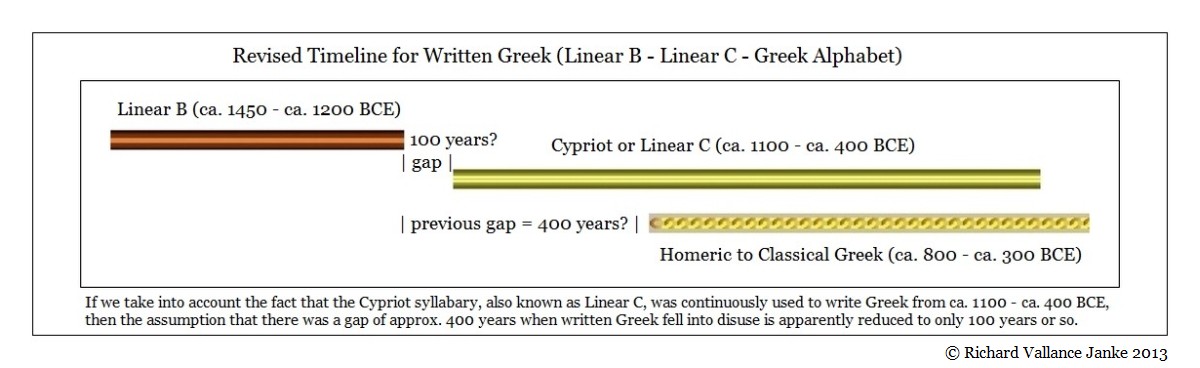


You must be logged in to post a comment.