Where are all these tens of thousands of rams from? Guess. One guess & you’re right! Click to ENLARGE:As I pointed out in great detail in a previous post, the Minoan/Mycenaean economy ca. 1450 BCE, with its home base at the city of Knossos itself, spread out its sheep husbandry locales among several key sites, notably, Kytaistos, Phaistos & Lykinthos, mentioned 20 times each, Exonos 15 times, Davos 14, Lato & Syrimos 12, Lasynthos 9, Sugrita 8, Tylisos (or Tyllisos) 5 & Raia 3 times. But Knossos is never mentioned at all! All of this is threshed out in the previous post, CRITICAL Post: The Minoans Counted Sheep While They Were Wide Awake, https://linearalinearblinearc.ca/2014/08/21/vital-post-the-minoans-counted-sheep-while-they-were-wide-awake-big-time/ which I strongly suggest you read, if you are at all fascinated by the Minoan economy and their international trade, especially in the area of sheep raising and husbandry, which was the vital underpinning of their entire subsistence as a people, outweighing by far all other economic activities of any kind whatsoever. Regardless of the fact that the scribes at Knossos never mention the city as a sheep raising site, it was in fact the primary locale for sheep husbandry, for the simple, plain reason that only a city of this size, with a population probably in excess of 50,000, enormous for the ancient world, had the human and land resources to accommodate such huge numbers of sheep as illustrated above, i.e. 24,000 at the very minimum, and only on these 5 tablets! In the next post, I shall post a Linear B tablet from Knossos, in which the numbers of sheep mentioned will literally blow you away! If anyone thinks even for a moment that any of the other sheep raising locales mentioned at the outset of this post had anywhere near the land space and human resources sufficient to raise such huge numbers of sheep, that person is probably deluding him- or herself. We are left with one bizarre mystery. The only thing that utterly baffles me is, where are all the ewes! That question, not a rhetorical question at all, begs the issue. I simply cannot figure this out for the life of me. How can you raise any new sheep, i.e. newborns, if there are no ewes around! If anyone has any suggestions or comments whatsoever to help us unravel this plainly weird mystery, be my guest! Richard
Tag: Mycenaean
-
Where are all these tens of thousands of rams from? Guess. One guess & you’re right!
-
The Wisconsin U.S.A. Tablet – Is it Minoan? PART B: Cross-Linguistic Comparison with the Indus Valley Harappan Script, 2,600 BCE
The Wisconsin U.S.A. Tablet – Is it Minoan? PART B: Cross-Linguistic Comparison with the Indus Valley Harappan Script, 2,600 BCE Firmly keeping in mind, and if at all possible, downloading and displaying my annotated version of the Wisconsin Tablet, so that you can view it alongside my annotated illustration of the Harappan script, I urge you to carefully consider the points I raise below, with reference to them both, as well as yet again to the early Cretan script, and to Linear A, B & C, allowing for a cross-comparative symbolic linguistic analysis of a total of no less than 6 ancient scripts, of which 3 are syllabic, 2 are in ancient Greek (Linear B and C), and 4 are undeciphered, the Wisconsin Tablet, the Harappan ad early Cretan scripts and the Linear a syllabary, all of which span an enormous historical timeline of 2,200 years, from ca. 2,600 – ca 400 BCE. Before we proceed any further, let us take a good close look at the Harappan script (Click to ENLARGE):
 which predates all of the other scripts, except for the Wisconsin Tablet, which itself apparently is not even approximately dated for a timeline, by at least 500 years (from 2,600 BCE onwards), the early Cretan script running as it does from ca 1,900 – ca. 1,600 BCE. I have resorted to invoking the Indus Valley or Harappan script for precisely this reason, that I wanted to be certain that we end up dealing with various scripts and syllabaries spanning a huge timeline of some 2,200 years, making it literally impossible to correlate the symbols or syllabograms in any of these scripts, including the Wisconsin, in any meaningful fashion, without trapping ourselves in a quagmire of irresolvable contradictions and in a blatant reductio ad absurdum. It is abundantly clear that all 6 of these scripts share at least a couple of symbols, if not several, in common, while at the same time, these very same symbols are totally undecipherable in 4 of the scripts, the Wisconsin, Harappan, early Cretan scripts, and in the Linear A syllabary, for which we know most of the values, these being either close to identical or identical to those in Linear B, at least where they overlap. And that is not always, given that Linear A has considerably more syllabograms and ideograms than Linear B. Unfortunately, this means that a large portion of Linear A is not only undecipherable, but that many of its syllabograms and ideograms are still totally impermeable to us at the present juncture.
Of course, all of this amounts to, shall we say, one hell of a mess, given that even where the some of symbols, syllabograms and ideograms in any of these 6 scripts either closely resemble one another or are identical to one another, they are either completely undecipherable and beyond our ken, or have been almost completely deciphered (with a few queer exceptions in the 2 Greek scripts, Mycenaean Linear B, ca. 1500 – 1200 BCE, and its closest historical cousin or offspring, if you will, Arcado-Cypriot, written in Linear C from ca. 1100 – ca. 400 BCE). My point is simply this, that it is very nearly impossible arrive at any reasonable correlation of any of these symbols or syllabograms in any of these 6 scripts, even when they match up perfectly, with the sole exception of Linear A & B, which after all were employed by one and the same civilization, the Minoan, without a perceptible break, from ca. 1,800 to ca. 1,200 BCE, i.e. over 600 years, and – get this! - even though though they actually overlap, undeciphered Linear A being in continual use from ca. 1,800 – ca. 1,400 BCE, and Linear B, which was the syllabary for the earliest East Greek dialect, Mycenaean Greek, from ca. 1,500 – ca. 1,200 BCE, making for a century or so when they were in bed together.
This throws yet another wrench into our linguistic equation. Since it makes perfect sense for the Minoan scribes to continue using a simpler variant of Linear A in Linear B, why on earth would the same scribes continue to resort to Linear A alongside of Linear B for a period of at least a century (1,500 – 1,400 BCE)? This might appear to be a flat contradiction in terms, but in fact, it is highly doubtful that it is, since after all, nowadays we use the Latin script for many European languages, some of which held sway over all the others for considerable periods, for instance, Italian from ca. 1200 – ca. 1550 AD, French from ca. 1500 to ca. 1700 AD (again overlapping), and English, from ca. 1500 AD to the present, once again overlapping with Italian and French. In other words, all three of these modern languages held the ascendancy in tandem with at least one other at the same time, while English has been at the top of the heap since at least the beginning of the 20th. century.
Likewise, there were eminently practical reasons for Minoan Linear A and Mycenaean Linear B to have been in use concomitantly for about 100 years or so, since after all, they used pretty much the same script, even if the former is undeciphered today, and I emphasize today. However, There can be no doubt whatsoever that the Minoan scribes were perfectly bilingual in this period of about a century, when the two scripts overlapped, and it is perfectly reasonable to assume that the Minoans and Mycenaeans clearly understood one another’s language, which they surely must have. Otherwise, why continue using Linear A alongside Linear B for at least a century? There was no question of their having to decipher the Minoan language, because there was nothing to decipher. The language was then a known one, spoken and written, all during that period. Some scribes and some literates must have not only been familiar with both languages, but perfectly bilingual in both. What a shame we have lost the Minoan language to the Lethe of history, while our dear genius Michael Ventris succeeded, against all odds, in deciphering Linear B as Greek!
But, you are probably asking yourselves, why am I bringing this point up in the first place? Well, it is pretty obvious, I think. We can clearly see that the same syllabary, common to Linear A & B, with minor variations and with a shift to greater simplicity in Linear B, can be used to write two completely unrelated languages, just as the modern Latin script is used for several Indo-European languages, English, French, Spanish, German and so forth, and even some Slavic languages to boot, while at the same time doing perfect service for the Finno-Ugaric languages, Finnish, Estonian, Latvian and Hungarian, which are not Indo-European at all.
On the other hand, as can clearly be observed in our cross-correlation of 6 scripts from Harappan on down to Arcado-Cypriot Linear C, even though a few symbols and syllabograms appear to be in common with at least some of these 6 languages, the pattern is totally haphazard, the result being a meaningless crazy-quilt. The same scenario exists for modern Indo-European languages, of which the majority use the Latin alphabet, while Greek has its own peculiar alphabet predating the Latin, and almost all of the Slavic languages use the Cyrillic (though not all). While the Latin and Cyrillic (accidentally) share some letters in common, Cyrillic has far more in common with Greek. Once again, we find ourselves up against a hodge-podge of alphabets, all of which have some, but scarcely all, letters in common, just as our 6 ancient scripts share some, but scarcely all, of the symbols and syllabograms they – and here again, I lay particular stress on this point – accidentally have in common, with the sole exception of Linear A and Linear B, which form a clear continuum.
Taken to its extreme, this observation leads us to the inevitable conclusion that, regardless or not whether or not any 2 or more languages share the same pictographs, hieroglyphics, ideograms, logograms, syllabograms or alphabets in common, whether almost totally or in more or less part, there is absolutely no guarantee whatsoever that these languages are related in any meaningful way by linguistic family or sub-class. For instance, early Mediterranean, such as early Cretan and Linear A, appear to be closely related, but may very well not be. Meanwhile Linear A, which is used for the Minoan language, remains undeciphered, and in all probability, is in no way related to Greek, including Mycenaean, written in Linear B,even though these scripts are almost identical. We find the same scenario with modern Occidental Indo-European languages versus their Finno-Ugaric counterparts, which are not Indo-European at all, and yet which share the same alphabet, just as Linear A and Linear B share the same syllabary, for all intents and purposes.
What then does all this imply if not this? - that any and all ancient, including prehistoric, scripts must be deciphered within the ambit of their own hieroglyphics, ideograms, syllabograms or alphabet, whether or not these look (even exactly) like the hieroglyphics, ideograms, syllabograms or alphabet of any other language whatsoever. In other words, forget about the nature of the script in which any undeciphered language is written, whether hieroglyphic, ideogrammatic, syllabogrammatic or alphabetical, and concentrate solely and entirely on endeavouring to decipher it in its own right sui generis, without reference at all to any other language, dead or living. That this is surely the case is made abundantly clear by the co-existence, indeed, entente cordiale, that comfortably existed between the syllabary used for the undeciphered Minoan language written in Linear A and the linguistically completely unrelated language, Mycenaean Greek, written in Linear B, the syllabary which for all intents and purposes was the brain-child of Linear A, which the Minoan scribes clearly adapted to suit their own eminently practical purposes. After all, why re-invent the wheel, and why fix something when it isn’t even broken in the first place? It is precisely for the same reason that the Greek alphabet, which has been in continual use for at least 2,800 years (ca. 800 BCE to the present), the Latin alphabet for at least 2,750 years (from the time of the time of the founding of Rome if not before), and last, but far from least, the much younger Cyrillic alphabet, from the ninth century AD onwards, are all still going gang-busters.
This is precisely why the presence of even a few symbols which look like Linear A or Linear B syllabograms on the Wisconsin Tablet is utterly meaningless.
You could cross-correlate the symbols in God knows how many pre-historic or ancient languages, and still come up with matches or near-matches, but these would be, and in fact, are utterly meaningless, especially where one language dates from as early as 10,000 or 5,000 BCE, having symbols in common with any one or more languages from a (far) later historical period. And they all too frequently do. In a word, the whole exercise of cross-comparing identical, near identical or similar looking symbols, pictographs, hieroglyphics, ideograms, syllabograms or alphabets, whether prehistoric, ancient or modern, is entirely meaningless in determining the nature or linguistic class of any and all of these languages whatsoever.
So any attempt to cross-correlate symbols from one language to another, even where they leap out at us, yelling, hey, I am the “same” symbol in such and such language (for instance that of the Wisconsin Tablet) as in another (for instance, Minoan in Linear A or Mycenaean Greek in Linear B), I regret to say, sadly amounts to a hill of beans, and nothing more.
Richard
which predates all of the other scripts, except for the Wisconsin Tablet, which itself apparently is not even approximately dated for a timeline, by at least 500 years (from 2,600 BCE onwards), the early Cretan script running as it does from ca 1,900 – ca. 1,600 BCE. I have resorted to invoking the Indus Valley or Harappan script for precisely this reason, that I wanted to be certain that we end up dealing with various scripts and syllabaries spanning a huge timeline of some 2,200 years, making it literally impossible to correlate the symbols or syllabograms in any of these scripts, including the Wisconsin, in any meaningful fashion, without trapping ourselves in a quagmire of irresolvable contradictions and in a blatant reductio ad absurdum. It is abundantly clear that all 6 of these scripts share at least a couple of symbols, if not several, in common, while at the same time, these very same symbols are totally undecipherable in 4 of the scripts, the Wisconsin, Harappan, early Cretan scripts, and in the Linear A syllabary, for which we know most of the values, these being either close to identical or identical to those in Linear B, at least where they overlap. And that is not always, given that Linear A has considerably more syllabograms and ideograms than Linear B. Unfortunately, this means that a large portion of Linear A is not only undecipherable, but that many of its syllabograms and ideograms are still totally impermeable to us at the present juncture.
Of course, all of this amounts to, shall we say, one hell of a mess, given that even where the some of symbols, syllabograms and ideograms in any of these 6 scripts either closely resemble one another or are identical to one another, they are either completely undecipherable and beyond our ken, or have been almost completely deciphered (with a few queer exceptions in the 2 Greek scripts, Mycenaean Linear B, ca. 1500 – 1200 BCE, and its closest historical cousin or offspring, if you will, Arcado-Cypriot, written in Linear C from ca. 1100 – ca. 400 BCE). My point is simply this, that it is very nearly impossible arrive at any reasonable correlation of any of these symbols or syllabograms in any of these 6 scripts, even when they match up perfectly, with the sole exception of Linear A & B, which after all were employed by one and the same civilization, the Minoan, without a perceptible break, from ca. 1,800 to ca. 1,200 BCE, i.e. over 600 years, and – get this! - even though though they actually overlap, undeciphered Linear A being in continual use from ca. 1,800 – ca. 1,400 BCE, and Linear B, which was the syllabary for the earliest East Greek dialect, Mycenaean Greek, from ca. 1,500 – ca. 1,200 BCE, making for a century or so when they were in bed together.
This throws yet another wrench into our linguistic equation. Since it makes perfect sense for the Minoan scribes to continue using a simpler variant of Linear A in Linear B, why on earth would the same scribes continue to resort to Linear A alongside of Linear B for a period of at least a century (1,500 – 1,400 BCE)? This might appear to be a flat contradiction in terms, but in fact, it is highly doubtful that it is, since after all, nowadays we use the Latin script for many European languages, some of which held sway over all the others for considerable periods, for instance, Italian from ca. 1200 – ca. 1550 AD, French from ca. 1500 to ca. 1700 AD (again overlapping), and English, from ca. 1500 AD to the present, once again overlapping with Italian and French. In other words, all three of these modern languages held the ascendancy in tandem with at least one other at the same time, while English has been at the top of the heap since at least the beginning of the 20th. century.
Likewise, there were eminently practical reasons for Minoan Linear A and Mycenaean Linear B to have been in use concomitantly for about 100 years or so, since after all, they used pretty much the same script, even if the former is undeciphered today, and I emphasize today. However, There can be no doubt whatsoever that the Minoan scribes were perfectly bilingual in this period of about a century, when the two scripts overlapped, and it is perfectly reasonable to assume that the Minoans and Mycenaeans clearly understood one another’s language, which they surely must have. Otherwise, why continue using Linear A alongside Linear B for at least a century? There was no question of their having to decipher the Minoan language, because there was nothing to decipher. The language was then a known one, spoken and written, all during that period. Some scribes and some literates must have not only been familiar with both languages, but perfectly bilingual in both. What a shame we have lost the Minoan language to the Lethe of history, while our dear genius Michael Ventris succeeded, against all odds, in deciphering Linear B as Greek!
But, you are probably asking yourselves, why am I bringing this point up in the first place? Well, it is pretty obvious, I think. We can clearly see that the same syllabary, common to Linear A & B, with minor variations and with a shift to greater simplicity in Linear B, can be used to write two completely unrelated languages, just as the modern Latin script is used for several Indo-European languages, English, French, Spanish, German and so forth, and even some Slavic languages to boot, while at the same time doing perfect service for the Finno-Ugaric languages, Finnish, Estonian, Latvian and Hungarian, which are not Indo-European at all.
On the other hand, as can clearly be observed in our cross-correlation of 6 scripts from Harappan on down to Arcado-Cypriot Linear C, even though a few symbols and syllabograms appear to be in common with at least some of these 6 languages, the pattern is totally haphazard, the result being a meaningless crazy-quilt. The same scenario exists for modern Indo-European languages, of which the majority use the Latin alphabet, while Greek has its own peculiar alphabet predating the Latin, and almost all of the Slavic languages use the Cyrillic (though not all). While the Latin and Cyrillic (accidentally) share some letters in common, Cyrillic has far more in common with Greek. Once again, we find ourselves up against a hodge-podge of alphabets, all of which have some, but scarcely all, letters in common, just as our 6 ancient scripts share some, but scarcely all, of the symbols and syllabograms they – and here again, I lay particular stress on this point – accidentally have in common, with the sole exception of Linear A and Linear B, which form a clear continuum.
Taken to its extreme, this observation leads us to the inevitable conclusion that, regardless or not whether or not any 2 or more languages share the same pictographs, hieroglyphics, ideograms, logograms, syllabograms or alphabets in common, whether almost totally or in more or less part, there is absolutely no guarantee whatsoever that these languages are related in any meaningful way by linguistic family or sub-class. For instance, early Mediterranean, such as early Cretan and Linear A, appear to be closely related, but may very well not be. Meanwhile Linear A, which is used for the Minoan language, remains undeciphered, and in all probability, is in no way related to Greek, including Mycenaean, written in Linear B,even though these scripts are almost identical. We find the same scenario with modern Occidental Indo-European languages versus their Finno-Ugaric counterparts, which are not Indo-European at all, and yet which share the same alphabet, just as Linear A and Linear B share the same syllabary, for all intents and purposes.
What then does all this imply if not this? - that any and all ancient, including prehistoric, scripts must be deciphered within the ambit of their own hieroglyphics, ideograms, syllabograms or alphabet, whether or not these look (even exactly) like the hieroglyphics, ideograms, syllabograms or alphabet of any other language whatsoever. In other words, forget about the nature of the script in which any undeciphered language is written, whether hieroglyphic, ideogrammatic, syllabogrammatic or alphabetical, and concentrate solely and entirely on endeavouring to decipher it in its own right sui generis, without reference at all to any other language, dead or living. That this is surely the case is made abundantly clear by the co-existence, indeed, entente cordiale, that comfortably existed between the syllabary used for the undeciphered Minoan language written in Linear A and the linguistically completely unrelated language, Mycenaean Greek, written in Linear B, the syllabary which for all intents and purposes was the brain-child of Linear A, which the Minoan scribes clearly adapted to suit their own eminently practical purposes. After all, why re-invent the wheel, and why fix something when it isn’t even broken in the first place? It is precisely for the same reason that the Greek alphabet, which has been in continual use for at least 2,800 years (ca. 800 BCE to the present), the Latin alphabet for at least 2,750 years (from the time of the time of the founding of Rome if not before), and last, but far from least, the much younger Cyrillic alphabet, from the ninth century AD onwards, are all still going gang-busters.
This is precisely why the presence of even a few symbols which look like Linear A or Linear B syllabograms on the Wisconsin Tablet is utterly meaningless.
You could cross-correlate the symbols in God knows how many pre-historic or ancient languages, and still come up with matches or near-matches, but these would be, and in fact, are utterly meaningless, especially where one language dates from as early as 10,000 or 5,000 BCE, having symbols in common with any one or more languages from a (far) later historical period. And they all too frequently do. In a word, the whole exercise of cross-comparing identical, near identical or similar looking symbols, pictographs, hieroglyphics, ideograms, syllabograms or alphabets, whether prehistoric, ancient or modern, is entirely meaningless in determining the nature or linguistic class of any and all of these languages whatsoever.
So any attempt to cross-correlate symbols from one language to another, even where they leap out at us, yelling, hey, I am the “same” symbol in such and such language (for instance that of the Wisconsin Tablet) as in another (for instance, Minoan in Linear A or Mycenaean Greek in Linear B), I regret to say, sadly amounts to a hill of beans, and nothing more.
Richard
Share this:
-
The Wisconsin U.S.A. Tablet — Is it Minoan? PART A: Comparison with 4 Ancient Northern Mediterranean Scripts
The Wisconsin U.S.A. Tablet — Is it Minoan? PART A: Comparison with 4 Ancient Northern Mediterranean Scripts A Thorough Linguistic Analysis of the Wisconsin Tablet (Click to ENLARGE):
 When I first saw the Wisconsin Tablet, which our friend, E.J. Heath, posted here on our blog, I stood amazed. Staring me in the face were 3 symbols, 2 of which which looked uncannily like 2 syllabograms (B, C&F) common to Linear A & B, and one of which (H) looked like the number 20, again in common with Linear A & B. Well now, that’s a real find, or so it would appear.
But my wonderment quickly faded as I began to closely, then more meticulously, examine its symbols, discovering as I did that only 1 other symbol looked anything like symbols in any early (pre-historic) Northern Mediterranean scripts, that being symbol A on the Wisconsin Tablet, which is identical to the same symbol in the early Cretan script, and closely resembles 2 similar symbols, called syllabograms, in Linear C, the latter being the vowels a & e in that script. But Linear C is a far later historical Greek script, in use continually from ca. 1100 BCE to 400 BCE, alongside the ancient Greek alphabet. And that period is more than likely to be much later than the Wisconsin Tablet. As for the rest of the symbols on the Wisconsin tablet, they bear little or no resemblance at all to the symbols in early Cretan (an undeciphered pictographic or ideographic script), or to the syllabograms in Linear A (which, though undeciphered, shares a great many of its syllabograms in common with deciphered Linear B, or at least shares some features of these), to the 200 or so syllabograms and ideograms in Linear B or yet again to any syllabograms other than the vowels a & e in deciphered Cypro-Minoan Linear C.
All this leaves me at a complete impasse, and opens a real can of worms. Questions, which are not hypothetical, but historically pregnant, pop up left, right and centre. For instance:
1. How on earth can a tablet unearthed in the north-western U.S.A. reasonably be considered to be Minoan, when its shares symbols in common with 4 different ancient scripts, 2 of them similar to one another (Linear A & B), but one being undeciphered and the other decidedly Greek (Mycenaean), and the other two completely dissimilar, not only to one another, but also to Linear A & B. Even granted that the 2 symbols (and only 2), and the apparent “number 20” which I can clearly see on the Wisconsin Tablet, which apparently look like their Linear A & B counterparts, are, for the sake of argument, actually those very syllabograms in Linear A & B, this raises another thorny question, how can we be even remotely sure that this is in fact the case, when all of the other symbols on the Wisconsin – I repeat – bear no resemblance with any syllabograms or ideograms in either Linear A or B (and that means 100s of them!). We have landed in a real quagmire. In short, we cannot decipher it under these conditions. Here is a chart summarizing my findings (Click to ENLARGE):
When I first saw the Wisconsin Tablet, which our friend, E.J. Heath, posted here on our blog, I stood amazed. Staring me in the face were 3 symbols, 2 of which which looked uncannily like 2 syllabograms (B, C&F) common to Linear A & B, and one of which (H) looked like the number 20, again in common with Linear A & B. Well now, that’s a real find, or so it would appear.
But my wonderment quickly faded as I began to closely, then more meticulously, examine its symbols, discovering as I did that only 1 other symbol looked anything like symbols in any early (pre-historic) Northern Mediterranean scripts, that being symbol A on the Wisconsin Tablet, which is identical to the same symbol in the early Cretan script, and closely resembles 2 similar symbols, called syllabograms, in Linear C, the latter being the vowels a & e in that script. But Linear C is a far later historical Greek script, in use continually from ca. 1100 BCE to 400 BCE, alongside the ancient Greek alphabet. And that period is more than likely to be much later than the Wisconsin Tablet. As for the rest of the symbols on the Wisconsin tablet, they bear little or no resemblance at all to the symbols in early Cretan (an undeciphered pictographic or ideographic script), or to the syllabograms in Linear A (which, though undeciphered, shares a great many of its syllabograms in common with deciphered Linear B, or at least shares some features of these), to the 200 or so syllabograms and ideograms in Linear B or yet again to any syllabograms other than the vowels a & e in deciphered Cypro-Minoan Linear C.
All this leaves me at a complete impasse, and opens a real can of worms. Questions, which are not hypothetical, but historically pregnant, pop up left, right and centre. For instance:
1. How on earth can a tablet unearthed in the north-western U.S.A. reasonably be considered to be Minoan, when its shares symbols in common with 4 different ancient scripts, 2 of them similar to one another (Linear A & B), but one being undeciphered and the other decidedly Greek (Mycenaean), and the other two completely dissimilar, not only to one another, but also to Linear A & B. Even granted that the 2 symbols (and only 2), and the apparent “number 20” which I can clearly see on the Wisconsin Tablet, which apparently look like their Linear A & B counterparts, are, for the sake of argument, actually those very syllabograms in Linear A & B, this raises another thorny question, how can we be even remotely sure that this is in fact the case, when all of the other symbols on the Wisconsin – I repeat – bear no resemblance with any syllabograms or ideograms in either Linear A or B (and that means 100s of them!). We have landed in a real quagmire. In short, we cannot decipher it under these conditions. Here is a chart summarizing my findings (Click to ENLARGE):
 Here are two Linear A tablets, which shed further light on the issue of the Wisconsin tablet sharing (or not) symbols with Linear A syllabograms (Click to ENLARGE):
 Refer back to the Wisconsin Tablet above for 2 of the symbols highlighted with the same letters (E & H) on both it and these two Linear A tablets.
2. On the other hand, if we take the stance that the 3 so-called “Minoan” symbols on the Wisconsin Tablet are not Linear A or B syllabograms or numerics – which is a perfectly reasonable assumption to proceed from – then what on earth are they? Are they even syllabograms or numerics? Or are they any one of the following: pictographs, such as we see in the famous Peterborough Pictographs, unearthed near Peterborough, Ontario, Canada, some time ago, or perhaps hieroglyphics, or yet again logographic, ideogrammatic, syllabogrammatic or even, as far fetched as it may seem (and it is) alphabetic? This stretches my poor imagination and my powers of reason almost beyond bearing.
3. When was the Wisconsin Tablet composed? This is an absolutely critical question, because, failing any knowledge of even the approximate date of its composition, the whole thing remains a complete mystery. There are, of course, two tried-and-tested archaeological approaches to getting closer to resolving this vital question, at least to some extent. First of all, has the Wisconsin Tablet been carbon-dated? If it has not, the mystery remains just that, and nothing more. If it has (which apparently seems not to be the case, but hopefully E.J. Heath can enlighten me on this matter), then the carbon-dating is entirely capable of determining whether or not it falls at least somewhere near or within the historical timeline of both Linear A and Linear BC together, i.e. 1,800 – 1,200 BCE. If the carbon-dating proves this to be the case, then at least our friend has a leg to stand on, however shaky. On the other hand, if the carbon-dating should prove that the Wisconsin tablet pre-dates or post-dates the Minoan/Mycenaean era (ca. 1,900 – 1,200 BCE), then it is, even in the very best scenario, highly unlikely that the Wisconsin Tablet is composed in anything like or near to Linear A or B, and the whole hypothesis falls apart like a house of cards.
4. Another way of establishing the approximate timeline of the Wisconsin tablet is to submit it to as many as possible eminently qualified North American, as well as European and Mediterranean, archaeologists, and eventually to draw up a team of archaeologist to address this sticky issue head on, by which I mean in conference or in writing and online or better still, all. All this would take considerable time, conceivably close to a decade.
It goes entirely without saying that both of these approaches to attempting to establish the approximate dating of the Wisconsin tablet are absolutely essential to the process of identifying in any way what it is, and can in no wise be omitted. I leave it to our friend E.J. Heath to get in touch with at least a few archaeologists in the field (pardon the pun!) in the U.S.A, first and foremost at the University of Wisconsin itself, to establish the credentials of the Wisconsin Tablet, as it were.
5. On yet another level, I am forcibly struck by the curious absence of any other tablet(s), especially in light of the fact that the Minoan scribes writing in both Minoan Linear A and in Mycenaean Greek in Linear B, were completely obsessed with record-keeping, inventories and statistics. While there is a dearth of Linear A tablets still in existence compared with Linear B tablets, there are still plenty enough of them. We can only assume that those Linear A tablets which have disappeared in the maelstrom of history have done so for various reasons bearing on lack of archaeological findings or evidence, which may nevertheless may be corrected, at least to some degree, by potential findings in the future. But there can be no assurance of this. So if we have a few hundred Linear A tablets at our disposal, why is there only 1 single tablet to be found in Wisconsin, when we know perfectly well that the Linear A and Linear B scribes were concerned with one thing and one thing only, keeping exhaustive records, inventories and statistics on absolutely anything and everything that affected their economy? This surely begs the question: why has only 1 and one only so-called “Minoan” tablet been unearthed in Wisconsin? If as E.J. Heath claims, this tablet is likely to be just that, Minoan, then surely at least a few, if not a few scores of other tablets, or ideally hundreds just like it, should have been unearthed with it. Since none have, the question is why – and it is a question that must eventually bear answering in some way or another, sooner or later.
On the other hand, there are literally 1,000s of Linear B Tablets (close to 6,000 at last count), and we can read them! Even if the 3 so-called Linear A & B look-alikes on the Wisconsin Tablet were in fact either Linear A or Linear B, we would still be stuck in the mud, right where we are. Since Linear A is undeciphered, even if 2 of the symbols on the Wisconsin Tablet are in Linear A (which I highly doubt), they too remain undecipherable (with the possible exception of the so-called number 20. For more in this, see infra).
If on the other hand, these are Linear B symbols, i.e. the 2 syllabograms ZO (B) and NO (C& F), along with the apparent numeric = 20?, the tablet is still undecipherable, because we can make no sense of any of the other symbols on it, and in order to decipher it, we must place the apparent Linear B ZO & NO strictly in context with all of the symbols immediately preceding and following them, if indeed these other symbols are syllabograms (which I highly doubt). Remember what I said above, that the symbols on the Wisconsin tablet must all either be pictographics, hieroglyphics, ideograms or (very unlikely) syllabograms, and almost inconceivably letters, but never an admixture of any one of the above, with the possible sole exception of syllabograms and ideograms, which do in fact co-exist happily in Linear A & B. At least we can admit of that. Yet, even with this single exception at our disposal, we will have practically backed ourselves up against a solid brick wall, given that there is a substantial likelihood of the symbols on the Wisconsin Tablet being either pictographs or hieroglyphics.
6. As for that presumed number 20, even if it is a number, is it the number 20, i.. in the tens, or is it a single digit, i.e. 2? This is no small matter. In several of the ancient and not so ancient scripts, single digit numbers are either denoted by parallel horizontal lines, in which case the tens are designated by parallel vertical lines (if at all), or vice versa, i.e. single digits are vertical parallels and 10s horizontal. The easiest way to illustrate this is by invoking the numbers 1, 2 & 3 in (ichi, ni & san) in Japanese Kanji, which are the exact reverse of the paradigms for numerics in Linear A & B. Whereas Linear A & B denote single digits with vertical parallel lines and 10s with horizontal, Japanese Kanji resorts to the horizontal for single digits, as seen here:
Refer back to the Wisconsin Tablet above for 2 of the symbols highlighted with the same letters (E & H) on both it and these two Linear A tablets.
2. On the other hand, if we take the stance that the 3 so-called “Minoan” symbols on the Wisconsin Tablet are not Linear A or B syllabograms or numerics – which is a perfectly reasonable assumption to proceed from – then what on earth are they? Are they even syllabograms or numerics? Or are they any one of the following: pictographs, such as we see in the famous Peterborough Pictographs, unearthed near Peterborough, Ontario, Canada, some time ago, or perhaps hieroglyphics, or yet again logographic, ideogrammatic, syllabogrammatic or even, as far fetched as it may seem (and it is) alphabetic? This stretches my poor imagination and my powers of reason almost beyond bearing.
3. When was the Wisconsin Tablet composed? This is an absolutely critical question, because, failing any knowledge of even the approximate date of its composition, the whole thing remains a complete mystery. There are, of course, two tried-and-tested archaeological approaches to getting closer to resolving this vital question, at least to some extent. First of all, has the Wisconsin Tablet been carbon-dated? If it has not, the mystery remains just that, and nothing more. If it has (which apparently seems not to be the case, but hopefully E.J. Heath can enlighten me on this matter), then the carbon-dating is entirely capable of determining whether or not it falls at least somewhere near or within the historical timeline of both Linear A and Linear BC together, i.e. 1,800 – 1,200 BCE. If the carbon-dating proves this to be the case, then at least our friend has a leg to stand on, however shaky. On the other hand, if the carbon-dating should prove that the Wisconsin tablet pre-dates or post-dates the Minoan/Mycenaean era (ca. 1,900 – 1,200 BCE), then it is, even in the very best scenario, highly unlikely that the Wisconsin Tablet is composed in anything like or near to Linear A or B, and the whole hypothesis falls apart like a house of cards.
4. Another way of establishing the approximate timeline of the Wisconsin tablet is to submit it to as many as possible eminently qualified North American, as well as European and Mediterranean, archaeologists, and eventually to draw up a team of archaeologist to address this sticky issue head on, by which I mean in conference or in writing and online or better still, all. All this would take considerable time, conceivably close to a decade.
It goes entirely without saying that both of these approaches to attempting to establish the approximate dating of the Wisconsin tablet are absolutely essential to the process of identifying in any way what it is, and can in no wise be omitted. I leave it to our friend E.J. Heath to get in touch with at least a few archaeologists in the field (pardon the pun!) in the U.S.A, first and foremost at the University of Wisconsin itself, to establish the credentials of the Wisconsin Tablet, as it were.
5. On yet another level, I am forcibly struck by the curious absence of any other tablet(s), especially in light of the fact that the Minoan scribes writing in both Minoan Linear A and in Mycenaean Greek in Linear B, were completely obsessed with record-keeping, inventories and statistics. While there is a dearth of Linear A tablets still in existence compared with Linear B tablets, there are still plenty enough of them. We can only assume that those Linear A tablets which have disappeared in the maelstrom of history have done so for various reasons bearing on lack of archaeological findings or evidence, which may nevertheless may be corrected, at least to some degree, by potential findings in the future. But there can be no assurance of this. So if we have a few hundred Linear A tablets at our disposal, why is there only 1 single tablet to be found in Wisconsin, when we know perfectly well that the Linear A and Linear B scribes were concerned with one thing and one thing only, keeping exhaustive records, inventories and statistics on absolutely anything and everything that affected their economy? This surely begs the question: why has only 1 and one only so-called “Minoan” tablet been unearthed in Wisconsin? If as E.J. Heath claims, this tablet is likely to be just that, Minoan, then surely at least a few, if not a few scores of other tablets, or ideally hundreds just like it, should have been unearthed with it. Since none have, the question is why – and it is a question that must eventually bear answering in some way or another, sooner or later.
On the other hand, there are literally 1,000s of Linear B Tablets (close to 6,000 at last count), and we can read them! Even if the 3 so-called Linear A & B look-alikes on the Wisconsin Tablet were in fact either Linear A or Linear B, we would still be stuck in the mud, right where we are. Since Linear A is undeciphered, even if 2 of the symbols on the Wisconsin Tablet are in Linear A (which I highly doubt), they too remain undecipherable (with the possible exception of the so-called number 20. For more in this, see infra).
If on the other hand, these are Linear B symbols, i.e. the 2 syllabograms ZO (B) and NO (C& F), along with the apparent numeric = 20?, the tablet is still undecipherable, because we can make no sense of any of the other symbols on it, and in order to decipher it, we must place the apparent Linear B ZO & NO strictly in context with all of the symbols immediately preceding and following them, if indeed these other symbols are syllabograms (which I highly doubt). Remember what I said above, that the symbols on the Wisconsin tablet must all either be pictographics, hieroglyphics, ideograms or (very unlikely) syllabograms, and almost inconceivably letters, but never an admixture of any one of the above, with the possible sole exception of syllabograms and ideograms, which do in fact co-exist happily in Linear A & B. At least we can admit of that. Yet, even with this single exception at our disposal, we will have practically backed ourselves up against a solid brick wall, given that there is a substantial likelihood of the symbols on the Wisconsin Tablet being either pictographs or hieroglyphics.
6. As for that presumed number 20, even if it is a number, is it the number 20, i.. in the tens, or is it a single digit, i.e. 2? This is no small matter. In several of the ancient and not so ancient scripts, single digit numbers are either denoted by parallel horizontal lines, in which case the tens are designated by parallel vertical lines (if at all), or vice versa, i.e. single digits are vertical parallels and 10s horizontal. The easiest way to illustrate this is by invoking the numbers 1, 2 & 3 in (ichi, ni & san) in Japanese Kanji, which are the exact reverse of the paradigms for numerics in Linear A & B. Whereas Linear A & B denote single digits with vertical parallel lines and 10s with horizontal, Japanese Kanji resorts to the horizontal for single digits, as seen here:
 All this still leaves us with one unanswered question, which is very much moot. Are these 2 parallel horizontal lines on the Wisconsin tablet either the number 20 or the number 2, or are they numbers at all? Pending decipherment, we can never really know.
To Summarize:
Given all the issues I have raised with respect to the Wisconsin Tablet, I sincerely doubt that it is composed in Linear A or Linear B, or anything remotely like that. This leaves the tablet not only undecipherable, but for now highly resistant to any attempt at decipherment. On the other hand, its discovery is significant. Writing as such, if indeed this is writing we have here on the Wisconsin Tablet, is almost unheard of in the annals of North American aboriginal tribes. Pictographs, such as the Peterborough Pictographs, occasionally appear, and they do contribute to the continuing search for symbolic evidence of North American aboriginal settlements. What strikes me about this particular tablet is that it does not appear to be composed of simple pictographs, but of something – I cannot imagine what – more sophisticated... hieroglyphics or ideograms or... heavens no what? In this light, I greatly encourage E. J. Heath and any and all researchers or aficionados of ancient scripts to pour their efforts into attempting to figure out the nature of the symbols on this fascinating tablet, if not to decipher it outright.
In the next post, I shall raise even more issues and concerns I have with the Wisconsin tablet, or for that matter with any tablet in any undeciphered language anywhere in the ancient pre-historic world. To do so, I shall have recourse to the 417 symbols of the ancient Harappan script of the Indus Valley civilization, which considerably predates by several centuries – ca. 2,600 to ca. 2,000 BCE -all four of the scripts we have held under consideration here (early Cretan, Linear A, Linear B and the historical Greek script, Arcado-Cypriot Linear C). What we will discover with this script is bound to increase, not decrease, the shock we all to often encounter, however valiantly we struggle to decipher any undeciphered ancient pre-historic script, let alone the Wisconsin Tablet.
That said, the fact that the Wisconsin Tablet remains a baffling mystery warrants more than its fair share of attention (whatever that might be), and so I applaud E. J. Heath for posting it here on our blog, and I invite him to counter each of the issues and objections I have raised here, and more of which I shall raise again in the next post, as he feels inclined.
Richard
All this still leaves us with one unanswered question, which is very much moot. Are these 2 parallel horizontal lines on the Wisconsin tablet either the number 20 or the number 2, or are they numbers at all? Pending decipherment, we can never really know.
To Summarize:
Given all the issues I have raised with respect to the Wisconsin Tablet, I sincerely doubt that it is composed in Linear A or Linear B, or anything remotely like that. This leaves the tablet not only undecipherable, but for now highly resistant to any attempt at decipherment. On the other hand, its discovery is significant. Writing as such, if indeed this is writing we have here on the Wisconsin Tablet, is almost unheard of in the annals of North American aboriginal tribes. Pictographs, such as the Peterborough Pictographs, occasionally appear, and they do contribute to the continuing search for symbolic evidence of North American aboriginal settlements. What strikes me about this particular tablet is that it does not appear to be composed of simple pictographs, but of something – I cannot imagine what – more sophisticated... hieroglyphics or ideograms or... heavens no what? In this light, I greatly encourage E. J. Heath and any and all researchers or aficionados of ancient scripts to pour their efforts into attempting to figure out the nature of the symbols on this fascinating tablet, if not to decipher it outright.
In the next post, I shall raise even more issues and concerns I have with the Wisconsin tablet, or for that matter with any tablet in any undeciphered language anywhere in the ancient pre-historic world. To do so, I shall have recourse to the 417 symbols of the ancient Harappan script of the Indus Valley civilization, which considerably predates by several centuries – ca. 2,600 to ca. 2,000 BCE -all four of the scripts we have held under consideration here (early Cretan, Linear A, Linear B and the historical Greek script, Arcado-Cypriot Linear C). What we will discover with this script is bound to increase, not decrease, the shock we all to often encounter, however valiantly we struggle to decipher any undeciphered ancient pre-historic script, let alone the Wisconsin Tablet.
That said, the fact that the Wisconsin Tablet remains a baffling mystery warrants more than its fair share of attention (whatever that might be), and so I applaud E. J. Heath for posting it here on our blog, and I invite him to counter each of the issues and objections I have raised here, and more of which I shall raise again in the next post, as he feels inclined.
Richard
Share this:
-
HAIKU in Linear B: Spices from the boughs of the terebinth… for whom, I wonder?
HAIKU in Linear B: Spices from the boughs of the terebinth... Click to ENLARGE
RichardShare this:
-
Photo of the Labrys or double Axe Fresco at Mycenae I took in May 2012 & description of the same by Sir Athur Evans in Scripta Minoa
Photo of the Labrys or double Axe Fresco at Mycenae I took in May 2012 & description of the same by Sir Athur Evans in Scripta Minoa: Click to ENLARGE:
 The Labrys or Double Axe was common to both Mycenae and Knossos, and indeed there is a large room of the Double Axes which I saw when I was there in May 2012.
Click to ENLARGE:
The Labrys or Double Axe was common to both Mycenae and Knossos, and indeed there is a large room of the Double Axes which I saw when I was there in May 2012.
Click to ENLARGE:
 The text of this entry in Scripta Minoa is really fascinating. This statement in particular caught my eye.
The diameter of this huge labrys (double axe) is √7 MC (1.20 m.). the √7 and especially √7-1, have been used in the geometry of many ancient monuments (see, for example, the geometry of the Parthenon and Stonehenge.)
Richard
The text of this entry in Scripta Minoa is really fascinating. This statement in particular caught my eye.
The diameter of this huge labrys (double axe) is √7 MC (1.20 m.). the √7 and especially √7-1, have been used in the geometry of many ancient monuments (see, for example, the geometry of the Parthenon and Stonehenge.)
Richard
Share this:
-
2 impressive photos of the entrance to the famous Treasury of Atreus at Mycenae I took in May 2012
2 impressive photos of the entrance to the famous Treasury of Atreus at Mycenae I took in May 2012: Click to ENLARGE:
 Click to ENLARGE:
 Richard
Share this:
-
2 photos of goddesses & pottery in the museum at Mycenae I took in May 2012
2 photos of goddesses & pottery in the museum at Mycenae I took in May 2012: Click to ENLARGE: These are of the Mycenaean Earth goddess, possibly also called Pipituna, and possibly equivalent to Erinu = Erinys mentioned in Knossos fragment KN 390J f 21, ERINU, the Avenging Deity:
 Click to ENLARGE:
 Mycenaean pottery, pitchers and bowls
Richard
Mycenaean pottery, pitchers and bowls
RichardShare this:
-
2 photos of goddesses & pottery in the museum at Mycenae I took in May 2012
2 photos of goddesses & pottery in the museum at Mycenae I took in May 2012:

Click to ENLARGE:


These are of the Mycenaean Earth goddess, possibly also called Pipituna, and possibly equivalent to Erinu = Erinys mentioned in Knossos fragment KN 390J f 21, ERINU, the Avenging Deity, here:

https://linearalinearblinearc.ca/2014/07/29/knossos-tablet-kn-390-j-f-21-erinu-the-avenging-deity-is-she-the-minoan-snake-goddess/

Click to ENLARGE:


Mycenaean pottery, pitchers and bowls

Richard
Share this:
-
2 photos of Frescoes at Mycenae I took in May 2012
2 photos of Frescoes at Mycenae I took in May 2012: Click to ENLARGE:
 Click to ENLARGE:
 Richard
Share this:
-
2 sweeping photos of Mycenae I took in May 2012
2 sweeping photos of Mycenae I took in May 2012: Click to ENLARGE:
 Click to ENLARGE:
 Richard
Share this:
-
Prof. Thomas G. Palaima Isolates 5 Single Syllabograms as Cities & Settlement Names
Prof. Thomas G. Palaima Isolates 5 Single Syllabograms as Cities & Settlement Names (Click to ENLARGE):
 When Prof. Thomas G. Palaima translated Heidelburg Tablet HE FL 1994, he hit upon something truly revelatory, namely, that 5 syllabograms in a row, as illustrated in the facsimile of this tablet above, were single syllabograms, which were in actuality the first syllable of the word each represented, and that each of these words was to prove to be the name of a major Minoan/Mycenaean city or settlement. These places, Knossos, Zakros, Palaikastro (or possibly Phaistos), Pulos & Mycenae, all played a key role in Minoan/Mycenaean economy and society.
The real question is, why did the scribe who inscribed this tablet, use abbreviations consisting of the first syllabogram, which is always the first syllable of a Linear B word to represent the entire word? Was this a phenomenon limited to Heidelburg tablet HE FL 1994, or could it be found on other tablets, and if so, how many... just a few or many? As it turns out, I have discovered this phenomenon occurring on not just a few Linear B tablets, not even a fairly wide cross-section, but — hold your breath — on literally hundreds of tablets. So what is going on here? Why would the Linear B scribes resorted to using single syllabograms on hundreds of tablets over and over again, unless they had very good reason to do so? But that is exactly what they did, and with astounding frequency. It is critical to recognize here that no Linear B scribe alone, let alone so many scribes, would resort to using just one single syllabogram just for the fun of it. That single syllabogram must have meant something, in fact, must have meant a very great deal, and have been a big deal; otherwise, the scribes would not have used them so very often.
The next obvious question is why did they resort to using single syllabograms so often?... & to represent what? Prof. Palaima’s translation of Heidelburg Tablet HE FL 1994 makes it abundantly clear that what these syllabograms represent is entire words, in the case of this tablet, names of Minoan/Mycenaean cities and settlements.
But, as it turns out, when I went to investigate several other single syllabograms (8 in all), I discovered to my astonishment that they could and did represent much more than just the names of cities and settlements. Of the 8 new syllabograms of this type or class, I was able to at least tentatively decipher 6 of them, and I found that none of these represented merely city or settlement names, but something quite different. I recognized a specific word, one word and one word only, in a specific context, in that context and that context alone, for each and every one of the syllabograms I was able to decipher, even if my decipherment was not necessarily “correct”, whatever that is supposed to mean. What was astounding was this: in the specific context which each of these syllabograms appeared in, the word they represented always fits the context like a glove. For instance, the syllabogram for O stands for the word “onaton” = lease field, the syllabogram for KI stands for “kitimena” = plot of land & the syllabogram PE for “periqoro” = enclosure or pen, i.e. a sheep pen, and I emphatically stress, all three of them in the specific context of sheep. In this context and this context alone all three of these translations fit like a glove. For this reason, although my decipherment or translation of each one of these syllabograms (O, KI & PE) may be viewed as tentative by some, I truly believe that they have gone beyond that point, and may in fact be entirely sound, having the very meaning which I have assigned them.
Now, since single syllabograms such as these are all, without exception, the first syllable by default of the Mycenaean Greek word in Linear B which of which they are the abbreviation, I feel obliged to assign them a name, calling them “supersyllabograms”. As it now stands, my co-researcher and I have isolated 8 sypersyllabograms, of which we have managed to tentatively decipher 6, in addition to the 5 sypersyllabograms identified by Prof. Thomas G. Palaima, for a total of 13.
Richard
When Prof. Thomas G. Palaima translated Heidelburg Tablet HE FL 1994, he hit upon something truly revelatory, namely, that 5 syllabograms in a row, as illustrated in the facsimile of this tablet above, were single syllabograms, which were in actuality the first syllable of the word each represented, and that each of these words was to prove to be the name of a major Minoan/Mycenaean city or settlement. These places, Knossos, Zakros, Palaikastro (or possibly Phaistos), Pulos & Mycenae, all played a key role in Minoan/Mycenaean economy and society.
The real question is, why did the scribe who inscribed this tablet, use abbreviations consisting of the first syllabogram, which is always the first syllable of a Linear B word to represent the entire word? Was this a phenomenon limited to Heidelburg tablet HE FL 1994, or could it be found on other tablets, and if so, how many... just a few or many? As it turns out, I have discovered this phenomenon occurring on not just a few Linear B tablets, not even a fairly wide cross-section, but — hold your breath — on literally hundreds of tablets. So what is going on here? Why would the Linear B scribes resorted to using single syllabograms on hundreds of tablets over and over again, unless they had very good reason to do so? But that is exactly what they did, and with astounding frequency. It is critical to recognize here that no Linear B scribe alone, let alone so many scribes, would resort to using just one single syllabogram just for the fun of it. That single syllabogram must have meant something, in fact, must have meant a very great deal, and have been a big deal; otherwise, the scribes would not have used them so very often.
The next obvious question is why did they resort to using single syllabograms so often?... & to represent what? Prof. Palaima’s translation of Heidelburg Tablet HE FL 1994 makes it abundantly clear that what these syllabograms represent is entire words, in the case of this tablet, names of Minoan/Mycenaean cities and settlements.
But, as it turns out, when I went to investigate several other single syllabograms (8 in all), I discovered to my astonishment that they could and did represent much more than just the names of cities and settlements. Of the 8 new syllabograms of this type or class, I was able to at least tentatively decipher 6 of them, and I found that none of these represented merely city or settlement names, but something quite different. I recognized a specific word, one word and one word only, in a specific context, in that context and that context alone, for each and every one of the syllabograms I was able to decipher, even if my decipherment was not necessarily “correct”, whatever that is supposed to mean. What was astounding was this: in the specific context which each of these syllabograms appeared in, the word they represented always fits the context like a glove. For instance, the syllabogram for O stands for the word “onaton” = lease field, the syllabogram for KI stands for “kitimena” = plot of land & the syllabogram PE for “periqoro” = enclosure or pen, i.e. a sheep pen, and I emphatically stress, all three of them in the specific context of sheep. In this context and this context alone all three of these translations fit like a glove. For this reason, although my decipherment or translation of each one of these syllabograms (O, KI & PE) may be viewed as tentative by some, I truly believe that they have gone beyond that point, and may in fact be entirely sound, having the very meaning which I have assigned them.
Now, since single syllabograms such as these are all, without exception, the first syllable by default of the Mycenaean Greek word in Linear B which of which they are the abbreviation, I feel obliged to assign them a name, calling them “supersyllabograms”. As it now stands, my co-researcher and I have isolated 8 sypersyllabograms, of which we have managed to tentatively decipher 6, in addition to the 5 sypersyllabograms identified by Prof. Thomas G. Palaima, for a total of 13.
Richard
Share this:
-
Homer: Iliad: Book II: The Catalogue of Ships (continued) – Introduction: Lines 76-108
Homer: Iliad: Book II: The Catalogue of Ships (continued) – Introduction: Lines 76-108 (Click to ENLARGE):
 With this post, we continue our translation of the Introduction to Book II of Homer’s Iliad, which contains the famous Catalogue of Ships (lines 484-779). You can find the Introductory texts to Book II of the Iliad in sequence by clicking on the Heading, “Iliad: Book II” at the top of our home page, right under the title, Linear B, Knossos & Mycenae. I have so far translated lines 1-108 of the Introduction, and I shall soon post lines 109-130, which will bring my translation of the Introduction to Book II of the Iliad to an end.
I have translated the Introduction specifically to provide the setting for the translation of the entire Catalogue of Ships (lines 484-779). which is much more germane to our purposes, given that the a good deal of the grammar and vocabulary of Catalogue of Ships (lines 484-779) can be seen to have been either directly or indirectly derived from the much earlier Mycenaean Greek grammar and vocabulary in Linear B, and from that of Arcado-Cypriot Linear C, the closest cousin of the East Greek dialects to Mycenaean Greek. I shall shortly post (what I consider to be) the remainder of the Introduction to Book II of the Iliad, that is, lines 109-130, after which I will jump straightaway to the Catalogue of ships, starting at line 484 of Book II, and proceeding all the way to the end of the Catalogue of Ships (line 779). I expect this translation to take up the rest of 2014 and the better part of 2015.
IT IS WELL-NIGH IMPOSSIBLE TO RECONSTRUCT MYCENAEAN GREEK GRAMMAR AND VOCABULARY IN LINEAR B WITHOUT RECOURSE TO BOTH THE CATALOGUE OF SHIPS IN BOOK II OF THE ILIAD, AND TO THE FAMOUS “IDALION” TABLET IN ARCADO-CYPRIOT LINEAR C, both of which I intend to translate by early 2016 at the latest, all things being equal.
Richard
With this post, we continue our translation of the Introduction to Book II of Homer’s Iliad, which contains the famous Catalogue of Ships (lines 484-779). You can find the Introductory texts to Book II of the Iliad in sequence by clicking on the Heading, “Iliad: Book II” at the top of our home page, right under the title, Linear B, Knossos & Mycenae. I have so far translated lines 1-108 of the Introduction, and I shall soon post lines 109-130, which will bring my translation of the Introduction to Book II of the Iliad to an end.
I have translated the Introduction specifically to provide the setting for the translation of the entire Catalogue of Ships (lines 484-779). which is much more germane to our purposes, given that the a good deal of the grammar and vocabulary of Catalogue of Ships (lines 484-779) can be seen to have been either directly or indirectly derived from the much earlier Mycenaean Greek grammar and vocabulary in Linear B, and from that of Arcado-Cypriot Linear C, the closest cousin of the East Greek dialects to Mycenaean Greek. I shall shortly post (what I consider to be) the remainder of the Introduction to Book II of the Iliad, that is, lines 109-130, after which I will jump straightaway to the Catalogue of ships, starting at line 484 of Book II, and proceeding all the way to the end of the Catalogue of Ships (line 779). I expect this translation to take up the rest of 2014 and the better part of 2015.
IT IS WELL-NIGH IMPOSSIBLE TO RECONSTRUCT MYCENAEAN GREEK GRAMMAR AND VOCABULARY IN LINEAR B WITHOUT RECOURSE TO BOTH THE CATALOGUE OF SHIPS IN BOOK II OF THE ILIAD, AND TO THE FAMOUS “IDALION” TABLET IN ARCADO-CYPRIOT LINEAR C, both of which I intend to translate by early 2016 at the latest, all things being equal.
Richard
Share this:
-
KEY POST: my translation of Knossos Tablet KN RA 1548 = 3 finer quality swords… another tough nut to crack
KEY POST: my translation of Knossos Tablet KN RA 1548 = 3 finer quality swords... another tough nut to crack: Click to ENLARGE: There are MAJOR problems with this post, all centred around the word, ariyete, which I now believe I have translated wrongly. As soon as I can clear up the problems, I will report the Tablet, KN RA 1548, and modify the text accordingly. I also invite any Linear B expert to catch me out on this one, as I am quite certain you will. Apart from this tricky (sneaky) word, I believe the rest of the translation is accurate.
 There are several noteworthy aspects to my translation of this very significant tablet from Knossos, which has been translated many times over. However, each translator has his or her own take on what the tablet signifies, and I am no exception. I researched every single word on the table very carefully before translating it, but the word which caused me the greatest grief was “ariyete”. What on earth was that supposed to mean? Once again, Liddell & Scott (1986 ed.) came to my rescue, as you can see on the tablet above. Some will say I am really going out on a limb with this interpretation, and actually I suppose I am. But as I have so often said before in this blog, and shall never cease to repeat, one has to take chances with translations of Linear B Tablets, which are often (to say the very least) ambiguous. Now let us turn to the map upon which I base my hypothesis for my translation. Click to ENLARGE:
 At least my translation has the elegance of being consistent within its ambit. The swords here are described as “finer”, and there are only 3 of them in inventory, further attesting to their quality. Moreover, the attribution of Median origin of manufacture is not such a far stretch of the imagination, since as the map itself clearly illustrates, the Medians were a migratory people at that time, and the word for the people described as “ariyete” on the tablet bears a more than passing resemblance to “Arzawa” on the map. I am not at all claiming that my translation is the “right” one, as there simply is no such thing in cases such as this, with Knossos KN RA 1548, which is about as ambiguous as you can get.
While my literal translation is just that, literal, following the tablet word by word, what is my justification for my free translation? Why do I insist that the 3 swords, which are made of Cyperus, have “chain-braided hilts”, rather than simply saying what the text clearly says, that they are “with chains” (dative plural)? I do so for two good reasons: (1) because if the swords were hung from chains (presumably shoulder straps), the poor blokes who wanted to attack with them would be killed themselves before they even got them off their shoulders! & (2) Bronze-Age swords were frequently adorned with chain-braided hilts, as you can see in these two examples: Click to ENLARGE:
At least my translation has the elegance of being consistent within its ambit. The swords here are described as “finer”, and there are only 3 of them in inventory, further attesting to their quality. Moreover, the attribution of Median origin of manufacture is not such a far stretch of the imagination, since as the map itself clearly illustrates, the Medians were a migratory people at that time, and the word for the people described as “ariyete” on the tablet bears a more than passing resemblance to “Arzawa” on the map. I am not at all claiming that my translation is the “right” one, as there simply is no such thing in cases such as this, with Knossos KN RA 1548, which is about as ambiguous as you can get.
While my literal translation is just that, literal, following the tablet word by word, what is my justification for my free translation? Why do I insist that the 3 swords, which are made of Cyperus, have “chain-braided hilts”, rather than simply saying what the text clearly says, that they are “with chains” (dative plural)? I do so for two good reasons: (1) because if the swords were hung from chains (presumably shoulder straps), the poor blokes who wanted to attack with them would be killed themselves before they even got them off their shoulders! & (2) Bronze-Age swords were frequently adorned with chain-braided hilts, as you can see in these two examples: Click to ENLARGE:
 We must recall at all times that the Minoan & Mycenaean scribes were very adept at using shorthand in transcribing their tablets, since the tablets were almost invariably very small. That is why a literal translation is quite unlikely to represent accurately what they really meant when they wrote out their tablets. It is for this reason, for instance, that the noun “kuperos” stands (in) for the adjective “kuperosiya”, which in fact would be feminine, were it to modify the noun, “pakana”. So why did the scribes use the noun instead of the adjective? The answer is apparent... to save space on the tablet. Minoan and Mycenaean scribes resorted to this ploy over and over on 100s, even 1,000s of tablets, so is it any wonder they would have done so on this tablet?
I welcome any and all observations, critiques and criticisms of this translation, however agreeable or, on the other hand, contrary or vexatious.
Richard
We must recall at all times that the Minoan & Mycenaean scribes were very adept at using shorthand in transcribing their tablets, since the tablets were almost invariably very small. That is why a literal translation is quite unlikely to represent accurately what they really meant when they wrote out their tablets. It is for this reason, for instance, that the noun “kuperos” stands (in) for the adjective “kuperosiya”, which in fact would be feminine, were it to modify the noun, “pakana”. So why did the scribes use the noun instead of the adjective? The answer is apparent... to save space on the tablet. Minoan and Mycenaean scribes resorted to this ploy over and over on 100s, even 1,000s of tablets, so is it any wonder they would have done so on this tablet?
I welcome any and all observations, critiques and criticisms of this translation, however agreeable or, on the other hand, contrary or vexatious.
Richard
Share this:
-
Arcado-Cypriot Linear C Syllabograms: Moderate-Intermediate Linear
Arcado-Cypriot Linear C Syllabograms: Moderate-Intermediate Linear: Click to ENLARGE:
 These 8 syllabograms all consist of 3-6 linear strokes only, and are relatively easy to learn. Once again, remember that the majority of Linear C syllabograms are primarily linear, with a few of them circular, or a combination of linear & circular, making the syllabary relatively straightforward to learn. For the time being, this is as far as we intend to go with Linear C syllabograms, having introduced the first 22 or already 40 % of 56 syllabograms, enough for us to decipher a few words on the Arcado-Cypriot Linear C Idalion Tablet, and to compare these with their counterparts in Mycenaean Linear B. These comparisons, or as I prefer to call them, cross-correlations, serve to make it perfectly obvious to anyone familiar with either of these syllabaries, Linear B or Linear C, and especially to those familiar with both syllabaries, that indeed the Mycenaean dialect in Linear B and the Arcado-Cypriot in Linear C are the 2 most closely related early East Greek dialects, which were all to eventually merge into the Ionic and finally, the Attic dialect. In other words, what I am saying is that all of these East Greek dialects, from Mycenaean to Attic, are all of the self-same family.
Richard
These 8 syllabograms all consist of 3-6 linear strokes only, and are relatively easy to learn. Once again, remember that the majority of Linear C syllabograms are primarily linear, with a few of them circular, or a combination of linear & circular, making the syllabary relatively straightforward to learn. For the time being, this is as far as we intend to go with Linear C syllabograms, having introduced the first 22 or already 40 % of 56 syllabograms, enough for us to decipher a few words on the Arcado-Cypriot Linear C Idalion Tablet, and to compare these with their counterparts in Mycenaean Linear B. These comparisons, or as I prefer to call them, cross-correlations, serve to make it perfectly obvious to anyone familiar with either of these syllabaries, Linear B or Linear C, and especially to those familiar with both syllabaries, that indeed the Mycenaean dialect in Linear B and the Arcado-Cypriot in Linear C are the 2 most closely related early East Greek dialects, which were all to eventually merge into the Ionic and finally, the Attic dialect. In other words, what I am saying is that all of these East Greek dialects, from Mycenaean to Attic, are all of the self-same family.
RichardShare this:
-
What is the Relationship between Mycenaean Greek & Arcado-Cypriot? … there is a lot more to this than meets the eye!
What is the Relationship between Mycenaean Greek & Arcado-Cypriot? ... there is a lot more to this than meets the eye! NOTE! Researchers in the field of Mycenaean Linear B, who are also fascinated with Arcado-Cypriot Linear C, would do well to read the illustrative dialectical map and text below, for on it hinges the foundation of the entire theory of Progressive Linear B as I intend to expound it in greater and greater depth throughout 2014 and 2015. And here you can clearly see where I am carrying this ball (Click to ENLARGE this huge illustrative text):

 My basic premise is this, that since Arcado-Cypriot (written in the syllabary Linear C) subsisted all the way through from ca 1100 BCE to ca 400 BCE (700 years!), before the Arcado-Cypriots, i.e. Arcadians, finally caved in to alphabetic Hellenistic Greek, otherwise known as “koine” (the common language), in the face of its otherwise universal use, is without a shadow of a doubt the ancient Greek dialect most closely related to Mycenaean Greek (written in the syllabary Linear B), being for all intents and purposes its younger cousin, it must logically follow that Mycenaean Greek must be Greek and nothing but Greek. The really peculiar notion held by a tiny minority of self-appointed high-minded “researchers” that Mycenaean is not Greek, and that Michael Ventris, as brilliant and methodologically logical as he was to a fault, was merely “making clever guesses as to what the language was, truly boggles the mind. It intend to establish once-and-for-all that such silly notions are not only specious in the extreme, but entirely tautological. The mere fact that the two dialects share a virtually common grammar and vocabulary is enough to lay the myth that Mycenaean Greek is not Greek to rest forever. For if it is not Greek, then what on earth is it? And if such researchers are so clever (and apparently brighter than a genius of Ventris' stature), then they ought to have long since been able to decipher whatever the blazes they imagine it is. But they have not, and I wager my life they never will.
To this end, I will also master Linear C this year, and subsequently translate the entire Idalion Tablet (the longest text by far composed in Linear C) into English, with the view to cross-correlating Arcado-Cypriot and Mycenaean down to the most fundamental level, by reconstructing the grammar and vocabulary of both dialects to the greatest possible extent that I can. And I shall. The next post displays Idalion Tablet.
Progressive Linear B Grammar & Vocabulary © Richard Vallance Janke 2014
My basic premise is this, that since Arcado-Cypriot (written in the syllabary Linear C) subsisted all the way through from ca 1100 BCE to ca 400 BCE (700 years!), before the Arcado-Cypriots, i.e. Arcadians, finally caved in to alphabetic Hellenistic Greek, otherwise known as “koine” (the common language), in the face of its otherwise universal use, is without a shadow of a doubt the ancient Greek dialect most closely related to Mycenaean Greek (written in the syllabary Linear B), being for all intents and purposes its younger cousin, it must logically follow that Mycenaean Greek must be Greek and nothing but Greek. The really peculiar notion held by a tiny minority of self-appointed high-minded “researchers” that Mycenaean is not Greek, and that Michael Ventris, as brilliant and methodologically logical as he was to a fault, was merely “making clever guesses as to what the language was, truly boggles the mind. It intend to establish once-and-for-all that such silly notions are not only specious in the extreme, but entirely tautological. The mere fact that the two dialects share a virtually common grammar and vocabulary is enough to lay the myth that Mycenaean Greek is not Greek to rest forever. For if it is not Greek, then what on earth is it? And if such researchers are so clever (and apparently brighter than a genius of Ventris' stature), then they ought to have long since been able to decipher whatever the blazes they imagine it is. But they have not, and I wager my life they never will.
To this end, I will also master Linear C this year, and subsequently translate the entire Idalion Tablet (the longest text by far composed in Linear C) into English, with the view to cross-correlating Arcado-Cypriot and Mycenaean down to the most fundamental level, by reconstructing the grammar and vocabulary of both dialects to the greatest possible extent that I can. And I shall. The next post displays Idalion Tablet.
Progressive Linear B Grammar & Vocabulary © Richard Vallance Janke 2014
Share this:
-
Conjugations in the present Active and Middle voices of 9 common Mycenaean Greek verbs in Linear B
Conjugations in the present active and middle of 9 common Greek verbs in Linear B:
Introduction: we now take the Theory of Progressive Linear B one step further, by illustrating its eminently successful application to the Greek Middle Voice in the present tense. This is the one and only conjugation in Linear B which remains fully intact, and as such it fundamentally serves to validate the Theory of Progressive Linear B Grammar, and it does so nicely, thank you very much. For those of you who are not familiar with ancient Greek, I suggest once again that it is probably better for your sanity not to read this post, as it discusses the minutiae of one of the most convoluted grammatical concepts in Greek, ancient or modern, the function of the Middle Voice, which unless you already know Greek, is so maddeningly difficult to get a handle on that is probably not worth your trouble. But I know that, regardless of what I say, some of you more adventurous “curious cats” will storm right ahead anyway… and who can blame you for that? If you do manage a basic understanding of the notion of the Middle Voice, all the more power to you. In fact, leave me a comment bragging about your marvelous feat. It took me three months (!) to really get a grip on the Middle Voice when I first learned Greek. Finally, one day the light came on, I shouted the proverbial “EUREKA!”, and ever since then there’s been no looking back ! Anyway, here is the table of conjugations of the present tense of 9 of the most common verbs in Mycenaean Linear B, one of which just so happens to be in the Middle Voice, either a disaster or a blessing, depending. So why not give it yourself a shot? Here we go! CLICK to ENLARGE:

I offer up another of my typically copious and convoluted “notes” (much like the labyrinth of Knossos) for your entertainment, enlightenment or nervous breakdown, as the case may be. A bit of humour never hurt anyone, eh? I know it practically drove me mad to compile them in the first place. So here we go again! CLICK to ENLARGE:

Richard
Share this:


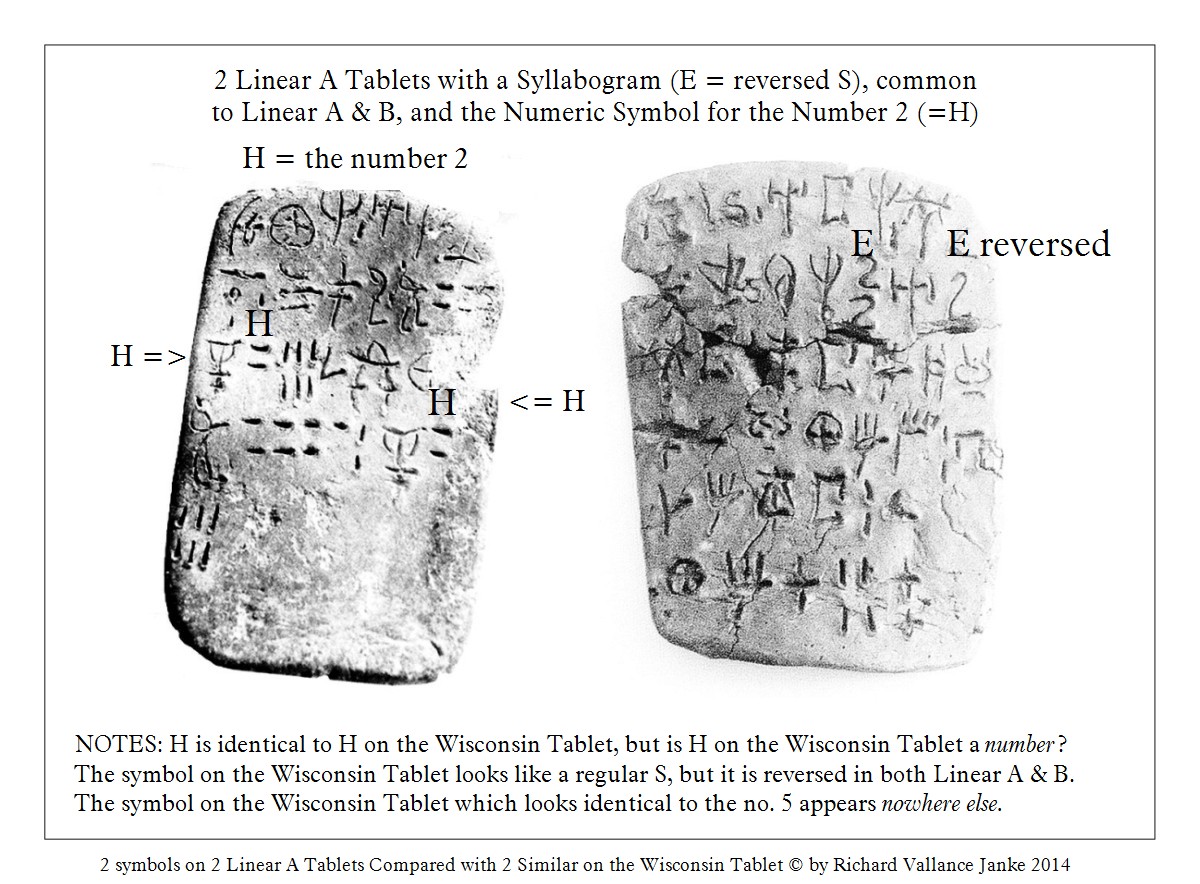


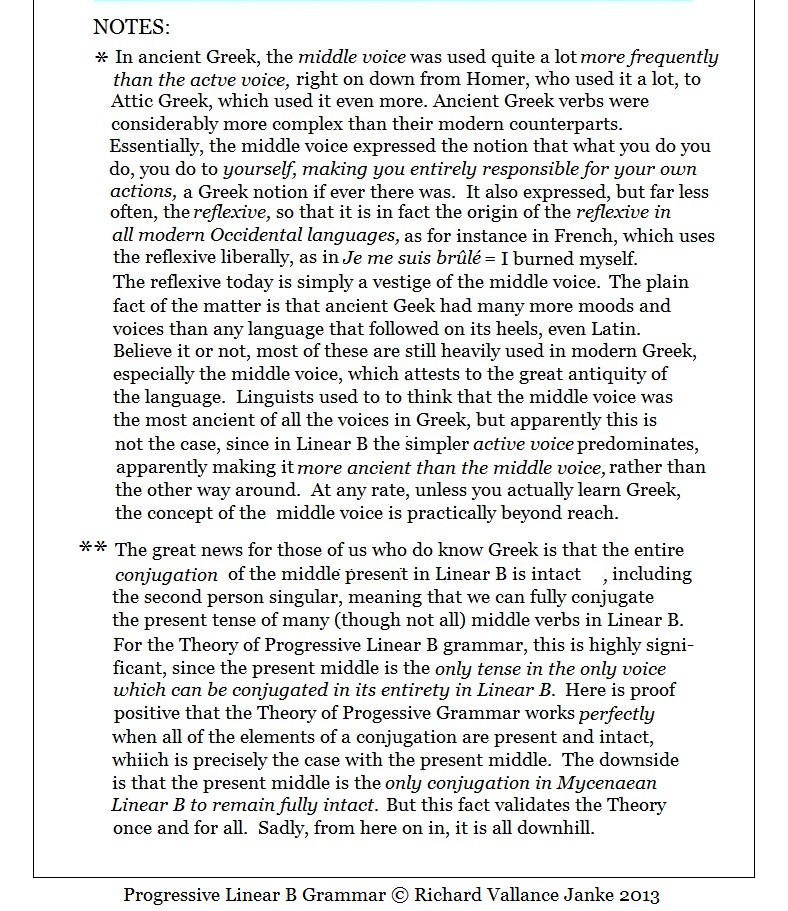

You must be logged in to post a comment.