Tag: Mycenaean Greek

  • Another Linear A tablet bites the dust… Troullos TL Za 1… horsemanship and hunting


    Another Linear A tablet bites the dust… Troullos TL Za 1… horsemanship and hunting:

    Troullos tablet TL Za 1

    This tablet or nodule completely eluded me for over 2 years. Then tonight, all of sudden, its meaning literally burst wide open. The first hint came when I began to decipher the obvious Linear words, all of which happen to be Mycenaean-derived New Minoan NM1. The most obvious word, which stands out like a sore thumb, is WAJA = #ai/a in Mycenaean-derived Greek, in other words land. The rest of the Mycenaean-derived words were more difficult to extract from the agglutinated text, since in an agglutinative language such as Minoan, words which would otherwise be separate in a fusional or inflected language, such as ancient or modern Greek or German, are simply strung together in long strings. So it is difficult to know where one word ends and another begins … but far from impossible. Because so many words on this tablet are agglutinated, it presents a particularly challenging target for decipherment. But decipher it I did, as you can see below.

    If we break apart the agglutinated words, meanings start to surface. For instance, ATAI*301 appears to mean 0astai= from oastei=a, meaning of the town, community.

    Moving on, we have QARE0 = ba/lei ba/loj = at the threshold (locative singular). For the time being, I do not know what OSU, which is almost certainly Old Minoan, means but I am confident I shall soon figure it out. If we then decipher the first 2 agglutinated words ATA*301WAJA. OSUQARE, we get something along these lines (OSU being omitted for the time being), on the … threshold of community of town, i.e. on the … outskirts of the community or town

    The the next two agglutinated words are UNAKANASI. UNA is Old Minoan. KANASI is instrumental plural Mycenaean-derived New Minoan (NM1) for ka/nnasi (instr. plural) = made of reeds, i.e. wicker. This almost certainly refers to the chariot itself, which like almost all Mycenaean chariots, is probably made of wicker, as illustrated below. If my hunch is correct, given that KANASI means made of wicker, then UNA must necessarily mean chariot, hence a chariot made of wicker. Remember: UNAKANASI is a composite agglutination of 2 words, first Old Minoan (UNA) and the second Mycenaean-derived New Minoan (NM1) = KANASI.

    Troullos tablet original with Mycenaean horse and chariot and modern horse halter

    IPINAMASIRUTE is another agglutination, this time consisting of 3 words, all of them Mycenaean-derived New Minoan (NM1). The tablet or nodule above provides us with the full translation, which in its actual order reads, with horsemanship + running + (towards) prey. In other words, we have a charioteer, whose name is JASASARAME, clearly a highly skilled charioteer and hunter, whose ridership or horsemanship allows him to run towards his prey, and at a fast pace at that, given that NAMA always refers to something flowing fast, usually a stream, but in this context, clearly horses, 2 of them, of course, since Mycenaean chariots always have two horses.

    So the free translation runs along these lines, and very well indeed,

    Jasasarame, the hunter-charioteer, in his chariot made of wicker, is exercising his (considerable) ridership skills, by running at break-neck speed (or: running by a stream) towards the wild prey he is hunting on the outskirts of his town (community).

    This decipherment, which is almost entirely in Mycenaean-derived New Minoan (NM1) hangs together admirably well. It is a major breakthrough in the ongoing saga of the decipherment of Linear A. It is also buttressed by the fact that the tablet or nodule actually looks like a horses halter. While the word halter appears, at least at first sight, not to figure in the text, this is of little consequence. The tablet itself makes it quite clear enough that here we have two horses (always two with Mycenaean chariots) and that a well-heeled, and most likely aristocratic or warrior-class charioteer, Jasasarame, is at the reins.

    I rest my case.

  • Astonishing commentary on my Exhaustive Linear A lexicon, comparing my achievements to those of Albert Einstein!

    Astonishing commentary on my Exhaustive Linear A lexicon, comparing my achievements to those of Albert Einstein!
    
    In the past week since I first uploaded my Exhaustive Linear A Lexicon, it has received 410 hits, i.e. downloads, as of 5:00 pm., Monday 7 August 2017. This amounts to almost 60 downloads a day. To download it, click below. You will then be taken to the next page, where you simply click the green DOWNLOAD button.
    
    Exhausitve Linear Lexicon Richard Vallance Janke academia.edu
    
    The lexicon has catapulted me from the top 5% to the top 0.1% of academia.edu users.
     
    Comments and commendations have been pouring in. Unquestionably, the most astonishing is this one:
    
    Linear A research by Richard Vallance Janke related to Albert Einstein and Coliln Renfrew
    
    Other comments include:
    
    wonderful topic... 
    
    Inspired by your new perspective on one of the most studied cultures in the world.
    
    Yes when you see their artifacts and the technology needed to create such items is amazing... Thanks for the reply and keep up the great work 
    
    e=mc2


  • T. Farkas’ brilliant decipherment of Linear B tablet KN 894 Nv 01

    T. Farkas’ brilliant decipherment of Linear B tablet KN 894 Nv 01:

    Knossos tablet KN 984 Nv 01

    Linear B transliteration

    Line 1. ateretea peterewa temidwe -ideogram for wheel, SSYL ZE for set or pair tablet broken off (i.e. right truncated)

    Line 2. kakiya -ideogram for wheel, SSYL ZE for set or pair 1. kakodeta -ideogram for wheel, SSYL ZE for pair or set tablet broken off (i.e. right truncated)

    Line 3. kidapa temidweta -ideogram for wheel, SSYL ZE for set or pair 41 tablet broken off (i.e. right truncated)

    line 4. odatuweta erika -ideogram for wheel, SSYL ZE for set or pair 40 to 89 tablet broken off (i.e. right truncated)

    Translation (my knowlege of Greek grammar is not sufficient at present to write out proper sentences [NOTE 1] but I have looked up and know the Greek equivalents for the Linear B words which I will write here.)

    Line 1. Pair/set of inlaid/unfinished? elmwood chariot wheel rims

    Οn your blog you have translated ateretea as “inlaid” from the Greek ἀιτh=ρeς. I found these words ατελείωτος , ατελεις … that means “unfinished” Do you think that could work? Either way I get that ateretea is an adjective that describes the wheel rims [2].

    α)τερεδέα/ατελείωτος πτελεFάς τερμιδFέντα ζευγάρι a1ρμοτα, (sorry for the mishmash Greek [3]).

    Line 2. 1 Copper [4] set or pair of wheel fasteners , bronze set or pair of wheel fasteners

    I looked around the net and some say copper was used as a band or even as a tire and as leather tire fasteners on bronze age chariot wheels.

    Since the deta on kakodeta refers to bindings perhaps this line is refering to sets of types of fasteners of both copper and bronze for wheels? (hubs, linch pins, nails, etc…) [Richard, YES!]

    χαλκίος ζευγάρι α1ρμοτα, χαλκοδέτα ζευγάρι α1ρμοτα

    Line 3. 41 Sets or pairs of “kidapa” chariot wheel rims

    Looked around the net didn’t find and words to match kidapa…I did take note that you think ― like L.R. Palmer ― that it means ash-wood.

    κιδάπα τερμιδFέντα ζευγἀρι α1ρμοτα

    Line 4. 40 to 89 ? sets of toothed/grooved willow-wood chariot wheels.

    Ive looked at many diagrams and pictures of chariot wheels… but none that I could find were clear enough to really understand what might be meant by toothed [5]… Ι even watched a documentary where an Egyptian chariot is built. It is called building Pharaoh’s Chariot. Perhaps one day I’ll happen upon some chariot wheels somewhere and finally understand what is meant.

    ο0δατFέντα ε0λικα ζευγἀρι α1ρμοτα 40 -89 ?

    Comments by our moderator, Richard Vallance Janke:

    This is absolutely brilliant work! I am astounded! 100 % hands down. This is one of the most difficult Linear A tablets to decipher. I too take kidapa to mean ash wood, as it is a tough wood. It is also probably Minoan, since it begins with ki, a common Minoan prefix:

    kida/kidi 
    kidapa OM = ash wood? (a type of wood) Appears only on Linear B tablet KN 894 N v 01
    kidaro MOSC NM1 kidaro ke/dron = juniper berry-or- kedri/a = oil of cedar Cf. Linear B kidaro
    kidata OM = to be accepted or delivered? (of crops) Cf. Linear B dekesato de/catoj
    kidini
    kidiora

    See my Comprehensive Linear A lexicon for further details I imagine you have already downloaded the Lexicon, given that at least 16 % of Linear A is Mycenaean-derived Greek. This decipherment alone of an extremely difficult Linear B tablet entitles you to a secondary school graduation diploma, which I shall draw up and send to you by mid-August.

    Specific notes:

    [1] Thalassa Farkas declares that … my knowlege of Greek grammar is not sufficient at present to write out proper sentences… , but the actual point is that it is not really possible to write out Greek sentences in Mycenaean Greek, in view of the fact that sentences are almost never used on Linear B tablets, given that these are inventories. Grammar is not characteristic of inventories, ancient or modern. So it is up to us as decipherers to reconstruct the putative “sentences which might be derived from each of the tabular lines in an inventory. So long as the sentences and the ultimate paragraph(s) make sense, all is well.

    [2] wheel rims is an acceptable reading.

    [3] This is hardly mishmash Greek. It is in fact archaic Greek, and archaic Greek in the Mycenaean dialect, absolutely appropriate in the context.

    [4] In Line 2, kakiya (genitive singular of kako) might mean copper, but is much more likely to mean “(made of) bronze” (gen. sing.), given that copper is a brittle metal, more likely to shatter under stress than is bronze. Copper tires would simply not hold up. Neither would pure bronze ones. Either would have to be re-inforced, and in this case by kidapa = ash-wood. That is the clincher, and that is why the word kidapa appears on this tablet.

    [5] In Line 5, temidweta does not mean with teeth, but the exact opposite, with grooves” or “with notches. After all, if we invert teeth in 3 dimensions, so that they are inside out, we end up with grooves. This can be seen in the following illustration of a Mycenaean chariot in the Tiryns fresco of women (warrior) charioteers:

    Tiryns fresco women charioteers

    On the other hand, scythes, which are after all similar to teeth, were commonplace on ancient chariots, including Egyptian, a nice little clever addition to help cut or chop up your enemies. Still, it is unlikely that Mycenaean chariots would be reinforced by scythes, in view of the fact that there are far too many of them even on fresco above. That is why I take temidweta to mean indentations” or “notches”. But temidweta could refer to “studs”, which like notches, are small, even though they stick out.

    Richard


  • New interpretation of Linear A tablet HT 7 (Haghia Triada)

    New interpretation of Linear A tablet HT 7 (Haghia Triada):

    Linear A tablet HT 7 Haghia Triada


    A few months ago, I tentatively deciphered Linear A tablet New interpretation of Linear A tablet HT 7 (Haghia Triada), but when I look back on that decipherment now, I find it implausible. So I have re-interpreted here in light of new data I have acquired since then. As the tablet is inscribed mostly in Old Minoan, it is rather difficult to make complete sense of it. However, the two Mycenaean-derived New Minoan (NM1) terms offer us a clue. These are iruja = a priestess and tanati, which appears to be dative singular for “death”. However, although iruja is nominative singular, it is followed by the number 3, which would seem to indicate that there are 3 priestesses. And the Minoan plural of a is e, hence iruje. The only explanation I can find for this discrepancy is that the 3 priestesses are operating independently, one by one, each one making at least 1 offering, while 1 priestess makes 2, for a total of 4. But this translation, which is rather convoluted, remains in doubt because I cannot verify with any real certainty the meanings of the Old Minoan words. However, it does manage to hold together. Perhaps someday in the future, we shall unearth more Linear A tablets, which will provide us with insight into the significance of the Old Minoan vocabulary.

  • New interpretation of Linear A tablet ZA 20 (Zakros)

    New interpretation of Linear A tablet ZA 20 (Zakros):

    Linear A tablet ZA 20 HM 1636 Zakros

    This new interpretation of Linear A tablet ZA 20 (Zakros) varies only slightly from my original one. I interpret the syllabogram on line 0 (the indecipherable line) as being NI, since the bottom of NI is a vertical line. And figs often figure prominently in Linear A tablets. The actual reading of the text is not quite clear, since there are at least 2 damaged syllabograms following MI on line 1. It is impossible to determine with any accuracy what the actual units of measurement are for anything on this tablet, although of course the units of chaff from wheat would have to be considerably less than the total units of wheat. So 1 unit + 6 units of wheat probably refers to something like bushels (a mere approximation), from which we would not get all that much chaff… which may explain the presence of the container, supposedly containing 3 smallish units of chaff. But why would anyone want to place chaff in a container? So we see problems with the decipherment.

  • Linear A tablet HT 38 (Haghia Triada) with 2 supersyllabograms, dealing with wine

    Linear A tablet HT 38 (Haghia Triada) with 2 supersyllabograms, dealing with wine:

    Linear A tablet TA HT 38 Linear A

    This intriguing tablet apparently deals with containers for wine, ranging from a type of vase (daropa) to a wine-skin (aka) to cloth, which appears to have been treated to be water-proof. Since the ideogram for pig appears immediately to the left of aka, we can surmise that the wine-skin is made of pigs hide. The notion that cloth containers could have been water-proofed is somewhat in doubt, but the overall decipherment of HT 38 appears sound enough.


  • Linear A haiku, violets parallel to violets for Kaniami, from her father, in Linear A, archaic Greek, English and French

    Linear A haiku, violets parallel to violets for Kaniami, from her father, in Linear A, archaic Greek, English and French:

    As can clearly be seen from the original inscription on this exquisitely crafted golden pin from the A.Y. Nikolaos Museum, Crete, the text of the haiku closely follows the original:

    Linear A golden pin Zf 1 Ayios Nikolaos Museum


  • Just uploaded to academia.edu = Exhaustive Linear A lexicon of 1030 New Minoan and Old Minoan words, with extensive sectional commentaries.pdf

    Just uploaded to academia.edu = Exhaustive Linear A lexicon of 1030 New Minoan and Old Minoan words, with extensive sectional commentaries.pdf 
    
    
    exhaustive linear a lexicon of 1030 Minoan words with extensive sectional commentaries
    
    
    What with its 1030 entries of New Minoan (NM1), Pre-Greek substratum and Old Minoan terms, this is the most exhaustive Linear A Lexicon ever published in history, exceeding Prof. John G. Younger’s (at 774 intact words) by 226, with the emphasis squarely on intact exograms (words). Every possible origin of Linear A words is investigated, with extensive sectional commentaries. This lexicon, 65 pp. long, includes 4 appendices and a bibliography of 108 items. 
    
    You will not want to miss out on reading this paper, representing one of the most significant historical breakthroughs in the decipherment of the Linear syllabary. If you are a member of academia.edu, please download it, and read it at your leisure. If you are not already a member of academia.edu, you can sign up for free, and then download it.
    
    My recent research into (Minoan) Linear A has meant that I have been catapulted from the top 5 % to the top 0.1 % of users on academia.edu in the past three weeks, here:
    
    Richard Vallance profile academia.edu


  • Silver pin from Mavro Spelio: A.Y. Nikolaos Museum PL Zf 1

    Silver pin from Mavro Spelio: A.Y. Nikolaos Museum PL Zf 1:
    
    Minoan Linear APL Zf1 silver pin Nikolaus Museum


    This silver pin, PL Zf 1, from Mavro Spelio, now housed in the A.Y. Nikolaos Museum, Crete, bears an inscription which may read dextrograde (left-to-right) or sinistrograde (right-to-left), but either way the text reads the same way. The inscription is a mixture of Mycenaean-derived New Minoan (NM1) and Old Minoan. The words Tanunikina (nom. fem. sing.) and Ninuni (dat. sing.) are almost certainly eponyms, with the former acting in some way as an agent of healing to the latter. Apart from the eponyms, the Old Minoan text is indecipherable. But that does not mean we cannot catch the drift of the inscription, because we can. It certainly makes sense that Tanunikina, despite her best efforts to spin or weave a magic spell, cannot heal Ninuna. We can infer that Tanunikina is a healer priestess. Such personages were extremely common in the ancient world, and certainly in Minoan Crete and on the Mycenaean mainland, with this practice surviving into archaic and classical Greece. She may even be an oracle, such as we find at Delphi much later on in ancient Greek history. If she is an oracle, she probably worked from a Minoan peak sanctuary.   


  • Linear A haiku: the saffron goddess, her crimson dress adorned with ivy

    Linear A haiku: the saffron goddess, her crimson dress adorned with ivy:

    Minoan Linear A haiku sea sarai the saffron goddess

    In this haiku, all of the words except sarai = “flax or saffron” (the latter in this context) are Mycenaean-derived New Minoan (NM1). The onomatopoeia of the 3 phrases rolls off the tongue. Not only is her dress adorned with ivy, apparently she is as well.


  • Just uploaded to academia.edu: Decipherment of Linear A tablet HT 86 Haghia Triada, a mirror image of HT 95

    Just uploaded to academia.edu: Decipherment of Linear A tablet HT 86 Haghia Triada, a mirror image of HT 95:
    
    decipherment of Linear A tablet HT 86 academia.edu
    
    Linear A Tablet HT 86 (Haghia Triada) Linear A tablet HT 86 (Haghia Triada) appears to be inscribed partially in Mycenaean-derived New Minoan and partially in Old Minoan, just as is HT 95 (Haghia Triada). This is one of the most significant of all Linear A tablets, because it so closely parallels HT 95. The fact that the text of HT 86 so closely mirrors that of HT 95 lends further credence to our decipherment of both of these tablets taken together. We find approximately equal parts of Mycenaean-derived New Minoan and Old Minoan vocabulary on HT 86. Here we have the New Minoan vocabulary on HT 86: akaru, dideru (equivalent to Linear B didero), dame & minute Old Minoan vocabulary on HT 86: kunisu, saru, qara2wa (qaraiwa) & adu. We must pay special heed to the terms akaru and dideru in New Minoan, as these in turn signify " field " (archaic acc.), where all of these crops are obviously grown and didero, which is Linear A for " einkorn wheat ". As for the Old Minoan terminology, we have kunisu, which is " emmer wheat " and adu, which is a very large unit of dry measurement, probably " bales ". Astonishingly, the text as a whole admirably hangs together, all the more so when compared with that of HT 95. 
    
    
  • The first ever complete and entirely unique decipherment of Linear A tablet HT 123 RECTO (Haghia Triada)

    The first ever complete and entirely unique decipherment of Linear A tablet HT 123 RECTO (Haghia Triada):

    Linear A tablet HT 123 Haghia Triada RECTO olives saffron flax wine

    This decipherment of Linear A tablet HT 123 RECTO (Haghia Triada) is entirely unique and is the first ever of its kind. It incorporates several key features never before seen in any of the failed attempts at deciphering this tablet. These are:

    1. It accurately identifies the crops as (a) olives (b) wine and (c) saffron/flax;

    2. It accurately identifies what all previous decipherers” have erroneously assumed to be fractions as crop shares;

    3. It accurately identifies the supersyllabogram PU, which no one has ever before been able to decipher as the Old Minoan word, punikaso = Phoenician or in the case of wine = purple, equivalent to Linear B ponikiyo.

    4. It clearly and accurately identifies the shares of crops, usually 8 shares per;

    5. The Old Minoan Linear A word kiro appears to mean they owed, which suits the context to a T;

    6. the combination of the number 8 with harvesting fits the season exactly, the month for harvesting being lunar August (at least if the Minoans counted counted their lunar months from the first month in the year, which certainly appears to be the case).

    7. Since the total 20 + is right-truncated on the last line, I have to assume that it refers to 20 or more months, given that 9 months are mentioned above, with the ninth month implying that 8 preceded it, for a total 17. The number 4 with the unknown character probably also references months, bringing the potential total to 21. Thus a grand total of 20+ months is not out of the question.

    This is the first ever successful decipherment of Linear A tablet HT 123 (RECTO) in toto.


  • Statistical incidence of various types of gains and of flax on Linear A tablets from Haghia Triada and elsewhere, now on academia.edu

    Statistical incidence of various types of gains and of flax on Linear A tablets from Haghia Triada and elsewhere, now on academia.edu

    Statistical incidence of various types of grains and of flax on Linear A tablets from Haghia Triada and elsewhere


  • Statistical incidence of various types of grains on Linear A tablets from Haghia Triada and elsewhere

    Statistical incidence of various types of grains on Linear A tablets from Haghia Triada and elsewhere:

    incidence of barley einkorn emmer on Linear A tablets

    akaru = field HT 2 (20+) HT 86 X2 (20+ )

    TOTAL = 40+

    barley

    kireta2 (kiretai) = barley HT 85 (1) + HT 129 (33)

    TOTAL = 34

    kiretana = barley-like HT 2 (54+) HT 8 X 2 (5) HT 108 (1) HT 120 (60)

    TOTAL = 120

    einkorn wheat

    dideru = einkorn wheat HT 86 X 2 (2nd. trunc.) (20) HT 95 X 2 (20)

    TOTAL = 40

    emmer wheat

    kunisu = emmer wheat HT 10 (0) HT 86 X 2 (40+) HT 95 X 2 (30)

    TOTAL = 70+

    flax

    [sara2 = flax HT 18 (10) HT 28 X 2 (21) HT 30 (0) HT 32-34 (0) HT 90 (20) HT 93 (20) HT 94 (5) HT 97 (0) HT 99 (4+) HT 100-102 (985+) HT 105 (234) HT 114 (10) HT 121 (5) HT 125 (2) HT 130 (0)

    TOTAL = 1306+

    + saru (oblique case) HT 86 X 3 (41+) HT 95 X 2 (30) HT 123+124 (16 )

    TOTAL = 87+

    TOTAL for all references to flax = 1393]

    spelt or millet

    dame = spelt or millet HT 86 (20) HT 95 X2 (20) HT 120 (74)

    TOTAL = 94

    millet or spelt

    qera2u/qera2wa = millet or spelt HT 1 (197) HT 95 X2 (17)
    TOTAL = 214

    durare = durum wheat? Knossos KN Zc 7 (0)

    TOTAL = 0

    minute = a type of grain -or- and for a month HT 86 (20) HT 95 X2 (20) HT 106 (6+)

    TOTAL = 46+

    pura2 = a type of grain HT 28 (6) HT 116 (45) KN 54 (0)

    TOTAL = 51

    qanuma = ditto HT 116 (20) KH 88 (Khania) (10)

    TOTAL = 20

    standard units of measurement on all Linear A tablets:

    adu HT 85 (0) HT 86 (0) HT 88 (20) HT 92 (680) HT 95 (0) HT 99 (0) HT 133 (55) (bales?)

    TOTAL = 755

    adureza (0) = standard unit of dry measurement, something like a bushel

    dureza (7 ) = variant of the same

    TOTAL = 7

    kireza ( 42) = standard unit of measurement for figs, dates or grapes = 1 basket

    TOTAL = 42

    reza (67+ ) = standard unit of linear measurement

    TOTAL = 67+

    tereza (0) = standard unit of liquid measurement

    © by Richard Vallance Janke 2017

  • Linear A rock crystal vase IO Za 10 from Iouktas

    Linear A rock crystal vase IO Za 10 from Iouktas:
    
    Linear A IO Za 10 crystal rock vase Iouktas
    
    The finely chiselled Linear A rock crystal vase IO Za 10 from Iouktas appears to bear an inscription along the lines of, “the peak sanctuary or shrine of the goddess of healing and health”. I came to this conclusion in the following manner. The word zudisika appears to be a composite Linear A word, of which the first two syllables, zudi, are Old Minoan (OM), while the last two syllables, sika, are almost certainly Mycenaean-derived New Minoan (NM1). Linear A sika corresponds neatly with archaic Greek sika, which is arch. accus. for sikos (Latinized), meaning “a sacred precinct or shrine”. It is a historical fact that there were numerous peak sanctuaries in the Minoan eras. So it strikes me that zudi may very well mean, “summit or peak”, hence our decipherment, which after all is said is done, makes perfect sense. 
    
    This decipherment is strongly corroborated by the fact that Juktas (Iouktas)is indeed a Middle Minoan peak sanctuary! Click to visit:
    
    Middle Minoan Juktas Peak Sanctuary
    
    Iouktas Peak Sanctuary, Crete


  • Haiku in Minoan Linear A: violets in fine craftsmanship from her father

    Haiku in Minoan Linear A: violets in fine craftsmanship from her father:

    haiku in Linear A violets from father


  • Are Minoan and Mycenaean fractions fractions? I am not at all convinced

    Are Minoan and Mycenaean fractions fractions? I am not at all convinced
    
    Are Minoan Linear A fractions fractions or something else
    
    Are Mycenaean Linear B fractions fractions or something else
    
    Since Minoan and Mycenaean fractions, as estimated by Andras Zeke of the Minoan Language Blog and Prof. John G. Younger, fall as low as 1/10 and 1/32, I am not at all convinced that these are fractions at all. They are, as far as I can tell, crop shares. This makes a lot more sense, since we are dealing with farming, where crop shares have always been of paramount importance. As for units of measurement, we have no real idea what they were, since Minoan Crete and the Mycenaean Empire are so remote in history. No one can possibly determine fractions that far back in history. In fact, Prof. Younger and Andras Zeke cannot even agree on the values of the fractions... not that that argument invalidates the notion they are not fractions. That is a specious argument. However, it makes more sense to consider these as crop shares, especially in view of the fact that some of the Mycenaean symbols are so remarkably similar to their Minoan counterparts. The appearance of symbols has nothing to do with what we take them to mean. This again is an arbitrary decision, which may be right or wrong.  


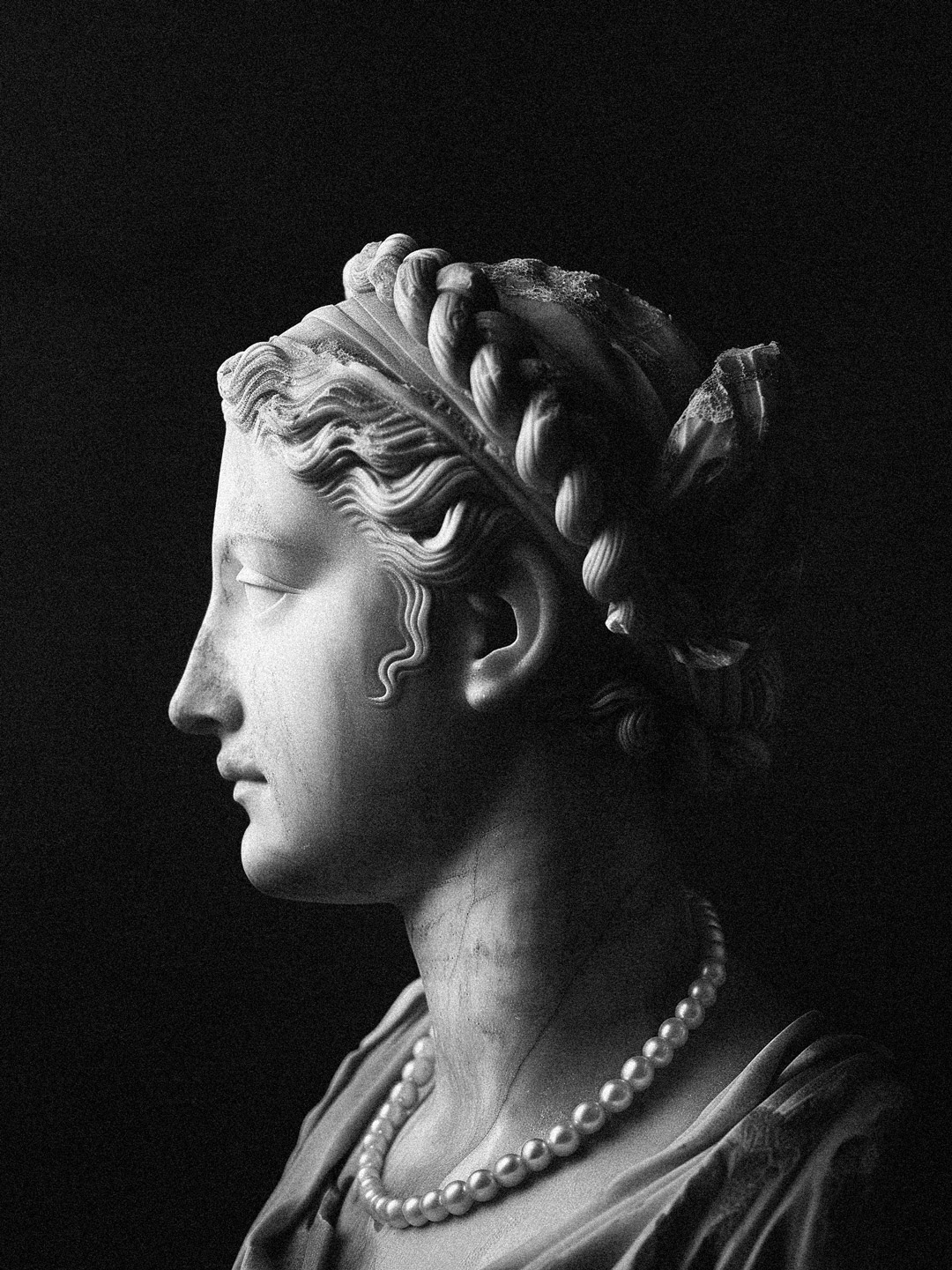
Sappho, spelled (in the dialect spoken by the poet) Psappho, (born c. 610, Lesbos, Greece — died c. 570 BCE). A lyric poet greatly admired in all ages for the beauty of her writing style.

Her language contains elements from Aeolic vernacular and poetic tradition, with traces of epic vocabulary familiar to readers of Homer. She has the ability to judge critically her own ecstasies and grief, and her emotions lose nothing of their force by being recollected in tranquillity.

Marble statue of Sappho on side profile.

Designed with WordPress