Tag: LinearB

  • Knossos Fragment, KN 201 X a 26, TARASA “The Sea”, a Surprise Find! & a Fresco! CLICK TO ENLARGE:

    Knossos Fragment, KN 201 X a 26, TARASA “The Sea”, a Surprise Find! & a Fresco! CLICK TO ENLARGE:
    
    Knossos fragment KN 201 X TARASA the SEA
    
    Although you would think that there should be references to the sea (of all places!) on Linear B tablets and fragments, until now at least such references simply have not appeared. It is a good thing I have slogged through at least 2,000 of the Scripta Minoa fragments and tablets, because at last I found one mentioning the sea, and even if this fragment is truncated on the right, as it surely appears to be, I am still convinced that this is an entire word, and if so, then it can mean only one thing, the sea. The chances of ever finding another Linear B fragment or tablet with this word, the sea, seem very slim indeed, although you never know. One thing you can be sure of, I shall keep on looking.
    
    Minoan Fresco depicting Minoan ships at the island of Thera: Click to ENLARGE:
    Fresco Minoan Ships in Thera
    
    Richard
    
    
  • POST 300! A Sampling of Linear B Fragments on Amnisos, the Harbour of Knossos, in Scripta Minoa

    POST 300! A Sampling of Linear B Fragments on Amnisos, the Harbour of Knossos, in Scripta Minoa (Click to ENLARGE):
    
    AMINISO 10 samples from Scripta Minoa
    
    In this set of Linear B fragments from Scripta Minoa, we feature even more fragments on Amnisos, the harbour of Knossos. Like fragments and sometimes whole tablets dealing with Knossos, there are scores dealing with Amnisos, and sometimes the same fragment or tablet deals with both Amnisos and Knossos, which should come as no surprise, considering the extreme importance of these two locales to the thriving Minoan economy. One fragment in particular, KN 410 X (top right) is of particular significance, because it reveals more about the Minoan economy than might be assumed at first sight. This fragment states, “to Amnisos”. The only question is, from where?  There can only be 2 possibilities, either (a) from Knossos itself or (b) from overseas, since Amnisos was the international trading port of Knossos. If this distinction sounds a bit academic, I would put it to you that it is not, because either meaning fits the bill supremely. And in any case, the missing portions of some fragments would have said, “from Knossos”, while others would have said “from overseas/from Mycenae/from Egypt” etc. I think we can probably take that much for granted. To summarize, what I am getting at here is simply this, that the Linear B fragments can often reveal something valuable, i.e. at least some information about their context, even where that context is missing. In those instances, such as in this case, where this is not entirely a matter of conjecture, we may find ourselves learning something new about the Minoan/Mycenaean society and economy, however sparse that new information may be.
    
    Richard


  • A Sampling of Linear B Fragments mentioning Knossos & its Harbour, Amnisos in Scripta Minoa

    A Sampling of Linear B Fragments mentioning Knossos & its Harbour, Amnisos in Scripta Minoa (Click to ENLARGE):
    
    KONOSO X 6
    
    This is only a small sampling of the scores of fragments and tablets in the Scripta Minoa mentioning Knossos and its harbour, Amnisos. In the next post, we will feature even more fragments mentioning Amnisos. It is critical to understand the prime importance of both Knossos & Amnisos together in tandem, just as one would picture the Pireaus with Athens and the port of Ostia with Rome.
    
    One of these fragments also mentions the island of Lykinthos. I am providing a map here to pinpoint the precise location of each locale (Click to ENLARGE):
    
    Lykinthos LEFT and Minoan Crete Knossos & Amnisos RIGHT
    
    Richard 
    
    
  • Translation of Knossos Fragment KN 190 B with the Sypersyllabogram DI by Rita Roberts


    Translation of Knossos Fragment KN 190 B with the Sypersyllabogram DI by Rita Roberts 
    
    Well over a year ago I became interested in the ancient script writings of the Minoans. These scripts are written on clay tablets and were discovered by Sir Arthur Evans whilst excavating the grand Palace of Knossos in Crete. It was Evans who named these scripts Linear B.
    
    My Linear B teacher and mentor Richard Vallance Janke is extremely helpful in guiding me through what would be a difficult course for me to follow. However, with Richards humour and patience and his unique way of teaching I have found this subject a delight to learn in so much that I have now completed levels 1-4 (Basic to Advanced, Part 1).
    
    Now Richard has given me my first assignment in translating Linear B fragments into English. These fragments seemed simple at a first glance as all of them contained the words KOWA for girl and KOWO for boy, so I thought, this should be reasonably easy. However, when I looked at what I thought was a simple translation where the first word was KOWA followed by the single syllabogram DI this confused me, I had no idea what this could possibly mean.
    
    I know that Richard has been working hard on his new theory of Sypersyllabograms. I call them Supergrams to myself, so I knew he would advise me to consult the Linear B English Glossary and the Linear B Lexicon a much larger dictionary where I most likely would find what the Syllabogram DI might mean, this I did and to my astonishment there I found an entry which made sense " diwiya" alternately spelled "diwiyaya" meaning "a or the Priestess of the god Zeus".
    This Sypersyllabogram DI meaning is to me a logical translation since the three most important deities the Minoans worshipped were Pipituna, the Snake Goddess and Zeus, hence my translation as follows:
    
    Translation of Knossos Fragment KN 190 B with the Sypersyllabogram DI by Rita Roberts (Click to ENLARGE):
    
    Folder Ref DI translation 2
    
    Rita Roberts
    
    NOTE by Richard Vallance Janke.
    
    Folks, this is Rita’s firs major contribution as an official translator of Linear B fragments. Considering that Rita only just began learning Linear B in the spring of 2013, she has come a very, very long way indeed. The task of translating this recalcitrant fragment placed enormous intellectual demands on Rita, and she has surpassed herself in the sheer ingenuity of her translation, which I would never have dreamt of myself, in spite of my extensive knowledge of Linear B, and a translation which I consider to be not only second to none, but highly accurate. Congratulations, Rita. We look forward to more fine translations from your expert hand.
    
    Richard


  • Haiku: eni wanakatero… kowo suni kowaisi… prenuptial celebrations!

    Haiku: eni wanakatero... kowo suni kowaisi... prenuptial celebrations! (Click to ENLARGE):
    
    haikueniwanakaterjpg2
    
    Imagine yourself joyous in the presence of the King and Queen of Knossos, 6 lush floral arrangements, some with the sacred lilies, circling the throne room, while boys and girls swirl about, dancing with one another, celebrating the marriage of the Princess, the daughter of the King and Queen, to the Prince of Lilies, such as we see in this lovely triptych of 2 frescoes and 4 of the 6 flower pots: Click to ENLARGE:
    
    PrincessandPrinceofLilies
    
    Finally, we see that in the second line of this celebratory haiku, I have used two of the new ideologograms for “flower pot”, for a total of 6 flower pots, which I take to be a floral arrangement, as for instance for a wedding, which may be what this haiku is about, at least to my mind. Others will find other interpretations for this haiku, as that is what haiku are all about. We leave it to our own imagination to see what we see in the haiku.
    Richard


  • Review of Homophones in Linear B: the Diphthong AI (the Most Common in Linear B)

    Review of Homophones in Linear B: the Diphthong AI (the Most Common in Linear B): Click to ENLARGE:
    
    
    AI series homophones in Linear B
    
    This post, as the next few following it dealing with homophones in Linear B, is intended for students of Linear B who have already mastered the Basic Syllabograms, and for researchers and others who would just like to review their homophones. I would like to point out that I have no intention of covering all of the homophones, since some of them are so rarely used as to be practically inconsequential, but that I shall focus on these ones alone: AI, HA, PTE, DIPTE, RAI, RIYA, RIYO, SIYA and TIYA, with passing references to SWA & SWI.  Our final review of homophones will be concluded well before the end of June 2012.
    
    In the next post, we will be featuring the next most commonly used homophone in Linear B, HA, which was used to express an initial aspirated A.
    
    Richard
    
  • Is the syllabogram ZE just a plain old syllabogram? A MAJOR discovery soon to be announced!

    Is the syllabogram ZE just a plain old syllabogram?  A MAJOR discovery soon to be announced!
    
    ZE, the Super Syllabogram!
    
    Linear B ZE syllabogram logogram combinatory ideogram
    
    Just the other day, while meticulously examining some of the 100s of the fragments of the Scripta Minoa I have already ploughed through with a fine-tooth comb, I noticed something particularly astonishing, something which has never been directly observed until now, but which is bound to have a significant impact on the continuing saga all of us, as researchers, are pursuing in our attempts to successfully decipher certain aspects of the Linear B syllabary, including both logograms and ideograms, which have hitherto remained entirely recalcitrant to interpretation. But I sincerely believe I have actually cracked another mystery in the Linear B saga, and that mystery revolves around not one, but more than one, Linear B syllabogram, logogram and ideogram, taken not in isolation but in specific, invariable combination(s) with one another.
    
    This entirely new approach to the decipherment of hitherto inexplicable portions of Linear B tablets, indeed, even of fragments of Linear B tablets, is bound to have profound implications in our ability to break open at least some of the remaining mysteries of Linear B. Not only did I discover this particular syllabogram ZE in a specific configuration, that is to say, a specific, invariable order with the very same ideogram several times over, but I also discovered the same phenomenon occurring at least as frequently and in some cases, far more frequently, with specific syllabograms always combined in exactly the same order with exactly the same ideogram. Something is going on here, and I mean something big, which has eluded the notice of all Linear B researchers to date, in the 60 years plus since Michael Ventris first deciphered Linear B.
    
    To say the very least, I was extremely lucky to have stumbled upon this particular and particularly precise usage of the “syllabogram” ZE in the Scripta Minoa, which places it firmly in the same class as the most common Linear B logograms, all of which are already perfectly understood. The big difference here is that, until now, all Linear B logograms we know the precise meaning of are all comprised of nothing but two or more syllabograms.  I stress this.  In the case of ZE, we have an entirely new phenomenon, as you shall soon discover for yourselves. Please understand that for my purposes, and in fact for the sake of absolute clarity and for sound theoretical purposes, I insist on a clear distinction between a logogram and an ideogram. In fact, as you are soon to see, we may have to “invent” at least one new class of Linear B “symbols” which is a composite of either:
    
    a both a syllabogram and an ideogram, but always in the same precise configuration and in the same precise order;
    b and, yes, even 2 ideograms, again always in the same precise configuration and in the same precise order.
    
    I am in fact so convinced that the “meaning” I am about to assign to the syllabogram ZE in combination with the (as yet) “secret” syllabogram I shall be unveiling is in fact so sound as to be practically self-evident. I challenge all major researchers into Linear B to challenge my interpretation of the ZE + ideogram logogram, since after all I may be barking up the wrong tree. But somehow, intuitively, inductively and contextually, I do not believe I err. Only time will tell. 
    
    What I sincerely believe I am about to demonstrate is this: Linear B is an even more complex, more sophisticated, in short, a more elegant syllabary system than we have yet imagined, so much so indeed that it may be the most sophisticated syllabary ever to have existed prior to the advent of the alphabetic scripts.   
    
    Keep posted!
    
    Richard


  • Linear B Show & Tell # 4: Amphora Decorated with Spirals


    Linear B Show & Tell # 4:  Amphora Decorated with Spirals (Click to ENLARGE):
    
    Mycenaean Linear B aporowewe amphora decorated with spirals
    
    Anyone who is at all familiar with Minoan-Mycenaean architectural, fresco and pottery designs knows fully well that the Minoans and Mycenaeans were quite crazy about spirals in their beautiful designs, which proliferate above all else on their exquisite pottery: pithoi (huge storage jars, as seen at Knossos, used to store olive oil and many other commodities), amphorae, vases, jars, bowls, drinking vessels, you name it.
    
    Here is a composite of more exquisite examples + the word for “cup” (Click to ENLARGE):
    
    Kamares Middle Minoan Mycenaean octopus wine cup Minoan Dolphiin Oinos wine cup


  • Prepositions in Mycenaean Linear B & Homeric Greek & the Cases they Govern

    Prepositions in Mycenaean Linear B & Homeric Greek & the Cases they Govern (Click to ENLARGE):
    
    Mycenaean Linear B Prepositions and their Classical Equivalents
    The use of prepositions and the cases they govern in Mycenaean Linear B correspond exactly to the use of the same prepositions in Homeric and Classical Greek. Just a few minor notes: first of all, Linear B uses the more ancient form “apu”, which is (not surprisingly) Arcado-Cypriot & hence also found in Linear C for “apo”, and again, uses “eni” (often used by Homer in Book II of the Iliad, in which we find the most archaic Greek) for “en”. Other than that, everything is pretty much straightforward.  Beginning with the next post, I shall proceed to illustrate the uses of the prepositions with examples of sentences in both Linear B and in (Homeric) Greek, according to the case(s) they govern, beginning with prepositions governing only 1 case, either genitive or dative or accusative, moving on to prepositions which govern 2 cases, and finally to those which govern 3 cases. Finally, while almost all the prepositions in Mycenaean Greek are either Attested [A] or Derived [D], we can pretty much assume their authenticity. However, I cannot guarantee the same for the prepositions "eke" or "eise", as they are entirely conjectural [C], and quite possibly unreliable.
    
    Richard
  • Sir Arthur Evans’ successful decipherment of the Numeric Accounting System in Linear B:

    Sir Arthur Evans‘ successful decipherment of the Numeric Accounting System in Linear B (Click to ENLARGE):

    Scripta Minoa Arthur Evans Numerics pp. 51-52

    as published in Scripta Minoa (Oxford University Press, 1952), the very same year that Michael Ventris finally deciphered the entire Linear B syllabary as well as a large number of its ideograms. Sir Arthur Evans had, of course, deciphered the numeric system years before.

    SCRIPTA MINOA Oxford 1952

  • Progressive Linear B Grammar: was there a Future Tense?

    Progressive Linear B Grammar: the Conjectural Future Tense (Click to ENLARGE):
    
    Progressive Linear B Future Tense Conjectural
    
    Progressive Linear B Grammar: was there a Future Tense? Well, yes and no...
    
    The first thing we need to clear up before we go any further with the conjectural derived future tense in Linear B is this: there are absolutely no instances of the future tense attested anywhere on any extant Linear B tablets (at least to date), and I doubt there ever will be any. Why so? It is actually quite simple: the Linear B scribes were accountants, solely concerned with record-keeping and fiscal accounts for the current year only, and nothing else. Linear B scribes never kept records or accounts for more than one fiscal year (so-called, since that is scarcely what they would have called it, being as it is modern terminology). They routinely destroyed all accounting records for the previous year by wiping their clay tablets clean and reusing them all over again, year after year, until of course they (the tablets, not the scribes!) were no longer usable, and had to be replaced.
    
    In other words, their total preoccupation with records for the current year, or as they called it, WETO or the “running year” precluded any concern at all for what lay ahead in the future, near or far, not even the next “running year”, a contradiction in terms per se, since only the current year can be “running”. So I must conclude that it is unlikely that the Linear B scribes ever used the future tense for their strictly administrative tabular accounts.
    
    This does not mean, however, that the Mycenaeans did not use the spoken future tense, as that too is an absurd proposition. Like all peoples speaking almost any Occidental IE language, they had to use the future tense, and do so frequently, which is why I have reconstructed it regressively from Homeric Greek (or if not possible, from other early Greek dialectical forms). Once I have derived the conjugation for any tense, present, future, aorist, perfect, etc. it is a simple matter to reconstruct progressively the conjugation in its quasi-entirety, omitting the second person singular in the present & future tenses, since I am unable to reconstruct it with any degree of certainty... as I have pointed out numerous times before on this Blog.
    
    CONCLUSION: Just because the future tense is not attested anywhere on extant Linear B tablets does not mean it did not exist. In fact, the contrary must be the case, since an IE (Indo-European) language (in almost all cases) must have a future tense. Had the Mycenaeans ever had reason to write in the future tense, they most surely would have. But they didn’t – at least we have not seen it so far. Linear B tablets unearthed sometime in the future may possibly give instances of the use of the future tense in writing, but once again, I sincerely doubt it, for the reasons elucidated above.
    
    Richard
    
    
  • Samples of Colours on Frescoes at Knossos: Les Parisiennes & The Bluebird

    Samples of Colours on Frescoes at Knossos: Les Parisiennes & The Bluebird [Click to ENLARGE]:

    Knossos Frescos Blue Bird and Les Parisiennes details

    See NOTES on the previous post.

  • Minoan Frescoes & the Prevalence of Colour in Linear B Vocabulary

    Minoan Frescoes & the Prevalence of Colour in Linear B Vocabulary (Click to ENLARGE):

    Dyes Colors Colours Frescos Cloth Purple in Linear B

    Minoan Frescoes & The Prevalence of Colours in Linear B Vocabulary:

    Despite the paucity of Linear B vocabulary on extant Mycenaean/Minoan tablets (estimated as some 2,000 words more or less), colours play a predominant rôle. What is so striking about the Linear B vocabulary for colours is its precision and richness. Linear B not only has the standard words for several colours, white, red, purple and black, it even has words for (often highly) unusual variants of the some colours, such as the colour of the yellow water lily (instead of just plain “yellow”); aquamarine (instead of plain “blue”); saffron (from the crocus); crimson, which is directly derived from the Linear B word for “Phoenician”, meaning of course that the colour we know as “crimson” is in actuality, “the Phoenican colour”; “painted/dyed red”, in addition to just plain old red; and “shell purple” as well as “purple”. Shell purple is a gorgeous marbled purple from sea shells. So to summarize, the Minoans were extremely conscious of the power and magnificence of colours, and they sure knew how to “put on the Ritz” in their generous application of them. One look at any single surviving Minoan/Mycenaean fresco speaks volumes to the exquisite taste the Minoans and Mycenaeans had for colour in art, as attested by their absolutely stunning frescoes! Few, if any, civilizations, ancient or modern, have ever attained the heights of brilliant artistry in frescoes as did the Minoans. I for one consider Minoan/Mycenaean frescoes to be far superior to the rather stiff frescoes and iconic art of the early Christian and Medieval churches. But of course I am biased.

    Now, one seemingly perplexing question remains. Where is the colour green? The answer is much simpler than you might imagine. In spite of all their talent for producing a dizzying array of lustrous colours on their frescoes, the Minoans – or for that matter – none of the ancients in the Western world at that time – were unable to produce green, which is why all the trees in their frescoes are blue. But we can forgive them for this omission, considering the spectacular and enduring beauty of their frescoes.

    In the next post, I will display for your delight and artistic appreciation 2 of the most magnificent frescoes from Knossos, illustrating the highly imaginative application of colours the Minoan artisans lavished on their frescoes. I will tag these frescoes with the colours applied with their Linear B, Greek and English names.

    Richard


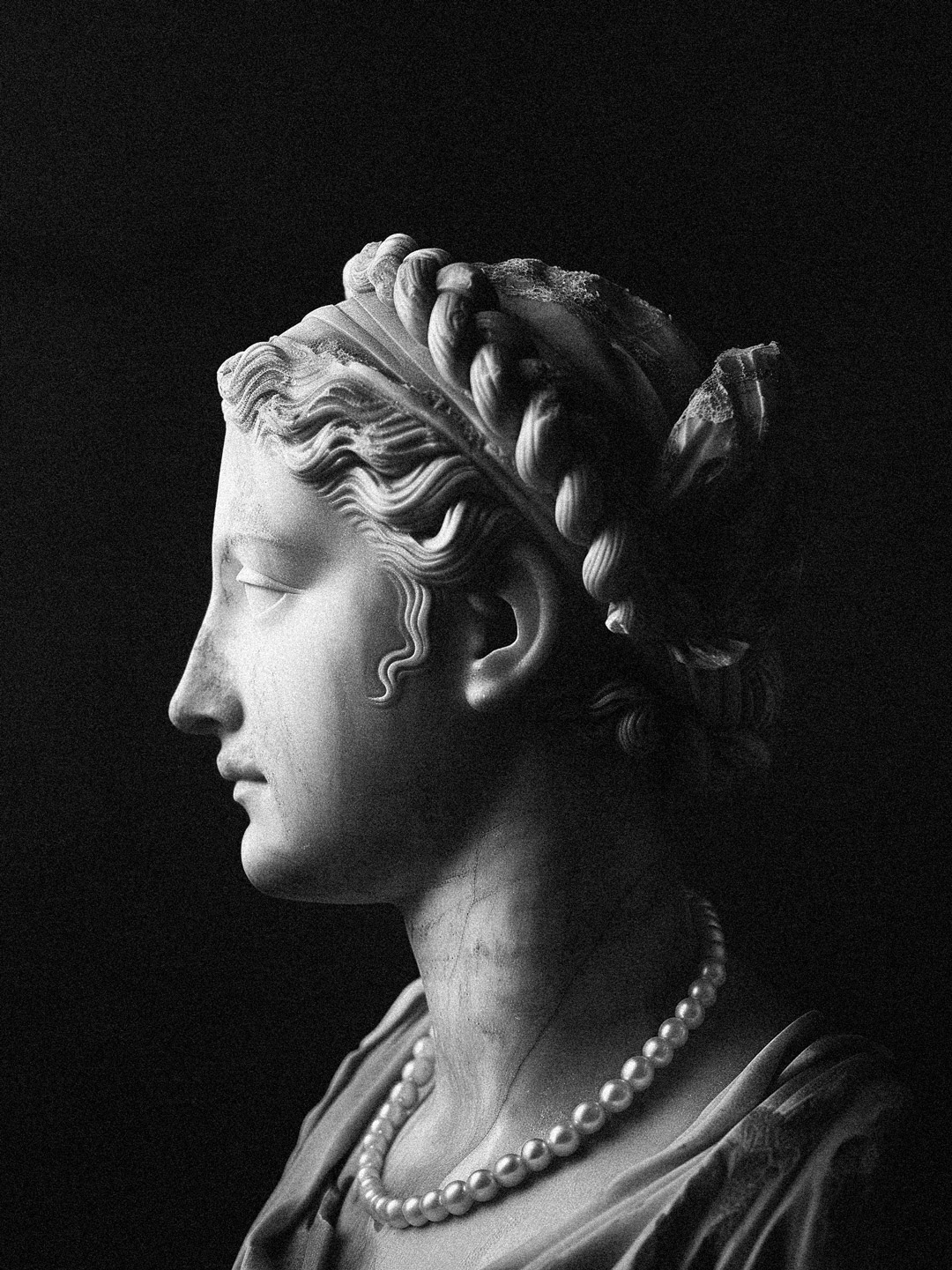
Sappho, spelled (in the dialect spoken by the poet) Psappho, (born c. 610, Lesbos, Greece — died c. 570 BCE). A lyric poet greatly admired in all ages for the beauty of her writing style.

Her language contains elements from Aeolic vernacular and poetic tradition, with traces of epic vocabulary familiar to readers of Homer. She has the ability to judge critically her own ecstasies and grief, and her emotions lose nothing of their force by being recollected in tranquillity.

Marble statue of Sappho on side profile.

Designed with WordPress