How to Insert Logograms and Ideograms into Linear B Text Insertion of Logograms: Now that we have learned how to type Linear B in a document, the only thing left for us to do is to insert logograms and ideograms as required into our text. In Linear B, a logogram is either (a) a homophone such as rai, which also means “saffron” -or- (b) a combination of two or three syllabograms, one on top of the other, which combine to form the word which they represent. Linear B scribes often resorted to this short-cut in order to save precious space on the tiny tablets they inscribed. The procedure for each of these two different types of logograms is not the same. For (a), it is simple. Since the logogram, such as rai for “saffron” is already a homophone, it is on the Linear B keyboard. So you just type it, as we see here: (First switch from your default font to Linear B as per the instructions in the last post): Click to ENLARGE both examples
NOTES: (1) right after you insert the logogram, you must then select Wrap – Wrap Through, otherwise the logogram will appear above or below the preceding word in Linear B, but not beside. In other words, the logogram must be anchored to the paragraph in which the Linear B word is found, or if there is no paragraph, immediately to the right of the Linear B word. (2) You can easily see that the logogram for “ointment” is actually the Linear B word for ointment. In the sentence, The Queen has wool, the logogram = the syllabogram MA with RE underneath = mare = wool. Note that the logogram is not spelled the same as the word for -wool = mari. For the logogram for honey = meri, see below. Insertion of Ideograms: The procedure for the insertion of ideograms is identical to method (b) above for logograms such as arepa, mari (above) & meri (below) for ointment, wool & honey respectively. 1 Insert (from the Insert Menu) - Picture – From File, as illustrated here in the introductory text to Pylos Tablet Py 641-1952 (Ventris): Click to ENLARGE
NOTE: Right after you insert the ideogram, you must then select Wrap – Wrap Through, otherwise the ideogram will appear above or below the preceding word in Linear B, but not beside it. In other words, the ideogram must be anchored to the paragraph in which the Linear B word is found, or if there is no paragraph, immediately to the right of the Linear B word. Richard
Tag: LinearB
-
Learn How to Type Linear B FAST! – well, at least much faster than usual: Click to ENLARGE
Learn How to Type Linear B FAST! - well, at least much faster than usual: Click to ENLARGE
 Typically, keyboard layouts for Mycenaean Linear B are so abstruse that they actually confuse us more than they help us. I hope to remedy this messy state of affairs with this brand new keyboard layout for Mycenaean Linear B which I have just devised, with its own mnemonics and other guidelines for easy learning. Here are the keys to this keyboard layout:
KEYS:
Your first time round, you must download & install the Linear B Font by Curtis Clark, here: Click to go to the site and download the font:
Typically, keyboard layouts for Mycenaean Linear B are so abstruse that they actually confuse us more than they help us. I hope to remedy this messy state of affairs with this brand new keyboard layout for Mycenaean Linear B which I have just devised, with its own mnemonics and other guidelines for easy learning. Here are the keys to this keyboard layout:
KEYS:
Your first time round, you must download & install the Linear B Font by Curtis Clark, here: Click to go to the site and download the font:
 Once you have installed the Linear B Font, you can then proceed to type anything you like in Linear B, by following these steps in order.
(a) First you must change your Font from your default (Times New Roman, Georgia etc.) to Linear B
(b) Next, you should increase the size of your Linear B font 2 points up from your default font size in (a). Thus, if you default font size is 12 points, you should set the Linear B font to 14 points. You may also need to set the Linear B font to BOLD if it does not appear clearly enough to your satisfaction. This is up to you.
(c) SYLLABOGRAMS:
Syllabograms: If you start typing any linear series of 5 q w e r t y keyboard keys from the left to the right, you will be typing the entire series of a particular group of syllabograms from [consonant + a + e + i + o + u], as illustrated in the examples here:
If you type A S D F G, you will automatically get DA DE DI DO DU. Try it!
If you type a s d f g, you will automatically get TA TE TI TO TU.
If you type Z X C V B, you will automatically get NA NE NI NO NU.
If you type z x c v b, you will automatically get SA SE SI SO SU.
Etc.
NOTE the mnemonics, DATA & NASA, for the syllabogram series DATA = DA... + TA... and NASA for the syllabogram series NASA = NA... + SA... Think about it for a second or two, and you will get it. From then on in, it will be a cinch for you to type DA... from A... & TA... from a... (DATA) + NA... from Z & SA from z... (NASA). Anyway, it is for me. If you don ’t like using mnemonics (memory reminders, the string on an elephant ’s trunk), you can just skip this part.
The only exception to this is the series: q w e r t (lower-case LC), which gives you the 5 vowels in order: a e i o u.
Some series of syllabograms are incomplete. In these cases, you do not have to type as far across the keyboard. For example:
If you type Y U I O, you will automatically get QA QE QI QO
If you type y u i o, you will automatically get WA WE WI WO
Examples of actual Linear B text (Latinized):
If you type .Vv, you get the word, KONOSO (Knossos)
If you type hef, you get the word, PAITO (Phaistos)
If you type Ep, you get thew word, AIZA (goat)
If you type qXLe[, you get the word, ANEMOIYERIYA (Priestess of the Winds)
(d) NUMERICS:
These are easy. Once you are in Linear B, 1 = 1, 2 = 2, 3 = 10... 5 = 100 8 = 2,000 etc. The only thing you need to remember is how many times to press each number key to write a large number in Linear B, e.g. for 43,537, type: 0 0 8 7 5 5 5 5 5 4 3 1 1 1 1 1 1 1
(e) HOMOPHONES:
Some series (some of which are also incomplete) yield only homophones. For example:
SHIFT 1 2 3 4 5 = ! @ # $ % yield the homophones: ha nwa pu2 rai riya.
[ ] \ yield the syllabograms YE & YO + the homophone -two- & when shifted to upper case (UC)
{ } | yield the syllabograms ZE & ZO + the homophone -dwo- (lower case! LC)
You will be typing homophones very rarely; so you don’t really need to learn these keys. Just refer to the chart when you need to type homophones (at a ratio of some 100 syllabograms per homophone, i.e. 100:1)
CLOSING THE LINEAR B FONT & SWTICHING BACK TO YOUR DEFAULT FONT:
(A) You MUST follow these steps after you have finished typing text in Linear B.
(a) SAVE your document immediately in .doc or .docx format!
(b) SWITCH to your default font (e.g. Times New Roman or Georgia) and reduce your font size by 2 points (also remove BOLD if you used BOLD to type in Linear B).
(c) You may now continue typing in your default font. If Linear B still appears, and your default font does not, you have incorrectly followed this procedure.
TO SWITCH BACK TO THE LINEAR B FONT:
(B) You MUST follow these steps to switch to the Linear B font, after you have finished typing text in your default font (Times New Roman or...)
(a) SAVE your document immediately in .doc or .docx format!
(b) SWITCH to the Linear B font and increase your font size by 2 points (also add BOLD if you want your Linear B text to stand out).
(c) You may now continue typing in Linear B. If your default font still appears, but Linear B does not, you have incorrectly followed this procedure.
Simply alternate from (A) to (B) to switch back and from your default font & Linear B. DO NOT OMIT ANY STEPS!
IT IS IMPOSSIBLE TO TYPE LOGOGRAMS & IDEOGRAMS USING THE LINEAR B FONT.
Oh, and don’ t forget to print out this template of the Linear B font, laminate it in plastic and pin it to the wall above your computer for quick reference!
I shall illustrate how to insert these in your Linear B text in the next post.
Richard
Once you have installed the Linear B Font, you can then proceed to type anything you like in Linear B, by following these steps in order.
(a) First you must change your Font from your default (Times New Roman, Georgia etc.) to Linear B
(b) Next, you should increase the size of your Linear B font 2 points up from your default font size in (a). Thus, if you default font size is 12 points, you should set the Linear B font to 14 points. You may also need to set the Linear B font to BOLD if it does not appear clearly enough to your satisfaction. This is up to you.
(c) SYLLABOGRAMS:
Syllabograms: If you start typing any linear series of 5 q w e r t y keyboard keys from the left to the right, you will be typing the entire series of a particular group of syllabograms from [consonant + a + e + i + o + u], as illustrated in the examples here:
If you type A S D F G, you will automatically get DA DE DI DO DU. Try it!
If you type a s d f g, you will automatically get TA TE TI TO TU.
If you type Z X C V B, you will automatically get NA NE NI NO NU.
If you type z x c v b, you will automatically get SA SE SI SO SU.
Etc.
NOTE the mnemonics, DATA & NASA, for the syllabogram series DATA = DA... + TA... and NASA for the syllabogram series NASA = NA... + SA... Think about it for a second or two, and you will get it. From then on in, it will be a cinch for you to type DA... from A... & TA... from a... (DATA) + NA... from Z & SA from z... (NASA). Anyway, it is for me. If you don ’t like using mnemonics (memory reminders, the string on an elephant ’s trunk), you can just skip this part.
The only exception to this is the series: q w e r t (lower-case LC), which gives you the 5 vowels in order: a e i o u.
Some series of syllabograms are incomplete. In these cases, you do not have to type as far across the keyboard. For example:
If you type Y U I O, you will automatically get QA QE QI QO
If you type y u i o, you will automatically get WA WE WI WO
Examples of actual Linear B text (Latinized):
If you type .Vv, you get the word, KONOSO (Knossos)
If you type hef, you get the word, PAITO (Phaistos)
If you type Ep, you get thew word, AIZA (goat)
If you type qXLe[, you get the word, ANEMOIYERIYA (Priestess of the Winds)
(d) NUMERICS:
These are easy. Once you are in Linear B, 1 = 1, 2 = 2, 3 = 10... 5 = 100 8 = 2,000 etc. The only thing you need to remember is how many times to press each number key to write a large number in Linear B, e.g. for 43,537, type: 0 0 8 7 5 5 5 5 5 4 3 1 1 1 1 1 1 1
(e) HOMOPHONES:
Some series (some of which are also incomplete) yield only homophones. For example:
SHIFT 1 2 3 4 5 = ! @ # $ % yield the homophones: ha nwa pu2 rai riya.
[ ] \ yield the syllabograms YE & YO + the homophone -two- & when shifted to upper case (UC)
{ } | yield the syllabograms ZE & ZO + the homophone -dwo- (lower case! LC)
You will be typing homophones very rarely; so you don’t really need to learn these keys. Just refer to the chart when you need to type homophones (at a ratio of some 100 syllabograms per homophone, i.e. 100:1)
CLOSING THE LINEAR B FONT & SWTICHING BACK TO YOUR DEFAULT FONT:
(A) You MUST follow these steps after you have finished typing text in Linear B.
(a) SAVE your document immediately in .doc or .docx format!
(b) SWITCH to your default font (e.g. Times New Roman or Georgia) and reduce your font size by 2 points (also remove BOLD if you used BOLD to type in Linear B).
(c) You may now continue typing in your default font. If Linear B still appears, and your default font does not, you have incorrectly followed this procedure.
TO SWITCH BACK TO THE LINEAR B FONT:
(B) You MUST follow these steps to switch to the Linear B font, after you have finished typing text in your default font (Times New Roman or...)
(a) SAVE your document immediately in .doc or .docx format!
(b) SWITCH to the Linear B font and increase your font size by 2 points (also add BOLD if you want your Linear B text to stand out).
(c) You may now continue typing in Linear B. If your default font still appears, but Linear B does not, you have incorrectly followed this procedure.
Simply alternate from (A) to (B) to switch back and from your default font & Linear B. DO NOT OMIT ANY STEPS!
IT IS IMPOSSIBLE TO TYPE LOGOGRAMS & IDEOGRAMS USING THE LINEAR B FONT.
Oh, and don’ t forget to print out this template of the Linear B font, laminate it in plastic and pin it to the wall above your computer for quick reference!
I shall illustrate how to insert these in your Linear B text in the next post.
Richard
Share this:
-
Coriander in Linear B. How does it measure up? Big time! Click to ENLARGE
Coriander in Linear B. How does it measure up? Big time! Click to ENLARGE
 The translation of these three sequential * tablets is a straightforward affair ( * sequential because I have already translated KN 416). As I mentioned in a previous post, the Minoans & Mycenaeans at Knossos, Phaistos Lykinthos, Surimos, Pylos, Mycenae and elsewhere were crazy about coriander, because that is all they ever talk about on their inventory tablets referencing spices. The only thing that perplexed me at the outset on these tablets was the reference to crimson on tablets KN 417 L e 01 & KN 418 L e 11. I simply could not figure out why the total no. of grams for crimson were at variance with those for coriander. It is obvious to any experienced cook or chef that I know next to nothing about spices. This is unquestionably the reason why initially I could not figure out what the totals for crimson and coriander meant. I strongly suspected that the colour, crimson, was an instance of synecdoche, a literary device where the part represents the whole, in other words, the scribe is referring to a spice which is crimson coloured. Since coriander is green, the crimson spice must be another. That spice must be saffron, since saffron is vividly crimson in colour. So it appears our little conundrum is resolved. I freely admit I had to look these spices up on Google, then Wikipedia, just to confirm my suspicions, and thankfully, they turned out to be right.
So the two spices referenced on these tablets are coriander and saffron.
This is the last of our posts on the metric style measurement system used by the Linear B scribes at all of the locales mentioned above, and others besides.
Richard
The translation of these three sequential * tablets is a straightforward affair ( * sequential because I have already translated KN 416). As I mentioned in a previous post, the Minoans & Mycenaeans at Knossos, Phaistos Lykinthos, Surimos, Pylos, Mycenae and elsewhere were crazy about coriander, because that is all they ever talk about on their inventory tablets referencing spices. The only thing that perplexed me at the outset on these tablets was the reference to crimson on tablets KN 417 L e 01 & KN 418 L e 11. I simply could not figure out why the total no. of grams for crimson were at variance with those for coriander. It is obvious to any experienced cook or chef that I know next to nothing about spices. This is unquestionably the reason why initially I could not figure out what the totals for crimson and coriander meant. I strongly suspected that the colour, crimson, was an instance of synecdoche, a literary device where the part represents the whole, in other words, the scribe is referring to a spice which is crimson coloured. Since coriander is green, the crimson spice must be another. That spice must be saffron, since saffron is vividly crimson in colour. So it appears our little conundrum is resolved. I freely admit I had to look these spices up on Google, then Wikipedia, just to confirm my suspicions, and thankfully, they turned out to be right.
So the two spices referenced on these tablets are coriander and saffron.
This is the last of our posts on the metric style measurement system used by the Linear B scribes at all of the locales mentioned above, and others besides.
Richard
Share this:
-
Pylos Tablet PY 641-1952 (Ventris): The Brilliant Translation by Michael Ventris (Click to ENLARGE)
Pylos Tablet PY 641-1952 (Ventris): The Brilliant Translation by Michael Ventris (Click to ENLARGE)
 This is the first ever translation of Pylos Tablet PY 641-1952 (Ventris) by Michael Ventris himself, and the first tablet in Mycenaean Linear B ever translated into English. A bit of background is in order. It was actually the archaeologist Carl Blegen, who had just unearthed this tablet along with several others at Pylos in 1951-1952, who was the first person to recognize that it was almost certainly written in Greek, because he correctly translated the very first word as tiripode, which was clearly the Greek word for “tripod”, no matter how archaic the dialect. That dialect we now call Mycenaean Greek, which is so closely related to Arcado-Cypriot Greek, later written in both Linear C and in the archaic Arcado-Cypriot alphabet (ca. 1100 to 400 BCE) as to be its kissing cousin. These two dialects were more closely allied than any other ancient Greek dialects, including the Ionic and Attic, a fact which proves to be of enormous import in any decipherment or translation in either Mycenaean Linear B or Arcado-Cypriot Linear C (or alphabetic). We must keep this fact firmly in mind at all times when translating any tablet in either of these dialects, which are both firmly ensconced in the East Greek class.
As for Michael Ventris’ meticulous decipherment of this justly famous tablet in his beautiful handwriting, it still holds its own as one of the finest to this day. The only flaw of any significance was his translation of the word “Aikeu”, which he interpreted as meaning “of the Aikeu type”, for want of any more convincing alternative. But in retrospect we can scarcely blame him for that, as we have nowadays the privilege and the insight to peer back through the looking glass or the mirror, if you like, into the past 63 years ago, to pass judgement on his decipherment, armed as we are with a clearer understanding of the intricacies of Mycenaean Greek and of Linear B. To do so would be paramount to violating the integrity of his decipherment which was the very finest anyone could have come up with in the earliest days of the decipherment of Linear B, of which he was the avowed master par excellence.
We shall turn next to two modern translations of the same tablet, one by Rita Roberts of Crete and the other by Gretchen Leonhardt of the U.S.A, holding them up in the mirror of Ventris’ own inimitable decipherment, to see how they both stack up against his own, and against the other. I shall be rating each of the 3 translations on its own merits and demerits on the basis of several strict criteria for decipherment, one of which was recently introduced by Ms. Gretchen Leonhardt herself, a criterion which must stand the test of theoretical validity, as well as measure up to firm empirical evidence, as we shall soon see.
Richard
This is the first ever translation of Pylos Tablet PY 641-1952 (Ventris) by Michael Ventris himself, and the first tablet in Mycenaean Linear B ever translated into English. A bit of background is in order. It was actually the archaeologist Carl Blegen, who had just unearthed this tablet along with several others at Pylos in 1951-1952, who was the first person to recognize that it was almost certainly written in Greek, because he correctly translated the very first word as tiripode, which was clearly the Greek word for “tripod”, no matter how archaic the dialect. That dialect we now call Mycenaean Greek, which is so closely related to Arcado-Cypriot Greek, later written in both Linear C and in the archaic Arcado-Cypriot alphabet (ca. 1100 to 400 BCE) as to be its kissing cousin. These two dialects were more closely allied than any other ancient Greek dialects, including the Ionic and Attic, a fact which proves to be of enormous import in any decipherment or translation in either Mycenaean Linear B or Arcado-Cypriot Linear C (or alphabetic). We must keep this fact firmly in mind at all times when translating any tablet in either of these dialects, which are both firmly ensconced in the East Greek class.
As for Michael Ventris’ meticulous decipherment of this justly famous tablet in his beautiful handwriting, it still holds its own as one of the finest to this day. The only flaw of any significance was his translation of the word “Aikeu”, which he interpreted as meaning “of the Aikeu type”, for want of any more convincing alternative. But in retrospect we can scarcely blame him for that, as we have nowadays the privilege and the insight to peer back through the looking glass or the mirror, if you like, into the past 63 years ago, to pass judgement on his decipherment, armed as we are with a clearer understanding of the intricacies of Mycenaean Greek and of Linear B. To do so would be paramount to violating the integrity of his decipherment which was the very finest anyone could have come up with in the earliest days of the decipherment of Linear B, of which he was the avowed master par excellence.
We shall turn next to two modern translations of the same tablet, one by Rita Roberts of Crete and the other by Gretchen Leonhardt of the U.S.A, holding them up in the mirror of Ventris’ own inimitable decipherment, to see how they both stack up against his own, and against the other. I shall be rating each of the 3 translations on its own merits and demerits on the basis of several strict criteria for decipherment, one of which was recently introduced by Ms. Gretchen Leonhardt herself, a criterion which must stand the test of theoretical validity, as well as measure up to firm empirical evidence, as we shall soon see.
Richard
Share this:
-
REVISED: Co-op Storage of Olive Oil & Mass Production of Wheat in Linear B
REVISED: Co-op Storage of Olive Oil & Mass Production of Wheat in Linear B: Click to ENLARGE
 This tablet has been one of the most fruitful I have ever had the pleasure to translate. Not only did it yield up its contents (meaning) with little effort on my part, it also provided a brand new verb to add to the Mycenaean Greek Linear B lexicon (in the sense of vocabulary), with the prefix ama + the verb, epikere (3rd. person sing.) which, translated literally would mean, “cuts down all together”, or more appropriately “co-operates in cutting down” & in this context better still “co-operates in harvesting”, which in turn can be neatly rendered into English as “the co-operative of (the village of Dawos) harvests...”. I would like to extend my profound thanks to Ms. Gretchen Leonhardt, who has brought to my attention a critical error I made when I first translated this tablet. I had read ama & epikere as a single word, when a mere glance at this tablet clearly shows the words separated by the standard Linear B word divider, a vertical bar. Her vital correction serves to add more weight to my translation. It all makes perfect sense in this context, as it would indeed take an intensive co-operative effort on the part of the entire village of Dawos to harvest such a massive wheat crop. We note that the harvest is approx. 10,000 kilograms at the very least, and, considering the right truncation of this tablet, likely even more, from a minimum of 10K kilograms to 99.99K kilograms, though the upper limit figure is almost certainly way too high. So for the sake of expediency, let us assume the harvest runs to something in the range of 10K – 20K kilograms of wheat, still an enormous intake.
The second line of this tablet presents only one rather peculiar problem, the insertion of the number 1 inside the second ideogram for olive or olive oil, in this case, clearly olive oil, since people store olive oil rather than olives in pithoi or giant amphorae. I am not quite sure what that number 1 inside the second ideogram for olive oil refers to, but I assume it describes 1 type of amphora, as apposed to another, viz. the previous type mentioned on the same line with reference to 70 amphorae of olive oil. However, here again, we are confronted with the same difficulty we always encounter when trying to ascertain quantities in Mycenaean Linear B. The scribes knew perfectly well what an attributive number meant when assigned to an ideogram (here, for olive oil), but we do not and cannot 32 centuries later.
As for the rest of the line, going back to the first reference to olive oil, we find the syllabogram A inside the ideogram for olive oil. In this instance, it is an attributive supersyllabogram, and it clearly means A for aporewe, the Mycenaean Greek plural of amphora = amphorae, in this case the giant pithoi in which the Minoans at Knossos always stored their olive oil and wine.
Since the SSYL A is attributive and not associative (i.e. outside the ideogram), it must mean that the scribe is referring to olive oil which is always stored in pithoi or giant amphorae rather than consumed for immediate use (another attributive but separate value or characteristic for which there appears to be no known sypersyllabogram, since it is never referenced in any extant Linear B tablet). The distinction is subtle, but essential. When we say that a use of an item or commodity is typical, this means that it is an attributive characteristic or that item. The olive oil in this specific context can only be olive oil that is always stored in amphorae for later consumption... and when I say, amphorae, I mean the enormous pithoi or amphorae we encounter when we visit Knossos, as illustrated here: Click to ENLARGE
This tablet has been one of the most fruitful I have ever had the pleasure to translate. Not only did it yield up its contents (meaning) with little effort on my part, it also provided a brand new verb to add to the Mycenaean Greek Linear B lexicon (in the sense of vocabulary), with the prefix ama + the verb, epikere (3rd. person sing.) which, translated literally would mean, “cuts down all together”, or more appropriately “co-operates in cutting down” & in this context better still “co-operates in harvesting”, which in turn can be neatly rendered into English as “the co-operative of (the village of Dawos) harvests...”. I would like to extend my profound thanks to Ms. Gretchen Leonhardt, who has brought to my attention a critical error I made when I first translated this tablet. I had read ama & epikere as a single word, when a mere glance at this tablet clearly shows the words separated by the standard Linear B word divider, a vertical bar. Her vital correction serves to add more weight to my translation. It all makes perfect sense in this context, as it would indeed take an intensive co-operative effort on the part of the entire village of Dawos to harvest such a massive wheat crop. We note that the harvest is approx. 10,000 kilograms at the very least, and, considering the right truncation of this tablet, likely even more, from a minimum of 10K kilograms to 99.99K kilograms, though the upper limit figure is almost certainly way too high. So for the sake of expediency, let us assume the harvest runs to something in the range of 10K – 20K kilograms of wheat, still an enormous intake.
The second line of this tablet presents only one rather peculiar problem, the insertion of the number 1 inside the second ideogram for olive or olive oil, in this case, clearly olive oil, since people store olive oil rather than olives in pithoi or giant amphorae. I am not quite sure what that number 1 inside the second ideogram for olive oil refers to, but I assume it describes 1 type of amphora, as apposed to another, viz. the previous type mentioned on the same line with reference to 70 amphorae of olive oil. However, here again, we are confronted with the same difficulty we always encounter when trying to ascertain quantities in Mycenaean Linear B. The scribes knew perfectly well what an attributive number meant when assigned to an ideogram (here, for olive oil), but we do not and cannot 32 centuries later.
As for the rest of the line, going back to the first reference to olive oil, we find the syllabogram A inside the ideogram for olive oil. In this instance, it is an attributive supersyllabogram, and it clearly means A for aporewe, the Mycenaean Greek plural of amphora = amphorae, in this case the giant pithoi in which the Minoans at Knossos always stored their olive oil and wine.
Since the SSYL A is attributive and not associative (i.e. outside the ideogram), it must mean that the scribe is referring to olive oil which is always stored in pithoi or giant amphorae rather than consumed for immediate use (another attributive but separate value or characteristic for which there appears to be no known sypersyllabogram, since it is never referenced in any extant Linear B tablet). The distinction is subtle, but essential. When we say that a use of an item or commodity is typical, this means that it is an attributive characteristic or that item. The olive oil in this specific context can only be olive oil that is always stored in amphorae for later consumption... and when I say, amphorae, I mean the enormous pithoi or amphorae we encounter when we visit Knossos, as illustrated here: Click to ENLARGE
 Richard
Share this:
-
Dry Measurement of Wheat, Barley & Grain Seeds in Linear B: Click to ENLARGE
Dry Measurement of Wheat, Barley & Grain Seeds in Linear B: Click to ENLARGE

Because this tablet is largely intact, it is fairly easy to translate. But there are still a few small problems in the second line. First of all, the total wheat production for 1 month (or does this mean, the average monthly wheat total for 1 year?) is given as approx. 3 kilograms, if we are to trust the measurement table established by Andras Zeke of the Minoan Language Blog- and there is no reason why we should not under the circumstances, namely, that we really have no idea what the actual total (represented by the Linear B logogram which looks like a T) for dry measurement was. So kilograms will do as well as anything. Still, at least the system appears to have been metric. This is followed by a much larger output for barley of 3 x 9 = 27 kilograms, which strikes me as a little bit odd, given that wheat was probably the staple crop, followed by barley. On the other hand, there is nothing to indicate that this is a monthly total for barley. In fact, the total of approx. 27 kilograms is immediately followed by the number 7. My interpretation of this apparently stray number is that it may represent 7 months (the ideogram for month being conveniently omitted), yielding a total of a little less than 4 kilograms per month, which would align the barley production total with the wheat. But this still strikes me as really odd. Why would the scribe assign the total for only 1 month’s production of wheat, and follow it up with the total production of barley for 7 months? This does not make much sense. We then have a total production of about 3 x 3 = approx. 9 kilograms of seed, if I am interpreting this right. The reason I assign 3 x 3 = about 9 kilograms of seed is this: I believe the scribe deliberately omitted the T logogram (which is equal to about 3 kilograms), hence 3 (x 3) = 9.

Why would he do that? It is really quite simple. He has apparently omitted the ideogram for “month” right after the number 7. He has already used the T logogram twice on this line, and so – again to save valuable space on a very small tablet - he simply omits it the third time (as he did for the second occurrence for “month”), since he knows that all of the other scribes clearly understand that it is implicit. Just another shortcut. More shorthand. Big surprise. Still, the statistics do not seem to square. Our translation of the inventory totals just does not “feel right”. For this reason, I have to reserve judgement on the translation, given that there appears to be something the scribes all implicitly understood - I am not quite sure what – but which we do not at a remove of some 32 centuries. And I fear I may have taken the scribal practice of omitting what was “obvious” to the scribes a little too far.

Richard
Share this:
-
My Cup Runneth Over! Liquid Measurement for Wine & Olive Oil in Mycenaean Linear B
My Cup Runneth Over! Liquid Measurement for Wine & Olive Oil in Mycenaean Linear B: Click to ENLARGE
 Because it is damaged and fragmentary, a decent translation of this tablet is unattainable. But this is no excuse for not taking a stab at it. The several notes appended to the end of the tablet highlight the multiple problems facing the translator confronted with a fragmentary tablet in Linear B, let alone any other ancient script. Some difficulties are dependent on the nature (i.e. type) of script itself (hieroglyphs, cuneiform, a syllabary or an alphabet), hence, script-dependent. Taking our notes step by step:
[1] The difficulty posed by this ideogram for a “ladle” arises from the fact that we have no idea of the size of ladle (if that is what it is) the Linear B scribes were referencing. This problem is exacerbated by further considerations below.
[2] I am unable to accurately identify the syllabogram on the left side of this line, which is itself apparently the last syllabogram of a word in Mycenaean Linear B. This particular problem is not script-dependent.
[3] The syllabogram following KE is illegible; the two-syllable word cannot be recovered.
[4] Same problem as in [3], although in this case the syllabogram, if it is one, is chopped off from the middle down. Such problems are endemic to fragmentary tablets, regardless of script (not script-dependent).
[5] The ideogram for “wine” in Linear B is very easy to spot & identify. It is also commonplace.
[6] The ideogram for “olive oil” in Linear B is very easy to spot & identify. It is also commonplace.
[7] This is just one of the ideograms for “bowl”. Once again, we are confronted with the same old dilemma, which keeps popping up all over Linear B tablets. What kind of bowl is this? Once again, the scribes all knew perfectly well what kind of bowl this ideogram referenced, just as they knew precisely what all other ideograms in Linear B meant (mean). Unfortunately for us in the twenty-first century, the precise meaning of scores of ideograms is beyond our ken. When I refer to meaning, I do not simply mean, “This is a mixing bowl.” - “That is a soup bowl” - “This is a cereal bowl” etc.
Far from it. Whenever the Linear B scribes referred to any kind of vessel: cauldron, cooking pot, bowl, cup, jar, jug, vase (including amphorae) etc. etc., they identified each and every type not only by its specific type (nomenclature), but by its capacity (liquid or dry measurement), and its primary function. That is a lot of “definition” to cram into one ideogram. And this is precisely why we will probably never be able to accurately identify the type of vessel so many ideograms refer to, because we were not there when the scribal guild assigned standard names married to standard measurements to identify and classify each and every ideogram.
The Key Rôle of Archaeology in Tentatively Identifying Types of Vessels Referenced by Linear B Ideograms:
However, all this does not mean that we cannot take a good stab at tentatively identifying at least the type of vessel referenced by any given ideogram, in every case where an adequate description evades us. Why so? As my research colleague and friend, Rita Roberts, who lives not far from Heraklion, Crete, and who is an archaeologist, has pointed out on numerous occasions, archaeology is eminently suited to provide us with alternative tools to at least tentatively correlate many Linear B ideograms for vessels with the astonishing plethora of known vessel types which have been unearthed for each and every ancient civilization – including of course the Minoan and Mycenaean. Vessels of the same type (for instance, amphorae) can be readily identified. The archaeologist can then attempt to correlate a particular vessel type or sub-type (amphorae are easily classified into sub-types) with a particular ideogram. But here several problems arise:
(a) Since ideograms are by nature semi-abstract, we can never be really sure that any particular ideogram we assign to any particular vessel type actually does correspond to “the real thing”. It is always a best-guess scenario. But it is better than nothing, and in some cases, at least, the semi-abstract ideogram may look well enough alike the actual vessel to confirm the former with reasonable accuracy.
(b) Since several ideograms for vessels in Linear B look almost exactly the same, this poses yet another dilemma. What are the sizes of similar ideograms? - in other words, what dry or liquid volume are they intended to hold, as the function of measurement alone?
(c) There is also the very real question of the kind of function for any vessel. While the ideogram for some vessel look-alike types may refer to cooking vessels, pots, pans, utensils etc., others in the same run of ideograms may be symbolic of higher class, palatial and even royal vessels, such as silver and gold cups (dipa), bowls, plates etc.
A Plethora of Ideograms for Vessels in Linear B & their Approximate Archaeological Equivalents:
Click to ENLARGE:
Because it is damaged and fragmentary, a decent translation of this tablet is unattainable. But this is no excuse for not taking a stab at it. The several notes appended to the end of the tablet highlight the multiple problems facing the translator confronted with a fragmentary tablet in Linear B, let alone any other ancient script. Some difficulties are dependent on the nature (i.e. type) of script itself (hieroglyphs, cuneiform, a syllabary or an alphabet), hence, script-dependent. Taking our notes step by step:
[1] The difficulty posed by this ideogram for a “ladle” arises from the fact that we have no idea of the size of ladle (if that is what it is) the Linear B scribes were referencing. This problem is exacerbated by further considerations below.
[2] I am unable to accurately identify the syllabogram on the left side of this line, which is itself apparently the last syllabogram of a word in Mycenaean Linear B. This particular problem is not script-dependent.
[3] The syllabogram following KE is illegible; the two-syllable word cannot be recovered.
[4] Same problem as in [3], although in this case the syllabogram, if it is one, is chopped off from the middle down. Such problems are endemic to fragmentary tablets, regardless of script (not script-dependent).
[5] The ideogram for “wine” in Linear B is very easy to spot & identify. It is also commonplace.
[6] The ideogram for “olive oil” in Linear B is very easy to spot & identify. It is also commonplace.
[7] This is just one of the ideograms for “bowl”. Once again, we are confronted with the same old dilemma, which keeps popping up all over Linear B tablets. What kind of bowl is this? Once again, the scribes all knew perfectly well what kind of bowl this ideogram referenced, just as they knew precisely what all other ideograms in Linear B meant (mean). Unfortunately for us in the twenty-first century, the precise meaning of scores of ideograms is beyond our ken. When I refer to meaning, I do not simply mean, “This is a mixing bowl.” - “That is a soup bowl” - “This is a cereal bowl” etc.
Far from it. Whenever the Linear B scribes referred to any kind of vessel: cauldron, cooking pot, bowl, cup, jar, jug, vase (including amphorae) etc. etc., they identified each and every type not only by its specific type (nomenclature), but by its capacity (liquid or dry measurement), and its primary function. That is a lot of “definition” to cram into one ideogram. And this is precisely why we will probably never be able to accurately identify the type of vessel so many ideograms refer to, because we were not there when the scribal guild assigned standard names married to standard measurements to identify and classify each and every ideogram.
The Key Rôle of Archaeology in Tentatively Identifying Types of Vessels Referenced by Linear B Ideograms:
However, all this does not mean that we cannot take a good stab at tentatively identifying at least the type of vessel referenced by any given ideogram, in every case where an adequate description evades us. Why so? As my research colleague and friend, Rita Roberts, who lives not far from Heraklion, Crete, and who is an archaeologist, has pointed out on numerous occasions, archaeology is eminently suited to provide us with alternative tools to at least tentatively correlate many Linear B ideograms for vessels with the astonishing plethora of known vessel types which have been unearthed for each and every ancient civilization – including of course the Minoan and Mycenaean. Vessels of the same type (for instance, amphorae) can be readily identified. The archaeologist can then attempt to correlate a particular vessel type or sub-type (amphorae are easily classified into sub-types) with a particular ideogram. But here several problems arise:
(a) Since ideograms are by nature semi-abstract, we can never be really sure that any particular ideogram we assign to any particular vessel type actually does correspond to “the real thing”. It is always a best-guess scenario. But it is better than nothing, and in some cases, at least, the semi-abstract ideogram may look well enough alike the actual vessel to confirm the former with reasonable accuracy.
(b) Since several ideograms for vessels in Linear B look almost exactly the same, this poses yet another dilemma. What are the sizes of similar ideograms? - in other words, what dry or liquid volume are they intended to hold, as the function of measurement alone?
(c) There is also the very real question of the kind of function for any vessel. While the ideogram for some vessel look-alike types may refer to cooking vessels, pots, pans, utensils etc., others in the same run of ideograms may be symbolic of higher class, palatial and even royal vessels, such as silver and gold cups (dipa), bowls, plates etc.
A Plethora of Ideograms for Vessels in Linear B & their Approximate Archaeological Equivalents:
Click to ENLARGE:
 I am sure our resident archaeologist, Rita Roberts, can think of other distinctions and functions of various Linear B look-alike ideograms and of their corresponding “real ware” than can I. Or perhaps we could assign the modern counterparts, “software” to ideograms and “hardware” to archaeologically identified vessel types.
[8] See [7]. Same difficulty. The most glaring problems with this ideogram are the size of the cup, and in particular, its function. Is this just any old cup or is it silver-ware or even gold? Who is to say? No one today. But you can be sure the scribes knew exactly what kind of cup this ideogram refers so.
[9] Here is where things get really messy. According to Andras Zeke of the Minoan Language Blog, the T style logogram is supposed to reference dry measure only, and is meant to be the equivalent of approx. 3 kilograms (give or take). But on this tablet, the T measurement refers to liquid measurement for wine and olive oil. This appears to be another contradiction in terms. To further complicate the matter, the amount of wine measured appears to be quite voluminous, at some 4 x 5 = 20 litres in the first instance (if it is not right-truncated!) & 6 x 5 = 30 litres in the second. Someone must have thrown a huge party, and lots of folks must have got drunk as skunks! Or else Andras Zeke is wrong. This is all the more likely to be the case if we take into account the amount of liquid a ladle can hold – as in [1] above and in particular, how much a ladle of olive oil is supposed to be – as in [6] above. Those measurement standards [1] & [6] are way out of kilter with those for kilograms (dry measurement) or perhaps litres (liquid measurement) in [9]. How can we possibly square the small measurement standards for olive oil with the voluminous ones for wine on this tablet, without ending up in a morass of contradictions? - unless of course whoever wrote this tablet meant to say that the “the recipe” (if recipe it is) called for adding a small amount of olive oil to a heck of a lot of wine. Such a combination makes no sense to me, but I am no archaeologist. So my archaeologist colleagues and friends... come to the rescue! But then again, Andras Zeke is still right, and we are missing implicit rather than explicit details of the nature (type, volume & function) of any given ideogram for vessel.
[10] This is clearly the supersyllabogram DI, which almost certainly refers to the Linear B word for “a drinking cup” or dipa in the specific context alone of ideograms for vessels. But it might also designate the function of the cup, which would be representative of any of the Linear B words beginning with diwo or diwe, in other words, to the God Zeus or possibly even Dionysus (also beginning with DI). In that case, the cup is a libation cup. However, the first meaning is the more convincing of the two. When used in a religious context, the supersyllabogram always takes on the latter meaning.
[11] This is the syllabogram PE, apparently left-truncated. If so, it is impossible to recover the rest of the Linear B word of which it is the ultimate.
[12] This looks like a Linear B word, nopono (whatever that is), but once again, the word is almost certainly left-truncated, because the tablet is fragmented. So again, the word appears to be irretrievable.
As we can all see from this tablet, any attempt at a reasonable or definitive decipherment or translation is next to impossible. However, it is our solemn duty as translators of Mycenaean Linear B to make the best of the not-so-good of all possible worlds, and to attempt a translation that reveals something of the true intent of the text as the scribe wrote it. This is what I always do, and have done here.
Richard
I am sure our resident archaeologist, Rita Roberts, can think of other distinctions and functions of various Linear B look-alike ideograms and of their corresponding “real ware” than can I. Or perhaps we could assign the modern counterparts, “software” to ideograms and “hardware” to archaeologically identified vessel types.
[8] See [7]. Same difficulty. The most glaring problems with this ideogram are the size of the cup, and in particular, its function. Is this just any old cup or is it silver-ware or even gold? Who is to say? No one today. But you can be sure the scribes knew exactly what kind of cup this ideogram refers so.
[9] Here is where things get really messy. According to Andras Zeke of the Minoan Language Blog, the T style logogram is supposed to reference dry measure only, and is meant to be the equivalent of approx. 3 kilograms (give or take). But on this tablet, the T measurement refers to liquid measurement for wine and olive oil. This appears to be another contradiction in terms. To further complicate the matter, the amount of wine measured appears to be quite voluminous, at some 4 x 5 = 20 litres in the first instance (if it is not right-truncated!) & 6 x 5 = 30 litres in the second. Someone must have thrown a huge party, and lots of folks must have got drunk as skunks! Or else Andras Zeke is wrong. This is all the more likely to be the case if we take into account the amount of liquid a ladle can hold – as in [1] above and in particular, how much a ladle of olive oil is supposed to be – as in [6] above. Those measurement standards [1] & [6] are way out of kilter with those for kilograms (dry measurement) or perhaps litres (liquid measurement) in [9]. How can we possibly square the small measurement standards for olive oil with the voluminous ones for wine on this tablet, without ending up in a morass of contradictions? - unless of course whoever wrote this tablet meant to say that the “the recipe” (if recipe it is) called for adding a small amount of olive oil to a heck of a lot of wine. Such a combination makes no sense to me, but I am no archaeologist. So my archaeologist colleagues and friends... come to the rescue! But then again, Andras Zeke is still right, and we are missing implicit rather than explicit details of the nature (type, volume & function) of any given ideogram for vessel.
[10] This is clearly the supersyllabogram DI, which almost certainly refers to the Linear B word for “a drinking cup” or dipa in the specific context alone of ideograms for vessels. But it might also designate the function of the cup, which would be representative of any of the Linear B words beginning with diwo or diwe, in other words, to the God Zeus or possibly even Dionysus (also beginning with DI). In that case, the cup is a libation cup. However, the first meaning is the more convincing of the two. When used in a religious context, the supersyllabogram always takes on the latter meaning.
[11] This is the syllabogram PE, apparently left-truncated. If so, it is impossible to recover the rest of the Linear B word of which it is the ultimate.
[12] This looks like a Linear B word, nopono (whatever that is), but once again, the word is almost certainly left-truncated, because the tablet is fragmented. So again, the word appears to be irretrievable.
As we can all see from this tablet, any attempt at a reasonable or definitive decipherment or translation is next to impossible. However, it is our solemn duty as translators of Mycenaean Linear B to make the best of the not-so-good of all possible worlds, and to attempt a translation that reveals something of the true intent of the text as the scribe wrote it. This is what I always do, and have done here.
Richard
Share this:
-
What is a Top-Notch Translation? Is there any such thing? Pylos Tablet 641-1952 (Ventris)
What is a Top-Notch Translation? Is there any such thing? Pylos Tablet 641-1952 (Ventris) Those of you who are regular readers of our blog, and who take the trouble to really delve into the fine points of our posts on the decipherment of scores of Linear B tablets which we have already translated, will have surely noticed by now that I never take any translation for granted, yes, even down to the very last word, phrase, logogram or ideogram, while strictly taking into account whether or not the tablet itself is completely intact, or – as is far more often the case - left- or right-truncated. In every instance of the latter, any decipherment, however carefully devised, is likely to be considerably more inaccurate than any translation of an intact tablet. Not to follow these strict procedures would be tantamount a one-sided, highly subjective and excessively biased exercise in imposing a single, strictly personal, interpretation on any extant Linear B tablet, a practice which is fraught with so many pitfalls as to invite certain error and misinterpretation. I would much rather offer all alternative translations of every single last word, phrase, logogram, ideogram etc. in any and all Linear B tablets, than to rashly commit myself to any single translation. It is only in this way that you, our readers, can decide for yourselves which of my translations appears to be the most feasible or appropriate to you in the precise (or more likely than not, not so precise) context of the tablet in question. No decipherer or translator of Mycenaean Linear B extant tablets or text in his or her right mind has a monopoly on the so-called “right” or “correct” translation of any Mycenaean source, because if that individual imagines he or she does, that person is dreaming in technicolour or – dare I say - even high on psychedelics. The only people who had the very real monopoly, in other words, the actual precise meaning of each and every tablet or source firmly in hand in Mycenaean Linear B were – you guessed it – the Mycenaean scribes themselves. We absolutely must bear this critical consideration in mind at all times whenever we dare approach the translation of any Linear B source, if we are to maintain any sense of the rational golden mean, of our own glaring linguistic inadequacies at a remote of some 3,500 years, and our own decidedly limited cognitive, associative powers of translation, which are in fact extremely circumscribed at the level of the individual translator. It is only through the greatest sustained, systematic international co-operative effort on the part of all translators of Linear B, let alone of Linear C or of any other ancient language, regardless of script, that we as a community of professional linguists, can ever hope to eventually approximate a reasonably accurate translation. The greater the number of times a (Linear B) tablet is translated, the greater the likelihood that our sustained, combined co-operative efforts at translation is bound to bear positive fruit. Those who insist on being loners in the decipherment or translation of any texts in any in any ancient language run the severe risk of exposing themselves to sharp critical responses and, in the worst case scenario, to public ridicule in the research community specializing in ancient linguistics. Caveat interpres ille. That sort of translator should watch his Ps & Qs. An excellent case in point, the translation of the very first tablet ever deciphered by our genius code-breaker, Michael Ventris, in 1952 & 1953, Pylos Tablet PY 641-1952 (Ventris): Click to ENLARGE:
 We previously discussed the letters between Emmett L. Bennett and Micheal Ventris in June 1952 which effectively broke the code for Mycenaean Linear B, when Bennett first brought to Ventris’ attention his correct translation of the very first word on this famous tablet, tiripode, which unequivocally meant “tripod”. With this master key to Linear B, Ventris was able to decipher the entire tablet in no time flat, making it the first tablet ever to have been translated end-to-end into English. For our commentary on the letters, please click on this banner:
 Since that time, the tablet has been translated scores and scores of times. Several translators have gone so far as to claim that theirs “is the best translation”. If you will forgive me for saying this, people making such an injudicious claim are all, without exception, wrong. It is only by combining, cross-checking and cross-correlating every last one of the translations attempted to date on this fascinating tablet, Pylos Tablet PY 641-1952, that we can ever hope to come up with at least one or two translations which are bound to meet the criteria for a really top-notch translation. Those criteria are several. I shall address them one by one, finally summarizing all such criteria, throughout the coming year.
In the meantime, stay posted for the latest carefully considered, extremely well-researched and eminently consistent translation of this famous tablet, with fresh new insights, by Rita Roberts, soon to be posted right here on this blog. It is not my own translation, but trust me, it is a highly professional one, fully taking into account a number of historical translations, one of the best of which is that by Michael Ventris himself. I freely admit I could not have matched Rita’s translation myself, for reasons which will be made perfectly clear when we come to post her excellent decipherment early in March 2015. To my mind, it is one of the finest translations of Pylos PY 631-1952 ever penned.
Subsequently, we shall rigorously examine Gretchen Leonhardt’ s translation of the same tablet, to which she assigns the alternative identifier, Pylos PY Ta 641, rather than its usual attribution. It strikes me as rather strange that she would have resorted to the alternate identifier, almost as if she intended - consciously or not - to distance herself from the original translation by Ventris himself. For her translation, please click on this banner:
Since that time, the tablet has been translated scores and scores of times. Several translators have gone so far as to claim that theirs “is the best translation”. If you will forgive me for saying this, people making such an injudicious claim are all, without exception, wrong. It is only by combining, cross-checking and cross-correlating every last one of the translations attempted to date on this fascinating tablet, Pylos Tablet PY 641-1952, that we can ever hope to come up with at least one or two translations which are bound to meet the criteria for a really top-notch translation. Those criteria are several. I shall address them one by one, finally summarizing all such criteria, throughout the coming year.
In the meantime, stay posted for the latest carefully considered, extremely well-researched and eminently consistent translation of this famous tablet, with fresh new insights, by Rita Roberts, soon to be posted right here on this blog. It is not my own translation, but trust me, it is a highly professional one, fully taking into account a number of historical translations, one of the best of which is that by Michael Ventris himself. I freely admit I could not have matched Rita’s translation myself, for reasons which will be made perfectly clear when we come to post her excellent decipherment early in March 2015. To my mind, it is one of the finest translations of Pylos PY 631-1952 ever penned.
Subsequently, we shall rigorously examine Gretchen Leonhardt’ s translation of the same tablet, to which she assigns the alternative identifier, Pylos PY Ta 641, rather than its usual attribution. It strikes me as rather strange that she would have resorted to the alternate identifier, almost as if she intended - consciously or not - to distance herself from the original translation by Ventris himself. For her translation, please click on this banner:
 Ms. Leonhardt’ s decipherment is, if anything, unique and - shall we say - intriguing. We shall see how it stacks up against Michael Ventris’ and Rita Roberts’ translations, meticulously cross-correlating her own translation of every word or ideogram which is at variance with that of the same word or ideogram in either of the other two decipherments. Each translation will then be subjected to a range of rigorous criteria to determine in which respects it is as sound as, or inferior or superior to its other 2 counterparts. Of course, the table of merits and demerits of each of the three translations is strictly my own interpretation, and as such is as subject to sound linguistic, logical, contextual and practical counter-criticism as any other. Anyone who (strongly) disagrees with my assessments of each of these 3 translations should feel free to address his or her critiques of them. I shall be more than happy to post such criticisms word-for-word on our blog, with the proviso that both Rita Roberts and I myself are free to counter them as we see fit under the strict terms enumerated above.
Richard
Ms. Leonhardt’ s decipherment is, if anything, unique and - shall we say - intriguing. We shall see how it stacks up against Michael Ventris’ and Rita Roberts’ translations, meticulously cross-correlating her own translation of every word or ideogram which is at variance with that of the same word or ideogram in either of the other two decipherments. Each translation will then be subjected to a range of rigorous criteria to determine in which respects it is as sound as, or inferior or superior to its other 2 counterparts. Of course, the table of merits and demerits of each of the three translations is strictly my own interpretation, and as such is as subject to sound linguistic, logical, contextual and practical counter-criticism as any other. Anyone who (strongly) disagrees with my assessments of each of these 3 translations should feel free to address his or her critiques of them. I shall be more than happy to post such criticisms word-for-word on our blog, with the proviso that both Rita Roberts and I myself are free to counter them as we see fit under the strict terms enumerated above.
Richard
Share this:
-
A Mind Blower! Monthly Statistics on Wheat & Barley at Knossos, Amnisos & Phaistos in Linear B: Click to ENLARGE
A Mind Blower! Monthly Statistics on Wheat & Barley at Knossos, Amnisos & Phaistos in Linear B: Click to ENLARGE
 Ambiguities pop up as a matter of course in any attempt to translate all too many tablets in Mycenaean Linear B. These ambiguities arise for a number of reasons, such as:
(a.1) The scribes routinely omitted any word(s) or phrase(s) which they as a guild implicitly understood, since after all no-one but themselves and the palace administration would ever have to read the tablets in the first place. The regular formulae involved in the production of Linear B accounting, inventory or statistical texts of whatever length were commonly understood by all, and shared (or not, as the case may be) by all the scribes.
Formulaic text, including the same Linear B stock phrases, the same logograms & the same ideograms appearing over and over again, are routine. But even that does not give us the whole picture. Some text, which would have otherwise explicitly appeared as per the criteria just mentioned, was deliberately omitted. This bothers us today, in the twenty-first century, because we expect all text to be there, right on the tablet. Sorry. No can do. The scribes merely wrote what were routine annual accounts only, and nothing more (to be summarily erased at the end of the current fiscal year and replaced by the next fiscal year’s inventories). That was their job, or as we would call it today, their job description, as demanded by the palace administration. Nothing more or less. It would never have entered the minds of the scribes or the palace administrations of any Mycenaean city, trade centre, harbour or citadel to preserve inventories beyond one fiscal year, because they never did. Routine is routine.
So if we take it upon ourselves to complain that “vital information is missing”, we mislead ourselves grossly. That information was never “missing” to the personnel concerned. It is only absent to us. It is up to use to try and put ourselves into the mindset of the palace administration(s) and of the scribes, and not the other way around. Tough challenge? You bet it is. But we have no other choice.
(a.2) In the case of this tablet specifically, the text which is annoyingly “missing” is that in the independent nominative variable upon which the phrase in the dative, “for barley-by-month” (kiritiwetiyai) directly depends. The “whatever” (nominative) ... “for barley-by-month” (dative) has to be something. But what? I translated the missing nominative independent variable as “ration” on the illustration of the tablet above, but this is a very rough translation.
(b) What is the semantic value of the implicit independent nominative variable?
If we stop even for a second and ask ourselves the really vital question, to what step or element or procedure in barley production do our average monthly statistics refer, then we are on the right track. Note that the word “average” is also absent, since it is obvious to all (us scribes) that monthly statistics for any commodity are average, after all. It is impossible for these monthly statistics for Knossos, Amnisos & Phaistos to refer to the barley crop or harvest, because that happens only once a year. The scribes all knew this, and anyway it is perfectly obvious even to us, if we just stop and consider the thing logically. So to what does the dependent dative variable refer?
There are a few cogent alternatives, but here are the most likely candidates, at least to my mind. First, we have (a) ration. Fair enough. But what about (b) consumption of barley -or- (c) monthly metropolitan (market) sales of barley for the city of Knossos alone -or- (d) routine monthly trade in barley, by which I mean, international trade? All of these make sense. In fact, more than one of these alternatives may apply, depending on the site locale. Line 1 refers to the independent variable in the nominative for Knossos. That could easily be the monthly metropolitan market (akora) sales of barley. However, line 2 refers to Amnisos, which is the international harbour of Knossos, and the major hub of all international trade and commerce between Knossos and the rest of the Mycenaean Empire, and between Knossos and the rest of the then-known maritime world, i.e. all empires, nations and city states surrounding at least the mid-Eastern & South Mediterranean, especially Egypt, Knossos’s most wealthy, hence, primary trading partner. So in the case of Amnisos (line 2), the independent variable in the nominative is much more likely to be the average monthly figure for international trade in or for barley-by-month. As for Phaistos, it is probably a toss-up, although I prefer international trade.
(c) Hundreds of Units of Barley or is it Wheat? But how many Hundreds?
(c.1) Before we go any further, it is best to clear one thing up. While line item 1 on this tablet refers specifically to barley, and not to wheat, I find it really peculiar that, in the first place, the ideogram used in line 1 (Knossos) is the ideogram for wheat and not for barley. This appears to be a contradiction in terms. The only explanations I can come up with are that (a) the scribe used the ideogram for wheat in line item 1, because he used it in both line items 2 & 3 (for Amnisos and Phaistos), where he actually did intend to reference wheat specifically, and not barley, or (b) the other way around, that he meant to reference barley in all 3 line items, but did not bother to repeat the phrase kiritiwetiyai = “for barley-by-month”, because (as he perceived it) he did not have to. Wasn’t it obvious to all concerned, himself and his fellow scribes, and their overseers, the palace administration, that is exactly what he meant? Of course it was. But which alternative was obvious (a) or (b)? We shall never know.
(c.2) Since the right hand side of this tablet is sharply truncated immediately after the appearance of the numeric syllabogram for 100, we are left high and dry as to the value of the total number of units for each of lines 1 to 3. The number must be somewhere between 100 & 999. Ostensibly, it cannot possibly be the same for Knossos, Amnisos & Phaistos. The problem compounds itself if we are referring to sales or consumption of barley at Knossos versus international trade for Amnisos and Phaistos or, for that matter, any combination or permutation of any of these formulae for each of these line items in the inventory. This being the case, there is obviously no point wasting our breath trying to figure out which is which (consumption, sales or international trade) because it will get us nowhere. One thing is certain, however. The scribes themselves knew perfectly well what the figures in each of lines 1 to 3 referred to. We are the ones who are the poorer, not the wiser.
(d) You will have noticed that, whatever the semantic value of the implicit nominative independent variable is in lines 1 & 2, which reference Knossos and Amnisos respectively, I mentioned on the illustration of the tablet above that the line item figure for Amnisos could either be lower than or higher than that for Knossos. And that is a correct observation. Assuming that the figure for Knossos probably refers to either average monthly consumption or metropolitan market sales of barley in the city itself, with a population estimated at some 55,000 at its height, the average monthly figure for consumption or sales alone would probably have been quite high, ranging well into the multiple hundreds. But how high? I wouldn’t dare hazard a guess.
Likewise, the average monthly volume in international trade of barley (let alone wheat and all other major commodities such as wool, olive oil, spices, crafts and fine Minoan/Mycenaean jewelry) would have been very significant, probably at least as great if not greater than the the average monthly figure for consumption or sales of barley, wheat etc. etc. in the city market (akora) of Knossos. Regardless, the monthly figures for Amnisos and Knossos almost certainly do not reference the same economic activity, so we are comparing apples with oranges.
As for Amnisos and Phaistos, the average monthly figures are more likely to reference the same economic phenomenon, namely, international trade. If this is the case, the monthly figures would have been far greater for Amnisos, the primary port of the entire Mycenaean Empire, for international commerce and trade, than for Phaistos, which was an important centre for commerce, but certainly not the hub. However, once again, we have no idea of the average ratio for monthly international trade and commerce between Amnisos and Phaistos, although I surmise it was probably in the order of at least 4:1.
Richard
Ambiguities pop up as a matter of course in any attempt to translate all too many tablets in Mycenaean Linear B. These ambiguities arise for a number of reasons, such as:
(a.1) The scribes routinely omitted any word(s) or phrase(s) which they as a guild implicitly understood, since after all no-one but themselves and the palace administration would ever have to read the tablets in the first place. The regular formulae involved in the production of Linear B accounting, inventory or statistical texts of whatever length were commonly understood by all, and shared (or not, as the case may be) by all the scribes.
Formulaic text, including the same Linear B stock phrases, the same logograms & the same ideograms appearing over and over again, are routine. But even that does not give us the whole picture. Some text, which would have otherwise explicitly appeared as per the criteria just mentioned, was deliberately omitted. This bothers us today, in the twenty-first century, because we expect all text to be there, right on the tablet. Sorry. No can do. The scribes merely wrote what were routine annual accounts only, and nothing more (to be summarily erased at the end of the current fiscal year and replaced by the next fiscal year’s inventories). That was their job, or as we would call it today, their job description, as demanded by the palace administration. Nothing more or less. It would never have entered the minds of the scribes or the palace administrations of any Mycenaean city, trade centre, harbour or citadel to preserve inventories beyond one fiscal year, because they never did. Routine is routine.
So if we take it upon ourselves to complain that “vital information is missing”, we mislead ourselves grossly. That information was never “missing” to the personnel concerned. It is only absent to us. It is up to use to try and put ourselves into the mindset of the palace administration(s) and of the scribes, and not the other way around. Tough challenge? You bet it is. But we have no other choice.
(a.2) In the case of this tablet specifically, the text which is annoyingly “missing” is that in the independent nominative variable upon which the phrase in the dative, “for barley-by-month” (kiritiwetiyai) directly depends. The “whatever” (nominative) ... “for barley-by-month” (dative) has to be something. But what? I translated the missing nominative independent variable as “ration” on the illustration of the tablet above, but this is a very rough translation.
(b) What is the semantic value of the implicit independent nominative variable?
If we stop even for a second and ask ourselves the really vital question, to what step or element or procedure in barley production do our average monthly statistics refer, then we are on the right track. Note that the word “average” is also absent, since it is obvious to all (us scribes) that monthly statistics for any commodity are average, after all. It is impossible for these monthly statistics for Knossos, Amnisos & Phaistos to refer to the barley crop or harvest, because that happens only once a year. The scribes all knew this, and anyway it is perfectly obvious even to us, if we just stop and consider the thing logically. So to what does the dependent dative variable refer?
There are a few cogent alternatives, but here are the most likely candidates, at least to my mind. First, we have (a) ration. Fair enough. But what about (b) consumption of barley -or- (c) monthly metropolitan (market) sales of barley for the city of Knossos alone -or- (d) routine monthly trade in barley, by which I mean, international trade? All of these make sense. In fact, more than one of these alternatives may apply, depending on the site locale. Line 1 refers to the independent variable in the nominative for Knossos. That could easily be the monthly metropolitan market (akora) sales of barley. However, line 2 refers to Amnisos, which is the international harbour of Knossos, and the major hub of all international trade and commerce between Knossos and the rest of the Mycenaean Empire, and between Knossos and the rest of the then-known maritime world, i.e. all empires, nations and city states surrounding at least the mid-Eastern & South Mediterranean, especially Egypt, Knossos’s most wealthy, hence, primary trading partner. So in the case of Amnisos (line 2), the independent variable in the nominative is much more likely to be the average monthly figure for international trade in or for barley-by-month. As for Phaistos, it is probably a toss-up, although I prefer international trade.
(c) Hundreds of Units of Barley or is it Wheat? But how many Hundreds?
(c.1) Before we go any further, it is best to clear one thing up. While line item 1 on this tablet refers specifically to barley, and not to wheat, I find it really peculiar that, in the first place, the ideogram used in line 1 (Knossos) is the ideogram for wheat and not for barley. This appears to be a contradiction in terms. The only explanations I can come up with are that (a) the scribe used the ideogram for wheat in line item 1, because he used it in both line items 2 & 3 (for Amnisos and Phaistos), where he actually did intend to reference wheat specifically, and not barley, or (b) the other way around, that he meant to reference barley in all 3 line items, but did not bother to repeat the phrase kiritiwetiyai = “for barley-by-month”, because (as he perceived it) he did not have to. Wasn’t it obvious to all concerned, himself and his fellow scribes, and their overseers, the palace administration, that is exactly what he meant? Of course it was. But which alternative was obvious (a) or (b)? We shall never know.
(c.2) Since the right hand side of this tablet is sharply truncated immediately after the appearance of the numeric syllabogram for 100, we are left high and dry as to the value of the total number of units for each of lines 1 to 3. The number must be somewhere between 100 & 999. Ostensibly, it cannot possibly be the same for Knossos, Amnisos & Phaistos. The problem compounds itself if we are referring to sales or consumption of barley at Knossos versus international trade for Amnisos and Phaistos or, for that matter, any combination or permutation of any of these formulae for each of these line items in the inventory. This being the case, there is obviously no point wasting our breath trying to figure out which is which (consumption, sales or international trade) because it will get us nowhere. One thing is certain, however. The scribes themselves knew perfectly well what the figures in each of lines 1 to 3 referred to. We are the ones who are the poorer, not the wiser.
(d) You will have noticed that, whatever the semantic value of the implicit nominative independent variable is in lines 1 & 2, which reference Knossos and Amnisos respectively, I mentioned on the illustration of the tablet above that the line item figure for Amnisos could either be lower than or higher than that for Knossos. And that is a correct observation. Assuming that the figure for Knossos probably refers to either average monthly consumption or metropolitan market sales of barley in the city itself, with a population estimated at some 55,000 at its height, the average monthly figure for consumption or sales alone would probably have been quite high, ranging well into the multiple hundreds. But how high? I wouldn’t dare hazard a guess.
Likewise, the average monthly volume in international trade of barley (let alone wheat and all other major commodities such as wool, olive oil, spices, crafts and fine Minoan/Mycenaean jewelry) would have been very significant, probably at least as great if not greater than the the average monthly figure for consumption or sales of barley, wheat etc. etc. in the city market (akora) of Knossos. Regardless, the monthly figures for Amnisos and Knossos almost certainly do not reference the same economic activity, so we are comparing apples with oranges.
As for Amnisos and Phaistos, the average monthly figures are more likely to reference the same economic phenomenon, namely, international trade. If this is the case, the monthly figures would have been far greater for Amnisos, the primary port of the entire Mycenaean Empire, for international commerce and trade, than for Phaistos, which was an important centre for commerce, but certainly not the hub. However, once again, we have no idea of the average ratio for monthly international trade and commerce between Amnisos and Phaistos, although I surmise it was probably in the order of at least 4:1.
Richard
Share this:
-
Minuscule Units of Measurement & yet Another Major Breakthrough in Supersyllabograms in Linear B: Click to ENLARGE
Minuscule Units of Measurement & yet Another Major Breakthrough in Supersyllabograms in Linear B: Click to ENLARGE
 Upon close examination of the syllabogram WE in the context of dry weight in Mycenaean Linear B, in this particular instance, dry weight of saffron, I have come to the conclusion that the line(s) transversing the syllabogram WE at an approximate angle of 105 - 110 º are actually equivalent to the tens (10 & 20), while the black circles in the upper and lower portions of WE are equivalent to the 100s (100 & 200) in the Linear B numeric system. Once again, the scribes would never had added these lines and circles to the syllabogram, unless they had good reason to. And they surely did. There is a striking resemblance between the approximately horizontal lines to the 10s, and of the black circles to the 100s in that system, as can be seen from the actual placement values for 10s and 100s immediately above the syllabogram WE. As if this is not impressive enough, there is even more to this syllabogram.
It is in fact a supersyllabogram. Its meaning is identical to the same SSYL for crops in the agricultural sector, namely; WE is the first syllable of the Mycenaean Linear B word weto, which literally means “the running year”, in other words “the current fiscal year”. This makes perfect sense, since the scribes at Knossos, Phaistos, Mycenae, Pylos, Thebes and other Mycenaean locales only kept records for the current fiscal year, never any longer. The most astonishing feature of this supersyllabogram is that it combines itself as a SSYL with the Linear B numeric system, meaning that it alone of all the SSYLS refers to both the number of minusucle items (in this case, saffron, but it could just as easily refer to coriander or other spices) and the total production output of the same items for the current fiscal year. The Linear B scribes have truly outdone themselves in this unique application of the supersyllabogram, distilling it down to the most microscopic level of shorthand, thereby eliminating much more running text from the tablet we see here than they ever did from any other tablet, including all of those sporting “regular” supersyllabograms. In this instance alone (on this and the few other tablets on which it appears), this unique “special” SSYL is a supersyllabogram with a specific numeric measurement value at the minuscule level, something entirely new, and seen nowhere else in all of the extant Linear B literature.
Quite amazing, if you ask me.
NOTE: the assignment of a value approximating 1 gram for the single unit, i.e. the simple syllabogram WE with no traversing lines or black circles, is just that, nothing more than an approximation. I had to correlate the single unit with something we can relate to in the twenty-first century, so I chose the gram as an approximate equivalent. One thing is certain: the unit WE is very small, indicating as it does minuscule dry measurement weight.
Richard
Upon close examination of the syllabogram WE in the context of dry weight in Mycenaean Linear B, in this particular instance, dry weight of saffron, I have come to the conclusion that the line(s) transversing the syllabogram WE at an approximate angle of 105 - 110 º are actually equivalent to the tens (10 & 20), while the black circles in the upper and lower portions of WE are equivalent to the 100s (100 & 200) in the Linear B numeric system. Once again, the scribes would never had added these lines and circles to the syllabogram, unless they had good reason to. And they surely did. There is a striking resemblance between the approximately horizontal lines to the 10s, and of the black circles to the 100s in that system, as can be seen from the actual placement values for 10s and 100s immediately above the syllabogram WE. As if this is not impressive enough, there is even more to this syllabogram.

It is in fact a supersyllabogram. Its meaning is identical to the same SSYL for crops in the agricultural sector, namely; WE is the first syllable of the Mycenaean Linear B word weto, which literally means “the running year”, in other words “the current fiscal year”. This makes perfect sense, since the scribes at Knossos, Phaistos, Mycenae, Pylos, Thebes and other Mycenaean locales only kept records for the current fiscal year, never any longer. The most astonishing feature of this supersyllabogram is that it combines itself as a SSYL with the Linear B numeric system, meaning that it alone of all the SSYLS refers to both the number of minusucle items (in this case, saffron, but it could just as easily refer to coriander or other spices) and the total production output of the same items for the current fiscal year. The Linear B scribes have truly outdone themselves in this unique application of the supersyllabogram, distilling it down to the most microscopic level of shorthand, thereby eliminating much more running text from the tablet we see here than they ever did from any other tablet, including all of those sporting “regular” supersyllabograms. In this instance alone (on this and the few other tablets on which it appears), this unique “special” SSYL is a supersyllabogram with a specific numeric measurement value at the minuscule level, something entirely new, and seen nowhere else in all of the extant Linear B literature.

Quite amazing, if you ask me.

NOTE: the assignment of a value approximating 1 gram for the single unit, i.e. the simple syllabogram WE with no traversing lines or black circles, is just that, nothing more than an approximation. I had to correlate the single unit with something we can relate to in the twenty-first century, so I chose the gram as an approximate equivalent. One thing is certain: the unit WE is very small, indicating as it does minuscule dry measurement weight.

Richard
Share this:
-
Measurement of Wheat Crop Yields in Mycenaean Linear B: Click to ENLARGE
Measurement of Wheat Crop Yields in Mycenaean Linear B: Click to ENLARGE
 In the case of these two tablets from Knossos, apart from the fact that we do not know what the base unit for the measurement of wheat crop yields was in Mycenaean Greek, the numeric totals are very easy to translate. As I have said before, in previous posts, I am convinced that their measurement system was metric, to keep it in line with their metric base-10 counting system. So whatever the base unit for the measurement of wheat crop yields was, it was mostly likely metric. The best yardstick we have is, I suppose, the Imperial measurement of a bushel, but there is absolutely no way of telling what real value the Mycenaean base unit had, so there is no point wasting our time trying to figure it out... except that we can be sure that 130 or more units of wheat crop yield was a lot of wheat.
The First Tablet: KN 849 K j 72
The real problems with any attempted translation of these two tablets, however valiant, lies in the fragmentation of the tablets themselves, resulting in the unfortunate loss of (right-truncated) text in the first tablet, and (left-truncated) text in the second. It is a lot easier to reconstruct or retrieve right-truncated text, especially in the case of the first tablet, in which the missing syllables of the last word almost leap at us. Immediately after the phrase “cultivated estates” we see the preposition “pera”, which in this case is almost certainly not the simple preposition, but the prefix “pera” of a longer Mycenaean Linear B word. In Chris Tselentis’ fine Linear B Lexicon, we immediately happen upon a word which fits the bill to a T, peraakoraiya = the further provinces, more properly translated as, the outer provinces. So far, so good.
But where on earth did I dig up the word, kotona = plot of land -or- estate? How can I possibly justify the insertion of a word that is not on the tablet? The adjective putariya = cultivated is the give-away. If we are saying that something is cultivated, that something has to be a field, plot of land, estate ... whatever. Now since our scribe is referencing lands in the outer provinces, which are at quite a geographic distance from Knossos (presumably at Mycenae, Tiryns or even Thebes), these lands must be of great enough importance to merit such close scrutiny. The actual wheat yield of 130-139 basic units of wheat, makes it all the more likely that the scribe means to say estate, because that is quite a lot of wheat. Once again, the Mycenaean scribal practice of not explicitly writing out what is implicitly understood by all of the scribes as a guild rears its head. Once again, to save space on the tablets, minuscule as they were. After all, if the adjective cultivated is already spelled out on the tablet, then we know for certain that the scribe is referring to land. It is that simple. Simple in a sense, since we still have to come up with the most appropriate translation for the kind of land the scribe is talking about. Since we were not there when the scribe wrote this tablet, or for that matter, when any scribe wrote other tablets with the almost identical formula on them, we can never be certain that we have assigned the right word to the generic concept of land. But, as is always the case with myself, I am not loathe to venture at a sensible translation... ergo.
The Second Tablet: KN 850 K j 31
Here we run up against the opposite scenario. The tablet is left-truncated, meaning of course that the syllablograms masiyo are the last three syllables of some Mycenaean Linear B word. But what word? Your guess is as good as mine. The translation goes on to read, “at the same time (as)” followed by the totals for wheat yield. But we are left up in the air concerning what other crop(s) if any are being tabulated “at the same time as” the wheat crop yield. In other words, the yields for at least one other crop (the other likely being barley) is tabulated here together with wheat yields, as being harvested “at the same time”. Beyond this we can go no further, because all else is speculation. So any attempt to reconstruct the missing parts of this tablet is an exercise in futility. I merely wanted us to be aware that there assuredly is missing text on this tablet, probably on the right as well as on the left. As for masiyo, I hazard a guess that this is the name of the person who was accountable for the crops. But even this is uncertain.
We are still left with one last problem. Why does the tablet report 132 units of wheat and then add (almost as an afterthought) the syllabogram TO, which just so happens to be the supersyllabogram for toso (so much, so many, i.e. a total of), and then add another figure, 5? 5 what? What is going on here? Why does the scribe give us a total of 132 units of wheat, and then go on to reference 5 units? What are these units? What do they have to do with the 132 units (cf. bushels) of wheat? Here is my take on it. It appears that there were a total of 5 separate crops of wheat harvested, yielding a total of 132 units in all, or approximately 42 units per harvest. It is a good try, if nothing else.
Richard
In the case of these two tablets from Knossos, apart from the fact that we do not know what the base unit for the measurement of wheat crop yields was in Mycenaean Greek, the numeric totals are very easy to translate. As I have said before, in previous posts, I am convinced that their measurement system was metric, to keep it in line with their metric base-10 counting system. So whatever the base unit for the measurement of wheat crop yields was, it was mostly likely metric. The best yardstick we have is, I suppose, the Imperial measurement of a bushel, but there is absolutely no way of telling what real value the Mycenaean base unit had, so there is no point wasting our time trying to figure it out... except that we can be sure that 130 or more units of wheat crop yield was a lot of wheat.
The First Tablet: KN 849 K j 72
The real problems with any attempted translation of these two tablets, however valiant, lies in the fragmentation of the tablets themselves, resulting in the unfortunate loss of (right-truncated) text in the first tablet, and (left-truncated) text in the second. It is a lot easier to reconstruct or retrieve right-truncated text, especially in the case of the first tablet, in which the missing syllables of the last word almost leap at us. Immediately after the phrase “cultivated estates” we see the preposition “pera”, which in this case is almost certainly not the simple preposition, but the prefix “pera” of a longer Mycenaean Linear B word. In Chris Tselentis’ fine Linear B Lexicon, we immediately happen upon a word which fits the bill to a T, peraakoraiya = the further provinces, more properly translated as, the outer provinces. So far, so good.
But where on earth did I dig up the word, kotona = plot of land -or- estate? How can I possibly justify the insertion of a word that is not on the tablet? The adjective putariya = cultivated is the give-away. If we are saying that something is cultivated, that something has to be a field, plot of land, estate ... whatever. Now since our scribe is referencing lands in the outer provinces, which are at quite a geographic distance from Knossos (presumably at Mycenae, Tiryns or even Thebes), these lands must be of great enough importance to merit such close scrutiny. The actual wheat yield of 130-139 basic units of wheat, makes it all the more likely that the scribe means to say estate, because that is quite a lot of wheat. Once again, the Mycenaean scribal practice of not explicitly writing out what is implicitly understood by all of the scribes as a guild rears its head. Once again, to save space on the tablets, minuscule as they were. After all, if the adjective cultivated is already spelled out on the tablet, then we know for certain that the scribe is referring to land. It is that simple. Simple in a sense, since we still have to come up with the most appropriate translation for the kind of land the scribe is talking about. Since we were not there when the scribe wrote this tablet, or for that matter, when any scribe wrote other tablets with the almost identical formula on them, we can never be certain that we have assigned the right word to the generic concept of land. But, as is always the case with myself, I am not loathe to venture at a sensible translation... ergo.
The Second Tablet: KN 850 K j 31
Here we run up against the opposite scenario. The tablet is left-truncated, meaning of course that the syllablograms masiyo are the last three syllables of some Mycenaean Linear B word. But what word? Your guess is as good as mine. The translation goes on to read, “at the same time (as)” followed by the totals for wheat yield. But we are left up in the air concerning what other crop(s) if any are being tabulated “at the same time as” the wheat crop yield. In other words, the yields for at least one other crop (the other likely being barley) is tabulated here together with wheat yields, as being harvested “at the same time”. Beyond this we can go no further, because all else is speculation. So any attempt to reconstruct the missing parts of this tablet is an exercise in futility. I merely wanted us to be aware that there assuredly is missing text on this tablet, probably on the right as well as on the left. As for masiyo, I hazard a guess that this is the name of the person who was accountable for the crops. But even this is uncertain.
We are still left with one last problem. Why does the tablet report 132 units of wheat and then add (almost as an afterthought) the syllabogram TO, which just so happens to be the supersyllabogram for toso (so much, so many, i.e. a total of), and then add another figure, 5? 5 what? What is going on here? Why does the scribe give us a total of 132 units of wheat, and then go on to reference 5 units? What are these units? What do they have to do with the 132 units (cf. bushels) of wheat? Here is my take on it. It appears that there were a total of 5 separate crops of wheat harvested, yielding a total of 132 units in all, or approximately 42 units per harvest. It is a good try, if nothing else.
Richard
Share this:
-
Mycenaean Linear B Units of Measurement, Liquid & by Weight: Click to ENLARGE
Mycenaean Linear B Units of Measurement, Liquid & by Weight: Click to ENLARGE
 Aside from the fact that we cannot be at all sure how much each of these units of measurement is supposed to represent, I am still operating on the premise that the Mycenaean system of measurement is 10-based or decimal, hence, something along the lines of the modern metric system. However the units are configured, it is quite certain that in the case of these two tablets, the units must be small, because the items measured, saffron (on the left) and olive oil (on the right) are usually dispensed in small amounts. Since saffron is very light, I assume that the weight is something like 10 grams, while the liquid measurement for the olive oil is in the range of about 2 litres, or whatever amount the Minoans & Mycenaeans used to house these commodities.
Richard
Aside from the fact that we cannot be at all sure how much each of these units of measurement is supposed to represent, I am still operating on the premise that the Mycenaean system of measurement is 10-based or decimal, hence, something along the lines of the modern metric system. However the units are configured, it is quite certain that in the case of these two tablets, the units must be small, because the items measured, saffron (on the left) and olive oil (on the right) are usually dispensed in small amounts. Since saffron is very light, I assume that the weight is something like 10 grams, while the liquid measurement for the olive oil is in the range of about 2 litres, or whatever amount the Minoans & Mycenaeans used to house these commodities.
Richard
Share this:
-
Mycenaean Linear B Units of Dry Measure, Knossos Tablet KN 406 L c 02: Click to ENLARGE
Mycenaean Linear B Units of Dry Measure, Knossos Tablet KN 406 L c 02: Click to ENLARGE
 The translation of this tablet from Knossos into English is relatively straightforward. The problem is that no one really knows what exactly the unit of measure designated by the Linear B symbol that looks like a T means. My best guess is that the 9 shakers of coriander (I say, shakers, because the ideogram looks like a shaker & it is most likely folks used shakers back in the good old days in Knossos, just as we do nowadays). However, the problem remains, how do 9 shakers of coriander add up to only 2 units. My best guess is that the shakers were boxed, 5 units per box. So 9 shakers would have filled one box and most of another... something along those lines.
Andras Zeke of the Minoan Language Blog gives a value of approx. 3 kilograms per unit, meaning we would end up with about 5 kg. or so for 9 shakers of coriander. They would have had to be really huge shakers! No one could have held them. So it is quite apparent that the measured value Andras Zeke has assigned to our wee little T is in fact way off the mark, if we are to believe our eyes. On the other hand, that T might very well have been divisible by 10 or even 100, given that the Mycenaean numeric system is based on units of 10, just like our own. So it is conceivable that we are dealing with some kind of metric system here. Given that the Mycenaean numeric is base 10, that would make sense. So we could be dealing with something like 50 grams and not 5 kilograms of coriander... that would make a hell of a lot of sense. But since we were not there to see how the scribes allocated the spice jars into so-called units, we shall never really know. Still, there is no harm in speculating.
Now, as for my translation of the ideogram for a spice container (spice shaker), I have translated it specifically as a “a coriander spice shaker”, since on every single every tablet, bar none, from Knossos mentioning spice containers, it is always coriander that is spelled out. The folks at Knossos must have been crazy about coriander! Since there are only 2 or 3 tablets which do not mention coriander outright, that leaves us with around 95 % of all tablets referring to spices which do spell it out. Linear B scribes were very fussy about having to spell out the names of spices, or for that matter, anything on Linear B tablets which could be easily represented, i.e. symbolized by an ideogram. The ideogram appears on this tablet, but the word does not. This is practically beside the point. It appears that the scribe simply did not bother writing it, for some reason or another. The practice of spelling out the name of any item on a Linear B tablet which can easily be illustrated with an ideogram is very unusual. The scribes were sticklers for saving space at all costs on what is admittedly a very small medium, rarely more than 30 cm. wide by 15 cm. deep, and more often than not, even smaller than that! So the fact that the scribes generally did spell out coriander as the spice of choice for Minoan Knossos seems to imply that the king, queen, princes and the palace attendants prized it very highly.
Another point: almost all of the tablets mentioning koriyadana = coriander also use the word apudosi = delivery, i.e. they tabulate the actual delivery of so many units of coriander to the palace. So this tablet can be translated any of these ways:
Achareus delivers to Phaistos 9 shakers of coriander for a total of 2 units
or
Achareus delivers for deposit at Phaistos 9 shakers of coriander for a total of 2 units.
or even
Achareus delivers for deposit at the palace of Phaistos 9 shakers of coriander for a total of 2 units.
These are all valid translations, since after all everyone who was anyone, meaning the scribes, the nobility and the wealthy businessmen) knew perfectly well that such precious commodities as coriander could only be consumed by the well-to-do, and that these folks all lived – you guessed it – in the palace! There was absolutely no need in the minds of the scribes, meaning, in practice, for them to write out what was obvious to everyone. This is precisely why nowadays we need to learn to read out of the tablets what the scribes were actually inventorying, rather than trying to read into them. If this sounds like a tough slog, you bet it is. But it is far better to aim at getting the actual gist of the message on the tablet (whether or not spelled out in text, or simply with logograms and ideograms) than to strip down your translation to the point where it becomes unintelligible.
This is all the more true in light of the fact that at least 800 of 3,000 tablets I meticulously consulted from the Scripta Minoa from Knossos contain very little if any text at all, and rather a lot of supersyllabograms (single syllabograms), ideograms and logograms. The reason for this is obvious: in order to save as much space as humanly possible, the Linear B accountants (scribes) never wrote out what was obvious to them all as a guild. In other words, Mycenaean Linear B, as an inventory and statistical accounting language – which is what it basically is – combines two notable features: (a) the language is highly formulaic & (b) the greater part of it is shorthand for Mycenaean Greek text inferred but rarely explicitly spelled out. If this sounds peculiar to us nowadays, we need only recall that this is exactly how modern shorthand functions. All too many Linear B translators have completely overlooked this fundamental characteristic of Mycenaean Linear B, which in large part explains its almost total uniformity over a wide geographic area, from Knossos to Phaistos and other Mycenaean sites on the island to Crete itself to Pylos on the opposite coast, all the way to Mycenae and Tiryns on the far side of the Peloponnese and even as far away as Thebes in Boeotia, which was a key Mycenaean centre and which has been continually occupied from then on right through to today. Click on the map to ENLARGE:
The translation of this tablet from Knossos into English is relatively straightforward. The problem is that no one really knows what exactly the unit of measure designated by the Linear B symbol that looks like a T means. My best guess is that the 9 shakers of coriander (I say, shakers, because the ideogram looks like a shaker & it is most likely folks used shakers back in the good old days in Knossos, just as we do nowadays). However, the problem remains, how do 9 shakers of coriander add up to only 2 units. My best guess is that the shakers were boxed, 5 units per box. So 9 shakers would have filled one box and most of another... something along those lines.
Andras Zeke of the Minoan Language Blog gives a value of approx. 3 kilograms per unit, meaning we would end up with about 5 kg. or so for 9 shakers of coriander. They would have had to be really huge shakers! No one could have held them. So it is quite apparent that the measured value Andras Zeke has assigned to our wee little T is in fact way off the mark, if we are to believe our eyes. On the other hand, that T might very well have been divisible by 10 or even 100, given that the Mycenaean numeric system is based on units of 10, just like our own. So it is conceivable that we are dealing with some kind of metric system here. Given that the Mycenaean numeric is base 10, that would make sense. So we could be dealing with something like 50 grams and not 5 kilograms of coriander... that would make a hell of a lot of sense. But since we were not there to see how the scribes allocated the spice jars into so-called units, we shall never really know. Still, there is no harm in speculating.
Now, as for my translation of the ideogram for a spice container (spice shaker), I have translated it specifically as a “a coriander spice shaker”, since on every single every tablet, bar none, from Knossos mentioning spice containers, it is always coriander that is spelled out. The folks at Knossos must have been crazy about coriander! Since there are only 2 or 3 tablets which do not mention coriander outright, that leaves us with around 95 % of all tablets referring to spices which do spell it out. Linear B scribes were very fussy about having to spell out the names of spices, or for that matter, anything on Linear B tablets which could be easily represented, i.e. symbolized by an ideogram. The ideogram appears on this tablet, but the word does not. This is practically beside the point. It appears that the scribe simply did not bother writing it, for some reason or another. The practice of spelling out the name of any item on a Linear B tablet which can easily be illustrated with an ideogram is very unusual. The scribes were sticklers for saving space at all costs on what is admittedly a very small medium, rarely more than 30 cm. wide by 15 cm. deep, and more often than not, even smaller than that! So the fact that the scribes generally did spell out coriander as the spice of choice for Minoan Knossos seems to imply that the king, queen, princes and the palace attendants prized it very highly.
Another point: almost all of the tablets mentioning koriyadana = coriander also use the word apudosi = delivery, i.e. they tabulate the actual delivery of so many units of coriander to the palace. So this tablet can be translated any of these ways:
Achareus delivers to Phaistos 9 shakers of coriander for a total of 2 units
or
Achareus delivers for deposit at Phaistos 9 shakers of coriander for a total of 2 units.
or even
Achareus delivers for deposit at the palace of Phaistos 9 shakers of coriander for a total of 2 units.
These are all valid translations, since after all everyone who was anyone, meaning the scribes, the nobility and the wealthy businessmen) knew perfectly well that such precious commodities as coriander could only be consumed by the well-to-do, and that these folks all lived – you guessed it – in the palace! There was absolutely no need in the minds of the scribes, meaning, in practice, for them to write out what was obvious to everyone. This is precisely why nowadays we need to learn to read out of the tablets what the scribes were actually inventorying, rather than trying to read into them. If this sounds like a tough slog, you bet it is. But it is far better to aim at getting the actual gist of the message on the tablet (whether or not spelled out in text, or simply with logograms and ideograms) than to strip down your translation to the point where it becomes unintelligible.
This is all the more true in light of the fact that at least 800 of 3,000 tablets I meticulously consulted from the Scripta Minoa from Knossos contain very little if any text at all, and rather a lot of supersyllabograms (single syllabograms), ideograms and logograms. The reason for this is obvious: in order to save as much space as humanly possible, the Linear B accountants (scribes) never wrote out what was obvious to them all as a guild. In other words, Mycenaean Linear B, as an inventory and statistical accounting language – which is what it basically is – combines two notable features: (a) the language is highly formulaic & (b) the greater part of it is shorthand for Mycenaean Greek text inferred but rarely explicitly spelled out. If this sounds peculiar to us nowadays, we need only recall that this is exactly how modern shorthand functions. All too many Linear B translators have completely overlooked this fundamental characteristic of Mycenaean Linear B, which in large part explains its almost total uniformity over a wide geographic area, from Knossos to Phaistos and other Mycenaean sites on the island to Crete itself to Pylos on the opposite coast, all the way to Mycenae and Tiryns on the far side of the Peloponnese and even as far away as Thebes in Boeotia, which was a key Mycenaean centre and which has been continually occupied from then on right through to today. Click on the map to ENLARGE:
 All of this further implies that, while Linear B, the accounting and inventorying language for Mycenaean Greek, was homogeneous, uniform and formulaic to the teeth, the actual Mycenaean dialect may very well have not been. In fact, I sincerely doubt it was, since it is symptomatic of all ancient Greek dialects, even those which are closely related (such as the Ionic and Attic) to diverge and go their own merry way, regardless of the structure, orthography and grammatical quirks of their closest relatives. Since that was surely the case with every ancient Greek dialect with which we are familiar – and God knows it was! - then it must have also been the case with Mycenaean Greek and with its closest, kissing cousin, Arcado-Cypriot Greek, the latter written in Linear C or in the quirky Arcado-Cypriot alphabet. Even though no other ancient Greek dialects were as closely related as were Mycenaean and its kissing cousin, Arcado-Cypriot, these dialects were somewhat different. What is more, it is almost certain that there were notable variations within each of these dialects, the further afield you went. In other words, the Mycenaean Greek spoken at Knossos and Phaistos, which would have been much more influenced by its forbear, the Minoan language, was a little different from that spoken at Pylos, and doubtless even more from the Mycenaean Greek at Mycenae, Tiryns and especially Thebes.
But spoken Mycenaean Greek and the Mycenaean Linear B accounting and inventorying language are not the same beast. The latter is a homogeneous, formulaic and largely shorthand subset of the former. I shall have a great deal more to say about this extremely important distinction between the two in future.
Richard
All of this further implies that, while Linear B, the accounting and inventorying language for Mycenaean Greek, was homogeneous, uniform and formulaic to the teeth, the actual Mycenaean dialect may very well have not been. In fact, I sincerely doubt it was, since it is symptomatic of all ancient Greek dialects, even those which are closely related (such as the Ionic and Attic) to diverge and go their own merry way, regardless of the structure, orthography and grammatical quirks of their closest relatives. Since that was surely the case with every ancient Greek dialect with which we are familiar – and God knows it was! - then it must have also been the case with Mycenaean Greek and with its closest, kissing cousin, Arcado-Cypriot Greek, the latter written in Linear C or in the quirky Arcado-Cypriot alphabet. Even though no other ancient Greek dialects were as closely related as were Mycenaean and its kissing cousin, Arcado-Cypriot, these dialects were somewhat different. What is more, it is almost certain that there were notable variations within each of these dialects, the further afield you went. In other words, the Mycenaean Greek spoken at Knossos and Phaistos, which would have been much more influenced by its forbear, the Minoan language, was a little different from that spoken at Pylos, and doubtless even more from the Mycenaean Greek at Mycenae, Tiryns and especially Thebes.
But spoken Mycenaean Greek and the Mycenaean Linear B accounting and inventorying language are not the same beast. The latter is a homogeneous, formulaic and largely shorthand subset of the former. I shall have a great deal more to say about this extremely important distinction between the two in future.
Richard
Share this:
-
Mycenaean Linear B Units of Measurement (Liquid, Dry & Weight): Click to ENLARGE
Mycenaean Linear B Units of Measurement (Liquid, Dry & Weight): Click to ENLARGE
 This table illustrates the syllabograms, logograms & ideograms used to represent units of measurement, liquid, dry and by weight. As can clearly be seen, the exact values many of the units are uncertain. I have hazarded a guess that the unit of measurement in this table which is represented by the ideogram for sheep may very well be the agricultural unit, a hogshead, in which case it is a liquid unit of measurement. Even that unit is variable, ranging anywhere from 46 to 65 US imperial gallons, with several stops in between. So if the Mycenaean measurement is anything like a hogshead, then it is probably just as unreliable, especially in light of the fact that the Mycenaean unit is ancient. Ancient units of measurement were notoriously variable. After all, if merchants could cheat, they would. There is nothing new in that practice!
The following units of measurement, which are syllabograms – RO, PE, ZE, MO & O, are all also supersyllabograms (more on this in subsequent posts). The meanings of ZE, MO & O are clear, and well established. ZE always means “a pair of” (wheels etc.) or “a team of” (horses, oxen etc.), while MO always means “a single” wheel etc., and O always refers to “deficit”.
The meaning of PE is unclear. The meaning of PE as a supersyllabogram varies from sector to sector of the Mycenaean economy. In the field of agriculture, sub-field livestock/sheep, it is periqoro in Mycenaean Linear B Latinized, which means “an enclosure, i.e. a sheep pen”, whereas in the wine-making sector it appears as perusinowo (Latinized), meaning “last year’s (wine)”. Prof. Lynne Ribaud, who initially compiled this table of units of measurement in Mycenaean Linear B, assigned the value “a bunch of...”, presumably referring to “a bunch of grapes”, but this meaning is very uncertain.
Since these accounting terms are extremely common in Linear B inventories, anyone wishing to truly master Linear B must become familiar with all of them.
Andras Zeke of Hungary, the owner of the now defunct
This table illustrates the syllabograms, logograms & ideograms used to represent units of measurement, liquid, dry and by weight. As can clearly be seen, the exact values many of the units are uncertain. I have hazarded a guess that the unit of measurement in this table which is represented by the ideogram for sheep may very well be the agricultural unit, a hogshead, in which case it is a liquid unit of measurement. Even that unit is variable, ranging anywhere from 46 to 65 US imperial gallons, with several stops in between. So if the Mycenaean measurement is anything like a hogshead, then it is probably just as unreliable, especially in light of the fact that the Mycenaean unit is ancient. Ancient units of measurement were notoriously variable. After all, if merchants could cheat, they would. There is nothing new in that practice!
The following units of measurement, which are syllabograms – RO, PE, ZE, MO & O, are all also supersyllabograms (more on this in subsequent posts). The meanings of ZE, MO & O are clear, and well established. ZE always means “a pair of” (wheels etc.) or “a team of” (horses, oxen etc.), while MO always means “a single” wheel etc., and O always refers to “deficit”.
The meaning of PE is unclear. The meaning of PE as a supersyllabogram varies from sector to sector of the Mycenaean economy. In the field of agriculture, sub-field livestock/sheep, it is periqoro in Mycenaean Linear B Latinized, which means “an enclosure, i.e. a sheep pen”, whereas in the wine-making sector it appears as perusinowo (Latinized), meaning “last year’s (wine)”. Prof. Lynne Ribaud, who initially compiled this table of units of measurement in Mycenaean Linear B, assigned the value “a bunch of...”, presumably referring to “a bunch of grapes”, but this meaning is very uncertain.
Since these accounting terms are extremely common in Linear B inventories, anyone wishing to truly master Linear B must become familiar with all of them.
Andras Zeke of Hungary, the owner of the now defunct
 (a terrible pity, since it was such a magnificent blog) has taken a further step in the right direction, by hazarding more exact estimates of the values of several of the these measurement units, as illustrated here: Click to ENLARGE
 I have always greatly admired his extremely meticulous logical approach to the analysis of both the Linear A and Linear B syllabaries, and so I am inclined to accept the measurement values he assigns at their approximate face value, although I have no way of verifying his overall accuracy. Other Linear B researchers must have already cross-checked his findings, but as of now I am unaware of the results of any such findings. If anyone reading our blog is aware of other research into the units of measurement in Mycenaean Linear B, please advise me as soon as possible.
Richard
I have always greatly admired his extremely meticulous logical approach to the analysis of both the Linear A and Linear B syllabaries, and so I am inclined to accept the measurement values he assigns at their approximate face value, although I have no way of verifying his overall accuracy. Other Linear B researchers must have already cross-checked his findings, but as of now I am unaware of the results of any such findings. If anyone reading our blog is aware of other research into the units of measurement in Mycenaean Linear B, please advise me as soon as possible.
Richard
Share this:
-
Table of Athematic Third Declension Nouns & Adjectives in “eu” in Mycenaean Linear B: Click to ENLARGE
Table of Athematic Third Declension Nouns & Adjectives in “eu” in Mycenaean Linear B: Click to ENLARGE
 NOTE: this table took me 12 hours (!) to compile. I sincerely hope that some of our visitors will acknowledge this in some way or other, by tagging the post with LIKE, assigning it the numbers of STARS they believe it merits, by re-blogging it, posting it on Facebook, tweeting it, posting it on Scoopit, whatever...
Based on the template declension of the noun qasireu = “viceroy” in Mycenaean Linear B, itself derived in large part from extant archaic forms in The Catalogue of Ships of Book II of the Iliad by Homer, we have here all of the nouns, including proper, and adjectives I have been able to cull from various sources, all of which are referenced in the KEY at the top of the table.
There are a few items in particular we need to take into consideration:
(a) Apart from proper nouns, there are very few extant or derived nouns or adjectives in “eu” in Mycenaean Linear B;
(b) The astonishing thing about the extant proper nouns is that a considerable number of them are also found in The Catalogue of Ships of Book II of the Iliad, in the most archaic Greek, hence, the most reliable source for derived Mycenaean proper names. While some proper names which are found in the Linear B Lexicon by Chris Tselentis are not found in The Catalogue of Ships, they are nevertheless Homeric. When I say “Homeric”, I refer specifically to proper names solely from The Catalogue of Ships, as those which are found elsewhere in the Iliad or the Odyssey may not be authentic Mycenaean eponymns or names, unless of course they are replicated in The Catalogue of Ships. I am, in short, extremely reticent to accept proper names as Mycenaean, unless they occur in The Catalogue of Ships.
(c) On the other hand, the rest of the proper names found in this table may very well be, and some of them must be authentic Mycenaean proper names. Given this, it is quite probable that at least some of these names not to be found anywhere in Homer are nevertheless the names of original Mycenaean heroes and warriors, which might have been mentioned in an original Mycenaean epic of the Trojan War, almost certainly oral. It is absolutely critical in this scenario to underscore one point in particular: that if there ever did exist a Mycenaean epic upon which the Iliad was based, such a (stripped-down) epic could only have seeded The Catalogue of Ships, and no other part of the Iliad or Odyssey, since it is in The Catalogue of Ships alone that we find far and away the greatest number of occurrences of archaic Greek, and not in the remainder of the Iliad or the Odyssey. Some will of course argue that some archaic remnants still pop up here and there in the the remainder of the Iliad and Odyssey, but it is important to realize in this particular that Homer most likely – indeed, almost certainly – (unconsciously) carried over the habit of using bits and pieces of archaic Greek, much more common in The Catalogue of Ships, to the rest of the epic cycle.
In fact, there is real doubt that he ever did compose outright The Catalogue of Ships. Rather, it appears, he may very well have had access to an earlier, archaic epic, which had indeed been copied from its original Mycenaean template. He then in turn copied the whole thing lock-stock-and-barrel, embellishing it with his own peculiar style in so-called Epic Greek, as he went along. That seems the more likely scenario to me. At any rate, the more simplistic structure, and above all other considerations, the characteristically Mycenaean inventory have stamped themselves prominently on The Catalogue of Ships alone. If nothing else, there can be little or no doubt that the entire Catalogue of Ships (exclusive of the rest of Book II of the Iliad, which was a later addition) was composed well before the rest of the Iliad, and long before the Odyssey.
So the question remains, Who were all those Mycenaean warriors? Which ones had Homer forgotten, or conveniently omitted from The Catalogue of Ships? One thing appears almost undeniable. The proper names we see in this table, which are not in The Catalogue of Ships, are very likely those of Mycenaean wanaka or kings, qasirewe or viceroys, heroes and other assorted warriors. Why they do not appear anywhere in the Iliad is beyond our reckoning. But they do appear on extant Mycenaean Linear B tablets, and this constitutes enough evidence for me that they were important figures to the Mycenaeans.
Richard
NOTE: this table took me 12 hours (!) to compile. I sincerely hope that some of our visitors will acknowledge this in some way or other, by tagging the post with LIKE, assigning it the numbers of STARS they believe it merits, by re-blogging it, posting it on Facebook, tweeting it, posting it on Scoopit, whatever...
Based on the template declension of the noun qasireu = “viceroy” in Mycenaean Linear B, itself derived in large part from extant archaic forms in The Catalogue of Ships of Book II of the Iliad by Homer, we have here all of the nouns, including proper, and adjectives I have been able to cull from various sources, all of which are referenced in the KEY at the top of the table.
There are a few items in particular we need to take into consideration:
(a) Apart from proper nouns, there are very few extant or derived nouns or adjectives in “eu” in Mycenaean Linear B;
(b) The astonishing thing about the extant proper nouns is that a considerable number of them are also found in The Catalogue of Ships of Book II of the Iliad, in the most archaic Greek, hence, the most reliable source for derived Mycenaean proper names. While some proper names which are found in the Linear B Lexicon by Chris Tselentis are not found in The Catalogue of Ships, they are nevertheless Homeric. When I say “Homeric”, I refer specifically to proper names solely from The Catalogue of Ships, as those which are found elsewhere in the Iliad or the Odyssey may not be authentic Mycenaean eponymns or names, unless of course they are replicated in The Catalogue of Ships. I am, in short, extremely reticent to accept proper names as Mycenaean, unless they occur in The Catalogue of Ships.
(c) On the other hand, the rest of the proper names found in this table may very well be, and some of them must be authentic Mycenaean proper names. Given this, it is quite probable that at least some of these names not to be found anywhere in Homer are nevertheless the names of original Mycenaean heroes and warriors, which might have been mentioned in an original Mycenaean epic of the Trojan War, almost certainly oral. It is absolutely critical in this scenario to underscore one point in particular: that if there ever did exist a Mycenaean epic upon which the Iliad was based, such a (stripped-down) epic could only have seeded The Catalogue of Ships, and no other part of the Iliad or Odyssey, since it is in The Catalogue of Ships alone that we find far and away the greatest number of occurrences of archaic Greek, and not in the remainder of the Iliad or the Odyssey. Some will of course argue that some archaic remnants still pop up here and there in the the remainder of the Iliad and Odyssey, but it is important to realize in this particular that Homer most likely – indeed, almost certainly – (unconsciously) carried over the habit of using bits and pieces of archaic Greek, much more common in The Catalogue of Ships, to the rest of the epic cycle.
In fact, there is real doubt that he ever did compose outright The Catalogue of Ships. Rather, it appears, he may very well have had access to an earlier, archaic epic, which had indeed been copied from its original Mycenaean template. He then in turn copied the whole thing lock-stock-and-barrel, embellishing it with his own peculiar style in so-called Epic Greek, as he went along. That seems the more likely scenario to me. At any rate, the more simplistic structure, and above all other considerations, the characteristically Mycenaean inventory have stamped themselves prominently on The Catalogue of Ships alone. If nothing else, there can be little or no doubt that the entire Catalogue of Ships (exclusive of the rest of Book II of the Iliad, which was a later addition) was composed well before the rest of the Iliad, and long before the Odyssey.
So the question remains, Who were all those Mycenaean warriors? Which ones had Homer forgotten, or conveniently omitted from The Catalogue of Ships? One thing appears almost undeniable. The proper names we see in this table, which are not in The Catalogue of Ships, are very likely those of Mycenaean wanaka or kings, qasirewe or viceroys, heroes and other assorted warriors. Why they do not appear anywhere in the Iliad is beyond our reckoning. But they do appear on extant Mycenaean Linear B tablets, and this constitutes enough evidence for me that they were important figures to the Mycenaeans.
Richard
Share this:
-
UD: The Real Problems with Gretchen E. Leonhardt’s Commentary on the Rôle of the Syllabogram WE in Linear B as Representative of the final “s” or sigma stem in Mycenaean Greek.
UD: The Real Problems with Gretchen E. Leonhardt’s Commentary on the Rôle of the Syllabogram WE in Linear B as Representative of the final “s” or sigma stem in Mycenaean Greek. With reference to our previous post, I now fully acknowledge her unique contributions to the use of the syllabogram WE in Mycenaean Greek as follows: Many Mycenaean Linear B [words] ending with “WE” indicate that “WE” as the last syllable of such Mycenaean words is actually the consonant “S”. Unfortunately, at the time of that post, I entirely neglected to credit Ms. Leonhardt for her professed “discovery” that the syllabogram WE in the ultimate position in Mycenaean Linear B words can and often does exactly correspond with a final sigma or “s” stem. I hereby correct my oversight. Click this banner to read it in its entirety:
 However, on her own Linear A, Linear B & Linear C blog, Ms. Leonhardt makes this telling observation on the rôle of the syllabogram WE in Linear B as being the exact equivalent of final “s” or sigma stem in Mycenaean Greek when it is in the ultimate position in a Mycenaean Greek word stem (relevant parts underlined):

Now this I believe to be a significant contribution to our ongoing understanding of the phonetic values of syllabograms in Mycenaean Linear B, in this particular instance of the possible of the final sigma stem to the syllabogram WE in the ultimate.

But I am obliged to set the record straight, reserving full copyright to Ms. Leonhardt on this account, with the strict provisos I underline below.

I am in fact, not at all in accord with with Ms. Leonhardt’s theory in this regard. Quite to the contrary. I understand that if Ms. Leonhardt wishes to take this stance, she is perfectly entitled to do so. But I respectfully disagree. In her observations on the syllabogram WE in the ultimate as acting as the sigma stem, I find myself greatly at odds with her conclusion on several key counts. Moreover, she flatly contradicts herself when she asserts that,

“These suggest that the inclusion of the final consonant * without a vowel nucleus was either a later development or was a contemporaneous dialectical development.” (where “final consonant * ” refers specifically to the sigma stem).  Apart from that fact that she unnecessarily repeats the word “development” the statement is clearly misleading on several counts:

(a) Why has Ms. Leonhardt omitted a specific reference to the consonant “sigma” in this summary statement? It is always preferable to repeat the actual consonant under consideration than not to, just to be certain readers clearly understand what that consonant is. I fully realize that Ms. Leonhardt will flatly disagree with me on this count, but I would much rather repeat the direct reference to sigma as the consonant stem in question than needlessly repeat the word “development”. In other words, I would have phrased the statement as follows:

These Linear B pairs suggest that the inclusion of the final consonant sigma without a vowel nucleus was either a later or a contemporaneous dialectical development.

... except that even with these changes, the statement is still unclear and quite misleading.

(b) If Ms. Leonhardt means to say that this phenomenon was a later development (in Mycenaean Greek), this presupposes that in early Mycenaean Greek the inclusion of the final consonant sigma without a vowel nucleus did not in fact exist, and that the only phonetic attribution that could have been assigned to the syllabogram WE in early Mycenaean was, quite simply, WE.

(c) I am quite at a loss with reference to her claim that, on the other hand, it (meaning the assignment of ultimate sigma as consonant stem) was – as she calls it - “a contemporaneous dialectical development”. Contemporaneous with what? - with the early Mycenaean Greek value of WE, in which case WE would have simultaneously meant WE (i.e. itself ) and ultimate sigma as consonant stem in early Mycenaean Greek – OR -

that the evolution of the early Mycenaean phonetic value of WE as itself and nothing more than that into WE + ultimate sigma as consonant stem was in fact contemporaneous with the appearance of the latter in later Mycenaean Greek. But this constitutes a flat-out contradiction in terms. Either WE always stood for WE + ultimate sigma as consonant stem from the very beginning of Mycenaean Greek in Linear B, or it never did. You cannot have it both ways. Languages do not fundamentally and arbitrarily change the principle(s) upon which word stems are formed in mid-stream.

Languages simply do not arbitrarily change any of their grammatical underpinnings in mid-stream, without becoming another, entirely new language. This is the case with ancient Greek versus modern Greek. Modern Greek is a different and entirely new linguistic phenomenon, in other words, a new language, simply because it has fundamentally re-written wholesale so many of the grammatical principles underlying it, abandoning lock-stock-and-barrel huge chunks of the linguistic structural foundation(s) of ancient Greek. For instance, there are no infinitives as such in modern Greek. That is one huge departure from ancient Greek.

I am certain that Ms. Leonhardt certainly surely did not mean to imply anything like this, but her statement is so unclear that it begs the issue. This is precisely why I always spell out any observation whatsoever I make on Linear B down to the very last detail – even it entails repetition – because I must be certain that I have clearly and unequivocally made myself clear to my readers, most of whom are not familiar with Linear B at all, let alone with the notion of a syllabary.

(d)... and that is precisely where Ms. Leonhardt’s all too brief and all too terse statement falls flat on its face. She unfailingly assumes that her readers are familiar – even intimately so – with the concept of a syllabary. But if the majority of her readers do not know what a syllabary is (and we can be quite sure they do not), then how on earth she expects them to be familiar with the very arcane Minoan Linear A, the complex syllabary, Mycenaean Linear B, or with the slightly less arcane Arcade-Cypriot Linear C simply stumps me. Such an assumption leaves her wide open to misunderstanding, misinterpretation, if not complete bafflement, on the part of her readers, the majority whom are not even necessarily versed in linguistics. In fact, even among linguistics who are profoundly versed in Minoan Linear & Mycenaean Linear B, there are are almost none who have any understanding of Cypro-Minoan Linear C, by far the easiest of the three syllabaries to master. Apart from the Egyptologist, Samuel Birch, who, with the assistant of other researchers, deciphered Arcado-Cypriot Linear C in the first place in the 1870s, very few linguists these days can even read Linear C, apart from Ms. Leonhardt and myself. Summa in veritate, who says they should? Certainly not I. Yes, even we linguists have plenty to learn from one another. I for one am still struggling to unravel the the subtle niceties of both Mycenaean Linear B and Arcado-Cypriot Linear C. I have a long long road ahead of me just trying to cope with these two syllabaries, let alone any other!

e) She then rounds up her observations on the syllabogram WE by noting (correctly) that “As for /we/ in the initial and medial positions, the tentative conclusion is that /we/ shifts to /e/” (My apologies for being unable to reproduce epsilon in the body of my post). The problem here is that /we/ does not shift at all, because it never did in the first place. WE is WE is WE. A rose is a rose is a rose.

(f) All of my observations above are absolutely critical to a clear-cut understanding the actual rôle the syllabogram WE plays in the ultimate in Mycenaean Linear B as merely an indicator of the unseen presence of a final “s” or sigma stem. I say, “unseen” or invisible, because – and I repeat - WE in Mycenaean Greek is just that WE, i.e. digamma followed by the vowel epsilon or eita ... and nothing else. Since Linear B, being an open-ended vowel-based syllabary, forbids the presence of a consonant in the ultimate of any syllabogram, and more to the point, since no-one in any language ever pronounces the ultima word stem alone without the addition of a proper inflection (verb conjugation or nominal/adjectival declension), the whole argument implodes on itself.

So while Ms. Leonhardt most assuredly holds the copyright on her own professed theory that the syllabogram WE in the ultimate is the exact equivalent of final “s” or sigma indicating the stem of the word in question, for all of the reasons I have cited above, I simply cannot agree with her hypothesis.

My counter-hypothesis, which I shall presently post in great detail, is firmly and roundly based on my regressive-progressive extrapolation of the declension of all nouns in adjectives in the Athematic Third Declension of Mycenaean Linear B I have just posted on our blog. My extrapolated declension of such adjectives and nouns makes it perfectly clear that, even if the syllabograms WE, as well as – I must also add - WA in the ultimate, might both be indicators of the presence of a final “s” or sigma stem pronounced in spoken Mycenaean Greek, this does not mean that WA & WE actually contain within themselves this putatively pronounced final “s” or sigma, simply because they cannot. In fact, the syllabogram WE in the ultimate position in the dative/locative/instrumental singular presupposes the total absence of any final “s” or sigma stem, clearly marking instead the actual presence of an ultimate “i”, the tell-tale indicator of that (those) case(s). The ultimate “i” in the dative/locative/instrumental was always present in archaic Greek dialects, and subscripted into the iota subscript much later in ancient Greek, as in the Attic dialect.

In other words, my own hypothesis of the actual rôle of ultimate WA & WE in Mycenaean Linear B is at marked variance with that of Ms. Leonhardt on the same issue.

Keep posted.

Richard
Share this:
-
REVISED: Archaic Declensions in “eu” in Mycenaean Greek = “eus” in Homeric Greek: Click to ENLARGE
REVISED: Archaic Declensions in “eu” in Mycenaean Greek = “eus” in Homeric Greek: Click to ENLARGE
 One of the most archaic declensions in ancient Greek is the Athematic Third Declension in which nouns in the nominative end in “eus” in Homeric Greek or “eu” in Mycenaean Greek, as illustrated by the complete declension table above of the noun “qasireu” = “viceroy” in Mycenaean Linear B, and of “basileus” = “(lesser) king” in Homeric Greek. The process whereby I can reasonably reconstruct any verb conjugation or any nominal or adjectival declension from the Homeric Greek of The Catalogue of Ships in Book II of the Iliad or, failing that, from Book II of the Iliad, I call regressive extrapolation. In the table of the athematic third declension above for “qasireu” = “viceroy” in Mycenaean Linear B, very few forms are already attested on the tablets (mainly the nominative singular), but all of the cases, singular, dual and plural, can be reconstructed with almost complete accuracy by means of regressive extrapolation. It is critical in this regard to understand that, if at all possible, the forms derived in this manner must reflect their most archaic equivalents in Homer, which is why I always resort to The Catalogue of Ships in Book II, and also why I have taken it upon myself to translate The Catalogue in its entirety (although I still have 4 more sequential sections to translate).
Once I have reconstructed any conjugation or declension, and the table is complete, as seen above, the process of reconstruction in Mycenaean Linear B forward through all the cases (nominative, genitive, dative/locative/instrumental & accusative) and all three numbers (singular, dual & plural) I call progressive extrapolation. Starting this month, and working through the spring of 2015, I shall attempt to reconstruct as many declensions of nouns and adjectives as I am convinced can stand the test of regressive-progressive extrapolation, without resulting in absurdities, i.e. without falling into the trap of reductio ab adsurdum. Unfortunately, such reconstruction can be and sometimes is open to precisely that pitfall. So where it is impossible to reconstruct any verbal conjugation or nominal/ adjectival declension without unsubstantiated Homeric or Arcado-Cypriot forms, I shall not do so.
Last year (2014), we successfully reconstructed verb tables for the present, future, imperfect, aorist & perfect tenses of the active voice of both thematic and athematic verbs in Mycenaean Linear B, of which the complete tables can be consulted in the CATEGORY, PROGESSIVE LINEAR B, of this blog.
In the next post, I shall provide a reasonably comprehensive list of nouns and adjectives in the Athematic Third Declension, ending in “eu” in Mycenaean Greek.
The likelihood that the Mycenaean Linear B syllabogram for WE is indicative of the nominative plural of certain Mycenaean nouns and adjectives of the athematic third declension was first brought to my attention by Ms. Gretchen Leonhardt, whose site is: Click on this Banner to visit -
One of the most archaic declensions in ancient Greek is the Athematic Third Declension in which nouns in the nominative end in “eus” in Homeric Greek or “eu” in Mycenaean Greek, as illustrated by the complete declension table above of the noun “qasireu” = “viceroy” in Mycenaean Linear B, and of “basileus” = “(lesser) king” in Homeric Greek. The process whereby I can reasonably reconstruct any verb conjugation or any nominal or adjectival declension from the Homeric Greek of The Catalogue of Ships in Book II of the Iliad or, failing that, from Book II of the Iliad, I call regressive extrapolation. In the table of the athematic third declension above for “qasireu” = “viceroy” in Mycenaean Linear B, very few forms are already attested on the tablets (mainly the nominative singular), but all of the cases, singular, dual and plural, can be reconstructed with almost complete accuracy by means of regressive extrapolation. It is critical in this regard to understand that, if at all possible, the forms derived in this manner must reflect their most archaic equivalents in Homer, which is why I always resort to The Catalogue of Ships in Book II, and also why I have taken it upon myself to translate The Catalogue in its entirety (although I still have 4 more sequential sections to translate).
Once I have reconstructed any conjugation or declension, and the table is complete, as seen above, the process of reconstruction in Mycenaean Linear B forward through all the cases (nominative, genitive, dative/locative/instrumental & accusative) and all three numbers (singular, dual & plural) I call progressive extrapolation. Starting this month, and working through the spring of 2015, I shall attempt to reconstruct as many declensions of nouns and adjectives as I am convinced can stand the test of regressive-progressive extrapolation, without resulting in absurdities, i.e. without falling into the trap of reductio ab adsurdum. Unfortunately, such reconstruction can be and sometimes is open to precisely that pitfall. So where it is impossible to reconstruct any verbal conjugation or nominal/ adjectival declension without unsubstantiated Homeric or Arcado-Cypriot forms, I shall not do so.
Last year (2014), we successfully reconstructed verb tables for the present, future, imperfect, aorist & perfect tenses of the active voice of both thematic and athematic verbs in Mycenaean Linear B, of which the complete tables can be consulted in the CATEGORY, PROGESSIVE LINEAR B, of this blog.
In the next post, I shall provide a reasonably comprehensive list of nouns and adjectives in the Athematic Third Declension, ending in “eu” in Mycenaean Greek.
The likelihood that the Mycenaean Linear B syllabogram for WE is indicative of the nominative plural of certain Mycenaean nouns and adjectives of the athematic third declension was first brought to my attention by Ms. Gretchen Leonhardt, whose site is: Click on this Banner to visit -
 By extapolation, the same principle can be applied to the Mycenaean Linear B syllabogram for WA, which is reperesentative of the accusative plural of certain nouns and adjectives of the athematic third declension, among others.
Richard
By extapolation, the same principle can be applied to the Mycenaean Linear B syllabogram for WA, which is reperesentative of the accusative plural of certain nouns and adjectives of the athematic third declension, among others.
Richard
Share this:
-
Linear B Ideogram for Wheel + ZE = a set of wheels on axle – Distinctions, Distinctions! Fussy, Fussy
Linear B Ideogram for Wheel + ZE = a set of wheels on axle - Distinctions, Distinctions! Fussy, fussy Since the use of the supersyllabogram ZE, which invariably means “a pair of/a team of” or minor variants thereof in the military sector of Minoan/Mycenaean society, was the first supersyllabogram we ever discovered, when we deciphered the ideogram for horse IQO + ZE as meaning “a team of horses” back in the spring of 2014, we really ought to have followed that post up right away with our discussion of this combination of ideogram + supersyllabogram, the ideogram for “wheel(s)” + the supersyllabogram ZE. But we did not. This situation we now rectify. We should have posted our observations on these two combinations the other way around, i.e. the ideogram for “wheel(s)” + ZE before the ideogram for horse IQO + ZE, since to be perfectly honest, it was not I who discovered the meaning of the former, but Chris Tselentis, in the Appendix of Linear B Tablets he translated at the end of his excellent Linear B Lexicon, as clearly illustrated here with my first three examples of the usage of the ideogram for “wheel(s)” + ZE: Click to ENLARGE
 There is absolutely no doubt about it. Chris Tselentis hit the nail right on the head. In addition, he also cleverly intuited the meaning of the second supersyllabogram appearing right after the first (ZE) on the same tablet, i.e. MO which he correctly translated as “monos”, meaning “only 1, 1 only or – single- ”. However, he did not take his insight any further. This is undoubtedly due to the fact that he must not have had the occasion or the chance to do as I have had, i.e. to trudge through some 3,000 tablets in the Scripta Minoa from Knossos. Missing that opportunity, he could not have realistically been expected to discover that there were 24 other Linear B tablets from Knossos sporting the precise same formula, the ideogram for “wheel(s)” + ZE. Nor could he have possibly known that there were not just scores, but hundreds of other Scripta Minoa tablets, on which scores of other formulae, constructed on the exact same principles, recurred over and over and over.
I need only cite a few examples of these to underscore my hypothesis beyond the point of no return, or more to the point, if you will pardon the pun, to the very point where returns have richly rewarded our exhaustive efforts to dig up the truth about supersyllabograms. And what an amazing phenomenon they have proven to be, in the most practical terms and in their application in the realm of attested Linear B. The most common supersyllabograms by far are found in the agricultural sector of Minoan/Mycenaean society. Of the 3,000 tablets from Knossos I meticulously examined, 800 tablets (27%!) contain supersyllabograms, all of them following the exact same formulaic structure as the military supersyllabograms IQO + ZE & wheel + ZE. Even more astonishingly, some 700 (23%!) of these tablets refer to sheep husbandry (of rams and ewes) alone and to nothing else, attesting to the extreme significance of the sheep raising sector of the Minoan/Mycenaean economy, the one single sector with which the scribes were obsessed far beyond all others, even the military. Here are just a few examples of supersyllabogram + ideogram formulae in the sheep husbandry sector of the economy, which follow precisely the template established by IQO + ZE & wheel + ZE to the letter. In order to clearly illustrate the formulaic function of supersyllabograms for those of you who are not familiar at all with Mycenaean Linear B, we have, for instance:
We have for the Military:
Ideogram for horse (IQO) + ZE = a team of horses
Ideogram for X wheels + ZE = X sets of wheels on axle ready to be mounted
Ideogram for X chariots + wheels + ZE = X sets of wheels on axle mounted on chariots
We have for Sheep Husbandry:
Ideogram for X Rams or Ewes + vowel O = X Rams or Ewes on a lease field (Onaton)
Ideogram for X Rams or Ewes + syllabogram KI = X Rams or Ewes on a plot of land (KItimena)
Ideogram for X Rams or Ewes + syllabogram PE = X Rams or Ewes in an enclosure or sheep pen (PEriqoro)
Ideogram for X Rams or Ewes + syllabogram ZA = X Rams or Ewes of this year (ZAweto), meaning X young Rams or Ewes
We have for textiles:
Ideogram for textile or cloth + syllabogram KU = gold cloth (KUruso)
Ideogram for textile or cloth + syllabogram RI = linen (RIno)
Ideogram for textile or cloth + syllabogram TE = well-prepared, well-spun (TEtukowoa)
Even if you have no prior knowledge of Mycenaean Linear B, the latinized forms of the ideograms and supersyllabograms you see above make it crystal clear that the template for the formula for ideogram-dependent supersyllabograms is invariable, from one sector to another of Minoan/Mycenaean society. The very inflexibility of the formula = ideogram + syllabogram, in all cases, clearly serves to underscore its authenticity throughout the range of some 800 of 3,000 tablets in Scripta Minoa, where it so frequently re-appears with the absolute consistency you see illustrated above.
As I have demonstrated over and over on this blog, the same formulae invariably apply to all sectors of Minoan/Mycenaean society, agricultural, military, textiles, pottery and vessels, and religious, without exception. If the formulae work in one sector, they will work in the next. And since the overall structure of the formulae, i.e. ideogram + supersyllabogram, is always invariable and always in that particular order, we have hit upon a phenomenon in Mycenaean Linear B which has been staring us in the face ever since 1952, when our genius, Michael Ventris, first deciphered the vast majority of the Linear B syllabary, but which no-one, not even Prof. John Chadwick or Chris Tselentis, has ever isolated for extrapolation, at least until now. I must however give both of these brilliant researchers, Prof. John Chadwick & Chris Tselentis, the full credit that is without question due to them, for without their invaluable insights into two specific examples of the appearance of supersyllabograms, one by Prof. Chadwick, and the other by Chris Tselentis (as illustrated by the presence of the supersyllabogram ZE with the ideogram for – wheel – in Knossos Tablet KN SO 4439 above), I would have never been able to extrapolate their discoveries of these two specific occurrences into the general hypothesis of the signal contribution of supersyllabograms, which occur at high enough a frequency (800 times in 3,000 tablets) to warrant their inclusion as actual Linear B words and phrases in the lexicon of extant Mycenaean Linear B vocabulary. What once seemed merely to be stray single syllabograms on so many tablets have turned out not to be simple syllabograms at all, but the first syllabogram i.e. the first syllable of scores of words and even entire phrases in Mycenaean Greek.
If this is not a major step forward in the decipherment of Mycenaean Linear B, I don’t know what is.
Richard
There is absolutely no doubt about it. Chris Tselentis hit the nail right on the head. In addition, he also cleverly intuited the meaning of the second supersyllabogram appearing right after the first (ZE) on the same tablet, i.e. MO which he correctly translated as “monos”, meaning “only 1, 1 only or – single- ”. However, he did not take his insight any further. This is undoubtedly due to the fact that he must not have had the occasion or the chance to do as I have had, i.e. to trudge through some 3,000 tablets in the Scripta Minoa from Knossos. Missing that opportunity, he could not have realistically been expected to discover that there were 24 other Linear B tablets from Knossos sporting the precise same formula, the ideogram for “wheel(s)” + ZE. Nor could he have possibly known that there were not just scores, but hundreds of other Scripta Minoa tablets, on which scores of other formulae, constructed on the exact same principles, recurred over and over and over.
I need only cite a few examples of these to underscore my hypothesis beyond the point of no return, or more to the point, if you will pardon the pun, to the very point where returns have richly rewarded our exhaustive efforts to dig up the truth about supersyllabograms. And what an amazing phenomenon they have proven to be, in the most practical terms and in their application in the realm of attested Linear B. The most common supersyllabograms by far are found in the agricultural sector of Minoan/Mycenaean society. Of the 3,000 tablets from Knossos I meticulously examined, 800 tablets (27%!) contain supersyllabograms, all of them following the exact same formulaic structure as the military supersyllabograms IQO + ZE & wheel + ZE. Even more astonishingly, some 700 (23%!) of these tablets refer to sheep husbandry (of rams and ewes) alone and to nothing else, attesting to the extreme significance of the sheep raising sector of the Minoan/Mycenaean economy, the one single sector with which the scribes were obsessed far beyond all others, even the military. Here are just a few examples of supersyllabogram + ideogram formulae in the sheep husbandry sector of the economy, which follow precisely the template established by IQO + ZE & wheel + ZE to the letter. In order to clearly illustrate the formulaic function of supersyllabograms for those of you who are not familiar at all with Mycenaean Linear B, we have, for instance:
We have for the Military:
Ideogram for horse (IQO) + ZE = a team of horses
Ideogram for X wheels + ZE = X sets of wheels on axle ready to be mounted
Ideogram for X chariots + wheels + ZE = X sets of wheels on axle mounted on chariots
We have for Sheep Husbandry:
Ideogram for X Rams or Ewes + vowel O = X Rams or Ewes on a lease field (Onaton)
Ideogram for X Rams or Ewes + syllabogram KI = X Rams or Ewes on a plot of land (KItimena)
Ideogram for X Rams or Ewes + syllabogram PE = X Rams or Ewes in an enclosure or sheep pen (PEriqoro)
Ideogram for X Rams or Ewes + syllabogram ZA = X Rams or Ewes of this year (ZAweto), meaning X young Rams or Ewes
We have for textiles:
Ideogram for textile or cloth + syllabogram KU = gold cloth (KUruso)
Ideogram for textile or cloth + syllabogram RI = linen (RIno)
Ideogram for textile or cloth + syllabogram TE = well-prepared, well-spun (TEtukowoa)
Even if you have no prior knowledge of Mycenaean Linear B, the latinized forms of the ideograms and supersyllabograms you see above make it crystal clear that the template for the formula for ideogram-dependent supersyllabograms is invariable, from one sector to another of Minoan/Mycenaean society. The very inflexibility of the formula = ideogram + syllabogram, in all cases, clearly serves to underscore its authenticity throughout the range of some 800 of 3,000 tablets in Scripta Minoa, where it so frequently re-appears with the absolute consistency you see illustrated above.
As I have demonstrated over and over on this blog, the same formulae invariably apply to all sectors of Minoan/Mycenaean society, agricultural, military, textiles, pottery and vessels, and religious, without exception. If the formulae work in one sector, they will work in the next. And since the overall structure of the formulae, i.e. ideogram + supersyllabogram, is always invariable and always in that particular order, we have hit upon a phenomenon in Mycenaean Linear B which has been staring us in the face ever since 1952, when our genius, Michael Ventris, first deciphered the vast majority of the Linear B syllabary, but which no-one, not even Prof. John Chadwick or Chris Tselentis, has ever isolated for extrapolation, at least until now. I must however give both of these brilliant researchers, Prof. John Chadwick & Chris Tselentis, the full credit that is without question due to them, for without their invaluable insights into two specific examples of the appearance of supersyllabograms, one by Prof. Chadwick, and the other by Chris Tselentis (as illustrated by the presence of the supersyllabogram ZE with the ideogram for – wheel – in Knossos Tablet KN SO 4439 above), I would have never been able to extrapolate their discoveries of these two specific occurrences into the general hypothesis of the signal contribution of supersyllabograms, which occur at high enough a frequency (800 times in 3,000 tablets) to warrant their inclusion as actual Linear B words and phrases in the lexicon of extant Mycenaean Linear B vocabulary. What once seemed merely to be stray single syllabograms on so many tablets have turned out not to be simple syllabograms at all, but the first syllabogram i.e. the first syllable of scores of words and even entire phrases in Mycenaean Greek.
If this is not a major step forward in the decipherment of Mycenaean Linear B, I don’t know what is.
Richard
Share this:
-
All About Sypersyllabograms: Their Enormous Impact on the Nature of Linear B – Everything you ever wanted to know, but were afraid to ask!
All About Sypersyllabograms: Their Enormous Impact on the Nature of Linear B – Everything you ever wanted to know, but were afraid to ask!
Given that supersyllabograms invariably display the characteristics highlighted in the previous post, they must also be formulaic by nature. The several restrictions placed on their disposition next to or inside ideograms, the invariability of their meanings within each sector, and other such considerations means they are always formulaic. Although the language of Homer is also very often formulaic in the Iliad, especially in The Catalogue of Ships in Book II, there is probably little or no relationship between the formulaic nature of supersyllabograms in Mycenaean Linear B and his archaic formulae. Nevertheless, it cannot be denied that formulaic language is a particular characteristic of both Mycenaean Linear B and of Homer’s own so-called Epic Greek. However, the nature of the formulaic language of Linear B and that of Homeric Greek are of a different order. In the chart which follows, we see for the first time ever on our blog the disposition of each supersyllabogram in each sector of Minoan/Mycenaean society, with repetitions of certain supersyllabograms, which re-appear in different sectors, usually with different meanings from one sector to the next, with the exception of the supersyllabogram “newo/newa”, which always means “new”, regardless of sector. It alone appears in three sectors: agriculture (livestock, mainly sheep, rams & ewes), textiles & vessels, as seen in the chart here: Click to ENLARGE
 While the meanings of some supersyllabograms are firmly established, due primarily to their high frequency on Linear B tablets from Knossos, others are less firmly demonstrable. For instance, in the sector, agriculture, sub-sector sheep husbandry, the meanings of the supersyllabograms O = lease field, KI = plot of land , NE = new & PE = enclosure or sheep pen, are firmly established with a very high degree of probability, if not total accuracy. In the case of PE, the definition is 100 % confirmed, since on one of the tablets in that series, the scribe conveniently spelled out the word in full, instead of using the simple superyllabogram PE. It is this very tablet which establishes beyond a doubt the authenticity of supersyllabograms as a phenomenon innate to Linear B alone, and not found in Arcado-Cypriot Linear C. As for Minoan Linear A, no-one knows whether SSYLS exist, because the language remains recalcitrant to decipherment.
In the military sector, the supersyllabogram ZE almost certainly means “a pair of..” or “a team of...”, with a 90 % or greater probability. However, once we get past the two primary sectors in which supersyllabograms are used extremely frequently, given that there are so many tablets to be found in these two primary sectors of Minoan/Mycenaean society, the situation devolves by degrees into less certainty.
Supersyllabograms found adjacent to any ideogram, as for instance those with the ideograms for sheep, ram, ewe (livestock), or horse or chariot (military) are considered to be associative. Associative Supersyllabograms are those which define characteristics of the environment or specific context in which their associative ideograms appear. For instance, it is natural and logical to associate sheep with lease fields, plots of land & sheep enclosures. The same goes for military ideograms. The ideograms for horse and chariot naturally associate with pairs or teams of... (fill in the blanks).
There are still quite a large number of tablets in the textiles sector; so the meanings of most of the supersyllabograms in that sector are more than likely still very reliable, not the least because each of them still makes good sense: KU = gold cloth, PA = dyed cloth, PU = purple or Phoenician cloth (amounting to pretty much the same thing, anyway) & RI = linen. I would assign at least a 70 % to 90 % degree of probability to each of the definitions I have deduced for each of these supersyllabograms in textiles. The supersyllabograms in the sector of vessels (amphorae, drinking cups, water jugs etc.) may be a little less firm, but I am still convinced that I deduced most of them accurately, yielding a probability of 70 % - 80 %.
Supersyllabograms in the textile and vessels sector are another kettle of fish. Since they appear inside the ideograms they modify, they are attributive in nature. In other words, they describe attributes of the textiles or vessels which they modify, and are, in almost all instances, adjectival in nature. Their placement inside the ideograms makes it quite clear that this is what the scribes actually indented, since a symbol inside another always describes attributes of the ideogram in which it appears. Should anyone doubt this, we have only to appeal to symbols appearing inside others as they are found in today’s world, since they follow the exact same principle. For instance, we have: click to ENLARGE:
While the meanings of some supersyllabograms are firmly established, due primarily to their high frequency on Linear B tablets from Knossos, others are less firmly demonstrable. For instance, in the sector, agriculture, sub-sector sheep husbandry, the meanings of the supersyllabograms O = lease field, KI = plot of land , NE = new & PE = enclosure or sheep pen, are firmly established with a very high degree of probability, if not total accuracy. In the case of PE, the definition is 100 % confirmed, since on one of the tablets in that series, the scribe conveniently spelled out the word in full, instead of using the simple superyllabogram PE. It is this very tablet which establishes beyond a doubt the authenticity of supersyllabograms as a phenomenon innate to Linear B alone, and not found in Arcado-Cypriot Linear C. As for Minoan Linear A, no-one knows whether SSYLS exist, because the language remains recalcitrant to decipherment.
In the military sector, the supersyllabogram ZE almost certainly means “a pair of..” or “a team of...”, with a 90 % or greater probability. However, once we get past the two primary sectors in which supersyllabograms are used extremely frequently, given that there are so many tablets to be found in these two primary sectors of Minoan/Mycenaean society, the situation devolves by degrees into less certainty.
Supersyllabograms found adjacent to any ideogram, as for instance those with the ideograms for sheep, ram, ewe (livestock), or horse or chariot (military) are considered to be associative. Associative Supersyllabograms are those which define characteristics of the environment or specific context in which their associative ideograms appear. For instance, it is natural and logical to associate sheep with lease fields, plots of land & sheep enclosures. The same goes for military ideograms. The ideograms for horse and chariot naturally associate with pairs or teams of... (fill in the blanks).
There are still quite a large number of tablets in the textiles sector; so the meanings of most of the supersyllabograms in that sector are more than likely still very reliable, not the least because each of them still makes good sense: KU = gold cloth, PA = dyed cloth, PU = purple or Phoenician cloth (amounting to pretty much the same thing, anyway) & RI = linen. I would assign at least a 70 % to 90 % degree of probability to each of the definitions I have deduced for each of these supersyllabograms in textiles. The supersyllabograms in the sector of vessels (amphorae, drinking cups, water jugs etc.) may be a little less firm, but I am still convinced that I deduced most of them accurately, yielding a probability of 70 % - 80 %.
Supersyllabograms in the textile and vessels sector are another kettle of fish. Since they appear inside the ideograms they modify, they are attributive in nature. In other words, they describe attributes of the textiles or vessels which they modify, and are, in almost all instances, adjectival in nature. Their placement inside the ideograms makes it quite clear that this is what the scribes actually indented, since a symbol inside another always describes attributes of the ideogram in which it appears. Should anyone doubt this, we have only to appeal to symbols appearing inside others as they are found in today’s world, since they follow the exact same principle. For instance, we have: click to ENLARGE:
 Need I say more?
On the other hand, I have been quite unable to decipher at least one supersyllabogram, SE, which sadly appears only 3 times on extant tablets from Knossos. For this reason alone, I dare not assign it a meaning, since I am quite sure that if I did, I would probably be (way) off the mark.
There remain the supersyllabograms for place names, which are in a category of their own, since none of them appear with ideograms, and all of them are found on only 1 tablet, Heidelburg HE Fl 1994, which Prof. Thomas G. Palaima so expertly deciphered in 1994. Click on this banner to read his translation and my explanatory POST in its entirety:
Need I say more?
On the other hand, I have been quite unable to decipher at least one supersyllabogram, SE, which sadly appears only 3 times on extant tablets from Knossos. For this reason alone, I dare not assign it a meaning, since I am quite sure that if I did, I would probably be (way) off the mark.
There remain the supersyllabograms for place names, which are in a category of their own, since none of them appear with ideograms, and all of them are found on only 1 tablet, Heidelburg HE Fl 1994, which Prof. Thomas G. Palaima so expertly deciphered in 1994. Click on this banner to read his translation and my explanatory POST in its entirety:
 There can be no question whatsoever that these are in fact supersyllabograms, the very first ever to have been isolated, for which we owe Prof. Palaima full credit. Of course, he did not define them as supersyllabograms, as he was unaware of the high frequency of the rest of them as adduced above in this post. Nevertheless, they are what they are, supersyllabograms. We have KO for Konoso (Knossos), MU for Mukene (Mycenae), ZA for Zakros etc.
And if a few of you are still in doubt as to the viability of supersyllabograms in Mycenaean Linear B, remember: the very same phenomenon applies to internationally standardized signs nowadays.
Once again, nowadays, we have a symbol within a symbol, or if you like, a symbol inside an ideogram. It is truly amazing how such a practice has resurfaced after at least 32 centuries, even if it was only the Minoan/Mycenaean scribes in the ancient world who figured out the system in the first place, leaving it interred for 32 centuries before it re-appeared in the twentieth century. So once again, we find ourselves face to face with a very ancient script, namely the Linear B syllabary, which was so systematic, formulaic and logical that it can only be considered as a brilliant breakthrough in the art of writing. After all, supersyllabograms are not the only phenomenon Linear B sported with such bravado. Ideograms in and of themselves abounded (over 100 of them!). They even used ideograms as the equivalent of subject headings as they resurfaced in nineteenth century libaries, in the Dewey Decimal & Library of Congress systems.
Witness just one tablet alone, namely, Pylos 641-1952 (Ventris), the very first tablet ever translated with complete success by none other than the great Michael Ventris himself, and you can see these “subject headings” for yourself, plastered all over that amazing tablet! Why did the scribes use so many ideograms for vessel types on this single tablet? The answer was obvious, at least to them... the ideograms for vessels were the signposts or indexing markers of this tablet which instantly allowed the scribes to identify the precise type of vessel described in the full text immediately preceding each one, even before they bothered reading the descriptive text. That this is a very clever indexing system goes without saying. And it re-appears over and over on so many tablets that it is without question one of the hallmarks of the Linear B syllabary. Finally, their numeric accounting system was the most efficient ever devised in the ancient world. Summarizing all of the streamlined characteristics of Linear B we have just enumerated, it becomes obvious that Linear B was, first and foremost, a carefully devised form of shorthand for Mycenaean Greek. Once again, the Mycenaean scribes anticipated a methodology for writing business transactions which would not re-appear as modern shorthand – you guessed it – until the nineteenth century AD.
All of this adds up to one inescapable conclusion: Linear B was the world’s fist ever commercial shorthand, and until the nineteenth and twentieth centuries, there was nothing even remotely as efficient, logical and practical ever to be found throughout history until... the modern era. This is precisely why I am so in awe of Linear B, a script which was millennia ahead of its time. It is also why I refuse to characterize Linear B as being prehistoric. It is nothing of the sort. It is in a word, a proto-historic writing and accounting system, leading me to the inexorable conclusion that Minoan/Mycenaean society was in fact not prehistoric at all, but proto-historic. I am not the first linguist specializing in ancient linguistics to have asserted this claim, but I am the first to speak up as emphatically and unequivocally as this.
This then has been a brief summary of the functions and the key rôle supersyllabograms play in the decipherment of Mycenaean Linear B.
Richard
There can be no question whatsoever that these are in fact supersyllabograms, the very first ever to have been isolated, for which we owe Prof. Palaima full credit. Of course, he did not define them as supersyllabograms, as he was unaware of the high frequency of the rest of them as adduced above in this post. Nevertheless, they are what they are, supersyllabograms. We have KO for Konoso (Knossos), MU for Mukene (Mycenae), ZA for Zakros etc.
And if a few of you are still in doubt as to the viability of supersyllabograms in Mycenaean Linear B, remember: the very same phenomenon applies to internationally standardized signs nowadays.
Once again, nowadays, we have a symbol within a symbol, or if you like, a symbol inside an ideogram. It is truly amazing how such a practice has resurfaced after at least 32 centuries, even if it was only the Minoan/Mycenaean scribes in the ancient world who figured out the system in the first place, leaving it interred for 32 centuries before it re-appeared in the twentieth century. So once again, we find ourselves face to face with a very ancient script, namely the Linear B syllabary, which was so systematic, formulaic and logical that it can only be considered as a brilliant breakthrough in the art of writing. After all, supersyllabograms are not the only phenomenon Linear B sported with such bravado. Ideograms in and of themselves abounded (over 100 of them!). They even used ideograms as the equivalent of subject headings as they resurfaced in nineteenth century libaries, in the Dewey Decimal & Library of Congress systems.
Witness just one tablet alone, namely, Pylos 641-1952 (Ventris), the very first tablet ever translated with complete success by none other than the great Michael Ventris himself, and you can see these “subject headings” for yourself, plastered all over that amazing tablet! Why did the scribes use so many ideograms for vessel types on this single tablet? The answer was obvious, at least to them... the ideograms for vessels were the signposts or indexing markers of this tablet which instantly allowed the scribes to identify the precise type of vessel described in the full text immediately preceding each one, even before they bothered reading the descriptive text. That this is a very clever indexing system goes without saying. And it re-appears over and over on so many tablets that it is without question one of the hallmarks of the Linear B syllabary. Finally, their numeric accounting system was the most efficient ever devised in the ancient world. Summarizing all of the streamlined characteristics of Linear B we have just enumerated, it becomes obvious that Linear B was, first and foremost, a carefully devised form of shorthand for Mycenaean Greek. Once again, the Mycenaean scribes anticipated a methodology for writing business transactions which would not re-appear as modern shorthand – you guessed it – until the nineteenth century AD.
All of this adds up to one inescapable conclusion: Linear B was the world’s fist ever commercial shorthand, and until the nineteenth and twentieth centuries, there was nothing even remotely as efficient, logical and practical ever to be found throughout history until... the modern era. This is precisely why I am so in awe of Linear B, a script which was millennia ahead of its time. It is also why I refuse to characterize Linear B as being prehistoric. It is nothing of the sort. It is in a word, a proto-historic writing and accounting system, leading me to the inexorable conclusion that Minoan/Mycenaean society was in fact not prehistoric at all, but proto-historic. I am not the first linguist specializing in ancient linguistics to have asserted this claim, but I am the first to speak up as emphatically and unequivocally as this.
This then has been a brief summary of the functions and the key rôle supersyllabograms play in the decipherment of Mycenaean Linear B.
Richard
Share this:
-
KEY POST: A Résumé of the Rôle of Supersyllabograms in Mycenaean Linear B
KEY POST: A Résumé of the Rôle of Supersyllabograms in Mycenaean Linear B This post, which is of supreme importance, has been a long time coming. I will be making a MAJOR ANNOUNCEMENT concerning this post in the next few days, as this constitutes the most significant breakthrough for us here at Linear B, Knossos & Mycenae since its inception 22 months ago. The résumé as submitted to the institutions concerned is illustrated in the visual .jpg text here: Click to ENLARGE
 This résumé, which I repeat below in a slightly less compressed format, but without the examples of supersyllabograms in Linear B, serves as the basis of a much more in-depth institutionally sponsored paper, The Rôle of Supersyllabograms in Mycenaean Linear B, which is to be published before the end of this year, and which may even appear in other venues.
***
A supersyllabogram (SSYL) is defined as the first syllabogram or vowel, i.e. the first syllable of a Linear B word or phrase, and it is always found adjacent to or inside an ideogram, and always with the same invariable meaning in a particular sector of Minoan/ Mycenaean society. Sectors include agriculture, military, textiles, vessels & religious. If the ideogram or the sector changes, so does the meaning of the supersyllabogram.
Here is an example of a Linear B tablet from Knossos which uses three (4)! supersyllabograms with the ideogram for RAM. Click to ENLARGE:
This résumé, which I repeat below in a slightly less compressed format, but without the examples of supersyllabograms in Linear B, serves as the basis of a much more in-depth institutionally sponsored paper, The Rôle of Supersyllabograms in Mycenaean Linear B, which is to be published before the end of this year, and which may even appear in other venues.
***
A supersyllabogram (SSYL) is defined as the first syllabogram or vowel, i.e. the first syllable of a Linear B word or phrase, and it is always found adjacent to or inside an ideogram, and always with the same invariable meaning in a particular sector of Minoan/ Mycenaean society. Sectors include agriculture, military, textiles, vessels & religious. If the ideogram or the sector changes, so does the meaning of the supersyllabogram.
Here is an example of a Linear B tablet from Knossos which uses three (4)! supersyllabograms with the ideogram for RAM. Click to ENLARGE:
 “What!”, I hear you saying. “I thought you said that super- syllabograms always appeared singly adjacent to or inside an ideogram in any sector of Minoan/Mycenaean society.” But if you re-read what I said above, that is not quite what I said. I pointed out that a supersyllabogram is always a single syllabogram or vowel, and the first syllable only of any Mycenaean word or phrase in Linear B. I did not claim that more than one supersyllabogram could not appear adjacent to or inside an ideogram. To the contrary. Scribes frequently resorted to using as many as four (4) SSYLS on one tablet, thereby eliminating all extraneous text, which would have otherwise wasted much valuable space on what were (and are) extremely small tablets. Few tablets exceed 30 cm. in width or 15 cm. in depth. Some are so tiny you have to look at them through a magnifying glass to read them! The scribes knew exactly what they were doing. The fewer words or phrases they had to write out, the more space they saved on the tablets... which is precisely why some 800 of 3,000 tablets (27%) from Knossos, which I examined and read meticulously use supersyllabograms to replace words and even entire phrases in Mycenaean Greek.
Scribes would never have written single syllabograms unless they meant something! - with ideograms, they do. SSYLs are a form of shorthand.
See the visual post above for examples of Supersyllabograms.
28 of 61 syllabograms (46 percent) are supersyllabograms. About 800/3000 tablets from Knossos I meticulously examined use supersyllabograms.
In the next post, we shall discuss the idiosyncratic characteristics of supersyllabograms.
Richard
“What!”, I hear you saying. “I thought you said that super- syllabograms always appeared singly adjacent to or inside an ideogram in any sector of Minoan/Mycenaean society.” But if you re-read what I said above, that is not quite what I said. I pointed out that a supersyllabogram is always a single syllabogram or vowel, and the first syllable only of any Mycenaean word or phrase in Linear B. I did not claim that more than one supersyllabogram could not appear adjacent to or inside an ideogram. To the contrary. Scribes frequently resorted to using as many as four (4) SSYLS on one tablet, thereby eliminating all extraneous text, which would have otherwise wasted much valuable space on what were (and are) extremely small tablets. Few tablets exceed 30 cm. in width or 15 cm. in depth. Some are so tiny you have to look at them through a magnifying glass to read them! The scribes knew exactly what they were doing. The fewer words or phrases they had to write out, the more space they saved on the tablets... which is precisely why some 800 of 3,000 tablets (27%) from Knossos, which I examined and read meticulously use supersyllabograms to replace words and even entire phrases in Mycenaean Greek.
Scribes would never have written single syllabograms unless they meant something! - with ideograms, they do. SSYLs are a form of shorthand.
See the visual post above for examples of Supersyllabograms.
28 of 61 syllabograms (46 percent) are supersyllabograms. About 800/3000 tablets from Knossos I meticulously examined use supersyllabograms.
In the next post, we shall discuss the idiosyncratic characteristics of supersyllabograms.
Richard
Share this:


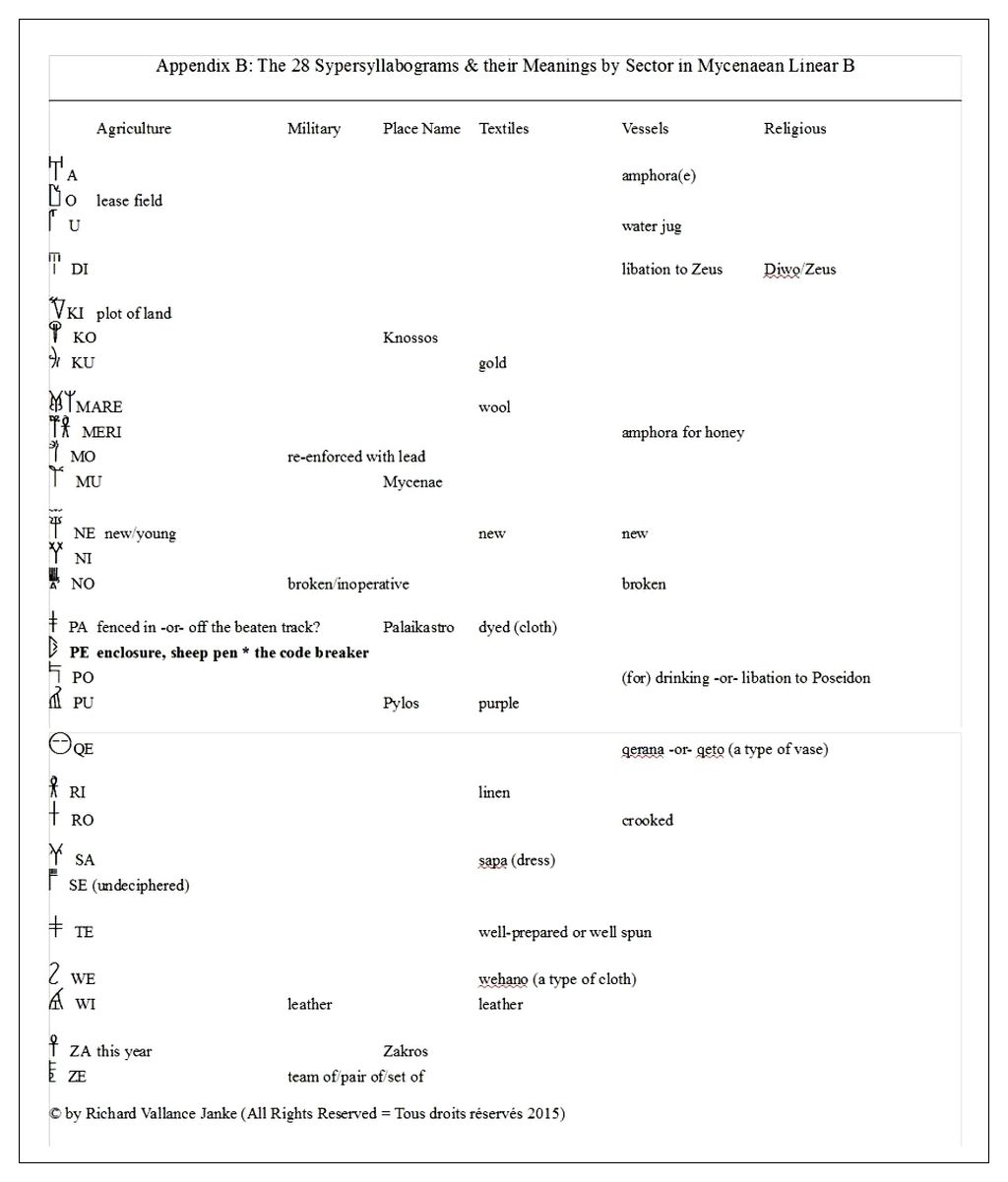


You must be logged in to post a comment.