A Map of the Mycenaean Empire (ca.. 1600-1200 BCE), with Major Locales, Attested (A) & Derived (D) Named in Linear B for the First Time: Click to ENLARGE:Whereas we find only attested (A) Minoan & Mycenaean city and settlement names on the map of the Mycenaean Empire in the previous post, the majority of the Mycenaean settlement names for which I managed to find room to translate on this map are derived (D). Attested (A) Linear B words and toponyms are those found on any extant Linear B tablet, regardless of provenance. Derived (D) Linear B words and place names are precisely that, derived, which is to say regressively extrapolated from their ancient Greek counterparts (if any) or where no alphabetical Greek toponym can be found, directly from their English names. This of course implies that a few of them may not be quite accurate, and where there was any real doubt in my mind, I assigned alternative spellings, just in case. At any rate, the orthography of most of the derived (D) toponyms on this map is probably pretty much on target, but only if you go along with Mycenaean orthographic conventions as I interpret them, as follows: 1. When the settlement name ends in “ria” in English, as in the case of Agios Ilias, I translate it into Linear B as Akio Iriya, not Akio Iria, since the latter is not what you would really expect in a Linear B toponym, whereas the termination YA is extremely common in Linear B vocabulary regardless. 2. When the settlement name ends in “sios/sion” or “ios/ion” in English, here again I translate it as YO, since that termination is also extremely common in Linear B vocabulary regardless. Examples are (a) Korifasion which translates as Koriwasiyo in Linear B, the “f” being of course the digamma, otherwise known as “wau”, which was always rendered in Linear B words by the W+ vowel series of syllabograms, i.e. WA WE WI & WO & (b) Aigion, which translates as Aikiyo in Linear B. In fact, the syllabograms YA & YO are at the very highest frequency level of use among all the Linear B syllabograms, another extremely sound reason for preferring them as word terminations over the simple “ria” and “rio” endings, which just do not wash with me. 3. As illustrated by Korifasion = Koriwasiyo in Linear B, so also Linear B Epidawo for Epidauros. In other words, the cluster “auro” in the Greek equivalent of this site is regressively extrapolated to “awo” in Linear B, the intervocalic “r” disappearing altogether. This is standard Mycenaean orthography. 4. Likewise, standard Mycenaean orthography stipulates, in fact, demands that filler vowels be inserted in any Greek word, toponym or not, in which there are two or more consecutive consonants (called consonant clusters). Since Linear B is a syllabary, in which all the syllabogams are either pure vowels (a, e, i, o & u) or a consonant + any of these vowels (a, e, i, o & u), it is patently impossible (with only a couple of bizarre exceptions, such as the homophone PTE) for Linear B words to allow for clusters of two or more consonants. So, when confronted with a place name such as this, Kastri, we must somehow fill in the blank spaces, so to speak, or more properly speaking fill them out, by inserting vowels after both the interior “s” & “t”, thus: Kasatiri or Kasitiri. In the case of this place name, I was uncertain which of these variants was likely to be more accurate, so I have given both versions. Linear B linguists of some note will soon enough straighten me out on this account, I am sure. Other simpler examples are Linear B Atene for Athens & Katarakiti for Greek Katarraktis (notice also that double consonants are also forbidden in Mycenaean, for the very same reason) 5. Since Mycenaean words never end in consonants, even though they are Greek, all consonant terminations in place names must be dropped, as in Linear B Puro for Pylos, Orokomeno for Orchomenos & Aikio Tepano for Agios Stephanos. Note also that the initial “S” in Stephanos must be dropped, again for the same reason, namely, that Mycenaean Greek forbids two consecutive consonants. So where there are two of them, the vocally weaker of them must be eliminated, in this case, the weaker sibilant “s” yielding to the stronger plosive “t”. I know, I know. Practically all of you who are well versed in ancient Greek are going to (loudly) protest, “But so many ancient Greek words end in a consonant!” True enough. But you will just have to swallow your pride, and accept the fact that, even if Mycenaean Greek words were pronounced with consonant endings (which is highly likely to have been the case), the Linear B syllabary is utterly and hopelessly incapable of accounting for them. So you will have to do the same thing as the (rest of us) Linear B specialists, get over it and get used to it, frustrating as it is. Even after two years of reading 3,000 + Linear B tablets, I myself am often still unable to wrap my poor skull around this phenomenon, let alone around several other apparent vagaries of Linear B spelling. But there are plenty of reasons why Linear B orthography is the way it is, not the least of which is that the Linear B syllabary is the child or direct spinoff of Linear A, a syllabary which was never meant to be used to spell Greek in the first place. And please do not protest again. The Mycenaeans had to use Linear A or some sort of syllabary, because the blasted (Greek) alphabet hadn’t been invented yet! So give the poor blokes a break. They did a pretty bang-up job of it, if you ask me, considering the insane odds they were up against just trying to make Linear A square syllabograms fit into round holes in Mycenaean Greek. I would like to see you try to do that. Good luck. Fat chance. So there you have it, a neat little lesson in the apparent vagaries of Mycenaean orthography. I say apparent, because in fact they are not. But I can tell you one thing. They sure cause a lot of headaches to translators who wish to regressively extrapolate ancient alphabetical Greek words to their Mycenaean forbears. Remember! The derived Mycenaean toponyms on this map are precisely that, and nothing more. While their Linear B equivalents are my own, they are not even close to mere guesses. Given the Mycenaean orthographic conventions I have outlined above (at least as I see them), these spellings are perfectly sound... except of course in those instances where some Linear B experts might take exception to some of the conventions as I have outlined them above, which some of them are bound to do. If anyone does take exception to any of the derivative (D) place names I have assigned, for heaven’s sake, let me know! Nothing is cast in stone (or even clay, for that matter) where it comes to translating into or from Linear B. Trust me on that one. Never believe any Linear B translator, myself included, of course, or should I say, especially myself, has a monopoly on translating any Greek word from certain ancient Greek dialects (but not all of them, by a long shot) into Mycenaean Greek in Linear B, or vice versa. Anyone who does make such a claim is leaving him- or herself wide open as a target for being roundly, and dare I say, soundly criticized. And the more I am criticized, the better. I have always been the doubting Thomas, anyway. Richard
Tag: Ancient Greek
-
Just released & a Must Read! A Companion to the Ancient Greek Language by Egbert J. Bakker (ed.) © 2014
Just released & a Must Read! A Companion to the Ancient Greek Language by Egbert J. Bakker (ed.) © 2014 A Companion to the Ancient Greek Language Paperback – January 28, 2014, by Egbert J. Bakker (Editor) ISBN-13: 978-1118782910 (hard cover) ISBN-10: 1118782917 (paperback) Edition: 1st $50! Click to ENLARGE:
 with an extensive review in: Bryn Mawr Classical Review. Click the banner to read the review:
 Here is an extract from that review to whet your appetite:
“But whatever one might think of companion volumes, this is a useful book. It boasts a wide range of generally high-quality essays by a parade of eminent scholars. Perhaps its most praiseworthy feature is the clarity and accessibility of many of its contributions, which makes them ideal starting points for the non-specialist. We will no doubt be assigning several of these chapters in our classes.”
The Significance of A Companion to the Ancient Greek Language in Contemporary Research into Ancient Greek Linguistics:
This new book, representative of the latest linguistic research into the ancient Greek language, may very well become a definitive classic in its own right. It is all the more relevant as it contains an entire chapter on Mycenaean Greek and Linear B & Arcado-Cypriot and Linear C, confirming beyond a shadow of a doubt my own firm contention that Arcado-Cypriot as a Greek dialect is intimately allied with its slightly older cousin, Mycenaean Greek. What Egbert J. Bakker to say about the close bond between the Mycenaean and Arcado-Cypriot dialects deserves to be quoted verbatim:
“Mycenaean is clearly, therefore, an East Greek dialect, along with Attic-Ionic and Arcado-Cypriot...” (pg. 198) and again, “Mycenaean is therefore a dialect related to Arcado-Cypriot - not unexpected, given the geography - but not necessarily to be identified as the direct ancestor of either Arcadian and Cypriot. The precise relationship between the three is difficult to determine. Presumably the Arcadians were the descendents of speakers of a Mycenaean-like (page 199) dialect who took to the hills when the Dorians invade the Peloponnese, while the Cypriots were émigré cousins.”
Recall what C.D. Buck had to say about the Mycenaean & Arcado-Cypriot dialects way back in 1955, in his equally impressive, then cutting-edge, linguistic study of ancient Greek, The Greek Dialects:
“The most fundamental division of the Greek dialects is that into the West Greek and the East Greek dialects, the terms referring to their location prior to the great migrations. The East Greek are the “the old Hellenic” dialects, that is, those employed by the peoples who held the stage almost exclusively in the period represented by the Homeric poems, when the West Greek peoples remained in obscurity in the northwest. To the East Greek belong the Attic and Aeolic groups... passim... And to the East Greek (dialects) also belong the Arcado-Cyprian.”
And, of course, just to be certain we have the whole picture clearly in focus, we must also include Mycenaean Greek and early Arcadian as proto-Ionic, both of which dialects held sway “prior to the great migrations” (of the Dorians)...
and you can easily see that not much has changed in the past 50 or so years since its publication and the release of A Companion to the Ancient Greek Language by Egbert J. Bakker, in our overall perspectives on the intimate relationship between the East Greek dialects, Mycenaean and Arcado-Cypriot dialects, as I was at great pains to stress in a post on this very same issue just a few days ago, when I myself echoed the opinions of both these esteemed scholars, as follows:
“Astonishingly (and for my purposes, very conveniently) these two proto-Ionic dialects are as closely allied as their natural descendents, Ionic and Attic Greek, which rose to prominence some 5 centuries after Linear C first popped up out of the clear blue.”
Need I say more? - except to assert unequivocally that my own research into the intimate bond between the Mycenaean and Arcado-Cypriots will go far beyond merely this consideration, as I shall soon delve deeply into the close relationship between (at least some) Mycenaean vocabulary in Linear B and Arado-Cypriot in Linear C, the implications of which should prove profound for a greater understanding of Mycenaean Greek per se. Keep posted.
Richard
Here is an extract from that review to whet your appetite:
“But whatever one might think of companion volumes, this is a useful book. It boasts a wide range of generally high-quality essays by a parade of eminent scholars. Perhaps its most praiseworthy feature is the clarity and accessibility of many of its contributions, which makes them ideal starting points for the non-specialist. We will no doubt be assigning several of these chapters in our classes.”
The Significance of A Companion to the Ancient Greek Language in Contemporary Research into Ancient Greek Linguistics:
This new book, representative of the latest linguistic research into the ancient Greek language, may very well become a definitive classic in its own right. It is all the more relevant as it contains an entire chapter on Mycenaean Greek and Linear B & Arcado-Cypriot and Linear C, confirming beyond a shadow of a doubt my own firm contention that Arcado-Cypriot as a Greek dialect is intimately allied with its slightly older cousin, Mycenaean Greek. What Egbert J. Bakker to say about the close bond between the Mycenaean and Arcado-Cypriot dialects deserves to be quoted verbatim:
“Mycenaean is clearly, therefore, an East Greek dialect, along with Attic-Ionic and Arcado-Cypriot...” (pg. 198) and again, “Mycenaean is therefore a dialect related to Arcado-Cypriot - not unexpected, given the geography - but not necessarily to be identified as the direct ancestor of either Arcadian and Cypriot. The precise relationship between the three is difficult to determine. Presumably the Arcadians were the descendents of speakers of a Mycenaean-like (page 199) dialect who took to the hills when the Dorians invade the Peloponnese, while the Cypriots were émigré cousins.”
Recall what C.D. Buck had to say about the Mycenaean & Arcado-Cypriot dialects way back in 1955, in his equally impressive, then cutting-edge, linguistic study of ancient Greek, The Greek Dialects:
“The most fundamental division of the Greek dialects is that into the West Greek and the East Greek dialects, the terms referring to their location prior to the great migrations. The East Greek are the “the old Hellenic” dialects, that is, those employed by the peoples who held the stage almost exclusively in the period represented by the Homeric poems, when the West Greek peoples remained in obscurity in the northwest. To the East Greek belong the Attic and Aeolic groups... passim... And to the East Greek (dialects) also belong the Arcado-Cyprian.”
And, of course, just to be certain we have the whole picture clearly in focus, we must also include Mycenaean Greek and early Arcadian as proto-Ionic, both of which dialects held sway “prior to the great migrations” (of the Dorians)...
and you can easily see that not much has changed in the past 50 or so years since its publication and the release of A Companion to the Ancient Greek Language by Egbert J. Bakker, in our overall perspectives on the intimate relationship between the East Greek dialects, Mycenaean and Arcado-Cypriot dialects, as I was at great pains to stress in a post on this very same issue just a few days ago, when I myself echoed the opinions of both these esteemed scholars, as follows:
“Astonishingly (and for my purposes, very conveniently) these two proto-Ionic dialects are as closely allied as their natural descendents, Ionic and Attic Greek, which rose to prominence some 5 centuries after Linear C first popped up out of the clear blue.”
Need I say more? - except to assert unequivocally that my own research into the intimate bond between the Mycenaean and Arcado-Cypriots will go far beyond merely this consideration, as I shall soon delve deeply into the close relationship between (at least some) Mycenaean vocabulary in Linear B and Arado-Cypriot in Linear C, the implications of which should prove profound for a greater understanding of Mycenaean Greek per se. Keep posted.
Richard
-
20 Greek Words in the Arcadian Dialect Translated into Tentative & Actual Linear B
20 Greek Words in the Arcadian Dialect Translated into Tentative & Actual Linear B: (Click to ENLARGE):
 As I just did in our previous post with a much larger vocabulary of the Cypriot dialect, from which I extracted as many putative or hypothetical Linear B concrete and semi-abstract words as I could, leaving purely abstract words aside (as they almost never appear in in Linear B in Mycenaean Greek), I am providing 20 hypothetical Linear B equivalents to everyone on our blog or on the Internet fascinated by the near intimate relationship between the Mycenaean and Arcado-Cypriot dialects, written in Linear B and C respectively, with a vocabulary in the Arcadian dialect, somewhat briefer than that I posted for the Cypriot.
By way of introduction, I should like to draw your attention to some highly pertinent facts. In his ground-breaking exhaustive survey of all of the ancient Greek dialects, C. D. Buck, in The Greek Dialects (a), has this to say about the relationship of the Arcadian and Cypriot dialects, which are fact but minor variants on the same dialect (all italics mine):
“No two dialects, not even Attic and Ionic, belong together more obviously than do those of Arcadia and the distant Cyprus. They share in a number of notable peculiarities which are unknown elsewhere. See 189 and Chart I. This is to be accounted for by the fact that Cyprus was colonized, not necessarily or probably from Arcadia itself, as tradition states, but from the Peloponnesian coast, at a time when its speech was like that which in Arcadia survived the Doric migration. This group represents, beyond question, the pre-Doric speech of most of the Peloponnesus whatever we choose to call it... passim...
... There are in fact notable points of agreement between Arcado-Cypriot and Aeolic (see 190.3-6 and Chart I,) which cannot be accidental... passim... and there are certain points of agreement with Attic-Ionic...”
C.D. Buck’s comments pretty much speak for themselves. But it is extremely important to stress the very intimate relationship between Arcado-Cypriot Greek (being the natural conflagration of the Arcadian and Cypriot dialects into one almost seamless continuum) on the one hand to Aeolic and Attic-Ionic on the other, all of these dialects inclusive falling squarely within the orbit of East Greek, as we move chronologically forward in time. On the other hand, along the same timeline, only in reverse chronological order, we can confirm that (proto-)Arcadian and Mycenaean Greek also unquestionably belong to the same class of ancient Greek dialects, namely, the East Greek. This is precisely why I choose to term both Mycenaean and (proto-)Arcadian as proto-Ionic, since that is in fact what these dialects were.
In this perspective, we need to add one more critical comment, again quoting directly from C.D. Buck (although he and I would certainly mirror one another, if we either of us were to say this, even without knowing the other one had. He did say this, and I do.) So allow me to steal the words right out of his mouth, in the sure realization that this is precisely what I, and for that matter, all linguists worldwide would say about the relationship between the ancient Greek dialects would assert... save for a few lone renegades, whom I won’t even bother with, as it is a waste of my breath and our time. C.D. Buck has this to say:
“The most fundamental division of the Greek dialects is that into the West Greek and the East Greek dialects, the terms referring to their location prior to the great migrations. The East Greek are the “the old Hellenic” dialects, that is, those employed by the peoples who held the stage almost exclusively in the period represented by the Homeric poems, when the West Greek peoples remained in obscurity in the northwest. To the East Greek belong the Attic and Aeolic groups... passim... And to the East Greek (dialects) also belong the Arcado-Cyprian.” And, of course, just to be certain we have the whole picture clearly in focus, we must also include Mycenaean Greek and early Arcadian as proto-Ionic, both of which dialects held sway “prior to the great migrations.” Here C.D. Buck is referring specifically to the great Doric invasion of the Greek peninsula ca. 1200-1100 BCE or thereabouts.
The following summary can be drawn with relative ease from C.D. Buck’s linguistic analysis:
1. The division between the East Greek dialects, among which we count the Arcado-Cypriot (subsumed by its slightly different Arcadian and Cypriot variants) plus the Aeolic, Ionic and Attic dialects, as representative, there being others as well... and the West Greek dialects, under the generic, Doric, is clear and distinct. Never the twain shall meet.
2. Since Mycenaean, proto-Arcado-Cypriot and its later metamorphoses, Arcadian and Cypriot, are all in the same dialectical class, i.e. East Greek, any consideration of the function(s), historical rôle and influences of any and all of these dialects in particular play, must be decisively distinguished from the rôle the Doric dialects played, since the former were all firmly in place and fully operative all over the Greek peninsula well before the Doric invasions ca. 1200-1100 BCE. In fact, in the case of Mycenaean Greek, that dialect held sway for at least 300 years prior to the Doric invasions, so that any putative influence or impact of the latter on the former is de facto impossible.
3. The proto-Arcado-Cypriot dialect is clearly the younger cousin of Mycenaean Greek, as is its later evolution into literary Arcado-Cypriot (Arcadian/Cypriot) as found on the Idalion tablet (fifth century BCE). This fact alone serves to reinforce beyond a shadow of a doubt that Doric Greek could have had no influence on Mycenaean Greek any more than it did on Arcado-Cypriot, as both of the latter were, as C.D. Buck underlines, the “the old Hellenic” dialects. Thus, the intimate relationship between Mycenaean and Arcado-Cypriot doubly reinforces the total exclusion of Doric influences, however meagre.
4. It naturally follows from 3., as day follows night, that documents composed in Mycenaean Linear B and in Arcado-Cypriot Linear C are soundly ensconced in the framework of the very same class of ancient Greek dialects, the East Greek.
Henceforth, in this blog, any discussion of the intimate relationship between the Mycenaean and Arcado-Cypriot dialects and of the application of their respective scripts, Linear B and Linear C is firmly set in the framework of this hypothesis, which bears extensive historical linguistic evidence mitigating strongly in its favour.
A few final comments are in order with respect to the actual Linear B correlatives of Arcadian words in the vocabulary above. These observations revolve around the methodological process of cross-correlation between Arcadian documents, in this case in alphabetical Greek, with those in Linear B. What we have already discovered, to our great astonishment and delight, even without taking the requisite step of a thorough methodology of cross-correlation, as discussed at length in our previous post on the relationship between Cypriot and Mycenaean Greek, is that at least one of the words in Linear B extracted from this vocabulary of Arcadian, and very probably two, are clearly and indisputably real attested (A) Linear B words. They are, of course, the Linear B for “and” (QE) and for “girl” (KOWA).
By extension, we may as well add a third, “boy” KOWO, since it is simply the masculine of the former. KOWA appears both in Linear B and in Linear C, and is therefore, by default, attested (A) in both.
As I just did in our previous post with a much larger vocabulary of the Cypriot dialect, from which I extracted as many putative or hypothetical Linear B concrete and semi-abstract words as I could, leaving purely abstract words aside (as they almost never appear in in Linear B in Mycenaean Greek), I am providing 20 hypothetical Linear B equivalents to everyone on our blog or on the Internet fascinated by the near intimate relationship between the Mycenaean and Arcado-Cypriot dialects, written in Linear B and C respectively, with a vocabulary in the Arcadian dialect, somewhat briefer than that I posted for the Cypriot.
By way of introduction, I should like to draw your attention to some highly pertinent facts. In his ground-breaking exhaustive survey of all of the ancient Greek dialects, C. D. Buck, in The Greek Dialects (a), has this to say about the relationship of the Arcadian and Cypriot dialects, which are fact but minor variants on the same dialect (all italics mine):
“No two dialects, not even Attic and Ionic, belong together more obviously than do those of Arcadia and the distant Cyprus. They share in a number of notable peculiarities which are unknown elsewhere. See 189 and Chart I. This is to be accounted for by the fact that Cyprus was colonized, not necessarily or probably from Arcadia itself, as tradition states, but from the Peloponnesian coast, at a time when its speech was like that which in Arcadia survived the Doric migration. This group represents, beyond question, the pre-Doric speech of most of the Peloponnesus whatever we choose to call it... passim...
... There are in fact notable points of agreement between Arcado-Cypriot and Aeolic (see 190.3-6 and Chart I,) which cannot be accidental... passim... and there are certain points of agreement with Attic-Ionic...”
C.D. Buck’s comments pretty much speak for themselves. But it is extremely important to stress the very intimate relationship between Arcado-Cypriot Greek (being the natural conflagration of the Arcadian and Cypriot dialects into one almost seamless continuum) on the one hand to Aeolic and Attic-Ionic on the other, all of these dialects inclusive falling squarely within the orbit of East Greek, as we move chronologically forward in time. On the other hand, along the same timeline, only in reverse chronological order, we can confirm that (proto-)Arcadian and Mycenaean Greek also unquestionably belong to the same class of ancient Greek dialects, namely, the East Greek. This is precisely why I choose to term both Mycenaean and (proto-)Arcadian as proto-Ionic, since that is in fact what these dialects were.
In this perspective, we need to add one more critical comment, again quoting directly from C.D. Buck (although he and I would certainly mirror one another, if we either of us were to say this, even without knowing the other one had. He did say this, and I do.) So allow me to steal the words right out of his mouth, in the sure realization that this is precisely what I, and for that matter, all linguists worldwide would say about the relationship between the ancient Greek dialects would assert... save for a few lone renegades, whom I won’t even bother with, as it is a waste of my breath and our time. C.D. Buck has this to say:
“The most fundamental division of the Greek dialects is that into the West Greek and the East Greek dialects, the terms referring to their location prior to the great migrations. The East Greek are the “the old Hellenic” dialects, that is, those employed by the peoples who held the stage almost exclusively in the period represented by the Homeric poems, when the West Greek peoples remained in obscurity in the northwest. To the East Greek belong the Attic and Aeolic groups... passim... And to the East Greek (dialects) also belong the Arcado-Cyprian.” And, of course, just to be certain we have the whole picture clearly in focus, we must also include Mycenaean Greek and early Arcadian as proto-Ionic, both of which dialects held sway “prior to the great migrations.” Here C.D. Buck is referring specifically to the great Doric invasion of the Greek peninsula ca. 1200-1100 BCE or thereabouts.
The following summary can be drawn with relative ease from C.D. Buck’s linguistic analysis:
1. The division between the East Greek dialects, among which we count the Arcado-Cypriot (subsumed by its slightly different Arcadian and Cypriot variants) plus the Aeolic, Ionic and Attic dialects, as representative, there being others as well... and the West Greek dialects, under the generic, Doric, is clear and distinct. Never the twain shall meet.
2. Since Mycenaean, proto-Arcado-Cypriot and its later metamorphoses, Arcadian and Cypriot, are all in the same dialectical class, i.e. East Greek, any consideration of the function(s), historical rôle and influences of any and all of these dialects in particular play, must be decisively distinguished from the rôle the Doric dialects played, since the former were all firmly in place and fully operative all over the Greek peninsula well before the Doric invasions ca. 1200-1100 BCE. In fact, in the case of Mycenaean Greek, that dialect held sway for at least 300 years prior to the Doric invasions, so that any putative influence or impact of the latter on the former is de facto impossible.
3. The proto-Arcado-Cypriot dialect is clearly the younger cousin of Mycenaean Greek, as is its later evolution into literary Arcado-Cypriot (Arcadian/Cypriot) as found on the Idalion tablet (fifth century BCE). This fact alone serves to reinforce beyond a shadow of a doubt that Doric Greek could have had no influence on Mycenaean Greek any more than it did on Arcado-Cypriot, as both of the latter were, as C.D. Buck underlines, the “the old Hellenic” dialects. Thus, the intimate relationship between Mycenaean and Arcado-Cypriot doubly reinforces the total exclusion of Doric influences, however meagre.
4. It naturally follows from 3., as day follows night, that documents composed in Mycenaean Linear B and in Arcado-Cypriot Linear C are soundly ensconced in the framework of the very same class of ancient Greek dialects, the East Greek.
Henceforth, in this blog, any discussion of the intimate relationship between the Mycenaean and Arcado-Cypriot dialects and of the application of their respective scripts, Linear B and Linear C is firmly set in the framework of this hypothesis, which bears extensive historical linguistic evidence mitigating strongly in its favour.
A few final comments are in order with respect to the actual Linear B correlatives of Arcadian words in the vocabulary above. These observations revolve around the methodological process of cross-correlation between Arcadian documents, in this case in alphabetical Greek, with those in Linear B. What we have already discovered, to our great astonishment and delight, even without taking the requisite step of a thorough methodology of cross-correlation, as discussed at length in our previous post on the relationship between Cypriot and Mycenaean Greek, is that at least one of the words in Linear B extracted from this vocabulary of Arcadian, and very probably two, are clearly and indisputably real attested (A) Linear B words. They are, of course, the Linear B for “and” (QE) and for “girl” (KOWA).
By extension, we may as well add a third, “boy” KOWO, since it is simply the masculine of the former. KOWA appears both in Linear B and in Linear C, and is therefore, by default, attested (A) in both.
 This is a rare jewel of a find, and to my mind, it is the very first instance of actual confirmation of any word in the vocabulary of Linear B & C common to Mycenaean and Arcado-Cypriot. This in effect constitutes our very first, albeit baby, step in the cross-correlation of Mycenaean and Arcado-Cypriot vocabulary by means of a tried-and-tested linguistic methodology. How many Mycenaean and Arcado-Cypriot will eventually (nearly) match up, whether scores, some or just a few, I cannot possibly predict right now. But it is certain that we shall eventually be able to compile at least a small vocabulary of equivalent Mycenaean & Arcado-Cypriot words, and as soon as we can (b), I shall be sure to let you know. Such a vocabulary will prove of inestimable value in going a long way to confirming attested Linear C = derivative Linear B words (ALC+DLB), as explained in the previous post.
NOTES:
(a) Buck, C.D. The Greek Dialects. London: Bristol Classical Press, © 1955, 1998. ISBN 1-85399-566-8. xvi, 373 pp.
(b) sometime in 2015 or at the latest, early 2016.
(c) All italics mine.
This is a rare jewel of a find, and to my mind, it is the very first instance of actual confirmation of any word in the vocabulary of Linear B & C common to Mycenaean and Arcado-Cypriot. This in effect constitutes our very first, albeit baby, step in the cross-correlation of Mycenaean and Arcado-Cypriot vocabulary by means of a tried-and-tested linguistic methodology. How many Mycenaean and Arcado-Cypriot will eventually (nearly) match up, whether scores, some or just a few, I cannot possibly predict right now. But it is certain that we shall eventually be able to compile at least a small vocabulary of equivalent Mycenaean & Arcado-Cypriot words, and as soon as we can (b), I shall be sure to let you know. Such a vocabulary will prove of inestimable value in going a long way to confirming attested Linear C = derivative Linear B words (ALC+DLB), as explained in the previous post.
NOTES:
(a) Buck, C.D. The Greek Dialects. London: Bristol Classical Press, © 1955, 1998. ISBN 1-85399-566-8. xvi, 373 pp.
(b) sometime in 2015 or at the latest, early 2016.
(c) All italics mine.
-
A Short Vocabulary of Arcado-Cypriot in Alphabetic Cypriot, with Numerous Putative Linear B Transliterations
A Short Vocabulary of Arcado-Cypriot in Alphabetic Cypriot, with Numerous Putative Linear B Transliterations (Click to ENLARGE):
 ... and a cry for help! You will have to read this entire post thoroughly if you expect to be able to assist me in any way with this prodigious project.
Preparatory to our in-depth study of the Arcado-Cypriot Linear C syllabary, it is probably wise for us to give you a clear idea of exactly how Linear C words actually look once they have been transliterated from the Linear C syllabary into (in this case) Cypriot words in alphabetic Greek.
A few comments are in order. The first thing you will notice is that I have translated many of the Cypriot words in alphabetic Greek straightaway into their putative Linear B counterparts, and not from their original C. There are two reasons for this, the first unavoidable, as there is no font available for Arcado-Cypriot Linear C. What a drag! And there is no way on earth that I am going to drive myself nuts trying to write all of these words in Linear C.
The second reason is eminently practical and linguistically sound (I sincerely hope). Because my eventual goal in the study of Arcado-Cypriot Linear C is not simply to learn the syllabary, which would be nice in and of itself but hardly necessary, unless I simply had to learn it for an ulterior reason. Unfortunately — or more to the point, fortunately — I have no other choice but to learn it since I am roundly obliged to read the famous legal decree in Linear C, the Idalion Tablet, illustrated here:
... and a cry for help! You will have to read this entire post thoroughly if you expect to be able to assist me in any way with this prodigious project.
Preparatory to our in-depth study of the Arcado-Cypriot Linear C syllabary, it is probably wise for us to give you a clear idea of exactly how Linear C words actually look once they have been transliterated from the Linear C syllabary into (in this case) Cypriot words in alphabetic Greek.
A few comments are in order. The first thing you will notice is that I have translated many of the Cypriot words in alphabetic Greek straightaway into their putative Linear B counterparts, and not from their original C. There are two reasons for this, the first unavoidable, as there is no font available for Arcado-Cypriot Linear C. What a drag! And there is no way on earth that I am going to drive myself nuts trying to write all of these words in Linear C.
The second reason is eminently practical and linguistically sound (I sincerely hope). Because my eventual goal in the study of Arcado-Cypriot Linear C is not simply to learn the syllabary, which would be nice in and of itself but hardly necessary, unless I simply had to learn it for an ulterior reason. Unfortunately — or more to the point, fortunately — I have no other choice but to learn it since I am roundly obliged to read the famous legal decree in Linear C, the Idalion Tablet, illustrated here:
 Why obliged? I must learn it if I wish to cross-correlate any and all words in Linear C on the Idalion tablet, which have an exact or near exact match, or a very similar counterpart in Mycenaean Linear B. This exercise could conceivably be characterized as regressive extrapolation from a later Greek dialect, Arcado-Cypriot and its syllabary (Linear C) to an earlier, Mycenaean Greek and its own (Linear B), although to term the extrapolation as regressive is a bit of a misnomer here, since only one century or so separates these two East Greek proto-Ionic dialects, from the fall of Mycenae ca. 1200 BCE & the sudden disappearance of Linear B from the scene to the equally sudden, dramatic appearance virtually out of nowhere of its younger cousin, Arcado-Cypriot and its syllabary (Linear C). Astonishingly (and for my purposes, very conveniently) these two proto-Ionic dialects are as closely allied as their natural descendents, Ionic and Attic Greek, which rose to prominence some 5 centuries after Linear C first popped up out of the clear blue.
Don’t think for a moment that Linear C was to fall by the wayside as precipitously as did its slightly older cousin, Linear B. Not for the world. Linear C in fact tenaciously held its own for at least 700 years (!) after its first appearance ca. 1100 BCE, i.e. until at least 400 BCE, when the Cypriots finally caved in and accepted the (by then) standardized Greek alphabet for Attic Greek. And it does not even end there. The Cypriots cherished the Idalion tablet in Linear C as one of the key documents of their society and its literature, and above all, as a legal document of the highest import. So of course, they translated the whole thing word-for-word, from the Linear C of Idalion tablet, much larger than any in Linear B, and a tablet cast in bronze, no less, into the Greek alphabetic version... for their descendants who would no longer be able to read Linear C, once it fell into disuse almost as abruptly as had Linear B.
The preservation of this invaluable and priceless historical literary heritage was absolutely de rigueur to the Cypriots. As a result, the bronze Idalion has survived 2,500 years virtually intact and in very fine condition, unlike so many Linear B tablets, which were all cast in clay, and furnace fired, saved only by the lucky (for us!) happenstance that Knossos burned to the ground ca. 1450 BCE, charring and hardening some 4,000 tablets and fragments, while being unceremoniously buried by the huge volcanic eruption of the Thera volcano... or at least as many historians believe to have happened in that particular timeline. As a mere Linear B linguist, who am I to question the chronology of the Thera eruption, whether it was (reputedly) ca. 1600 or 1500 or 1450 BCE? Besides, it suits us linguists just fine, thank you. We gladly accept 1450 BCE or thereabouts as the time of the eruption, since that is when so many Linear B tablets got buried, along with almost all of the 55,000 or so inhabitants of the city of Knossos... a horrible tragedy for them, but a real stroke of good luck for us. Makes you think of Pompeii. But I am rambling.
As I mentioned above, Linear C held its own for 7 centuries, as the preferred literary script for the Arcadians and Cypriots, alongside the Greek alphabet, and no one thought anything of it. It worked fine, so that was that. No point re-inventing the wheel.
In fact, for my own purposes, one of the three primary missions of our blog, that of cross-correlating every single Linear C word on the Idalion tablet for which there is an exact, near exact or very similar counterpart in Mycenaean Linear B is obligatory, whether I like it or not. So as I always say, I might as well like it and have fun. The over-riding purpose for this unavoidable exercise will become crystal clear to our blog members in the next few months. Just hang in there, folks.
Still, for the time being, I have done a big favour to everyone who is the slightest bit fascinated by the extremely close relationship of these two proto-Ionic East Greek dialects, Mycenaean & Arcado-Cypriot Greek, by extrapolating the (exact?... hardly!) Linear B counterparts of a great many concrete and semi-abstract words in the alphabetic Greek vocabulary we see above, entirely skipping the absolute requirement of first cross-correlating the actual Linear C words on the Idalion tablet and any other Linear C tablet I can lay my hands on with their Linear B counterparts, before attempting to cross-correlate the Linear B words with the alphabetical counterparts of the Linear C words.
In other words, for the time being, I have reversed the process, flipping it on its head. I must emphatically stress, however, that this is not even remotely a valid experimental approach to the exercise. To clearly illustrate my point, there are two approaches, the first being largely invalid, the second being largely valid. Please understand, and do not forget, that every single one of the Linear B words you see in the vocabulary above is entirely derivative (D), and nothing more, if it even qualifies as that.
1. (as I have done the extrapolation from the Greek alphabet directly into Linear B, illustrated above), entirely missing the obligatory steps:
Linear B words < -------------- (from) the same words in alphabetic Greek)
versus
2. Extrapolation from the vocabulary in Linear C on the Idalion Tablet and any other, first from Linear C into its alphabetic counterpart, and then regressively extrapolating every single word on the Idalion tablet from its Greek alphabetic version directly into its (putative) equivalent in Mycenaean Linear B, and then taking the final third step of double-checking my translations of every single word transliterated into Linear B, by cross-correlating the Linear B versions with their original Linear C counterparts and (yet again) with their alphabetic counterparts in the Cypriot alphabet (which differs somewhat from the Attic), like this:
From the Linear C words --------------> to the same words in alphabetic Cypriot Greek --------------> to their (putative) counterparts in Linear B, then reversing the entire process: Linear B --------------> Linear C --------------> alphabetic Cypriot,
as a confirmation that I have not made any egregious errors, and if necessary (as is certain to be the case) to repeat the entire process all over again,
Linear C --------------> alphabetic Cypriot Greek --------------> (putative) Linear B, (flip) Linear B --------------> Linear C --------------> alphabetic Cypriot
This procedure is far sounder than the first, which hardly qualifies as a procedure at all. However, 1. above is surely better than nothing, as it gives those of us who are really familiar with Linear B a bit of a handle on what the Cypriot words in this vocabulary might look like in Linear B. I say, might, because the second approach, which is linguistically sound, is the only way to confirm or at least to firm up the (putative) Linear B words you see in the Cypriot vocabulary above.
Every single one of the Linear B words flagged in this Cypriot vocabulary is entirely derivative (D), and not attested (A) in any way whatsoever. Any (close) match with an attested Linear B word (A), i.e. an actual Mycenaean word on any extant Linear B tablet is entirely accidental and fortuitous. This means that even if any of the words I have transliterated from the Cypriot vocabulary using (the sloppy) method 1. above look like (real) words in Linear B, their validity as attributed Linear B words cannot be confirmed in the least. After all, the so-called Linear B words I have cross-correlated with their alphabetic counterparts in this vocabulary are merely astute guesses, nothing more. So it would be inadvisable, if not downright stupid, to assume that in fact any of the Linear B words you see in the vocabulary above are in fact really exactly the same as any real, i.e. attested (A) Mycenaean word in Linear B, even if they look identical. There is simply no way to confirm this, unless we follow the strict methodology in 2. above, and there is no way I can do that right now. I have not even mastered Linear C. It is going to take quite some time, probably six months to a year, so don’t hold your breath.
On the other hand, I would be only too happy to receive feedback from my fellow Linear B translators on whether or not any of my guestimates of (putative) Linear B words is potentially well-grounded or just some fanciful notion I have cooked up in my head. So why not share what you have cooked in your head, so that I can compile a list or alternatives for each word. That way, when I finally get around to completing exercise 2. above, we shall all know which version(s) of any so-called Mycenaean word in Linear B any of us have cooked up really can be cooked and please our linguistic palates. One of 4 things is bound to happen with each derived (D) word in Linear B at the end of our research:
1. one of the versions of any word in Linear B in this vocabulary will prove to be correct (but whose we cannot say yet) or
2. one of the versions of any word in Linear B in this vocabulary may prove to be a reasonable candidate as a derived (D) Linear B word or
3 none of the versions we have cooked up will amount to anything but a hill of beans or
4 one (or possibly even more than 1) of the versions of any derived (D) Linear B word will prove to be (a near) exact match with its Linear C counterpart, in which case that word can be reclassified as derivative Mycenaean, attested Linear C, as follows: word (LBD+LCA). Such a word will come a long way from being merely derivative (D), and a long shot at that, to being a sure candidate for a Mycenaean word that probably did exist, even though it is not attested on any Linear B tablet or fragment. But, since it has proven to be attested on the Idalion tablet or any other in Linear C, we have at least a half-confirmation or better that there is a high probably that this word was Mycenaean. So at the culmination of this long process, while none of the so-called Mycenaean words in Linear B we have successfully cross-correlated with their Linear B counterparts can strictly be classified as attributed (D) in Mycenaean Greek, several, possibly even a great many will, I trust, be classified as partially derivative (D), and partially attributed (A), but only if they are definitely attributed (A) in Linear C (not in alphabetical Greek!) These words will then be classified as LBD+LCA, and tentatively added to the vocabulary of Mycenaean Greek, pending confirmation from future archeological finds. To my mind, such confirmation from attested (A) vocabulary on new tablets or fragments in the future is one heck of an exciting prospect, because even if 2 or 3 words match up perfectly with newly discovered attested (A) Mycenaean words, that circumstantial evidence alone will set in actual context some of my own discoveries of certain LBD+LCA words which match up (almost) perfectly with newly discovered Mycenaean words. What an exciting prospect indeed!
And there you have it, my methodology in a nutshell. If anyone can find any way(s) to improve on this methodology any time in the next six months or so, fire away. Please do not be shy, even if you are just learning Linear B. It would be disastrous for this project if the methodology were full of loopholes. There is no real way I can determine this for myself, because I am looking at it subjectively from the inside out, whereas any of you can at least lend some objectivity to the procedure by helping me iron out the bugs. If you do not come forward, there is simply no way I can be sure I have got this down pretty much pat.
Thanks so much.
Richard
Why obliged? I must learn it if I wish to cross-correlate any and all words in Linear C on the Idalion tablet, which have an exact or near exact match, or a very similar counterpart in Mycenaean Linear B. This exercise could conceivably be characterized as regressive extrapolation from a later Greek dialect, Arcado-Cypriot and its syllabary (Linear C) to an earlier, Mycenaean Greek and its own (Linear B), although to term the extrapolation as regressive is a bit of a misnomer here, since only one century or so separates these two East Greek proto-Ionic dialects, from the fall of Mycenae ca. 1200 BCE & the sudden disappearance of Linear B from the scene to the equally sudden, dramatic appearance virtually out of nowhere of its younger cousin, Arcado-Cypriot and its syllabary (Linear C). Astonishingly (and for my purposes, very conveniently) these two proto-Ionic dialects are as closely allied as their natural descendents, Ionic and Attic Greek, which rose to prominence some 5 centuries after Linear C first popped up out of the clear blue.
Don’t think for a moment that Linear C was to fall by the wayside as precipitously as did its slightly older cousin, Linear B. Not for the world. Linear C in fact tenaciously held its own for at least 700 years (!) after its first appearance ca. 1100 BCE, i.e. until at least 400 BCE, when the Cypriots finally caved in and accepted the (by then) standardized Greek alphabet for Attic Greek. And it does not even end there. The Cypriots cherished the Idalion tablet in Linear C as one of the key documents of their society and its literature, and above all, as a legal document of the highest import. So of course, they translated the whole thing word-for-word, from the Linear C of Idalion tablet, much larger than any in Linear B, and a tablet cast in bronze, no less, into the Greek alphabetic version... for their descendants who would no longer be able to read Linear C, once it fell into disuse almost as abruptly as had Linear B.
The preservation of this invaluable and priceless historical literary heritage was absolutely de rigueur to the Cypriots. As a result, the bronze Idalion has survived 2,500 years virtually intact and in very fine condition, unlike so many Linear B tablets, which were all cast in clay, and furnace fired, saved only by the lucky (for us!) happenstance that Knossos burned to the ground ca. 1450 BCE, charring and hardening some 4,000 tablets and fragments, while being unceremoniously buried by the huge volcanic eruption of the Thera volcano... or at least as many historians believe to have happened in that particular timeline. As a mere Linear B linguist, who am I to question the chronology of the Thera eruption, whether it was (reputedly) ca. 1600 or 1500 or 1450 BCE? Besides, it suits us linguists just fine, thank you. We gladly accept 1450 BCE or thereabouts as the time of the eruption, since that is when so many Linear B tablets got buried, along with almost all of the 55,000 or so inhabitants of the city of Knossos... a horrible tragedy for them, but a real stroke of good luck for us. Makes you think of Pompeii. But I am rambling.
As I mentioned above, Linear C held its own for 7 centuries, as the preferred literary script for the Arcadians and Cypriots, alongside the Greek alphabet, and no one thought anything of it. It worked fine, so that was that. No point re-inventing the wheel.
In fact, for my own purposes, one of the three primary missions of our blog, that of cross-correlating every single Linear C word on the Idalion tablet for which there is an exact, near exact or very similar counterpart in Mycenaean Linear B is obligatory, whether I like it or not. So as I always say, I might as well like it and have fun. The over-riding purpose for this unavoidable exercise will become crystal clear to our blog members in the next few months. Just hang in there, folks.
Still, for the time being, I have done a big favour to everyone who is the slightest bit fascinated by the extremely close relationship of these two proto-Ionic East Greek dialects, Mycenaean & Arcado-Cypriot Greek, by extrapolating the (exact?... hardly!) Linear B counterparts of a great many concrete and semi-abstract words in the alphabetic Greek vocabulary we see above, entirely skipping the absolute requirement of first cross-correlating the actual Linear C words on the Idalion tablet and any other Linear C tablet I can lay my hands on with their Linear B counterparts, before attempting to cross-correlate the Linear B words with the alphabetical counterparts of the Linear C words.
In other words, for the time being, I have reversed the process, flipping it on its head. I must emphatically stress, however, that this is not even remotely a valid experimental approach to the exercise. To clearly illustrate my point, there are two approaches, the first being largely invalid, the second being largely valid. Please understand, and do not forget, that every single one of the Linear B words you see in the vocabulary above is entirely derivative (D), and nothing more, if it even qualifies as that.
1. (as I have done the extrapolation from the Greek alphabet directly into Linear B, illustrated above), entirely missing the obligatory steps:
Linear B words < -------------- (from) the same words in alphabetic Greek)
versus
2. Extrapolation from the vocabulary in Linear C on the Idalion Tablet and any other, first from Linear C into its alphabetic counterpart, and then regressively extrapolating every single word on the Idalion tablet from its Greek alphabetic version directly into its (putative) equivalent in Mycenaean Linear B, and then taking the final third step of double-checking my translations of every single word transliterated into Linear B, by cross-correlating the Linear B versions with their original Linear C counterparts and (yet again) with their alphabetic counterparts in the Cypriot alphabet (which differs somewhat from the Attic), like this:
From the Linear C words --------------> to the same words in alphabetic Cypriot Greek --------------> to their (putative) counterparts in Linear B, then reversing the entire process: Linear B --------------> Linear C --------------> alphabetic Cypriot,
as a confirmation that I have not made any egregious errors, and if necessary (as is certain to be the case) to repeat the entire process all over again,
Linear C --------------> alphabetic Cypriot Greek --------------> (putative) Linear B, (flip) Linear B --------------> Linear C --------------> alphabetic Cypriot
This procedure is far sounder than the first, which hardly qualifies as a procedure at all. However, 1. above is surely better than nothing, as it gives those of us who are really familiar with Linear B a bit of a handle on what the Cypriot words in this vocabulary might look like in Linear B. I say, might, because the second approach, which is linguistically sound, is the only way to confirm or at least to firm up the (putative) Linear B words you see in the Cypriot vocabulary above.
Every single one of the Linear B words flagged in this Cypriot vocabulary is entirely derivative (D), and not attested (A) in any way whatsoever. Any (close) match with an attested Linear B word (A), i.e. an actual Mycenaean word on any extant Linear B tablet is entirely accidental and fortuitous. This means that even if any of the words I have transliterated from the Cypriot vocabulary using (the sloppy) method 1. above look like (real) words in Linear B, their validity as attributed Linear B words cannot be confirmed in the least. After all, the so-called Linear B words I have cross-correlated with their alphabetic counterparts in this vocabulary are merely astute guesses, nothing more. So it would be inadvisable, if not downright stupid, to assume that in fact any of the Linear B words you see in the vocabulary above are in fact really exactly the same as any real, i.e. attested (A) Mycenaean word in Linear B, even if they look identical. There is simply no way to confirm this, unless we follow the strict methodology in 2. above, and there is no way I can do that right now. I have not even mastered Linear C. It is going to take quite some time, probably six months to a year, so don’t hold your breath.
On the other hand, I would be only too happy to receive feedback from my fellow Linear B translators on whether or not any of my guestimates of (putative) Linear B words is potentially well-grounded or just some fanciful notion I have cooked up in my head. So why not share what you have cooked in your head, so that I can compile a list or alternatives for each word. That way, when I finally get around to completing exercise 2. above, we shall all know which version(s) of any so-called Mycenaean word in Linear B any of us have cooked up really can be cooked and please our linguistic palates. One of 4 things is bound to happen with each derived (D) word in Linear B at the end of our research:
1. one of the versions of any word in Linear B in this vocabulary will prove to be correct (but whose we cannot say yet) or
2. one of the versions of any word in Linear B in this vocabulary may prove to be a reasonable candidate as a derived (D) Linear B word or
3 none of the versions we have cooked up will amount to anything but a hill of beans or
4 one (or possibly even more than 1) of the versions of any derived (D) Linear B word will prove to be (a near) exact match with its Linear C counterpart, in which case that word can be reclassified as derivative Mycenaean, attested Linear C, as follows: word (LBD+LCA). Such a word will come a long way from being merely derivative (D), and a long shot at that, to being a sure candidate for a Mycenaean word that probably did exist, even though it is not attested on any Linear B tablet or fragment. But, since it has proven to be attested on the Idalion tablet or any other in Linear C, we have at least a half-confirmation or better that there is a high probably that this word was Mycenaean. So at the culmination of this long process, while none of the so-called Mycenaean words in Linear B we have successfully cross-correlated with their Linear B counterparts can strictly be classified as attributed (D) in Mycenaean Greek, several, possibly even a great many will, I trust, be classified as partially derivative (D), and partially attributed (A), but only if they are definitely attributed (A) in Linear C (not in alphabetical Greek!) These words will then be classified as LBD+LCA, and tentatively added to the vocabulary of Mycenaean Greek, pending confirmation from future archeological finds. To my mind, such confirmation from attested (A) vocabulary on new tablets or fragments in the future is one heck of an exciting prospect, because even if 2 or 3 words match up perfectly with newly discovered attested (A) Mycenaean words, that circumstantial evidence alone will set in actual context some of my own discoveries of certain LBD+LCA words which match up (almost) perfectly with newly discovered Mycenaean words. What an exciting prospect indeed!
And there you have it, my methodology in a nutshell. If anyone can find any way(s) to improve on this methodology any time in the next six months or so, fire away. Please do not be shy, even if you are just learning Linear B. It would be disastrous for this project if the methodology were full of loopholes. There is no real way I can determine this for myself, because I am looking at it subjectively from the inside out, whereas any of you can at least lend some objectivity to the procedure by helping me iron out the bugs. If you do not come forward, there is simply no way I can be sure I have got this down pretty much pat.
Thanks so much.
Richard
-
EREPATO in Mycenaean Greek. Is this the word for “ivory” or “slain in war”? Extensive Circumstantial Evidence for the case against the latter
EREPATO in Mycenaean Greek. Is this the word for “ivory” or “slain in war”? Extensive Circumstantial Evidence for the case against the latter Here we have Gretchen Leonhardt’s translation of Knossos tablet KN V 684 (Click to ENLARGE):
 From the very outset, when I ran across Ms. Gretchen Leonhardt’s highly unusual, irregular translation for the Mycenaean Greek word in Linear B, EREPATO (here latinized for most folks visiting our blog, who cannot read Linear B), my first reaction was to be totally confused, bordering on dazed. I just couldn’t wrap this decidedly esoteric translation around my head. I was stumped. Was Ms. Leonhardt on to something no other researcher has even remotely entertained as a possible translation of EREPATO in the past 62 years since the decipherment of Linear B by the brilliant Michael Ventris? OK, I thought, I will give her the benefit of the doubt, but when my own doubts starting piling up one on top of the other, the benefit of the doubt simply vanished in a puff of smoke. I hasten to add that my doubts as a Linear B researcher and translator, hopefully as adept as Ms. Leonhardt most certainly is, over her newly coined decipherment of this one word alone are founded, not on mere speculation, but on truly practical, experimental and logical factors which together conspire to cast serious doubt on, if not almost certain evidence strongly mitigating against such a translation.
To put a fine point on it, either one or the other of our translations, but not both, can reasonably be said to be close to the mark if not on it.
My reservations are based on the following factors impinging on Ms. Leonhardt’s highly imaginative – and I stress, imaginative – decipherment of EREPATO, and subsequently on the huge impact her translation has on the entire text, warping the meaning of the tablet way out of kilter. Since I have spent months on end ruminating over her translation, I have come up with more and more practical and/or logical objections to it, and there are many. So please bear with me. These are:
[1] Given the minimal context surrounding the word EREPATO on this tablet, it would seem, at least on the surface, that Ms. Leonhardt is perfectly justified in entertaining a newly coined translation that makes sense, once it passes closer scrutiny. So where context is minimal, I must grant Ms. Leonhardt the prerogative to translate this word as she sees fit.
However, there is one Linear B tablet from Pylos containing the very same word, EREPATO, in which context is not minimal at all, but extremely precise. And here it is Click to ENLARGE:
From the very outset, when I ran across Ms. Gretchen Leonhardt’s highly unusual, irregular translation for the Mycenaean Greek word in Linear B, EREPATO (here latinized for most folks visiting our blog, who cannot read Linear B), my first reaction was to be totally confused, bordering on dazed. I just couldn’t wrap this decidedly esoteric translation around my head. I was stumped. Was Ms. Leonhardt on to something no other researcher has even remotely entertained as a possible translation of EREPATO in the past 62 years since the decipherment of Linear B by the brilliant Michael Ventris? OK, I thought, I will give her the benefit of the doubt, but when my own doubts starting piling up one on top of the other, the benefit of the doubt simply vanished in a puff of smoke. I hasten to add that my doubts as a Linear B researcher and translator, hopefully as adept as Ms. Leonhardt most certainly is, over her newly coined decipherment of this one word alone are founded, not on mere speculation, but on truly practical, experimental and logical factors which together conspire to cast serious doubt on, if not almost certain evidence strongly mitigating against such a translation.
To put a fine point on it, either one or the other of our translations, but not both, can reasonably be said to be close to the mark if not on it.
My reservations are based on the following factors impinging on Ms. Leonhardt’s highly imaginative – and I stress, imaginative – decipherment of EREPATO, and subsequently on the huge impact her translation has on the entire text, warping the meaning of the tablet way out of kilter. Since I have spent months on end ruminating over her translation, I have come up with more and more practical and/or logical objections to it, and there are many. So please bear with me. These are:
[1] Given the minimal context surrounding the word EREPATO on this tablet, it would seem, at least on the surface, that Ms. Leonhardt is perfectly justified in entertaining a newly coined translation that makes sense, once it passes closer scrutiny. So where context is minimal, I must grant Ms. Leonhardt the prerogative to translate this word as she sees fit.
However, there is one Linear B tablet from Pylos containing the very same word, EREPATO, in which context is not minimal at all, but extremely precise. And here it is Click to ENLARGE:
 I posit that in the context of the Pylos tablet, bearing on craftsmanship alone, EREPATO can mean one thing and one thing only, “ivory”. Certainly not “slain in war” or “slain by Ares” or more properly “slain by Ares in war”, unless the translator of the Pylos tablet consciously sets out to radically change the meaning of almost all the other words, to force them to conform with his or her pet decipherment of just one single word on the Pylos tablet. But this is patently a very risky, if not outright dangerous, route to pursue, since it is bound to warp huge chunks of Mycenaean vocabulary way out of joint, the more and more one relies on it and pursues it to the exclusion of most if not all other impinging factors for any and all Linear B tablets one intends to translate.
In this light, I would like to ask Ms. Leonhardt if she truly believes the Pylos tablet, of which the context is very precise, namely, the fine craftsmanship of chariot wheels, can be rendered any other way than it has already been. Is it even possible, let alone feasible and – I fear I must say it again - practical or logical to pursue this method of decipherment of this particular tablet?
With all this in mind, I really have no other choice but to invite her to do precisely that, i.e. to decipher this detailed tablet as she sees fit, and to come up with a really convincing alternate translation. When I say “convincing”, I certainly do not mean to me alone (even if it does convince me, even partially) but convincing as a practical alternative substantial version to the community of Linear B translators at large of the very kinds of things Linear B scribes were so bent on tallying, almost exclusively in the domain of inventories or statistics.
[2] This brings us right to our next point, the overarching rôle of inventory keeping and statistical analysis which the Linear B scribes were fixated on, to the exclusion of practically any other consideration, almost without exception. I can hear Ms. Leonhardt proclaim, “But my translation is an inventory.” Fair enough. But here lies the rub... an inventory of precisely what? To her mind, it seems pretty obvious – to a strictly military matter. But it is surely in this regard that the entire translation, let alone the rendering of EREPATO as “slain in war” or “slain by Ares” simply crumbles to pieces. And here is why. It is not a question of tabular context at all, since Ms. Leonhardt has frequently informed me that, to her mind at least, context is not an over-riding factor in the decipherment of any Linear B tablet. Again, fair enough. I’ll buy that, at least for the time-being.
But what Ms. Leonhardt has failed to seriously take into account is the level or frequency of occurrence of Linear B tablets specifically and solely concerned with military matters as their primary focus. And I hate to say this, there is not one single tablet or fragment in the 3,000 (give or take a few) that I have meticulously examined from Scripta Minoa that deals with anything like something as specific as Ms. Leonhardt’s translation, relating - and I emphatically stress – to sweeping up the spoils of war from the battlefield. Not even remotely. But there is more, a lot more to take into account.
[3] In my recent exhaustive statistical analysis of the occurrence of the primary, over-riding concern of the huge cross-section of 3,000 of the Linear B tablets out of some 4,000+ (i.e. 75 %!) I closely examined from Knossos, I was astonished to discover that no fewer than 700+! or 20 %+ of all of them put together deal exclusively with sheep, rams and ewes, and nothing else. Here are the published results of my survey of sheepish tablets (pardon the pun!) Click to ENLARGE:
I posit that in the context of the Pylos tablet, bearing on craftsmanship alone, EREPATO can mean one thing and one thing only, “ivory”. Certainly not “slain in war” or “slain by Ares” or more properly “slain by Ares in war”, unless the translator of the Pylos tablet consciously sets out to radically change the meaning of almost all the other words, to force them to conform with his or her pet decipherment of just one single word on the Pylos tablet. But this is patently a very risky, if not outright dangerous, route to pursue, since it is bound to warp huge chunks of Mycenaean vocabulary way out of joint, the more and more one relies on it and pursues it to the exclusion of most if not all other impinging factors for any and all Linear B tablets one intends to translate.
In this light, I would like to ask Ms. Leonhardt if she truly believes the Pylos tablet, of which the context is very precise, namely, the fine craftsmanship of chariot wheels, can be rendered any other way than it has already been. Is it even possible, let alone feasible and – I fear I must say it again - practical or logical to pursue this method of decipherment of this particular tablet?
With all this in mind, I really have no other choice but to invite her to do precisely that, i.e. to decipher this detailed tablet as she sees fit, and to come up with a really convincing alternate translation. When I say “convincing”, I certainly do not mean to me alone (even if it does convince me, even partially) but convincing as a practical alternative substantial version to the community of Linear B translators at large of the very kinds of things Linear B scribes were so bent on tallying, almost exclusively in the domain of inventories or statistics.
[2] This brings us right to our next point, the overarching rôle of inventory keeping and statistical analysis which the Linear B scribes were fixated on, to the exclusion of practically any other consideration, almost without exception. I can hear Ms. Leonhardt proclaim, “But my translation is an inventory.” Fair enough. But here lies the rub... an inventory of precisely what? To her mind, it seems pretty obvious – to a strictly military matter. But it is surely in this regard that the entire translation, let alone the rendering of EREPATO as “slain in war” or “slain by Ares” simply crumbles to pieces. And here is why. It is not a question of tabular context at all, since Ms. Leonhardt has frequently informed me that, to her mind at least, context is not an over-riding factor in the decipherment of any Linear B tablet. Again, fair enough. I’ll buy that, at least for the time-being.
But what Ms. Leonhardt has failed to seriously take into account is the level or frequency of occurrence of Linear B tablets specifically and solely concerned with military matters as their primary focus. And I hate to say this, there is not one single tablet or fragment in the 3,000 (give or take a few) that I have meticulously examined from Scripta Minoa that deals with anything like something as specific as Ms. Leonhardt’s translation, relating - and I emphatically stress – to sweeping up the spoils of war from the battlefield. Not even remotely. But there is more, a lot more to take into account.
[3] In my recent exhaustive statistical analysis of the occurrence of the primary, over-riding concern of the huge cross-section of 3,000 of the Linear B tablets out of some 4,000+ (i.e. 75 %!) I closely examined from Knossos, I was astonished to discover that no fewer than 700+! or 20 %+ of all of them put together deal exclusively with sheep, rams and ewes, and nothing else. Here are the published results of my survey of sheepish tablets (pardon the pun!) Click to ENLARGE:
 In fact, the pre-occupation of the Linear B scribes with sheep at Knossos and everywhere else is nothing short of obsessive. Once we get past sheep — I stress again — every other agricultural, economic area of Minoan society, in short, any and all concerns otherwise addressed by the Linear B scribes, at least at Knossos, all come a very distant second to sheep. The Linear B scribes were utterly obsessed with sheep, and the reason is obvious. Sheep raising and husbandry was squarely at the heart of the Minoan/Mycenaean economy. It was, plainly put, the underpinning of their entire socio-economic platform. Now, what really amazes is that not even the consideration of wool, which is the end-product of sheep raising, plays anywhere near the rôle as do the sheep themselves on the 3,000 tablets and fragments I examined. There are only about 100 tablets or 3.3% zeroing in on wool in the entire inventory of 3,000. The situation gets worse and worse, even where other areas of the agricultural economy are concerned, which is after all the real underpinning of Minoan society (however huge the sheep subset is). This includes all other livestock, pigs, bulls and cows etc. regardless. These tablets and fragments account for something like 50 or a mere 1.65 % of all Linear B media.
When it comes to military matters, the situation is positively dismal. Of the 3,000 tablets and fragments at Knossos, only about 125 or a little over 4% deal with military matters whatsoever, all inclusively, from top to bottom, leaving nothing out, including the inventory of chariots as such, some 25 or about 0.8%, and then falling dramatically where the tablets and fragments deal specifically with things such as chariot wheels in working order or in need of repair, chariot bodies (5 as far as I can recall), horses etc. etc. And of all the tablets specifically dealing with military matters, there is not a single one which zeroes in on gathering the trophies and spoils of war. Not one.
Why is this so? Well, I think one of the reasons for this state of affairs is that Knossos itself was a peaceful city, rarely, if ever involved in any wars (except when conquered by the Mycenaeans, if it ever was in the first place), to the extent that it was unwalled and practically undefended. Granted, even if we still allow for Ms. Leonhardt’s highly imaginative translation, the Minoan Linear B scribes at Knossos would have inventoried the spoils or war only for their Mycenaean overlords (if that is even who they were) and for no other reason. Inventories of the actual spoils of war would be of such little concern to the scribes at Knossos that the whole business would have amounted to nothing more than a hill of beans, if that. Yet nowhere else than on this single tablet KN V 684, if we are to grant Ms. Leonhardt’s translation the benefit of the doubt, are military matters the subject of any great concern on any Linear B tablet, except for fixing broken wheels and chariots and boring things like that.
Come to think of it, practically everything the Linear B scribes so loved to inventory (at least at Knossos, where by far the greatest trove of extant tablets is found) sounds crashingly boring to us nowadays. But I put it to you, are not all inventories boring, even ours today? Yet the sole purpose of the Linear B tablets (with paltry exceptions few and far between) was to keep inventories on absolutely everything pertaining to the Minoan agri-economy. I have to say I was not prepared at all for their overwhelming obsession with sheep to the exclusion of so much else in their social fabric. In fact, I was astonished. But there you have it. Boring, yes, but to the Minoan scribes at Knossos, absolutely essential to the smooth functioning of their entire economy from top to bottom. Unfortunately, concern for inventory keeping for military matters was practically at the bottom of the barrel.
Such statistical evidence, if we are to put our faith in statistics, and in the case of Mycenaean Linear B literacy, there is nothing else to rely on, greatly mitigates against the possibility, even remote, of the decipherment Ms. Leonhardt attributes to KN V 684.
So what does this tablet really say? Linear B translators, including myself, decipher it as follows (give or take a few picayune variations). This is my own translation, which in fact Ms. Leonhardt challenged to me decipher (Click to ENLARGE):
In fact, the pre-occupation of the Linear B scribes with sheep at Knossos and everywhere else is nothing short of obsessive. Once we get past sheep — I stress again — every other agricultural, economic area of Minoan society, in short, any and all concerns otherwise addressed by the Linear B scribes, at least at Knossos, all come a very distant second to sheep. The Linear B scribes were utterly obsessed with sheep, and the reason is obvious. Sheep raising and husbandry was squarely at the heart of the Minoan/Mycenaean economy. It was, plainly put, the underpinning of their entire socio-economic platform. Now, what really amazes is that not even the consideration of wool, which is the end-product of sheep raising, plays anywhere near the rôle as do the sheep themselves on the 3,000 tablets and fragments I examined. There are only about 100 tablets or 3.3% zeroing in on wool in the entire inventory of 3,000. The situation gets worse and worse, even where other areas of the agricultural economy are concerned, which is after all the real underpinning of Minoan society (however huge the sheep subset is). This includes all other livestock, pigs, bulls and cows etc. regardless. These tablets and fragments account for something like 50 or a mere 1.65 % of all Linear B media.
When it comes to military matters, the situation is positively dismal. Of the 3,000 tablets and fragments at Knossos, only about 125 or a little over 4% deal with military matters whatsoever, all inclusively, from top to bottom, leaving nothing out, including the inventory of chariots as such, some 25 or about 0.8%, and then falling dramatically where the tablets and fragments deal specifically with things such as chariot wheels in working order or in need of repair, chariot bodies (5 as far as I can recall), horses etc. etc. And of all the tablets specifically dealing with military matters, there is not a single one which zeroes in on gathering the trophies and spoils of war. Not one.
Why is this so? Well, I think one of the reasons for this state of affairs is that Knossos itself was a peaceful city, rarely, if ever involved in any wars (except when conquered by the Mycenaeans, if it ever was in the first place), to the extent that it was unwalled and practically undefended. Granted, even if we still allow for Ms. Leonhardt’s highly imaginative translation, the Minoan Linear B scribes at Knossos would have inventoried the spoils or war only for their Mycenaean overlords (if that is even who they were) and for no other reason. Inventories of the actual spoils of war would be of such little concern to the scribes at Knossos that the whole business would have amounted to nothing more than a hill of beans, if that. Yet nowhere else than on this single tablet KN V 684, if we are to grant Ms. Leonhardt’s translation the benefit of the doubt, are military matters the subject of any great concern on any Linear B tablet, except for fixing broken wheels and chariots and boring things like that.
Come to think of it, practically everything the Linear B scribes so loved to inventory (at least at Knossos, where by far the greatest trove of extant tablets is found) sounds crashingly boring to us nowadays. But I put it to you, are not all inventories boring, even ours today? Yet the sole purpose of the Linear B tablets (with paltry exceptions few and far between) was to keep inventories on absolutely everything pertaining to the Minoan agri-economy. I have to say I was not prepared at all for their overwhelming obsession with sheep to the exclusion of so much else in their social fabric. In fact, I was astonished. But there you have it. Boring, yes, but to the Minoan scribes at Knossos, absolutely essential to the smooth functioning of their entire economy from top to bottom. Unfortunately, concern for inventory keeping for military matters was practically at the bottom of the barrel.
Such statistical evidence, if we are to put our faith in statistics, and in the case of Mycenaean Linear B literacy, there is nothing else to rely on, greatly mitigates against the possibility, even remote, of the decipherment Ms. Leonhardt attributes to KN V 684.
So what does this tablet really say? Linear B translators, including myself, decipher it as follows (give or take a few picayune variations). This is my own translation, which in fact Ms. Leonhardt challenged to me decipher (Click to ENLARGE):
 As you can see, it is just another boring inventory, in this case of smashed ivory, as opposed to the perfectly intact ivory on the Pylos tablet. But that is what inventories always are, nothing more or less, dull as concrete. This does not mean that they are not significant! They are in fact the only real-time indicators of the Minoan agri-economy we have to go on. I say, thank God the Minoan scribes at Knossos were hell-bent on inventories. The reason is apparent. The King or “wanax” of Knossos and his own subalterns, the overseers of the scribal community, positively demanded it.
[4] I am far from finished. Regressive extrapolation of archaic Greek vocabulary from the Catalogue of Ships in Book II of the Iliad, where the most archaic Greek in the entire Iliad appears, backwards to Mycenaean Greek actually seems to confirm (if we are to accept the premise of regressive extrapolation, and I do) that the word EREPATO in Mycenaean Greek is the exact counterpart of “elephantos” in Homer, which meant only one thing, “ivory” and not “elephant”. If you want to assign it the meaning of elephant too, that is fine with me. But in the context of the Pylos tablet above, that translation is silly. Given the strict application of “ivory” to EREPATO, I am strongly inclined to reject Ms. Leonhardt’s hypothetical “slain in war” or “slain by Ares” out of hand.
[5] And there is even more. In the entire lexicon of the extant Mycenaean vocabulary, there are almost no abstract words. This cannot come as the least surprise, since after all the entire purpose of keeping records in Linear B was to inventory everything and anything the Minoan scribes were obliged by their overseers to keep track of at all cost. The very presence of several words for overseer in Mycenaean Linear B (wanaka = king, damokoro = village overseer or mayor, qasireu = viceroy, korete = governor, opidamiyo = accountable village administrator, rawaketa = general & tereta = master of ceremonies, among others) serves to firmly underscore this phenomenon.
Unfortunately, however, Leonhardt’s “slain in war” or “slain by Ares” flirts almost too closely, if not actually crossing the line, with the semi-abstract. In and of itself, this factor again mitigates against her translation of EREPATO.
[6] But it does much more than just that. It practically invalidates her entire translation, from top to bottom, because she makes the whole thing hinge exclusively on one word only, EREPATO, as she envisions it. The result is that her translation warps the meaning of the integral text of KN V 684 way out of whack.
What particularly disturbs me is the summative, indirect way she translates the tablet. She does not translate it word by word, but instead comes up with a summary, an ideal translation as she envisages it, “I envision the scribe, or another person, roaming the battlefield to loot bodies and to gather... passim... (Greek words omitted) ‘lost things on the ground’ detritus such as weapons, armor and personal items.” OK, let us take a good hard look at this translation, which strikes me far more like a quotation from Homer than an inventory.
(a) Why on earth would a Minoan scribe working exclusively at Knossos, just doing his job, which was solely to keep inventories, be wandering around in a battlefield to loot bodies and to gather detritus? This fanciful scene stretches my powers of reason beyond credulity. And since the Linear B tablets are concerned only with statistical inventories, and nothing else whatsoever, why would the scribes even bother to mention booty they themselves might have pilfered off some bloody battlefield (which, as I say, they never would have done), let alone from soldiers slain by Ares? What on earth did Ares have to do with looting battle fields?... and here I mean, in the scribe’s own mind, not mine. Probably bugger all, if you don’t mind my saying (and even if you do, I am just having a bit of fun). By the way, the word Ares does not appear in Tselentis’ huge Linear B Lexicon.
(b) Can we really imagine that some bloodied, possibly injured, messenger or soldier from the battlefield would come barging into the office of a bunch of bureaucratic scribes half bored out of their skulls to report such esoteric, if not insignificant, information to them? They would either have been horrified at the intrusion, and summarily kicked him out or laughed at him. Not a pretty picture.
(c) Such a herald or messenger would have been completely illiterate (analphabetic), and a member of a lower stratum of Minoan society. The scribes were the only literate people in that society, apart (possibly) from the nobility, and their sole function was to serve their overseers without question, not to kowtow to their own subalterns.
(d) Now here the waters get really muddy. Why does Ms. Leonhardt tell us that she envisions, i.e. imagines this entire scenario, when all we are asked for is a straightforward decipherment and translation of what is ostensibly an inventory, period? The whole exercise of decipherment and translation of Linear B tablets cannot and must not be the demonstrable result of some imagined or fanciful notion of what the tablet appears to say to the mind of the translator, but instead must be the ostensible result of a thorough-going practical, logical contextual and, if at all possible, cross-correlated analysis of any and all tablets referring to any single Mycenaean word one wishes to translate. Otherwise, the whole exercise invalidates itself in a hopeless cycle of purely hypothetical, tautological reasoning, even if it is reasoning at all. Poetry is fine, as poetry. I am a frequently published poet myself. But inventories are as far removed from poetry as a stone is from God.
[7] Compare my own crushingly boring translation with Ms. Leonhardt’s, and you will instantly observe the multiple practical and eminently logical processes I followed to arrive at the run-of-the-mill inventory of smashed ivory that I did. First off (a) given the sparse context of KN V 684, it was even pretty much impossible to verify that EREPATO meant “ivory”. So we had to have recourse to another extant tablet, if such exists, which provides plenty of sound context for the very same word... which is precisely what I did by digging up the Pylos tablet illustrated above.
And guess what? It means “ivory”. Period.
I put it to you that of our two translations, taken as a whole, one or the other must be right, but certainly not both.
I repeat: given the fact that Mycenaean words are almost exclusively concrete, preference for a concrete over an abstract translation of any Mycenaean word on any Linear B medium must take overwhelming if not absolute precedence over the (semi-)abstract. In fact, I would be willing to posit the relatively sound hypothesis, that translation of any Mycenaean word as semi-abstract or an abstract is fraught with so many difficulties, contradictions and loopholes that it is a risky venture at best.
Unfortunately, Ms. Leonhardt’s translation of EREPATO suffers from all of these defects, and because of this, it in turn tinctures the connotation of all the other words she translates, even though her translations are technically correct. The real issue here is that she has taken all of these concrete words, which admit only of denotation, and turned them on their heads, so that taken all together, as an ensemble, as a sentence, if you like, they end up transformed into semi-abstracts with inherent connotations, thus essentially violating their own concrete meaning. It is a flat-out contradiction in terms. This, I venture to say, is a decided step backwards in the decipherment of any medium in Mycenaean Greek written in Linear B. Just read her translation, and you can immediately see that it is the product of her own imagination, rather than of a thorough scientific, linguistic analysis of the actual text, based on such principles as (a)(absence of) context, (b) cross-correlation to contextually (more) precise Linear B media in which context sets the matter aright; (c) with the Idalion tablet in the slightly younger cousin dialect of East Greek Mycenaean Greek, Arcado-Cypriot, composed in Linear C and (d) regressive extrapolation from the Catalogue of Ships in Book II of the Iliad, and other similar procedures.
[8] There still lacks but one final step, which is bound to nip in the bud the matter of the precise meaning of a great many Linear B words once and for all, and that is to resort to cross-correlation between Linear B tablets in Mycenaean Greek and Linear C tablets in Arcado-Cypriot. There are several reasons to adopt this strategy, which I cannot as yet do, as I am still trying to master Linear C, yet another syllabary, which bears no physical resemblance to Linear B, but for which the values of almost every single syllabogram and every single word are either practically identical with their Linear B counterparts, or very similar to them. The fact of the matter is that East Greek proto-Ionic Mycenaean Greek and Arcado-Cypriot are as closely related and as strikingly similar as are Ionic and Attic Greek some five centuries later, give or take.
And there is more. Not only was Arcado-Cypriot written in Linear C (almost exclusively for about 700 years, from ca. 1100 – 400 BCE), it ended up being written solely in the Greek alphabet from ca. 400 BCE onwards, for reasons which we shall not enter into at this time. What happened then goes without saying. All of the Arcado-Cypriot Linear C tablets, including the extremely long famous Idalion tablet, a legal proclamation, were translated into alphabetical Greek. All of the vocabulary on the Idalion tablets and others instantly leaped into clear focus.
The impact of this revolutionary development on the completely accurate translation of the entire vocabulary of the Idalion tablet is enormous. Once we know the precise meaning of the 100s of words on this tablet it is but one small step for man and one huge leap for mankind to cross-correlate the precise meaning of each and every Arcado-Cypriot word which has an exact or close match to its Mycenaean counterpart (and these are in the clear majority), to settle once and for all time the precise denotation of a large number of concrete Mycenaean words, the meaning of which is currently somewhat or seriously ambiguous or in doubt. I can at least assure Ms. Leonhardt that EREPATO is not one of those words, so she is safe on that account... at least for that word, but not for any exclusively concrete Mycenaean word which I successfully match up with its Arcado-Cypriot counterpart. And rest assured, there will be plenty. I do happen to know that the word for “physician” in Arcado-Cypriot Linear C and Mycenaean Linear B (iyate) is practically identical. So no matter how much any Linear B translator struggles to decipher it otherwise, he or she is bound to fail by default. In anticipation of a counter argument I suspect Ms. Leonhardt will advance, that plenty of words on the Idalion tablet are bound to be (semi-)abstract, given that it is a legal decree, I have only this to say. I simply would not even bother to take these words into account, as they would perforce invalidate my own procedure of cross-correlation. A rose is a rose is a rose. I hasten to add that I have read the Idalion tablet in the Arcado-Cypriot Greek dialect.
I am astonished that for the last 62 years no Linear B researcher, expert in decipherment or translator has even bothered to take into consideration the extremely close relationship between these two pre-Ionic East Greek dialects in order to extract the precise meaning from a (large) number of concrete, denotative Mycenaean words, just as one would extract a tooth, let alone that anyone would take the next obvious step, take the trouble to learn Linear C, read the Idalion tablet in both Linear C and in Greek, and methodically have at it, surgically analyzing and cross-correlating every single concrete word on the Idalion tablet that (nearly) matches up with its Mycenaean Linear B equivalent.
This is precisely what I intend to do, to lay to rest any lingering doubts about the meaning of (hopefully) a substantial number of Mycenaean words, and again to cross-correlate the results of these translations to a great number of other (similar) Mycenaean words, based on the orthographic conventions & the syntactical structure (so often identical) of both of these dialects. Once we have the alphabetical version of any concrete Linear C word matched with its Linear B counterpart, it is but one small step to applying the same or similar orthography to its Mycenaean equivalent, let alone to firming up the precise meaning of the word in both dialects. This is going to be hard work, but a lot of fun, because I am more than just reasonably certain the overall results will shock the daylights out of the Linear B research community.
For the time being, I am not going to bother targeting Ms. Leonhardt’s heavy reliance on the West Greek Doric dialect, which bears little resemblance to the East Greek proto-Ionic dialects, Mycenaean Greek and Arcado-Cypriot, since this factor does not directly impinge on the validity or lack thereof of the translation in the context of the methodology by which we are here considering it. This analysis will have to wait until a later post, as it also will require my strictest attention to most of the vocabulary Ms. Leonhardt translates on at least one Linear B tablet.
Richard
As you can see, it is just another boring inventory, in this case of smashed ivory, as opposed to the perfectly intact ivory on the Pylos tablet. But that is what inventories always are, nothing more or less, dull as concrete. This does not mean that they are not significant! They are in fact the only real-time indicators of the Minoan agri-economy we have to go on. I say, thank God the Minoan scribes at Knossos were hell-bent on inventories. The reason is apparent. The King or “wanax” of Knossos and his own subalterns, the overseers of the scribal community, positively demanded it.
[4] I am far from finished. Regressive extrapolation of archaic Greek vocabulary from the Catalogue of Ships in Book II of the Iliad, where the most archaic Greek in the entire Iliad appears, backwards to Mycenaean Greek actually seems to confirm (if we are to accept the premise of regressive extrapolation, and I do) that the word EREPATO in Mycenaean Greek is the exact counterpart of “elephantos” in Homer, which meant only one thing, “ivory” and not “elephant”. If you want to assign it the meaning of elephant too, that is fine with me. But in the context of the Pylos tablet above, that translation is silly. Given the strict application of “ivory” to EREPATO, I am strongly inclined to reject Ms. Leonhardt’s hypothetical “slain in war” or “slain by Ares” out of hand.
[5] And there is even more. In the entire lexicon of the extant Mycenaean vocabulary, there are almost no abstract words. This cannot come as the least surprise, since after all the entire purpose of keeping records in Linear B was to inventory everything and anything the Minoan scribes were obliged by their overseers to keep track of at all cost. The very presence of several words for overseer in Mycenaean Linear B (wanaka = king, damokoro = village overseer or mayor, qasireu = viceroy, korete = governor, opidamiyo = accountable village administrator, rawaketa = general & tereta = master of ceremonies, among others) serves to firmly underscore this phenomenon.
Unfortunately, however, Leonhardt’s “slain in war” or “slain by Ares” flirts almost too closely, if not actually crossing the line, with the semi-abstract. In and of itself, this factor again mitigates against her translation of EREPATO.
[6] But it does much more than just that. It practically invalidates her entire translation, from top to bottom, because she makes the whole thing hinge exclusively on one word only, EREPATO, as she envisions it. The result is that her translation warps the meaning of the integral text of KN V 684 way out of whack.
What particularly disturbs me is the summative, indirect way she translates the tablet. She does not translate it word by word, but instead comes up with a summary, an ideal translation as she envisages it, “I envision the scribe, or another person, roaming the battlefield to loot bodies and to gather... passim... (Greek words omitted) ‘lost things on the ground’ detritus such as weapons, armor and personal items.” OK, let us take a good hard look at this translation, which strikes me far more like a quotation from Homer than an inventory.
(a) Why on earth would a Minoan scribe working exclusively at Knossos, just doing his job, which was solely to keep inventories, be wandering around in a battlefield to loot bodies and to gather detritus? This fanciful scene stretches my powers of reason beyond credulity. And since the Linear B tablets are concerned only with statistical inventories, and nothing else whatsoever, why would the scribes even bother to mention booty they themselves might have pilfered off some bloody battlefield (which, as I say, they never would have done), let alone from soldiers slain by Ares? What on earth did Ares have to do with looting battle fields?... and here I mean, in the scribe’s own mind, not mine. Probably bugger all, if you don’t mind my saying (and even if you do, I am just having a bit of fun). By the way, the word Ares does not appear in Tselentis’ huge Linear B Lexicon.
(b) Can we really imagine that some bloodied, possibly injured, messenger or soldier from the battlefield would come barging into the office of a bunch of bureaucratic scribes half bored out of their skulls to report such esoteric, if not insignificant, information to them? They would either have been horrified at the intrusion, and summarily kicked him out or laughed at him. Not a pretty picture.
(c) Such a herald or messenger would have been completely illiterate (analphabetic), and a member of a lower stratum of Minoan society. The scribes were the only literate people in that society, apart (possibly) from the nobility, and their sole function was to serve their overseers without question, not to kowtow to their own subalterns.
(d) Now here the waters get really muddy. Why does Ms. Leonhardt tell us that she envisions, i.e. imagines this entire scenario, when all we are asked for is a straightforward decipherment and translation of what is ostensibly an inventory, period? The whole exercise of decipherment and translation of Linear B tablets cannot and must not be the demonstrable result of some imagined or fanciful notion of what the tablet appears to say to the mind of the translator, but instead must be the ostensible result of a thorough-going practical, logical contextual and, if at all possible, cross-correlated analysis of any and all tablets referring to any single Mycenaean word one wishes to translate. Otherwise, the whole exercise invalidates itself in a hopeless cycle of purely hypothetical, tautological reasoning, even if it is reasoning at all. Poetry is fine, as poetry. I am a frequently published poet myself. But inventories are as far removed from poetry as a stone is from God.
[7] Compare my own crushingly boring translation with Ms. Leonhardt’s, and you will instantly observe the multiple practical and eminently logical processes I followed to arrive at the run-of-the-mill inventory of smashed ivory that I did. First off (a) given the sparse context of KN V 684, it was even pretty much impossible to verify that EREPATO meant “ivory”. So we had to have recourse to another extant tablet, if such exists, which provides plenty of sound context for the very same word... which is precisely what I did by digging up the Pylos tablet illustrated above.
And guess what? It means “ivory”. Period.
I put it to you that of our two translations, taken as a whole, one or the other must be right, but certainly not both.
I repeat: given the fact that Mycenaean words are almost exclusively concrete, preference for a concrete over an abstract translation of any Mycenaean word on any Linear B medium must take overwhelming if not absolute precedence over the (semi-)abstract. In fact, I would be willing to posit the relatively sound hypothesis, that translation of any Mycenaean word as semi-abstract or an abstract is fraught with so many difficulties, contradictions and loopholes that it is a risky venture at best.
Unfortunately, Ms. Leonhardt’s translation of EREPATO suffers from all of these defects, and because of this, it in turn tinctures the connotation of all the other words she translates, even though her translations are technically correct. The real issue here is that she has taken all of these concrete words, which admit only of denotation, and turned them on their heads, so that taken all together, as an ensemble, as a sentence, if you like, they end up transformed into semi-abstracts with inherent connotations, thus essentially violating their own concrete meaning. It is a flat-out contradiction in terms. This, I venture to say, is a decided step backwards in the decipherment of any medium in Mycenaean Greek written in Linear B. Just read her translation, and you can immediately see that it is the product of her own imagination, rather than of a thorough scientific, linguistic analysis of the actual text, based on such principles as (a)(absence of) context, (b) cross-correlation to contextually (more) precise Linear B media in which context sets the matter aright; (c) with the Idalion tablet in the slightly younger cousin dialect of East Greek Mycenaean Greek, Arcado-Cypriot, composed in Linear C and (d) regressive extrapolation from the Catalogue of Ships in Book II of the Iliad, and other similar procedures.
[8] There still lacks but one final step, which is bound to nip in the bud the matter of the precise meaning of a great many Linear B words once and for all, and that is to resort to cross-correlation between Linear B tablets in Mycenaean Greek and Linear C tablets in Arcado-Cypriot. There are several reasons to adopt this strategy, which I cannot as yet do, as I am still trying to master Linear C, yet another syllabary, which bears no physical resemblance to Linear B, but for which the values of almost every single syllabogram and every single word are either practically identical with their Linear B counterparts, or very similar to them. The fact of the matter is that East Greek proto-Ionic Mycenaean Greek and Arcado-Cypriot are as closely related and as strikingly similar as are Ionic and Attic Greek some five centuries later, give or take.
And there is more. Not only was Arcado-Cypriot written in Linear C (almost exclusively for about 700 years, from ca. 1100 – 400 BCE), it ended up being written solely in the Greek alphabet from ca. 400 BCE onwards, for reasons which we shall not enter into at this time. What happened then goes without saying. All of the Arcado-Cypriot Linear C tablets, including the extremely long famous Idalion tablet, a legal proclamation, were translated into alphabetical Greek. All of the vocabulary on the Idalion tablets and others instantly leaped into clear focus.
The impact of this revolutionary development on the completely accurate translation of the entire vocabulary of the Idalion tablet is enormous. Once we know the precise meaning of the 100s of words on this tablet it is but one small step for man and one huge leap for mankind to cross-correlate the precise meaning of each and every Arcado-Cypriot word which has an exact or close match to its Mycenaean counterpart (and these are in the clear majority), to settle once and for all time the precise denotation of a large number of concrete Mycenaean words, the meaning of which is currently somewhat or seriously ambiguous or in doubt. I can at least assure Ms. Leonhardt that EREPATO is not one of those words, so she is safe on that account... at least for that word, but not for any exclusively concrete Mycenaean word which I successfully match up with its Arcado-Cypriot counterpart. And rest assured, there will be plenty. I do happen to know that the word for “physician” in Arcado-Cypriot Linear C and Mycenaean Linear B (iyate) is practically identical. So no matter how much any Linear B translator struggles to decipher it otherwise, he or she is bound to fail by default. In anticipation of a counter argument I suspect Ms. Leonhardt will advance, that plenty of words on the Idalion tablet are bound to be (semi-)abstract, given that it is a legal decree, I have only this to say. I simply would not even bother to take these words into account, as they would perforce invalidate my own procedure of cross-correlation. A rose is a rose is a rose. I hasten to add that I have read the Idalion tablet in the Arcado-Cypriot Greek dialect.
I am astonished that for the last 62 years no Linear B researcher, expert in decipherment or translator has even bothered to take into consideration the extremely close relationship between these two pre-Ionic East Greek dialects in order to extract the precise meaning from a (large) number of concrete, denotative Mycenaean words, just as one would extract a tooth, let alone that anyone would take the next obvious step, take the trouble to learn Linear C, read the Idalion tablet in both Linear C and in Greek, and methodically have at it, surgically analyzing and cross-correlating every single concrete word on the Idalion tablet that (nearly) matches up with its Mycenaean Linear B equivalent.
This is precisely what I intend to do, to lay to rest any lingering doubts about the meaning of (hopefully) a substantial number of Mycenaean words, and again to cross-correlate the results of these translations to a great number of other (similar) Mycenaean words, based on the orthographic conventions & the syntactical structure (so often identical) of both of these dialects. Once we have the alphabetical version of any concrete Linear C word matched with its Linear B counterpart, it is but one small step to applying the same or similar orthography to its Mycenaean equivalent, let alone to firming up the precise meaning of the word in both dialects. This is going to be hard work, but a lot of fun, because I am more than just reasonably certain the overall results will shock the daylights out of the Linear B research community.
For the time being, I am not going to bother targeting Ms. Leonhardt’s heavy reliance on the West Greek Doric dialect, which bears little resemblance to the East Greek proto-Ionic dialects, Mycenaean Greek and Arcado-Cypriot, since this factor does not directly impinge on the validity or lack thereof of the translation in the context of the methodology by which we are here considering it. This analysis will have to wait until a later post, as it also will require my strictest attention to most of the vocabulary Ms. Leonhardt translates on at least one Linear B tablet.
Richard
-
The New Linear B Ideogram TE: PARWEA = “well prepared, ready” … Another Nut Cracked: Knossos Tablets KN 552-557
The New Linear B Ideogram TE: PARWEA = “well prepared, ready” ... Another Nut Cracked: Knossos Tablets KN 552-557 (Click to ENLARGE):
 With the introduction of the new supersyllabogram/ideogram TE “well prepared, ready” in the context of the logogram for “wool”, the translations of these 5 tablets is pretty much straightforward. This is the first time we are confronted with a supersyllabogram inside an ideogram. There are many others. While the basic ideogram for “cloth” is blank, almost all others contain some syllabogram inside the ideogram. For instance, when the ideogram for “cloth” contains the sypersyllabogram TE inside it, the meaning of the ideogram is immediately altered to reflect the meaning of the entire word beginning with the syllabogram. Once again, Tselentis comes to the rescue.
It just so happens that the one and only Linear B word beginning with TE in his Linear B Lexicon which can possibly apply to cloth is TETUKOWOA, alternately spelled TETUKOWOA. It means “well prepared” or “ready”. This fits almost like a glove with the logogram “cloth”. The further we delve into new supersyllabograms, the more their tentative translations are firmed up. Since we first tentatively deciphered the supersyllabograms KI = KITIMENA (plot of land), MA = MARE (wool), ONATO (lease field), NE (new or young), PA (lost sheep, recovered or found? - very doubtful), PE (enclosure, sheep pen) & ZA (this year) in the context of “wheat”, not “wool”, the evidence appears to be confirming the semantic values consonant with the context, where context is defined as a specific area of the Minoan/Mycenaean agri-economy, trade and artisanship etc., such as sheep raising and husbandry, the underpinning of their entire social fabric. Tablets focusing directly on sheep raising and husbandry account for over 700 or 20+ % of 3,000 Linear B tablets at Knossos, for which I compiled complete statistics. This is an enormous sampling (75 %) of all 4,000 tablets at Knossos, so its accuracy is probably within the range of less than + / -.05 %. All other areas of the Minoan/Mycenaean agri-economy, trade and artisanship etc. fall a distant second to sheep raising and husbandry, including shearing the sheep for wool!
Since the supersyllabogram PE was spelled out as PERIQORO on just one Linear B tablet, we can be almost certain it means “enclosure or sheep pen”, regressively derived from the entry in Liddell & Scott, 1986, pg. 547, for “periobolos” (which is the Greek spelling of this very word) = compassing, encircling, and more specifically an enclosure. Since Mycenaean Greek consists almost exclusively of denotative, concrete nouns, I believe we can safely derive the Mycenaean for this word as enclosure. Additionally, the further back one goes in the historical timeline of pretty much any language, the much more likely the concrete/abstract and abstract meanings of words devolve retrospectively into the concrete alone.
It is but a small step from defining PERIQORO as “enclosure” to an even more remote definition “sheep pen”. This is precisely what I have done, in the confidence that the Mycenaean meaning of the word is highly likely to be “enclosure” and even “sheep pen.” Reversing the historical process to the normal chronological timeline, we note that languages do in fact evolve from the purely concrete to concrete/semi-abstract and finally to concrete/semi-abstract/abstract. For ancient Greek, this process starts with the Mycenaean proto-Ionic dialect and continues unbroken through Arcado-Cypriot to Ionic to Attic Greek. In this process, languages have a strong tendency to abandon the very earliest concrete values in their vocabulary, and replace them with less specific concrete meanings, as for instance in the case of the putative original Mycenaean PERIQORO sheep pen & enclosure to the Attic, enclosure alone, sheep pen having vanished in the dark recesses of the distant past. However, nothing in this process detracts from the definite possibility, even probability that the original Mycenaean, PERIQORO, does mean “sheep pen”, especially in light of the fact that sheep raising and husbandry was at the core of Minoan/Mycenaean society. The remarkable preeminence of sheep husbandry simply serves to reinforce the notion that PERIQORO means, not only enclosure, but also sheep pen. There you have it, the justification for the conclusions I have reached.
Now, taking my cue from the sypersyllabogram PE, I discovered, to my astonishment and delight, that the semantic values of the next 2 syllabograms I was able almost immediately to decipher, i.e. O, KI as ONATO (lease field), KITIMENA (plot of land), for the simple reason that (again) in the context of sheep husbandry alone, they practically leaped from Tselentis right in my face. Sure enough, when I came around to decipher almost 100 tablets with these 3 supersyllabograms, PE, O & KI, they all fit the context of sheep husbandry like a glove. Moreover, the Linear B scribes frequently used them in combination, 2 and even 3 together, so that, for instance, a tablet with all three of these SSYs (PE, O & KI) strung together in front of the ideogram for rams, ewes or sheep, still makes perfect sense. For example, O + KI + PE + 25 rams turns out to mean, “25 rams in a sheep pen (enclosure) on a leased plot of land”. Once the process of decipherment of syllabograms got up its steam, it swiftly yielded 16! more sypersyllabograms, of which we have either tentatively or pretty much firmly defined 12. And many more are yet to be investigated. I suspect that something like 25-30 syllabograms are also supersyllabograms! This startling discovery, if it ultimately proves to stand the test of further linguistic research, is nothing short of revolutionary where the decipherment of much of the remaining residue of Linear B which has defied decipherment to date.
This is nothing short of amazing! It very much appears to confirm my hypothesis that Linear B is in large part shorthand, which makes it utterly unlike any other ancient script. Shorthand, as the Linear B scribes appear to have practised with gusto, did not resurface in such complexity until the 19th. century AD!
None of this surprises me in the least, given the sophistication of Minoan/Mycenaean society. Take for example the fact that the Minoans at Knossos mastered the fundamentals of hydraulics to construct a water conservation and plumbing system that was never repeated in any ancient civilization, and did not resurface in such complexity until the end of the 19th. century (yet again!). What is going on here? I leave it to you to decide for yourself, but as far as I am concerned, the notion the commonly accepted notion that the Minoan/Mycenaean civilization during the extended period of dominance of Linear B (ca. 1450 – 1200 BCE) was prehistoric borders on the absurd. Flatly put, their civilization was not prehistoric, but proto-historic. And there lies a truly significant gap. It is but a small step from a proto-historic to a historic civilization.
Richard
With the introduction of the new supersyllabogram/ideogram TE “well prepared, ready” in the context of the logogram for “wool”, the translations of these 5 tablets is pretty much straightforward. This is the first time we are confronted with a supersyllabogram inside an ideogram. There are many others. While the basic ideogram for “cloth” is blank, almost all others contain some syllabogram inside the ideogram. For instance, when the ideogram for “cloth” contains the sypersyllabogram TE inside it, the meaning of the ideogram is immediately altered to reflect the meaning of the entire word beginning with the syllabogram. Once again, Tselentis comes to the rescue.
It just so happens that the one and only Linear B word beginning with TE in his Linear B Lexicon which can possibly apply to cloth is TETUKOWOA, alternately spelled TETUKOWOA. It means “well prepared” or “ready”. This fits almost like a glove with the logogram “cloth”. The further we delve into new supersyllabograms, the more their tentative translations are firmed up. Since we first tentatively deciphered the supersyllabograms KI = KITIMENA (plot of land), MA = MARE (wool), ONATO (lease field), NE (new or young), PA (lost sheep, recovered or found? - very doubtful), PE (enclosure, sheep pen) & ZA (this year) in the context of “wheat”, not “wool”, the evidence appears to be confirming the semantic values consonant with the context, where context is defined as a specific area of the Minoan/Mycenaean agri-economy, trade and artisanship etc., such as sheep raising and husbandry, the underpinning of their entire social fabric. Tablets focusing directly on sheep raising and husbandry account for over 700 or 20+ % of 3,000 Linear B tablets at Knossos, for which I compiled complete statistics. This is an enormous sampling (75 %) of all 4,000 tablets at Knossos, so its accuracy is probably within the range of less than + / -.05 %. All other areas of the Minoan/Mycenaean agri-economy, trade and artisanship etc. fall a distant second to sheep raising and husbandry, including shearing the sheep for wool!
Since the supersyllabogram PE was spelled out as PERIQORO on just one Linear B tablet, we can be almost certain it means “enclosure or sheep pen”, regressively derived from the entry in Liddell & Scott, 1986, pg. 547, for “periobolos” (which is the Greek spelling of this very word) = compassing, encircling, and more specifically an enclosure. Since Mycenaean Greek consists almost exclusively of denotative, concrete nouns, I believe we can safely derive the Mycenaean for this word as enclosure. Additionally, the further back one goes in the historical timeline of pretty much any language, the much more likely the concrete/abstract and abstract meanings of words devolve retrospectively into the concrete alone.
It is but a small step from defining PERIQORO as “enclosure” to an even more remote definition “sheep pen”. This is precisely what I have done, in the confidence that the Mycenaean meaning of the word is highly likely to be “enclosure” and even “sheep pen.” Reversing the historical process to the normal chronological timeline, we note that languages do in fact evolve from the purely concrete to concrete/semi-abstract and finally to concrete/semi-abstract/abstract. For ancient Greek, this process starts with the Mycenaean proto-Ionic dialect and continues unbroken through Arcado-Cypriot to Ionic to Attic Greek. In this process, languages have a strong tendency to abandon the very earliest concrete values in their vocabulary, and replace them with less specific concrete meanings, as for instance in the case of the putative original Mycenaean PERIQORO sheep pen & enclosure to the Attic, enclosure alone, sheep pen having vanished in the dark recesses of the distant past. However, nothing in this process detracts from the definite possibility, even probability that the original Mycenaean, PERIQORO, does mean “sheep pen”, especially in light of the fact that sheep raising and husbandry was at the core of Minoan/Mycenaean society. The remarkable preeminence of sheep husbandry simply serves to reinforce the notion that PERIQORO means, not only enclosure, but also sheep pen. There you have it, the justification for the conclusions I have reached.
Now, taking my cue from the sypersyllabogram PE, I discovered, to my astonishment and delight, that the semantic values of the next 2 syllabograms I was able almost immediately to decipher, i.e. O, KI as ONATO (lease field), KITIMENA (plot of land), for the simple reason that (again) in the context of sheep husbandry alone, they practically leaped from Tselentis right in my face. Sure enough, when I came around to decipher almost 100 tablets with these 3 supersyllabograms, PE, O & KI, they all fit the context of sheep husbandry like a glove. Moreover, the Linear B scribes frequently used them in combination, 2 and even 3 together, so that, for instance, a tablet with all three of these SSYs (PE, O & KI) strung together in front of the ideogram for rams, ewes or sheep, still makes perfect sense. For example, O + KI + PE + 25 rams turns out to mean, “25 rams in a sheep pen (enclosure) on a leased plot of land”. Once the process of decipherment of syllabograms got up its steam, it swiftly yielded 16! more sypersyllabograms, of which we have either tentatively or pretty much firmly defined 12. And many more are yet to be investigated. I suspect that something like 25-30 syllabograms are also supersyllabograms! This startling discovery, if it ultimately proves to stand the test of further linguistic research, is nothing short of revolutionary where the decipherment of much of the remaining residue of Linear B which has defied decipherment to date.
This is nothing short of amazing! It very much appears to confirm my hypothesis that Linear B is in large part shorthand, which makes it utterly unlike any other ancient script. Shorthand, as the Linear B scribes appear to have practised with gusto, did not resurface in such complexity until the 19th. century AD!
None of this surprises me in the least, given the sophistication of Minoan/Mycenaean society. Take for example the fact that the Minoans at Knossos mastered the fundamentals of hydraulics to construct a water conservation and plumbing system that was never repeated in any ancient civilization, and did not resurface in such complexity until the end of the 19th. century (yet again!). What is going on here? I leave it to you to decide for yourself, but as far as I am concerned, the notion the commonly accepted notion that the Minoan/Mycenaean civilization during the extended period of dominance of Linear B (ca. 1450 – 1200 BCE) was prehistoric borders on the absurd. Flatly put, their civilization was not prehistoric, but proto-historic. And there lies a truly significant gap. It is but a small step from a proto-historic to a historic civilization.
Richard
-
CRITICAL POST! Basic Guide to the Arcado-Cypriot Linear C syllabary compared with Mycenaean Linear B & the Intimate Relationship Between these Two Dialects
CRITICAL POST! Basic Guide to the Arcado-Cypriot Linear C syllabary compared with Mycenaean Linear B & the Intimate Relationship Between these Two Dialects (Click to ENLARGE):
 The Linear C Syllabary used to write in the Arcado-Cypriot is entirely different from Linear B (except for a very few syllabograms, Linear C LO = Linear B RO, C NA = B NA, C PA = B PA, C SE = B SE & C TA = B DA, which look similar to or the same as their Linear B counterparts, but almost certainly by accident). It is very important not to be confused by the fact that Linear B has only a R+ vowel syllabogram series, while Linear C has only a L+vowel series, because in fact they are the very same series. Recall that the Japanese cannot pronounce a pure L or pure R. The same phenomenon occurs with the Mycenaean & Arcado-Cypriot dialects, but only half way. The Mycenaeans could not pronounce the consonant L, which clearly explains why they only had the R syllabary series, which had to make do for both L & R + the vowels a e i o u, while Linear C had the exact opposite problem, where the L syllabary series had to make do for both L & R + the vowels a e i o u. Again, a slight variation of the same phenomenon occurs with the Arcado-Cypriot T syllabary series, which which had to make do for both D & T + the vowels a e i o u, because the Arcado-Cypriots apparently could not pronounce the consonant D. Compare with Mycenaean Greek Linear B, which has both the D & T syllabogram series, for the simple reason that the Mycenaeans could pronounce both of these consonants, while apparently the Arcado-Cypriots could not.
All of this boils down to two things: (a) that the Linear B & Linear C syllabaries are entirely unrelated in appearance alone & (b) that, in spite of this, the syllabograms in both Linear B & Linear C all represent precisely the same consonants & vowels, in spite of minor differences in pronunciation (cf. above). This means that once you have learned the syllabograms for both Linear B & Linear C, the underlying morphemes or words must be (almost) the same in both dialects, again with minor differences in pronunciation. For instance, the word IYATE (or IJATE) has the exact same meaning in both dialects = “physician”, in spite of the fact that the syllabograms in Linear B bear no physical resemblance to those in Linear C. Note that there are no logograms or ideograms in Linear C. The scribes simply did away with them as spurious.
But this has no effect whatsoever on the phonemic values of the syllabograms in both dialects & in both syllabaries, which are almost always identical, except in those cases where pronunciation in one dialect prohibits the exact same pronunciation in the other, as explained above. Yet even where the pronunciation differs in each of these dialects, this difference is of no real consequence.
Take for instance, this. Any possible ambiguity in the meaning of the word, IYATE, in Mycenaean Greek, has now been resolved once and for all, and simply vanishes. I happen to know this for a fact, because I took the trouble to learn and read the Linear C version of this word in Arcado-Cypriot, which just so happens to be identical to its Linear B counterpart. And in case anyone chooses to protest, “But how can you be sure that the Linear C word does mean ‘physician’?” The answer to that is as plain as the nose on my face. The Idalion tablet was translated, word-for-word, from Linear C into alphabetic Greek in the fifth century BCE. Problem solved. No hay más problema nada. The ambiguity is resolved once and for all. It simply vanishes. You can see where I am going with the ball.
The Historical Evolution of the Scripts used for Arcado-Cypriot and their Impact on Semantic Meaning in Mycenaean Greek:
It is absolutely essential to understand four things about the Arcado-Cypriot dialect before we proceed any further. These are:
[1] The Arcado-Cypriot dialect is the younger cousin of the Mycenaean Greek. They are both East Greek Proto-Ionic dialects as closely allied to one another as the much later Ionic and Attic dialects were. The implications of this extreme similarity are bound to be nothing short of definitive where the clarification of (much) more accurate definitions of Mycenaean words is concerned. More on this below.
[2] In spite of everything that almost all historians in ancient history and linguists specializing in ancient linguistics have been asserting since the successful decipherment of Linear B in 1952, that writing in ancient Greek fell by the wayside for something like four centuries after the demise of Linear B ca. 1200 BCE, nothing could be further from the truth. The gap is not four centuries, as is commonly supposed, but only about one. This is readily demonstrated by this chart:
The Linear C Syllabary used to write in the Arcado-Cypriot is entirely different from Linear B (except for a very few syllabograms, Linear C LO = Linear B RO, C NA = B NA, C PA = B PA, C SE = B SE & C TA = B DA, which look similar to or the same as their Linear B counterparts, but almost certainly by accident). It is very important not to be confused by the fact that Linear B has only a R+ vowel syllabogram series, while Linear C has only a L+vowel series, because in fact they are the very same series. Recall that the Japanese cannot pronounce a pure L or pure R. The same phenomenon occurs with the Mycenaean & Arcado-Cypriot dialects, but only half way. The Mycenaeans could not pronounce the consonant L, which clearly explains why they only had the R syllabary series, which had to make do for both L & R + the vowels a e i o u, while Linear C had the exact opposite problem, where the L syllabary series had to make do for both L & R + the vowels a e i o u. Again, a slight variation of the same phenomenon occurs with the Arcado-Cypriot T syllabary series, which which had to make do for both D & T + the vowels a e i o u, because the Arcado-Cypriots apparently could not pronounce the consonant D. Compare with Mycenaean Greek Linear B, which has both the D & T syllabogram series, for the simple reason that the Mycenaeans could pronounce both of these consonants, while apparently the Arcado-Cypriots could not.
All of this boils down to two things: (a) that the Linear B & Linear C syllabaries are entirely unrelated in appearance alone & (b) that, in spite of this, the syllabograms in both Linear B & Linear C all represent precisely the same consonants & vowels, in spite of minor differences in pronunciation (cf. above). This means that once you have learned the syllabograms for both Linear B & Linear C, the underlying morphemes or words must be (almost) the same in both dialects, again with minor differences in pronunciation. For instance, the word IYATE (or IJATE) has the exact same meaning in both dialects = “physician”, in spite of the fact that the syllabograms in Linear B bear no physical resemblance to those in Linear C. Note that there are no logograms or ideograms in Linear C. The scribes simply did away with them as spurious.
But this has no effect whatsoever on the phonemic values of the syllabograms in both dialects & in both syllabaries, which are almost always identical, except in those cases where pronunciation in one dialect prohibits the exact same pronunciation in the other, as explained above. Yet even where the pronunciation differs in each of these dialects, this difference is of no real consequence.
Take for instance, this. Any possible ambiguity in the meaning of the word, IYATE, in Mycenaean Greek, has now been resolved once and for all, and simply vanishes. I happen to know this for a fact, because I took the trouble to learn and read the Linear C version of this word in Arcado-Cypriot, which just so happens to be identical to its Linear B counterpart. And in case anyone chooses to protest, “But how can you be sure that the Linear C word does mean ‘physician’?” The answer to that is as plain as the nose on my face. The Idalion tablet was translated, word-for-word, from Linear C into alphabetic Greek in the fifth century BCE. Problem solved. No hay más problema nada. The ambiguity is resolved once and for all. It simply vanishes. You can see where I am going with the ball.
The Historical Evolution of the Scripts used for Arcado-Cypriot and their Impact on Semantic Meaning in Mycenaean Greek:
It is absolutely essential to understand four things about the Arcado-Cypriot dialect before we proceed any further. These are:
[1] The Arcado-Cypriot dialect is the younger cousin of the Mycenaean Greek. They are both East Greek Proto-Ionic dialects as closely allied to one another as the much later Ionic and Attic dialects were. The implications of this extreme similarity are bound to be nothing short of definitive where the clarification of (much) more accurate definitions of Mycenaean words is concerned. More on this below.
[2] In spite of everything that almost all historians in ancient history and linguists specializing in ancient linguistics have been asserting since the successful decipherment of Linear B in 1952, that writing in ancient Greek fell by the wayside for something like four centuries after the demise of Linear B ca. 1200 BCE, nothing could be further from the truth. The gap is not four centuries, as is commonly supposed, but only about one. This is readily demonstrated by this chart:

Written Greek, Linear B, Cyprriot Syllabary, Linear C, Homeric Greek, Classical Greek As can be instantly seen, Linear C came to the forefront ca. 1100 BCE, a mere 100 years, give or take, after the disappearance of Linear B from the scene. If we must insist on categorizing Mycenaean Greek as prehistoric, we are bound to fall into a trap from which we cannot extricate ourselves. Allow me to explain. Let us assume for the moment that Mycenaean Greek and its syllabary are prehistoric. But what about the Linear C syllabary? Can it be considered as prehistoric? The answer to this question is a flat no. The Linear C syllabary was in continuous use from ca. 1100 BCE to ca. 400 BCE, when the Arcado-Cypriots finally caved into the preeminence Attic Greek was then assuming all over the Greek-speaking world, and finally abandoned Linear C. However, and this is the key to the entire mess, if Linear C was a historic script (as it mostly certainly was), then at the very least Linear B should more properly designated proto-historic, and along with it, Mycenaean Greek itself. Several historians nowadays have already adopted the position that indeed the entire Minoan/Mycenaean civilization, when Linear B was their sole script, was proto-historic, and not prehistoric. The label prehistoric can only be applied to civilizations for which we have no deciphered written record. This applies to pre-Mycenaean Crete and Knossos, since Linear A, the script the Minoans used for their as yet undeciphered language was in use. Until Linear A is deciphered (if it ever is), we really have no choice but to regard the Minoan civilization prior to the advent of Linear B as prehistoric. However, to put a fine point on it, it is questionable at best to regard the Minoan/Mycenaean civilization as actually historic, while it is probably sound to call it proto-historic. Here is why. While Linear B was almost exclusively used for statistical inventory keeping, which might best be categorized as proto-literate, Linear C, on the other hand, was a literate script, since the Arcado-Cypriots used it, not for statistical inventories (far from it) but for legal documents and decrees. In other words, with the advent of Linear C, we enter into the age of Greek literacy, in which words begin to acquire significant connotative, abstract value, as opposed to merely denotative or concrete. If we accept this hypothesis, and I for one no longer question it, then the historical gap between proto-literate Linear B used for Mycenaean Greek and literate Greek, of which the earliest exemplar was Linear C for Arcado-Cypriot, is indeed only one century and not four. Linear C was a huge step forward from Linear B. One of the principal underlying characteristics of these two scripts is that one (Linear B) is almost totally denotative and concrete, whereas the other (Linear C) is both denotative and concrete, and connotative and abstract. In a nutshell, this means that Linear C is without a doubt a historic script, whereas Linear B is not (quite). This is why some historians and linguists specializing in ancient history choose to call Mycenaean Greek and its script, Linear B, proto-historic. You can definitely count me among them. [3] Now comes the clincher, the one factor that decisively favours Linear C as a historic script for writing ancient Greek. I have already addressed it. When Linear C was finally abandoned by the Arcado-Cypriots ca. 400 BCE, they did not simply cast aside all their documents in Linear C from the previous 8 centuries (!), which would have been completely insane, but did something quite remarkable instead. Since to them the famous Idalion tablet, which was actually composed in the fifth century BCE at Cyprus (yes, the script spread that far!), they knew they simply had to preserve the original in Linear C. The Idalion tablet is not a product of early Linear C, centuries earlier, when it first came to the fore. Since this tablet was an extremely important legal decree, they not only left it intact in Linear C, but they also translated the entire thing into alphabetic Greek. Given that the text on the Idalion tablet is completely intact and much, much longer than any text on any extant Linear B tablet, the implications of its translation into Greek on the Arcado-Cypriot vocabulary are enormous, in fact, potentially revolutionary, as we shall momentarily see. Here is the Idalion tablet:
Now we arrive at the very last step in our analysis of Linear C as a historic Greek script, and of the Idalion tablet itself as the primary source emblematic of the script itself. The very fact that the Cypriots who wrote the thing in Linear C in the first place considered it absolutely essential to translate it in its entirety into alphabetical Greek speaks to their over-riding concern that the extremely significant content of this precious tablet be preserved both in Linear C and in the Greek alphabet. In other words, the Linear C (original) version of the Idalion tablet was as essential to defining the literary heritage of their advanced culture as was its Greek translation. It was a treasured document to them in every sense of the word. But why translate it into alphabetical Greek when they could easily read it in Linear C? — the answer sticks out like a sore thumb — for their descendents, who within a couple of generations would no longer be able to read Linear C at all. But that fact does not in the least detract from the fundamentally extreme historical significance of the actual tablet.
I am not finished. Since Michael Ventris successfully deciphered Linear B in July 1952, no translator of ancient scripts, in this case, syllabaries, has ever bothered cross-correlate the vocabulary of Mycenaean Greek composed in Linear B with the vocabulary of Arcado-Cypriot in Linear C and — I hasten to underscore — as well as in alphabetical Greek in the 4th. century BCE, a mere century after its composition. It simply flabbergasts me that no-one has.
Since the Proto-Ionic East Greek dialects, Mycenaean Greek and Arcado-Cypriot are as closely related as Ionic is to Attic Greek, the necessity of cross-correlating the vocabulary of the slightly younger dialect with that of its forebear, Mycenaean Greek, becomes imperative. Another highly significant point: while Linear C started out as a proto-Ionic dialect, most probably largely denotative and concrete like its immediate predecessor, Linear B, not only did it change but little over the span of eight centuries, but it actually ended up being a quasi-Ionic historical dialect by the time the Idalion tablet was composed in Linear C in the sixth century BCE (and probably well before that). So then, if the same script is both proto-historic and historic, this begs the question, which is it? I leave it up to you to decide, but as for myself, it is both at the same time, even though it was proto-historic for the first few centuries (how many I cannot determine) and subsequently historic from the sixth century onwards. But where do you draw the line? Well, that is up to you, I suppose, but I don’t see any point in the exercise, because it ended up as historic. Simple as that.
This is precisely the reason why I intend to master Linear C, and to read the entire Idalion tablet — I stress gain — in both Linear C and in Greek. In fact, I have already read it in alphabetic Greek, so I am very familiar with its legal contents. Now here comes the cruncher. Since we know exactly what every single word means in the alphabetical translation of the Idalion tablet, we also know precisely what every single word, word-by-word, means in the original Linear C. The implications of the bilingual text are nothing less than immense, and I would dare say, revolutionary where Mycenaean Greek and especially its syllabary, Linear B, are concerned.
The reason is obvious. For the time being, we are unable to zoom in on the precise meaning of a great many Mycenaean words, let alone decide between one interpretation of their meaning and another or still yet others, because of the (so-called inherent) ambiguity of the phonetic values of so many of the Linear B syllabograms. I cannot delve into this quagmire in this post. There is simply no way to do so without doubling or tripling the length of our discussion.
However, in our blog, I have several times addressed the issue of the ambiguity of every syllabogram in Linear B which can be interpreted in more than one way. You can refer to those posts for a thorough analysis of the ambiguous nature of the Linear B syllabary. I have even published complete charts of every possible variation of all the vowels and every syllabogram affected in each and every one of the aforementioned posts.
But that is not our primary concern here. It is rather this: given that the alternate pronunciations for each vowel and for all of the apparently ambiguous syllabograms in Linear C have been largely resolved thanks to that timely translation of the Idalion tablet into alphabetical Greek, cross-correlation of alternate values, where applicable, between Arcado-Cypriot and Mycenaean Greek, which are after all cousins, is bound to resolve, once and for all, the actual alternative values of all the vowels and a great many, if not the majority of syllabograms in the latter, at least for shared vocabulary. That this constitutes a huge step forward in the generic clarification of a large chunk of Mycenaean vocabulary almost goes without saying.
For the past 62 years, too many — I would even venture to say — far too many Mycenaean words have been open to multiple interpretations, some of which are very likely to be plain wrong. But cross-correlation of every single word on the Idalion tablet, the meaning of which we definitely know beyond a shadow of a doubt, with any and all Mycenaean words that are found to be (almost) the same as their counterparts on the Idalion tablet is bound to resolve a great many ambiguities in Mycenaean Greek once and for all. This is why I have unequivocally decided to do what no translator-researcher in Linear B has ever bothered to do to this day, and that is to master Linear C to the same extent as I have Linear B, and to set out on the road to resolving as many of the ambiguities of the Linear B script as I possibly can. And I know I eventually shall.
I have not the faintest idea why practically all researchers and translators specialized in ancient history have never bothered to learn Linear C, but if anyone who visits our blog has done so, I beg you get in touch with me and let me know, because I shall need all the help I possibly can muster even to lay the basic groundwork for such an enormous undertaking. My aim is nothing less than to take the astonishingly comprehensive accomplishment of Michael Ventris and his mentor, Dr. John Chadwick, one major step further, and to resolve as many of the ambiguous remnants of Linear B as I possibly can — or should I say, we possibly can, if there is anyone out there in outer space who is willing to come to my rescue. What I fear more than anything else is that there are unquestionably so very few individuals who can read Linear C. If that is so, then may God help us, as I have the implicit faith He or She will.
This post took me 8 hours to compose. Please tag it LIKE if you like it.
Richard
-
Bid a Warm Welcome to Ourselves & Our Friends on Twitter & their Linear B Sites
Bid a Warm Welcome to Ourselves & Our Friends on Twitter & their Linear B Sites Here are a few links to our collegial sites, first for Rita Roberts and myself on Twitter. For each site you wish to visit, simply click on its banner: Rita Roberts:
 Richard Vallance Janke:
 You may very well want to sign up with Rita and me on Twitter, because between us we are following at least 1,500 Twitter accounts, a great many them archaeological or on ancient linguistics, often relating specifically to Minoan Linear A, Mycenaean Linear B & Arcado-Cypriot Linear C, the ancient Cycladic, Cypriot, Cretan and Mycenaean civilizations, among others directly related to them, as well as other contemporaneous civilizations such as ancient Egypt, Syria etc. Although we follow well over 2,000 Twitter accounts between us, the overlap is certain to be considerable, which is why I have given an estimate of 1,500. If you are not already a member of Twitter, I really do advise you to do so, if not for these reasons: (a) you will automatically be able to pick up your own followers from the approximately 1,500 Rita and I already follow. (b) by so doing, you will help widen the Twitter community already focused on our very own concerns, as noted above (c) you will hopefully become an active member of the international Twitter community focused on the same issues as ourselves. And even though Linear A, B & C and related archaeological disciplines are esoteric, to say the least, Richard already has over 600 followers, and Rita over 300. Even with considerable overlap, our followers may very well exceed 700 in all. Note that, unlike Facebook, which I loathe, Twitter is not greedily invasive on personal privacy.
Also of great interest to our community are our shared Pinterest boards. which I strongly urge you to join. All the images posted on our blog, Linear B, Knossos & Mycenae are posted here:
You may very well want to sign up with Rita and me on Twitter, because between us we are following at least 1,500 Twitter accounts, a great many them archaeological or on ancient linguistics, often relating specifically to Minoan Linear A, Mycenaean Linear B & Arcado-Cypriot Linear C, the ancient Cycladic, Cypriot, Cretan and Mycenaean civilizations, among others directly related to them, as well as other contemporaneous civilizations such as ancient Egypt, Syria etc. Although we follow well over 2,000 Twitter accounts between us, the overlap is certain to be considerable, which is why I have given an estimate of 1,500. If you are not already a member of Twitter, I really do advise you to do so, if not for these reasons: (a) you will automatically be able to pick up your own followers from the approximately 1,500 Rita and I already follow. (b) by so doing, you will help widen the Twitter community already focused on our very own concerns, as noted above (c) you will hopefully become an active member of the international Twitter community focused on the same issues as ourselves. And even though Linear A, B & C and related archaeological disciplines are esoteric, to say the least, Richard already has over 600 followers, and Rita over 300. Even with considerable overlap, our followers may very well exceed 700 in all. Note that, unlike Facebook, which I loathe, Twitter is not greedily invasive on personal privacy.
Also of great interest to our community are our shared Pinterest boards. which I strongly urge you to join. All the images posted on our blog, Linear B, Knossos & Mycenae are posted here:
 where you will be able to view and download at your leisure any images, illustrations, charts etc. etc. directly related to early Cretan & Minoan hieroglyphics, Minoan Linear A, Mycenaean Linear B & Arcado-Cypriot Linear C, and any and all ancient scripts of possible interest to you as a researcher or translator. I, Richard, am by far the primary contributor to this board, which already has over 750 pins to date, but if you join, I will be delighted to invite you to post your own images directly related only to the ancient scripts mentioned here:
where you will find any and all images, photos and artwork of Knossos, Mycenae, the Minoan/Mycenaean civilizations, and plenty of other illustrations of related interest. Rita Roberts is the moderator by default of this amazing board, since she has posted the vast majority of images there (almost 900 pins to date). I leave it to her to take care of this board, as I simply do not have the time to do so.
where you will be able to view and download at your leisure any images, illustrations, charts etc. etc. directly related to early Cretan & Minoan hieroglyphics, Minoan Linear A, Mycenaean Linear B & Arcado-Cypriot Linear C, and any and all ancient scripts of possible interest to you as a researcher or translator. I, Richard, am by far the primary contributor to this board, which already has over 750 pins to date, but if you join, I will be delighted to invite you to post your own images directly related only to the ancient scripts mentioned here:
where you will find any and all images, photos and artwork of Knossos, Mycenae, the Minoan/Mycenaean civilizations, and plenty of other illustrations of related interest. Rita Roberts is the moderator by default of this amazing board, since she has posted the vast majority of images there (almost 900 pins to date). I leave it to her to take care of this board, as I simply do not have the time to do so.
 and Ancient Sea People, which Violet Shimmer Love just recently invited me to join. The overlap between Violet’s board and Knossos & Mycenae, Civilizations and with Mycenaean Linear B, Progressive Grammar & Vocabulary is not considerable, so I really do encourage you to subscribe to Ancient Sea Peoples as well.
 We also have just invited aboard our newest member, Gretchen E. Leonhardt, here at Linear B, Knossos & Mycenae. Here is her site:
 Gretchen is a linguistic specialist of the highest order who has been studying, deciphering and translating Linear B for well over a decade. I for one know that I will often need to rely on her to clarify matters related to Linear B with which I am unfamiliar. Although her approach to the decipherment and translation of Linear B is very much add odds with my own, this is of little consequence, as we all know that I encourage truly scholarly debate and differences in points of view and theoretical constructs, in the sure knowledge that everyone who is adept with Linear B has his or her own unique contribution to make, and that no one is in competition with anyone else. Anyone who visits our blog can decide for him- or herself which translations of Linear B tablets and fragments he or she prefers, whether they be those of myself, Rita Roberts, Gretchen Leonhardt or of absolutely anyone else who becomes a new member in the future. Or if you are like me, you may prefer to entertain the merits of any and all translations of the same original tablet or fragment, or to cull from them those elements which you find most to your taste, should you yourself wish to post translations of the same originals. No translator of Linear B, no matter how competent or advanced, has a monopoly on the “best” translations of Linear B originals, since as we all know, Linear B texts can – and more often than not – are very ambiguous.
And of course, we must not forget about Minoan Linear A & Mycenaean Linear B, Dead Languages of the Mediterranean, one of the Internet’s most prestigious primary resources, here:
Gretchen is a linguistic specialist of the highest order who has been studying, deciphering and translating Linear B for well over a decade. I for one know that I will often need to rely on her to clarify matters related to Linear B with which I am unfamiliar. Although her approach to the decipherment and translation of Linear B is very much add odds with my own, this is of little consequence, as we all know that I encourage truly scholarly debate and differences in points of view and theoretical constructs, in the sure knowledge that everyone who is adept with Linear B has his or her own unique contribution to make, and that no one is in competition with anyone else. Anyone who visits our blog can decide for him- or herself which translations of Linear B tablets and fragments he or she prefers, whether they be those of myself, Rita Roberts, Gretchen Leonhardt or of absolutely anyone else who becomes a new member in the future. Or if you are like me, you may prefer to entertain the merits of any and all translations of the same original tablet or fragment, or to cull from them those elements which you find most to your taste, should you yourself wish to post translations of the same originals. No translator of Linear B, no matter how competent or advanced, has a monopoly on the “best” translations of Linear B originals, since as we all know, Linear B texts can – and more often than not – are very ambiguous.
And of course, we must not forget about Minoan Linear A & Mycenaean Linear B, Dead Languages of the Mediterranean, one of the Internet’s most prestigious primary resources, here:
 As new key sites related to Linear A B & C come to light, I shall of course add them to our list, so that you may decide for yourselves which ones you really wish to take an interest in.
On a final note, ours is an extremely busy Blog, having seen tens of thousands of visitors in only a year and a half, so I would greatly appreciate it if member contributors and authors would take this into account, as I can sometimes easily feel overwhelmed. I believe it is called burnout when it goes over the top. That is just the way I am.
Richard
As new key sites related to Linear A B & C come to light, I shall of course add them to our list, so that you may decide for yourselves which ones you really wish to take an interest in.
On a final note, ours is an extremely busy Blog, having seen tens of thousands of visitors in only a year and a half, so I would greatly appreciate it if member contributors and authors would take this into account, as I can sometimes easily feel overwhelmed. I believe it is called burnout when it goes over the top. That is just the way I am.
Richard
-
The Linear B Ideogram for “wheat” = SITO. Ideograms are fun!
The Linear B Ideogram for “wheat” = SITO. Ideograms are fun! (Click to ENLARGE):
 I don’t know about you, but I think learning Linear B ideograms is fun. Since there are so many of them (at least 100!), it makes for easier translation of a lot of Linear B tablets. As is their usual practice, Linear B scribes writing Mycenaean Greek frequently resorted to ideograms, since they were a great way to save precious space on those small tablets they used. Once again, we see Linear B scribes resorting to what I prefer to call Linear B shorthand. Ideograms are only 1 way to achieve this goal. Logograms and supersyllabograms are another. Scribes also routinely did not even bother with nominal and adjectival declensions and verb conjugations, because what was the point when (yes, here we go again!) they could save valuable space on the tablets. These scribes were a clever bunch, who had the routine down pat, following strict standard universal guidelines which apply to tablets, no matter what their provenance (Knossos, Phaistos, Pylos etc.).
The use of a script, in this case, a syllabary as shorthand is a highly unusual trait for ancient writing systems, unless of course they are hieroglyphic, in which case they are automatically shorthand. We must nevertheless make a clear distinction between so-called hieroglyphic “shorthand”, since the Egyptian scribes almost certainly were not conscious that this is what hieroglyphics actually are. Since the entire system of Egyptian writing was hieroglyphic, from top to bottom, it was simply writing to them, and nothing more. On the other hand, it is quite clear that the Minoan scribes writing Mycenaean Greek in Linear B almost certainly were conscious that they were using shorthand, because they deliberately mixed logograms, ideograms and supersyllabograms with regular text spelled out, a practice totally unheard of in Egyptian writing, or for that matter in cuneiform and other earlier scripts prior to Linear B. Whether Linear A shared this characteristic with Linear B is an open question, but if it did, this would give us yet another clue to the eventual decipherment of Linear A. We note also that when the Greek alphabet was finally adopted ca. 900 – 800 BCE, shorthand, as practised in Linear B, disappeared, because it was no longer needed, being impractical and redundant in the earliest alphabetic system.
In fact, I am now quite confident to postulate that Linear B is in fact to a large extent a shorthand for Mycenaean Greek. Yes, the scribes did spell out words, but they just as often did not, resorting instead to the totally innovative, clever tricks I have mentioned above.
It also strikes me that the practice of cultivating grain and wheat right at the port of Knossos, Amnisos, was a truly intelligent economic practice. By so doing, the Minoans were able to expedite the international shipping of grain and wheat supplies, especially in the case of emergencies or famine abroad. This is yet another reminder that the Minoans were eminently practical businessmen, familiar at least with some of the fundamental principles of economics, as we understand that term nowadays.
Incidentally, my translation “cultivation practices for grain” is entirely speculative, and probably wrong. But as is my usual practice, I would much rather take a shot at some sort of translation that at least makes contextual sense than not try at all. After all, nobody’s going to shoot me for doing this... I hope!
Richard
I don’t know about you, but I think learning Linear B ideograms is fun. Since there are so many of them (at least 100!), it makes for easier translation of a lot of Linear B tablets. As is their usual practice, Linear B scribes writing Mycenaean Greek frequently resorted to ideograms, since they were a great way to save precious space on those small tablets they used. Once again, we see Linear B scribes resorting to what I prefer to call Linear B shorthand. Ideograms are only 1 way to achieve this goal. Logograms and supersyllabograms are another. Scribes also routinely did not even bother with nominal and adjectival declensions and verb conjugations, because what was the point when (yes, here we go again!) they could save valuable space on the tablets. These scribes were a clever bunch, who had the routine down pat, following strict standard universal guidelines which apply to tablets, no matter what their provenance (Knossos, Phaistos, Pylos etc.).
The use of a script, in this case, a syllabary as shorthand is a highly unusual trait for ancient writing systems, unless of course they are hieroglyphic, in which case they are automatically shorthand. We must nevertheless make a clear distinction between so-called hieroglyphic “shorthand”, since the Egyptian scribes almost certainly were not conscious that this is what hieroglyphics actually are. Since the entire system of Egyptian writing was hieroglyphic, from top to bottom, it was simply writing to them, and nothing more. On the other hand, it is quite clear that the Minoan scribes writing Mycenaean Greek in Linear B almost certainly were conscious that they were using shorthand, because they deliberately mixed logograms, ideograms and supersyllabograms with regular text spelled out, a practice totally unheard of in Egyptian writing, or for that matter in cuneiform and other earlier scripts prior to Linear B. Whether Linear A shared this characteristic with Linear B is an open question, but if it did, this would give us yet another clue to the eventual decipherment of Linear A. We note also that when the Greek alphabet was finally adopted ca. 900 – 800 BCE, shorthand, as practised in Linear B, disappeared, because it was no longer needed, being impractical and redundant in the earliest alphabetic system.
In fact, I am now quite confident to postulate that Linear B is in fact to a large extent a shorthand for Mycenaean Greek. Yes, the scribes did spell out words, but they just as often did not, resorting instead to the totally innovative, clever tricks I have mentioned above.
It also strikes me that the practice of cultivating grain and wheat right at the port of Knossos, Amnisos, was a truly intelligent economic practice. By so doing, the Minoans were able to expedite the international shipping of grain and wheat supplies, especially in the case of emergencies or famine abroad. This is yet another reminder that the Minoans were eminently practical businessmen, familiar at least with some of the fundamental principles of economics, as we understand that term nowadays.
Incidentally, my translation “cultivation practices for grain” is entirely speculative, and probably wrong. But as is my usual practice, I would much rather take a shot at some sort of translation that at least makes contextual sense than not try at all. After all, nobody’s going to shoot me for doing this... I hope!
Richard
-
The Wisconsin U.S.A. Tablet – Is it Minoan? PART B: Cross-Linguistic Comparison with the Indus Valley Harappan Script, 2,600 BCE
The Wisconsin U.S.A. Tablet – Is it Minoan? PART B: Cross-Linguistic Comparison with the Indus Valley Harappan Script, 2,600 BCE Firmly keeping in mind, and if at all possible, downloading and displaying my annotated version of the Wisconsin Tablet, so that you can view it alongside my annotated illustration of the Harappan script, I urge you to carefully consider the points I raise below, with reference to them both, as well as yet again to the early Cretan script, and to Linear A, B & C, allowing for a cross-comparative symbolic linguistic analysis of a total of no less than 6 ancient scripts, of which 3 are syllabic, 2 are in ancient Greek (Linear B and C), and 4 are undeciphered, the Wisconsin Tablet, the Harappan ad early Cretan scripts and the Linear a syllabary, all of which span an enormous historical timeline of 2,200 years, from ca. 2,600 – ca 400 BCE. Before we proceed any further, let us take a good close look at the Harappan script (Click to ENLARGE):
 which predates all of the other scripts, except for the Wisconsin Tablet, which itself apparently is not even approximately dated for a timeline, by at least 500 years (from 2,600 BCE onwards), the early Cretan script running as it does from ca 1,900 – ca. 1,600 BCE. I have resorted to invoking the Indus Valley or Harappan script for precisely this reason, that I wanted to be certain that we end up dealing with various scripts and syllabaries spanning a huge timeline of some 2,200 years, making it literally impossible to correlate the symbols or syllabograms in any of these scripts, including the Wisconsin, in any meaningful fashion, without trapping ourselves in a quagmire of irresolvable contradictions and in a blatant reductio ad absurdum. It is abundantly clear that all 6 of these scripts share at least a couple of symbols, if not several, in common, while at the same time, these very same symbols are totally undecipherable in 4 of the scripts, the Wisconsin, Harappan, early Cretan scripts, and in the Linear A syllabary, for which we know most of the values, these being either close to identical or identical to those in Linear B, at least where they overlap. And that is not always, given that Linear A has considerably more syllabograms and ideograms than Linear B. Unfortunately, this means that a large portion of Linear A is not only undecipherable, but that many of its syllabograms and ideograms are still totally impermeable to us at the present juncture.
Of course, all of this amounts to, shall we say, one hell of a mess, given that even where the some of symbols, syllabograms and ideograms in any of these 6 scripts either closely resemble one another or are identical to one another, they are either completely undecipherable and beyond our ken, or have been almost completely deciphered (with a few queer exceptions in the 2 Greek scripts, Mycenaean Linear B, ca. 1500 – 1200 BCE, and its closest historical cousin or offspring, if you will, Arcado-Cypriot, written in Linear C from ca. 1100 – ca. 400 BCE). My point is simply this, that it is very nearly impossible arrive at any reasonable correlation of any of these symbols or syllabograms in any of these 6 scripts, even when they match up perfectly, with the sole exception of Linear A & B, which after all were employed by one and the same civilization, the Minoan, without a perceptible break, from ca. 1,800 to ca. 1,200 BCE, i.e. over 600 years, and – get this! - even though though they actually overlap, undeciphered Linear A being in continual use from ca. 1,800 – ca. 1,400 BCE, and Linear B, which was the syllabary for the earliest East Greek dialect, Mycenaean Greek, from ca. 1,500 – ca. 1,200 BCE, making for a century or so when they were in bed together.
This throws yet another wrench into our linguistic equation. Since it makes perfect sense for the Minoan scribes to continue using a simpler variant of Linear A in Linear B, why on earth would the same scribes continue to resort to Linear A alongside of Linear B for a period of at least a century (1,500 – 1,400 BCE)? This might appear to be a flat contradiction in terms, but in fact, it is highly doubtful that it is, since after all, nowadays we use the Latin script for many European languages, some of which held sway over all the others for considerable periods, for instance, Italian from ca. 1200 – ca. 1550 AD, French from ca. 1500 to ca. 1700 AD (again overlapping), and English, from ca. 1500 AD to the present, once again overlapping with Italian and French. In other words, all three of these modern languages held the ascendancy in tandem with at least one other at the same time, while English has been at the top of the heap since at least the beginning of the 20th. century.
Likewise, there were eminently practical reasons for Minoan Linear A and Mycenaean Linear B to have been in use concomitantly for about 100 years or so, since after all, they used pretty much the same script, even if the former is undeciphered today, and I emphasize today. However, There can be no doubt whatsoever that the Minoan scribes were perfectly bilingual in this period of about a century, when the two scripts overlapped, and it is perfectly reasonable to assume that the Minoans and Mycenaeans clearly understood one another’s language, which they surely must have. Otherwise, why continue using Linear A alongside Linear B for at least a century? There was no question of their having to decipher the Minoan language, because there was nothing to decipher. The language was then a known one, spoken and written, all during that period. Some scribes and some literates must have not only been familiar with both languages, but perfectly bilingual in both. What a shame we have lost the Minoan language to the Lethe of history, while our dear genius Michael Ventris succeeded, against all odds, in deciphering Linear B as Greek!
But, you are probably asking yourselves, why am I bringing this point up in the first place? Well, it is pretty obvious, I think. We can clearly see that the same syllabary, common to Linear A & B, with minor variations and with a shift to greater simplicity in Linear B, can be used to write two completely unrelated languages, just as the modern Latin script is used for several Indo-European languages, English, French, Spanish, German and so forth, and even some Slavic languages to boot, while at the same time doing perfect service for the Finno-Ugaric languages, Finnish, Estonian, Latvian and Hungarian, which are not Indo-European at all.
On the other hand, as can clearly be observed in our cross-correlation of 6 scripts from Harappan on down to Arcado-Cypriot Linear C, even though a few symbols and syllabograms appear to be in common with at least some of these 6 languages, the pattern is totally haphazard, the result being a meaningless crazy-quilt. The same scenario exists for modern Indo-European languages, of which the majority use the Latin alphabet, while Greek has its own peculiar alphabet predating the Latin, and almost all of the Slavic languages use the Cyrillic (though not all). While the Latin and Cyrillic (accidentally) share some letters in common, Cyrillic has far more in common with Greek. Once again, we find ourselves up against a hodge-podge of alphabets, all of which have some, but scarcely all, letters in common, just as our 6 ancient scripts share some, but scarcely all, of the symbols and syllabograms they – and here again, I lay particular stress on this point – accidentally have in common, with the sole exception of Linear A and Linear B, which form a clear continuum.
Taken to its extreme, this observation leads us to the inevitable conclusion that, regardless or not whether or not any 2 or more languages share the same pictographs, hieroglyphics, ideograms, logograms, syllabograms or alphabets in common, whether almost totally or in more or less part, there is absolutely no guarantee whatsoever that these languages are related in any meaningful way by linguistic family or sub-class. For instance, early Mediterranean, such as early Cretan and Linear A, appear to be closely related, but may very well not be. Meanwhile Linear A, which is used for the Minoan language, remains undeciphered, and in all probability, is in no way related to Greek, including Mycenaean, written in Linear B,even though these scripts are almost identical. We find the same scenario with modern Occidental Indo-European languages versus their Finno-Ugaric counterparts, which are not Indo-European at all, and yet which share the same alphabet, just as Linear A and Linear B share the same syllabary, for all intents and purposes.
What then does all this imply if not this? - that any and all ancient, including prehistoric, scripts must be deciphered within the ambit of their own hieroglyphics, ideograms, syllabograms or alphabet, whether or not these look (even exactly) like the hieroglyphics, ideograms, syllabograms or alphabet of any other language whatsoever. In other words, forget about the nature of the script in which any undeciphered language is written, whether hieroglyphic, ideogrammatic, syllabogrammatic or alphabetical, and concentrate solely and entirely on endeavouring to decipher it in its own right sui generis, without reference at all to any other language, dead or living. That this is surely the case is made abundantly clear by the co-existence, indeed, entente cordiale, that comfortably existed between the syllabary used for the undeciphered Minoan language written in Linear A and the linguistically completely unrelated language, Mycenaean Greek, written in Linear B, the syllabary which for all intents and purposes was the brain-child of Linear A, which the Minoan scribes clearly adapted to suit their own eminently practical purposes. After all, why re-invent the wheel, and why fix something when it isn’t even broken in the first place? It is precisely for the same reason that the Greek alphabet, which has been in continual use for at least 2,800 years (ca. 800 BCE to the present), the Latin alphabet for at least 2,750 years (from the time of the time of the founding of Rome if not before), and last, but far from least, the much younger Cyrillic alphabet, from the ninth century AD onwards, are all still going gang-busters.
This is precisely why the presence of even a few symbols which look like Linear A or Linear B syllabograms on the Wisconsin Tablet is utterly meaningless.
You could cross-correlate the symbols in God knows how many pre-historic or ancient languages, and still come up with matches or near-matches, but these would be, and in fact, are utterly meaningless, especially where one language dates from as early as 10,000 or 5,000 BCE, having symbols in common with any one or more languages from a (far) later historical period. And they all too frequently do. In a word, the whole exercise of cross-comparing identical, near identical or similar looking symbols, pictographs, hieroglyphics, ideograms, syllabograms or alphabets, whether prehistoric, ancient or modern, is entirely meaningless in determining the nature or linguistic class of any and all of these languages whatsoever.
So any attempt to cross-correlate symbols from one language to another, even where they leap out at us, yelling, hey, I am the “same” symbol in such and such language (for instance that of the Wisconsin Tablet) as in another (for instance, Minoan in Linear A or Mycenaean Greek in Linear B), I regret to say, sadly amounts to a hill of beans, and nothing more.
Richard
which predates all of the other scripts, except for the Wisconsin Tablet, which itself apparently is not even approximately dated for a timeline, by at least 500 years (from 2,600 BCE onwards), the early Cretan script running as it does from ca 1,900 – ca. 1,600 BCE. I have resorted to invoking the Indus Valley or Harappan script for precisely this reason, that I wanted to be certain that we end up dealing with various scripts and syllabaries spanning a huge timeline of some 2,200 years, making it literally impossible to correlate the symbols or syllabograms in any of these scripts, including the Wisconsin, in any meaningful fashion, without trapping ourselves in a quagmire of irresolvable contradictions and in a blatant reductio ad absurdum. It is abundantly clear that all 6 of these scripts share at least a couple of symbols, if not several, in common, while at the same time, these very same symbols are totally undecipherable in 4 of the scripts, the Wisconsin, Harappan, early Cretan scripts, and in the Linear A syllabary, for which we know most of the values, these being either close to identical or identical to those in Linear B, at least where they overlap. And that is not always, given that Linear A has considerably more syllabograms and ideograms than Linear B. Unfortunately, this means that a large portion of Linear A is not only undecipherable, but that many of its syllabograms and ideograms are still totally impermeable to us at the present juncture.
Of course, all of this amounts to, shall we say, one hell of a mess, given that even where the some of symbols, syllabograms and ideograms in any of these 6 scripts either closely resemble one another or are identical to one another, they are either completely undecipherable and beyond our ken, or have been almost completely deciphered (with a few queer exceptions in the 2 Greek scripts, Mycenaean Linear B, ca. 1500 – 1200 BCE, and its closest historical cousin or offspring, if you will, Arcado-Cypriot, written in Linear C from ca. 1100 – ca. 400 BCE). My point is simply this, that it is very nearly impossible arrive at any reasonable correlation of any of these symbols or syllabograms in any of these 6 scripts, even when they match up perfectly, with the sole exception of Linear A & B, which after all were employed by one and the same civilization, the Minoan, without a perceptible break, from ca. 1,800 to ca. 1,200 BCE, i.e. over 600 years, and – get this! - even though though they actually overlap, undeciphered Linear A being in continual use from ca. 1,800 – ca. 1,400 BCE, and Linear B, which was the syllabary for the earliest East Greek dialect, Mycenaean Greek, from ca. 1,500 – ca. 1,200 BCE, making for a century or so when they were in bed together.
This throws yet another wrench into our linguistic equation. Since it makes perfect sense for the Minoan scribes to continue using a simpler variant of Linear A in Linear B, why on earth would the same scribes continue to resort to Linear A alongside of Linear B for a period of at least a century (1,500 – 1,400 BCE)? This might appear to be a flat contradiction in terms, but in fact, it is highly doubtful that it is, since after all, nowadays we use the Latin script for many European languages, some of which held sway over all the others for considerable periods, for instance, Italian from ca. 1200 – ca. 1550 AD, French from ca. 1500 to ca. 1700 AD (again overlapping), and English, from ca. 1500 AD to the present, once again overlapping with Italian and French. In other words, all three of these modern languages held the ascendancy in tandem with at least one other at the same time, while English has been at the top of the heap since at least the beginning of the 20th. century.
Likewise, there were eminently practical reasons for Minoan Linear A and Mycenaean Linear B to have been in use concomitantly for about 100 years or so, since after all, they used pretty much the same script, even if the former is undeciphered today, and I emphasize today. However, There can be no doubt whatsoever that the Minoan scribes were perfectly bilingual in this period of about a century, when the two scripts overlapped, and it is perfectly reasonable to assume that the Minoans and Mycenaeans clearly understood one another’s language, which they surely must have. Otherwise, why continue using Linear A alongside Linear B for at least a century? There was no question of their having to decipher the Minoan language, because there was nothing to decipher. The language was then a known one, spoken and written, all during that period. Some scribes and some literates must have not only been familiar with both languages, but perfectly bilingual in both. What a shame we have lost the Minoan language to the Lethe of history, while our dear genius Michael Ventris succeeded, against all odds, in deciphering Linear B as Greek!
But, you are probably asking yourselves, why am I bringing this point up in the first place? Well, it is pretty obvious, I think. We can clearly see that the same syllabary, common to Linear A & B, with minor variations and with a shift to greater simplicity in Linear B, can be used to write two completely unrelated languages, just as the modern Latin script is used for several Indo-European languages, English, French, Spanish, German and so forth, and even some Slavic languages to boot, while at the same time doing perfect service for the Finno-Ugaric languages, Finnish, Estonian, Latvian and Hungarian, which are not Indo-European at all.
On the other hand, as can clearly be observed in our cross-correlation of 6 scripts from Harappan on down to Arcado-Cypriot Linear C, even though a few symbols and syllabograms appear to be in common with at least some of these 6 languages, the pattern is totally haphazard, the result being a meaningless crazy-quilt. The same scenario exists for modern Indo-European languages, of which the majority use the Latin alphabet, while Greek has its own peculiar alphabet predating the Latin, and almost all of the Slavic languages use the Cyrillic (though not all). While the Latin and Cyrillic (accidentally) share some letters in common, Cyrillic has far more in common with Greek. Once again, we find ourselves up against a hodge-podge of alphabets, all of which have some, but scarcely all, letters in common, just as our 6 ancient scripts share some, but scarcely all, of the symbols and syllabograms they – and here again, I lay particular stress on this point – accidentally have in common, with the sole exception of Linear A and Linear B, which form a clear continuum.
Taken to its extreme, this observation leads us to the inevitable conclusion that, regardless or not whether or not any 2 or more languages share the same pictographs, hieroglyphics, ideograms, logograms, syllabograms or alphabets in common, whether almost totally or in more or less part, there is absolutely no guarantee whatsoever that these languages are related in any meaningful way by linguistic family or sub-class. For instance, early Mediterranean, such as early Cretan and Linear A, appear to be closely related, but may very well not be. Meanwhile Linear A, which is used for the Minoan language, remains undeciphered, and in all probability, is in no way related to Greek, including Mycenaean, written in Linear B,even though these scripts are almost identical. We find the same scenario with modern Occidental Indo-European languages versus their Finno-Ugaric counterparts, which are not Indo-European at all, and yet which share the same alphabet, just as Linear A and Linear B share the same syllabary, for all intents and purposes.
What then does all this imply if not this? - that any and all ancient, including prehistoric, scripts must be deciphered within the ambit of their own hieroglyphics, ideograms, syllabograms or alphabet, whether or not these look (even exactly) like the hieroglyphics, ideograms, syllabograms or alphabet of any other language whatsoever. In other words, forget about the nature of the script in which any undeciphered language is written, whether hieroglyphic, ideogrammatic, syllabogrammatic or alphabetical, and concentrate solely and entirely on endeavouring to decipher it in its own right sui generis, without reference at all to any other language, dead or living. That this is surely the case is made abundantly clear by the co-existence, indeed, entente cordiale, that comfortably existed between the syllabary used for the undeciphered Minoan language written in Linear A and the linguistically completely unrelated language, Mycenaean Greek, written in Linear B, the syllabary which for all intents and purposes was the brain-child of Linear A, which the Minoan scribes clearly adapted to suit their own eminently practical purposes. After all, why re-invent the wheel, and why fix something when it isn’t even broken in the first place? It is precisely for the same reason that the Greek alphabet, which has been in continual use for at least 2,800 years (ca. 800 BCE to the present), the Latin alphabet for at least 2,750 years (from the time of the time of the founding of Rome if not before), and last, but far from least, the much younger Cyrillic alphabet, from the ninth century AD onwards, are all still going gang-busters.
This is precisely why the presence of even a few symbols which look like Linear A or Linear B syllabograms on the Wisconsin Tablet is utterly meaningless.
You could cross-correlate the symbols in God knows how many pre-historic or ancient languages, and still come up with matches or near-matches, but these would be, and in fact, are utterly meaningless, especially where one language dates from as early as 10,000 or 5,000 BCE, having symbols in common with any one or more languages from a (far) later historical period. And they all too frequently do. In a word, the whole exercise of cross-comparing identical, near identical or similar looking symbols, pictographs, hieroglyphics, ideograms, syllabograms or alphabets, whether prehistoric, ancient or modern, is entirely meaningless in determining the nature or linguistic class of any and all of these languages whatsoever.
So any attempt to cross-correlate symbols from one language to another, even where they leap out at us, yelling, hey, I am the “same” symbol in such and such language (for instance that of the Wisconsin Tablet) as in another (for instance, Minoan in Linear A or Mycenaean Greek in Linear B), I regret to say, sadly amounts to a hill of beans, and nothing more.
Richard
-
Knossos Tablet, KN 390 J f 21, Erinu, the Avenging Deity. Is she the Minoan Snake Goddess?
Translation of Knossos Tablet, KN 390 J f 21, Erinu, the Avenging Deity. Is she the Minoan Snake Goddess? (Click to ENLARGE):
 This is no idle speculation. If indeed the Minoan Snake Goddess is one and the same as ERINU, which is entirely feasible, given that she is after all a snake goddess, wielding not one, but two snakes, then we may at long last have at least a handle on who in fact was the Snake Goddess, none other than the frightening spectre of Erinu. This is all the more striking, as the word Erinys lasts almost unchanged from Mycenaean Greek down to Classical Athens, where in the plural, the goddess mutates into the Eumenides, the Furies or avenging deities. Nothing could be fiercer than those rough-and-tumble “ladies”, whom the Greeks justly feared in their concept of Moira or Fate.
If this is true, then this particular tablet is of great significance to the Minoan religion.
Two of the ERINYES. 3722: Johann Heinrich Wilhelm Tischbein, 1751-1829: Erynnien 1787/88. Landesmuseum Oldenburg, Das Schloß (Click to ENLARGE):
This is no idle speculation. If indeed the Minoan Snake Goddess is one and the same as ERINU, which is entirely feasible, given that she is after all a snake goddess, wielding not one, but two snakes, then we may at long last have at least a handle on who in fact was the Snake Goddess, none other than the frightening spectre of Erinu. This is all the more striking, as the word Erinys lasts almost unchanged from Mycenaean Greek down to Classical Athens, where in the plural, the goddess mutates into the Eumenides, the Furies or avenging deities. Nothing could be fiercer than those rough-and-tumble “ladies”, whom the Greeks justly feared in their concept of Moira or Fate.
If this is true, then this particular tablet is of great significance to the Minoan religion.
Two of the ERINYES. 3722: Johann Heinrich Wilhelm Tischbein, 1751-1829: Erynnien 1787/88. Landesmuseum Oldenburg, Das Schloß (Click to ENLARGE):
 They are the three goddesses of vengeance: Tisiphone (avenger of murder), Megaera (the jealous) and Alecto (constant anger). They were also known as the daughters of the night but were actually the daughters of Uranus and Gaea. Notice in particular the snakes in their hair, hence the clear association I have made with the Minoan Snake goddess (Click to ENLARGE Eumenides & Minoan Snake Goddess):

 Richard
-
Translation of Knossos Tablet KN 601 A g 02, “Even more for people to admire in Amnisos… ”
Translation of Knossos Tablet KN 601 A g 02, “Even more for people to admire in Amnisos... ” (Click to ENLARGE):

First of all, it is vital that you read the Notes to the previous post, Knossos Tablet KN 600 A g 01, which is for all intents and purposes almost identical to this tablet; otherwise the grammatical constructs of this tablet will make little sense. A few explanatory notes on the grammatical constructs in both of these tablets, except for “AMINISOYO”, which occurs on this tablet only.

[1] The comment on AMORAMA appears in the previous post.
[2] As per the notes in tablet KN 600 A g 01, the verb, ESOTO, in Linear B, is the neuter impersonal form of the Greek verb, “to look at, admire”, and so on this tablet the Linear B word, TOSO, must also be neuter. I cannot over-emphasize this.
[3] Since the impersonal verb, ESOTO, contains the prefix “ES” = ancient Greek “eis”, the notion of “in or into” is clearly implied. Hence, the presence of the preposition EPA, which is merely an archaic form of “epi”. Greek verbs prefixed with “es” or “eis” often take the preposition “epa” or “epi”.
[4] The presence of the Linear B, AMINISOYO = Greek archaic genitive, “Amnisoio”, throws a wrench into this translation, as “epa” cannot possibly be modified by the genitive, only the dative. So the question arises, WHAT is modified by “epa”. If we assume that the end of this tablet is truncated, it is quite possible, even likely that the phrase “in the port” follows and if so, it can easily be modified by the genitive, “in the port of Knossos”. But all this is speculative.

Richard
-
Translation of Knossos Tablet KN 600 A g 01, “There is so much for people to admire… ”
Translation of Knossos Tablet KN 600 A g 01, “There is so much for people to admire... ” (Click to ENLARGE):
 At first, I found this tablet a little tricky to translate, as it contains the word, “epa”, which I could not recognize off the top of my head. However, it came to me like a flash that “epa” is merely an archaic form of “epi”, as is readily confirmed when we consult Liddell & Scott, 1986, pp. 288-243, where the meanings of the vast majority of the verbs with this prefix, “epa”, terminate with either, “in, on or over.” This is strong confirmation of the existence of an earlier, archaic form of “epi”, namely “epa”. Consequently, whenever the preposition “epa” occurs in any Linear B tablet, it has to mean “in, on or over” and variations thereof.
The translation of “amorama”, according to Chris Tselentis, in his lengthy Lexicon, is doubtful, but it does make sound sense in the context of this tablet.
Finally, I have to say that I find both this tablet, KN 600 A g 01 and the next one in the next post, very unusual, to say the least, because neither of them speaks of that obsession of Linear B scribes, statistics and lists. Instead, these two tablets appear to be so informal as to almost defy logic. While tablet KN 600 Ag 01 does not specifically mention Amnisos, KN 601 Ag 02 does. So I think we can safely say that both of these tablets refer to Amnisos, as they are otherwise practically identical on all respects.
What they seem to be saying is that it is a lot of fun for folks to wander around Amnisos, the lovely port of Knossos, and that there is even a possibility the tablet is referring to foreign visitors, in other words, as we would call at least some of them, “tourists”. But that is a bit of stretch, as the very notion of a tourist seems alien to the cultures of the ancient world, especially of Greece, where such visitors from abroad where always called “strangers” or “foreigners”. Of course, the tablet probably also (and even predominantly) is referring to the inhabitants and citizens of Knossos, some of whom dropped by every single day to admire its beauty. On this tablet, we have 25 visitors, and on the next, KN 601 A g 02, we have 9.
Richard
At first, I found this tablet a little tricky to translate, as it contains the word, “epa”, which I could not recognize off the top of my head. However, it came to me like a flash that “epa” is merely an archaic form of “epi”, as is readily confirmed when we consult Liddell & Scott, 1986, pp. 288-243, where the meanings of the vast majority of the verbs with this prefix, “epa”, terminate with either, “in, on or over.” This is strong confirmation of the existence of an earlier, archaic form of “epi”, namely “epa”. Consequently, whenever the preposition “epa” occurs in any Linear B tablet, it has to mean “in, on or over” and variations thereof.
The translation of “amorama”, according to Chris Tselentis, in his lengthy Lexicon, is doubtful, but it does make sound sense in the context of this tablet.
Finally, I have to say that I find both this tablet, KN 600 A g 01 and the next one in the next post, very unusual, to say the least, because neither of them speaks of that obsession of Linear B scribes, statistics and lists. Instead, these two tablets appear to be so informal as to almost defy logic. While tablet KN 600 Ag 01 does not specifically mention Amnisos, KN 601 Ag 02 does. So I think we can safely say that both of these tablets refer to Amnisos, as they are otherwise practically identical on all respects.
What they seem to be saying is that it is a lot of fun for folks to wander around Amnisos, the lovely port of Knossos, and that there is even a possibility the tablet is referring to foreign visitors, in other words, as we would call at least some of them, “tourists”. But that is a bit of stretch, as the very notion of a tourist seems alien to the cultures of the ancient world, especially of Greece, where such visitors from abroad where always called “strangers” or “foreigners”. Of course, the tablet probably also (and even predominantly) is referring to the inhabitants and citizens of Knossos, some of whom dropped by every single day to admire its beauty. On this tablet, we have 25 visitors, and on the next, KN 601 A g 02, we have 9.
Richard
-
Haiku, The Sea! The Sea! in Linear B, ancient Greek, English & French …which I am sure you will love
Haiku, The Sea! The Sea in Linear B, ancient Greek, English & French ...which I am sure you will love (Click to ENLARGE):
 Richard
 -
Mnemonics for learning Linear B Syllabograms: Vowels
Mnemonics for learning Linear B Syllabograms: Vowels Over a year ago, when we first started up this blog on learning the ins and outs of Linear B in all its intricacies and finer points, I was sorely tempted to teach (so-to-speak) Linear B vowels and syllabograms by means of mnemonics, but I rather thought this might come off across as rather insulting to folks’ intelligence... well, except for my own, for instance, and the intelligence of plenty of other people, as I might well have imagined at the time (and did!), since many of us lesser lights learn far better by mnemonic or visual association than by mere rote learning, of which I personally stand in horror! So, at the time, thinking the wiser of it, I didn’t take that route, but now, being a lot less wiser for it, I might as well go for it, which is why you see this silly little chart illustrating at least one way (my way, as if!) for learning the Linear B vowels by mnemonics. Mnemonics for learning Linear B Syllabograms: Vowels (Click to ENLARGE):
 Just to drive you completely insane, from time to time over the next few months, I shall be doing precisely the same thing for all of the syllabograms and key homophones. Some of you will love this approach; others it will probably leave cold; and still others may hate it. But, heck, why not let everyone have his or her say in court. If you have even funnier suggestions for mnemonic learning devices for Linear B syllabograms, homophones and vowels, toss them our way in the “Comments” Section of our Blog, or if you like, you can e-mail your suggestions to me at:
vallance22@gmx.com
and I shall be glad to post them. All for a good laugh!
Richard
Just to drive you completely insane, from time to time over the next few months, I shall be doing precisely the same thing for all of the syllabograms and key homophones. Some of you will love this approach; others it will probably leave cold; and still others may hate it. But, heck, why not let everyone have his or her say in court. If you have even funnier suggestions for mnemonic learning devices for Linear B syllabograms, homophones and vowels, toss them our way in the “Comments” Section of our Blog, or if you like, you can e-mail your suggestions to me at:
vallance22@gmx.com
and I shall be glad to post them. All for a good laugh!
Richard
-
One Brave Soul’s Courageous Attempt to Transcribe some of the Proemium of the Iliad into Mycenaean Linear B
One Brave Soul’s Courageous Attempt to Transcribe some of the Proemium of the Iliad into Mycenaean Linear B (Click to ENLARGE):
 Now I must admit that when I ran across this wonderful exercise some brave soul recently undertook to try to translate at least some of the Proemium of the first book of Homer’s Iliad into Mycenaean Linear B, I was delightfully rewarded by the person’s true grasp of the manifold difficulties (some of them well-nigh insurmountable, or so it would appear) in any such hazard-fraught attempt! But as I have so often said before on our blog, someone has got to do it first. And my congratulations to this person! I would be delighted if you would identify yourself to us all.
Eventually, we will be attempting the same zany exercise, not only with the Proemium (Introduction) to Book I of the Iliad, but for certain portions of the famous Catalogue of Ships in Book II, which will more easily lend themselves to translation from Homeric Greek to Linear B text, since the Homeric Greek in the Catalogue of Ships in Book II of the Iliad is the most archaic Greek in the entire Iliad. And the reasons why we shall insist on translating certain key passages in the Catalogue of Ships will become abundantly clear when we eventually get around to said translations. But don’t hold your breath. That will not happen until sometime in 2015, since I must first translate the entire Catalogue of Ships (viz. Lines 489-784 of Book II of the Iliad) this year, before we can even begin to think about taking that next bold step.
In the meantime, I invite you to enjoy our friend’s translation as we do.
Richard
Now I must admit that when I ran across this wonderful exercise some brave soul recently undertook to try to translate at least some of the Proemium of the first book of Homer’s Iliad into Mycenaean Linear B, I was delightfully rewarded by the person’s true grasp of the manifold difficulties (some of them well-nigh insurmountable, or so it would appear) in any such hazard-fraught attempt! But as I have so often said before on our blog, someone has got to do it first. And my congratulations to this person! I would be delighted if you would identify yourself to us all.
Eventually, we will be attempting the same zany exercise, not only with the Proemium (Introduction) to Book I of the Iliad, but for certain portions of the famous Catalogue of Ships in Book II, which will more easily lend themselves to translation from Homeric Greek to Linear B text, since the Homeric Greek in the Catalogue of Ships in Book II of the Iliad is the most archaic Greek in the entire Iliad. And the reasons why we shall insist on translating certain key passages in the Catalogue of Ships will become abundantly clear when we eventually get around to said translations. But don’t hold your breath. That will not happen until sometime in 2015, since I must first translate the entire Catalogue of Ships (viz. Lines 489-784 of Book II of the Iliad) this year, before we can even begin to think about taking that next bold step.
In the meantime, I invite you to enjoy our friend’s translation as we do.
Richard
-
End of our Translation of the Introduction to Book II of the Iliad: lines 109-130
End of our Translation of the Introduction to Book II of the Iliad: lines 109-130 Click to ENLARGE:
 As I promised in my last post, I would draw to a definite conclusion my translation of the Introduction to Book II of the Iliad, arbitrarily cutting the whole thing off at line 130, since after this point Agamemnon, after his usual fashion, flies off into a fit (even worse than this one!), lamenting in self-pity that Almighty Zeus would have dared pull such a stunt on him, and not allow to the Archeans to sack Troy, but to have to turn around and sail back home with their tails between their legs, something no man as arrogant and pig-headed as Agamemnon would ever accept. When we next return to our translation of The Catalogue of Ships, starting with line 484, everything is hunkey-dorey again, since Agamemnon has finally (finally!... was there ever any question he would not!) got his way, and he is mustering all the companies of ships of all his kings in fealty from every country state in Greece, and is hell-bent & determined to get his way, and sack the city of Troy.... which everyone knows that is precisely what he will do, even poor old blow-hard Zeus, who can do nothing about it anymore.
I shall focus specifically on the extreme importance of translating the Catalogue of Ships (lines 484-789), which is considered to be written in the most archaic Greek of all the Iliad over and above all of the rest of the Iliad, even the rest of Book II,. But enough of that for now.
Richard
As I promised in my last post, I would draw to a definite conclusion my translation of the Introduction to Book II of the Iliad, arbitrarily cutting the whole thing off at line 130, since after this point Agamemnon, after his usual fashion, flies off into a fit (even worse than this one!), lamenting in self-pity that Almighty Zeus would have dared pull such a stunt on him, and not allow to the Archeans to sack Troy, but to have to turn around and sail back home with their tails between their legs, something no man as arrogant and pig-headed as Agamemnon would ever accept. When we next return to our translation of The Catalogue of Ships, starting with line 484, everything is hunkey-dorey again, since Agamemnon has finally (finally!... was there ever any question he would not!) got his way, and he is mustering all the companies of ships of all his kings in fealty from every country state in Greece, and is hell-bent & determined to get his way, and sack the city of Troy.... which everyone knows that is precisely what he will do, even poor old blow-hard Zeus, who can do nothing about it anymore.
I shall focus specifically on the extreme importance of translating the Catalogue of Ships (lines 484-789), which is considered to be written in the most archaic Greek of all the Iliad over and above all of the rest of the Iliad, even the rest of Book II,. But enough of that for now.
Richard
-
Homer: Iliad: Book II: The Catalogue of Ships (continued) – Introduction: Lines 76-108
Homer: Iliad: Book II: The Catalogue of Ships (continued) – Introduction: Lines 76-108 (Click to ENLARGE):
 With this post, we continue our translation of the Introduction to Book II of Homer’s Iliad, which contains the famous Catalogue of Ships (lines 484-779). You can find the Introductory texts to Book II of the Iliad in sequence by clicking on the Heading, “Iliad: Book II” at the top of our home page, right under the title, Linear B, Knossos & Mycenae. I have so far translated lines 1-108 of the Introduction, and I shall soon post lines 109-130, which will bring my translation of the Introduction to Book II of the Iliad to an end.
I have translated the Introduction specifically to provide the setting for the translation of the entire Catalogue of Ships (lines 484-779). which is much more germane to our purposes, given that the a good deal of the grammar and vocabulary of Catalogue of Ships (lines 484-779) can be seen to have been either directly or indirectly derived from the much earlier Mycenaean Greek grammar and vocabulary in Linear B, and from that of Arcado-Cypriot Linear C, the closest cousin of the East Greek dialects to Mycenaean Greek. I shall shortly post (what I consider to be) the remainder of the Introduction to Book II of the Iliad, that is, lines 109-130, after which I will jump straightaway to the Catalogue of ships, starting at line 484 of Book II, and proceeding all the way to the end of the Catalogue of Ships (line 779). I expect this translation to take up the rest of 2014 and the better part of 2015.
IT IS WELL-NIGH IMPOSSIBLE TO RECONSTRUCT MYCENAEAN GREEK GRAMMAR AND VOCABULARY IN LINEAR B WITHOUT RECOURSE TO BOTH THE CATALOGUE OF SHIPS IN BOOK II OF THE ILIAD, AND TO THE FAMOUS “IDALION” TABLET IN ARCADO-CYPRIOT LINEAR C, both of which I intend to translate by early 2016 at the latest, all things being equal.
Richard
With this post, we continue our translation of the Introduction to Book II of Homer’s Iliad, which contains the famous Catalogue of Ships (lines 484-779). You can find the Introductory texts to Book II of the Iliad in sequence by clicking on the Heading, “Iliad: Book II” at the top of our home page, right under the title, Linear B, Knossos & Mycenae. I have so far translated lines 1-108 of the Introduction, and I shall soon post lines 109-130, which will bring my translation of the Introduction to Book II of the Iliad to an end.
I have translated the Introduction specifically to provide the setting for the translation of the entire Catalogue of Ships (lines 484-779). which is much more germane to our purposes, given that the a good deal of the grammar and vocabulary of Catalogue of Ships (lines 484-779) can be seen to have been either directly or indirectly derived from the much earlier Mycenaean Greek grammar and vocabulary in Linear B, and from that of Arcado-Cypriot Linear C, the closest cousin of the East Greek dialects to Mycenaean Greek. I shall shortly post (what I consider to be) the remainder of the Introduction to Book II of the Iliad, that is, lines 109-130, after which I will jump straightaway to the Catalogue of ships, starting at line 484 of Book II, and proceeding all the way to the end of the Catalogue of Ships (line 779). I expect this translation to take up the rest of 2014 and the better part of 2015.
IT IS WELL-NIGH IMPOSSIBLE TO RECONSTRUCT MYCENAEAN GREEK GRAMMAR AND VOCABULARY IN LINEAR B WITHOUT RECOURSE TO BOTH THE CATALOGUE OF SHIPS IN BOOK II OF THE ILIAD, AND TO THE FAMOUS “IDALION” TABLET IN ARCADO-CYPRIOT LINEAR C, both of which I intend to translate by early 2016 at the latest, all things being equal.
Richard
-
Scripta Minoa: Not so Easy Fragments # 4
Scripta Minoa: Not so Easy Fragments # 4 (Click to ENLARGE):
 In this case, we have only 2 fragments, but they are nasty little buggers. In the first one, the ideograms for rams and ewes are clear as a bell, but what on earth is PAKOSOKI supposed to mean? ... or for that matter UKI? I have not the faintest idea, regardless of the fact that I thoroughly ploughed through all the Mycenaean-English Glossaries, so this is simply a case of, throw up your arms and give up. With the second one, we have considerably more luck. Once again, we are confronted with a single syllabogram WO, the first syllable of some word, God knows what. But I asked myself, quite naturally, “What would be purple that the Minoans loved to make”... and I came up with only 2 answers, (1) purple dyed cloth & (2) wine. Again, it was mere happenstance that I came up with the word, WONOWATISI, gardens with vines (dative case) by consulting the Mycenaean (Linear B) - English Glossary, and what with a bit of searching around in Liddell & Scott, I was thoroughly delighted to come up with the Ionic version of the same word, which as you can see written on the second fragment above, and which means, “made of or with wine”. So what we end up with here is something like, “with the purple colour of wine”. Sure makes a lot of sense to me, at least. But of course, plenty of folks will surely contest this interpretation.
Richard
In this case, we have only 2 fragments, but they are nasty little buggers. In the first one, the ideograms for rams and ewes are clear as a bell, but what on earth is PAKOSOKI supposed to mean? ... or for that matter UKI? I have not the faintest idea, regardless of the fact that I thoroughly ploughed through all the Mycenaean-English Glossaries, so this is simply a case of, throw up your arms and give up. With the second one, we have considerably more luck. Once again, we are confronted with a single syllabogram WO, the first syllable of some word, God knows what. But I asked myself, quite naturally, “What would be purple that the Minoans loved to make”... and I came up with only 2 answers, (1) purple dyed cloth & (2) wine. Again, it was mere happenstance that I came up with the word, WONOWATISI, gardens with vines (dative case) by consulting the Mycenaean (Linear B) - English Glossary, and what with a bit of searching around in Liddell & Scott, I was thoroughly delighted to come up with the Ionic version of the same word, which as you can see written on the second fragment above, and which means, “made of or with wine”. So what we end up with here is something like, “with the purple colour of wine”. Sure makes a lot of sense to me, at least. But of course, plenty of folks will surely contest this interpretation.
Richard
-
Scripta Minoa: Not so Easy Fragments # 3
Scripta Minoa: Not so Easy Fragments # 3 (Click to ENLARGE:)
 Now we come to fragments which are somewhat more difficult to interpret, because:
1. some of the syllabograms may be truncated on both the left and the right, making it almost impossible to figure out what the full word is in which they appear, as illustrated in the third fragment here, or
2. some of the syllabograms may or may not be truncated on the left, as appears to be the case in the first example above, where I finally decided WAKITARA was probably not truncated on the left, and was a man’s name. But that would only be the case if there were only 1 man, and since the fragment is truncated on the right, we shall never know this, or
3. as in the second example, where Haptarwara is clearly a man’s name, there still exist ambiguities. What about that half-erased syllabogram to the right of his name? It sure looks like RE, but that is not certain. But if it is RE, then that places his name in the dative case, which is highly significant for this particular fragment. Given that the second line clearly states that there are 102 men tending to rams or ewes or both, i.e. sheep, if Haptarwara’s name is in fact in the dative case, then the phrase means, “for Haptarwara”, surely implying that the 102 men are working for him, and that he is their overseer. In that case, the translation is pretty clear, and because it is so, it makes a lot of sense. It runs as follows: 102 men (shepherds) tending to sheep (rams & or ewes), working for their overseer, Haptarwara. Without the dative, however, this interpretation falls apart.
As you can, I have applied the general criteria outlined in the second post on Easy Syllabograms to this post on Syllabograms which are no longer so easy to decipher, but which nevertheless, are not entirely recalcitrant to interpretation.
Richard
Now we come to fragments which are somewhat more difficult to interpret, because:
1. some of the syllabograms may be truncated on both the left and the right, making it almost impossible to figure out what the full word is in which they appear, as illustrated in the third fragment here, or
2. some of the syllabograms may or may not be truncated on the left, as appears to be the case in the first example above, where I finally decided WAKITARA was probably not truncated on the left, and was a man’s name. But that would only be the case if there were only 1 man, and since the fragment is truncated on the right, we shall never know this, or
3. as in the second example, where Haptarwara is clearly a man’s name, there still exist ambiguities. What about that half-erased syllabogram to the right of his name? It sure looks like RE, but that is not certain. But if it is RE, then that places his name in the dative case, which is highly significant for this particular fragment. Given that the second line clearly states that there are 102 men tending to rams or ewes or both, i.e. sheep, if Haptarwara’s name is in fact in the dative case, then the phrase means, “for Haptarwara”, surely implying that the 102 men are working for him, and that he is their overseer. In that case, the translation is pretty clear, and because it is so, it makes a lot of sense. It runs as follows: 102 men (shepherds) tending to sheep (rams & or ewes), working for their overseer, Haptarwara. Without the dative, however, this interpretation falls apart.
As you can, I have applied the general criteria outlined in the second post on Easy Syllabograms to this post on Syllabograms which are no longer so easy to decipher, but which nevertheless, are not entirely recalcitrant to interpretation.
Richard


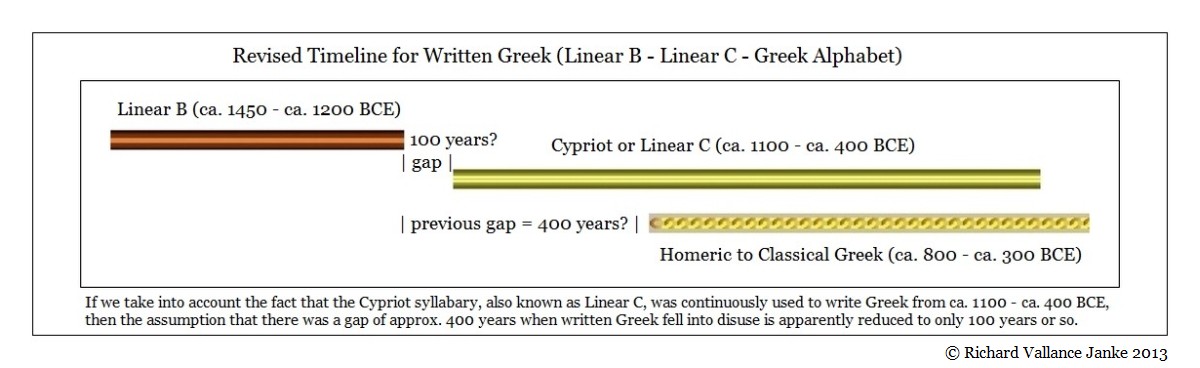


You must be logged in to post a comment.