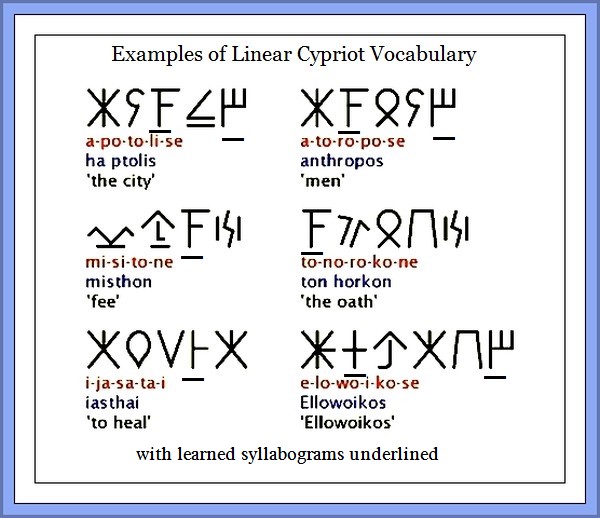
Let’s Learn Arcado-Cypriot Linear C: the First 6 Syllabograms Very Similar to their Equivalents in Linear B: Click to ENLARGE:For those of us like myself who have absolutely no choice but to learn Arcado-Cypriot Linear C (in use ca. 1100 – 400 BCE), the syllabary most closely related to Mycenaean Linear B (in use ca. 1500 – 1200 BCE), as indeed are the dialects themselves, being the nearest cousins and the earliest East Greek dialects, this serves as our little introduction. Anyone else visiting our Blog already familiar with Linear C can use these lessons to brush up on it, while those of you who are just curious yellow and wish to learn it, please be my guest, and go right ahead. The first 6 syllabograms in Linear C are strikingly similar to their equivalents in Linear B. Whether this is mere happenstance, I do not know, but I rather doubt it, as they look remarkably like direct borrowings from Linear B. However, none of the other 50 Linear C syllabograms look the least bit like any Linear B syllabograms. But, thank Heavens, they are a lot simpler. Certain striking characteristics distinguish Linear C from Linear B: 1. While Linear B has at least 81 syllabograms, Linear C has only 56. Thus, it is approaching the size of an alphabet. 2. While Linear B has over 200 ideograms and logograms, Linear C has none. 3. Arcado-Cypriot Linear C is the very last stage in the development of Greek script before the adoption of the primitive Greek alphabet ca. 900-800 BCE. 4. The script is so simple and easy to learn that the Arcado-Cypriots persisted in using it in their inscriptions right on up to ca. 400 BCE, when they finally cried Uncle, and caved in to using the by-then standard universal Attic alphabet. 5. The extremely important legal source document, the “Idalion Tablet” is absolutely critical in establishing the tight grammatical and vocabulary bond between Linear B, which fell into disuse only 1 century (!) before the adoption of Linear C. Since it has long since been proven beyond a doubt that Linear C was consistently used to write Arcado-Cypriot, an East Greek dialect, which is beyond question Greek, all we need to do to convince the few agnostics or silly “nay-sayers” who still insist Mycenaean Greek is not Greek (yes, such people still exist, especially in Macedonia, for some bizarre reason). Once I have mastered Arcado-Cypriot Linear C, I fully intend to establish beyond any reasonable doubt that both the vocabulary and the grammar of Mycenaean and Arcado-Cypriot Greek are practically identical, thereby rationally settling once and for all time any controversy that Mycenaean Greek is not Greek. The two dialects being almost identical (and trust me, they are), if Arcado-Cypriot is Greek, which it emphatically is, then we must conclude that Mycenaean is Greek and nothing but Greek. I shall have proven this conclusively sometime in 2015, once I have mastered Linear C, and have read the very substantial Idalion tablet, illustrated here: Click to ENLARGE:
In the next post, to lend further weight to my hypothesis, I shall translate these words in this little table in Linear C into Linear B, and place them side-by-side for your edification and mine alike.
Richard
Tag: translation
-
The Linear B “Attendants” Tablet – a Tough Nut to Crack!
The Linear B “Attendants” Tablet – a Tough Nut to Crack! (Click to ENLARGE):
 This has got to be one of the most difficult Linear B tablets to decipher, not because most of it isn't all that hard to translate, but for that last syllabogram TA, which I am sure must have stumped practically everyone who has ever tried to tackle it. However, upon consulting the most comprehensive Linear B Glossary on the Internet, A Companion to Linear B, Mycenaean Greek Texts and their World [Bibliothèque de l’Institut linguistique de Louvain ― 127 (2011)] I discovered, to my utter astonishment, the two entries you see flagged just under the tablet itself in this post, TAPA EOTE, which is in early ancient Greek, tapa\ e1ontej. What we need to understand in this context is that the Linear B scribes frequently used abbreviations to save valuable space on what were, after all, (very) small tablets. For instance, on the Heidelberg Tablet HE FL 1994, the scribe has used the single syllabobgrams KO PA & MU to stand in for KONOSO, PAITO & MUKENE respectively, thereby saving a great deal of space. I shall be translating this fascinating tablet as well sometime in April or May. Another reason why I believe we can lend credence to my translation is this: attendants actually do appear on Minoan frescoes, such as this one from Knossos (Click to ENLARGE):
 My explanatory commentary below goes a long way to clarifying and lending further credence to my decipherment. So unless you actually read the commentary, you will not get a full grasp on the decipherment.
We notice that in the fresco above, the one woman, almost certainly a priestess has 7 attendants, all male, which might go some way to explaining why there are 41 attendants for only 32 people. If for instance the priestess in a procession of 32 people has, as in the fresco we see here, 7 attendants, and everyone else coming up the rear has 1 attendant, for a total of 38 attendants, the total is very close to the 41 given on this tablet. But it is also possible that the priestess would have an acolyte following right behind her, and if her acolyte were to have 3 attendants, we would then have our 41. Of course all this is pure conjecture on my part, but the possibility still remains, and at any rate we cannot conjecture how many attendants would follow in a particular procession, as processions were probably held very often at Knossos, Chania, Mycenae, Pylos and other Mycenaean centres for different festivals. All ancient cities without exception held frequent festivals, which were almost all religious in nature, festivals for the city's patron goddess, for spring sowing and autumn reaping of crops, feasting festivals for the "wanaka" or King and his Queen, and in the case of Knossos and the Mycenaean fortress towns, for the Snake Goddess of fertility, without whom the population would not have been well replenished... at least for the Minoans and Mycenaeans.
Another equally feasible interpretation for some festivals at least, is that many of the attendants would have been musicians, just as in the fresco above, where we see a lyre player on the left and/or libation bearers, such as the 1 on the right in this fresco holding a rhyton, probably filled with mead or wine. So if that were to be the case, and 31 people had 1 attendant each, that would leave, for instance, possibly 4 musicians and 6 libation or "cup bearers"(again giving a total of 41 as in this case). Processions proliferate on Minoan/Mycenaean frescoes... and the number of attendants would have surely varied widely, depending on the type of festival. Of course, we shall never really know, as the extensive research into Minoan/ Mycenaean festivals to date has never been able to shed sufficient light on the arcane "mysteries" of Minoan/Mycenaean religious rites, processions and festivals, nor is it likely that future research will get much further, barring the unearthing of a considerable number of new tablets dealing specifically with religious matters.
Still, I feel quite confident that I have come up with a sound decipherment of the final syllabogram TA on the Linear B “Attendants” Tablet, but I would love to receive feedback from any and all researchers into Linear B tablets concerning other equally feasible interpretations of that pesky little syllabogram.
CAVEAT:
On the other hand, this translation crams an awful lot of significance into one pesky syllabogram, TA. The solution could be a lot simpler. So if I can come up with any alternative simpler decipherment(s), I will let you all know. One should never take anything for granted.
Richard
My explanatory commentary below goes a long way to clarifying and lending further credence to my decipherment. So unless you actually read the commentary, you will not get a full grasp on the decipherment.
We notice that in the fresco above, the one woman, almost certainly a priestess has 7 attendants, all male, which might go some way to explaining why there are 41 attendants for only 32 people. If for instance the priestess in a procession of 32 people has, as in the fresco we see here, 7 attendants, and everyone else coming up the rear has 1 attendant, for a total of 38 attendants, the total is very close to the 41 given on this tablet. But it is also possible that the priestess would have an acolyte following right behind her, and if her acolyte were to have 3 attendants, we would then have our 41. Of course all this is pure conjecture on my part, but the possibility still remains, and at any rate we cannot conjecture how many attendants would follow in a particular procession, as processions were probably held very often at Knossos, Chania, Mycenae, Pylos and other Mycenaean centres for different festivals. All ancient cities without exception held frequent festivals, which were almost all religious in nature, festivals for the city's patron goddess, for spring sowing and autumn reaping of crops, feasting festivals for the "wanaka" or King and his Queen, and in the case of Knossos and the Mycenaean fortress towns, for the Snake Goddess of fertility, without whom the population would not have been well replenished... at least for the Minoans and Mycenaeans.
Another equally feasible interpretation for some festivals at least, is that many of the attendants would have been musicians, just as in the fresco above, where we see a lyre player on the left and/or libation bearers, such as the 1 on the right in this fresco holding a rhyton, probably filled with mead or wine. So if that were to be the case, and 31 people had 1 attendant each, that would leave, for instance, possibly 4 musicians and 6 libation or "cup bearers"(again giving a total of 41 as in this case). Processions proliferate on Minoan/Mycenaean frescoes... and the number of attendants would have surely varied widely, depending on the type of festival. Of course, we shall never really know, as the extensive research into Minoan/ Mycenaean festivals to date has never been able to shed sufficient light on the arcane "mysteries" of Minoan/Mycenaean religious rites, processions and festivals, nor is it likely that future research will get much further, barring the unearthing of a considerable number of new tablets dealing specifically with religious matters.
Still, I feel quite confident that I have come up with a sound decipherment of the final syllabogram TA on the Linear B “Attendants” Tablet, but I would love to receive feedback from any and all researchers into Linear B tablets concerning other equally feasible interpretations of that pesky little syllabogram.
CAVEAT:
On the other hand, this translation crams an awful lot of significance into one pesky syllabogram, TA. The solution could be a lot simpler. So if I can come up with any alternative simpler decipherment(s), I will let you all know. One should never take anything for granted.
Richard
Share this:
-
Translation of Pylos Tablet: Ae 08 on the Internet vs. my own Translation
Translation of Pylos Tablet: Ae 08 on the Internet vs. my own Translation: Click to Enlarge
 Comparing the translation of Pylos Tablet: Ae 08 currently available on the Internet with my own, we find some minor errors in it, and there are also a few points where it can be improved on, which is what I have done my level best to achieve in my own translation of the same tablet. My notes make it clear where the original Greek text in particular is found lacking. The translators have in fact translated the tablet into archaic (Homeric) Greek, which is very much to their credit. But there a few points for discussion. First of all, “honeka” for “heneka” is incorrect in the transliteration of the Linear B syllabograms into Latin script. Other than that, the transcription is fine. Where I am at odds is with the transliteration of the genitive, for which the Linear B syllabograms are either “ja” & “jo” or “ya” & “yo”. Personally, I prefer the latter, since the pronunciation much more closely approximates the archaic Greek “oio”, even though it is almost a certainty that the Mycenaeans very likely never pronounced “oio” either way. What do I mean by this? As the study of linguistics makes it perfectly clear, consonants have a tendency to mutate or morph over time. It is for this reason that I personally believe that the Mycenaean pronunciation probably fell somewhere between “ja” & “jo” as in the English “jam” & “joke” and “ya” & “yo”, being more like “ja” & “jo” in French, as in “jamais” & “joindre”. The French pronunciation of “j” is in fact intermediately situated about halfway between the English “j” and the Greek “i”. Of course, all of this conjectural, but it does make some sense of the fact that some linguists prefer the English pronunciation to the Greek. To my mind, however, a pronunciation similar to the French “j”, falling somewhere between the two equally justifiable choices one can make neatly resolves the problem. That is precisely why I lean towards the “y” option, as the French pronunciation more closely approximates the Greek “i” or “y” than the English pronunciation. But it is all a matter of taste, I suppose.
Richard
Comparing the translation of Pylos Tablet: Ae 08 currently available on the Internet with my own, we find some minor errors in it, and there are also a few points where it can be improved on, which is what I have done my level best to achieve in my own translation of the same tablet. My notes make it clear where the original Greek text in particular is found lacking. The translators have in fact translated the tablet into archaic (Homeric) Greek, which is very much to their credit. But there a few points for discussion. First of all, “honeka” for “heneka” is incorrect in the transliteration of the Linear B syllabograms into Latin script. Other than that, the transcription is fine. Where I am at odds is with the transliteration of the genitive, for which the Linear B syllabograms are either “ja” & “jo” or “ya” & “yo”. Personally, I prefer the latter, since the pronunciation much more closely approximates the archaic Greek “oio”, even though it is almost a certainty that the Mycenaeans very likely never pronounced “oio” either way. What do I mean by this? As the study of linguistics makes it perfectly clear, consonants have a tendency to mutate or morph over time. It is for this reason that I personally believe that the Mycenaean pronunciation probably fell somewhere between “ja” & “jo” as in the English “jam” & “joke” and “ya” & “yo”, being more like “ja” & “jo” in French, as in “jamais” & “joindre”. The French pronunciation of “j” is in fact intermediately situated about halfway between the English “j” and the Greek “i”. Of course, all of this conjectural, but it does make some sense of the fact that some linguists prefer the English pronunciation to the Greek. To my mind, however, a pronunciation similar to the French “j”, falling somewhere between the two equally justifiable choices one can make neatly resolves the problem. That is precisely why I lean towards the “y” option, as the French pronunciation more closely approximates the Greek “i” or “y” than the English pronunciation. But it is all a matter of taste, I suppose.
Richard
Share this:
-
Archaic Greek in Book II, The Iliad, “The Catalogue of Ships” Translation into English: Part II, Lines 35-75
Archaic Greek in Book II, The Iliad, “The Catalogue of Ships” Translation into English: Part II, Lines 35-75 (Click to ENLARGE):
 My commentary on the derivation of the archaic Greek vocabulary and grammar in Book II of the Iliad from its much older Mycenean Linear B counterparts appears immediately after this post, and after every consecutive post of my running translation of Book II. As we proceed through Book II of the Iliad, we shall come to realize, quickly enough, that in fact the grammar and vocabulary of Book II, and in particular of the Catalogue of Ships (Lines 484-779), is inextricably woven with its parent dialect, namely, Mycenaean Greek, and consequently with the grammar and vocabulary of Linear B itself, from which the archaic Greek of this book of th Iliad is ultimately derived.
One thing I would like to make perfectly clear. While the Greek of Book II of the Iliad is archaic in many places, there is no way on earth that I would translate any of the Iliad into archaic English! Far too many translations of the Iliad reek of archaic English, and to my mind at least, have no place whatsoever in the annals of twenty-first century translations of ancient Greek texts into English, or into any other modern language, for that matter. The whole idea of the exercise is to make the ancient Homeric Greek as accessible and as readable as is humanly possible to today's allophone readers of the Iliad. Otherwise, I see no point in translating the text at all. If we are to get any real enjoyment out of any translation of the Iliad, for heaven's sake, let it be easy (and perhaps even fun) to read!
Richard
My commentary on the derivation of the archaic Greek vocabulary and grammar in Book II of the Iliad from its much older Mycenean Linear B counterparts appears immediately after this post, and after every consecutive post of my running translation of Book II. As we proceed through Book II of the Iliad, we shall come to realize, quickly enough, that in fact the grammar and vocabulary of Book II, and in particular of the Catalogue of Ships (Lines 484-779), is inextricably woven with its parent dialect, namely, Mycenaean Greek, and consequently with the grammar and vocabulary of Linear B itself, from which the archaic Greek of this book of th Iliad is ultimately derived.
One thing I would like to make perfectly clear. While the Greek of Book II of the Iliad is archaic in many places, there is no way on earth that I would translate any of the Iliad into archaic English! Far too many translations of the Iliad reek of archaic English, and to my mind at least, have no place whatsoever in the annals of twenty-first century translations of ancient Greek texts into English, or into any other modern language, for that matter. The whole idea of the exercise is to make the ancient Homeric Greek as accessible and as readable as is humanly possible to today's allophone readers of the Iliad. Otherwise, I see no point in translating the text at all. If we are to get any real enjoyment out of any translation of the Iliad, for heaven's sake, let it be easy (and perhaps even fun) to read!
RichardShare this:
-
Science Daily reports: automated Time Machine to reconstruct ancient languages!
Science Daily reports: automated Time Machine to reconstruct ancient languages! (Click to enlarge)

Source: http://www.sciencedaily.com/releases/2013/02/130212112025.htm

Share this:




You must be logged in to post a comment.