Haiku, The Sea! The Sea in Linear B, ancient Greek, English & French ...which I am sure you will love (Click to ENLARGE):Richard
Tag: syllabic scripts
-
Knossos Fragment, KN 201 X a 26, TARASA “The Sea”, a Surprise Find! & a Fresco! CLICK TO ENLARGE:
Knossos Fragment, KN 201 X a 26, TARASA “The Sea”, a Surprise Find! & a Fresco! CLICK TO ENLARGE:
 Although you would think that there should be references to the sea (of all places!) on Linear B tablets and fragments, until now at least such references simply have not appeared. It is a good thing I have slogged through at least 2,000 of the Scripta Minoa fragments and tablets, because at last I found one mentioning the sea, and even if this fragment is truncated on the right, as it surely appears to be, I am still convinced that this is an entire word, and if so, then it can mean only one thing, the sea. The chances of ever finding another Linear B fragment or tablet with this word, the sea, seem very slim indeed, although you never know. One thing you can be sure of, I shall keep on looking.
Minoan Fresco depicting Minoan ships at the island of Thera: Click to ENLARGE:
Although you would think that there should be references to the sea (of all places!) on Linear B tablets and fragments, until now at least such references simply have not appeared. It is a good thing I have slogged through at least 2,000 of the Scripta Minoa fragments and tablets, because at last I found one mentioning the sea, and even if this fragment is truncated on the right, as it surely appears to be, I am still convinced that this is an entire word, and if so, then it can mean only one thing, the sea. The chances of ever finding another Linear B fragment or tablet with this word, the sea, seem very slim indeed, although you never know. One thing you can be sure of, I shall keep on looking.
Minoan Fresco depicting Minoan ships at the island of Thera: Click to ENLARGE: Richard
Share this:
-
POST 300! A Sampling of Linear B Fragments on Amnisos, the Harbour of Knossos, in Scripta Minoa
POST 300! A Sampling of Linear B Fragments on Amnisos, the Harbour of Knossos, in Scripta Minoa (Click to ENLARGE):
 In this set of Linear B fragments from Scripta Minoa, we feature even more fragments on Amnisos, the harbour of Knossos. Like fragments and sometimes whole tablets dealing with Knossos, there are scores dealing with Amnisos, and sometimes the same fragment or tablet deals with both Amnisos and Knossos, which should come as no surprise, considering the extreme importance of these two locales to the thriving Minoan economy. One fragment in particular, KN 410 X (top right) is of particular significance, because it reveals more about the Minoan economy than might be assumed at first sight. This fragment states, “to Amnisos”. The only question is, from where? There can only be 2 possibilities, either (a) from Knossos itself or (b) from overseas, since Amnisos was the international trading port of Knossos. If this distinction sounds a bit academic, I would put it to you that it is not, because either meaning fits the bill supremely. And in any case, the missing portions of some fragments would have said, “from Knossos”, while others would have said “from overseas/from Mycenae/from Egypt” etc. I think we can probably take that much for granted. To summarize, what I am getting at here is simply this, that the Linear B fragments can often reveal something valuable, i.e. at least some information about their context, even where that context is missing. In those instances, such as in this case, where this is not entirely a matter of conjecture, we may find ourselves learning something new about the Minoan/Mycenaean society and economy, however sparse that new information may be.
Richard
In this set of Linear B fragments from Scripta Minoa, we feature even more fragments on Amnisos, the harbour of Knossos. Like fragments and sometimes whole tablets dealing with Knossos, there are scores dealing with Amnisos, and sometimes the same fragment or tablet deals with both Amnisos and Knossos, which should come as no surprise, considering the extreme importance of these two locales to the thriving Minoan economy. One fragment in particular, KN 410 X (top right) is of particular significance, because it reveals more about the Minoan economy than might be assumed at first sight. This fragment states, “to Amnisos”. The only question is, from where? There can only be 2 possibilities, either (a) from Knossos itself or (b) from overseas, since Amnisos was the international trading port of Knossos. If this distinction sounds a bit academic, I would put it to you that it is not, because either meaning fits the bill supremely. And in any case, the missing portions of some fragments would have said, “from Knossos”, while others would have said “from overseas/from Mycenae/from Egypt” etc. I think we can probably take that much for granted. To summarize, what I am getting at here is simply this, that the Linear B fragments can often reveal something valuable, i.e. at least some information about their context, even where that context is missing. In those instances, such as in this case, where this is not entirely a matter of conjecture, we may find ourselves learning something new about the Minoan/Mycenaean society and economy, however sparse that new information may be.
Richard
Share this:
-
Translation of Knossos Fragment KN 190 B with the Sypersyllabogram DI by Rita Roberts
Translation of Knossos Fragment KN 190 B with the Sypersyllabogram DI by Rita Roberts

Well over a year ago I became interested in the ancient script writings of the Minoans. These scripts are written on clay tablets and were discovered by Sir Arthur Evans whilst excavating the grand Palace of Knossos in Crete. It was Evans who named these scripts Linear B.

My Linear B teacher and mentor Richard Vallance Janke is extremely helpful in guiding me through what would be a difficult course for me to follow. However, with Richards humour and patience and his unique way of teaching I have found this subject a delight to learn in so much that I have now completed levels 1-4 (Basic to Advanced, Part 1).

Now Richard has given me my first assignment in translating Linear B fragments into English. These fragments seemed simple at a first glance as all of them contained the words KOWA for girl and KOWO for boy, so I thought, this should be reasonably easy. However, when I looked at what I thought was a simple translation where the first word was KOWA followed by the single syllabogram DI this confused me, I had no idea what this could possibly mean.

I know that Richard has been working hard on his new theory of Sypersyllabograms. I call them Supergrams to myself, so I knew he would advise me to consult the Linear B English Glossary and the Linear B Lexicon a much larger dictionary where I most likely would find what the Syllabogram DI might mean, this I did and to my astonishment there I found an entry which made sense " diwiya" alternately spelled "diwiyaya" meaning "a or the Priestess of the god Zeus".
This Sypersyllabogram DI meaning is to me a logical translation since the three most important deities the Minoans worshipped were Pipituna, the Snake Goddess and Zeus, hence my translation as follows: Translation of Knossos Fragment KN 190 B with the Sypersyllabogram DI by Rita Roberts (Click to ENLARGE):
 Rita Roberts
NOTE by Richard Vallance Janke.
Folks, this is Rita’s firs major contribution as an official translator of Linear B fragments. Considering that Rita only just began learning Linear B in the spring of 2013, she has come a very, very long way indeed. The task of translating this recalcitrant fragment placed enormous intellectual demands on Rita, and she has surpassed herself in the sheer ingenuity of her translation, which I would never have dreamt of myself, in spite of my extensive knowledge of Linear B, and a translation which I consider to be not only second to none, but highly accurate. Congratulations, Rita. We look forward to more fine translations from your expert hand.
Richard
Rita Roberts
NOTE by Richard Vallance Janke.
Folks, this is Rita’s firs major contribution as an official translator of Linear B fragments. Considering that Rita only just began learning Linear B in the spring of 2013, she has come a very, very long way indeed. The task of translating this recalcitrant fragment placed enormous intellectual demands on Rita, and she has surpassed herself in the sheer ingenuity of her translation, which I would never have dreamt of myself, in spite of my extensive knowledge of Linear B, and a translation which I consider to be not only second to none, but highly accurate. Congratulations, Rita. We look forward to more fine translations from your expert hand.
RichardShare this:
-
Translation of Knossos Fragment KN 212 X – ivory worker(s)?
Translation of Knossos Fragment KN 212 X - ivory worker(s)? (Click to ENLARGE):
 This particular fragment poses yet another vexing problem in the translation of Linear B fragments. Where context is lacking, as it surely is here, a tablet often admits of more than one translation, and often several translations, but if this so, which one is the most likely? In this case, when I consulted Liddell & Scott (1986), I immediately discovered a verb, “to trick or destroy”, which fit the bill perfectly, but the real problem here is that this verb is almost certainly of much later Greek origin, and is Ionic or Attic, not Mycenaean. This is made all the more obvious by the fact that the primary meanings of the verb are abstract, and if anything, abstract words are few and far between in Mycenaean Greek. That is our first interpretation. The second [2] is far more likely to be correct because ivory workers were commonplace in the Minoan economy. The problem here is that I had to invent the noun, which may or may not have existed in the Mycenaean era. Although the noun is purely a construct of my own making, it does make perfect sense in the context; so I am going to assume that something like this noun may have existed in Mycenaean times. Otherwise, if either or both of these interpretations does not pass muster, this fragment must be deemed unintelligible.
Richard
This particular fragment poses yet another vexing problem in the translation of Linear B fragments. Where context is lacking, as it surely is here, a tablet often admits of more than one translation, and often several translations, but if this so, which one is the most likely? In this case, when I consulted Liddell & Scott (1986), I immediately discovered a verb, “to trick or destroy”, which fit the bill perfectly, but the real problem here is that this verb is almost certainly of much later Greek origin, and is Ionic or Attic, not Mycenaean. This is made all the more obvious by the fact that the primary meanings of the verb are abstract, and if anything, abstract words are few and far between in Mycenaean Greek. That is our first interpretation. The second [2] is far more likely to be correct because ivory workers were commonplace in the Minoan economy. The problem here is that I had to invent the noun, which may or may not have existed in the Mycenaean era. Although the noun is purely a construct of my own making, it does make perfect sense in the context; so I am going to assume that something like this noun may have existed in Mycenaean times. Otherwise, if either or both of these interpretations does not pass muster, this fragment must be deemed unintelligible.
Richard
Share this:
-
Hi, friends! More mnemonics to learn the Linear B syllabograms MA MI MO NA NE NU
Hi, friends! More mnemonics to learn the Linear B syllabograms MA MI MO NA NE NU Click to ENLARGE:
 Well, then, here is another dose of mnemonics to learn more of those pesky Linear B syllabograms, which can stump even the most assiduous and enthusiastic of learners. I know they did me. It took me months to master even all of the basic syllabograms, which is why I resorted to mnemonics myself, which were a great help to me.
Richard
Well, then, here is another dose of mnemonics to learn more of those pesky Linear B syllabograms, which can stump even the most assiduous and enthusiastic of learners. I know they did me. It took me months to master even all of the basic syllabograms, which is why I resorted to mnemonics myself, which were a great help to me.
Richard
Share this:
-
Linear B Mnemonics for K Series Syllabograms … kartwheels, kites, corkscrews & acrobats
Linear B Mnemonics for K Series Syllabograms (Click to ENLARGE):
 Judging from the number of visits we have been getting to our blog in the past few days, it certainly looks as if folks really appreciate this fun way of learning Linear B Syllabograms. Unfortunately, it does not always work out precisely as I would like it to. For instance, try as I might, I just could not come up with anything remotely mnemonic for the syllabogram KE. If anyone can, please be my guest.
Richard
Judging from the number of visits we have been getting to our blog in the past few days, it certainly looks as if folks really appreciate this fun way of learning Linear B Syllabograms. Unfortunately, it does not always work out precisely as I would like it to. For instance, try as I might, I just could not come up with anything remotely mnemonic for the syllabogram KE. If anyone can, please be my guest.
RichardShare this:
-
Linear B Mnemonics for D Series Syllabograms… DA is for DArtboard, DE is for…
Linear B Mnemonics for D Series Syllabograms (Click to ENLARGE):
 Cute eh?
Share this:
-
Mnemonics for learning Linear B Syllabograms: Vowels
Mnemonics for learning Linear B Syllabograms: Vowels Over a year ago, when we first started up this blog on learning the ins and outs of Linear B in all its intricacies and finer points, I was sorely tempted to teach (so-to-speak) Linear B vowels and syllabograms by means of mnemonics, but I rather thought this might come off across as rather insulting to folks’ intelligence... well, except for my own, for instance, and the intelligence of plenty of other people, as I might well have imagined at the time (and did!), since many of us lesser lights learn far better by mnemonic or visual association than by mere rote learning, of which I personally stand in horror! So, at the time, thinking the wiser of it, I didn’t take that route, but now, being a lot less wiser for it, I might as well go for it, which is why you see this silly little chart illustrating at least one way (my way, as if!) for learning the Linear B vowels by mnemonics. Mnemonics for learning Linear B Syllabograms: Vowels (Click to ENLARGE):
 Just to drive you completely insane, from time to time over the next few months, I shall be doing precisely the same thing for all of the syllabograms and key homophones. Some of you will love this approach; others it will probably leave cold; and still others may hate it. But, heck, why not let everyone have his or her say in court. If you have even funnier suggestions for mnemonic learning devices for Linear B syllabograms, homophones and vowels, toss them our way in the “Comments” Section of our Blog, or if you like, you can e-mail your suggestions to me at:
vallance22@gmx.com
and I shall be glad to post them. All for a good laugh!
Richard
Just to drive you completely insane, from time to time over the next few months, I shall be doing precisely the same thing for all of the syllabograms and key homophones. Some of you will love this approach; others it will probably leave cold; and still others may hate it. But, heck, why not let everyone have his or her say in court. If you have even funnier suggestions for mnemonic learning devices for Linear B syllabograms, homophones and vowels, toss them our way in the “Comments” Section of our Blog, or if you like, you can e-mail your suggestions to me at:
vallance22@gmx.com
and I shall be glad to post them. All for a good laugh!
Richard
Share this:
-
Scripta Minoa: Not so Easy Fragments # 4
Scripta Minoa: Not so Easy Fragments # 4 (Click to ENLARGE):
 In this case, we have only 2 fragments, but they are nasty little buggers. In the first one, the ideograms for rams and ewes are clear as a bell, but what on earth is PAKOSOKI supposed to mean? ... or for that matter UKI? I have not the faintest idea, regardless of the fact that I thoroughly ploughed through all the Mycenaean-English Glossaries, so this is simply a case of, throw up your arms and give up. With the second one, we have considerably more luck. Once again, we are confronted with a single syllabogram WO, the first syllable of some word, God knows what. But I asked myself, quite naturally, “What would be purple that the Minoans loved to make”... and I came up with only 2 answers, (1) purple dyed cloth & (2) wine. Again, it was mere happenstance that I came up with the word, WONOWATISI, gardens with vines (dative case) by consulting the Mycenaean (Linear B) - English Glossary, and what with a bit of searching around in Liddell & Scott, I was thoroughly delighted to come up with the Ionic version of the same word, which as you can see written on the second fragment above, and which means, “made of or with wine”. So what we end up with here is something like, “with the purple colour of wine”. Sure makes a lot of sense to me, at least. But of course, plenty of folks will surely contest this interpretation.
Richard
In this case, we have only 2 fragments, but they are nasty little buggers. In the first one, the ideograms for rams and ewes are clear as a bell, but what on earth is PAKOSOKI supposed to mean? ... or for that matter UKI? I have not the faintest idea, regardless of the fact that I thoroughly ploughed through all the Mycenaean-English Glossaries, so this is simply a case of, throw up your arms and give up. With the second one, we have considerably more luck. Once again, we are confronted with a single syllabogram WO, the first syllable of some word, God knows what. But I asked myself, quite naturally, “What would be purple that the Minoans loved to make”... and I came up with only 2 answers, (1) purple dyed cloth & (2) wine. Again, it was mere happenstance that I came up with the word, WONOWATISI, gardens with vines (dative case) by consulting the Mycenaean (Linear B) - English Glossary, and what with a bit of searching around in Liddell & Scott, I was thoroughly delighted to come up with the Ionic version of the same word, which as you can see written on the second fragment above, and which means, “made of or with wine”. So what we end up with here is something like, “with the purple colour of wine”. Sure makes a lot of sense to me, at least. But of course, plenty of folks will surely contest this interpretation.
Richard
Share this:
-
Scripta Minoa: Not so Easy Fragments # 3
Scripta Minoa: Not so Easy Fragments # 3 (Click to ENLARGE:)
 Now we come to fragments which are somewhat more difficult to interpret, because:
1. some of the syllabograms may be truncated on both the left and the right, making it almost impossible to figure out what the full word is in which they appear, as illustrated in the third fragment here, or
2. some of the syllabograms may or may not be truncated on the left, as appears to be the case in the first example above, where I finally decided WAKITARA was probably not truncated on the left, and was a man’s name. But that would only be the case if there were only 1 man, and since the fragment is truncated on the right, we shall never know this, or
3. as in the second example, where Haptarwara is clearly a man’s name, there still exist ambiguities. What about that half-erased syllabogram to the right of his name? It sure looks like RE, but that is not certain. But if it is RE, then that places his name in the dative case, which is highly significant for this particular fragment. Given that the second line clearly states that there are 102 men tending to rams or ewes or both, i.e. sheep, if Haptarwara’s name is in fact in the dative case, then the phrase means, “for Haptarwara”, surely implying that the 102 men are working for him, and that he is their overseer. In that case, the translation is pretty clear, and because it is so, it makes a lot of sense. It runs as follows: 102 men (shepherds) tending to sheep (rams & or ewes), working for their overseer, Haptarwara. Without the dative, however, this interpretation falls apart.
As you can, I have applied the general criteria outlined in the second post on Easy Syllabograms to this post on Syllabograms which are no longer so easy to decipher, but which nevertheless, are not entirely recalcitrant to interpretation.
Richard
Now we come to fragments which are somewhat more difficult to interpret, because:
1. some of the syllabograms may be truncated on both the left and the right, making it almost impossible to figure out what the full word is in which they appear, as illustrated in the third fragment here, or
2. some of the syllabograms may or may not be truncated on the left, as appears to be the case in the first example above, where I finally decided WAKITARA was probably not truncated on the left, and was a man’s name. But that would only be the case if there were only 1 man, and since the fragment is truncated on the right, we shall never know this, or
3. as in the second example, where Haptarwara is clearly a man’s name, there still exist ambiguities. What about that half-erased syllabogram to the right of his name? It sure looks like RE, but that is not certain. But if it is RE, then that places his name in the dative case, which is highly significant for this particular fragment. Given that the second line clearly states that there are 102 men tending to rams or ewes or both, i.e. sheep, if Haptarwara’s name is in fact in the dative case, then the phrase means, “for Haptarwara”, surely implying that the 102 men are working for him, and that he is their overseer. In that case, the translation is pretty clear, and because it is so, it makes a lot of sense. It runs as follows: 102 men (shepherds) tending to sheep (rams & or ewes), working for their overseer, Haptarwara. Without the dative, however, this interpretation falls apart.
As you can, I have applied the general criteria outlined in the second post on Easy Syllabograms to this post on Syllabograms which are no longer so easy to decipher, but which nevertheless, are not entirely recalcitrant to interpretation.
Richard
Share this:
-
Scripta Minoa: So-called Easy Fragments # 2: Knossos, Amnisos & Potnia. General Criteria for Interpretation of Fragments
Scripta Minoa: So-called Easy Fragments # 2: Knossos, Amnisos & Potnia (Click to ENLARGE:)
 To summarize the criteria we laid out in detail in the previous post, in general terms, the following conditions pertain to all fragments (not tablets!) regardless:
1. There is no context by which to establish what sense or meaning the word or words (usually no more than 5 or 6 at most) actually are meant to convey.
2. Almost all fragments are truncated on the left or right, making it practically (though not utterly) impossible to interpret whatever the cropped text is supposed to mean.
3. But things are not quite so hopeless as it would at first sight appear. If the occurrences of all extant words beginning with a particular syllabogram in every Linear B dictionary now available online are relatively few, then we can predict that our translation has a 1 in nn chance, sometimes even as low as 1 in 10 or 10% of actually being the right translation.
4.Even where right hand truncation is the order of the day, sometimes there is only one interpretation. But here again, ambiguity of context frustrates once again. What on earth does the fragment in question tell us about (usually one single) word? In almost all instances, precisely nothing.
5. Ambiguities in grammatical construction further complicate matters.
6. Scribes often (half) ERASE one or more syllabograms on fragments, almost always on the right side. This usuallly happens when a scribe simply erases the last (extraneous) character, which he never meant to write in the first place. On the other hand, he may be hesitating whether or not he should erase it, as will be illustrated in he next 2 posts.
Our second example of 5 fragments: Scripta Minoa: So-called Easy Fragments # 2: Knossos, Amnisos & Potnia speak for themselves, or more accurately do not speak for themselves. I invite you to try and interpret each of the 5 fragments on your own. I am quite sure you will come up for air pretty quickly, feeling (somewhat or annoyingly) frustrated. For instance, who the blazes is Potnia? Look her up in almost any classical Greek-English dictionary and you are likely bound to hit a brick wall. Fortunately, our excellent companion, Liddell & Scott, comes to the rescue yet again (pg. 581), which is why any serious Linear B researcher should have this invaluable resource in his or her collection. I am not going to tell you who she is. I believe it is up to you to do your own research on this one, even if you have to go to the library.
Things are going to get a lot messier from here on in!
Richard
To summarize the criteria we laid out in detail in the previous post, in general terms, the following conditions pertain to all fragments (not tablets!) regardless:
1. There is no context by which to establish what sense or meaning the word or words (usually no more than 5 or 6 at most) actually are meant to convey.
2. Almost all fragments are truncated on the left or right, making it practically (though not utterly) impossible to interpret whatever the cropped text is supposed to mean.
3. But things are not quite so hopeless as it would at first sight appear. If the occurrences of all extant words beginning with a particular syllabogram in every Linear B dictionary now available online are relatively few, then we can predict that our translation has a 1 in nn chance, sometimes even as low as 1 in 10 or 10% of actually being the right translation.
4.Even where right hand truncation is the order of the day, sometimes there is only one interpretation. But here again, ambiguity of context frustrates once again. What on earth does the fragment in question tell us about (usually one single) word? In almost all instances, precisely nothing.
5. Ambiguities in grammatical construction further complicate matters.
6. Scribes often (half) ERASE one or more syllabograms on fragments, almost always on the right side. This usuallly happens when a scribe simply erases the last (extraneous) character, which he never meant to write in the first place. On the other hand, he may be hesitating whether or not he should erase it, as will be illustrated in he next 2 posts.
Our second example of 5 fragments: Scripta Minoa: So-called Easy Fragments # 2: Knossos, Amnisos & Potnia speak for themselves, or more accurately do not speak for themselves. I invite you to try and interpret each of the 5 fragments on your own. I am quite sure you will come up for air pretty quickly, feeling (somewhat or annoyingly) frustrated. For instance, who the blazes is Potnia? Look her up in almost any classical Greek-English dictionary and you are likely bound to hit a brick wall. Fortunately, our excellent companion, Liddell & Scott, comes to the rescue yet again (pg. 581), which is why any serious Linear B researcher should have this invaluable resource in his or her collection. I am not going to tell you who she is. I believe it is up to you to do your own research on this one, even if you have to go to the library.
Things are going to get a lot messier from here on in!
Richard
Share this:
-
Scripta Minoa: So-called Easy Fragments # 1: Knossos & Amnisos. Do not be fooled!
Scripta Minoa: So-called Easy Fragments # 1: Knossos & Amnisos (Click to ENLARGE:)
 We now begin our long series of posts of some 2,000 of the approximately 3,500 tablets and fragments from Knossos, which Sir Arthur Evans published in his Scripta Minoa (Oxford University Press, 1952). The first 4 fragments you see here already amply illustrate some of the (sometimes intractable) problems faced by translators, especially when we have to deal with fragments. In general terms, the following conditions pertain to all fragments (not tablets!) regardless:
1. There is no context by which to establish what sense or meaning the word or words (usually no more than 5 or 6 at most) actually are meant to convey. The last of the 4 in this table amply illustrates this problem. First of all, does the word “enereya” mean “operation or better still, industry”... possibly, even probably (by a stretch), but also probably not. And plenty of translators will contest my “translation”.
2. Almost all fragments are truncated on the left or right, making it practically (though not utterly) impossible to interpret whatever the cropped text is supposed to mean. This is fully illustrated by the second fragment in this table.
3. But things are not quite so hopeless as it would at first sight appear. If the occurrences of all extant words beginning with a particular syllabogram (in this case TE) in every Linear B dictionary now available online are relatively few, then we can predict that our translation, here = temenos (boundary) has a 1 in nn chance of actually being the right translation. Allow me to illustrate. In the two largest Mycenaean Linear B – English dictionaries now available online (the larger one in PDF format and over 260 pages long!), there are 6+17 = 23 instances of all extant words beginning the single syllabogram TE as the first syllable. So let’s assume the ratio is 1/25 or about 4%. But wait. But only a very few of these words make any sense in fragment #2, and as it happens that number adds up to only: te = then, tekotones = carpenters, temeno = boundary or temple,teo(i) = god(s), temidweta = wheel with studs, tereta = official title of a tax collector or master of ceremonies, tetukuoa = well prepared or ready, teukepi = with implements, thereby reducing our chances of being “correct” to 1 in 7 according to this vocabulary. But let’s err on the side of caution, and say, 1 in 10, or 10 %, and that is a heck of a lot better than our initial calculation. Of course, I for one are more than willing to substitute any of the other 6 words above for “temenos”, because they all make sense in this admittedly very limited context, if you can even call it that. But, in fact, the collateral evidence I have just laid out makes it even probable that any of these 7 (or slightly more) interpretations fits the bill.
But in the second example in this table the meaning is clear. It can only be Aminiso or Aminisoyo (genitive) or some such variant. So even where right hand truncation is the order of the day, sometimes there is only one interpretation. But here again, ambiguity of context frustrates once again. What on earth does this fragment tell us about Amnisos... Precisely nothing.
5. Ambiguities in grammatical construction further complicate matters, as in fragment 1. Why is Konosoyo in the genitive and Rukitiyo (apparently) nominative? Why are these two places mentioned together? What is the association or link between them? We shall never know. Richard
We now begin our long series of posts of some 2,000 of the approximately 3,500 tablets and fragments from Knossos, which Sir Arthur Evans published in his Scripta Minoa (Oxford University Press, 1952). The first 4 fragments you see here already amply illustrate some of the (sometimes intractable) problems faced by translators, especially when we have to deal with fragments. In general terms, the following conditions pertain to all fragments (not tablets!) regardless:
1. There is no context by which to establish what sense or meaning the word or words (usually no more than 5 or 6 at most) actually are meant to convey. The last of the 4 in this table amply illustrates this problem. First of all, does the word “enereya” mean “operation or better still, industry”... possibly, even probably (by a stretch), but also probably not. And plenty of translators will contest my “translation”.
2. Almost all fragments are truncated on the left or right, making it practically (though not utterly) impossible to interpret whatever the cropped text is supposed to mean. This is fully illustrated by the second fragment in this table.
3. But things are not quite so hopeless as it would at first sight appear. If the occurrences of all extant words beginning with a particular syllabogram (in this case TE) in every Linear B dictionary now available online are relatively few, then we can predict that our translation, here = temenos (boundary) has a 1 in nn chance of actually being the right translation. Allow me to illustrate. In the two largest Mycenaean Linear B – English dictionaries now available online (the larger one in PDF format and over 260 pages long!), there are 6+17 = 23 instances of all extant words beginning the single syllabogram TE as the first syllable. So let’s assume the ratio is 1/25 or about 4%. But wait. But only a very few of these words make any sense in fragment #2, and as it happens that number adds up to only: te = then, tekotones = carpenters, temeno = boundary or temple,teo(i) = god(s), temidweta = wheel with studs, tereta = official title of a tax collector or master of ceremonies, tetukuoa = well prepared or ready, teukepi = with implements, thereby reducing our chances of being “correct” to 1 in 7 according to this vocabulary. But let’s err on the side of caution, and say, 1 in 10, or 10 %, and that is a heck of a lot better than our initial calculation. Of course, I for one are more than willing to substitute any of the other 6 words above for “temenos”, because they all make sense in this admittedly very limited context, if you can even call it that. But, in fact, the collateral evidence I have just laid out makes it even probable that any of these 7 (or slightly more) interpretations fits the bill.
But in the second example in this table the meaning is clear. It can only be Aminiso or Aminisoyo (genitive) or some such variant. So even where right hand truncation is the order of the day, sometimes there is only one interpretation. But here again, ambiguity of context frustrates once again. What on earth does this fragment tell us about Amnisos... Precisely nothing.
5. Ambiguities in grammatical construction further complicate matters, as in fragment 1. Why is Konosoyo in the genitive and Rukitiyo (apparently) nominative? Why are these two places mentioned together? What is the association or link between them? We shall never know. RichardShare this:
-
All 22 Arcado-Cypriot Linear C syllabograms we have learned so far
All 22 Arcado-Cypriot Linear C syllabograms we have learned so far I have tagged each of 22 of the syllabograms we have covered so far with a large asterisk on the chart of the Arcado-Cypriot syllabary below. Click to ENLARGE:
 & again!
 I will introduce the remainder of the Arcado-Cypriot syllabary sometime in the late summer.
Richard
I will introduce the remainder of the Arcado-Cypriot syllabary sometime in the late summer.
Richard
Share this:
-
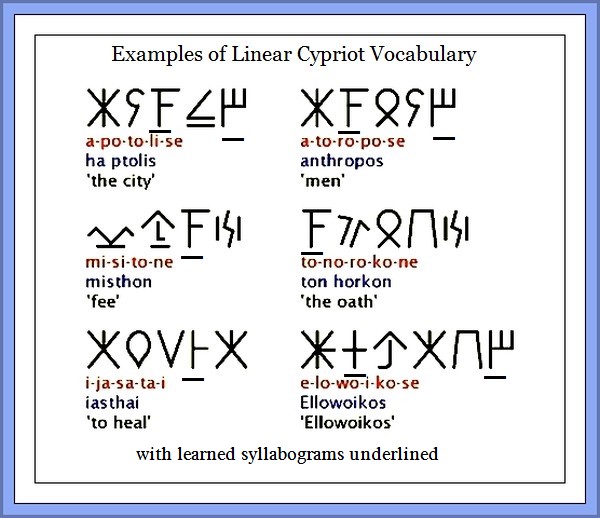
Let’s Learn Arcado-Cypriot Linear C: the First 6 Syllabograms Very Similar to their Equivalents in Linear B
Let’s Learn Arcado-Cypriot Linear C: the First 6 Syllabograms Very Similar to their Equivalents in Linear B: Click to ENLARGE:
 For those of us like myself who have absolutely no choice but to learn Arcado-Cypriot Linear C (in use ca. 1100 – 400 BCE), the syllabary most closely related to Mycenaean Linear B (in use ca. 1500 – 1200 BCE), as indeed are the dialects themselves, being the nearest cousins and the earliest East Greek dialects, this serves as our little introduction. Anyone else visiting our Blog already familiar with Linear C can use these lessons to brush up on it, while those of you who are just curious yellow and wish to learn it, please be my guest, and go right ahead.
The first 6 syllabograms in Linear C are strikingly similar to their equivalents in Linear B. Whether this is mere happenstance, I do not know, but I rather doubt it, as they look remarkably like direct borrowings from Linear B.
However, none of the other 50 Linear C syllabograms look the least bit like any Linear B syllabograms. But, thank Heavens, they are a lot simpler.
Certain striking characteristics distinguish Linear C from Linear B:
1. While Linear B has at least 81 syllabograms, Linear C has only 56. Thus, it is approaching the size of an alphabet.
2. While Linear B has over 200 ideograms and logograms, Linear C has none.
3. Arcado-Cypriot Linear C is the very last stage in the development of Greek script before the adoption of the primitive Greek alphabet ca. 900-800 BCE.
4. The script is so simple and easy to learn that the Arcado-Cypriots persisted in using it in their inscriptions right on up to ca. 400 BCE, when they finally cried Uncle, and caved in to using the by-then standard universal Attic alphabet.
5. The extremely important legal source document, the “Idalion Tablet” is absolutely critical in establishing the tight grammatical and vocabulary bond between Linear B, which fell into disuse only 1 century (!) before the adoption of Linear C. Since it has long since been proven beyond a doubt that Linear C was consistently used to write Arcado-Cypriot, an East Greek dialect, which is beyond question Greek, all we need to do to convince the few agnostics or silly “nay-sayers” who still insist Mycenaean Greek is not Greek (yes, such people still exist, especially in Macedonia, for some bizarre reason). Once I have mastered Arcado-Cypriot Linear C, I fully intend to establish beyond any reasonable doubt that both the vocabulary and the grammar of Mycenaean and Arcado-Cypriot Greek are practically identical, thereby rationally settling once and for all time any controversy that Mycenaean Greek is not Greek. The two dialects being almost identical (and trust me, they are), if Arcado-Cypriot is Greek, which it emphatically is, then we must conclude that Mycenaean is Greek and nothing but Greek. I shall have proven this conclusively sometime in 2015, once I have mastered Linear C, and have read the very substantial Idalion tablet, illustrated here: Click to ENLARGE:
For those of us like myself who have absolutely no choice but to learn Arcado-Cypriot Linear C (in use ca. 1100 – 400 BCE), the syllabary most closely related to Mycenaean Linear B (in use ca. 1500 – 1200 BCE), as indeed are the dialects themselves, being the nearest cousins and the earliest East Greek dialects, this serves as our little introduction. Anyone else visiting our Blog already familiar with Linear C can use these lessons to brush up on it, while those of you who are just curious yellow and wish to learn it, please be my guest, and go right ahead.
The first 6 syllabograms in Linear C are strikingly similar to their equivalents in Linear B. Whether this is mere happenstance, I do not know, but I rather doubt it, as they look remarkably like direct borrowings from Linear B.
However, none of the other 50 Linear C syllabograms look the least bit like any Linear B syllabograms. But, thank Heavens, they are a lot simpler.
Certain striking characteristics distinguish Linear C from Linear B:
1. While Linear B has at least 81 syllabograms, Linear C has only 56. Thus, it is approaching the size of an alphabet.
2. While Linear B has over 200 ideograms and logograms, Linear C has none.
3. Arcado-Cypriot Linear C is the very last stage in the development of Greek script before the adoption of the primitive Greek alphabet ca. 900-800 BCE.
4. The script is so simple and easy to learn that the Arcado-Cypriots persisted in using it in their inscriptions right on up to ca. 400 BCE, when they finally cried Uncle, and caved in to using the by-then standard universal Attic alphabet.
5. The extremely important legal source document, the “Idalion Tablet” is absolutely critical in establishing the tight grammatical and vocabulary bond between Linear B, which fell into disuse only 1 century (!) before the adoption of Linear C. Since it has long since been proven beyond a doubt that Linear C was consistently used to write Arcado-Cypriot, an East Greek dialect, which is beyond question Greek, all we need to do to convince the few agnostics or silly “nay-sayers” who still insist Mycenaean Greek is not Greek (yes, such people still exist, especially in Macedonia, for some bizarre reason). Once I have mastered Arcado-Cypriot Linear C, I fully intend to establish beyond any reasonable doubt that both the vocabulary and the grammar of Mycenaean and Arcado-Cypriot Greek are practically identical, thereby rationally settling once and for all time any controversy that Mycenaean Greek is not Greek. The two dialects being almost identical (and trust me, they are), if Arcado-Cypriot is Greek, which it emphatically is, then we must conclude that Mycenaean is Greek and nothing but Greek. I shall have proven this conclusively sometime in 2015, once I have mastered Linear C, and have read the very substantial Idalion tablet, illustrated here: Click to ENLARGE:
 In the next post, to lend further weight to my hypothesis, I shall translate these words in this little table in Linear C into Linear B, and place them side-by-side for your edification and mine alike.
 Richard
Share this:



You must be logged in to post a comment.