Tag: Mycenaean Greek

  • What Are the Symbols on the Wisconsin U.S.A. Shard & What Might They Mean? PART B: Linguistic Implications

    What Are the Symbols on the Wisconsin U.S.A. Shard & What Might They Mean?
    
    PART B: LINGUISTIC IMPLICATIONS:
    
    A Shard from Wisconsin, U.S.A. Click to ENLARGE):
    
    SNAKE LADY
    
    James R. Heath, who unearthed the Wisconsin shard, has this to say about the symbols (whatever they are) on the shard:
    
    As you might see, in the upper left corner; three symbols. Certainly distinguishable is the symbol ‘u’, appears, with the ‘boat’ ideogram. Preceding the symbol for ‘u’ is the first character shaped like the letter ‘C’... passim … what does the obtrusive “S”, in the middle; mean? Is it an S?
    
    I’m not going to pretend to translate, just show anyone willing to view this piece; there is more to discover at this site.
    
    Please present your arguments, I can only tell you where I unearthed them, not who or why they were made.
    
    James
    
    ___________________________________________________________________________________
    
    In response to James’ comments above, I would like to make this observation first, that it is not a question of arguments we should be focusing on in this particular case of an archeological find which may turn out to be of some true significance once it is carbon-dated, simply because there is nothing to “argue” about, even in the strictly academic understanding of this word, argumenta (Latin), an argument in the sense of proof. Yet it is clear that with respect to these findings, the Wisconsin tablet and shard, no proof of any kind is yet forthcoming, pending substantiation of the findings by carbon-dating and, if possible, examination by petrological microscope, as our resident archaeologist, Rita Roberts, who specializes in Minoan ware, has urged be done.
    
    On the linguistic level, however, I believe I am on much firmer ground.  What becomes immediately obvious when we compare all of the 70-odd basic values of the Linear B syllabary with the symbols (whatever they are) on both the Wisconsin tablet and shard, is that none of the Linear B syllabograms and homophones, which in fact are writing, correspond in any meaningful way with any of the symbols on the Wisconsin tablet and shard, with the possible exception of symbol B on the Wisconsin tablet, which looks remarkably like the Linear B syllabogram ZO and C&F on the Wisconsin tablet, which appears to be similar to the syllabogram, the vowel I in Linear B. Other than that, we come up empty-handed. Here is the basic Linear B syllabary set (Click to ENLARGE): 
    
    Wisconsin Tablet Linear B and Minoan
    
    This is, as I have already pointed out in a previous post, a serious impediment to cross-correlating the symbols (whatever they are) on the Wisconsin tablet and shard with absolutely any and all Linear B syllabograms, homophones, logograms and ideograms. Although I have not illustrated the Linear B logograms and ideograms in the table above, since there are far too many of them, I can assure you that none of them, with the sole exception of the Linear B ideogram for “month”, corresponds in any meaningful way with any of the symbols on the Wisconsin tablet and shard.
    There is also no ideogram for “boat” in Linear B.
    If anything, this renders any attempt cross-correlation between the Wisconsin symbols and the entire Linear B script corpus a futile exercise at best. Readers of our blog can see the Linear B ideogram for themselves on Linear B tablet KN 162a D b 01, Scripta Minoa, on the post, A KEY TO THE MINOAN ECONOMY? An emphatic YES. 21,904 sheep in one place? Guess where...
    
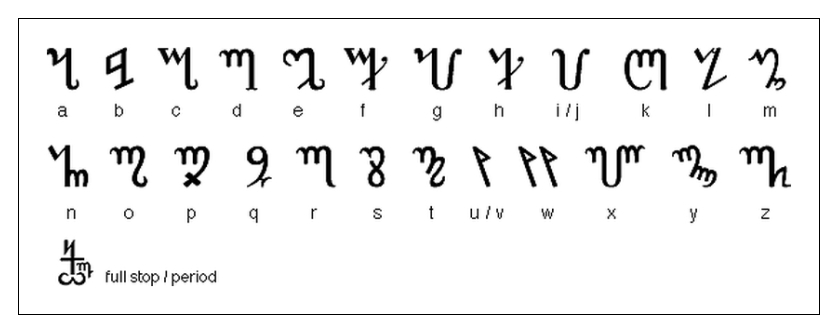
    However, what has really unsettled me right from the outset, when I first viewed the Wisconsin tablet and then subsequently, the Wisconsin shard, is that no less than 4 of the symbols look uncannily like alpha-numerics in the Latin alphabet, namely, C S U and 5. Their appearance on either one or the other of the Wisconsin finds actually spooks me. It strikes me as very peculiar indeed that no less than 4 symbols out of a total of at best a score or so actually look painfully like alpha-numeric Latin characters. I simply cannot wrap my head around this. I have yet to see any ancient script from anywhere in the Mediterranean, the Mid-East and India which includes any more than 2 or 3 symbols at best that look almost exactly or even approximately like any alpha-numeric Latin characters. This is probably the one characteristic of the Wisconsin tablet and shard which scares me off more than anything else. Should it turn out that the tablet is carbon-dated to the any historical era post dating the birth of Christ (anno domini = AD), say, for instance, to the sixteenth to eighteenth centuries AD, the symbols would then become rather more explicable. They could in fact turn out to be exactly what they look like, the letters C S & U and the number 5. But what could that possibly imply? Well, I am not entirely sure, but it could mean that the tablet and the shard, even though perfectly authentic, were a latter-day, early modern exercise in magical, alchemy or occult symbols or glyphs, secret cyphers or esoteric arcane runes such as the so-called “Theban” alphabet, a mystical script used to conceal meanings or make signs, blessings or cursings: 
    
    Theban script 
    
    Yet again, this arcane German script, 250 years old, also shares some symbols in common with the Wisconsin script and, quite by accident of course, 3 with Linear B (annotated with an asterisk): 
    arcane German script 250 years old 
    
    All of this may just be a figment of my imagination, but I simply cannot brush aside my own misgivings. On the other hand, pending carbon dating, there is simply no way on earth we can verify whether or not the Wisconsin tablet and shard are a relatively recent or more ancient phenomenon. If carbon-dating should prove that these fragments are indeed ancient, then my misgivings are just that, misgivings, and nothing more. If the Wisconsin tablet and shard are ancient, by which I mean at least a millennium old, then my concerns about thee symbols C S U & 5 looking eerily like alpha-numerics fly right out the window. I believe I have quite exhausted any and all observations I could possibly make on the Wisconsin tablet and shard. So I will have to leave it at that. In the meantime, all the three of us, James, Rita and I, can do now is patiently await the results of carbon-dating.
    
    Richard
  • A KEY TO THE MINOAN ECONOMY? An emphatic YES. 21,904 sheep in one place? Guess where…

    A KEY TO THE MINOAN ECONOMY? An emphatic YES. 21,904 sheep in one place? Guess where... (Click to ENLARGE):
    
    Knossos KN 162a D b
    
    Knossos, of course! I have a number of relevant comments to make on this fascinating numeric tablet, which is is typical of the scads of numeric tablets the Minoan scribes (mostly at Knossos) produced for inventory, just as they did with pretty much every other agricultural animals or crops, or economic merchandise or trade in general. One of my comments in particular [2 infra] turns on the possibility, if not probability, that the word in question may even be Minoan! 
    
    Following the NOTES in the illustration above, we notice that:
    
    [1] the numbers to the left of the generic ideogram for sheep seem to be meaningless, for lack of context, the usual bugbear that plagues so many Linear B tablets. What these numbers, which seem quite haphazard, refer to is anyone’s guess, but I prefer to think of them as mere practice scribblings. On the other hand, they may refer to the ideogram [3] below. See infra.    
    
    [2] This is undoubtedly the ideogram for “month”. The problem is, what does the supersyllabogram RE immediately preceding it refer to, if not the name of the month itself? And that is just what I take it to mean. The difficulty we are now faced with, what is the name of the month which begins with the first syllable, the syllabogram RE? We cannot assume it is a Classical Greek name for any month, because in the Minoan & Mycenaean era (ca. 1900 BCE – 1200 BCE), Classical Greek month names did not exist. So either the month name referred to here beginning with the supersyllabogram RE is a Mycenaean Greek month name or even a Minoan month name, for the simple reason that the Minoan scribes writing in Mycenaean Greek sometimes very likely transposed (i.e. used) Minoan names for islands, municipalities, names of people, names of the seasons and months etc. This practice, if indeed it was their practice, may very well serve to provide a definite clue to the categories of Minoan vocabulary I refer to above, and then some. It is an approach to the partial decipherment of Linear A we need to take seriously. The problem with supersyllabograms such as RE is that they are only the first syllable of any word they represent, and are thus incapable of revealing what the word behind the supersyllabogram in question refers to, unless we already know the language the supersyllabogram is used for. If the language is Mycenaean Greek in Linear B, then we stand a (usually remote) chance of deciphering the word, but if the word is Minoan, and – I must strongly emphasize this – a Minoan month name written, not in Linear A, but in Linear B (since this is after all a Linear B tablet) we stand no chance whatsoever of deciphering the month name, at least for the present. 
        
    [3] This ideogram looks remarkably like the ideogram for “honey”, but wait! Hold on now! Does that make any sense at all in the context of this tablet, which otherwise and principally provides meaningful statistics on sheep, and nothing else? So it appears that suggesting this is the ideogram for “honey” may be stretching the limits of credibility, especially in light of the fact that the numbers to the left of the generic ideogram for “sheep” appear haphazard at best, hence, probably meaningless, except as (practice) doodles. There is simply no way of knowing.   
    
    [4] The scribe appears to have effaced the lower half of this 1K (1,000), but I prefer to assume that he did so in error. If not, then the total number of sheep would be 21,804 rather than 21,904, as if that makes much of a difference! It is still a helluva lot of sheep. 
    
    [5] This modified ideogram for “person”, in which the person appears to be holding a spear or something of that ilk, poses a few problems, none of them insurmountable, and any of which may be valid in the context of this tablet. First of all, why would a person hanging around sheep bear a spear, except to chase off predators such as wolves? If we assume that this modified ideogram actually means “shepherd”, then the problem almost resolves itself. Almost. The difficulty now is, what is the shepherd holding? It certainly could still be a spear, but shepherds usually hold staffs, and so that it what I take it to mean for this modified ideogram, unless... this is the signature of the scribe, which is an entirely plausible alternative. So this ideogram could mean 1 of 3 things. Take your pick.
    
    Last, but far from least, we are still left with two nagging questions. How is it possible that this tablet, in combination with the 5 tablets on rams from Knossos, all 6 of them, can yield a mind-boggling total of over 45,000 sheep?  Was the even countryside around Knossos capable of sustaining such an immense number of livestock, let alone only sheep, not counting bulls & cows, horses etc. etc.? What is going on here? Have our assiduous scribes gone overboard?  The answer is simply, no. The second part of our question must reference the time, i.e. the year, season or month each and every one of these tablets was composed. This is no idle matter for speculation. The tablet in this post seems to refer only to the month RE, though only on the left side of the ideogram for sheep, leaving us with the question whether the rest of the tablet dealing only with sheep to the right of the ideogram for sheep, refers to the same time period, i.e. on month, that month being RE. It could go either way. But once again, we shall never know.
    
    It simply strikes me as a little odd, in fact bordering on the ridiculous, that there would be 45,000 sheep around Knossos all at once! However, the explanation for this oddity follows. Once we clear that up, we can then conclude, within reasonable parameters, that there more than likely were never as many as 45,000 sheep wandering around, stinking up the countryside, and posing an awful environmental hazard to the city of Knossos. Otherwise, the city, as prosperous and as clean as the Minoans were, would never have survived more a few years. But ostensibly it did. I have addressed this issue before in posts where I refer to the strong likelihood that the Minoans, being the advanced civilization they were, were not only plainly familiar with the basic principles of hydrology and plumbing (which they most certainly were), but equally with the principles and practice of crop rotation and even rotation of animals in husbandry. If we allow for this scenario, then there would more likely than not, be far fewer than 45,000 sheep hanging around Knossos in any given running or fiscal year, though how many there would be we can never know... except that, given the fact that almost all sheep-related tablets from Knossos itself rarely inventory fewer than 5,000 sheep on any one tablet. So we can at least speculate an annual figure of some 5,000-10,000 sheep, if nothing else.      
         
    And who is to say this tablet, and any or all of the remaining tablets, were inscribed in the same year? Again, no idle question, for two inescapable reasons.
    
    [1] The Minoan scribes kept annual statistics for absolutely anything and everything they inventoried, and erased the very same tablets on which these annual statistics were inscribed, and replaced the whole shebang with the new statistics for the next fiscal year for the same inventories of whatever they were recording (sheep, rams, ewes, cows, bulls, horses, chariots, armour, vessels and vases of all kinds, cloth, jewelry, you name it, the list goes on and on and on). In other words, putting it in a nutshell, there is simply no way of determining whether any or all of these 6 tablets in this and the previous post originate from the same “wetos” or “running year” = fiscal year, as the Minoan scribes so aptly called each inventory year.
    
    [2] Add on top of this scenario the fact that all 4,000 or so of the tablets at Knossos were unearthed from the rubble of either a massive earthquake or the destruction of the city by invasion (the place is scarred with burns), or both, how can anyone be sure that any fragments laying side-by-side in the messy rubble on any aspect of Minoan life whatsoever, are from the same year, let alone the same category of inventory shelves on which they were almost certainly stored according to some classification system making it easy for the scribes to retrieve any tablet on any aspect of the Minoan agri-economy for any given running year, i.e. fiscal year? Once again we are at an impasse, up against a solid (or if you like, crumbling) brick wall.  The likelihood that there is a strong relationship, some sort of relationship, or little relationship at all between one tablet and the next lying beside aside in the rubble that Sir Arthur Evans and company had to all too meticulously and cautiously rummage through remains an open question at best. True enough, as I have myself discovered in certain sequential ranges of tablets and fragments in Scripta Minoa, there are several instances in which the tablets in a particular entirely intact series, say speculatively, KN 1610 – KN 1654, for the sake of argument, all deal with the very same aspect of the Minoan agri-economy, for instance, sheep, rams and ewes, but even when they do, there is still absolutely no guarantee that any of these intact sequences all deal with the same running or fiscal year. And all too many adjacent tablets are not directly related. So we are left with the same enigma we were confronted with in the first place. 
    
    Richard
    
    
  • Tentative Translation of Knossos Tablet KN 686 E X 321 as “spinning a carpet”…

    Tentative Translation of Knossos Tablet KN 686 E X 321 as  “spinning a carpet”... or something like that, a bit of a stretch no matter how you look at it.
    
    Here is my tentative translation of this tablet (Click to ENLARGE):
    
    Knossos KN 686 E
    But, as per my usual approach to Linear B translations, I would much rather make an attempt at it, however bizarre the translation may seem, because not to do so is simply to cop out, which I never do. Here is my translation of this truly recalcitrant tablet, a translation which does make sense IF you take it at its face value, since all of the words I have preselected meet my own needs to make sense of it. But all this of course, is a nice little exercise in tautology, as indeed are quite a number of translations of Linear B tablets, the presumed (yet plausible) texts of which are ambiguous at best. This problem of ambiguity plagues our attempts at deciphering or translating so many tablets for a number of obvious reasons, among which we count, as I have mentioned several times already in our blog,
    
    1. A large number of Linear B syllabograms are ambiguous in and of themselves, as they must do service for more than one Greek alphabetic consonant + more than 1 Greek vowel. This tablet makes this all too painfully obvious.  TEKI is NOT teki but texnh&, omitting the “n”, a common practice in Linear B, while the Linear B K is equivalent to Greek x in this case. Instances of such glides abound in Linear B, and we must always be on our guard not to interpret Linear B syllabograms being literally what they look like. 
    
    2. So many Linear B tablets are truncated, i.e. chopped off, on either or both the left and/or right that it we should practically count on this being the case, rather than vice versa, i.e. assuming that the tablet is complete, which is, more often than not, not the case.
    
    3. Ideograms further complicate matters. What is the grammatical relationship between 1 or more ideograms with the other words on any tablet whatsoever? Since pretty much all ideograms are nouns, I mean by this, What is the case relationship between the ideogram(s) and the other word(s) on the tablet or fragment? This is no idle matter, and it must always be kept uppermost in mind when translating any tablet or fragment whatsoever; otherwise, the translation is likely to be false.
    4. When a tablet or fragment (this one is definitely a fragment) ends with an ideogram, there may very well be followed by other ideograms or logograms. If we accept something like my translation as being even partially tenable, then there is no reason at all not to assume that, in this context, the logogram for “wool” may just follow the ideogram for “ram”, at least in the context of my tentative translation on this particular tablet alone, and nowhere else.
    
    I could go on, but you get the point. I have raised these issues and others relevant to the same problem so many times in our blog that I feel I am beating a dead horse. But I must insist on raising them again and again, to make certain that would-be students of Linear B get the picture, so to speak.
    
    Richard
    
  • The Wisconsin U.S.A. Tablet – Is it Minoan? PART B: Cross-Linguistic Comparison with the Indus Valley Harappan Script, 2,600 BCE

    The Wisconsin U.S.A. Tablet – Is it Minoan? PART B: Cross-Linguistic Comparison with the Indus Valley Harappan Script, 2,600 BCE
    
    Firmly keeping in mind, and if at all possible, downloading and displaying my annotated version of the Wisconsin Tablet, so that you can view it alongside my annotated illustration of the Harappan script, I urge you to carefully consider the points I raise below, with reference to them both, as well as yet again to the early Cretan script, and to Linear A, B & C, allowing for a cross-comparative symbolic linguistic analysis of a total of no less than 6 ancient scripts, of which 3 are syllabic, 2 are in ancient Greek (Linear B and C), and 4 are undeciphered, the Wisconsin Tablet, the Harappan ad early Cretan scripts and the Linear a syllabary, all of which span an enormous historical timeline of 2,200 years, from ca. 2,600 – ca 400 BCE. Before we proceed any further, let us take a good close look at the Harappan script (Click to ENLARGE):
    
    Harappan Wisconsin Tablet and Mediterranean Scripts
    
    which predates all of the other scripts, except for the Wisconsin Tablet, which itself apparently is not even approximately dated for a timeline, by at least 500 years (from 2,600 BCE onwards), the early Cretan script running as it does from ca 1,900 – ca. 1,600 BCE. I have resorted to invoking the Indus Valley or Harappan script for precisely this reason, that I wanted to be certain that we end up dealing with various scripts and syllabaries spanning a huge timeline of some 2,200 years, making it literally impossible to correlate the symbols or syllabograms in any of these scripts, including the Wisconsin, in any meaningful fashion, without trapping ourselves in a quagmire of irresolvable contradictions and in a blatant reductio ad absurdum. It is abundantly clear that all 6 of these scripts share at least a couple of symbols, if not several, in common, while at the same time, these very same symbols are totally undecipherable in 4 of the scripts, the Wisconsin, Harappan, early Cretan scripts, and in the Linear A syllabary, for which we know most of the values, these being either close to identical or identical to those in Linear B, at least where they overlap. And that is not always, given that Linear A has considerably more syllabograms and ideograms than Linear B. Unfortunately, this means that a large portion of Linear A is not only undecipherable, but that many of its syllabograms and ideograms are still totally impermeable to us at the present juncture.
    
    Of course, all of this amounts to, shall we say, one hell of a mess, given that even where the some of symbols, syllabograms and ideograms in any of these 6 scripts either closely resemble one another or are identical to one another, they are either completely undecipherable and beyond our ken, or have been almost completely deciphered (with a few queer exceptions in the 2 Greek scripts, Mycenaean Linear B, ca. 1500 – 1200 BCE, and its closest historical cousin or offspring, if you will, Arcado-Cypriot, written in Linear C from ca. 1100 – ca. 400 BCE). My point is simply this, that it is very nearly impossible arrive at any reasonable correlation of any of these symbols or syllabograms in any of these 6 scripts, even when they match up perfectly, with the sole exception of Linear A & B, which after all were employed by one and the same civilization, the Minoan, without a perceptible break, from ca. 1,800 to ca. 1,200 BCE, i.e. over 600 years, and – get this! - even though though they actually overlap, undeciphered Linear A being in continual use from ca. 1,800 – ca. 1,400 BCE, and Linear B, which was the syllabary for the earliest East Greek dialect, Mycenaean Greek, from ca. 1,500 – ca. 1,200 BCE, making for a century or so when they were in bed together.
    
    This throws yet another wrench into our linguistic equation. Since it makes perfect sense for the Minoan scribes to continue using a simpler variant of Linear A in Linear B, why on earth would the same scribes continue to resort to Linear A alongside of Linear B for a period of at least a century (1,500 – 1,400 BCE)? This might appear to be a flat contradiction in terms, but in fact, it is highly doubtful that it is, since after all, nowadays we use the Latin script for many European languages, some of which held sway over all the others for considerable periods, for instance, Italian from ca. 1200 – ca. 1550 AD, French from ca. 1500 to ca. 1700 AD (again overlapping), and English, from ca. 1500 AD to the present, once again overlapping with Italian and French. In other words, all three of these modern languages held the ascendancy in tandem with at least one other at the same time, while English has been at the top of the heap since at least the beginning of the 20th. century.  
    
    Likewise, there were eminently practical reasons for Minoan Linear A and Mycenaean Linear B to have been in use concomitantly for about 100 years or so, since after all, they used pretty much the same script, even if the former is undeciphered today, and I emphasize today. However, There can be no doubt whatsoever that the Minoan scribes were perfectly bilingual in this period of about a century, when the two scripts overlapped, and it is perfectly reasonable to assume that the Minoans and Mycenaeans clearly understood one another’s language, which they surely must have. Otherwise, why continue using Linear A alongside Linear B for at least a century? There was no question of their having to decipher the Minoan language, because there was nothing to decipher. The language was then a known one, spoken and written, all during that period. Some scribes and some literates must have not only been familiar with both languages, but perfectly bilingual in both. What a shame we have lost the Minoan language to the Lethe of history, while our dear genius Michael Ventris succeeded, against all odds, in deciphering Linear B as Greek!
    
    But, you are probably asking yourselves, why am I bringing this point up in the first place? Well, it is pretty obvious, I think. We can clearly see that the same syllabary, common to Linear A & B, with minor variations and with a shift to greater simplicity in Linear B, can be used to write two completely unrelated languages, just as the modern Latin script is used for several Indo-European languages, English, French, Spanish, German and so forth, and even some Slavic languages to boot, while at the same time doing perfect service for the Finno-Ugaric languages, Finnish, Estonian, Latvian and Hungarian, which are not Indo-European at all.
    
    On the other hand, as can clearly be observed in our cross-correlation of 6 scripts from Harappan on down to Arcado-Cypriot Linear C, even though a few symbols and syllabograms appear to be in common with at least some of these 6 languages, the pattern is totally haphazard, the result being a meaningless crazy-quilt. The same scenario exists for modern Indo-European languages, of which the majority use the Latin alphabet, while Greek has its own peculiar alphabet predating the Latin, and almost all of the Slavic languages use the Cyrillic (though not all). While the Latin and Cyrillic (accidentally) share some letters in common, Cyrillic has far more in common with Greek. Once again, we find ourselves up against a hodge-podge of alphabets, all of which have some, but scarcely all, letters in common, just as our 6 ancient scripts share some, but scarcely all, of the symbols and syllabograms they – and here again, I lay particular stress on this point – accidentally have in common, with the sole exception of Linear A and Linear B, which form a clear continuum.
    
    Taken to its extreme, this observation leads us to the inevitable conclusion that, regardless or not whether or not any 2 or more languages share the same pictographs, hieroglyphics, ideograms, logograms, syllabograms or alphabets in common, whether almost totally or in more or less part, there is absolutely no guarantee whatsoever that these languages are related in any meaningful way by linguistic family or sub-class. For instance, early Mediterranean, such as early Cretan and Linear A, appear to be closely related, but may very well not be. Meanwhile Linear A, which is used for the Minoan language, remains undeciphered, and in all probability, is in no way related to Greek, including Mycenaean, written in Linear B,even though these scripts are almost identical. We find the same scenario with modern Occidental Indo-European languages versus their Finno-Ugaric counterparts, which are not Indo-European at all, and yet which share the same alphabet, just as Linear A and Linear B share the same syllabary, for all intents and purposes. 
    
    What then does all this imply if not this? - that any and all ancient, including prehistoric, scripts must be deciphered within the ambit of their own hieroglyphics, ideograms, syllabograms or alphabet, whether or not these look (even exactly) like the hieroglyphics, ideograms, syllabograms or alphabet of any other language whatsoever. In other words, forget about the nature of the script in which any undeciphered language is written, whether hieroglyphic, ideogrammatic, syllabogrammatic or alphabetical, and concentrate solely and entirely on endeavouring to decipher it in its own right sui generis, without reference at all to any other language, dead or living. That this is surely the case is made abundantly clear by the co-existence, indeed, entente cordiale, that comfortably existed between the syllabary used for the undeciphered Minoan language written in Linear A and the linguistically completely unrelated language, Mycenaean Greek, written in Linear B, the syllabary which for all intents and purposes was the brain-child of Linear A, which the Minoan scribes clearly adapted to suit their own eminently practical purposes. After all, why re-invent the wheel, and why fix something when it isn’t even broken in the first place? It is precisely for the same reason that the Greek alphabet, which has been in continual use for at least 2,800 years (ca. 800 BCE to the present), the Latin alphabet for at least 2,750 years (from the time of the time of the founding of Rome if not before), and last, but far from least, the much younger Cyrillic alphabet, from the ninth century AD onwards, are all still going gang-busters.
    
    This is precisely why the presence of even a few symbols which look like Linear A or Linear B syllabograms on the Wisconsin Tablet is utterly meaningless.
    
    You could cross-correlate the symbols in God knows how many pre-historic or ancient languages, and still come up with matches or near-matches, but these would be, and in fact, are utterly meaningless, especially where one language dates from as early as 10,000 or 5,000 BCE, having symbols in common with any one or more languages from a (far) later historical period. And they all too frequently do. In a word, the whole exercise of cross-comparing identical, near identical or similar looking symbols, pictographs, hieroglyphics, ideograms, syllabograms or alphabets, whether prehistoric, ancient or modern, is entirely meaningless in determining the nature or linguistic class of any and all of these languages whatsoever.
    
    So any attempt to cross-correlate symbols from one language to another, even where they leap out at us, yelling, hey, I am the “same” symbol in such and such language (for instance that of the Wisconsin Tablet) as in another (for instance, Minoan in Linear A or Mycenaean Greek in Linear B), I regret to say, sadly amounts to a hill of beans, and nothing more.    
    
    Richard
      
    
  • The Wisconsin U.S.A. Tablet — Is it Minoan? PART A: Comparison with 4 Ancient Northern Mediterranean Scripts

    The Wisconsin U.S.A. Tablet — Is it Minoan? PART A: Comparison with 4 Ancient Northern Mediterranean Scripts
    
    A Thorough Linguistic Analysis of the Wisconsin Tablet (Click to ENLARGE):
    
    A symbols and syllabograms early Cretan Linear A Linear B Linear C
    
    When I first saw the Wisconsin Tablet, which our friend, E.J. Heath, posted here on our blog, I stood amazed. Staring me in the face were 3 symbols, 2 of which which looked uncannily like 2 syllabograms (B, C&F) common to Linear A & B, and one of which (H) looked like the number 20, again in common with Linear A & B. Well now, that’s a real find, or so it would appear.
    
    But my wonderment quickly faded as I began to closely, then more meticulously, examine its symbols, discovering as I did that only 1 other symbol looked anything like symbols in any early (pre-historic) Northern Mediterranean scripts, that being symbol A on the Wisconsin Tablet, which is identical to the same symbol in the early Cretan script, and closely resembles 2 similar symbols, called syllabograms, in Linear C, the latter being the vowels a & e in that script. But Linear C is a far later historical Greek script, in use continually from ca. 1100 BCE to 400 BCE, alongside the ancient Greek alphabet. And that period is more than likely to be much later than the Wisconsin Tablet. As for the rest of the symbols on the Wisconsin tablet, they bear little or no resemblance at all to the symbols in early Cretan (an undeciphered pictographic or ideographic script), or to the syllabograms in Linear A (which, though undeciphered, shares a great many of its syllabograms in common with deciphered Linear B, or at least shares some features of these), to the 200 or so syllabograms and ideograms in Linear B or yet again to any syllabograms other than the vowels a & e in deciphered Cypro-Minoan Linear C.  
    
    All this leaves me at a complete impasse, and opens a real can of worms. Questions, which are not hypothetical, but historically pregnant, pop up left, right and centre. For instance:
    
    1. How on earth can a tablet unearthed in the north-western U.S.A. reasonably be considered to be Minoan, when its shares symbols in common with 4 different ancient scripts, 2 of them similar to one another (Linear A &  B), but one being undeciphered and the other decidedly Greek (Mycenaean), and the other two completely dissimilar, not only to one another, but also to Linear A & B. Even granted that the 2 symbols (and only 2), and the apparent “number 20” which I can clearly see on the Wisconsin Tablet, which apparently look like their Linear A & B counterparts, are, for the sake of argument, actually those very syllabograms in Linear A & B, this raises another thorny question, how can we be even remotely sure that this is in fact the case, when all of the other symbols on the Wisconsin – I repeat – bear no resemblance with any syllabograms or ideograms in either Linear A or B (and that means 100s of them!). We have landed in a real quagmire. In short, we cannot decipher it under these conditions.  Here is a chart summarizing my findings (Click to ENLARGE):
    
    Early Cretan Linear A B and C
    
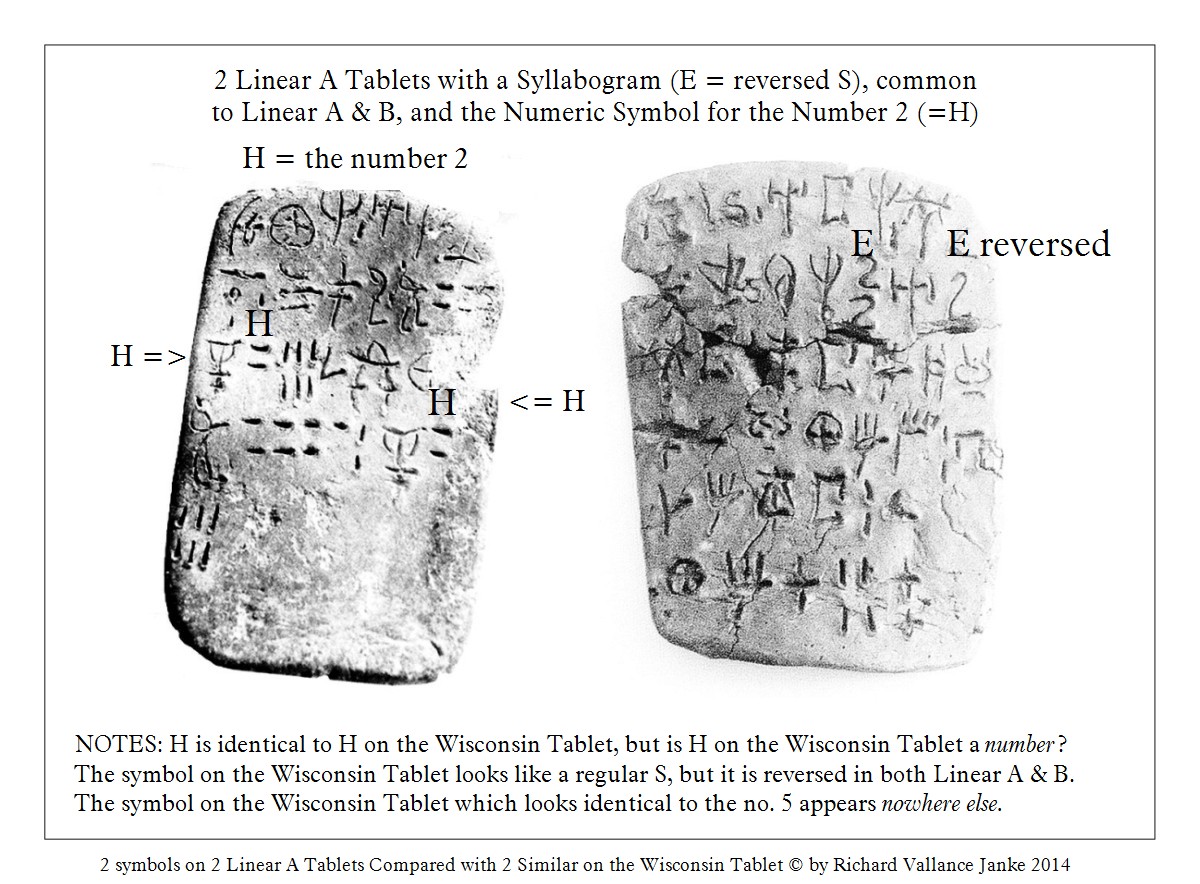
    Here are two Linear A tablets, which shed further light on the issue of the Wisconsin tablet sharing (or not) symbols with Linear A syllabograms (Click to ENLARGE):
    
    Linear A numeric & ss reversed
    
    Refer back to the Wisconsin Tablet above for 2 of the symbols highlighted with the same letters (E & H) on both it and these two Linear A tablets.  
    
    2. On the other hand, if we take the stance that the 3 so-called “Minoan” symbols on the Wisconsin Tablet are not Linear A or B syllabograms or numerics – which is a perfectly reasonable assumption to proceed from – then what on earth are they? Are they even syllabograms or numerics? Or are they any one of the following: pictographs, such as we see in the famous Peterborough Pictographs, unearthed near Peterborough, Ontario, Canada, some time ago, or perhaps hieroglyphics, or yet again logographic, ideogrammatic, syllabogrammatic or even, as far fetched as it may seem (and it is) alphabetic? This stretches my poor imagination and my powers of reason almost beyond bearing.
    
    3. When was the Wisconsin Tablet composed? This is an absolutely critical question, because, failing any knowledge of even the approximate date of its composition, the whole thing remains a complete mystery. There are, of course, two tried-and-tested archaeological approaches to getting closer to resolving this vital question, at least to some extent. First of all, has the Wisconsin Tablet been carbon-dated? If it has not, the mystery remains just that, and nothing more. If it has (which apparently seems not to be the case, but hopefully E.J. Heath can enlighten me on this matter), then the carbon-dating is entirely capable of determining whether or not it falls at least somewhere near or within the historical timeline of both Linear A and Linear BC together, i.e. 1,800 – 1,200 BCE. If the carbon-dating proves this to be the case, then at least our friend has a leg to stand on, however shaky. On the other hand, if the carbon-dating should prove that the Wisconsin tablet pre-dates or post-dates the Minoan/Mycenaean era (ca. 1,900 – 1,200 BCE), then it is, even in the very best scenario, highly unlikely that the Wisconsin Tablet is composed in anything like or near to Linear A or B, and the whole hypothesis falls apart like a house of cards. 
    
    4. Another way of establishing the approximate timeline of the Wisconsin tablet is to submit it to as many as possible eminently qualified North American, as well as European and Mediterranean, archaeologists, and eventually to draw up a team of archaeologist to address this sticky issue head on, by which I mean in conference or in writing and online or better still, all. All this would take considerable time, conceivably close to a decade. 
    
    It goes entirely without saying that both of these approaches to attempting to establish the approximate dating of the Wisconsin tablet are absolutely essential to the process of identifying in any way what it is, and can in no wise be omitted. I leave it to our friend E.J. Heath to get in touch with at least a few archaeologists in the field (pardon the pun!) in the U.S.A, first and foremost at the University of Wisconsin itself, to establish the credentials of the Wisconsin Tablet, as it were.
    
     
    5. On yet another level, I am forcibly struck by the curious absence of any other tablet(s), especially in light of the fact that the Minoan scribes writing in both Minoan Linear A and in Mycenaean Greek in Linear B, were completely obsessed with record-keeping, inventories and statistics. While there is a dearth of Linear A tablets still in existence compared with Linear B tablets, there are still plenty enough of them. We can only assume that those Linear A tablets which have disappeared in the maelstrom of history have done so for various reasons bearing on lack of archaeological findings or evidence, which may nevertheless may be corrected, at least to some degree, by potential findings in the future. But there can be no assurance of this. So if we have a few hundred Linear A tablets at our disposal, why is there only 1 single tablet to be found in Wisconsin, when we know perfectly well that the Linear A and Linear B scribes were concerned with one thing and one thing only, keeping exhaustive records, inventories and statistics on absolutely anything and everything that affected their economy?  This surely begs the question: why has only 1 and one only so-called “Minoan” tablet been unearthed in Wisconsin? If as E.J. Heath claims, this tablet is likely to be just that, Minoan, then surely at least a few, if not a few scores of other tablets, or ideally hundreds just like it, should have been unearthed with it.  Since none have, the question is why – and it is a question that must eventually bear answering in some way or another, sooner or later.  
    
    On the other hand, there are literally 1,000s of Linear B Tablets (close to 6,000 at last count), and we can read them! Even if the 3 so-called Linear A & B look-alikes on the Wisconsin Tablet were in fact either Linear A or Linear B, we would still be stuck in the mud, right where we are. Since Linear A is undeciphered, even if 2 of the symbols on the Wisconsin Tablet are in Linear A (which I highly doubt), they too remain undecipherable (with the possible exception of the so-called number 20. For more in this, see infra).
    
    If on the other hand, these are Linear B symbols, i.e. the 2 syllabograms ZO (B) and NO (C& F), along with the apparent numeric = 20?, the tablet is still undecipherable, because we can make no sense of any of the other symbols on it, and in order to decipher it, we must place the apparent Linear B ZO & NO strictly in context with all of the symbols immediately preceding and following them, if indeed these other symbols are syllabograms (which I highly doubt). Remember what I said above, that the symbols on the Wisconsin tablet must all either be pictographics, hieroglyphics, ideograms or (very unlikely) syllabograms, and almost inconceivably letters, but never an admixture of any one of the above, with the possible sole exception of syllabograms and ideograms, which do in fact co-exist happily in Linear A & B. At least we can admit of that. Yet, even with this single exception at our disposal, we will have practically backed ourselves up against a solid brick wall, given that there is a substantial likelihood of the symbols on the Wisconsin Tablet being either pictographs or hieroglyphics.
    
    6. As for that presumed number 20, even if it is a number, is it the number 20, i.. in the tens, or is it a single digit, i.e. 2?  This is no small matter. In several of the ancient and not so ancient scripts, single digit numbers are either denoted by parallel horizontal lines, in which case the tens are designated by parallel vertical lines (if at all), or vice versa, i.e. single digits are vertical parallels and 10s horizontal. The easiest way to illustrate this is by invoking the numbers 1, 2 & 3 in (ichi, ni & san) in Japanese Kanji, which are the exact reverse of the paradigms for numerics in Linear A & B. Whereas Linear A & B denote single digits with vertical parallel lines and 10s with horizontal, Japanese Kanji resorts to the horizontal for single digits, as seen here:
    
    Kanji ichi ni san
    
    All this still leaves us with one unanswered question, which is very much moot. Are these 2 parallel horizontal lines on the Wisconsin tablet either the number 20 or the number 2, or are they numbers at all? Pending decipherment, we can never really know.
    
    To Summarize:
    
    Given all the issues I have raised with respect to the Wisconsin Tablet, I sincerely doubt that it is composed in Linear A or Linear B, or anything remotely like that. This leaves the tablet not only undecipherable, but for now highly resistant to any attempt at decipherment. On the other hand, its discovery is significant. Writing as such, if indeed this is writing we have here on the Wisconsin Tablet, is almost unheard of in the annals of North American aboriginal tribes. Pictographs, such as the Peterborough Pictographs, occasionally appear, and they do contribute to the continuing search for symbolic evidence of North American aboriginal settlements. What strikes me about this particular tablet is that it does not appear to be composed of simple pictographs, but of something – I cannot imagine what – more sophisticated... hieroglyphics or ideograms or... heavens no what? In this light, I greatly encourage E. J. Heath and any and all researchers or aficionados of ancient scripts to pour their efforts into attempting to figure out the nature of the symbols on this fascinating tablet, if not to decipher it outright.
    
    In the next post, I shall raise even more issues and concerns I have with the Wisconsin tablet, or for that matter with any tablet in any undeciphered language anywhere in the ancient pre-historic world. To do so, I shall have recourse to the 417 symbols of the ancient Harappan script of the Indus Valley civilization, which considerably predates by several centuries – ca. 2,600 to ca. 2,000 BCE -all four of the scripts we have held under consideration here (early Cretan, Linear A, Linear B and the historical Greek script, Arcado-Cypriot Linear C). What we will discover with this script is bound to increase, not decrease, the shock we all to often encounter, however valiantly we struggle to decipher any undeciphered ancient pre-historic script, let alone the Wisconsin Tablet.
    
    That said, the fact that the Wisconsin Tablet remains a baffling mystery warrants more than its fair share of attention (whatever that might be), and so I applaud E. J. Heath for posting it here on our blog, and I invite him to counter each of the issues and objections I have raised here, and more of which I shall raise again in the next post, as he feels inclined.
    
    Richard
    
    
  • HAIKU in Linear B: Spices from the boughs of the terebinth… for whom, I wonder?

    HAIKU in Linear B: Spices from the boughs of the terebinth... Click to ENLARGE
    
    Mycenaean Linear B haiku terebinth tree
    
     Richard
  • Linear B Basic Values & the 13 Supersyllabograms

    Linear B Basic Values & the 13 Supersyllabograms (Click to ENLARGE):
    
    Linear B syllabary basic values with supersyllabograms


    This table is a modified version of the Linear B Basic Values table, with which many of you are already familiar. I have flagged in green font all 13 of the supersyllabograms isolated so far. There may be more, and there probably are. Complementing the supersyllabograms are the meanings, some of them firm, some of them likely to be correct, and others putative (at best).
    
    You should keep this table on hand if you are at all interested in learning supersyllabograms.
    All of the supersyllabograms have been fully illustrated by tablets bearing them in previous posts, so if you are serious about actually mastering sypersyllabograms yourself, you probably should read all of these posts, infra.
    
    Richard
    
    
  • Prof. Thomas G. Palaima Isolates 5 Single Syllabograms as Cities & Settlement Names

    Prof. Thomas G. Palaima Isolates 5 Single Syllabograms as Cities & Settlement Names (Click to ENLARGE):
    
    linear-b-heidelberg-he-fl-1994thomas-g--palaima
    
    When Prof. Thomas G. Palaima translated Heidelburg Tablet HE FL 1994, he hit upon something truly revelatory, namely, that 5 syllabograms in a row, as illustrated in the facsimile of this tablet above, were single syllabograms, which were in actuality the first syllable of the word each represented, and that each of these words was to prove to be the name of a major Minoan/Mycenaean city or settlement. These places, Knossos, Zakros, Palaikastro (or possibly Phaistos), Pulos & Mycenae, all played a key role in Minoan/Mycenaean economy and society.
    
    The real question is, why did the scribe who inscribed this tablet, use abbreviations consisting of the first syllabogram, which is always the first syllable of a Linear B word to represent the entire word?  Was this a phenomenon limited to Heidelburg tablet HE FL 1994, or could it be found on other tablets, and if so, how many... just a few or many? As it turns out, I have discovered this phenomenon occurring on not just a few Linear B tablets, not even a fairly wide cross-section, but — hold your breath — on literally hundreds of tablets. So what is going on here? Why would the Linear B scribes resorted to using single syllabograms on hundreds of tablets over and over again, unless they had very good reason to do so? But that is exactly what they did, and with astounding frequency. It is critical to recognize here that no Linear B scribe alone, let alone so many scribes, would resort to using just one single syllabogram just for the fun of it. That single syllabogram must have meant something, in fact, must have meant a very great deal, and have been a big deal; otherwise, the scribes would not have used them so very often.
    
    The next obvious question is why did they resort to using single syllabograms so often?... & to represent what?  Prof. Palaima’s translation of Heidelburg Tablet HE FL 1994 makes it abundantly clear that what these syllabograms represent is entire words, in the case of this tablet, names of Minoan/Mycenaean cities and settlements. 
    
    But, as it turns out, when I went to investigate several other single syllabograms (8 in all), I discovered to my astonishment that they could and did represent much more than just the names of cities and settlements.  Of the 8 new syllabograms of this type or class, I was able to at least tentatively decipher 6 of them, and I found that none of these represented merely city or settlement names, but something quite different. I recognized a specific word, one word and one word only, in a specific context, in that context and that context alone, for each and every one of the syllabograms I was able to decipher, even if my decipherment was not necessarily “correct”, whatever that is supposed to mean. What was astounding was this: in the specific context which each of these syllabograms appeared in, the word they represented always fits the context like a glove. For instance, the syllabogram for O stands for the word “onaton” = lease field, the syllabogram for KI stands for “kitimena” = plot of land & the syllabogram PE for “periqoro” = enclosure or pen, i.e. a sheep pen, and I emphatically stress, all three of them in the specific context of sheep. In this context and this context alone all three of these translations fit like a glove. For this reason, although my decipherment or translation of each one of these syllabograms (O, KI & PE) may be viewed as tentative by some, I truly believe that they have gone beyond that point, and may in fact be entirely sound, having the very meaning which I have assigned them. 
    
    Now, since single syllabograms such as these are all, without exception, the first syllable by default of the Mycenaean Greek word in Linear B which of which they are the abbreviation, I feel obliged to assign them a name, calling them “supersyllabograms”.  As it now stands, my co-researcher and I have isolated 8 sypersyllabograms, of which we have managed to tentatively decipher 6, in addition to the 5 sypersyllabograms identified by Prof. Thomas G. Palaima, for a total of 13.
    
    Richard
    
    
  • The Supersyllabogram PA… a huge challenge but… (Click to ENLARGE):

    The Supersyllabogram PA... a huge challenge but... (Click to ENLARGE):
    
    d1342 RATOYO PAITO ram
    
    If I thought the other supersyllabograms we have “deciphered” to date (O, DI, KI, PE, ZA & ZE) were a challenge, I had better think again! Before I show you the possible “translations” for this sypersyllabogram (PA) — there are 3 of them — I should first explain my somewhat unorthodox methodology. Faced with the fact that nowhere does there appear the full word which this pesky little sypersyllabogram (PA) can account for on any extant Linear B tablets or in any currently available Linear B Lexicon, I was completely stumped... at first. But then the light came on. I simply had to bite the bullet, and thoroughly scan every single entry in Liddell È& Scott, 1986, beginning with the Greek letters transliterated into Latin as PA, and encompassing no less than 37 pages of this voluminous lexicon (pp. 511-538), in the desperate hope that something, anything, might miraculously pop up and rescue me from my conundrum. And a few, a very few, words did. These are all to be found on the illustration of this tablet above.
    
    Although all of these alternatives make at least some sense in the specific context of sheep (rams and ewes), I eventually had to narrow down my choices from 6 (actually 5) to 3. This is how I did it. The putative translation “furnishing, supplying” is, after all, a bit of a stretch in the context of sheep, unless of course someone has supplied all of the sheep listed on this tablet (i.e. 300 of them all told), not just 3 of them. That doesn’t really make much sense. It is either all of them or none of them supplied, at least as far as I am concerned. The translation “by the sea” must also fall by the wayside, for the same reason. Why would 3 rams be by the sea, and the other 297 not?
    
    That leaves: [1] rams who have wandered off, wandered back, and are thus safely recovered, combining the first two meanings in the list below the tablet (see above) into one, since in effect they do constitute one meaning, amounting one and the same thing: if the 3 rams have wandered off and wandered back, then they are safely recovered. [2] then we have 3 rams enclosed by a fence, which makes an awful lot of sense in the context of sheep, especially when we recall the supersyllabogram PE, PERIQORO, which means virtually the same thing, (in) an enclosure or a pen or sheep pen. This is the most tenable translation, as it almost perfectly matches the translation we easily found for all the tablets using the supersyllabogram PE (and there are plenty of them). [3] off a trodden or beaten way or beaten path. This translation matches up well with [1], and is therefore admissible. In fact the tablet could feasibly be saying that these 3 little rams had wandered off on a trodden or beaten path, and wandered back safe & sound. Makes perfect sense in the context. However, given a choice, I prefer [2], for the simple reason that it matches the 2 syllabograms PA & PE into a unified field (pardon the pun!).
    
    We should also be sure to take note that on all of the Linear tablets using this syllabogram PA,s the number of sheep (all rams) it refers to is always very small (no more than 10), usually out of 100s, which makes the preceding translations all the more tenable.
    
    However, in spite of the apparent cleverness of all three of these translations, all of which nicely fit the bill, a strong word of caution. Caveat: since there exists no word in the extant Linear B lexicon, whether from the extant tablets themselves, or in the two major lexicons currently available online, this opens my interpretations or so-called “translations” to (serious) doubt. I can perfectly understand that a considerable number of researchers in the field of Linear B will protest my choices (some somewhat loudly). This is perfectly reasonable. On the other hand, I would have been remiss, had I not made a valiant attempt to come up with any kind of feasible translation(s) in the context of sheep. But I did this, because that is my way. Better venture into unknown territory, and possibly be right (on 1 of 3 counts, but which one is anybody’s guess). After all, someone can and, I believe, should take this risk, and that someone is me. 
    
    On the other hand, we should take into account that the discovery of new Linear B tablets in the future may just possibly supply a word or two to fill the gap and truly account for our little faux PAs, in a funny sort of way. Folks will surely object, the chances of that ever happening are pretty slim, if you ask me. And again, they would be right. But nothing ventured, nothing gained, I always say.
    
    Anyway, of these 3 translations, the one referring to our 3 little rams being fenced in has a remarkable ring of plausibility to it, especially in light of the much sounder translation of the sypersyllabogram PE, infra:
    
    https://linearalinearblinearc.ca/2014/08/03/a-major-milestone-in-the-further-decipherment-of-linear-b-the-supersyllabogram-defined/
    
    Richard


  • ISS Panels, Telegraph Poles, Pot, Table, Poodles & Teepee: More Fun Learning Syllabograms in Linear B

    ISS Panels, Telegraph Poles, Pot, Table, Poodles & Teepee: More Fun Learning Syllabograms in Linear B
    
    Want to have fun learning syllabograms in Linear B?  It’s easy with mnemonics (memory cues). Take for instance these little teasers Click to ENLARGE:
    
    fun learning syllabograms in Linear B
    
    Enjoy!
    
    Richard


  • Introducing the Supersyllabogram O (ONATO) lease field

    Introducing the Supersyllabogram O (ONATO) lease field (Click to ENLARGE):
    
    163 447 K j TA person DAMINISO ram
    
    We have now come to our sixth supersyllabogram, O. Again, I hear you protesting, “Aren’t you being quite arbitrary assigning this value (this word) to the supersyllabogram O?” And again, my answer has to be, “Not really, not at all”. Once again, by the simple process of elimination of absurdities and irrelevant words having nothing to do with agriculture, let alone, rams (or sheep), we are able to narrow down our choices for the actual meaning of this syllabogram to the following:
    
    1 According to the Mycenaean Linear B – ENGLISH Glossary, only the following words are potentially sound candidates for the Mycenaean Greek word the supersyllabogram O is meant to convey. These are, onato (lease field), opiara2 (coastal), oriko (few), oudidosi (not giving), ouqe (neither) and ouruto (guard). However, from all of these choices, ONATO alone appears to be best fit in the specific context of sheep (rams & ewes), especially in light of the fact that we already know that the supersyllabograms KI means KITIMENA, plot of land, and PE means PERIQORO = enclosure or pen (i.e. sheep pen). Given those interpretations, ONATO, lease field, fits like a glove.
    
    2 Turning to Chris Tselentis’s much more substantial linear B Lexicon, we find, in addition to the words already mentioned above, and excluding the numerous names of places and persons, the following: onatere (leasees), ono (payment), opero (debt, liability), orei (mountain) and ouwoze (not working). Here again, most of these words make some sense in the context of sheep, but still the best best by far is ONATO (lease field), and this is precisely why I have assigned this value to the sypersyllabogram O, given (a) the specific context of sheep & (b) our previously defined sypersyllabograms KI = KITIMENA or plot of land & PE = PERIQORO or enclosure or pen. I should also point out in passing that variations on the actually acceptable word a supersyllabogram stands in for are also possible, provided that they are directly derived from the accepted word (root). Thus, in this case, the word onatere (leasees) is probably also valid as an alternative to onato (lease land).
    
    Not only that, you are about to discover, in the next post, that these sypersyllabograms are often combined to produce an even more specific meaning to the context. We have already seen this anyway with the combination of NE = newa (new) & KI = kitimena (plot of land). In that instance, the two sypersyllabograms work in tandem to give us the very precise phrase, “a new plot of land.”   
    
    Richard
    
  • Introducing the Supersyllabograms KI (KITIMENA, plot of land) & NE (NEWA, new)

    Introducing the Supersyllabograms KI (KITIMENA, plot of land) & NE (NEWA, new):
    
    I have assigned the values KITIMENA (plot of land) to the sypersyllabogram KI and NEWA (new) to the sypersyllabogram NE.  I can hear you protesting, “How can you get away with that?  You are just guessing.”  Not really, not at all.  Due to the paucity of the extant Mycenaean Greek vocabulary, or if you will, lexicon, it was actually quite easy to come to this conclusion by the simple process of elimination.
    
    Consulting both The Mycenaean Linear B – ENGLISH Glossary and the much more comprehensive Linear B Lexicon by Chris Tselentis, and putting all the words I found under KI and PE in the specific context of sheep, I was quickly able to determine which words to automatically eliminate, since they did not make any sense whatsoever in this particular context. As if turns out, it was to prove to be almost all of the Mycenaean Greek words beginning with KI and PE in Linear B.
    
    As for Ki, the only viable candidates remaining after winnowing out the obviously ridiculous or non relevant words are: kitita (barley), kitano (terebinth tree), kitiyesi (they cultivate) & finally, kitimena (plot of land). Under NE, in both of these sources, all I could find was a single word, newa (new), all the other words under NE being nothing but personal names. So that narrows our choices down potentially to only 1 adjective and 1 of 3 nouns and 1 verb. However, our choices are even more circumscribed by the fact that “newa” is feminine, meaning that we must eliminate kitano and kitiyesi. That leaves only newa “newa kitita”, new barley and “newa kitimena”, new plot of land. Now I have rarely ever heard of anyone talking of “new barley” as such... fresh barley, harvested barley etc., yes, but not new barley. Besides, in the specific context of sheep, the only remaining word that makes sound sense with the feminine adjective “newa” is the feminine noun “kitimena”, giving us the completely transparent phrase “newa kitimena”, a new plot land. If anything makes perfect sense in the context of sheep, it has to be this. So be it.
    
    Thus, as far as I am concerned, the supersyllabograms KI and NE almost certainly mean “new” and “plot of land” respectively, Given these values, this translation of the tablet makes perfect sense. Click to ENLARGE:
    
    Knossos Tablet 1240 F k 01
     This brings the number of supersyllabograms we have so far defined to 5: DI, KI, NE, PE & ZE.  Richard 
  • A Major Milestone in the Further Decipherment of Linear B – the Supersyllabogram Defined

    A Major Milestone in the Further Decipherment of Linear B – the Supersyllabogram Defined
    
    In this post, I shall first illustrate the use of the supersyllabogram PE with 4 Linear B tablets from Knossos in Scripta Minoa, and then provide a basic definition of the supersyllabogram.
    
    The first of these tablets, KN 1232 E d 462, Rams & Ewes in their Sheep Pens, spells out the word PERIQORO peri/boloj an enclosure or pen (nominative) and peri/boloio archaic Greek genitive, “of or from an enclosure or pen”. So on this tablet, there is no problem. We know that we are dealing with enclosures or pens for rams and ewes, i.e. sheep pens, because that is what the word means. Click to ENLARGE this tablet:
    
    Knossos Tablet 1232 E
    
    However, in the next three tablets, the story is different. Instead of spelling out PERIQORO (nominative) or PERIQOROYO (genitive) in full, the scribe replaces this word with its first syllable only, PE. But the meaning is clear, since all 4 of these tablets appear very closely together in the 1200 E series, with 2 more in the 1300 E series, and since all 11 of these tablets, of which one, KN 1232 E d 462, spells out PERIQOROYO in full, and the other 10 substitute the sypersyllabogram PE, all are formatted identically, with the sypersyllabogram PE on the second line only, not on the first. This implies that only the rams & ewes on the second line are in their sheep pens, while those in the first are not. In other words, the rams and ewes in the first line are free range, as clearly shown by all 3 of the tablets here substituting PE for PERIQORO(Y0). Note also that it is impossible to tell what case PERIOQORO is in on these 3 tablets (or for that matter on the other 7 not posted here), since the first syllable alone of that word gives no hint of the declension.
    
    Click to ENLARGE each of these tablets in turn:
    
    Knossos Tablet 1228 E
    
    Knossos Tablet 1248 E
    
    Knossos Tablet 1285 E
    
    The question is, what on earth is a sypersyllabogram? Our examples make this clear enough. A supersyllabogram is the first syllable only of a specific Mycenaean Greek word in Linear B, standing in for that word and that word only, to the exclusion of all other extant Mycenaean Greek words in Linear B on any tablets, regardless of provenance, or in any Mycenaean Greek – English lexicon. With very few exceptions, supersyllabograms appear immediately before or after a Linear B ideogram, modifying its meaning by narrowing it down to a specific context, one context only and no other. In the case of the supersyllabogram PE, the meaning is clear. PE modifies the ideograms for either ram or ewe (or both) to designate specifically the enclosure or pen in which they are kept, i.e. a sheep pen, and nothing else. This is the beauty and the power of sypersyllabograms. They operate something like our abbreviations today, but not quite the same way, as abbreviations rarely are expressed by the first syllable only of a word. One thing you can bet on is this: the supersyllabogram is always the first syllable of the unique word for which it stands. 
    
    Supersyllabograms are far more common in Linear B than we could have ever imagined. I discovered this, to my amazement, as I went ploughing through some 3,000 Linear B tablets from Knossos in Scripta Minoa. At least 1,000 of them use sypersyllabograms, and what is more, several syllabograms qualify as supersyllabograms.  Among these we count these 12 syllabograms U, KO, MA, MU, NE, PA, PE, PU, TE, WE, ZA and ZE, all of which operate as sypersyllabograms in several tablets. And this list is not complete. In other words, not only are supersyllabograms very common, they constitute another kind of shorthand to which Linear B so often has recourse to (as with logograms and ideograms). In fact, we may safely say, at this point in time, that the Linear B syllabary incorporates to a significant extant the characteristics of a shorthand.
    
    Richard
    
    
  • Knossos Tablet KN 1233 E n 244, Rams & Ewes in their Sheep Pens. Boy oh boy, the beans are spilled!

    Knossos Tablet KN 1233 E n 244, Rams & Ewes in their Sheep Pens. Boy oh boy, the beans are spilled! Click to ENLARGE):
    
    Translation of Knossos Tablet KN 1233 E n 244
    
    If you thought the previous post was a winner, as the old saying goes, “You ain’t seen nothing yet.” With this tablet, we run right smack up with the phenonemon of the sypersyllabogram, in this instance in the guise of the syllabogram PE, which in this tablet, KN 1233 E n 244, stands in as the first syllable of the word, PERIQORO(YO), spelled out in full on the tablet in the previous post, KN 1232 E d 462, Rams & Ewes in their Sheep Pens, where we learned that PERIQORO is the Mycenaean equivalent of the Greek word,peri/boloj, an enclosure, or in this context (as for all tablets in the KN 1200 E series) a pen or sheep pen. When a single syllabogram, as in this case PE, is actually the first syllable of an entire Mycenaean Greek word in Linear B, and is used all on its own to represent or stand in for that entire word, I call this a supersyllabogram. A supersyllabogram, as we shall see in the next post, in which the term is defined in full, operates much like an abbreviation, except that unlike an abbreviation, it per se always the first syllable of one and only one Mycenaean Greek word, to the exclusion of all other words or vocabulary. I stress. A supersyllabogram can stand in for one and only one Mycenaean Greek word, and no other. If it were to replace any old word beginning with itself as the first syllable, in this case, PE, it would not and could not be a sypersyllabogram, and in fact would be meaningless gibberish.
    
    All of this begs the question, why are those so many, and I mean 100s of instances, of single syllabograms plastered all over 100s of tablets, unless they mean something and something quite specific? Yet I have just clearly demonstrated that this very Knossos Tablet, KN 1233 E n 244, in fact uses the sypersyllabogram PE all on its own to stand in for PERIQORO(YO), which our obliging scribe spelled out in full in Knossos Tablet KN 1232 E d 462. Although this is the sole instance among some 3,000 Linear B tablets I have scanned from Scripta Minoa, in which the scribe was kind enough to spell out the word the sypersyllabogram represents, at least on one tablet, by so doing, he gave the whole show away.
    
    This circumstantial evidence is very strong, for the following reasons:
    
    1. All 9 of the tablets in the PE 1200 E series & 2 in the 1300 E series all deal specifically with numbers of rams & ewes;
    2. Of these 11 tablets, 10 use the sypersyllabogram PE, and always in the same position on the tablet. The 11th. Tablet, KN 1232 E d 462, spells the word out in full,  PERIQOROYO (archaic genitive). The word may be PERIQORO(nominative) in some of the other tablets, since they all use the supersyllabogram PE, which cannot indicate case.
    3. All 11 of these tablets, even in the 1300 E series, are by same scribe’s hand, and his writing is neat and clear, so there can be no doubt of the text.
    
    It is for this reason that I now feel confident to announce that Linear B frequently resorts to sypersyllabograms to stand for, fill in or represent an entire specific Linear B word, that word and no other. In other words, sypersyllabograms constitute yet again another example of the shorthand to which Linear B so frequently resorts.
    
    As we shall see over the next year or so, not only can the syllabogram PE be a sypersyllabogram, but many others as well. For instance, I am already aware of PA, TA, TE and ZE operating as sypersyllabograms, and there are plenty of other examples I have noticed on the 3,000 or so Knossos tablets I have closely examined.
    
    Richard
    
    
  • Knossos Tablet KN 1232 E d 462, Rams & Ewes in their Sheep Pens & Some Sheep in a Field. The Code is Broken!

    Knossos Tablet KN 1232 E d 462, Rams & Ewes in their Sheep Pens & Some Sheep in a Field. The Code is Broken! (Click to ENLARGE):
    
    Translation of Knossos Tablet 1232 E d 462 sheep pens
    
    This is without a shadow of a doubt by far the most significant tablet we have posted to date in this blog, with the sole exception of the tablet in the next post which is, believe it or not, even more significant than this one, in fact ground-breaking. It was by sheer luck that I came upon this highly revealing tablet, revealing because it literally hands us the KEY to the supersyllabogram PE, which we will address head on in the next post. Were it not for this tablet, Knossos Tablet KN 1232 E d 462, it would have been impossible to decipher the sypersyllabogram PE which occurs in exactly the same context (with rams & ewes) in every other tablet without exception in the KN 1200 E series. This is no accident. Thank heavens the scribe who inscribed this tablet decided to spell out the word beginning with PE, PERIQOROYO, which just happens to be the archaic genitive of the Mycenaean Greek word for “enclosure or pen” (surprise, surprise!... for sheep and rams). What this means is simply this: this single tablet, KN 1232 E d 462, has provided us with incontrovertible circumstantial evidence of the precise meaning of the sypersyllabogram PE, namely, PERIQORO, sheep pen.
    
    Since all the other tablets in the KN 1200 E series replace the word PERIQO(RO) with simply the syllabogram PE all alone, and nothing else, we can safely assume that in the practically identical context which all the other tablets present, the single syllabogram PE has to be the first syllable of precisely this same word, PERIQORO (nominative or accusative) or PERIQOROYO (genitive). Accordingly, the syllabogram PE in all the other tablets in the KN 1200 E series almost certainly is the first syllable of the very same word, PERIQORO.
    
    The next few posts will reinforce this circumstantial evidence almost beyond a doubt.
    
    And with that, we shall have proven, circumstantially at least, not only the existence of sypersyllabograms, but precisely what they are. 
    
    The definitive definition of the Supersyllabogram is to be provided in the next post.
    
    Sheep in a field in Crete (Click to ENLARGE):
    
    flock of sheep in Crete
    
    Richard
    
    
  • Linear B Fragment Knossos KN 1484 X a 131 SAMARA from SAMA = Grave Circle or Burial Circle

    Linear B Fragment Knossos KN 1484 X a 131 SAMARA from SAMA = Grave Circle or Burial Circle (Click to ENLARGE):
    
    Linear B Fragment Knossos KN 1484 X SAMAra
    
    The NOTES in the illustration of KN 1484 X a 131 provide ample explanation of the most likely meaning of this fragment. However, some clarification is in order. By consulting both the Mycenaean (Linear B) – ENGLISH Glossary and Chris Tselentis’ much longer Linear B Lexicon (ca. 150 pp.) I was able to narrow down the most likely meaning of this fragment by the simple process of elimination. Since neither lexicon gave any other Linear B words beginning with the syllabograms SAMA. Thus, the only possible rendering of this fragment is either, simply SAMA, or the word which both of these Lexicons give, i.e. SAMARA, which is a place name only. Now, since these are the only two major Linear B lexicons currently available online, and they both attempt to account for all possible extant Linear B words on extant tablets and fragments, there can be no other extant word(s) other than these two, at least until such time, if ever it comes, as new Linear B fragments are unearthed, beginning with the syllabograms SAMA, but longer than 2 syllables, and with an entirely different meaning. But as of the present, no such words exist in Linear B.  
    
    Thus, SAMA almost certainly means what Liddell & Scott. 1986, pg. 633, say it means, namely: a sign, mark, token, portent; mound, burial mound; device on a shield etc. Consult Liddell & Scott.
    
    Now, in the context of Mycenaean Greek, I think we can safely narrow down the meaning to either a device on a shield or a burial mound. Since there are very few abstract words in Mycenaean Greek, the other meanings given in Liddell & Scott are pretty much precluded. But Liddell & Scott neither does nor can account for Mycenaean Greek, in which other possible meanings may arise. The other candidate in Mycenaean Greek for SAMA is in fact a “burial circle”, as there is an enormous burial circle right inside the fortress of Mycenae. So in Mycenaean Greek, both of these meanings are tenable: burial mound & burial circle, but the latter carries more weight. Now, since there is a large burial circle right inside Mycenae, then SAMARA almost certainly means the place of the burial circle, i.e. precisely where it is located in the fortress of Mycenae or in any other Myceanean fortress or sites.
    
    
    Mycenaean Burial Circle (Click to ENLARGE): 
    
    Mycenaean grave circle
    
     Richard
    
  • Translation of Knossos Tablet KN 601 A g 02, “Even more for people to admire in Amnisos… ”

    Translation of Knossos Tablet KN 601 A g 02, “Even more for people to admire in Amnisos... ” (Click to ENLARGE):
    
    First of all, it is vital that you read the Notes to the previous post, Knossos Tablet KN 600 A g 01, which is for all intents and purposes almost identical to this tablet; otherwise the grammatical constructs of this tablet will make little sense. A few explanatory notes on the grammatical constructs in both of these tablets, except for “AMINISOYO”, which occurs on this tablet only.
    
    [1] The comment on AMORAMA appears in the previous post. 
    [2] As per the notes in tablet KN 600 A g 01, the verb, ESOTO, in Linear B, is the neuter impersonal form of the Greek verb, “to look at, admire”, and so on this tablet the Linear B word, TOSO, must also be neuter. I cannot over-emphasize this.
    [3] Since the impersonal verb, ESOTO, contains the prefix “ES” = ancient Greek “eis”, the notion of “in or into” is clearly implied. Hence, the presence of the preposition EPA, which is merely an archaic form of “epi”. Greek verbs prefixed with “es” or “eis” often take the preposition “epa” or “epi”.
    [4] The presence of the Linear B, AMINISOYO = Greek archaic genitive, “Amnisoio”, throws a wrench into this translation, as “epa” cannot possibly be modified by the genitive, only the dative. So the question arises, WHAT is modified by “epa”. If we assume that the end of this tablet is truncated, it is quite possible, even likely that the phrase “in the port” follows and if so, it can easily be modified by the genitive, “in the port of Knossos”. But all this is speculative.
    
    Richard
    
    
  • Translation of Knossos Tablet KN 600 A g 01, “There is so much for people to admire… ”

    Translation of Knossos Tablet KN 600 A g 01, “There is so much for people to admire... ” (Click to ENLARGE):
    
    TRANS 600 A TOSO EPA ESOPA A 1024 450
    
    At first, I found this tablet a little tricky to translate, as it contains the word, “epa”, which I could not recognize off the top of my head. However, it came to me like a flash that “epa” is merely an archaic form of “epi”, as is readily confirmed when we consult Liddell & Scott, 1986, pp. 288-243,  where the meanings of the vast majority of the verbs with this prefix, “epa”, terminate with either, “in, on or over.” This is strong confirmation of the existence of an earlier, archaic form of “epi”, namely “epa”. Consequently, whenever the preposition “epa” occurs in any Linear B tablet, it has to mean “in, on or over” and variations thereof. 
    
    The translation of “amorama”, according to Chris Tselentis, in his lengthy Lexicon, is doubtful, but it does make sound sense in the context of this tablet.
    
    Finally, I have to say that I find both this tablet, KN 600 A g 01 and the next one in the next post, very unusual, to say the least, because neither of them speaks of that obsession of Linear B scribes, statistics and lists. Instead, these two tablets appear to be so informal as to almost defy logic. While tablet KN 600 Ag 01 does not specifically mention Amnisos, KN 601 Ag 02 does. So I think we can safely say that both of these tablets refer to Amnisos, as they are otherwise practically identical on all respects.
    
    What they seem to be saying is that it is a lot of fun for folks to wander around Amnisos, the lovely port of Knossos, and that there is even a possibility the tablet is referring to foreign visitors, in other words, as we would call at least some of them, “tourists”. But that is a bit of stretch, as the very notion of a tourist seems alien to the cultures of the ancient world, especially of Greece, where such visitors from abroad where always called “strangers” or “foreigners”. Of course, the tablet probably also (and even predominantly) is referring to the inhabitants and citizens of Knossos, some of whom dropped by every single day to admire its beauty. On this tablet, we have 25 visitors, and on the next, KN 601 A g 02, we have 9.
    
    Richard
    
    
  • POST 300! A Sampling of Linear B Fragments on Amnisos, the Harbour of Knossos, in Scripta Minoa

    POST 300! A Sampling of Linear B Fragments on Amnisos, the Harbour of Knossos, in Scripta Minoa (Click to ENLARGE):
    
    AMINISO 10 samples from Scripta Minoa
    
    In this set of Linear B fragments from Scripta Minoa, we feature even more fragments on Amnisos, the harbour of Knossos. Like fragments and sometimes whole tablets dealing with Knossos, there are scores dealing with Amnisos, and sometimes the same fragment or tablet deals with both Amnisos and Knossos, which should come as no surprise, considering the extreme importance of these two locales to the thriving Minoan economy. One fragment in particular, KN 410 X (top right) is of particular significance, because it reveals more about the Minoan economy than might be assumed at first sight. This fragment states, “to Amnisos”. The only question is, from where?  There can only be 2 possibilities, either (a) from Knossos itself or (b) from overseas, since Amnisos was the international trading port of Knossos. If this distinction sounds a bit academic, I would put it to you that it is not, because either meaning fits the bill supremely. And in any case, the missing portions of some fragments would have said, “from Knossos”, while others would have said “from overseas/from Mycenae/from Egypt” etc. I think we can probably take that much for granted. To summarize, what I am getting at here is simply this, that the Linear B fragments can often reveal something valuable, i.e. at least some information about their context, even where that context is missing. In those instances, such as in this case, where this is not entirely a matter of conjecture, we may find ourselves learning something new about the Minoan/Mycenaean society and economy, however sparse that new information may be.
    
    Richard


  • A Sampling of Linear B Fragments mentioning Knossos & its Harbour, Amnisos in Scripta Minoa

    A Sampling of Linear B Fragments mentioning Knossos & its Harbour, Amnisos in Scripta Minoa (Click to ENLARGE):
    
    KONOSO X 6
    
    This is only a small sampling of the scores of fragments and tablets in the Scripta Minoa mentioning Knossos and its harbour, Amnisos. In the next post, we will feature even more fragments mentioning Amnisos. It is critical to understand the prime importance of both Knossos & Amnisos together in tandem, just as one would picture the Pireaus with Athens and the port of Ostia with Rome.
    
    One of these fragments also mentions the island of Lykinthos. I am providing a map here to pinpoint the precise location of each locale (Click to ENLARGE):
    
    Lykinthos LEFT and Minoan Crete Knossos & Amnisos RIGHT
    
    Richard 


Sappho, spelled (in the dialect spoken by the poet) Psappho, (born c. 610, Lesbos, Greece — died c. 570 BCE). A lyric poet greatly admired in all ages for the beauty of her writing style.

Her language contains elements from Aeolic vernacular and poetic tradition, with traces of epic vocabulary familiar to readers of Homer. She has the ability to judge critically her own ecstasies and grief, and her emotions lose nothing of their force by being recollected in tranquillity.

Marble statue of Sappho on side profile.

Designed with WordPress