Tag: Ancient Greek

  • Scripta Minoa: So-called Easy Fragments # 2: Knossos, Amnisos & Potnia. General Criteria for Interpretation of Fragments


    Scripta Minoa: So-called Easy Fragments # 2: Knossos, Amnisos & Potnia (Click to ENLARGE:)
    
    ALL 5
    
    To summarize the criteria we laid out in detail in the previous post, in general terms, the following conditions pertain to all fragments (not tablets!) regardless:
    
    1. There is no context by which to establish what sense or meaning the word or words (usually no more than 5 or 6 at most) actually are meant to convey.
    2. Almost all fragments are truncated on the left or right, making it practically (though not utterly) impossible to interpret whatever the cropped text is supposed to mean.
    3. But things are not quite so hopeless as it would at first sight appear. If the occurrences of all extant words beginning with a particular syllabogram in every Linear B dictionary now available online are relatively few, then we can predict that our translation has a 1 in nn chance, sometimes even as low as 1 in 10 or 10% of actually being the right translation.  
    4.Even where right hand truncation is the order of the day, sometimes there is only one interpretation. But here again, ambiguity of context frustrates once again. What on earth does the fragment in question tell us about (usually one single) word? In almost all instances, precisely nothing. 
    5. Ambiguities in grammatical construction further complicate matters.
    6. Scribes often (half) ERASE one or more syllabograms on fragments, almost always on the right side. This usuallly happens when a scribe simply erases the last (extraneous) character, which he never meant to write in the first place. On the other hand, he may be hesitating whether or not he should erase it, as will be illustrated in he next 2 posts.
    
    Our second example of 5 fragments: Scripta Minoa: So-called Easy Fragments # 2: Knossos, Amnisos & Potnia speak for themselves, or more accurately do not speak for themselves. I invite you to try and interpret each of the 5 fragments on your own. I am quite sure you will come up for air pretty quickly, feeling (somewhat or annoyingly) frustrated. For instance, who the blazes is Potnia? Look her up in almost any classical Greek-English dictionary and you are likely bound to hit a brick wall. Fortunately, our excellent companion, Liddell & Scott, comes to the rescue yet again (pg. 581), which is why any serious Linear B researcher should have this invaluable resource in his or her collection. I am not going to tell you who she is. I believe it is up to you to do your own research on this one, even if you have to go to the library.
    
    Things are going to get a lot messier from here on in!
    
    
    Richard
    
    
  • Scripta Minoa: So-called Easy Fragments # 1: Knossos & Amnisos. Do not be fooled!

    Scripta Minoa: So-called Easy Fragments # 1: Knossos & Amnisos (Click to ENLARGE:)
    
    ALL 4
    
    We now begin our long series of posts of some 2,000 of the approximately 3,500 tablets and fragments from Knossos, which Sir Arthur Evans published in his Scripta Minoa (Oxford University Press, 1952). The first 4 fragments you see here already amply illustrate some of the (sometimes intractable) problems faced by translators, especially when we have to deal with fragments. In general terms, the following conditions pertain to all fragments (not tablets!) regardless:
    
    1. There is no context by which to establish what sense or meaning the word or words (usually no more than 5 or 6 at most) actually are meant to convey. The last of the 4 in this table amply illustrates this problem. First of all, does the word “enereya” mean “operation or better still, industry”... possibly, even probably (by a stretch), but also probably not. And plenty of translators will contest my “translation”.
    2. Almost all fragments are truncated on the left or right, making it practically (though not utterly) impossible to interpret whatever the cropped text is supposed to mean. This is fully illustrated by the second fragment in this table.
    3. But things are not quite so hopeless as it would at first sight appear. If the occurrences of all extant words beginning with a particular syllabogram (in this case TE) in every Linear B dictionary now available online are relatively few, then we can predict that our translation, here = temenos (boundary) has a 1 in nn chance of actually being the right translation. Allow me to illustrate. In the two largest Mycenaean Linear B – English dictionaries now available online (the larger one in PDF format and over 260 pages long!), there are 6+17 = 23 instances of all extant words beginning the single syllabogram TE as the first syllable.  So let’s assume the ratio is 1/25 or about 4%. But wait. But only a very few of these words make any sense in fragment #2, and as it happens that number adds up to only: te = then, tekotones = carpenters, temeno = boundary or temple,teo(i) = god(s), temidweta = wheel with studs, tereta = official title of a tax collector or master of ceremonies, tetukuoa = well prepared or ready, teukepi = with implements, thereby reducing our chances of being “correct” to 1 in 7 according to this vocabulary. But let’s err on the side of caution, and say, 1 in 10, or 10 %, and that is a heck of a lot better than our initial calculation. Of course, I for one are more than willing to substitute any of the other 6 words above for “temenos”, because they all make sense in this admittedly very limited context, if you can even call it that. But, in fact, the collateral evidence I have just laid out makes it even probable that any of these 7 (or slightly more) interpretations fits the bill.
    
    But in the second example in this table the meaning is clear. It can only be Aminiso or Aminisoyo (genitive) or some such variant. So even where right hand truncation is the order of the day, sometimes there is only one interpretation. But here again, ambiguity of context frustrates once again. What on earth does this fragment tell us about Amnisos... Precisely nothing.
    
    5. Ambiguities in grammatical construction further complicate matters, as in fragment 1. Why is Konosoyo in the genitive and Rukitiyo (apparently) nominative? Why are these two places mentioned together? What is the association or link between them? We shall never know. Richard
  • The Homophone HA, used less often than AI, but equally significant… if not more so!

    The Homophone HA, used less often than AI, but equally significant: Click to ENLARGE:
    
    
    HA homophone series Linear B 
    
    
    This makes for entertaining reading, though possibly somewhat perplexing to some.
     
    Let no-one be under any illusion that the Linear B homophone HA is any less significant than AI, regardless of the fact that it appears less often in Linear B texts on extant tablets. The homophone HA is not a diphthong! This homophone (HA) takes an enormous leap forward, specifically and exclusively in the Linear B syllabary, by explicitly expressing initial or even internal aspirated A’s. This incredible achievement eclipsed even the ancient Greek alphabet, which, need I remind you, was always written in CAPS (uppercase) alone, and hence, was utterly incapable of expressing any aspirated, let alone, unaspîrated vowels.
    
    "What” I hear you indignantly explain, "Of course, they had aspirated and unaspirated vowels.” Yes, they did. But they never expressed them. Search any ancient alphabetical text in any dialect whatsoever for aspirated or unaspirated vowels, and you search in vain. Search Linear B, and voilà, staring us squarely in the face, is the aspirated A. Astonishing? Perhaps... perhaps not. But what this tells us unequivocally is that the ancient Greeks, even after the appearance of the alphabet, must have pronounced aspirated and unaspirated vowels, because in Mycenaean Greek, the aspirated A is squarely in the syllabary.
    "But”, I hear you exclaim again, "If those Mycenaeans were so smart, why didn’t they also have a homophone for the aspirated E, which pops up all over the place in Medieval manuscripts in Classical Greek?”  The answer is that Mycenaean Greek almost certainly had no use for the aspirated E, since all classical Greek words beginning with an aspirated E invariably begin with an aspirated A in Mycenaean Greek, as for instance, Mycenaean "hateros” versus classical Greek "heteros” (well, in most dialects, if not all). In other words, Mycenaean Greek grammar has no homophone for aspirated E, simply because they never used it, nor were they even aware of its existence. 
    
    Still, the fact remains that, at least where the aspirated A is concerned, Linear B was one step ahead of ancient alphabetical Greek. Both aspirated and unaspirated initial consonants were a feature introduced into written classical Greek alphabet only in the Middle Ages, when monks & other scribes began making extensive use of lower case letters. And, sure enough, along with the aspiration and non-aspiration of initial vowels (most often A, E & U), they also introduced all those other crazy accents we all must now memorize: the acute, grave, circumflex and susbscripted iota, just to make reading ancient Greek wretchedly more complicated. Don’t you wish they had left well enough alone? I often do. But this was not to be, since from the Middle Ages, and especially from the Renaissance on, almost all Occidental languages (Greek & French being two of the worst offenders) used accents liberally. Apparently only the Romans never bothered with accents ... but even here we cannot be sure, as they too wrote only in CAPS (uppercase).  Even English, which is the Western language most adverse to accents, always uses them in borrowed words from French, Italian, Spanish etc.  So you just can’t win.
        
    Once again, amongst the ancient languages, at least as far as I know, Linear B alone was able to explicitly express the initial aspirated A, just as Linear B had the common sense to separate every word on the tablets from the next with a vertical line (|). After that, "something got lost in translation” (so to speak), and for at least 2 millennia, when all of a sudden everyone in the whole world went bonkers for accents.
    
    Such are the vagaries of linguistics.
    
    
    Richard
    
    
  • Table 3A: Examples of Linear B Spelling Conventions Cross-Correlated with (early) Ancient Alphabetical Greek


    Table 3A: Examples of Linear B Spelling Conventions Cross-Correlated with (early) Ancient Alphabetical Greek – Click to ENLARGE:
    
    Table 3 Examples of spelling conventions in Linear B versus Greek
    
    While most Linear B grammatical, didactic, instructional & research sites propound generally complex “rules” or regulatory tables for the transference of Linear B orthography (through no fault of their own), which is based almost exclusively on syllabograms, each consisting of a consonant + a vowel (with the sole exception of the vowels, which actually do correspond with their Greek alphabetical counterparts, but again with the exception of Linear B E & O, which cannot express short versus long E & O in alphabetical Greek, i.e. epsilon vs. aytay and omicron vs. omega), to my mind, it is simply not necessary to memorize all sorts of often perplexing arcane guidelines, when all we really need to do is illustrate how the single syllabograms in Linear B cross-correlate with their (frequently) multiple variants in early alphabetical Greek (by which I mean, first and foremost, the Homeric Greek in The Catalogue of Ships in Book II of the Iliad; failing that, the Homeric Greek in Book II of the Iliad; failing that the Homeric Greek of the Iliad in toto; and failing that Arcado-Cypriot Greek.  Just learn each of the relatively straight-forward procedures for the transference of Linear B spelling to early Greek alphabetical orthography in Tables 1, 2, 3A & 3B, and you will have it all down pat.  Once you have mastered these guidelines, which I have tried to simplify as far as I possibly can (although as we all know by now, nothing in Mycenaean Linear B grammar is simple!), you will be ready to move on to the mastery of the corpus Progressive Mycenaean Linear B grammar which I will be reconstructing for all parts of speech throughout 2014 & 2015, until we have under our belts the first truly comprehensive Mycenaean grammar ever devised since the decipherment of Linear B by Michael Ventris in 1952. This is the entire raison d’être of this Blog. 
    
    What is more, these very same principles of Linear B versus early ancient Greek orthography are equally applicable, and with a level of precision never before attained in any Mycenaean Linear B – early ancient Greek – English Glossary or Vocabulary, when we apply the theory of progressive Linear B Orthography to our English – Linear B – early ancient Greek Lexicon, another massive project which may very well take until 2018 to bring to fruition. As I have repeatedly pointed out before in this blog, our Lexicon, which will be conceived along the lines of Liddell and Scott’s Greek-English Lexicon, is intended to increase the current Linear B Vocabulary of some 2,500 words, phrases and expressions to at least triple that amount, i.e. some 7,500 entries, many of which are attested on the extant tablets, and a large number of which will be derived from entries on the tablets, as well as from The Catalogue of Ships of Book II of the Iliad.
    
    The scope of these undertakings,
    (1) the progressive reconstruction of as much of Mycenaean Linear B grammar as is feasible (and that is a lot more than you can imagine);
    (2) the progressive reconstruction of as much of Mycenaean Linear B vocabulary as is feasible (and that too is a lot more than you can imagine)
    
    Richard


  • Table 2: Comparison of Spelling Conventions in Linear B and Alphabetical Greek

    Table 2: Comparison of Spelling Conventions in Linear B and Alphabetical Greek – Click to ENLARGE:
    
    Linear B syllabograms correspondance with ancient Greek
    
    As you will quickly enough appreciate from studying Table 2, Comparison of Spelling Conventions in Linear B and Alphabetical Greek, the Linear B syllabary sometimes has a tough time representing exactly the Greek vowels and consonants they are supposed to be (exactly but not always!) equivalent to. This is particularly true for:
    (a) the vowels E & O, which are both short and long (epsilon in the Table) and long (aytay in the Table in alphabetical Greek & o micron (short) & o mega (long) (See the 2 variants on each of these vowels in Greek in Table 2 above) can only be represented by 1 single vowel syllabogram for the same vowels, i.e. E & O, in Linear B. (See also the same Table).
    (b) the situation seems considerably more complicated with the alphabetical Greek consonants, but the appearance of complexity is just that, merely apparent.
    By studying the Table above (Table 2), it should dawn on you soon enough that the Linear B syllabograms in the KA, PA, RA, QE & TA series are forced to represent both alphabetical Greek variants on the vowels each of them contains, since once again, Linear B is unable to distinguish between a short vowel and a long vowel following the initial consonant in each one of these series.
    (c) In the next post, we will provide ample illustrations of these principles of spelling conventions in Linear cross-correlated with their equivalent spelling conventions in (early) alphabetical Greek.
    
    NOTE: When we eventually come around to analyzing the Syllabary of Arcado-Cypriot (the Greek dialect resembling the Mycenaean Greek dialect to a striking degree), we will discover that in fact the Syllabary for Arcado-Cypriot, known as Linear C, suffers from precisely the same deficiencies as Linear B, which in turn establishes and confirms the principle that no syllabary can substitute fully adequately for the Greek alphabet, although I must stress that both Linear B & Linear C are able to account for a great many (though certainly not all) of the peculiarities of the Greek alphabet. What is truly important to keep in mind is that a syllabary, in which all 5 vowels have already been accounted for, and in which the consonants (so to speak) are all immediately followed by any one of the vowels, is the very last step in evolution from hieroglyphic through to ideographic and logographic systems before the actual appearance of the (earliest form of) the ancient Greek alphabet. In other words, the evolution from hieroglyphic systems such as ancient Egyptian all the way right on through to the Greek alphabet, the culmination of 1,000s of years of evolution, looks something like this:
    
    hieroglyphics - ideograms -› logograms -› syllabary -› alphabet
    
    in which only the last two systems, the syllabaries, represented by Linear A, Linear B & Linear C, and the Greek alphabet, contain all of the vowels. This is of the greatest significance in the understanding of the geometric economy of both syllabaries and alphabets, explaining why syllabaries consist of far fewer characters (generally no more than about 80-90 syllabograms, not counting logogams and ideograms, which are merely remnants of the previous systems) than any previous stage(s)in the evolution of ancient writing systems, and why alphabets consist of even fewer characters (only 24 in the classical Attic Ancient alphabet, and never more than 30 in the earliest Greek alphabets).
    
    Richard


  • Mycenaean Linear B Spelling Conventions: Obligatory Prelude to the Progressive Reconstruction of Mycenaean Greek Grammar

    Mycenaean Linear B Spelling Conventions: Obligatory Prelude to the Progressive Reconstruction of Mycenaean Greek Grammar – Click to ENLARGE:
    
    Mycenaean Linear B Spelling Conventions Table 1
    I must emphasize in no uncertain terms that it is practically impossible to master Mycenaean Greek grammar unless you have first mastered all the spelling conventions in Linear B, as these directly correspond, whether directly or elliptically (the latter case obtains far more often than the former) to those of ancient Homeric Greek. Not doing so is bound to entangle you in a hopeless mish-mash or maze of spelling discrepancies between Linear B and alphabetical Greek, most of which will seem utterly incomprehensible to you, and worse yet, make it extremely difficult, if not impossible, for you to translate with any degree of fidelity the contents of almost all Linear B tablets, with the possible exception of the very simplest. So if you are as serious about learning Mycenaean Greek grammar in Linear B as I am in progressively reconstructing it from the ground up (as I have already done with the present, future, imperfect, aorist and perfect tenses of active voice of both thematic and athematic verbs), then you really have no choice but to master these conventions, even if you must memorize them as rules. Students who are already familiar with the spelling conventions of alphabetic ancient Greek should have little trouble mastering the subtleties of the Tables of Correspondences in Spelling Conventions in Linear B and Alphabetical Greek, beginning with Table 1 above. Those of you who are learning Mycenaean Greek grammar from scratch will have little choice but to memorize the correspondences, and to at least recognize at first sight the corresponding spelling conventions in ancient alphabetic Greek. And for that you will need to learn the Greek alphabet, as illustrated here – Click to ENLARGE:
    
    
    ancient Greek alphabet with approximate pronunciation
    
    Please note that the pronunciation of the ancient Greek alphabet (here in its Attic version) is only approximate, since we do not really know how the ancients precisely pronounced Greek, although our estimation of their pronunciation is probably reasonably accurate. It is crucial to understand that the pronunciation of Mycenaean Greek (the earliest East Greek dialect) is beyond our grasp, although we do know that it evolved at a steady pace through the pronunciation of Arcado-Cypriot, which was also written in a syllabary (Linear C) with a nearly identical pronunciation, and onto the pronunciation conceivably used by the Aecheans or Danians, as found primarily in the Catalogue of Ships of Book II of the Iliad. This then evolved into the later Ionic pronunciation, culminating in the Attic dialect, which in turn  was to become the universal standard koine or common Greek for Greek pronunciation in the Hellenic era (ca. 400-200 BCE). To anyone familiar with the melody of Attic Greek, various academic notions of Homeric Greek pronunciation are bound to sound very peculiar indeed. Nevertheless, any of the 3 or 4 interpretive variants on the sound of Homeric are still easily mastered by people familiar with Attic Greek. The difficulty then lies in the question: just how far had the pronunciation of proto-Ionic Greek evolved from its Mycenaean source in around 1500-1200 BCE to the Homeric ca. 800 BCE or thereabouts. No-one really knows, nor will we ever know. But we can certainly take a stab at it. And I for one eventually intend to do just that.
    
    Richard  
  • Which Greek Dialects are the Descendents of Mycenaean Greek?

    Which Greek Dialects are the Descendents of Mycenaean Greek? (Click to ENLARGE):
    
    Mycenaean-Greek_Arcado_Cypriot_East_Greek_dialects 
    
    Allow me to cite at some length four authoritative sources for the close-knit relationship between Mycenaean Greek (ca. 1500-1200 BCE) and the East Greek dialects which sprang up later, spreading out, first to Arcadia itself, as the Arcado-Cypriot dialect, which then in turn spread westward to Cyprus in the period of the great Greek migrations through colonization (ca. 750-550 BCE), also northwards towards Ionia and Attica, and eastwards to the island of Lesbos and its environs (Aeolic).
    
    Arcado-Cypriot, as C.D. Buck states in his ground-breaking study, The Greek Dialects (University of Chicago Press, 1955; republished in 1998 by Bristol Classical Press, © 1998 – ISBN 1-85399-556-8. xvi, 373 pp.), belongs to “The East Greek... Old Hellenic dialects, that is, those employed by the peoples who held the stage almost exclusively in the period represented by the Homeric poems, when the West Greek peoples remained in obscurity in in the northwest. To the East Greek division belong the Ionic and Aeolic groups.. [and].. also the Arcado-Cyprian.” Then he makes a point of stressing that “no two dialects, not even Attic and Ionic, belong together more obviously than do those of Arcadia and the distant Cyprus.” (pg. 7), and goes on to say, “There are, in fact, notable points of agreement between Arcado-Cypriot and Aeolic... which cannot be accidental.” (pg. 8, all italics mine). I have taken pains to quote all of these observations to make it abundantly clear that following dialects, Mycenaean, Arcado-Cypriot, Attic-Ionic, Aeolic and Lesbian, are all East Greek dialects, as illustrated by his table on page 9, as opposed to the West & North-West Greek dialects, which include all of the Doric dialects, such as Argolic, Megarian, Cretan etc.
    
    while Egbert J. Bakker. in his A Companion to the Ancient Greek (Wiley-Blackwell, © 2010. 704 pp. ISBN 978-1-4051-5326-3), asserts that “Mycenaean is clearly, therefore, an East Greek dialect, along with Attic-Ionic and Arcado-Cypriot... passim ... Some features align Mycenaean more closely with Arcado-Cypriot... passim... Mycenaean is therefore a dialect directly related to Arcado-Cypriot – not unexpected, given the geography...” (pp. 198-199),
    
    and again, Roger D. Woodward, in The Ancient Languages of Europe (Cambridge University Press, © 2008 ISBN 9780521684958), states that “Of the first-millennium dialects, it is Arcado-Cypriot to which Mycenaean Greek is most closely related.” (pg. 52)
    
    I wish to stress emphatically that there is no direct relationship between the East Greek dialects (Mycenaean, Arcado-Cypriot, Attic-Ionic or Aeolic) and the West Greek dialects, most notably, the Doric dialect, since the earliest of the East-Greek dialects, Mycenaean Greek, was widely spoken in the Peloponnese and around the Saronic Gulf well before the Doric invasion, and that consequently since all of the other East Greek dialects, Arcado-Cypriot, Attic-Ionic & Aeolic, spread out from the Mycenaean epicentre, they too are not and cannot be directly related to the West Greek dialects.  To add further fuel to the fire, allow me to conclude with  these highly pertinent observations Denys Page makes in, History and the Homeric Iliad (University of California Press, © 1966. 350 pp.) He says:
    
    The new theory maintains, in briefest summary, the following position. “The dialect which we call Ionic is fundamentally akin to Arcadian; the peculiar features which differentiate it from other dialects as Ionic are all (or most) of relatively late development. In the Mycenaean period one dialect was predominant in southern Greece: when the Dorians occupied the Peloponnese, part of the Mycenaean population stayed at home, part emigrated; the stay-at-homes, to be called “Arcadians”, retained their dialect with comparatively little change through the Dark Ages, ...”
    
    Now, from all we have just seen here, I feel I can safely draw the following conclusions:
    1  there is no direct relationship between the East Greek dialects (Mycenaean, Arcado-Cypriot, Attic-Ionic or Aeolic) and the West Greek dialects, most notably, the Doric dialect;
    2  All of the East Greek dialects migrated from their original home base during the great age of Greek colonization (ca. 750-550 BCE), as witnessed by the spread of the Arcadian dialect to Cyprus in the historical period, and of Attic-Ionic eastwards as Aeolic towards Lesbos and its environs.
    3 these patterns of migration of the East Greek dialects were paralleled by the migration of the West Greek dialects to colonies as prosperous and large as the great city of Syracuse (Doric) and other Greek cities along the west coast of Italy.
    4  Confirmation of Denys Page’s “new theory” (1966) has been re-affirmed and validated over and over again all the way through to the present day (Cf. Woodward, 2008 & Bakker, 2010), so that there remains little doubt, if any, that his  “new theory”, which is no longer new at all, having persisted a half century, is here to stay. 
    
    Richard 
  • Entire Loeb Classical Library (100s of books in ancient Greek) goes digital!

    Entire Loeb Classical Library (100s of books in ancient Greek) goes digital! Click Loeb Classical Library logo to read the news!

    Loeb_Classical_Library

    This is fantastic news for those of us who truly enjoy reading the Greek classics.

    Richard

  • Theory 3: The Principle of Cross-Correlation in Progressive Linear B Grammar – a giant leap forward

    The Principle of Cross-Correlation in Progressive Linear B Grammar:

    CAVEATS:

    1 If you are not familiar with the fundamental principles of linguistics and/ or you cannot understand ancient Greek, it is highly advisable that you do not read this post, since it is almost certain it will leave you completely baffled even before you get half way through it. This is in no way a reflection on your intelligence, only on my native ability even to get all of what I am about to say across in a manner even approaching clarity. It is not critical to your learning the grammar of Linear B, as I will be expoundinig it, since all you really need to know is the grammar of Mycenaean Linear B itself, and nothing more. Mercifully, Mycenaean Linear B grammar will prove to be much simpler than classical Greek grammar. But the upside to this is that you will be in a much better position to learn ancient Greek once you know Mycenaean Greek, rather than the other way around. Doing it the other way around is liable to drive you half mad, as ancient Greek is notoriously difficult to get a handle on.

    2. If you are a linguist or you do know ancient Greek, it is advisable to print out this entire post, so that you can read it at your leisure. Even for me, it is a bit of a “mind blower”.

    That said, we are about to make the first GIANT leap in the refinement of the Theory of Progressive Linear B Grammar & Vocabulary. To date, I have enumerated the following 3 basic principles underlining the theory I am in the process of expostulating. Before we can move on to explaining the Principle of Cross-Correlation in Progressive Linear B Grammar, it is imperative that we understand as fully as possible all the principles leading up to it. Since the original post for each principle antecedent to the The Principle of Cross-Correlation has been posted on this blog, I am cross-referencing to that post, so that you can review my explanation of each principle, step by step, from the first to the fourth. These steps are:

    1. The first, the Principle of Regression: http://linearalinearblinearc.ca/2013/09/30/951/

    whereby I proceed from a particular standard ancient Greek grammatical form, for instance, the conjugation of the present tense of the verb e1xein (to have) using it as my point of reference or departure to apply retrospectively (i.e. in reverse chronology) to the quasi- “identical” grammatical form in Mycenaean Greek in this instance, the present tense of the Mycenaean verb EKO (to have) in order to reconstruct the conjugation of its present tense, in so far as I possibly can, by applying the conjugation of the present tense of its chronologically much later ancient Greek grammatical equivalent, here being the verb e1xein but only in those instances where it is patently clear that the much more ancient Mycenaean grammatical form is in fact (quasi-) identical to its chronologically much later equivalent. You will forgive me for repeating my terminology over and over, but I do so simply because it was a struggle for me to delineate this principle in the first place. So I suppose it will be the same for you. Still, once you have grasped this, the first Principle of Progressive Linear B Grammar, all subsequent principles should (hopefully) fall neatly into place.

    In the application of the Principle of Regression, the chronologically much later ancient Greek grammatical form (in this case, the present tense of present tense of the verb e1xein (to have) thereby becomes the paradigm or template of its equivalent in Mycenaean Linear B, the verb EKO (to have).

    2 The second Principle of Progression (covered in the same post above) is the actual reconstruction of the same grammatical form in question, here the present tense of the Mycenaean Linear B verb EKO from its much later ancient Greek conjugation, in so far as this is even feasible and practical. In the event, we soon discover that I am able to reconstruct all persons of the present tense of EKO, except the second person singular, for the reasons I postulated in the post referenced above, as we can see here:

    Regressive Extrapolation Verb EKEE to have

    In so far as the first two principles are concerned, the chronologically much later grammatical form which serves as the point of reference or departure, i.e. the template or paradigm, is called the source, while its Mycenaean Linear B counterpart is known as the target. I will be using these terms henceforth in any discussion of grammatical forms transferred from ancient Greek to their Mycenaean Linear B equivalents, so please bear them in mind at all times.

    NOTE: where it is practically impossible to reconstruct the (presumed) Mycenaean target grammatical form from the sparsity of evidence from extant tablets, I shall not even venture to make such an attempt, since to do so would simply invalidate the procedure.

    3 The third Principle of Correlation takes all other instances of the same grammatical form with the same root, to reconstruct them in Linear B, given the assumption that, if all grammatical forms of the source template are identical when their root is the same, then the equivalent target forms in Mycenaean Greek must also be identical when their root is either identical or equivalent to their source forms. This just so happens to be the case for the ancient Greek source verbs e1xein, a1gein, qh=kein and their Linear B equivalents EKEE, AKEE & TEKEE. All this is explained in excruciating detail here:

    http://linearalinearblinearc.ca/2013/12/09/the-principle-of-correlation-in-progressive-reconstruction-of-the-present-tense-of-verbs-in-kee/

    and hereby illustrated:

    Mycanaean Verbs in KEE

    What, you say?… if you happen to know ancient Greek. How can this be, when these 3 source verbs in ancient Greek do not share the same root?… or so it would appear. But in fact they do, because their roots, ending in e1x, a1g, qh=k respectively are all of the same class, in this instance, the gutturals x, g, k. The distinction between gutturals of the same source class simply vanishes in their Linear B equivalent, the target syllabogram KE, since it must do service for all three of the source gutturals. This is because Linear B has no way to distinguish between Greek variants of the same class, whether they be the gutturals, linguals or labials. But enough of that for now. Only people familiar with ancient Greek or the fundamental principles of linguistics will understand what I am talking about. So if are neither a linguist nor one who reads ancient Greek, just forget about it.

    4 The Principle of Cross-Correlation:

    The fourth Principle of Cross-Correlation takes the previous principle one step further, but this time it is a giant leap. Fortunately, it is a lot easier to explain, now that we have slogged our way through the mire of the first 3 principles. Starting with the specific case of the conjugation of all regular source verbs whose stem ends in x, g, k – xein, gein, kein in ancient Greek, we assume in principle that the same target verbs in Linear B with the same stem KE must all be conjugated just as they are in their source equivalents. The best analogy to this theoretical assumption may just well be Einstein’s Theory of Specific Relatively, although our theory hardly approaches Einstein’s in its complexity. The one thing the Theory of Progressive Linear B Grammar and Einstein’s Theory of Specific Relatively do have in common is that they are logically both mathematical constructs, at least to my mind.

    Extrapolating from our example of the present tense of the aforementioned verbs with the same root in both ancient Greek (the source) and in Linear B (the target), we may now make the obvious leap from Specific Cross-Correlation to The General Principle of Cross-Correlation, whereby we claim that virtually all regular source verbs in ancient Greek with the same class of roots, regardless of class, must be conjugated the same way in Mycenaean Greek. Again, a comparison of Einstein’s General Theory of Relativity helps us place the General Principle of Cross-Correlation into its proper context, but with one crucial difference. Einstein’s General Theory of Relativity is a theoretical system sufficient in and of itself, whereas the the General Principle of Cross-Correlation is merely one of several consecutive parallel principles all derived from the same theoretical construct, the General Theory of Progressive Linear B Grammar (and ultimately Vocabulary).

    At this point in time, I am still a long way off from expostulating the General Theory of Progressive Linear B Grammar, but we have at last (and at least) arrived at the point where we can apply the General Principle of Cross-Correlation to absolutely any grammatical form in Linear B, whether verbal, adverbial, nominal, prepositional or modifying. Throughout the winter of 2014, I will be implementing the practical application of the first four principles, in their exact order in every case, to the reconstruction of every source verbal construct in ancient Greek for which it is possible to reconstruct the equivalent target construct in Mycenaean Linear B. Reconstructions will proceed from the present tense to the future, the aorist, perfect, optative, all the way through to the participles. A word of warning: it is far from possible to do so for a great many verbal constructs, for the simple reason that there are not enough examples of them on extant Linear B tablets to warrant any accurate reconstruction. In such cases, I simply won’t proceed. Reconstruction of the second person singular of the present tense of regular source (ancient Greek) verbs into their putative target (the second person singular) in Mycenaean Linear B is a case in point. I simply neither have enough evidence nor do I feel qualified “to go there”, as the saying goes. If any of you can crack it, all the more power to you. And if you can, please share your insights with me, because again, as the old saying goes, “two heads are better than one”, to which I would add, many heads are better than two.

    SUMMARY:

    In the reconstruction of any grammatical form in its target in Mycenaean Linear B, from its equivalent in its source, ancient Greek, it is necessary to follow each of these steps in order:

    1 deconstruction on the Principle of Regression

    2 reconstruction on the Principle of Progression

    3 correlative reconstruction on the Principle of Correlation

    4 complete reconstruction of an entire grammatical class on the Principle of Cross-Correlation

    the last of which we no longer need to call the General Principle of Cross-Correlation, because that is what it is anyway.

    Richard Vallance

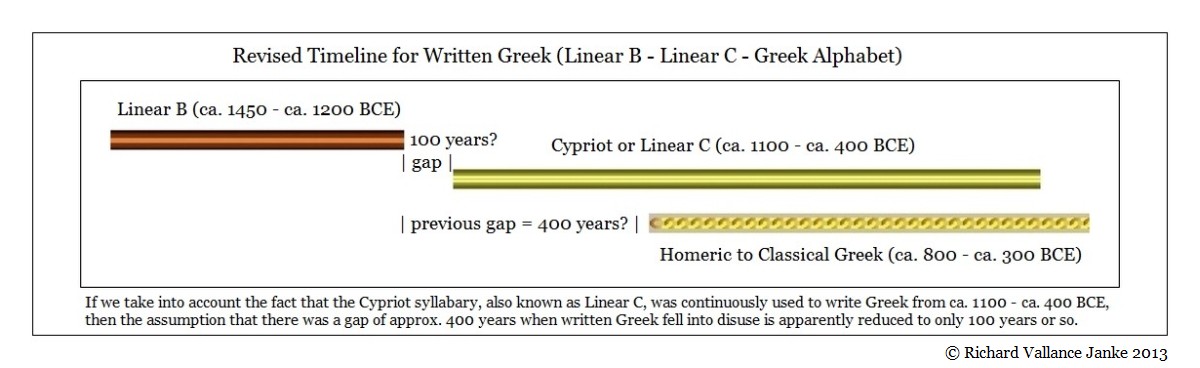
  • Revised Timeline for Written Greek (Linear B, Linear C and Greek alphabet)

    Revised Timeline for Written Greek (Linear B, Linear C and Greek alphabet): CLICK to enlarge:

    Revised Timeline for Written Greek (Linear B - Linear C - Greek Alphabet)
    Written Greek, Linear B, Cypriot Syllabary, Linear C, Homeric Greek, Classical Greek

    Until now, most historians have made the assumption that once Linear B fell into disuse around 1200 BCE, there were no more written Greek records until approximately some 400 years later, in around 800 BCE. However, as Wikipedia: Cypriot Syllabary: http://en.wikipedia.org/wiki/Cypriot_syllabary significantly points out, the Cypriot Syllabary, otherwise known as Linear C, was used to write Greek from ca. 1100 – ca. 400 BCE, when it finally lapsed into disuse, to be supplanted at that time in Cyprus by the Greek alphabet proper. Now, I for one am not about to make the rash claim that this necessarily means that written Greek was in constant use from ca. 1450 – ca. 1200 BCE, falling out of sight at that time, to be supplanted only a century  or so later by Linear C. (in use until ca. 400 BCE), thus overlapping with the Greek alphabet, which came into general use in around 800 BCE… or so it would appear.  The presumed historical gap of some 400 years is, however, fraught with pitfalls. For one thing, Hesiod mentions that there were poets even before Homer who wrote using the Greek alphabet. The problem is…. and it is a huge one… all of their works have been lost to the chasm of history. This should come as no surprise to anyone familiar with ancient Greek literature,  in so far as some 90% of all ancient Greek literature, even after 800 BCE, all the way through to 300 BCE and later, has also vanished in the abyss of history. To my mind, this raises all sorts of “red flags”, not the least of which is: how can we realistically define or even guestimate the so-called gap between pre-historic times, when there were no written records in Greek (including of course those written in Linear B) and the appearance of the Greek alphabet on the scene, when we do not even have the faintest notion when the earliest use of the Greek alphabet first manifested, by which I mean, in Greek literature.  When did Greek literature written with the most rudimentary forms of the Greek alphabet first appear?  In the 10th. century BCE?… in the 9th.? We shall never know, for the very reasons which I have just raised, let alone a whole host of other factors which come into play when we are forced to admit that we know from the ancient authors that there were writers before them, who were writing poetry with the Greek alphabet, poetry which was still extant in their day and time.  Hesiod must have read some of these authors (some of whom the ancient Greek authors cited by name).  Again, however, we run up against a brick wall, since the works the ancient Greeks had at hand, and were able to read, no longer exist. They have, as I have already made clear, simply vanished.

    Thus, it is my contention that it is really quite impossible to say for certain when (or even if) written Greek fell out of use, or if you prefer, into disuse, since it may never have lapsed into disuse. Of course, once again, I am going out on a limb. But I raise such questions simply to spur us, as historians, linguists and archeologists, to at least consider the possibility, however remote, that the apparent historical gap between that loss of Linear B writing and the assumption of the Greek alphabet may be somewhat or even significantly less than 4 centuries.  We must also always bear in mind that Linear C, a syllabary used in Cyprus, closely related to Linear B, was in fact in constant use from around the 12th. century to the 4th. century BCE.

Sappho, spelled (in the dialect spoken by the poet) Psappho, (born c. 610, Lesbos, Greece — died c. 570 BCE). A lyric poet greatly admired in all ages for the beauty of her writing style.

Her language contains elements from Aeolic vernacular and poetic tradition, with traces of epic vocabulary familiar to readers of Homer. She has the ability to judge critically her own ecstasies and grief, and her emotions lose nothing of their force by being recollected in tranquillity.

Marble statue of Sappho on side profile.

Designed with WordPress